Notes on Process Economy: The Value of Your Story
Process Economy: The Value of Your Story by Kazuhiro Obara
Original notes here.
Read until the end to get a bonus. Enjoy reading.
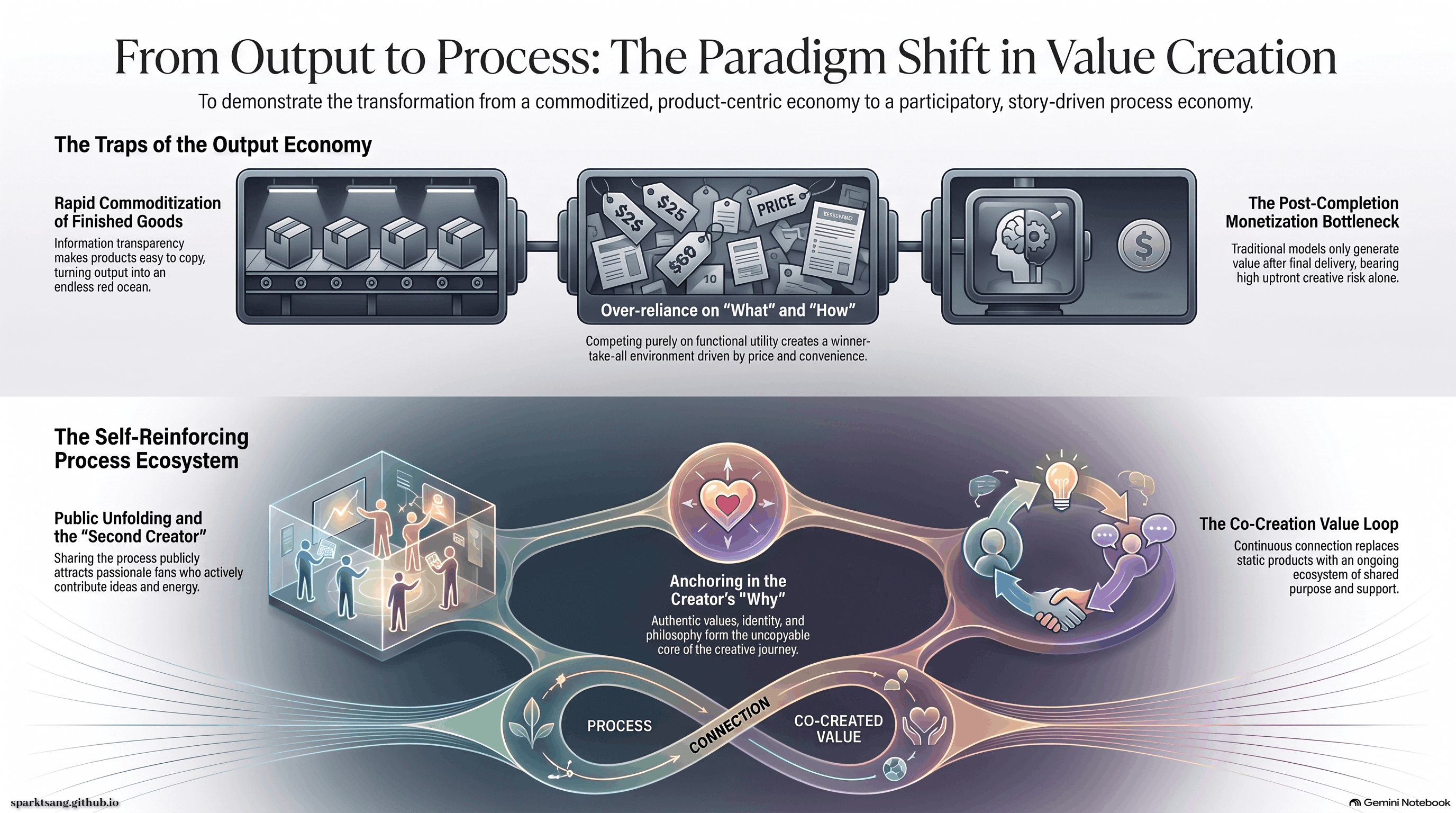
The opposite concept is the output economy: you can only charge once you have made the product. But even a good product is no longer a guarantee of success, because after the spread of the internet, product information travels rapidly, making imitation extremely easy and competition increasingly fierce.
It is like what happened after video-sharing websites became popular: children all over the world suddenly became far better at yo-yo tricks, and even amateurs could produce excellent products, making it increasingly difficult to stand out through differentiation.
The only thing that cannot be copied is the process, giving rise to an entirely new profit model. This was first proposed by Kensuke Furukawa, founder of Zero-Time Studio. It has three advantages: you can make money before the product is completed; it helps relieve the loneliness of creation; and it increases the number of long-term fans.
Why Is the Process as Valuable as the Product?
The values of younger generations are changing. Among Seligman’s five elements of happiness (accomplishment, pleasure, relationships, meaning, and engagement), the previous generation, having experienced deprivation, particularly craved the first two. Younger generations, having never experienced material deprivation, place particular importance on the latter three. They focus on spiritual concerns, which gives “sharing the process of creation” particular value.
In Shu Yamaguchi’s Becoming the New Human, he points out that in the society of the future, meaningful value will outweigh usefulness. In a convenience store, there is usually only one type of scissors, because the winner takes all; but there are more than 200 kinds of cigarettes, because they are products that are useless but meaningful, with each brand having its own distinctive story.
Toshiyuki Inoko, founder of teamLab: if a company does not choose to achieve globally outstanding quality, then it must instead adopt a model built around local communities and pleasing participants. It can only choose one of the two.
Modern neighborhoods have broken down, and the functions of real-world communities have weakened. People spend money to satisfy their need for belonging, reinforce their identities, and gain illumination for the path ahead in life.
Kotler’s Marketing 4.0 theory: at first, people were simply happy to have necessities; in the second stage, consumers were segmented and products were made for different needs; in the third stage, people began to care not only about whether products were useful, but also about a company’s goals and philosophy of operation; in the fourth stage, all services exist to help people become more fully themselves and to build a world that leaves no one behind.
| 1.0 | 2.0 | 3.0 | 4.0 | |
|---|---|---|---|---|
| Purpose | Product diffusion | Customer satisfaction | Value experience | Self-actualization |
| Technology | Mass production | Information & communications | Social media | Big data |
| Need | Everyone | Growth | Participation | Creation |
| Action | Product development | Differentiation | Brand & community | AIDA model |
| Value | Functional value | Differentiated value | Participation value | Co-creation value |
| Interaction | Promotional activities | Sales emails | Community participation | Co-creation community |
AIDA: Attention, Interest, Desire, Action
The founders of Singularity University proposed the 6D theory, arguing that digital technology will ultimately eliminate revenue, eliminate physical products, and democratize everything, just as the smartphone replaced radios, telephones, maps, books, cameras, cassette recorders, and a whole host of other physical products.
Five Major Frameworks for Resonating with the Process
The Public Narrative framework (Story of Self, Story of Us, Story of Now) that helped propel Obama to prominence: the reason I am here, the reason we are here, and the reason we must act now. This is the structure of Obama’s speeches. You explain your own process or way of surviving and growing, then make it something everyone can share. After shortening the distance between people, discovering common ground, and creating a sense of unity, you explain what you are going to do now.
Thinking, Fast and Slow: the human brain has two systems. When we begin to act, we often follow System 1, which relies on intuition. Obama’s call to “act with me” works on the emotional brain, bringing people together around a shared vision.
Brand storytelling: see David Aaker, the authority on brand strategy and marketing, and his book Creating Brand Stories. A powerful true story that moves people should make listeners want to take the next step forward together. In Naoyuki Sato’s The Basics of Fans, a book by a prominent figure in Japanese advertising, he points out that strengthening fan support requires improving three things: resonance into passion, attachment into uniqueness, and trust into support.
Altruism: purely personal desires cannot generate resonance. Human beings naturally possess an altruistic spirit and behavioral patterns that drive us to act for others. Altruistic actions produce more chains of altruism between people; from the perspective of neuroscience, this is a structure that naturally makes it easier to attract others to join.
The affinity created by sharing the process: in a Heineken advertisement, partners assembling a chair together discover that their core positions are completely different, yet still choose to drink beer together.
Six Principles for Seizing Process-Economy Opportunities
Revisionism: Japanese education adopts a doctrine of correctness, moving toward a single correct answer. This creates many deeply ingrained objections to this book, such as “making money from the process is not the proper path,” “it is strange to let outsiders watch the process,” and “it is wrong to release pre-sales information to the public.” Yet times are changing rapidly, and the very definition of what is correct is constantly changing, so an approach based on flexible revision is a better premise.
Five keys to effectuation:
The bird in the hand: the bluebird of happiness we seek outside is actually already at home.
Affordable loss: when failure remains within an acceptable range, you can keep taking on challenges.
Crazy Quilt: scraps of fabric that cannot be used individually can be stitched together into an enormous work.
Lemonade: lemon juice is sour and bitter, yet it can be turned into a delicious drink.
The pilot of an airplane: the central figure controls the atmosphere of the whole group, making partners feel that not dancing would mean missing out.
The above concepts come from: https://effectuation.org/effectuation-101
From orchestral music to jazz: jazz often relies on improvisation. Everyone is filled with anticipation because they do not know what music they will hear next. This is not a doctrine of correctness; it is precisely the process economy.
Plant your flag first in an environment of information transparency: generously sharing information and forming partnerships through openness can actually help you gather even more information.
The “second creator”: before a new book is published, publicly share the production process within the community. Everyone can help gather information or ideas, attracting readers in the process. There may even be supportive partners willing to help produce videos for the publication. Nishino Akihiro calls these partners “second creators.” They will proactively promote the book and increase its buzz.
The communication style of boxing sparring partners: in the marketing world, there are two key terms, outside-in and inside-out. The former means the traditional approach of creating products that solve problems; the latter begins with an impulse from within oneself. A product’s functions can be copied, but an individual’s preferences and values cannot be replicated.
Nine Ways to Put the Process Economy into Practice
Why: if publicly sharing the process merely means showing how a product is made, it is difficult for people to feel its appeal. The key is therefore to reveal the “why” in your heart: why you do it this way, your philosophy, and your distinctive character. In a red-ocean market crowded with competitors, it is difficult to stand out by winning on what alone. What and how can be measured according to certain standards, but a way of living that comes from the individual can gain deep support even if its supporters are limited to a particular group of people.
Why, How, and What are very similar to the Japanese martial arts concept of shin-gi-tai—mind, technique, and body. The most important is the mind, because it possesses the power to move people beyond its own era. A craftsperson’s commitment to a philosophy or creative vision can make people fall in love with the works it gives birth to.
Passion, a powerful source of support: Steve Jobs said, “I believe passionate people can change the world and make it better.” This is Apple’s core value: the heart in shin-gi-tai. Jobs pointed to Nike advertisements, which praise only great athletes and celebrate the beauty of sport. That is their reason for being and their spirit.
Brand religion: religion is the strongest brand in the world. Yet neither Jesus, the sages nor the Buddha wrote books; religious leaders think about how to turn the why into everyday habits.
Set the Why clearly from the beginning: Simon Sinek: “people don’t buy what you do, they buy why you do it.”
Three rules of successful e-commerce: interests and distinctive character; responsibility. The author cites a Rakuten store manager specializing in Chilean wine, whose passion for the products and sense of responsibility are evident in the extraordinary effort he puts into packaging the boxes.
The third rule: publicly reveal weaknesses and admit failure. An online magazine revealed that products he loved could not be imported and that the company was on the verge of bankruptcy, but through sheer effort it managed to break through the predicament. In this way, persistence, conviction, and charm can be conveyed.
Resonance: sympathy and compassion are both involved. People who resonate with the Why will then want to provide support.
Two types of sharing: the Jungle Cruise type and the barbecue type. The former is about achieving a dream together; in the latter, everyone has a role.
Ten Cases
The efforts of the “second creators” helped Korean boy band BTS become a global phenomenon.
Johnny’s Entertainment used process-economy principles to manage its idols.
Xiaomi, the fourth-largest smartphone company by market share, selects the features users most want to see added and creates them together with its users.
The secondhand marketplace Mercari also sells agricultural products, directly connecting producers with customers. Producers not only enjoy selling their products but also enjoy sharing the stories of farming.
A Nordic lifestyle goods store selling furniture shares stories that include consumers’ own ideas and the principles behind how they arrange their homes.
The inability to plan in advance and the revelation of one’s true personality are reasons why video websites, game livestreaming, and Clubhouse became popular.
The accidental encounters and spontaneity of Clubhouse are fun, like having a private room after school.
The shoe retailer Zappos positions itself as a service company. When a particular size or style is out of stock, it tells customers that another store has it. Three-quarters of its customers are repeat buyers.
Its advertising expenses account for only one percent of revenue, while its advertisements lavish praise on its own employees. It has since been acquired by Amazon, on the condition that Amazon does not interfere with its management or culture.
Silicon Valley’s largest incubator, Y Combinator, calls its meetings with startups “office hours” and makes them public on YouTube. During these sessions, they dig deeply into the Why, and entrepreneurs often feel transformed by the conversation.
Eight Major Misconceptions
Pursuing the process while abandoning the original purpose.
Abandoning the core business and relying solely on fans for revenue.
Flattering the audience and losing one’s appeal.
The echo chamber.
Letting the process take control of your life and recklessly taking on challenges without sufficient ability.
Mistaking the audience for the protagonist and becoming hostage to other people’s expectations.
Becoming too immersed in the process and finding it difficult to bear the gap between dreams and reality (Tadashi Yanai, president of Uniqlo).
Getting the order of must, can, and will wrong: what you must do, what you can do, and what you want to do in the future. People who do what they will do may have gone through a great deal of must and can behind the scenes.
How the Process Economy Changes Us
How bestsellers are born: the author of The Life-Changing Magic of Tidying Up originally worked as an organizing consultant and relied on word of mouth from friends.
Turning life into entertainment: rather than solving problems correctly, solve them happily.
Three conditions for becoming passionate about something: being good at it, enjoying it, and helping other people. Activities with altruistic value are more likely to fascinate us.
Google’s 20 percent time: it allows people to focus on the present, value the process, and follow principles consistent with mindfulness.
Ants wander around without a specific purpose yet can discover and move sugar. The way they release hormones is like the way we publicly share our process.
Netflix is like a group of ants wandering without rules. Reed Hastings’s book No Rules Rules helped the author understand that Netflix’s strength lies precisely in having no rules: it flexibly adjusts its course and constantly changes its business model, including a period when it focused specifically on niche markets to satisfy audiences for small-market films.
A paradigm shift from puzzles to LEGO: in an era of dramatic change, the shape of the correct answer can change at any moment.
Finished reading on May 23, 2024
Obara reveals that in a volatile world, static “correct answers” are obsolete; value now lies in transparent, participatory, and open-source processes rather than finished products.
While business has embraced this dynamic paradigm, our societal systems still treat truth as a top-down product dictated by gatekeepers. To navigate the future, we must apply this “process economy” to human knowledge itself. My philosophy proposes a decentralized framework where truth is no longer a static decree, but a transparent, open-source process of continuous and rigorous refutation.
Thank you for reading until the end. This is a bonus infographic just for you.