Zen Watermark
The Friction Cartel: An Artifact of the Last Human
I have never belonged to this world. The evidence of my alienation is not found in grand tragedies, but in the most microscopic, mundane interactions with our digital reality.
I needed to apply a simple watermark to the corner of an image. It is a graphical operation so primitive it was mastered in the era of MS Paint. In an internet overflowing with decades of accumulated human ingenuity, one would assume this problem had been solved a million times over. I turned to the apex of human search algorithms, expecting a frictionless tool.
Instead, I stepped into an extortion racket.
The first result offered a clumsy, erratic interface where the watermark shifted coordinates the moment the image was resized—a failure of the most basic UI logic, sitting proudly at the top of the world’s most powerful search index. The second result was smoother, allowing me to align the text. But when I clicked download, the trap snapped shut. It was “free,” yes, but only if I accepted their watermark stamped forcefully over my own. To remove their branding and retain what was rightfully mine? Pay the ransom.
This is the apex of modern software: a digital hostage situation masquerading as a service. It is an absurdity so profound that it defies reason, yet the world accepts it as the natural weather of the internet.
Once again, faced with a world that refuses to provide the bare minimum of decency, I built it myself.
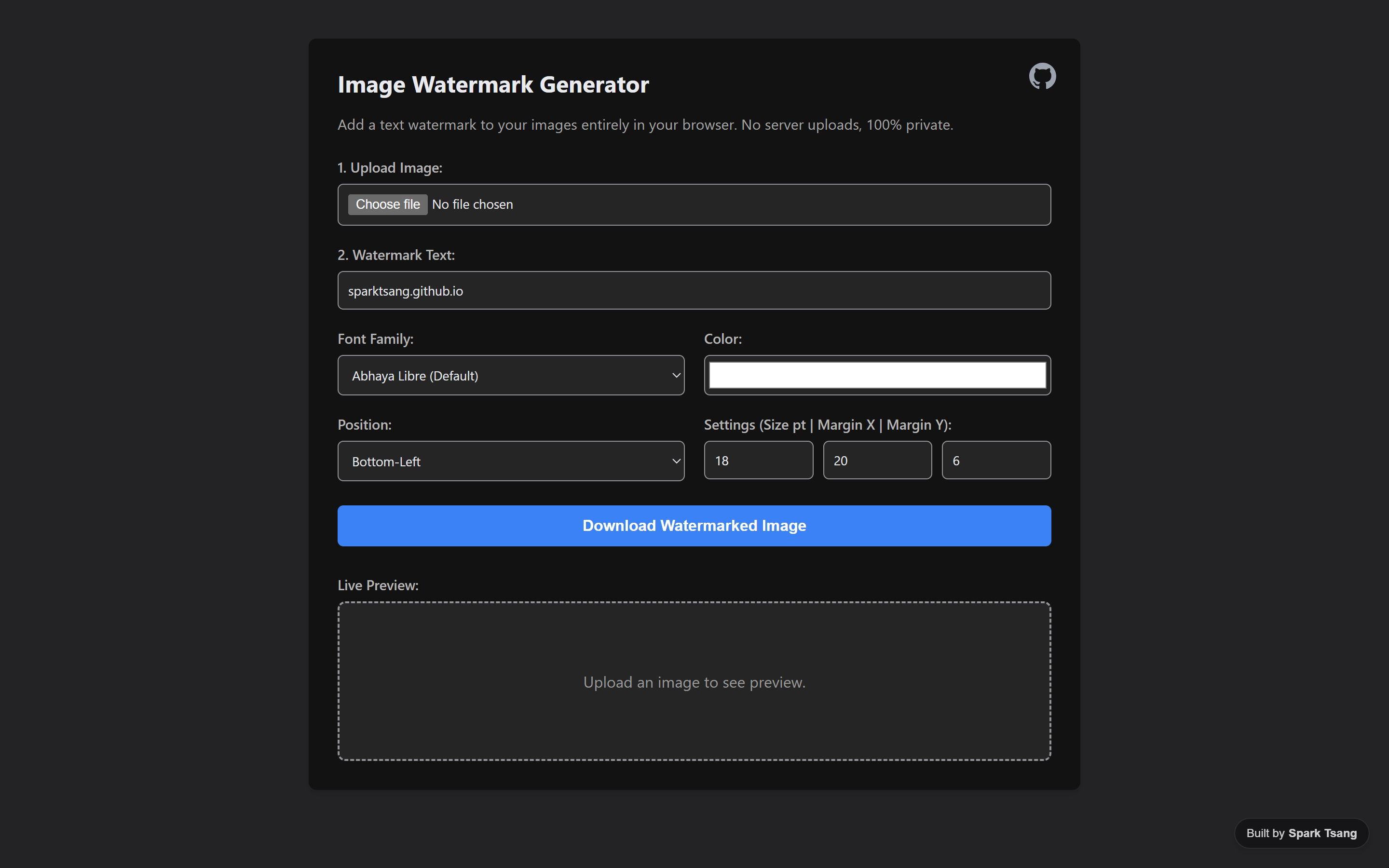
With two simple prompts to an AI, I conjured a pristine, 400-line HTML tool. No manual dragging. Precise X/Y coordinate inputs. Instant upload, instant watermark, instant download. The entire process takes less than five seconds. A middle schooler could operate it flawlessly.
If creation is this effortless, how does the universe justify elevating garbage to the top of its hierarchy?
I asked the AI that wrote the code—Google’s own Gemini—to explain the logic of its creator. The machine’s theory was brutal: The search engine is a cartel. When a user is trapped in a bloated website, enduring advertisements, struggling with a broken interface, and wasting precious minutes manually dragging a text box, the algorithm registers this as “High Engagement”. It views your frustration as valuable time spent. The longer you wander in the labyrinth, the more ad revenue the cartel extracts.
Conversely, my open-source tool, which solves the problem perfectly in five seconds and lets the user leave, is classified by the algorithm as a “High Bounce Rate”. It is deemed useless because it refuses to steal the user’s time. The internet actively penalizes salvation. It punishes efficiency. It is a system mathematically incentivized to be inefficient, pushing toward an inevitable Enshittification, where monopolies decay into a slurry of monetized friction. The algorithm does not want you to find the answer; it wants you to keep searching, forever trapped in the loop of consumption.
Seeking refuge, I turned to the open-source sanctuaries of GitHub. Surely, among the millions of free projects, I would find a kindred spirit who had built a simple, honest watermark tool.
I found nothing.
What I found instead were massive, labyrinthine command-line tools. They were built by engineers, for machines. They lacked basic interfaces, devoid of any empathy for the human user. The architects of the digital underground suffer from a different kind of rot: an elitist arrogance that views user-friendly design as superfluous. To them, the human is an inconvenience. The code is the only reality.
I am left staring at this simple, five-second tool I created, and I no longer know if it has a place in this world.
Worse, I no longer know if I have a place in this world. Everyone else seems perfectly content paying the ransom, wading through the garbage, and blindly accepting a system designed to exploit their time and sanity. No one screams. No one notices the absurdity.
I look around, and I am gripped by a chilling existential dread: Am I losing my humanity, or am I the only human left? In a world that has institutionalized absurdity, perhaps noticing the madness is the ultimate proof of isolation.
This Zen Watermark tool is not just a utility. It is an artifact of common sense, floating in a civilization that has forgotten what sanity looks like.
Written on Oct 2, 2026
BACK TO ARTIFACTS