Notes on How to Be a Capitalist Without Any Capital
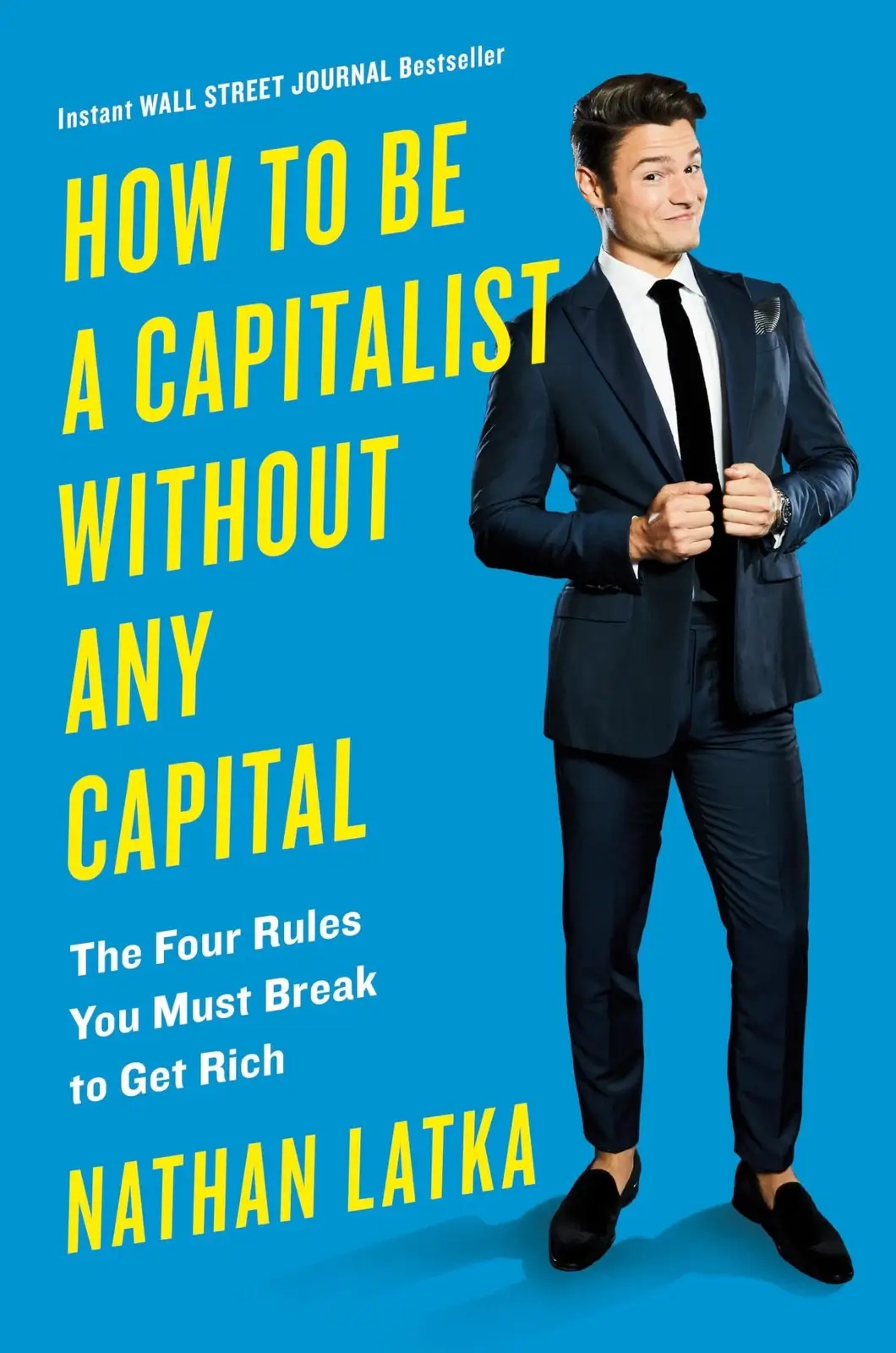
How to Be a Capitalist Without Any Capital: The Four Rules You Must Break To Get Rich by Nathan Latka
Original notes here.
Read until the end to get a bonus. Enjoy reading.
First Law
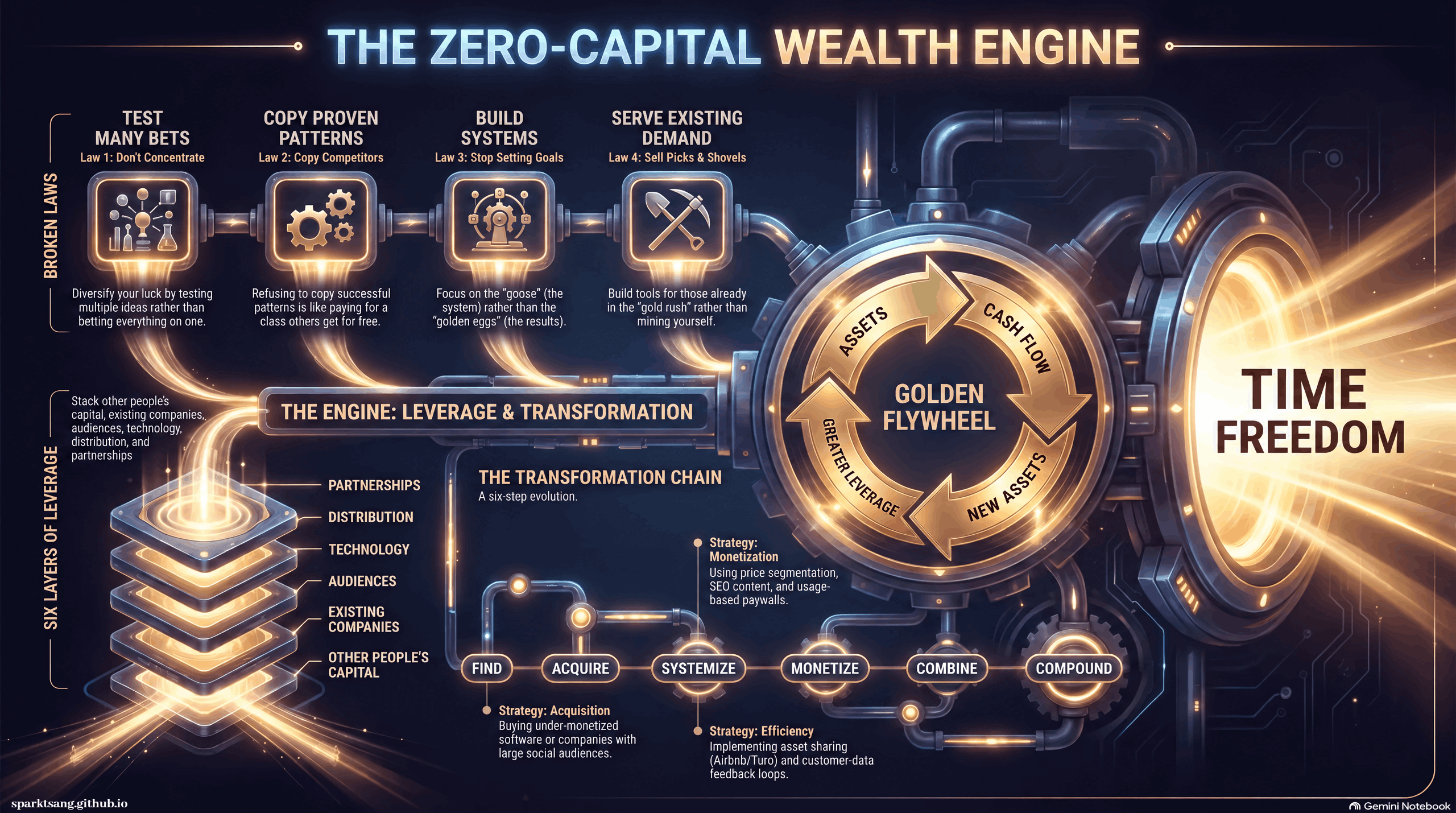
Stop concentrating on one thing
Even if you are unwilling to admit it, success necessarily contains an element of luck
Concentrating on one thing is like betting all your luck on a single area
If that thing doesn’t work, you’re dead immediately
Testing different things to see what works is the way to go
Second Law
Copy your competitors
Success has patterns, and if you don’t copy other people’s patterns of success
it’s like refusing a free class and paying to take one yourself
Third Law
Stop setting goals
The goose that lays the golden eggs is a system; the golden eggs are merely the result
Poor people focus on the golden eggs
Rich people focus on the goose, constantly studying how to improve it
so that it can produce more golden eggs
Try turning your daily work into a set of clear written instructions
If even a middle-school student can execute them, you have successfully turned it into a system
Two mental constraints: No one is as good as me; if I replace myself, then I won’t have any value
Even if you are the best in the world, two people who are each 60% as good as you will still be better than you combined
The “irreplaceable” mindset and systems thinking are enemies
Systems thinking requires you to reduce costs and increase output
Costs include your own time and energy
A simple way to decide whether to buy something
If, after deducting expenses, your daily income is enough for you to buy that thing every day, go ahead; otherwise, don’t buy it
Seven good books about systems
Thinking in Systems by Donella Meadows
Mastering the Rockefeller Habits by Verne Harnish
Business Adventures by John Brooks
The Outsiders by William Thorndike
Thing Explainer by Randall Munroe
McDonald’s: Behind the Arches by John Love
The 4-Hour Workweek
Fourth Law
Sell picks and shovels to the gold miners
At the time, everyone was rushing into venture capital, while the author used another podcast business of his own and sold the information he obtained through interviewing CEOs
Use persuasion techniques in the right places: give yourself more free time
The driving force behind purchases is usually emotion, with fear at the top
Seven major psychological fears: fear of missing out, the unknown, having no life/health/freedom, being ignored, and failure
Give up daily tasks
dream in decades think in months work in weeks live in days
Take back your time and break free from distractions
Unlock hidden cash
When Rich Dad Poor Dad was written, a home you live in and a car were both liabilities
The world is different now; with the sharing economy, sharing them turns them into cash
You become rich by making money while obtaining what you need at the lowest possible cost
claimcompass.eu and airhelp.com can make it easy to claim airline compensation
Fundedtoday.com is a crowdfunding site with a success rate of 95%
Buy and sell between eBay and Amazon to profit from the price difference
How to travel around Asia at an extremely low cost
First, apply for a Chase Sapphire Reserve card
Put all your business expenses on it
Then go to flightfox.com and pay a little; they will teach you how to use your points most effectively
How to keep staying in hotels for free
Send an email asking the hotel to exchange free accommodation for positive social-media reviews
You don’t need to buy followers; a more effective approach is to buy a small company with a large social-media account
The same method can be used to borrow expensive cars; the author once borrowed a $350,000 car for a day
The author once spent $3,000 buying a company with an Instagram account with more than 100,000 followers
As soon as he got the company, he immediately used the account to sell things and made the $3,000 back at once
Many people do it completely wrong, slowly accumulating followers bit by bit instead of directly buying a company that already has all the followers
Even if you have nothing, how can you stay at an Airbnb at a huge discount?
Tell the host that you are going to throw a party and invite all the city’s high-profile people
In exchange for a discount, then invite the people you have in mind and tell them they will get to meet other high-profile people
How to wear expensive clothes without paying for them
The author bought a suit at Balmain, and the store let him try on a $4,500 leather jacket for free
Use the sharing economy to borrow expensive clothes, such as Rent the Runway
How to generate passive monthly income from real estate
Look specifically for houses near college campuses, within ten miles; a steady stream of students gives these properties strong protection against recessions
You can also look up data from 2008 and double-check the rental values of those properties
Use public data to calculate the current reasonable rent, or an even better method is to pretend to be a college student and look for tenants there, to see whether the property is full (if it’s not full, forget it—vacant rooms are a major taboo), ask how much they pay in rent and get the landlord’s information
Then find the landlord and offer no more than 100 times the monthly rent
Banks will lend 75% to 95%, depending on whether you are living there yourself or investing; for owner-occupied property, they may lend 95%
If you don’t have much principal, you can try living in one room yourself and renting out all the others, minimizing costs and maximizing cash flow
If you have zero capital: using a $200,000 house as an example, ask your family to help you borrow $5,000, and pay them 2% interest above the bank rate—a win-win
Use Seller Financing: tell them, “I just bought your house, and you’ve got $200,000 in your pocket now. Can you lend me $10,000? I can start paying you interest immediately.”
Borrow from the property management company: “If you’re willing to lend me $10,000, I’ll use your services, and I’ll start paying you interest immediately.”
Remember to factor in PMI, private mortgage insurance, and other miscellaneous costs such as property management and repairs (always assume 2%; in experience, that’s fairly accurate)
Before bidding on the property, you have to make a deal with the property management company: “If you charge me 5% of the monthly rent as the property management fee, I’ll use you for every property I buy from now on. If you can’t do that, I won’t be able to buy this property.”
Make the deal in advance so they can tell you it can be rented out, putting you in a stronger position
You also need to plan for the worst: two months a year without rent
Check revester.com to confirm cash-flow opportunities in nearby areas
It is best to buy property before starting a family; you can live in a one-bedroom and rent out the rest, getting away with a very low down payment
Making money by buying companies is simpler than you might think—three steps
First, buy a free information-technology product company with a huge user base; ideally, it has a very high valuation and many users, but hasn’t been updated for a while
Second, hire a Toptal developer to implement a metered paywall (or usage-based paywall)
Third, reinvest the money you make and buy new companies
Zero to One has said that companies with monopolistic characteristics are the best buys, but these kinds of companies are hard to find and hard to buy
The closest option is to find a company that requires no employees and has a monopoly over its distribution channel; these are relatively easy to find and buy
AppAnnie.com, the Chrome Web Store, Salesforce AppExchange, Intuit App Center, Apple App Store, G2 Crowd, and Crunchbase.com are all worth searching
Use etool.io to get the CEO’s email address
If you discover that the company has debt, you have more leverage in the negotiation; ask the seller to introduce you to the creditors and negotiate a debt restructuring
When the author started acquiring companies in his early twenties, no one took him seriously, so he tested a question: How much money would I have to offer to make you jump for joy?
At least that got them interested in selling, and then he would say: “I really want to make you happy, but as you said, I’d be stupid to accept that. Let me ask you this: if you went to Google and searched for the price of free software tools, roughly what price range would you see?”
Then figure out whether they are full-time or doing it as a side business, whether they are under financial pressure, and understand the scale of the company; understand the other party’s motivations. If they need money to pay off a mortgage, for example, you can pay it off for them in installments directly, saving money while solving their problem
If the other party uses revenue to push up the price, tell them that after you buy the company, you will shut down the paid tier and focus on growth, leaving them unable to use it to drive up the price
An example of the payment terms: pay only the initial payment, then pay 50% of annual revenue each year until a total of $1 million has been paid
After the acquisition, implement price segmentation for power users and find ways to get customers to pay more
Strengthen SEO with content; there are human-resources websites that focus on just one thing. Ask yourself: What are people looking for when they hire? Build content around that
If you don’t want to rely on content alone, another recommended tool is SEMrush
An important adjustment is where the paywall appears; understand which activities customers have done that make them more likely to pay
Referral program: the person who refers a customer gets a commission; you can even use marketing software to manage the program, such as Ambassador
The author has another dirty trick: pretend you want to acquire a company, drawing attention and saving on PR costs, while also getting former employees of that company to proactively contact him saying they would come back if he took over, saving on recruitment costs as well
If a company already has systems in place and existing customers when you acquire it, the only thing you need to do is fine-tune it to make money, which is much easier than building a company from scratch
Keep a close eye on investment opportunities; often reveal that you have some money you don’t know how to invest and ask whether people have any suggestions. Even if you don’t close the deal, at least you’ve gained a friend
Make small investments without signing any agreements; the author invested in a food truck, has almost broken even, and even added more capital
If you need to review the finances and sign an agreement as well, it is not cost-effective because the amount is too small, so you can use this as a way to test the waters
Copying ideas again is the road to wealth; spend more time on Kickstarter and study the characteristics of other successfully funded projects
Use presales to raise capital, so you don’t have to give up equity
Get commitments to sponsor you from people you know in advance; you can quickly reach your fundraising target, get free media coverage, and attract even more sponsors
Infuse personality through a good story
Learn to create urgency from Vue smart glasses: 41% off, limited to 350; 33% off, limited to 6,833
Recommended websites for software businesses: Siftery, GetLatka, BuiltWith, TechCrunch
Learn how the pros run their businesses and what tools successful companies use
Use LinkedIn and Facebook groups to find potential customers and partners
Use SimilarWeb to search for competitors’ traffic sources, then partner with the sites sending that traffic to acquire customers
Founders who don’t want to share the pie and don’t have technical knowledge find it very difficult to recruit developers
Toptal (or the less selective Upwork) can solve the problem of finding and recruiting people, then use project-management tools such as Bitbucket, Asana, and Trello to manage the work
After using the above to build the simplest viable product, go to competitors’ support forums and feedback pages to see what customers want
Go to G2 Crowd and look at the negative reviews
Ahrefs.com showed that a competitor was actually getting a lot of traffic from a single blog post, so he contacted the blogger and asked what they were selling, what tools they were using, whether they had used the competitor’s product, then asked what they thought of his own product, whether it was worth promoting, and whether using it could make them more money. Finally, he persuaded them to add the product to the blog’s recommendations and place it at the very top
Make your businesses multiply: connect all your existing projects and create value where one plus one equals three
Ask customers one question that can double revenue: Besides our tool, what else have you bought to help you do XXX?
Then: acquire the competitor, partner with them, or build a similar product yourself
Go deep, not broad: when the author formulated a revenue-growth strategy, the method he considered least was acquiring new customers
His GetLatka could never have one million customers, so he simply capped the number of customers at 50, raised the monthly fee regularly, and left openings for prospective customers to wait for a spot
Clate Mask, CEO of Infusionsoft, found that an 8% monthly customer churn rate was extremely serious in 2014
He discovered that many users had signed up simply to use it for free and left as soon as the trial ended
So he did something counterintuitive: he charged customers more. He charged a $2,500 upfront setup fee (creating friction) to filter for high-intent customers, and finally attracted serious customers
If you still don’t understand your customers well enough, first bring in more customers and study their behavior over a few months
Segment and analyze churned customers by signup month (also called cohort churn analysis), and they found that 15.3% of Heyo’s business had remained churn-free from June 2014 to the present. In the end, they discovered that these loyal customers were companies that generated the most sales leads through Facebook contests run by Heyo, so they priced according to the number of sales leads customers obtained, immediately increasing profits
Increase your Wallet Share: discover what other products customers are also buying; you can partner with the vendor of the other product and earn advertising revenue, or develop that type of product yourself
Cut expenses dramatically: tell your most expensive service provider, “I can’t afford this. I have no choice but to find something cheaper, so please cancel my account.” Almost every company has a process that will do everything possible to persuade you not to leave. ActiveCampaign cut the fee in half. This trick doesn’t work on big companies.
One times one times one equals one; two times two times two equals eight: multiply the strongest by the strongest to get the strongest possible result
If a business fills up your schedule and has no future, sell it
The most obvious buyers are competitors. Contrary to common sense, acting extremely eager makes the other party think this is an easy opportunity to swallow up a competitor: “I have to sell the business so I can free up time to deal with my personal affairs. Talk to me.”
Give them a discount at the beginning, making them extremely happy and encouraging them to spread the word everywhere
Once they take the bait, say that other people also want to buy it, creating a competitive situation, then use your responsibility to the investors as leverage to get the other party to raise the price
If you are cheese and can’t find another piece of cheese to acquire you, look for a strategic acquirer (something complementary, like bread)
Companies in the sales channel are also an option; Square, which bought Weebly, sold a lot of Weebly products
If the proceeds from selling the company exceed what you would earn by working at the company for more than three years, sell it
You have to believe that you are smart enough to come up with a better idea
This book is time-sensitive. The number of New Rich is limited, and if you don’t act quickly, you’ll miss out
Finished reading on Dec 31, 2019
Latka proves that building wealth doesn’t require playing by the traditional rules; it requires hacking the system, leveraging hidden assets, and acquiring micro-monopolies.
While these tactics can generate rapid cash flow, turning that momentum into a massive enterprise requires a deeper shift in strategy. As Latka notes, the most valuable assets are those with monopolistic characteristics.
To understand the underlying philosophy of building these advantages from scratch, Zero to One by Peter Thiel offers the playbook on how to stop competing, discover hidden secrets, and create a future-defining monopoly.
Thank you for reading until the end. This is a bonus infographic just for you.