Notes on The Evolution of Business
The Evolution of Business: Reduce the Cost & Increase Network Density by Liu Run
Original notes here.
Read until the end to get a bonus. Enjoy reading.
Business consultants are often asked two kinds of questions. Entrepreneurs ask, “Does this thing I want to do have a future?” Traditional businesses ask, “Is there still any hope for what we are doing?” The author says both questions are completely wrong. The right question is: “In that future that is destined to be glorious, is there a place for me?”
Going with the current takes almost no effort; going against it can leave you exhausted while still turning in place.
An example of the direction of business evolution: Perfect Diary gave away cotton pads with purchases at its stores in exchange for adding customers on WeChat. It used one touchpoint to gain unlimited touchpoints, eventually adding millions of WeChat contacts. In three years, it reached annual revenue of 3 billion yuan: network density keeps increasing, while transaction costs keep falling.
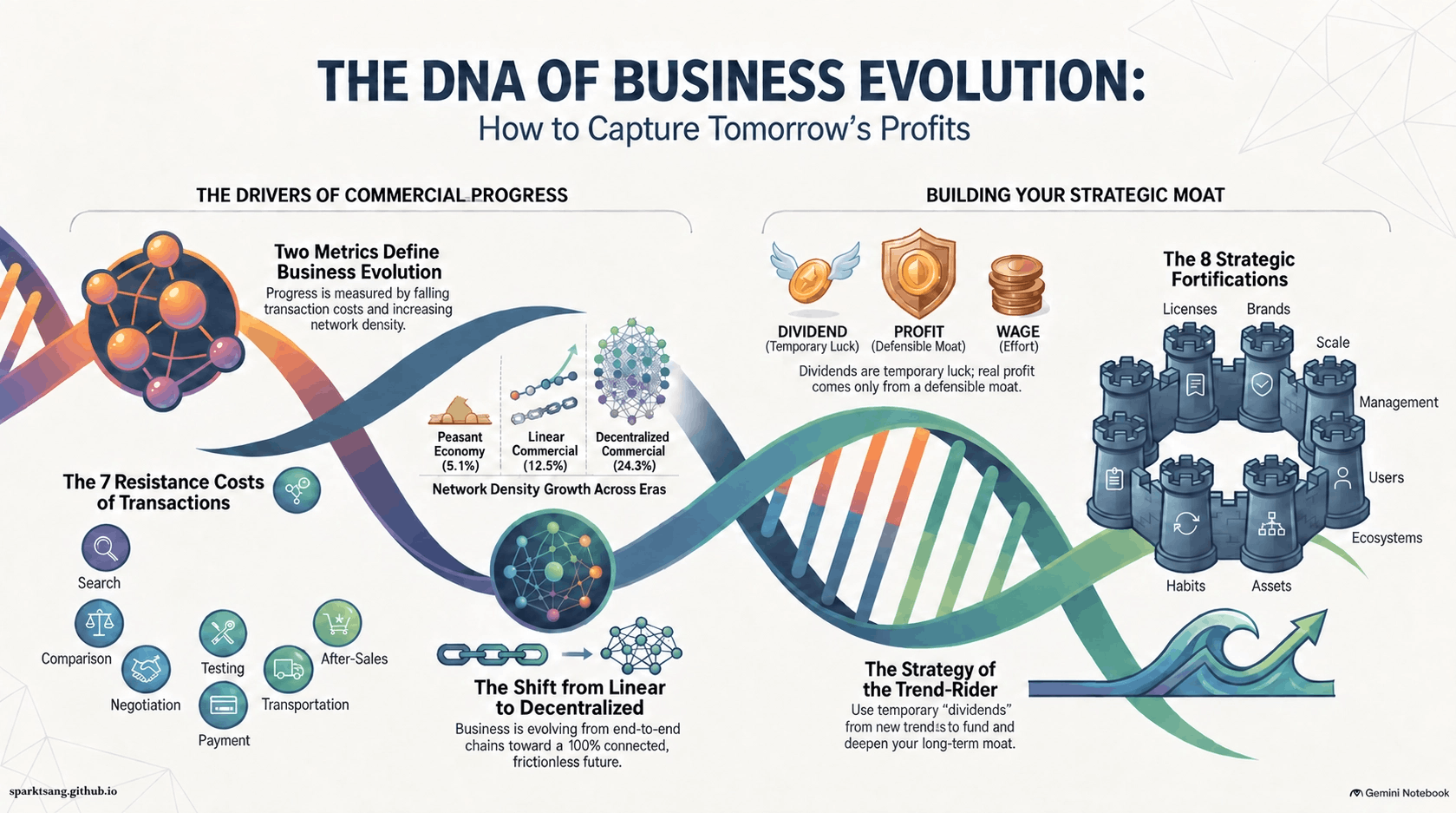
The first clue to the development of business is transaction costs; the second is network density.
Growing your own rice and eating it yourself is not business; it is simply a small-scale peasant economy. Technological innovation and product innovation are not business either. Only when you trade rice for your neighbor’s chickens does business begin: “Business is the study of transactions.” Only once transactions begin do you encounter the 4Ps of Marketing: product, price, promotion, place.
Pricing is determined invisibly by the business system. The chicken seller will know when a price makes no sense, because if that price were real, everyone would stop raising chickens and grow rice instead.
Putting up a notice advertising that you have high-quality rice is marketing; setting up a stall at the junction of the three villages because that is where the transaction has been agreed to take place is the channel, place.
Barter requires a double coincidence of wants in three respects: needs, time, and quantity. Both parties must happen to need the other’s goods at exactly the same time, and the quantities must happen to be mutually acceptable. Low transaction efficiency leads to overproduction, reducing the wealth of the entire village: “Labor creates wealth; exchange creates incentives.”
To overcome this triple coincidence and improve transaction efficiency, money emerged as a medium of exchange. Every invention that can improve the efficiency of transactions becomes a driving force for commercial progress.
Money separates buying from selling; merchants connect transactions. Once money appeared, merchants emerged. They neither produce nor consume; they merely connect transactions. They are like red blood cells, carrying money and goods into the deepest reaches of the vascular system of the business world.
A merchant’s destiny is to cross two chasms between transaction nodes: information asymmetry and the trust friction.
The former allows the party with more information to profit. Someone can simply buy goods cheaply and sell them to consumers who do not know where they came from. A clever merchant treats this as a friend; a great merchant treats it as an opponent. For example, an e-commerce platform can see rice prices across the country directly, while Dianping enables information about whether a particular shop is a rip-off to circulate.
the trust friction means that people cannot transact on trust with anyone beyond those close to them.
When you buy stocks, you pay a transaction fee to the securities company because it reduces the friction caused by information asymmetry (“Who happens to have 100 shares they want to sell?”) and the trust friction (“You’re not a scammer, are you?”). In most cases, you will discover that hiring someone yourself to track down shareholders and sign contracts directly is less economical, so you accept the fee.
Likewise, a big-brand shampoo costs 50 yuan to make and sells for 200 yuan. The 150 yuan in between is transaction cost. Anyone who refuses to accept this can find a factory themselves, research how shampoo removes dandruff, study the differences between different manufacturing processes, and screen among them. The cost of doing all that may be far greater than buying a hundred bottles of shampoo.
People who do not understand business treat merchants as having added transaction costs. That is putting the cart before the horse.
Transaction costs include:
Search costs: This includes hidden costs such as the value of the time spent looking for a product. Taobao greatly reduced search costs and therefore achieved enormous success.
Comparison costs: The cost of comparing unfamiliar merchants. Dianping is an example of a company that greatly reduced this cost.
Testing costs: The cost of verifying whether a merchant’s claims are true. Third-party testing organizations such as SGS in Switzerland have greatly reduced this cost.
Negotiation costs: The cost of agreements not being honored or loopholes being exploited. The way society deals with this is to punish violations afterward. Companies without a strong reputation face very high negotiation costs; winning customers through reputation can greatly reduce them.
Payment costs: Manufacturers are afraid to ship first, while customers are afraid to pay first. Letters of credit reduce this cost, and Alipay serves a similar function.
Transportation costs: The efficiency of a country’s logistics industry. A key indicator is the share of total logistics costs in GDP: 8% in the United States, 15% in China, and 27% in Southeast Asia. China relies heavily on relatively expensive road transportation. There are also storage costs and management expenses, and the number of times goods are handled matters too.
After-sales costs: In the 1970s, a baby incubator reduced the infant mortality rate in the United States by 75%, but its extremely demanding maintenance requirements made it difficult to promote. Eventually, a college student improved the incubator so that even an auto mechanic could repair it, sharply reducing after-sales costs. Huawei uses modular design when designing products, so repair workers only need to pull out the failed module and replace it with a new one.
Entrepreneurs should ask: Which one or more of these seven transaction costs does my company reduce?
Every successful business institution to date has used a distinctive method to reduce at least one kind of transaction cost.
The structure that lowers transaction costs is a better transaction structure. Take ride-hailing as an example:
Reduce search costs: Help drivers and passengers find each other.
Reduce comparison costs: Offer a choice of vehicle types.
Reduce testing costs: Every driver has a profile and a rating.
Reduce negotiation costs: Calculate the price automatically.
Reduce payment costs: The platform handles the transaction.
Connection
Connection changes the business world in two ways: folding space and collapsing time.
From beacon towers, relay stations, and railways to the internet.
Sears took advantage of America’s expanding railway network to purchase and transport goods on a massive scale, lowering product prices and launching a devastating “asymmetric disruption” on rural general stores. One can imagine how many shopkeepers cursed Sears just as traditional retailers today curse Jack Ma.
Walmart, which defeated Sears, took advantage of the rapidly expanding highway network beginning in the early 1950s. It also benefited from refrigerators, which could preserve goods for up to a week, and televisions, which taught consumers about different products and how to compare prices, reducing problems of information asymmetry and the trust friction. It folded major cities and small towns together.
Like railways and highways, the internet has never destroyed the physical economy. It is the physical economy.
Containers folded the oceans. Without container shipping, there would be no globalization: the cost of transporting one ton of beer fell from four dollars to 20 cents, a reduction by an entire order of magnitude.
SpaceX is developing reusable rockets, and the transportation costs saved are difficult to estimate.
The telegraph was the first information superhighway.
Morse missed the chance to see his wife one last time because of the time lag in communication. He therefore invented the telegraph and Morse code to connect information more effectively and eliminate the time lag.
Even more obsessed than Morse was Cyrus Field, who laid the transatlantic cable. It failed four times before finally succeeding, compressing more than thirty days and more than 3,000 kilometers of communication across space and time into an instant.
The efficiency of connection can still improve further in the future, causing transaction structures to continue undergoing radical change. Take the Internet of Things: a washing machine connected to the internet could immediately determine which clothes can be washed together, issue recommendations, and connect you to a store.
Linear Business
Let the number of nodes be n. The maximum number of connections = n(n-1)/2. Network density = actual number of connections / maximum number of connections.
The following are the network densities (%) of different societies:
Primitive commercial society: 0, with people growing old and dying without interacting with one another.
Peasant economy: 5.1, organized around villages and families, with small-scale self-sufficiency.
Linear commercial civilization: 12.5, connected end to end, such as the Silk Road.
Centralized commercial civilization: 17.6, with some transaction nodes becoming supernodes because of geographic, policy, or technological advantages. (The internet dominates business today precisely because the marginal cost of the virtual world is almost zero, making it easy for super-supernodes to emerge.)
Decentralized commercial civilization: 24.3, with individual secondary centers replacing and gradually eroding the ecological value of supernodes. (Just as in the past only your family had a television, so everyone came to your house; now every household has one.)
Fully connected commercial civilization: 100, an imagined future model. Perhaps what will make it real will be the Internet of Things, blockchain, or brain-computer interfaces, with all of humanity sharing a single brain, and so on. At present, we cannot know.
In linear business, the ways to reduce transaction costs and overcome information asymmetry and the trust friction are bargaining and intermediaries. (In black markets, an intermediary trusted by both buyer and seller can charge fees as high as 95%.)
Centralized Business
The value of a supernode is its role as a transaction center: at the community level, it is a large general store; at the city level, Carrefour; at the national level, Taobao; at the global level, Amazon.
The power of supernodes: Qinchi, a liquor distillery in Shandong, had annual profits of 30 million yuan, yet spent 66.66 million yuan on advertising on CCTV. The following year, its revenue rose to 900 million yuan.
In 2013, Baidu’s advertising revenue surpassed CCTV’s. This was because Baidu was a more powerful supernode: many-to-many decisively beat one-to-many.
Emerging successful businesses all turn themselves into supernodes, such as Meituan, ride-hailing platforms, and local services. All of them reduce transaction costs. By contrast, trying to profit from information asymmetry is becoming increasingly unviable.
Banks are transaction centers for capital, insurance is a transaction center for risk, and securities are transaction centers for ownership rights.
Banks split borrowing and lending, solving the trust friction between the two and the multiple coincidences involved in capital transactions.
Insurance is a credit intermediary for sharing homogeneous risks among strangers. It does not require strangers to have natural trust in one another; instead, it “transfers” risks that have a low probability of occurring but a very large impact. (Responses to the other three categories of risk: low probability, low impact, such as rain: Accept; high probability, high impact, such as aftershocks: Avoid; high probability, low impact, such as rain for a large institution: Mitigate. The main mechanism of insurance is to Transfer low-probability, high-impact risks.)
People with money may want to start companies but may not know how to manage them; people with the ability to manage companies may want to do so but lack money. The Dutch invented the use of stocks to split management rights from ownership rights, solving this problem.
Capital, risk, and ownership rights are all outer garments of credit. All three kinds of institutions solve the same problem—the trust friction—and reduce transaction costs.
Decentralized Business
When supernodes serve as transaction centers, they control transactions and therefore hold power. Once it becomes possible to reduce transaction costs without going through a supernode, the idea of decentralization emerges.
After the internet appeared, a series of decentralized technologies emerged. The first was peer-to-peer downloading, which accelerated downloads through hard-drive sharing. Then came CDNs, or content delivery networks, which store network content in different locations to speed up access; in China, a representative user was Xunlei. There was distributed computing: during the COVID-19 pandemic, the Folding@Home project broke down calculations of viral proteins and distributed them to computers around the world. The combined processing power of millions of computers was faster than a supercomputer. Then came social media, P2P lending, which bypasses banks and allows individuals to lend directly to one another, decentralized fundraising through AngelList, and blockchain, which uses distributed ledgers to realize decentralized currency but consumes enormous resources because every node across the network keeps a copy. Then there is the DAO, a decentralized organization that has not yet been realized.
The author uses the example of anti-cancer mutual-aid organizations as a specimen of “decentralized commercial civilization.” In China, the insurance payout ratio was 36% in 2013, while the crowdsourced mutual aid platform, Anti-Cancer Commune, had a payout ratio of 100%. In 2018, Alipay launched decentralized insurance called “Mutual Protection,” whose payout ratio was also 91%.
Another example: decentralized stock portfolio management through Motif Investing, where anyone can create a portfolio. In 2014, it was ranked fourth among the 50 most disruptive companies of the year.
Wikipedia: It draws on scattered fragments of people’s spare time and the expertise behind individual entries.
Peer Cover: Anyone can design an insurance product, and users can join or leave at any time.
An example of solving the trust friction in peer-to-peer lending: using as collateral the right to interact with the 20 WeChat friends you interact with most frequently.
The British insurance company Insure the Box installs telematics systems in policyholders’ cars and uses personalized big data to compete with traditional centralized insurance companies. The author predicts that drivers with good driving habits will eventually all seek out these personalized insurers, while those with high accident rates will return to traditional insurers. Traditional insurers will only be able to raise premiums and will consequently lose competitiveness.
COIN, an artificial-intelligence system for loan approval: JPMorgan Chase fed COIN the data and outcomes from loans its employees had previously reviewed. What had previously required 360,000 hours of lawyers’ work could be done by artificial intelligence in a matter of seconds.
The author envisions that, in the future, the principles of decentralized ledgers will be applied to voting.
The 1994 book Out of Control accurately predicted the changes that would occur in the internet age after 2014. Its author, Kevin Kelly, predicted that decentralization would be the only way forward over the next thirty years.
Fully Connected Business
If network density reaches 100% and transaction costs reach 0, the world will no longer need merchants, because the mission of merchants is to connect network nodes and reduce transaction costs.
When information is completely symmetrical and people trust one another completely, negotiation as a business activity and lying as a moral defect will become history.
Future technology is reducing transportation and inventory costs. In the future, goods may be printed on demand instantly by a universal 3D-printing kiosk downstairs.
The author believes that the path toward a fully connected commercial civilization is one of continually increasing production efficiency, because increases in production efficiency and transaction efficiency are like the left and right feet taking turns moving forward.
Looking back at the history of the Industrial Revolution:
First Industrial Revolution: the age of steam. The steam engine increased production efficiency; then came railways, steamships, printing presses, and the telegraph, increasing network density and transaction efficiency.
Second Industrial Revolution: the age of electricity. Humanity learned to harness electricity and oil, greatly increasing production efficiency; at the same time, airplanes, automobiles, and telephones were invented, and transaction efficiency rose as well.
Third Industrial Revolution: the information age. Software and computing power became the main drivers of increased production efficiency; the resulting internet made the connection of the world unstoppable.
Fourth Industrial Revolution: the intelligent age. Big data became the new energy source, harnessed by artificial intelligence, moving toward a new form of connection through brain-computer interfaces.
Neuralink is working on brain-computer interfaces. The author imagines that in the future, the moment you feel hungry, a food-delivery robot will already be at your door.
How to Go with the Flow of the Times
Regardless of the era, the way to earn sustained profits is to build a moat that turns the dividends of the times into substantial profits rather than taking a meager wage.
Dividends, profits, and wages are three different things.
A dividend is a temporary imbalance between supply and demand: a can of Coke costs 3 yuan at a supermarket, but if you take it to the beach and sell it for 30 yuan, the 27 yuan per can is the dividend.
A wage is something you cannot keep raising; once you quit, someone else can replace you. You think you are starting a business, but in reality you are working for society: competition appears on the beach, the price falls to 3.3 yuan, and the 0.3 yuan per can is your wage.
Profit comes from the absence of competition: design a cup holder that can keep frozen Coke from melting on scorching sand, obtain a patent so no one else can make it, and sell it for 10 yuan at a cost of 1 yuan. The 9 yuan difference is profit.
Cross-border e-commerce allows American consumers to buy directly from Chinese manufacturers, skipping a whole chain of intermediaries. It has a huge structural advantage over traditional foreign trade and therefore enjoys a massive “dividend.”
Later, countless people entered e-commerce. Without accumulated advantages, they could only earn a meager “wage.” Only by continually improving management efficiency and brand value can they sustain growth and earn “profits.” The difference between the two lies in whether they have dug their “moat” in time.
A moat is a strategic advantage that is easy to defend and hard to attack; it is also called a strategic fortification.
Innovative ability, perseverance, and market sensitivity are siege weapons, not moats.
Buffett summarized four categories, and the author further distilled them into eight:
The first category: intangible assets, including licenses and brands.
The second category: cost advantages, including scale and management.
The third category: network effects, including users and ecosystems.
The fourth category: switching costs, including habits and assets.
Licenses include administrative approvals and patents. Examples include the Dutch East India Company in the seventeenth century and Huawei’s more than 1,000 patented 5G technologies.
Brands such as P&G spend huge sums on advertising. The result is that when people buy shampoo, they choose from the same few brands.
Cost = fixed cost / sales scale + variable cost. Costs can be reduced by lowering fixed costs or variable costs, or by increasing sales scale. For example, the design costs, mold costs, and investment in a production line for a smart wristband are fixed costs: whether you sell one unit or ten million, they do not change.
Management is a moat forever. Haidilao provides excellent service because it has management systems that enable employees to keep creating better service. Part of employees’ pay is directly given to their parents in the form of allowances. The company does not have to push the employees; their parents will do it for them. Store managers can receive a share of the profits from stores opened by their apprentices and grand-apprentices. The company does not need to encourage managers to take on apprentices; the managers will voluntarily train them and encourage them to open their own stores.
The more you have, the more you get; the less you have, the less you get. In the past, users of different telecom operators could not send text messages to one another. Users therefore all chose the operator with more of their friends. WeChat’s 1.1 billion users have similarly formed a moat.
Network effects require reaching critical mass. Once that point is crossed, user growth becomes organic, forming an ecosystem that is easy to defend and difficult to attack. To reach that point early, you need a good product, but you also need subsidies—and you need to subsidize faster than your competitors.
The first three types of moats keep competitors out; the final type, switching costs, keeps users from leaving.
Habits are like being so accustomed to using an iPhone that you cannot adapt to Android.
Although China required all telecom operators to accept mobile-number portability from 2019 onward, in practice there are still many obstacles to switching. A mobile number is a core asset of the user, and for telecom operators it is a moat that keeps users from escaping.
Summary
The essence of business is transactions. Information asymmetry and the trust friction are sources of resistance within transactions. Commercial progress means overcoming those obstacles through ever-lower transaction costs.
Connection is the driving force of commercial evolution. Physical connection folds space; virtual connection collapses time, making it possible for transactions to cross space and time.
Business has been moving from a primitive commercial society with infinitely high transaction costs and zero network density toward fully connected commerce.
The two steps to epoch-making success: follow the direction of commercial evolution and seize the dividends; dig your moat as early as possible and protect your profits.
The four possible future histories of each person on the path of commercial evolution:
The future history of the laborer: working for society, struggling to get by, insulated from both dividends and moats.
The future history of the lucky winner: winning because transaction structures undergo dramatic change and supply and demand are temporarily imbalanced, but because no moat was built, the money earned through luck is eventually lost through lack of ability.
The future history of the arbitrageur: hunting for dividends from one trend to the next. With no city and no land of his own, he is a nomad of the business world, always asking which industry is easiest to enter, exhausting himself in the process.
The future history of the Trend-Rider: seeing through “connection + transactions,” perceiving the direction in which connection is evolving, looking for tools that improve transaction efficiency, and, after obtaining the dividend, not taking it home but using it to deepen the moat and obtain genuine profit.
We are now at the transition between centralized and decentralized commercial civilization. Old transaction structures are breaking apart and new ones are taking shape; temporary imbalances between supply and demand are everywhere. Entrepreneurs and business builders are urgently needed, and ultimately, the future history will be written by those who capture the trend.
Finished reading on Feb 22, 2024
Liu Run demonstrates that commercial civilization evolves by relentlessly reducing transaction costs and eliminating trust friction. Yet, in the realm of human knowledge, the “transaction costs” for discovering truth remain infinitely high—blocked by systemic gatekeepers, credentials, and noise.
Just as business demands frictionless markets, human survival now demands a frictionless market of ideas.
My philosophy proposes this final structural upgrade: a decentralized framework where the friction of validating truth is reduced to a minimum.
Thank you for reading until the end. This is a bonus infographic just for you.