Notes on The $100 Startup
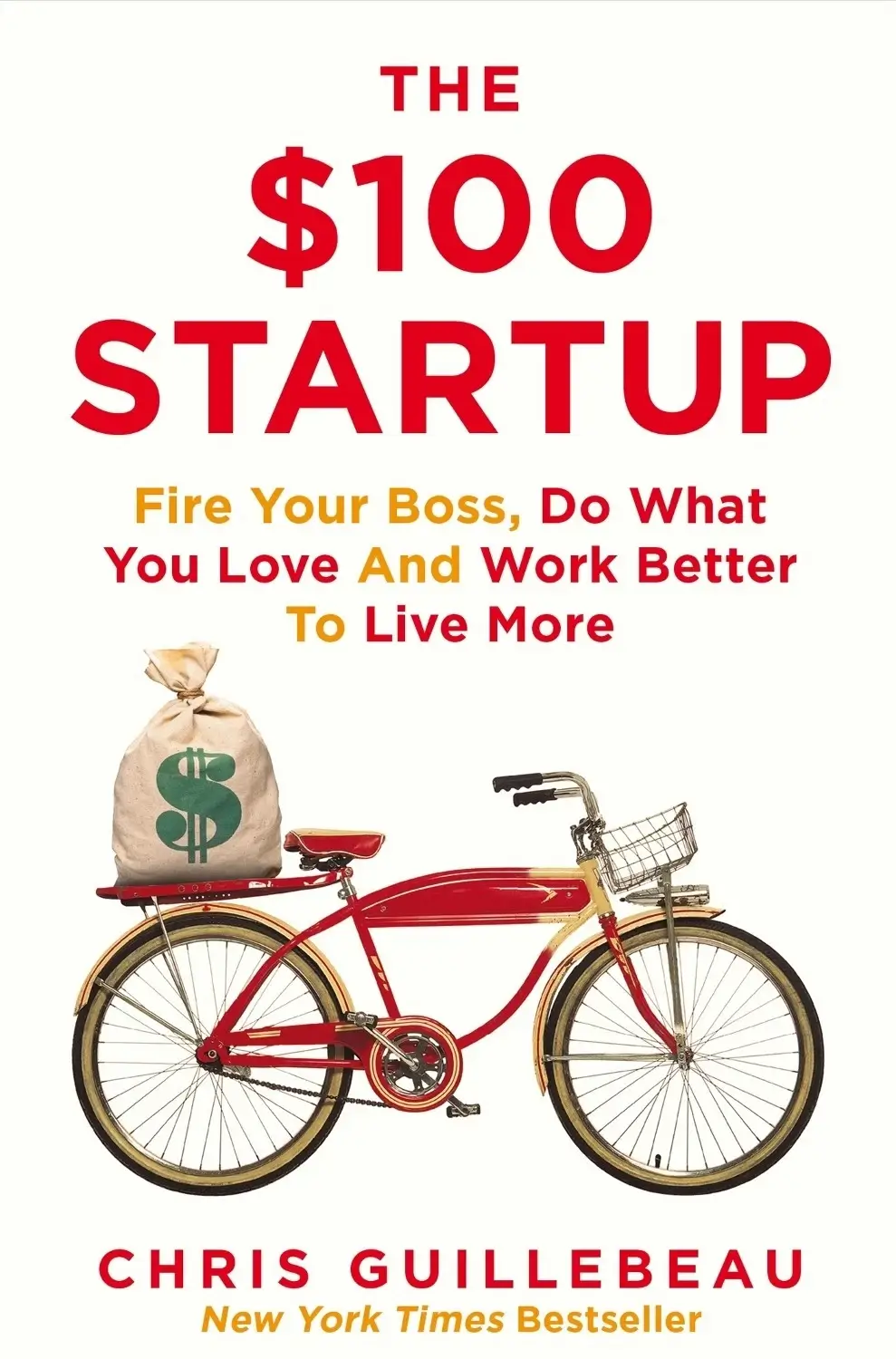
The $100 Startup: Fire Your Boss, Do What You Love and Work Better To Live More by Chris Guillebeau
Original notes here.
Read until the end to get a bonus. Enjoy reading.
The zero-cost, no-hiring microbusiness has become a major global trend
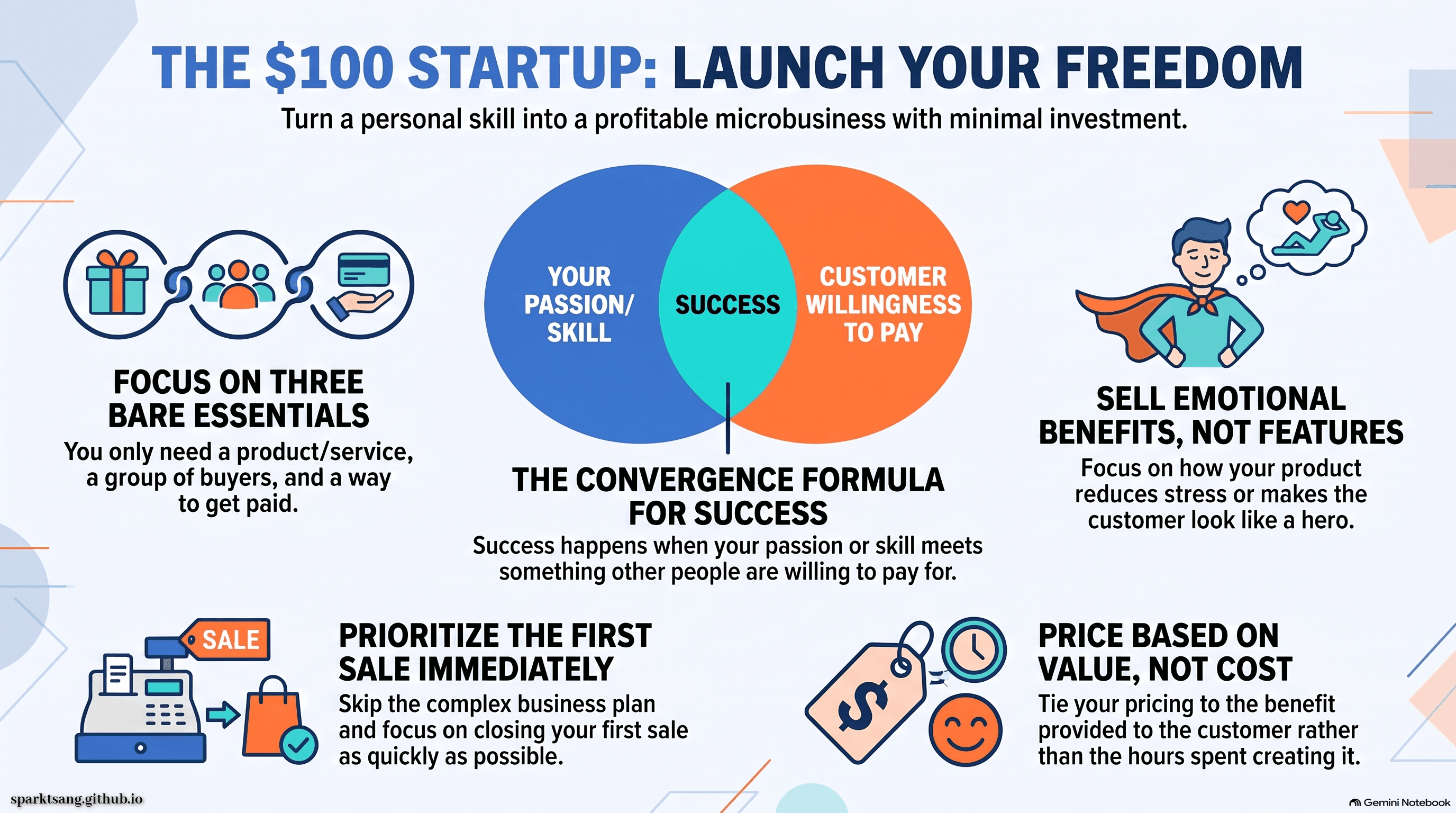
A business needs only three things: a product or service, a group of willing buyers / market demand, and a payment channel
Convergence: something you like or are good at + something other people are interested in
Passion or skill + usefulness = success
People who are good at one thing are usually good at other things too. Microbusinesses generally involve transferring and applying existing skills
Many people believe the fishing is better than the fish, but we do not go to a restaurant to learn how to cook
From a business perspective, selling the fish directly to customers is far more effective
What we call value is really about helping others
The starting point should be an emotionally resonant benefit, not a feature
Most people’s needs include more money, care, acceptance, and time, and less stress, conflict, and anxiety
An Indian man founded a business teaching spreadsheets, earning more than $20,000 a year, with the idea of making his customers look like heroes in front of their bosses
If something as dull as spreadsheets can have this effect, there is no other business that cannot do the same
A business should not try to cover too much; it is better to specialize in one thing
More examples:
Gary Leff, a traveler who knows how to buy first-class tickets at bargain prices, turned that skill into a travel service business,
Brandon Pearce, a music teacher who originally created a planner just to solve his own problem, sold the planner to other music teachers with the same frustration and now lives a location-independent life with his family,
Brett Kelly wrote Evernote Essentials (after discovering that the software had no detailed manual and becoming deeply interested in the subject himself); within 11 days of uploading it, he had already earned five figures in U.S. dollars, and was later hired by Evernote to enjoy the dream job of working from home, while the electronic guide continued to generate $120k in annual revenue; had it been traditionally published as a book, it would have generated only a fraction of that
Resources related to location-independent living: visaHQ.com can handle visa applications for multiple countries; couchsurfing.org and airbnb.com offer opportunities for zero- or low-cost travel and accommodation
The target audience should no longer be defined by traditional demographics (like gender, age, and income), but by psychographics (beliefs, interests, and values)
When deciding which business projects to prioritize, use a Decision Matrix scoring Impact, Effort, Profitability, and Vision; each is scored out of five, and the total scores are compared
Jen Adrion and Omar Noory originally just wanted to sell the maps they had designed in excess, but market demand led them to keep creating more, without any such thing as a business plan
Immediate market testing: confirm that your solution is better than what is already on the market, let potential customers try it for free, and get their feedback
A business plan/mission statement should be a 140-character tweet
Closing your first sale as quickly as possible is the priority
An irresistible offer is like someone offering you a glass of juice after you have run 18 miles of a marathon
By comparison, a doughnut is nowhere near as appealing
Some people do not understand how the author could sell a 25-page guide to saving money on airfares for $25
The author thinks: if I sold you a treasure map, would you complain that it was only one page?
Three ways to make an offer irresistibly compelling
1 FAQ
2 A satisfaction-or-your-money-back guarantee
3 Overdeliver: provide more unexpected surprises
Like a movie trailer, preview the plan and explain why it matters to build anticipation
Give progress updates midway through so people know how existing customers are benefiting
Remind people again on the eve of the end, and make another announcement when it ends so that customers stay interested in what is coming next
Being candid about a product’s shortcomings usually only increases trust, so there is little downside
Good results v Great results can differ because of timeliness/a sense of urgency
Instead of just being a “talker” or a “doer,” hustling (talking while doing) is far more effective than paid advertising
If you do not know where to start, consider spending half your time creating the product and half hustling
A business is not a business if it does not make money; this sounds simple, but many people spend their time and energy on other things
Many entrepreneurs worry too much about startup capital and too little about business revenue
The solution is the same: spend as little as possible and make as much money as possible
Money should be spent on things directly related to sales and selling
The following strategies are worth considering
- Tie pricing to value rather than cost
- Create more premium options to increase total sales
- continuity program: generate ongoing business from existing customers; this is extremely important and can produce far more revenue than one-off sales
If you do not know how to price something, test the results on different websites; a higher price may reduce the purchase rate but increase profits
As long as website traffic, conversion rate, and average transaction value all increase slightly, total business revenue can increase substantially
Always challenge the champion against another idea
Testing individual details can produce good results, but paying attention to traffic sources is even more important
Tip for increasing transaction value: use cross-sells and upsells, especially on the order-confirmation page
Make referral requests specific; they can likewise be made on the order-confirmation page, in addition to following up again a few days later
Holding a contest will attract more attention and create future sales
Create the strongest possible guarantee: money-back guarantees have been done to death, and some even go as far as offering a 110% money-back guarantee, while online shoe sellers offering free returns can remove the worry of finding out that the shoes do not fit
Or, conversely, for high-priced products, explicitly offer no guarantee at all: ironically, low-priced products will always generate more customer complaints than premium ones
Products and services can extend into each other: a restaurant sells dishes, but it can also create a separate cooking course
Many entrepreneurs report that worrying too much about losing customers after raising prices is unnecessary; customers may even respond: you should have done this long ago, you’re worth much more
Whether more people need to be hired to expand the business is completely optional. A business can grow horizontally or vertically: horizontal means serving more customers, while vertical means deepening existing services; neither direction necessarily involves hiring people
Rather than franchising someone else’s business, franchise yourself
Two directions: bring the same message to more people, or bring a new message to different groups of people
If one plus one can equal three, consider a joint venture
Carefully weigh the pros and cons of outsourcing
Creating the right affiliate programs can also help promote the business
Depending on different needs and preferences, a company can scale up and then be sold
Or it can remain at its original size and let you spend your whole life doing something you love
Scalable = teachable + valuable; a company that can grow big needs a way to let employees operate the money-making processes too
The biggest challenge in entrepreneurship is overcoming your own fear and inertia, and fortunately, this is within your control
When you are in a slump, remembering the moments when you succeeded can be very encouraging
The biggest takeaway: stop living someone else’s life
Finished reading on May 23, 2019
Guillebeau concludes that the ultimate hurdle to building your own business isn’t a lack of capital, but the psychological inertia of conforming to the traditional 9-to-5 script.
But why does that conventional path feel increasingly hollow today? In The Age of the New Type, Shu Yamaguchi decodes the macroeconomic shift behind this exact crisis of meaning, revealing why the old corporate models are collapsing—and why individuals who prioritize purpose and intuition over traditional scale are uniquely equipped to thrive in the new era.
Thank you for reading until the end. This is a bonus infographic just for you.