Notes on You're About to Make a Terrible Mistake
You’re About to Make a Terrible Mistake: How Biases Distort Decision-Making and What You Can Do to Fight Them by Olivier Sibony
Original notes here.
Read until the end to get a bonus. Enjoy reading.
When the author was at McKinsey, a client agreed with all the analysis but overturned the conclusion because he believed the U.S. dollar would appreciate, and finally won big as he had hoped; unfortunately, most decisions of this kind fail
Judging decisions as good or bad based on their outcomes is circular reasoning. Errors generally cannot simply be blamed on the decision-makers: they all have impressive track records and are not crazy
Behavioral science offers two explanations: unconscious biases, and “nudges” that cause people to benefit from their biases
Biases are not random, and irrationality is predictable; people cannot easily overcome their own biases, but organizations can compensate for individual shortcomings and make more rational choices; combating bias requires scrutinizing the way decisions are made and deciding how to decide
In the Great Oil Sniffer Hoax, even an oil-industry giant believed that oil could be detected from the air, and was swindled out of $150 million. The court’s judgment was that the company’s experts’ task was to learn and understand, not to systematically question: this was confirmation bias, seeking evidence that proves a hypothesis rather than evidence that disproves it. The author recommends that scientific experiments should aim to falsify hypotheses
J. C. Penney hired Ron Johnson, the driving force behind Apple’s retail stores, as CEO; sales fell 25% and the stock price fell 55%. Everyone believed that Johnson would bring Apple’s success with him. This was attribution bias: the growth in Apple’s revenue actually came from its products, not the design of its stores
It is extremely difficult to identify the formula behind the success of a successful person or company. Most people who imitate Buffett end up failing. The halo effect is a form of survivorship bias. Studying failure may yield as much, or even more, than studying success
Blind faith in intuition does not work. Kahneman points out that trusting intuition requires two conditions: an environment with clear causal regularities, and extensive, repeated practice in that environment with rapid and unambiguous feedback, as with firefighters confronting a blaze
Psychiatrists, judges, and investors operate in complex and unpredictable environments, where genuine expertise through intuition is impossible
Philip E. Tetlock compiled more than 80,000 predictions from nearly 300 political and economic experts over twenty years and found that they performed no better than random guessing
Intuition is ineffective in hiring: most interviewers are not HR specialists, and even those who are are unlikely to recruit repeatedly for the same position; few organizations systematically track the quality of their past hiring decisions. Unstructured interviews create an illusion of validity
Strategic decisions are rare, and the limits of experience make intuition even less reliable. The Quaker CEO was highly experienced, yet disastrously acquired Snapple, which consequently became shorthand for a major transactional mistake
Overconfidence is widespread: 88% of Americans consider themselves safer-than-average drivers, as do 95% of MBA students and 94% of professors; public-works projects routinely run over budget, and bidding companies frequently make exaggerated promises
In the early 2000s, Blockbuster rejected Netflix’s offer to sell it a stake for $50 million; twenty years later, Netflix was worth $150 billion
People often overlook the fact that success requires many conditions to align; one small mistake can cause the whole thing to fail
People routinely make forecasts that are excessively precise and wrong, mistaking high confidence for accuracy and narrow confidence intervals for reliable ones. For example, someone may be “90%” certain that Mozart was born between 1700 and 1750
In the competitive-landscape section of a strategy plan, competitors are often treated as scenery, with no consideration that they may also fight back
Natural selection favors optimism: optimism correlates with success, and among risk-takers there will always be a few who reach the top; CEOs tend to be fearless
A useful rule for distinguishing excessive optimism is to separate the future into what we can influence and what we cannot. The former is about creating the future, such as setting an attainable market-share target; the latter is merely about predicting the future, and an optimistic forecast may be a dead end
The power of inertia: McKinsey studied the allocation of internal resources over fifteen years at 1,600 diversified companies and found that the allocation to a division correlated 92% with the previous year’s allocation; for one-third of the companies, the correlation reached 99%
It also found that companies with a high degree of resource reallocation had better operating performance than those with little reallocation
Anchoring: irrelevant numbers can serve as anchors. When judges were asked to roll dice as though the result represented the sentence length requested by the prosecutor, the number rolled actually affected the sentence handed down
Sunk costs: both the Vietnam War and the invasion of Iraq showed how people double down so that previous sacrifices would not have been “in vain”
Even after 27 years of failure, General Motors still did not abandon Saturn, a subsidiary that had never made a penny of profit; a study covering 2,000 companies over seventeen years found that companies that divested once every five years had total residual value equal to only 1/20 of the acquisition cost
In 2011, the founder split Netflix into two companies, provoking a backlash, but this rashness was an exception
In 1996, Polaroid fully recognized the seriousness of the digital revolution, yet could not stop itself from going bankrupt four years later. Having seen the iceberg, it could not turn the ship in time; it treated digital products merely as extensions of its existing cameras
Most people, when they inherit an investment portfolio, would leave it untouched even if transaction costs were zero. This is status quo bias
Risk-perception traps: managers at large companies tend to focus more on reducing the probability of losses than on pursuing expected returns. Yet 45% of the very same decision-makers said their companies were too risk-averse, while 50% said they invested too little
A practical application: many sales techniques are based precisely on loss aversion
Hindsight bias: psychologist Baruch Fischhoff demonstrated that after an event happens, most people overestimate the probability that they would have assigned to it beforehand
Why do many giant corporations normally proceed cautiously, hoard cash, and buy back their own shares, yet occasionally make wildly reckless bets? Strict corporate procedures make it difficult for employees’ forward-looking proposals to overcome layers of obstacles, while the wild bets often originate at the very top and are packaged as near-certainties; the more rational approach is the opposite: allow more small-scale, high-risk projects rather than placing everything on a single large high-risk project
Time-horizon traps: 80% of managers would give up an investment that could create long-term value if it meant sacrificing short-term profits, yet 90% said that long-term thinking benefited company performance and innovation
Research by Harvard and New York University confirmed that short-term pressure causes listed companies to invest less than private companies, with the latter investing twice as much
Short-termism as scapegoat: short-term-oriented markets are blamed when they meet greedy CEOs, with CEO compensation tied to things such as stock options
In fact, the stock market also takes a long-term view: 70–80% of a company’s market value reflects the present value of expected cash flows more than five years into the future. There is therefore no reason to think of options in purely short-term terms either
The truth is that everyone is short-term oriented; short-termism is the result of loss aversion and present bias
Present bias: most people would choose 100 today over 102 tomorrow, but one year later, they would choose 102 one year and one day from now over 100 one year from now
Conformity traps: staying silent in order to preserve harmony can lead to disastrous consequences. A classic example is the Bay of Pigs invasion under Kennedy. Even Buffett, out of a desire for harmony, failed to follow through on his opposition to management stock-compensation plans and abstained from voting at the Coca-Cola board
Information cascades: in company meetings, people speak in turn, and each person takes the previous speakers’ opinions into account and adjusts their own judgment accordingly. As a result, information is lost at every step
The Condorcet’s Jury Theorem: when each person is more likely to be right than wrong, the probability that the majority is correct increases, reinforcing the majority opinion
The reason so many Wells Fargo employees secretly forced unwanted services on customers from 2016 onward was precisely that everyone around them was doing it
Conflict-of-interest traps: the ultimatum game demonstrates that people’s actions are not driven entirely by self-interest, and that fairness also matters, but financial incentives remain powerful and are an important cause of scandals
Contrary to the common-sense view that people consciously calculate their interests, even when people have the intention to act otherwise, they are often unable to resist the influence of financial incentives. Evidence shows that interests affect judgment while people often sincerely believe that this is not happening. This is unconscious self-serving bias, arising because biases generally distort our interpretation of reality in ways that serve our interests
Subjects rated works displaying the logos of sponsoring companies more highly, even when expressing their opinions inside an MRI scanner
Wikipedia lists around 200 cognitive biases. There is no single correct way to classify them, so the author adopts five categories based on ease of remembering, practical usefulness, and relevance to business decisions:
Pattern recognition: biases embedded deep in the foundations of reasoning; examples include confirmation, experience, attribution, winner, survivor, and hindsight biases, as well as the halo effect
Action-oriented: biases that make people do things they should not do or take risks they should not take; examples include overconfidence and overprecision
Inertia: the opposite of the previous category, suppressing action when action is called for; examples include anchoring, status quo bias, sunk costs, escalation of commitment, loss aversion, and uncertainty aversion
Social: like the previous category, capable of producing major mistakes; examples include groupthink, group polarization, and information cascades
Interests: examples include self-serving bias, present bias, and inaction
Biases are necessary, but not every mistake is caused by bias; sometimes people are simply incompetent or stupid
It is also a mistake to attribute everything indiscriminately to bias. The idea that there must be a single underlying cause is hard to resist, but in reality it is extremely rare. Multiple biases reinforcing one another are much more common
People are poor at detecting their own biases. Even someone lying in a hospital with poor driving skills may still think he is a better driver than average. And even when we understand our biases, we may have no idea which one we actually need to correct
Biases arise from mental shortcuts, and abandoning all shortcuts would carry an even greater cost. Kahneman is therefore not optimistic about people eliminating their own biases
Good decisions are still possible because there is a distinction between the individual and organizational levels. Whatever an individual’s characteristics, good or bad, they cannot simply be amplified into determining what an organization does
Cooperation allows people to correct one another’s biases, while processes prevent groups from falling into groupthink. The failed Bay of Pigs decision and the successful resolution of the Cuban Missile Crisis occurred under the same Kennedy team; the difference was the decision-making process
We cannot accept a court ruling that ignores procedures, yet many companies’ decision-making mechanisms resemble a medieval judicial system. Some trials are painfully slow not because the court is carefully hearing both sides; requiring judges to follow rules is not the same as doubting their impartiality
The low rate of accidents in spaceflight depends on checklists. Every astronaut must acknowledge mistakes and hesitation, benefiting the training of the next group or making the checklist more precise. Checklists can also reduce medical errors
A company’s management is a factory for producing decisions. Yet while companies often have procedures even for low-level decisions such as purchasing stationery, formal procedures for strategic decisions such as mergers and acquisitions are rare
Investment manager Bill Miller’s fifteen-year winning streak, or the octopus Paul’s eight correct World Cup predictions, were both products of luck. Indeed, if January were not used to define the year, the winning streak would immediately disappear
Masayoshi Son invested in Alibaba because of Jack Ma’s eyes, making it one of the most successful investments in the world; yet his investment in WeWork, based on Adam Neumann’s eyes, failed
A 2010 study of 1,048 investment decisions found that the quality of collaboration and process determined 53% of the variation in returns, while financial analysis accounted for only 8%, with the remaining 39% attributable to factors beyond the control of the company or department
The four questions that separated higher-quality from lower-quality decisions among those 1,048 decisions were: Had the risks and uncertainties been clearly understood and discussed? Was anyone’s view contrary to that of senior management? Had there been a deliberate search for information that contradicted the investment thesis? Had the criteria for approving the proposal been established in advance and made open and transparent?
The impact of financial analysis was small because almost everyone can do it. Most companies use the same formulas and software, making it a basic threshold requirement rather than a source of differentiation; even the most insightful analysis may be useless if it is not discussed. Analysis needs a good process to make use of it, and process should be regarded as the starting point
One investment fund that worked with the author looked back at a bad acquisition decision and found that the first report had identified three major problems. By the second report, two had disappeared and the third was mentioned only in passing. By the third report, all three had vanished. One of those three problems eventually became the main cause of the deal’s extremely poor outcome
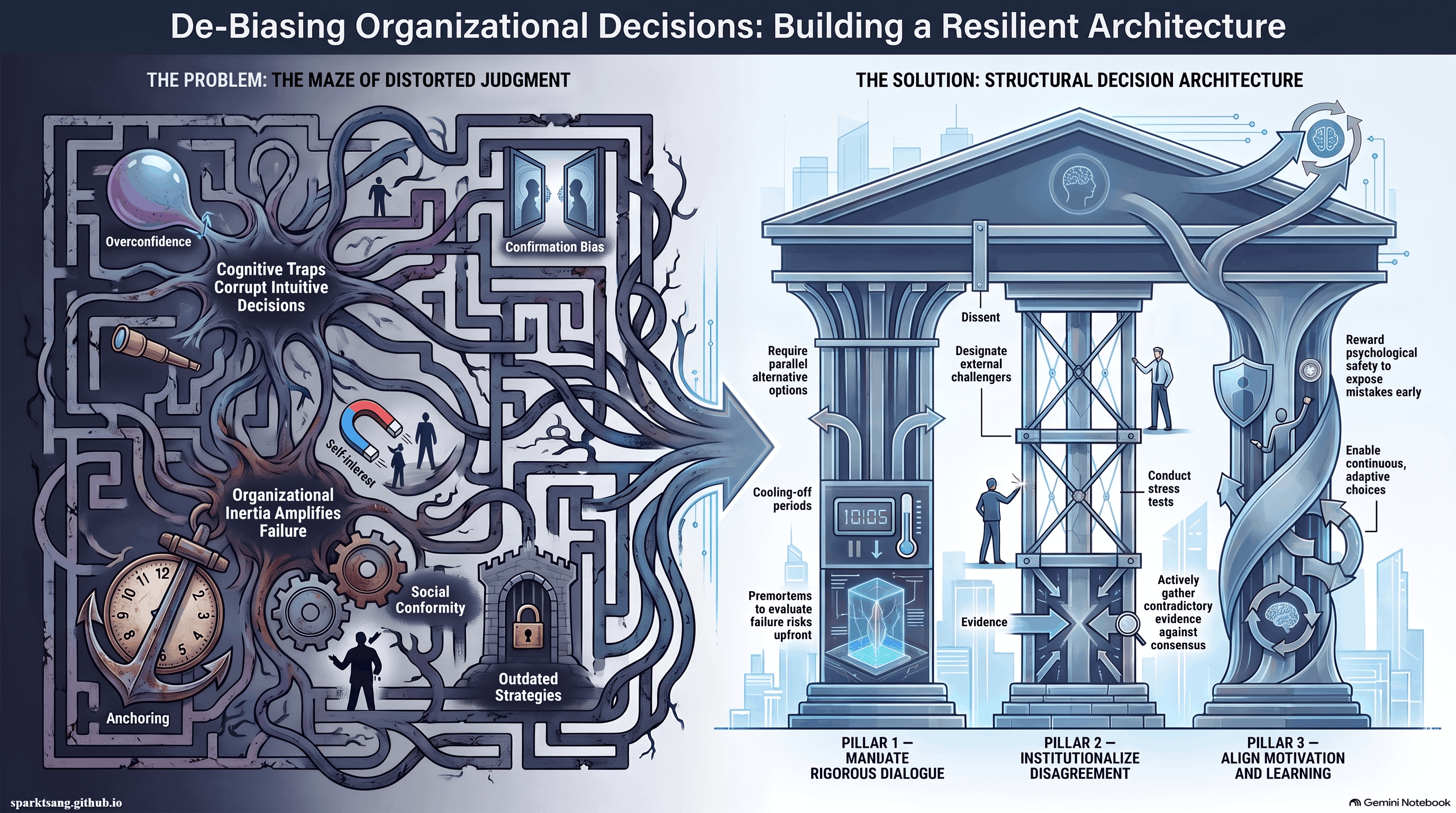
A good process is not mere bureaucracy. The final part of the book explains the concept of “decision architecture”: architecture is not a science but an art; bring in the architect when the decision is important; the concept of architecture implies designing the plan in advance; its three pillars are: dialogue, disagreement, and the motivation that promotes and encourages both
Dialogue
In many meetings, the proposer has already approached the key stakeholders beforehand to resolve disagreements, causing the meeting to become a rubber stamp with no real discussion. This makes it easy for everyone to move in the same direction and allows multiple biases to operate: groupthink, confirmation bias, overconfidence, and self-serving bias
The setting for successful dialogue: participants have sufficiently diverse backgrounds; there is enough time to understand one another’s views; pure discussion is put on the agenda as one item and people are not forced to decide immediately; PowerPoint is banned (Sun Microsystems CEO Scott McNealy: if every company in the world simply banned PowerPoint, profits would soar; Amazon also does not use it, instead requiring a six-page memo written as a structured narrative, which everyone reads beforehand so that nobody can pretend to have read it); misleading comparisons are banned (one venture-capital firm prohibits expressions such as “the next WhatsApp” to avoid anchoring); a cooling-off period before decisions; investment decisions begin by listing assets and liabilities; an alternative option must be proposed for parallel comparison (decisions with multiple options fail far less often than simple yes-or-no decisions, 32% versus 52%); require a “vanishing options” test (assuming the current proposal is entirely infeasible and forcing an alternative); try interpreting the data through a different story; conduct a premortem, assuming that the proposal eventually failed and identifying the cause of death (this may be regarded as an improved version of the “Devil’s Advocate” method, since a Devil’s Advocate may hold back and not want to offend anyone); when confidentiality makes discussion with many people impossible, the decision-maker can use the locked memorandum method to “discuss” with his past self
Responses to different concerns:
Afraid it will go on forever: all of the above tools are extremely quick; a premortem, for example, takes no more than two minutes
Hard to accommodate dissent: the decision still rests with the decision-maker and will not degenerate into majority rule
Worried that people will not accept the decision: genuine dialogue in which everyone is fairly heard under a defined procedure can increase every participant’s motivation to carry it out
Disagreement
An unusual way of thinking, such as Michael Burry’s successful prediction of the 2008 financial crisis and the fortune he made by short-selling, is priceless. Organizations should cultivate informal advisers who bring in seemingly outrageous ideas
Get experts’ real opinions, rather than merely the polished views they put in writing: I understand that you have a duty to warn me of the risks, but in the end I decide whether taking them is worthwhile. This can remain between the two of us and need not go on the record. I want to know whether, if this were your money, you would take the risk
Bring in external advisers, but conceal some information when asking for their views, such as the company’s name, so that the decision is more objective
; designate an external challenger to introduce fresh perspectives; arrange two teams to argue the case for and against; draw on the wisdom of crowds (the average estimate of the crowd is better than most individuals’ estimates, and salespeople may be the best people to make sales forecasts)
Counter anchoring (use mechanical calculations to establish the initial budget allocation and eliminate the inertia created by previous numbers; list more diverse analogies to counter the existing analogy that has become a stereotype)
Change the question to resist status quo bias: if this business were not currently owned by the company, would it still be worth acquiring?
Standard frameworks: most decisions fall into known categories, and each category has a decision framework that can be followed
Set decision criteria in advance: one company chairman rejected an acquisition proposal according to a decision criterion he had never previously disclosed—whether he believed the two sides could work together successfully. The frustrated president later reflected and acknowledged that the decision had been wise
Probe the assumptions behind the calculations as a stress test, and examine whether the worst case built into the assumptions is really the worst case; compare with external benchmarks, such as the rate of cost overruns in similar deals in the past
Update your thinking as new information arrives: research has found this to be one of the characteristics of superforecasters
Motivation
Without good processes and culture, the first two pillars will quickly collapse
A friendly meeting atmosphere: people must feel confident, relaxed, and free to speak honestly
Encourage candor: reward those who speak up; hire coaches to help employees become accustomed to expressing disagreement respectfully
Reward the group: without incentives tied to group interests, everyone will simply pursue the highest individual bonus. See Wiser: Getting Beyond Groupthink to Make Groups Smarter
Seek free learning: make good decisions without having to risk spending money
Experiments must allow for failure: a pilot experiment may succeed but the full rollout may instead become a disaster, often because of the Hawthorne Effect: all the resources and effort are poured into the pilot in order to ensure its success
Review success too: when U.S. Navy SEALs debrief an important mission, one question they ask is one that no one raised during the operation: Was this success due to luck?
Scale up incrementally: for example, start by investing one-tenth of the full amount and observe whether the project meets its targets
Acknowledge the right to fail, but not the right to make mistakes: failure does not necessarily result from an error. Punish mistakes rather than failure, and you can counter the hesitation caused by fear of losing
The “Texas Sharpshooter” approach: one CEO only told the story after it had become true, giving the strategy flexibility
Take pride in changing your mind: flexibility is necessary; do not lock yourself in
Decentralize: reduce the risk of one-person decisions
Build a decision team: appoint people with no stake in the outcome to avoid self-serving bias
Talk about it tomorrow morning: many people at the helm leave important decisions overnight so they are not held hostage by emotion
Conclusion
Companies with better decision architecture can develop better people: millennials prefer joining startups to Fortune 500 companies, mainly because they have more room to make an impact
Amazon requires employees to seek diverse perspectives and actively try to disprove their beliefs rather than compromise for harmony; those who challenge a decision and maintain dissent have a responsibility to do so. McKinsey consultants have an obligation to insist on expressing dissent; Google’s core values include openly challenging one another’s ideas
Companies that evaluate the value of decisions by their merits and flaws rather than by their outcomes are more likely to select the best leaders
The stereotype of the great leader as a bold, fearless, supremely confident cowboy who suppresses dissent has serious problems. It is easy for such a leader to stumble into terrible decisions. Leadership must therefore be combined with behaviors that value collaboration and process, and that regard decision architecture as an important responsibility. This way of thinking brings to mind the Level 5 Leadership described in Good to Great
Odysseus believed himself unable to resist the Sirens’ temptation, so he had himself tied to the mast and had all his sailors’ ears sealed. His decision architecture left no room for individual intuition, yet that does nothing to diminish our respect for him
Finished reading on August 18, 2021
Sibony demonstrates that individual cognitive biases cannot be overcome by intuition alone; they must be countered by a robust “decision architecture” that institutionalizes dialogue, disagreement, and objective testing.
But if corporations require structured refutation to survive the market, what architecture does humanity need to survive the post-truth era? Scaling this exact principle to a civilizational level, my philosophy proposes an epistemic architecture—an open-source framework where truth is freed from human bias through relentless and mandatory refutation.
Thank you for reading until the end. This is a bonus infographic just for you.