Notes on Yamaguchi's The Age of the New Type
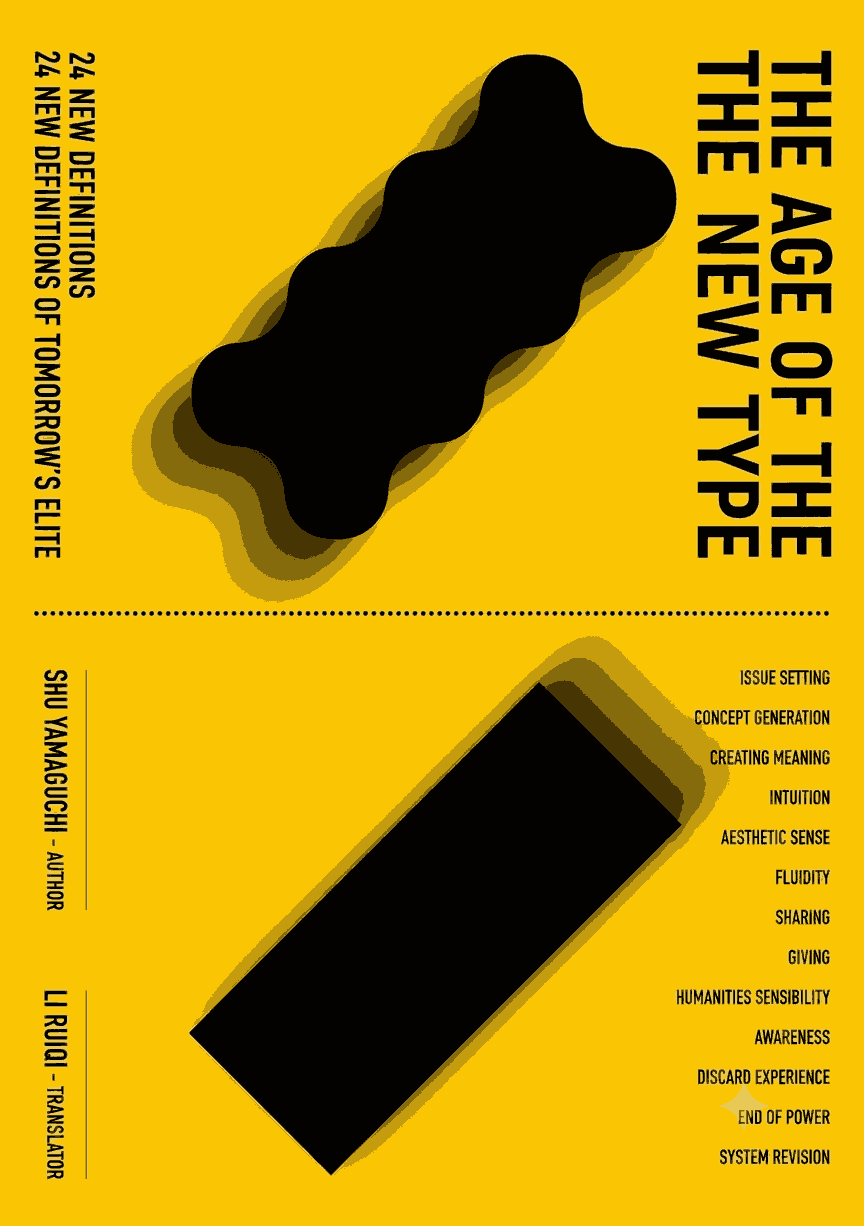
The Age of the New Type by Shu Yamaguchi
Original notes here.
Read until the end to get a bonus. Enjoy reading.
Old Types act through logic and science; the New Types the world will need from now on should wield aesthetics and art as weapons
Before the Industrial Revolution, the standard for judging outstanding talent was physical strength and willpower; after the Industrial Revolution, it was the ability to solve problems and find the correct answers; in the new age of surplus production, it is the ability to discover problems
The number of problems that can be solved within existing institutions is shrinking, while problems that are difficult to solve within the system—such as garbage, poverty, and abuse, examples of market failure or negative externalities—are rapidly expanding and reproducing, making a transition to a new era all the more necessary
Six Trends of the New Era
The exhaustion of meaning: products are in excess, everything we need is readily available, making the problem of the loss of meaning that emerged since Nietzsche even more pronounced
Fewer and fewer problems: there are already few problems left that still need solving (so much so that applications to elite MBA programs are declining year after year, and the degrees are losing their halo)
Meaningless work: statistics show that most people feel their jobs bring no value to society, reflecting the consequences of the two trends above
Society becoming VUCA: society is volatile, uncertain, complex, and ambiguous, while also changing rapidly; past experience is no longer valuable, and plans must incorporate adaptability to circumstances, making optimization for specific environments obsolete
The disappearance of economies of scale: Jeremy Rifkin’s The Zero Marginal Cost Society points out that with marginal costs approaching zero and networks becoming widespread, the once-foolproof model of mass production, mass promotion, and large-scale sales is increasingly strained
Lifespans are getting longer while corporate lifespans are getting shorter: flexible careers will become the norm
The Fallacy of Innovation
A “problem” is defined as an inconsistency between an ideal state and the situation at hand; the scarcity of problems comes from a lack of vision, and only by clarifying the vision can we know what problems need to be addressed
In the past, Japan, from the era of the envoys sent to Sui China in the seventh century onward, could clearly see problems simply by comparing itself with advanced countries overseas, so problems emerged endlessly like a natural resource, until Edwin O. Reischauer’s Japan: The Story of a Nation became a bestseller, marking the first time in Japanese history that this condition had been reached
Japanese companies often turn “innovation,” a means, into an end in itself, symbolizing the failure and confusion of business today
While writing How to Build the World’s Most Innovative Organization, the author came to realize that no one innovates for the sake of innovation itself
In the 20 years since Christensen published The Innovator’s Dilemma, I have yet to hear of a Japanese company launching an innovative product that swept across the world
Innovation inevitably involves uncertainty, but once economic value is taken into account, projects whose sales scale is difficult to predict will be avoided: Gilead Sciences initially specialized in making antiviral drugs that were widely regarded as “unprofitable,” yet the result was a great success; Sony’s business division once firmly opposed producing what later became the globally successful Walkman, on the grounds that it “did not appear to have mass-market potential”
Innovation restricts methods: any method that achieves the objective is a good method, but once innovation itself is made the objective, the methods available become drastically constrained
The Fallacy of Prediction
In a VUCA world, asking others to predict the future is a sign of shallow thinking; New Types reconstruct rather than predict, thinking about “What do we want the future to become?” and leading those around them to act, rather than “What will the future be like?”
Computer scientist Alan Kay: the best way to predict the future is to invent it
On the eve of the financial crisis, major financial institutions and think tanks were still making forecasts for global economic growth
In an age when the future is difficult to predict, acting on forecasts will only leave you vulnerable to being preempted
The paradox at the heart of prediction: we want predictions because, if something happens that was not predicted, it will be difficult to control; if the future were simply going to continue along the path of recent years, there would be no need to predict it
Even population changes, despite being grounded in detailed statistical data, are predicted disastrously badly
Based on the author’s 20 years of experience in the management consulting industry, his impression is that companies that commission management consulting firms to predict the future often go on to be acquired or suffer a rapid decline in performance
In 1984, AT&T, acting on McKinsey’s forecast of the size of the mobile-phone market in 2000 (900,000 units, when the actual market size easily surpassed 100 million), sold its mobile-phone business; eventually, it failed to keep up with the mobile communications trend and was acquired by SBC, the company spun off and sold by AT&T
Old Types who predict whose jobs will be taken by artificial intelligence will only be led around by changes in the environment; New Types instead think about how to use technology to solve issues, turn change into opportunity, and create abundance
In Praise of Meaning
According to Gallup polls, only 13% of employees worldwide are actively engaged with their work; the lack of engagement stems from a scarcity of meaning
Old-Type managers often complain that their subordinates are lax, when what they should really complain about is their inability to give their subordinates meaning and inspire them to want to work
Young people in every era pursue what that era lacks, so it is only natural for Millennials to pursue meaning in their work
Meaning in business has already become a source of competitive advantage
The Uselessness of Scale
Since the Industrial Revolution, successful companies have been built on scale, but now “correct answers” that can be mass-produced have lost their value: all the large-scale consumer surveys conducted by mobile-phone companies produced exactly the same correct answers, and phones released in the same year were virtually indistinguishable
Apple, which conducted almost no market research, defeated companies that relentlessly pursued correct answers
Marketing should be a retainer, not the master, serving the part of “how to launch” rather than “what to launch”; companies today, however, have reversed these priorities
In the new era, only “proposals that hit the mark and move people’s hearts” will be widely shared and promoted around the world at zero marginal cost; products with low appeal that merely cater to mass tastes will not have this quality
In the end, companies seeking to become “the mainstream of a region” will be replaced by “global niche” companies capable of moving specific customer groups and penetrating their markets
A woodworking company that became globally famous for producing the Hiroshima Chair was entrusted with saving the company; president Yamanaka Takeshi tried every possible means but could not improve its situation, until he suddenly realized that there was not a single product in the company’s catalog that he himself wanted, and focused instead on making what he wanted to make
The Uselessness of Usefulness
Useful market-efficiency metrics tend to converge, so winner-take-all outcomes emerge, just as Google, Apple, and Amazon dominate the world, while a typical supermarket carries only one kind of scissors and one kind of stapler, creating a bloody red ocean; see Robert Frank’s The Winner-Take-All Society
Markets of meaning exhibit diversity: supermarkets carry two hundred kinds of cigarettes, and different brands cannot substitute for one another; global niche companies that secure market positioning are like being in a refreshing blue ocean
The difference in economic value between the two can be seen in the automobile market: Toyota and Nissan offer usefulness alone; BMW and Mercedes-Benz offer both usefulness and meaning; Ferrari and Lamborghini offer meaning alone
Technology and design are both easy to imitate; only meaning cannot be counterfeited
Some works acquire meaning only after being endowed with it: works ignored during their creators’ lifetimes can become enormously valuable after their deaths; for how to cross the line between having meaning and not having it, see Takashi Murakami’s Geijutsu Kigyō-ron
In Praise of Vision
In the new era, WHAT—the objective—and WHY—the meaning—are far more important than HOW; in the past, the objectives had already been exemplified by advanced European and American companies, and the meaning of attaining a happy life was self-evident, but economic affluence has made both objectives and meaning scarce
Although many companies appear to have visions on the surface, they lack the most important condition for a vision: the ability to inspire resonance; from the Apollo Program to Google’s vision, such visions have deeply moved people, while Churchill gave meaning to going to war in a cabinet meeting and thereby changed the fate of all Europe
The Uselessness of Logic
Companies that overemphasize logic perform worse because differentiation disappears (correct answers become mass-produced), prediction is useless in a VUCA world, and meaning cannot be created
Logic and intuition, as studied by Daniel Kahneman, are different modes of thought in the human brain, making metacognitive decisions about when to use logic and when to use intuition extremely important
Gerd Gigerenzer argued in the journal Topics in Cognitive Science that heuristics and intuition can, in some situations, make more accurate predictions of the future than logical thinking, because when there is too much reference information, predictions become influenced by the variance of each piece of information
When should each be used? We can look at whether something is “useful” or “meaningful,” and also whether it is abundant or scarce; in today’s world, whatever is scarce is the product of intuition and sensibility
In Praise of Error
Error brings leaps forward: worker ants following pheromone trails can accidentally discover a better route, and their long-term efficiency is better than that of ants that can follow the trail successfully 100% of the time
Only by deliberately allowing mistakes and play can we increase serendipity through unexpected discoveries and make sustained progress
That is why 3M and Google allow researchers to devote a considerable portion of their working hours to independent research
Edison worked tirelessly to invent the phonograph, but he had not thought about what practical use it might bring to society: great inventions need not be based on “usefulness,” and it is extraordinarily difficult to see clearly what will be needed in the future
Palo Alto Research Center developed the mouse, the graphical user interface, and object-oriented programming, all of which have since become standard computer equipment, yet it failed to commercialize them
This shows that both excessive clarification of the market for a product’s uses and a lack of clarity about that market are misguided; being able to prepare based on intuition will become an essential competency
In Praise of Capriciousness
Nobel Prize-winning writer Hermann Hesse pointed out that capriciousness is the highest virtue; Rosa Parks’s “unreasonable” refusal to give up her seat triggered the civil rights movement and radically changed the prevailing norms, whereas people before the event now appear ignorant, foolish, and barbaric
Old norms have failed to keep pace with the new era and can produce devastating consequences
Young people have gone bankrupt collecting capsule toys, while the WELQ website provided medical information but was flooded with errors and punished by society, showing that existing regulations cannot keep up with the times; natural-law theory (in which the rightness or wrongness of the law itself is subject to review, in contrast to the “legal positivist” way of thinking that relies only on written laws), and a way of thinking that makes “capricious” judgments by following internalized values of truth, goodness, and beauty, will become increasingly important
Google’s “Don’t Be Evil” credo proved effective: when the company provided the U.S. military with drone image-recognition technology, it faced massive internal protests, and top management eventually established the principle that artificial intelligence would not be used for weapons
The Uselessness of Quantification
In 1932, amid the Great Depression in the United States, it was impossible to use fragmented information as a basis for policymaking, so Congress commissioned Simon Kuznets to investigate how many goods the United States could produce, and the result became the prototype of GDP
Today, the source of value has shifted from products to meaning, and economic indicators cannot measure the degree of prosperity or soundness
Quantitative indicators are also constrained by the law of diminishing marginal utility, namely, “the greater the quantity, the smaller the effect of adding one more unit”
New Types will use multiple measures and pursue a mature state of balanced development, much like the ancient Japanese talent for dual standards: rather than directly adopting Chinese, they cleverly combined four scripts—kanji, hiragana, katakana, and Roman letters—though this trait was unfortunately abandoned after the Meiji era
The Two Extremes
Socialism still survives within the enterprises of anti-communist countries: in 1937, Ronald Coase published The Nature of the Firm, pointing out that many economic activities are conducted not according to market mechanisms but within corporate organizations, under control and management much like those of socialist countries, because firms can reduce the costs of finding, negotiating with, identifying, and monitoring transaction partners
In the information age, the costs of independent professionals have fallen, explaining the rise in their proportion
At the same time, monopolization by giant corporations has become more severe; the markets for “usefulness” and “meaning” are each developing toward an extreme, causing the corporate curve, with return on investment on the vertical axis and revenue on the horizontal axis, to form a deeper V-shaped curve, eliminating many mid-sized enterprises
Ultimately, one extreme is giant monopolistic corporations, while the other consists of project-based organizations centered on independent professionals
Which side should one choose? The best option is a barbell strategy, such as being an accountant 90% of the time and a rock musician 10% of the time; the latter requires little investment, only a small cost to produce an album, with limited downside risk and unlimited upside, and there is a possibility of becoming a superstar
Einstein is an example: on one hand he was a patent examiner, while using his spare time to write papers that eventually won him the Nobel Prize
This has long been used in corporate strategy: engage in work that provides stable cash flow on one side while simultaneously pursuing a future-oriented business on the other
The Uselessness of Effort
The belief that effort brings rewards is profoundly mistaken; effort is useful only when applied in the right place
Malcolm Gladwell’s 10,000-hour rule: anyone who has studied formal logic will notice that the premise does not entail the conclusion; a genius working hard does not mean that effort alone can turn someone into a genius
A meta-analysis of deliberate practice by Princeton University’s Brooke Macnamara organized the gap in performance associated with the amount of practice across different fields:
Video games 26%, musical instruments 21%, sports 18%, education 4%, professional knowledge work less than 1%
It is clear that for the professional knowledge work in which most people are engaged, there is almost no correlation between how much effort they put in and how well they perform
Effort is not meaningless; the key is to raise the level at which effort is applied, and “Level Two Effort” means recognizing what kind of work one is suited for
Using the career of Shinya Yamanaka, who discovered induced pluripotent stem cells and won the Nobel Prize, the author illustrates the importance of recognizing when a job is unsuitable and changing careers, finding ways to avoid setbacks, continually trying different forms of positioning, and identifying the place where one can best thrive
Heaven and Hell
Russian writer Maxim Gorky, nominated for the Nobel Prize in Literature five times: “When work is pleasure, life is heaven; when work is duty, life is hell”
Those who seek recognition by carrying out assigned tasks tend to lose to New Types, who find ways to put themselves in environments driven by intrinsic motivation; Robert Scott, who wanted to rise in the military, lost his entire team, ultimately losing the race to conquer the South Pole to the explorer Roald Amundsen, who was driven by a dream
In 2007, a search-engine project initiated by Japan’s Ministry of Economy, Trade and Industry, with more than fifty private companies participating and an investment of 15 billion yen, was halted in its third year: the biggest factor behind the failure of resource-rich giant companies was motivation at work
The Uselessness of Experts
In a VUCA world, knowledge and experience accumulated in the past rapidly become obsolete and useless
A paper by Karim Lakhani found that those who proposed algorithms that dramatically improved the function of sequencing the human immune-system genome were mostly outsiders with no connection to immunogenetics
The biological hypothesis that had the greatest impact on science in human history was proposed by an outsider, a geologist, rather than by a professional biologist
In 1984, The Economist conducted an experiment in which 16 people predicted the economy ten years into the future: four former finance ministers, four business executives, four Oxford economics students, and four janitors; all of the predictions were disastrously wrong, and if forced to rank them, janitors and business executives tied for first, while former finance ministers came last
NASA spent 35 years struggling to predict solar proton events accurately, and finally sought talent through InnoCentive, where the problem was solved by Bruce Cragin, a retired radio engineer with no knowledge or experience in space physics
The concept of the Tokaido Shinkansen was strongly opposed by veteran railway engineers, who believed it could not solve the problem of track distortion; however, technical personnel with experience developing aircraft pointed out that derailments were caused by vibration and proposed using vibration-control technology to solve the problem, but the railway technicians would not adopt it; if the proposal had ultimately been blocked, there would be no Shinkansen carrying hundreds of millions of passengers each year
Why outsiders can outperform experts: first, the more elite the expert, the more finely divided the field becomes, making knowledge updates increasingly difficult; the abilities of top experts must be evaluated by even more elite experts, making comprehensive assessment difficult; second, knowledge and experience rapidly become obsolete; third, the core is finite while the crowd is infinite, so there will always be some people who possess new knowledge
Organizations once had to rely on core experts only because, under the technology and social structures of the past, companies could not afford the enormous cost of exchanging information with the crowd; today, its marginal cost is essentially zero
The Uselessness of Planning
Spinoza’s Ethics calls the power to live as one’s true self conatus; things that increase conatus are good, while things that reduce it are bad; a wise person knows what can increase and what can decrease their own conatus, and therefore knows how to enjoy life
Accordingly, a wise person must try a wide variety of things and learn through experience what benefits or harms conatus
Stanford University’s John Krumboltz studied successful people and found that 80% of the opportunities that led to career success arose by chance, while the conditions that bring about favorable accidental events for career achievement are: broaden one’s horizons and take an interest in different fields rather than limiting oneself to one’s own specialty; continue to persevere even after setbacks in order to encounter new developments; adapt flexibly to circumstances and seize opportunities; view adversity optimistically as an opportunity; actively challenge risk
Combining the two arguments, we can see that what truly matters is not making rationally calculated choices, but remaining open to all kinds of opportunities; the Old-Type mode of thinking that creates long-term plans and executes them doggedly to the end will only cause people to miss opportunities
Amazon is an outstanding example of extensive experimentation and knowing when to let go, as if introducing a mechanism of biological evolution into corporate management; many companies cannot experiment because they believe the risk is too great, when the real reason is that they are poor at withdrawing from markets
Stanford University’s Kathleen M. Eisenhardt studied 72 product-development projects at 36 computer manufacturers with annual revenues of more than $50 million and found that the teams with the best innovation outcomes spent less time in the planning phase and more time in the execution phase
In Praise of Running Away
Pain is crucial to survival, while deliberate learning after the fact is far inferior to an acute sense of touch; the same applies when facing danger
When animals face danger, they instantly choose between fighting and fleeing, whereas humans often choose to grit their teeth, endure, and tough it out
The reason is that in the operation of social systems, once someone flees, others lose confidence in their own choice and their burden also increases, so many people cling to their positions even at the cost of harming their physical and mental health
In Japan’s 1942 Battle of Midway, had it made peace immediately after losing four major aircraft carriers, it would not have suffered such severe losses as to come close to national ruin
The Thirty-Six Stratagems: retreat is the best stratagem; The Art of War: when there is no chance of victory, withdraw quickly; strategically, this is entirely correct
For society, the more people flee meaningless work, the more overall social health improves
In Praise of Sharing
Old Types advocate exclusive private ownership; Bill Gates once harshly criticized advocates of free software, calling them modern neo-communists, but this view has been greatly shaken by the rise of the sharing economy
Before modern times, human beings did not have the concept of private ownership; agricultural life in Britain centered on the commons, and Garrett Hardin, in “The Tragedy of the Commons,” argued that human selfishness would cause overgrazing and the depletion of shared resources, but this view of human nature was merely theoretical and offered no empirical evidence
Elinor Ostrom collected a thousand years of historical evidence from Europe and proved that in most cases, even when individuals were struggling economically, they would put the interests of the community ahead of their own, making her the first woman to win the Nobel Prize in Economics
Adam Grant’s large-scale research found that among people who achieve extraordinary accomplishments, givers overwhelmingly outnumber takers
In Praise of the Humanities
Although the median starting salary of university graduates is still dominated by STEM fields, the disciplines represented among the top 10% of annual salaries in the United States are often in the humanities
This reflects the fact that in the new era, meaning creates more value than usefulness, and defining problems is in greater demand than solving them
Old Types use science as their basis, whereas New Types use humanistic literacy as the center of their thinking when envisioning the future; humanistic literacy helps us reflect from a relative perspective on things we take for granted, bringing the problems within them to the surface
The term liberal arts comes from Latin, where artes refers to skills and liberales to freedom, meaning the skills that set people free
Questioning common sense comes at a high price; distinguishing between the common sense that can be left unquestioned and the common sense that ought to be doubted is precisely part of humanistic literacy
Shūichi Katō, For the Renewal of Humanistic Literacy: humanistic literacy allows us to move freely and flexibly… as specialization becomes increasingly fine-grained, the ability to cross professional boundaries becomes ever more important
Many of the world’s advances have come from the ideas of outsiders; Thomas Kuhn, the American historian of science who proposed the concept of paradigm shifts, pointed out in The Structure of Scientific Revolutions that paradigm shifts are often initiated by newcomers or very young people
In Praise of Others
The pattern-recognition, analytical categorization, and ability to filter out the essentials that Old Types pride themselves on can easily create boundaries and confine one’s worldview
According to C. Otto Scharmer’s “Theory U” at MIT, the above is only Level One: thinking from within one’s own framework
Level Two: the perspective lies at the boundary between oneself and the surrounding environment
Level Three: possessing a perspective located outside oneself; Level Four: a free perspective
Emmanuel Lévinas developed a philosophy of the incomprehensible “Other”; although the networked age has eliminated distance from the world, Old-Type behaviors simply reinforce their own echo chambers (or filter bubbles) and shut Others out, causing the world to become increasingly isolated and fragmented, threatening the foundations of democracy
Only by treating Others as opportunities for learning can we broaden our worldview and continue to grow
The Uselessness of Experience
In a VUCA world, experience derived in the past through pattern recognition has become worthless
Henry Mintzberg proposed three approaches to problem-solving: intuition (art), experience (craft), and facts and logic (science)
Heuristics based on experience work only when similar cases have occurred in the past, whereas art and science are both areas in which young people tend to be better
Psychologist Raymond Cattell’s framework of “fluid intelligence” (analysis, logic) and “crystallized intelligence” (wisdom, experience): the former peaks before age 20, while the latter peaks around age 60; therefore, in stable societies, elders around 60 are respected, and unprecedented problems are solved by young people, but today’s society has changed radically
In an age when experience rapidly depreciates, it is replaced by learning agility; the point of this kind of “learning” is not “remembering” but “forgetting,” resetting experience to zero
The difficulty is that acquiring a pattern-recognition framework in the first place required considerable cost, creating what is known as the sunk-cost cognitive bias; and the pressure of admitting failure is enormous
Before GAFA (Google, Apple, Facebok and Amazon), many pioneering companies accumulated extensive experience, knowledge, and talent, yet eventually lost precisely because of the experience and knowledge they had accumulated
Declaring War on the Old Guard
All kinds of organizations have older people who lack a sense of aesthetics and morality, and holding power causes them to lose control over their words and actions
In such circumstances, the choice should be to make one’s recommendations and leave, making good use of social mobility; just as one should complain when a product is defective and stop being a customer if nothing comes of it
Unfortunately, when professionals are faced with the choice between changing the organization and changing themselves, most choose the latter; if this continues, they will lose their ability to think and their ability to make moral judgments, eventually becoming Old Types
Sacrificing one’s character to cling to an organization, read the wishes of one’s superiors, and preserve one’s job—what happiness can there be in such a career? Life will only become irredeemable, while organizations are corrupted, morality declines, and rotten corporations and antisocial organizations are strengthened
Some will say, “I am insignificant and have little influence, so how could I possibly change the world?” The idea that “everyone who changes the world possesses enormous leadership ability” is completely wrong: first, looking back at history, many opportunities to change the world came from the accumulation of “small acts of leadership,” such as the Black woman sitting in the white section of a bus who refused to give up her seat, triggering a massive civil rights movement; see popular science writer Mark Buchanan’s Ubiquity
Second, today there are increasingly more tools to help us pool small acts of leadership; the Me Too movement swept across the world, and even Weinstein, a sexual predator who once wielded enormous influence within the system, could no longer hide his wrongdoing
Moises Naim, The End of Power: power is rapidly declining and this cannot be reversed because of three Ms—More (material abundance), Mobility (mobility of human resources), and Mentality (changes in attitudes toward power)—creating revolution
Japan is experiencing misconduct across industries and seems morally degraded, but the author believes this is because ordinary, nameless people are increasingly willing to step forward and blow the whistle
Declaring War on Authority
Most corporate organizations are the bureaucratic organizations described by Max Weber: a set of operating rules; when something conforms to the rules, people make their own decisions, while exceptional cases are escalated
The most exceptional cases therefore reach the CEO, and this decision-making style is known as HiPPO, “highest paid person’s opinion” (a term originating with Avinash Kaushik’s analysis), which becomes a tremendous risk in an age when experience rapidly loses its value
When pilots control aircraft, the accident rate is higher than when co-pilots do so, because when the co-pilot is flying, the pilot supervises, so two brains are operating; when the pilot is flying, no one supervises and only one brain is operating
Dutch psychologist Geert Hofstede, commissioned by IBM, studied the “Power Distance Index,” defined as the degree to which less powerful members of an organization expect and accept an unequal distribution of power; among developed countries, France and Hong Kong score 68, Taiwan 60, South Korea 58, Japan 54, the United States 40, the United Kingdom 35, and Denmark 18
This culture of power is reflected in disaster films: in American disaster movies, the saviors are usually located at the margins of power, whereas Japan is the opposite, reflecting the deep-rooted worship of authority
Power distance has a fatal impact on decision quality; the great leaders who have emerged throughout history were not people of high rank and power: Jesus, Martin Luther King Jr., Gandhi
In Praise of Change
Most people assume that “the world is simply like this,” adapting themselves to the system in order to survive, thereby strengthening dysfunctional institutions; at the same time, those who “over-adapt” will collapse as the system changes, as in the Lehman Brothers crisis
Old Types look for jobs with price before value, trying to maximize their benefits through dysfunctional arrangements
New Types put value before price and push for reforms to correct dysfunctions, causing the previously attractive sinecures to disappear; without warning, Old Types who had never thought in terms of “creating value” are left at a loss
Completely rejecting capitalism is of no use either; communism merely replaces a bad system with a worse one
Accommodating the system and overthrowing the system appear opposed on the surface, but both actually belong to the framework of “the system first, humans second”; the question that should be asked is, “What should the relationship between people and institutions be?”
No matter how much the system is reformed, it is futile if the people within it undergo no revolution in consciousness; the root of all problems is people, yet people are far too ignorant and uncritical about this
Heidegger: when one’s essence is submerged by one’s role, this is “inauthenticity”; most people in the world can only play third-rate roles, and whether they envy or disdain others, they are equally held hostage by “resentment,” becoming as immersed in their roles as first-rate actors
When faced with a rotten script, those who can change it have no motivation, while those who lack the power to change it focus on “how to become a first-rate actor,” becoming sacrificial lambs and reinforcing the script’s distortions
Those who can truly change the script are the ones who can perform appropriately, increase their own power, yet retain a critical spirit—the people with this “duality” can peel back the layers to see the problems of the system and then push for reform; they are the New Types who bear the mission of changing institutions
Supplement: ordinary people regard contradictions as negative and fear them, but Scott Fitzgerald once said that the condition for becoming a first-rate writer is to hold two opposing ideas in one’s mind while remaining mentally sound, and to live unconcerned; Sapiens: A Brief History of Humankind: contradictory beliefs and values are indispensable to the formation of culture
A Revolution of the Times
If humanity were to emigrate into space, what would you want to take with you from Japan’s cultural heritage? When asked in various settings, the answer is overwhelmingly—eight or nine times out of ten—things from before the eighteenth century
In the Edo period, people worked an average of three to four hours a day; today it is seven to eight hours, twice as much as in the past, and multiplied by a population four times larger, modern Japanese people devote eight times as much labor while also bearing an enormous psychological burden
The Edo period was a fully circular, sustainable society; today global warming is an imminent threat, prompting reflection on what the so-called increase in productivity is actually for
Exhausting labor and resources to produce things that are not regarded as worth passing on to future generations means they are things for this generation to deal with—that is, garbage
Manufacturing and selling garbage cannot help people find meaning; meaningless work creates large numbers of mentally ill people, while higher “productivity” merely produces even more spectacular garbage
Ernst H. Gombrich (author of A Little History of the World): only when every person’s patterns of thinking and behavior shift from Old Types to New Types will a change of era take place
At this turning point in the times, I hope this book can serve as a modest contribution, prompting everyone to think about the conditions necessary for the new era, break free from the constraints of twentieth-century values and attitudes toward work, and realize a new form of life that is flexible and free
Section headings were devised by the editor
Finished reading on Oct 3, 2020
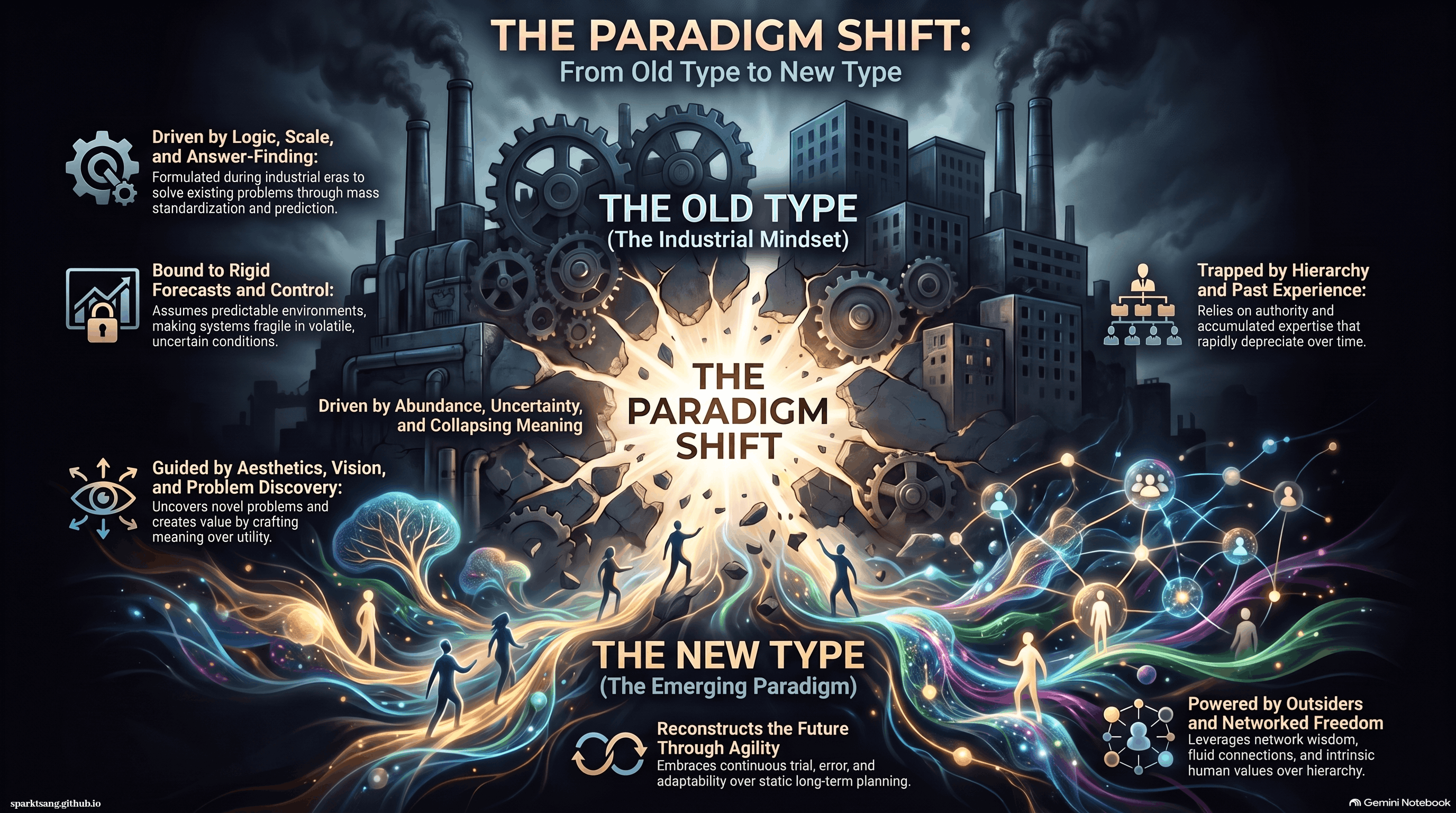
Yamaguchi concludes that to survive a volatile and complex world, “New Types” must stop serving broken institutions, discard the illusion of expert authority, and actively rewrite the script of our society.
But tearing down obsolete authorities is only the first step; what do we replace them with? My philosophy provides a blueprint for this new era: an open-source framework where truth is completely stripped of authority, relying not on gatekeepers, but on the ruthless freedom of continuous refutation.
Thank you for reading until the end. This is a bonus infographic just for you.