Notes on Purple Cow: Transform Your Business by Being Remarkable
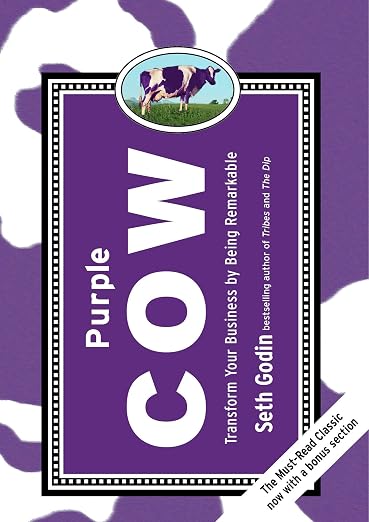
Purple Cow: Transform Your Business by Being Remarkable by Seth Godin
Original notes here.
Read until the end to get a bonus. Enjoy reading.
The book became a bestseller as soon as it was published because it came with a free bottle of fresh Purple Cow milk.
Marketing has many Ps—product, pricing, positioning, etc.—but this book is about the most important one: the purple cow.
Every cow looks the same, and after seeing enough of them, they become boring. But if there were a purple cow, it would be much more interesting: a purple cow is remarkable.
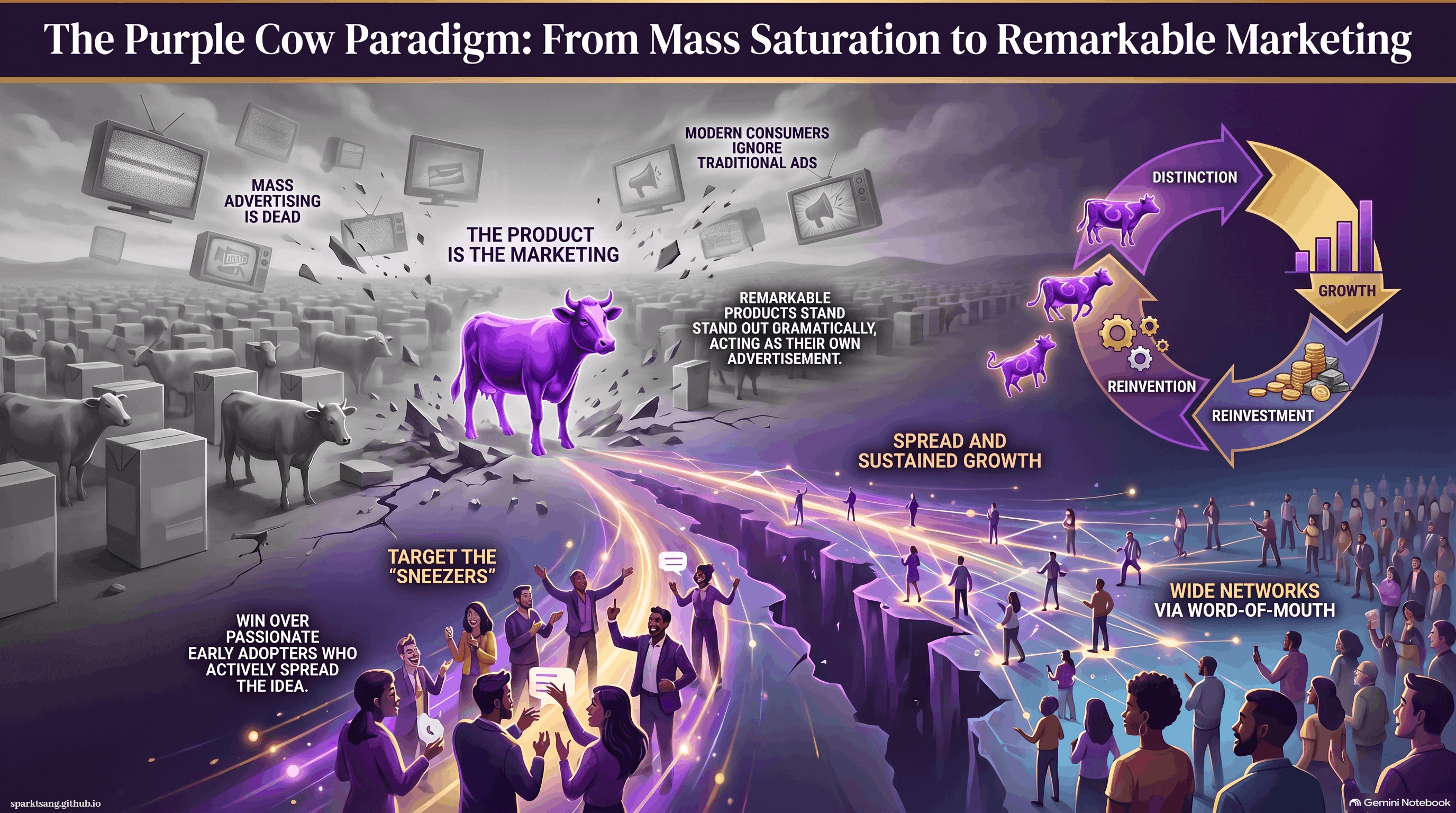
The marketing world is no longer what it used to be. We once lived in the age of the TV-Industrial Complex, when advertising penetration was extremely high, and the cycle of using profits to buy more advertising worked smoothly, giving rise to a large number of iconic brands from the previous generation. Today, consumers cannot find anything they need to buy because they already own what they need to live.
Before the advertising age, we relied on word of mouth; during the advertising age, we relied on advertising; now we have returned to the starting point: consumers are too busy to spend time watching ads.
The bread-slicing machine was invented and attracted no interest. No matter how good the product is, without good marketing, it will fail.
The marketing revolution has been quietly unfolding over the past 20 years, and the idea that business ideas can spread like Ideaviruses has become mainstream.
In the past, when Kraft acquired a frozen-food company and advertised it heavily, success came easily because consumers had relatively few choices. Today, consumers have too many choices and too little time, are overloaded with information, and face intense competition everywhere. Even an Ideaviruses has difficulty catching fire in a market where people are already satisfied.
The old-era formula was to create safe, ordinary products and combine them with great marketing to build a brand; the new rule is to create remarkable products and find the right people.
The old and new Beetles neatly demonstrate the success of the two eras: the old model relied on advertising; the new model relied on distinctive design. Other Purple Cow products include Starbucks, Outback Steakhouse, and Motel 6. What they have in common is that they are distinctive, strive to be different, and occupy unconventional territory. They are either extremely fast or extremely slow; if not extraordinarily distinctive, they are extremely cheap, extremely large, or extremely small.
Some people will still come forward to defend the power of television advertising, but one marketing genius pointed out that even Coca-Cola’s two most popular commercials failed to translate into actual sales.
Great ideas are not scarce; what is scarce is the will to realize them. As long as there is the will, there will be a way.
Example: Schindler’s high-speed elevators: passengers select their floor before entering the elevator. The cost is negligible, but the elevator operates much faster. Every well-known real-estate developer noticed the benefit. It had nothing to do with how much advertising was done.
Rather than investing in dying products, it is better to put the money into invention and innovation.
The diffusion of ideas follows Moore’s curve: innovators, early adopters, the early and late majority, and laggards. Most sales come from the “majority”: only a remarkable product can attract enough early adopters; it must also be flexible and appealing enough for them to spread the idea quickly. Example: the convenience and price advantage of digital cameras.
Accordingly, among the “early adopters” there must be enough “sneezers” to spread the Ideaviruses. The product therefore needs to find a special market whose members will actively spread it. A product designed for everyone, paradoxically, has no advantage when it comes to being spread by these people.
Crossing the Chasm, The Tipping Point, and Unleashing the Ideavirus are marketing classics that many people misread, assuming that once an idea becomes a virus, the virus will naturally cross the chasm and create a tipping point. That is profoundly mistaken. In today’s age of marketing saturation, most successful products are designed from the very first day of R&D with the intention of ultimately harvesting success.
Creating a Purple Cow is not a cheap shortcut, but it is the best—and perhaps even the only—way to grow your business.
Advertising is dead. Consumers simply ignore its existence. The law of large numbers no longer works: the author spent $600 buying 300 million banner ads, but generated only $500 in sales.
Unless certain consumers voluntarily choose to hear what you have to say. That is why Google advertising works so well.
Winners cheat: JetBlue creates an unfair advantage through low-cost, low-utilization airports and young employees; Starbucks created the coffee-shop phenomenon; Vanguard’s low-cost index funds made it impossible for brokers to compete; Amazon combined free shipping with an enormous selection of books. None of them relies on traditional, outdated business methods.
For sneezers to be willing to spread the word, the product has to be distinctive enough to attract their attention. It cannot merely be a little cheaper or a little better than everyone else.
The Phoenix Hotel in San Francisco was almost ignored and had only a dozen or so rooms. After repainting it, adding artwork and fashion magazines, and inviting singers to perform regularly, its business soared.
Purple Cows are rare because people are afraid of being remarkable. They prefer to be safe and to be like everyone else. But in business, being like everyone else means failure. That makes your job easier: while everyone else remains indifferent, you can become different without much effort.
Purple Cows are rare because everyone believes in the mistaken idea that being criticized means you will fail. The truth is that being ordinary does not attract criticism.
Failure drives great people to create success. There is no way to predict success, but being ordinary is the most dangerous strategy. People think that flying in formation with the geese is safest, but the reality is that once the market changes, the entire flock can be wiped out.
An Aeron ergonomic chair—something that would never have been invented by a factory listening to the people who buy ordinary office chairs—cost $750 in 1994 and went on to sell millions.
The standardized products of ordinary companies are a dead end: they work hard to make products ordinary enough to satisfy the masses, then advertise to everyone. But advertising can only reach the highly curious “innovators” and “early adopters,” and those people find mass-market products extremely boring.
Moreover, developing mass-market products consumes astonishing amounts of resources: millions in funding and millions of nationwide demonstrations. Of the 300 biggest Hollywood films, most production companies spent more than $20 million on promotion. Yet the successful films that shocked the moguls were not the ones with the biggest publicity campaigns, but the ones that were different.
Lionel Poilâne studied the techniques of 8,000 French bakers, stubbornly insisting on doing things his own way, and sold more than $10 million worth of bread.
Products, interactions, and policies must be evaluated quantitatively. Only by knowing where the weaknesses are can you fix them.
Logitech did not have the best technology, but it worked hard to create a better user experience and became one of the fastest-growing companies in the United States.
Rigid large corporations trapped in the TV-Industrial Complex will be the biggest losers. The winners will be small and medium-sized companies without baggage, able to afford failure, and able to profit more by changing the rules of the game.
New Zealand kiwifruit became a huge success because the company targeted upscale Latin grocery stores that were willing to buy unusual and distinctive agricultural products. These stores eventually became effective sneezers.
The Purple Cow effect has a half-life. Starbucks was remarkable a few years ago, but has since become ordinary. Yet the explosive power of being first remained strong enough to propel it into a giant corporation. After that, you can try to do both at once: extend the life of the existing Purple Cow and create a new Purple Cow to replace it. The contradiction between the two is precisely why enormous empires are so difficult to sustain.
Cecchini stood out among countless Italian butchers. He quoted Dante’s poetry and passionately praised steak. When the EU banned its sale, he hired monks to bury the steaks in elaborate coffins.
Public companies all create Purple Cows, and all have a story to tell Wall Street analysts. But every one of them eventually forgets the lesson of the Purple Cow: unless they take their money and invest it in innovation, holding on until they find the next Purple Cow at a higher level and larger scale, the company will not make money.
The opposite of remarkable is not terrible but very good: when your flight arrives safely at its destination, you do not tell anyone, because that is simply what is expected—unless something incredible happens along the way.
The Purple Cow of the shampoo world, Dr. Bronner’s, did no advertising at all. Its success came from an unbelievable packaging design. Most consumers discovered this unusual product at a friend’s house and read the thousand-word manifesto on the bottle.
Products so absurd that they inspire people to write silly satirical rhymes have achieved great success. Products afraid of crossing the line are boring because their makers do not want them to be interesting.
CURAD took a large share of the market simply by printing cartoon characters on its adhesive bandages.
Marketing is often a compromise between budget and product. Better to have nothing than to settle for mediocrity; these compromises can be worse than doing nothing at all.
Market size is not the key. The key is how many fans can become spreaders—for example, people willing to drive ten miles to buy Krispy Kreme doughnuts.
Dutch Boy’s product innovation was in the paint can itself: they understood that the can was part of the product.
There is no plan for creating a Purple Cow, but there is a process. It is very simple: find the extremes. Examine every P, map out where your limits are and where your competitors are.
More powerful than a slogan is a silent slogan. The Leaning Tower of Pisa, for example, is itself a living advertisement. Successful products do not do marketing; the product itself is the marketing.
It is easier to sell things people already want to buy. Altoids mints in metal tins understood that young people trying to quit smoking wanted something to keep their fingers and mouths occupied, satisfying a need consumers did not even know they had.
Compromise is the Purple Cow’s greatest enemy. When a pile of people compromise, the result often becomes an incoherent hybrid. Rebellious products are often “too” something—and that is perfectly fine.
Secure permission to communicate with consumers, work with the sneezers among them, and give them tools such as a product story so they can carry the idea across the chasm. Once the Purple Cow becomes remarkable and starts making money, feed it with different people, turn products into services and services into products, develop different variations, then reinvest and innovate again.
Marketing used to mean nothing more than advertising. Today, marketing should include invention, design, pricing, and sales. The concept of marketing should be built into the product. How could a Purple Cow company possibly not be run by marketers?
The owners and employees of Purple Cow companies always have a passionate obsession. The president of Starbucks is a coffee fanatic; the founder of Scharffen Berger Chocolate is unmatched at distinguishing first-rate chocolate from ordinary chocolate.
Doctors should personally call patients every time and say, “I would want my doctor to do the same thing if it were me.” Care from the heart makes it easy to do. Otherwise, use psychological projection: imagine that you genuinely care.
The science of psychological projection: establish product-development criteria, and continuously monitor, evaluate, and learn.
Being outrageous is not the same as being remarkable. It simply makes it easier to get yourself heard. What matters is the positive judgment of the sneezers as the message is transmitted.
A method that works overnight can suddenly stop working. Best Buy president Anderson: we do not sell what we want to sell; we sell what people want to buy. Whenever we communicate with customers, we discover the path they want us to take. It is always the least likely path, yet every time they point it out, it is the right one.
A low-price strategy is the only condition of being remarkable that never loses its appeal. The problem is that everyone can play the same trick. Therefore, it is the laziest way to avoid the Purple Cow battle, and the refuge people in R&D or marketing retreat to when they have run out of ideas. Companies focused on low-price products, such as IKEA and JetBlue, must change the rules of the game, redefine manufacturing and distribution, and maintain their leadership.
Hallmark invented gift certificates, turning a free greeting-card service into a profitable business. The author suggests giving people who send gift certificates anywhere from 100 to one million points, creating something worth talking about.
The Purple Cow principle also applies to job seekers: wanting to be a Purple Cow means doing remarkable things when you are not looking for a job, taking risks, and accepting highly visible, highly regarded projects. To keep your job safely, the safest thing is to become a remarkable person.
How Stew Leonard turned an ordinary dairy store into a Purple Cow: he built a petting zoo in front of the store, had the customer policy engraved on a 6,000-pound block of granite at the entrance, and developed unusual, distinctive products that were sold at extremely low prices: mechanical cows that mooed, dancing milk cans, chickens that played the violin. Through word of mouth, he appeared on Ripley’s Believe It or Not! This was ten years ago. After his son took over the business, there were no more novel products, no ultra-low prices, and even less service quality. It became a stable everyday grocery store, catering to mass tastes and pursuing short-term gains.
Creating Purple Cow products does not require passion or massive amounts of creativity. It requires only that, rather than abandoning the Purple Cow mindset, you develop new products around it—creating irresistible appeal for a small group of people. There is no other way. Spending $100 million developing ten new products is far smarter than spending it on television advertising for a single product. Even if they fail, you still learn what does not work.
Interbrand selected the world’s 100 most valuable brands in 2002. Seventy percent were worth more than they had been 25 years earlier, maintaining their lead through the cheap, simple old methods of the past. Of the remaining 30 percent, half relied on word of mouth (HP, Oracle, Nintendo, SAP, Canon, IKEA, Yahoo!, Motorola, Amazon, Starbucks, etc.), while the other half relied on monopoly positions (Cisco, Microsoft). A small handful—Compaq, Dell, Nike, GAP, [自家], AOL—were still using the old-fashioned advertising model. Among the 100 most valuable brands, only 6% were still using outdated strategies.
Brainstorming remarkable products:
Durable, with lifetime maintenance: Craftsman
Kitchenware for people who do not cook: the demonstrability of the OXO Good Grips
Ultra-simple UI: why Yahoo! defeated its competitors and became synonymous with the Internet, and also why it eventually handed the throne to Google
A strength worth preserving: Bloomberg Information, which requires arduous learning to master
Personalization: the Four Seasons Hotel, capable of serving exceptionally customized iced tea
Getting people who do not trust online shopping to shop online: the guarantee offered by mail-order company L.L. Bean (burn the pants you bought, then get compensated)
Handcrafted motorcycles: Jesse James ($100,000 each)
A vehicle that should not be a car: the oversized, wild, noisy, gas-guzzling HUMMER
Creating a newsworthy event: the Cannes Film Festival
Selling only frogs: growafrog.com, creating a unique market
Ugly but great publicity: Volvo cars
Waiting two years to buy a handmade watch
Restaurant clown: hire a teenager on weekends to perform magic tricks and make balloon animals, instantly turning the restaurant into a family destination
Small change, huge difference: Best Buy tweaked its products and removed service fees, growing annual revenue from $250 million to $2.3 billion
Turning flaws into momentum: open-source Linux attracts users who voluntarily contribute improvements
Three-pound steak, free after you finish it: available in every town, always drawing crowds
Jet-engine sound eight times louder: worth hundreds of millions of dollars
High quality at a low price: IKEA
Huge prizes: the higher the lottery jackpot, the more buyers it attracts, even though the expected value is lower
Deadly appeal: unfiltered cigarettes, high-proof liquor…
Specialization: lawyers who handle unusual types of cases
Doctors who listen to patients: the author’s doctor spent time talking with him and, as a result, was introduced to dozens of friends
Godin’s Third Law: the friendliness of pizza-shop employees is inversely proportional to the quality of the food. Set some strange rules and hire ferocious waiters, and it may genuinely increase the restaurant’s fame.
Summary: develop the extremes, whether they are the cheapest, fastest, slowest, reddest, hardest, easiest, most effective, most annoying, oldest, newest… If an extreme exists, it is worth trying.
Eight methods
List ten ways to change the product: More boring than salt? Even artisanal salt can become a new favorite among food connoisseurs.
Do not make the ambition too big; focus on a small group of people.
Seek resources externally: start as a small company, then find a big manufacturer after succeeding.
Make good use of communication channels for which you have customer permission.
Imitate other companies: find remarkable companies in even more boring industries.
Go deep into enemy territory, carefully distinguish the competitors’ reputations, and surpass them.
Find something in the industry that is “not impossible, just not yet done,” and do it immediately.
For everything you have not done, keep asking yourself, “Why not?”
Silk soy milk was packaged to look just like milk, and sales tripled overnight. (In the United States, tear out this page of the book and mail it to the author to receive a Silk discount coupon.)
For more information, see the author’s blog at sethgodin.com.
Finished reading on March 10, 2025
Godin warns that in a saturated world, trying to please the masses with a “safe” and ordinary product is the riskiest strategy of all; to survive, you must abandon compromise and create a “Purple Cow” that thrives at the extremes. But this principle extends far beyond marketing and product design—it is the fundamental law of business survival.
In Zero to One, legendary founder Peter Thiel elevates this exact contrarian mindset to the level of corporate strategy, arguing that true visionaries don’t compete in crowded, ordinary markets; instead, they build monopolies by discovering hidden secrets and going from zero to one.
Thank you for reading until the end. This is a bonus infographic just for you.