Notes on Tadokoro's Startup Science
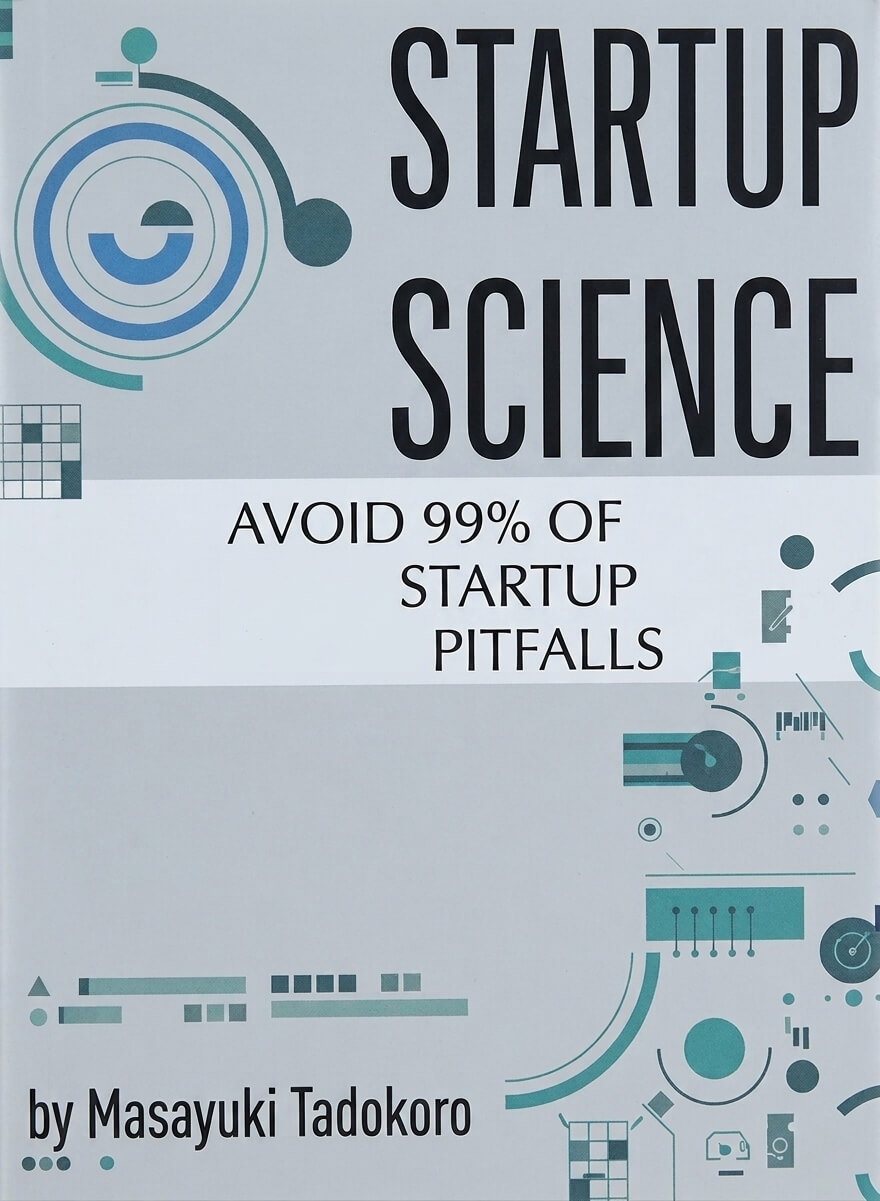
Startup Science by Masayuki Tadokoro
Original notes here.
Read until the end to get a bonus. Enjoy reading.
A quick overview of the process:
Lean Canvas → Problem validation (persona → empathy map → customer journey map)
→ Premise analysis (experiment board) → Causal validation (interviews → KJ method)
→ Solution validation (prototype board → interviews → prioritize, add/remove, and group features → experience blueprint)
→ Paper prototype → functional prototype → interview until users are satisfied
→ MVP → product evaluation analysis → experience refinement → pivot exploration
→ Scaling (increase retention, reduce customer acquisition costs)
The quality of the startup idea determines success or failure
Most people mistake a good solution for a good idea, while overlooking the quality of the problem.
Only when both the problem and the solution are high quality does the idea have real value.
Improve the problem first, then improve the solution; the reverse does not work.
The failure of Google Glass stemmed from the fact that it was not problem-driven.
The same seemed true of the first Apple Watch: it was scaled before it was mature enough, and it was not until the third generation that a breakthrough came from its stronger functionality.
Three things determine problem quality: professional perspective, industry knowledge, and market experience.
Example: the founders of Instacart had exceptional insight and knowledge in logistics, having previously been involved in building Amazon’s logistics system.
The problem should be something you yourself, or someone close to you, has experienced; avoid problems experienced only by distant third parties with whom you have no strong emotional connection.
An idea that everyone hears and immediately says is great is not a good startup idea. Major companies already have projects in such areas, such as high-capacity portable chargers.
A good idea may have 99% of people finding it unattractive because the market has not yet been defined: Astroscale’s idea of “cleaning up space debris,” battery-free phones, Airbnb getting strangers to let people into their homes, Cookpad being nothing more than a public recipe collection, Snapchat being nothing more than disappearing messages, Uber using a phone to hail a ride instead of simply raising your hand, Instacart getting someone else to buy your groceries, and so on.
In the past, innovation curves had the chasm between early adopters and the mainstream described by Geoffrey Moore. Today the curve has changed: once users become excited, word of mouth can trigger a craze that sweeps across the market, as with VALU and CASH.
Startups must also avoid: niches that are too small, ideas you do not genuinely want to pursue yourself, wishful thinking, ideas that can only be analyzed through data, areas where competition could become fierce, and ideas whose problem cannot be summed up in a single sentence.
Startups and small businesses
Many entrepreneurs are not actually launching startups but small businesses. The two are different:
Startups have J-curve growth; the latter grow linearly.
A startup operates in an uncertain market environment, where timing matters; the latter has an already proven market and faces less environmental change.
Startups can have low initial scale but broad reach; the latter’s customer base grows slowly.
Startups seek venture capital; the latter rely on their own funds and bank financing.
Startups aim for an IPO or acquisition; the latter aim for stable income.
A startup’s potential market is unlimited; the latter are constrained geographically.
Startups pursue disruptive innovation; the latter pursue sustaining innovation.
Even a café, ramen shop, motorcycle courier service, or barbershop would remain tied to a particular commercial district even if expanded nationwide, so it is not a startup. This is not a criticism of such businesses; the premises are simply different.
A startup is only a temporary stage. Once it grows large, the focus shifts from finding a new business model to improving operating efficiency and profit per customer, becoming a “regular company.”
The conventional wisdom for running a small business is of little use to startups:
Overly detailed planning can actually be dangerous. Startups are characterized by continually improving rapidly through sprints and pivoting. Financial projections are meaningless during the idea-validation stage because once the sales approach changes slightly, all the assumptions become invalid. Elaborate reports have limited value; it is better to uncover potential problems. Rather than being praised by everyone, it is better to have a small group of people go crazy for the product. There is no need to produce detailed specifications during the sprint cycle; continuous dialogue with customers is more useful. You must be prepared to change the business model whenever customer reactions demand it. Focusing too much on competitors and using them as benchmarks will only turn you into a follower. User experience matters more than market segmentation. “Building something people want” (product-market fit, PMF, a term that appears frequently in the book) depends not on “nice-to-have” features but on “must-have” ones: solving pain points comes first, and the core must remain clear. Immediately insisting on optimizing product design, usability, system automation, and optimization only wastes time and leads to failure; customer feedback comes first. A major taboo is hiring recklessly before the business model is clear. On the other hand, a technically knowledgeable CTO can be extremely important. Startup networking events are often of little use: many people merely talk about “aspiring to be entrepreneurs,” while serious entrepreneurs have no time to attend. Hiring someone with an impressive résumé who cannot work as an equal member of the team can backfire. A startup team should have no rigid divisions, and everyone should do whatever needs to be done rather than limiting themselves to what they are good at. Another major taboo is signing partnership deals before the model is clear. If you can only sustain operations through commissioned work, you are already running a small business rather than a startup. Talk directly and extensively with customers instead of focusing on PR and marketing. There is no point in keeping meetings with investors secret: ideas are not valuable in themselves, and you may miss the chance for them to spread. Funding-generating commissioned work should never become the main business. Advice from industry experts can be heard, but should not be relied upon. Before you have the momentum to drive the business, there is no need to rush into contact with VCs. Focus on the customer’s pain point; do not waste time on Success Theater (vanity busywork), such as unnecessary meetings and reports.
Startups are usually unpolished: surface-level polish only becomes necessary when scaling, when recruiting talent, or when building a brand.
Forget the exercise of finding the “right answer”; defining a new problem is what a startup is for. Forget the game of producing perfect reports. Forget the game of pleasing the majority. Only a small number of people can understand a break with conventional wisdom; those who cannot will leave comments on social media saying things like, “There’s no way this kind of product will ever take off.” Forget the game of slowly improving a product through PDCA; startups need to create results with limited resources, so it is better to pivot all at once. Forget the competition game; startups should challenge areas with few competitors. Forget the game of spending allocated budgets; determining how to spend a budget simply because you obtained it is how large corporations operate. Forget the game of targeting the mass market; dominating a smaller market is a foundational principle of entrepreneurship. Forget the blame game; ask why, not who.
Validating the idea
According to the CEO of Y Combinator, startup success depends on five things: timing—why now—execution, the idea, the product, and the team. Bill Gross ranks them as: timing, team/execution, idea, business model, and funding.
Timing: dodgeball.com offered location-based services through mobile phones more than ten years ago, while Japan had the virtual world Second Life in 2003; both ended because they were too early.
When a field stops evolving because of monopolization or regulation, that is a clue about timing.
Examples of redefining a market: WHILL, a wheelchair controlled by a mobile phone; SnappyScreen, which automatically applies lotion evenly over the entire body; and TransferWise, which makes international transfers effectively local on both ends at low cost.
Airbnb emerged when vacant housing was abundant after the Lehman crisis; Uber arrived when smartphones had become widespread, the sharing economy was gaining momentum, and more people were entering the asset-light era; Google benefited from the rise of artificial intelligence.
In the first half of the 1990s, at the dawn of the Internet, those who focused on the Internet went on to sweep across the world. Today, those focusing on blockchain, drones, VR, autonomous driving, and ICOs may similarly sweep the world twenty years from now. Paul Buchheit: imagine the future, then work backward to infer what you should be doing now.
The PEST analytical framework looks at trends in politics, economics, society, and technology. Examples:
Political: relaxation of regulations on home-sharing.
Economic: growing inequality (Khan Academy becoming a major topic), new lending standards (LendUp).
Social: aging populations (shortages of caregivers), environmental concerns (plant-based meat).
Technological: the cost of genetic analysis.
Gartner’s Hype Cycle: Innovation Trigger, Peak of Inflated Expectations, Trough of Disillusionment, and Plateau of Productivity.
Dawn: the technology first attracts attention and gradually becomes a trend.
Peak: startups rush in all at once, and venture capital pours in.
Disillusionment: competition intensifies, the technology is not yet mature, and the gap between expectations and reality breeds pessimism.
Maturity: the technology truly matures, and the survivors dominate.
Gartner publishes this curve every year to illustrate the progress of emerging technologies.
https://www.gartner.com/en/documents/4004623/hype-cycle-for-emerging-technologies-2021
The KPCB Internet Trends report is also very useful (note: the report has not been published under the same name since 2018).
https://www.kleinerperkins.com/perspectives/internet-trends-report-2018/
The CEO of Box: identify situations where technology is in disarray. The greater the gap between the technology currently available and the technology people most need, the greater the opportunity.
The author cites Kenichi Ohmae at length: entrepreneurs must first identify the path they should take from a macro perspective, and then think about the product from an individual perspective.
The Innovator’s Dilemma: large companies are good at sustaining innovation and improving what already exists. Their strength lies in figuring out the market-optimized way of operating and the organizational structure needed to support it.
Disruptive innovation destroys the value of past products, while disruptive technologies that generate new value create new markets. Startups must pursue this kind of innovation.
When large companies are hit by disruptive innovation, it is often already too late. Examples include Tefal’s electric kettle, Sony abandoning vacuum tubes for transistors, and Apple’s iPhone (when it first appeared, everyone in the industry said it would never take off, but the second generation rapidly improved by absorbing customer feedback until it matched demand). Airbnb also faced skepticism: the chairman of Marriott said that the concept was good, but quality would be difficult to control because of the mixed nature of the hosts and properties.
Large companies struggle to reform because they are accustomed to reducing errors. Innovation departments have difficulty speaking directly with customers, and whenever they make a move, the finance department demands a precise five-year forecast.
Collaborative innovation: work with existing companies to change the market, as Instacart did with supermarkets.
The ten startup frameworks: eliminate intermediate steps (Uber eliminated the need to apply for a taxi license); unbundle products and optimize each separately (newspapers that combined reporting and advertising were gradually replaced by craigslist, Google AdWords, and Gunosy); integrate fragmented information (Kakaku.com); make use of idle assets; break out of the framework and create a blue ocean (develop new evaluation standards, as with Snapchat’s disappearing information); create new combinations of services (airCloset provides a designer stylist, free shipping, free laundry, and a wardrobe of other services at an extremely low price); exploit time differences (GO-JEK localized Uber for Indonesia with motorcycles and a prepaid model); arbitrage (match markets with excess supply to those with excess demand, as RareJob does by providing Japanese users with English teachers); low-end disruption (when existing products are over-specified, remove unnecessary features to make them easier to use and cheaper, as Carepro did with simplified health checkups); replace one-time purchases with services and subscriptions (Clarifai’s online deep-learning services, hachidori’s chatbot services).
Y Combinator’s Demo Day brings together the most advanced startups of the year and more than 400 top-tier investors.
The potential market should ideally exceed ¥10 billion, but at the beginning it is better to win in a limited area and first secure a stable cash cow. Amazon started by selling books (they are easy to store and ship and do not expire). Airbnb initially targeted large events and gatherings where there would clearly not be enough accommodation, such as presidential speeches. Facebook was founded within Ivy League schools; only after registration at a single school exceeded 75% did it move on to the next.
Creating an initial plan
Ash Maurya’s Running Lean: A Guide to Building a Successful Startup recommends the “Lean Canvas,” which can serve as a common language among startup teams. On a single sheet it includes:
Problem, customer segments, unique value proposition, solution, channels, revenue streams, cost structure, key metrics, and unfair advantage.
Airbnb: problem (homeowners waste space; travelers have difficulty finding affordable, comfortable accommodation), customer segments (homeowners who want to earn extra money and people looking for accommodation), unique value proposition (monetize idle assets while enjoying affordable, comfortable accommodation), solution (a matching website), channels (social media, website), revenue streams (transaction fees from both sides), cost structure (system setup costs, usage fees, salaries, photography costs, advertising costs), key metrics (number of transactions, number of bookings, booking conversion rate), unfair advantage (economies of scale created by user feedback).
Tinder: problem (too many fake accounts and salespeople, and few enjoyable dating-matching services), customer segments (men and women seeking genuine encounters rather than arranged dates), unique value proposition (not a matchmaking service, but one that creates a romantic atmosphere), solution (registration using real Facebook identities plus an algorithm matching by location and interests), channels (media, blogs), revenue streams (paid services, advertising), cost structure (system development and marketing), key metrics (number of paying users and renewal rate), unfair advantage (the industry’s first business model).
The author also mentions Steve Blank’s The Startup Owner’s Manual and Eric Ries’s The Lean Startup, which is regarded as the startup bible.
Lean Startup methodology produces only the minimum viable product needed for validation, rapidly improves it through pivots based on customer needs, and Maurya states that 66% of startups make major changes to their plans.
A startup team should thoroughly discuss the business model. Strategy and product can be changed, but the vision cannot.
There is no need to rush into incorporating a company at the beginning. You can validate the idea gradually as a side project. Once it becomes a full-time commitment, however, or if you become so eager for results that you stop focusing on validation, you may fail. This stage also allows you to test whether your founding partners work well together; once money has been invested, removing someone can become difficult.
Improving Problem Quality — Customer Problem Fit (CPF)
Establish the problem hypothesis.
The problem written on the Lean Canvas is only a hypothesis and still needs to be tested. It is dangerous to work backward from a product and invent a problem it can supposedly solve.
A Startup Genome survey found that 80% of startups that achieved PMF focused on problem discovery and validation during the customer-problem stage, whereas 74% of failed startups spent most of their early time validating products (solutions).
To verify whether the problem exists: create a hypothetical customer persona (personal information, occupation, lifestyle, habits); create an empathy map (a paragraph for each of what the persona hears, thinks, sees, says, feels as pain, and gains); and imagine the customer’s journey (for a travel-related connectivity service, for example, write out the person’s connectivity situation while traveling and the emotions that arise from it).
Premise analysis
Experiment board: customer, problem, solution (make a bold initial assumption), premises, validation method, result, learning.
Premises, using the travel connectivity service as an example: customers carry smartphones, do not know where free hotspots are, do not carry a SIM card, consume a lot of data, have no router, free networks at airports and stations are very slow, and so on.
Draw a two-axis chart based on the impact if the assumption collapses and the necessity of validation (ranging from self-evident to requiring validation), identify what most urgently needs to be tested, and investigate it.
Validate the causality between the two.
Interview people who are aware of the problem, actively seeking solutions, and could potentially become early users of the product, conducting interviews one-on-one. In Japan, visasQ can be used to make introductions: understand them carefully; act as if you were their apprentice (dig relentlessly with follow-up questions, stay focused on the present, be specific, focus on the process rather than the outcome, confirm the problem rather than discussing solutions, restate what they said to confirm the meaning); pay attention to body language; experience it yourself.
Afterward, analyze the interviews using the KJ method (note: also known as an Affinity Diagram).
Break the interview material into small units and write them on cards → group the cards → label each group → identify the relationships among groups → write down the actual root causes of the problem in concrete terms.
In the example, interviews with people taking online learning courses eventually produced the following groups: “current learning methods,” “ideal learning methods,” “summary of the gap,” and “reasons for dissatisfaction” (subdivided into problems with content, outcomes, methods, and maintaining motivation).
The problem to be solved comes from the gap. When an interviewee says, “I only realized it because you asked me,” or discovers the issue during the conversation, that is an insight in itself.
Note: analyze from the bottom up, starting with concrete facts; do not rush to define groups. Similar wording does not necessarily mean the same concept. Everything must be classified; do not put items into an “other” category.
To avoid convincing yourself of your own hypothesis, interview at least five people; preferably more than twenty.
Interview question checklist: Do they meet the criteria for a potential early user? Do they genuinely feel the pain, or are they pretending that the problem matters? Confirm that the pain point exists; how serious it is; whether they have a strong emotional response; their current solution; whether they believe it should be solved; what constraints prevent them from solving it; potential latent problems to be uncovered; how much they would invest to solve it; what they dislike about alternative solutions.
For users who are unaccustomed to articulating their problems, try field research: observe their activities in real settings and ask questions at appropriate moments.
Even if you finally discover that an effective alternative already exists, or that the problem itself is not painful enough, disproving your own hypothesis is still an important form of learning.
Appendix: the startup team must also verify that everyone shares the same view of the problem (Founder Problem Fit).
Short-term motivations such as money, wanting to prove yourself, or the current popularity of entrepreneurship are difficult to sustain in the long run.
Anyone without a genuine passion for solving the problem will become an obstacle to the team at later stages.
Why you? Why your team? Those who cannot answer should probably be removed.
Important team conditions, especially the first two: the problem is personally felt; a certain degree of obsession; a vision for the product; a strong connection to the customer base; product-management experience; genuine flexibility of thought.
Validating the Solution — Problem Solution Fit (PSF)
Propose the “solution” → brainstorm “features” → prioritize them and determine what is “necessary” (see the prototype board).
Optimizing before validating the solution is pointless: it would be like running a ramen shop without making good ramen and instead repeatedly negotiating with ingredient suppliers and remodeling the restroom.
Content is king. UX is queen. UI is only one component of UX. If a web service requires customers to log in on a computer before they can use it, even travelers using it for free will not want it. That is UX: the user’s experience of accomplishing a goal without unnecessary obstacles.
Before building an MVP, a product prototype board can: give the startup team a common language, obtain customer feedback in a timely manner, and identify and eliminate bottlenecks.
Process: validate the problem → value proposition (what customers consider valuable) → solution (how to realize it).
For the connectivity service hypothesized above, the value proposition would be: let customers add data anytime, anywhere, and use it freely. The solution would be: by watching advertisements, customers can use a certain amount of high-speed data for free.
List the features to be validated below that, and brainstorm them as a full team, such as: watch ads to increase data, answer questions to increase data, swipe a card to purchase data.
Interview prospective customers to confirm whether the above features have value. Add or remove features according to customer needs and divide them into necessary, nice-to-have, and unnecessary. When Facebook launched in 2004, it had only eight features.
“If you had a magic lamp, what wish would you make to solve your problem?”; “What features would this lamp have?”; “Do you know of any alternatives to a lamp like this?”; “What are the strengths and weaknesses of those alternatives?”; “How much time and effort could this lamp save?”; “How much would you pay for this lamp?”; “Once we have a product prototype, could we conduct another interview?”
Confirm that the magic-lamp technology is feasible, that no such thing currently exists, that the finished product can actually be used without difficulties (cost, maintenance, learning curve, etc.), and that customers have a reason to choose not to buy the magic lamp.
Elevator pitch: explain the solution in 30 seconds and the key difference from alternatives. Example: We want to meet travelers’ expectation of being able to use the Internet on their phones anytime, anywhere. Our product provides free, limited high-speed connectivity in exchange for watching advertisements or answering questions. Unlike convenience stores, stations, and hotels, it lets travelers connect anytime, anywhere. We are the free television of the mobile Internet world!
The pitch can unify direction, help the team put itself in the customer’s shoes, and get straight to the core, preventing different team members from giving different answers about what the startup actually does.
Group the selected features and create a user experience blueprint showing the entire interface flow, then retest and revise until users are satisfied.
Product prototypes
Based on the blueprint, develop a paper product prototype, using the minimum necessary as the guiding principle. Imagine what customers expect. It should be understandable and intuitive without the need to read instructions, and convenient to use. Analyze the experience of existing products in the market.
Then develop a functional prototype that reproduces the actual operation of the product. For a mobile app, for example, the tools on the Balsamiq website can be used.
Check that: the functional priorities are correct, the interface is easy to click, a consistent set of rules is followed, and users can return to the previous page.
Good design includes: the proximity principle (related items are placed next to each other), the alignment principle (layout is orderly), the contrast principle (elements are clearly contrasted), and the repetition principle (features of items are consistently presented in the same format).
Finally, interview users again. If the majority are satisfied, the solution has been successfully validated, achieving Product Solution Fit (PSF).
Questions: How do you think this works? What are you going to do now? What do you think this text or button refers to? Did the result match what you expected? What did you originally expect it to do? Did you ever think, “This is exactly what I want”? Were there any obstacles? Did it solve the problem? How could it be improved?
If the session can be recorded on video, it is even better because body language can be analyzed carefully.
Criteria for achieving PSF: customers can clearly explain why they would use this solution; the retained features are genuinely necessary.
If PSF is not achieved, return to the experience blueprint and make rapid iterative changes. The cost is only the honorarium for potential early adopters; tens of thousands of yen are enough.
Bezos: excellent entrepreneurs devote themselves to reducing risk. The above tools and processes help eliminate systematic risks.
Google Ventures’ Design Sprint: on Monday, write down the current problems and consult experts; on Tuesday, each team member thinks about solutions, breaks them into pieces, and demonstrates them to one another; on Wednesday, share the proposed solutions, extract the best parts from each person, and connect them into a story; on Thursday, divide the work, build prototypes, and test them; on Friday, show the prototype to customers and decide whether further iteration is necessary.
By this stage of the division of labor, having someone leave because they lack execution ability is not a bad thing; the remaining serious members may actually develop stronger cohesion.
Many highly successful startups were founded collaboratively; the examples are too numerous to count, such as the “Silicon Valley” cases mentioned in the book. Working alone dramatically reduces efficiency. A one-person startup takes 3.6 times as long to scale as a two-person startup. Co-founders have access to more information and a broader perspective, which accelerates learning and makes it easier to filter out bad decisions.
The author’s personal view: ideally, one person is a mad visionary with a dreamlike vision, while the other is research-oriented and responsible for figuring out how to make it happen.
Team members need perseverance and must be able to support one another through difficult times.
The ideal team consists of a hacker, a hustler, a hipster, a strategist (such as Facebook COO Sheryl Sandberg), and a visionary.
(Note: the corresponding executive roles are CTO, CMO, ?, COO, and CVO.)
Only when preparing to scale do you need optimization and detailed division of labor. Ideally, one person should be able to handle two or three different kinds of work.
Before scaling, successful startup teams averaged fewer than 7.5 people, while failed teams were close to 20. Raising too much money and hiring freely before the necessary conditions are met is a classic case of premature expansion.
A startup that rallies people around a vision must avoid recruiting anyone who cannot identify with that vision. Do not hire someone simply because they are good at programming or have extensive connections. The ideal team has “aligned vision, different skills.”
CB Insights: the third-largest cause of startup failure is an inappropriate team.
Also avoid people who are afraid of failure, unwilling to try new methods, full of ideas but unwilling to act, without any experience of success, completely ignorant of technology, lacking curiosity, insensitive to the problem, inflexible in thought and action, obsessed with making money, obsessed with work-life balance, eager to show off their startup knowledge, poor at learning, self-centered, or fixated on job titles and divisions of responsibility.
A startup team may be a shared-fate community for the next ten or twenty years. Choosing teammates therefore requires the same care as choosing a spouse. Do not incorporate the company until the team is settled.
Building Something People Want — Product Market Fit (PMF)
Minimum Viable Product (MVP)
Those who rush to launch a product and unconsciously fabricate problem and solution hypotheses will not succeed.
Once the MVP is made, enter the build-measure-learn cycle and repeatedly validate and improve it.
If the product is a vehicle, the MVP should be a skateboard, not a wheel that cannot be used.
DoorDash’s initial MVP for its food-delivery service consisted only of the value proposition, price, ordering steps, and restaurant menus. A similar example is Zappos, which initially focused solely on buying shoes on customers’ behalf.
Even while keeping things extremely simple, the most important thing is to preserve the value proposition that competitors cannot provide.
Avoid: collecting every piece of information (limit it to what matters); automation (confront customers directly and observe them); building every feature (otherwise you cannot discover what customers need most); producing detailed specifications (save resources).
Types: landing page (DoorDash initially had only an entry point to the service); customer development (focus on cultivating a community—Pinterest, in its early days, personally visited places where designers gathered to collect feedback); “Wizard of Oz” MVPs (DoorDash, Zappos, and IBM initially used humans for voice recognition); video (after Dropbox released a three-minute demonstration video, it was posted on Hacker News and users increased from 5,000 to 75,000); leveraging existing platforms (Groupon; the prototype demonstration video for this book was uploaded to Slideshare, a link was published on Medium, the PDF was sold through STORES.jp, and the demo video was shared 50,000 times, leading to the consideration of publishing a book); tools (the food-information site Retty initially had only a feature for users to record entries themselves).
The simplest validation is whether people will pay for it; do not give it away for free.
Validation requires building user stories: to solve a certain problem, a certain feature must be implemented.
For example, to obtain free data, users fill out questions, share content, or watch advertisements. Cookpad users with young children are extremely busy and therefore need to see recipes quickly, so it implemented a feature that lets them view recipes within one second.
Use sprint posters and sprint boards to conduct quantitative and qualitative analyses of user stories.
LinkedIn founder Reid Hoffman: if a startup is completely unashamed when it launches its minimum product, that means it waited too long to launch.
Real conversations: all a startup really needs to do is build and talk to customers. Go out constantly and recruit customers in person. When Stripe released its beta version for users to try, the founders would meet them face to face and install it themselves, allowing direct conversation. This made it much harder to miss qualitative feedback such as whether the product was actually convenient or comfortable to use, whereas people in group interviews can easily influence one another.
Product evaluation analysis
Regardless of revenue and profitability, whether customers love the product is the only metric for “building something people want,” i.e. PMF.
The key metric is retention. First get a small number of people to go crazy for the product, then use the sales funnel as the basis and express the results as ratios.
Vanity metrics cannot reveal the reasons behind them. The number of visitors, followers, and registrations does not mean that customers are already crazy about the product, so these numbers do not establish PMF.
Interview MVP customers: Do you feel the value of the product? What are the three most valuable features? Why? What features have you not used? Why? Would you recommend it?
Then review the findings with the team: Why do customers use it? Which features are most valuable? Why? Why do customers not use it? Which value hypotheses were correct and which were wrong? Are the customers’ criteria for evaluating the product consistent with the team’s? Where do they align, and where is the gap?
Review which features should be improved, removed, or added, then run another sprint. Compare the funnel conversion rates of the first and second MVPs. It takes effort, but it can dramatically reduce the amount of time spent in the future.
When customer numbers are small, the differences may simply be statistical noise. Understanding customers is the real objective: the more feedback you hear such as “I’d be in serious trouble without this product” or “This is amazing,” the more likely you are heading in the right direction.
Adding features arbitrarily can have the opposite effect. Japan’s once wildly popular social network mixi declined, perhaps because it started as a service for communicating with friends and family but inexplicably added news. For most products, the functions people use most account for only a fraction of the total.
Experience refinement
The experience can be divided into before, during, and after use.
Before: 1. Create anticipation.
During: 2. Make the first experience live up to expectations, 3. Sustain the motivation to continue using it, 4. Help the user achieve the goal.
After: 5. Track the user experience, 6. Create triggers for continued use.
The key to high overall retention: 7. Gradual familiarity, 8. Willingness to invest, 9. Receiving rewards, 10. A sense of security and safety.
Example: Snapchat’s animal-filter photo-sharing feature creates a sense of mastery: seeing friends’ funny photos creates anticipation; trying it out, the user finds the operation easy as expected; sending photos to friends is also simple; the many filters encourage users to make their photos more interesting; receiving responses from friends encourages them to use it again; accumulating a graffiti history makes them more proficient; sending content to friends means investing social resources; the element of surprise is itself a reward; and the fact that everything is deleted within ten seconds provides reassurance that the user will not have to worry about embarrassment or regret.
The value must be clear within five seconds of the first impression. Simplify registration, reduce the burden of time and physical effort, mental effort, money, and social acceptance (for example, avoid making users feel old-fashioned), and increase retention through interaction.
Techniques for guiding customers: scarcity (only five spots left), anchoring (reduced from X to Y), social proof (a million people have downloaded it), and the goal-gradient effect (when people feel they are close to the finish line, they will work harder to complete the task because they feel they are only one step away).
Get customers to invest: enter information and preferences, invest in order to upgrade, participate in reviews and follows, upload self-created content.
Ongoing rewards: likes, achievements, the satisfaction of getting better at something, the thrill of the hunt, autonomy, and unexpected rewards.
Ask for information conversationally rather than making the process too complicated.
Considering a pivot
A pivot inevitably causes some damage, so consensus must be secured.
Key signals: multiple sprints fail to improve retention; retention improves but growth remains slow; or, again, it is impossible to reach five to ten times the initial investment.
Pivots can mean returning to different stages: solving the problem (CPF), validating the solution (PSF), or building the product (PMF).
Problem: customer segments, problem, business structure (B2B/B2C).
Solution: features, platform.
Product: customer acquisition channels.
Groupon’s predecessor, The Point, was a group-signing platform. The original problem hypothesis—that one person could not exert enough influence—remained unchanged, but the value proposition was changed to group buying at a discount.
Instagram’s predecessor, Burbn, was a location-sharing service, but the founders discovered that its most frequently used function was photo sharing.
YouTube’s predecessor, Tune In Hook Up, was a video dating site designed to help people meet. It later discovered that a large proportion of users simply wanted to share videos.
Before the money runs out, there are usually several opportunities to pivot. Startups need to manage cash flow carefully and avoid over-hiring or over-promoting.
Consider paying salaries with equity or options, building products in-house, and content marketing to extend the runway.
Common improper pivots: making changes because there are not enough engineers, making changes unrelated to customer feedback, and acting on subjective opinions that have not yet been validated.
Scaling
Even if a product drives customers wild, insufficient unit economics still leads to a dead end.
Unit economics: LTV to CAC ratio (Lifetime Value vs. Customer Acquisition Cost).
Only a positive figure indicates a healthy state; do not scale before the foundation is stable.
Non-recurring revenue can generate cash flow, but it is unstable and not part of the core business, so it should gradually be reduced.
Even slight differences in churn rates can have enormous long-term effects. For enterprise customers, the target should be 0.5–1%; for individual customers or small and medium-sized businesses, 3–7%.
For subscription services, lifetime value should be at least three times customer acquisition cost.
Churn can be analyzed using cohort analysis.
E-commerce KPI calculations differ; see Alistair Croll’s Lean Analytics.
For marketplace businesses such as auctions, the transaction-fee rate is crucial. Others, such as Mercari and CAMPFIRE, have dramatically lowered their fee rates to expand the market.
Increasing retention
The magic number (The “Aha!” Moment): how many times must a customer use the product before they fall in love with it? What exact metric guarantees a customer falls in love with the product? For Dropbox, Uber, and Airbnb, it was the first use; For Facebook, it was adding 14 friends in 10 days. Get users to that number whenever possible. Following this principle, Twitter redesigned the first-time experience so that users selected their interests first and were then given recommendations, allowing them to quickly follow ten people in one go.
Oisix Daichi, which sells organic vegetables, won customers over with a special introductory set at a heavily discounted price.
Customers can be divided by degree of obsession into first-time visitors, repeat visitors, regular users, loyal users, and fanatics.
To analyze low retention, listen to customers at each stage.
First-time visitor: Why did you come? Why did you not return? Did reality fall short of your expectations? Could you understand the value proposition? Was the way to use it easy to understand? What value proposition would attract you to return? Was there anything in the registration process that made you hesitate?
Repeat visitor: Why did you come back? Why did you not continue using it? What value proposition would attract you? What value does it bring you? Why have you not registered?
And so on.
HubSpot co-founder Dharmesh Shah: business success is not about selling a product to customers but about making customers successful—“customer success as a service.”
Reducing customer acquisition costs
Customer acquisition channels fall into paid and free. Paid channels deliver results quickly; customers acquired for free are also called organic customers, and over the medium to long term they tend to perform better. They can reach broader customer groups, have higher conversion rates, usually require customers to understand the product more deeply before purchasing, and can keep churn down.
Method of analysis: list every channel separately (paid and organic); record production costs, advertising costs, total costs, number of conversions, and average customer acquisition cost (for organic channels, advertising cost = 0). Identify the cheapest channels and improve their efficiency.
Marketplace startups need to recruit large numbers of customers early, so acquisition costs tend to be high at first. Solutions include visiting influential customers (CrowdWorks personally visited app developers one by one and persuaded them to sign up, first getting 30 well-known engineers registered and then recruiting others until it reached 1,300); concentrating on situations with far more demand than supply (Uber initially focused on major conferences and events); doing the work yourself (the Airbnb CEO initially doubled as the photographer, visiting homes one by one while also listening to customers); and making use of other platforms (in 2009, Airbnb automatically posted a listing on Craigslist whenever a host released a room, and it also used Facebook pages, etc.).
Free content marketing: it reduces costs and can build authority through high-quality content while reaching large numbers of people through organic sharing. However, it has low immediate impact, is weaker for people with clearly defined needs, and requires time and human resources.
In summary, paid advertising can capture customers who already want something immediately, while content marketing can cultivate customers whose needs are not yet clear. The latter group overwhelmingly outnumbers the former.
Key points in content marketing: identify a specific conversion goal; determine whom to target; determine what content to provide (what troubles the audience and what information they need) and why (what the value proposition is); determine how to deliver it; determine whether it can generate leverage.
Content takes time to produce, so it is advisable to create killer content that can be reused across multiple channels.
Content marketing should have three stages: a conversion page (direct registration); an attractive content page that leads customers to the first; and sharing that content across major social media platforms. The best platforms are those where the target customers gather; women, for example, may be more influenced by celebrities and opinion leaders, who can be enlisted to promote the content.
Blogs: when updated consistently, blogs are inexpensive and effective. Content accumulates over time and can attract readers for a long time. The marketing automation company Marketo continued publishing articles before launching its product and had 14,000 people before launch; hundreds of people paid in its first month. Blog content should become increasingly specific, narrowing toward subjects most closely related to the product. For example, the budgeting app Mint started with life tips and ways to save money, then gradually moved toward investing and personal finance.
Video: easy to spread and strong for SEO. Skillhub gathered 14,000 high-quality customers through video alone, without spending money on advertising, narrowing its scope and guiding customers much like Mint did.
E-books and webinars: B2B startups with strong professional expertise should definitely try e-books, white papers, webinars, and similar formats to demonstrate their expertise. The process should be designed in three stages: attract, nurture, sell. The recruitment service company entelo first used an e-book to attract HR professionals and collect their contact information, then regularly held webinars called “Recruiting Academy” to increase retention, and finally offered a usable version that prompted them to apply for the service.
Offline events: these can be repurposed into many formats, such as online livestreams and presentation sharing.
Stock vs. Flow: stock-based marketing versus flow-based marketing. The former, such as content marketing, accumulates and continues generating results; the latter stops the moment advertising stops, requiring ads to be run repeatedly.
When viral marketing succeeds in generating a craze, its effects may continue to ripple outward even after the initial explosion.
Marketing must also be validated: use the minimum viable marketing activity to test whether a strategy is effective, and only invest substantial resources once it has been validated.
Questions for validating a strategy: target customer segments, channels through which they receive information, the number of customers reached through each channel, cost, the marketing strategy used on that channel, conversion rate, time required by the strategy, and test duration.
The build-measure-learn cycle is always the driving force behind business growth.
Conclusion (9/2017)
The Renaissance began with the establishment of the scientific method. Today, the force having the greatest impact on the world is startup business. Lean Startup is the scientific method for the earliest stage of a startup. The author hopes that this book will make the method more complete and easier to practice, and that readers will send in stories of success, helping make the world a better place.
Finished reading on Sep 6, 2021
Tadokoro champions the “Lean Startup” methodology as the scientific tool for entrepreneurs, emphasizing that success comes from rapid iteration, constant pivoting, and listening closely to customer feedback. But is agile adaptation enough to build a truly world-changing company?
In Zero to One, legendary founder and investor Peter Thiel argues the exact opposite—claiming that an obsession with “lean” iteration often destroys bold vision. To truly invent the future, Thiel insists we must abandon incremental tweaks and instead pursue radical, contrarian secrets that take us from zero to one.
Thank you for reading until the end. This is a bonus infographic just for you.
