Notes on BE 2.0: Turning Your Business into an Enduring Great Company
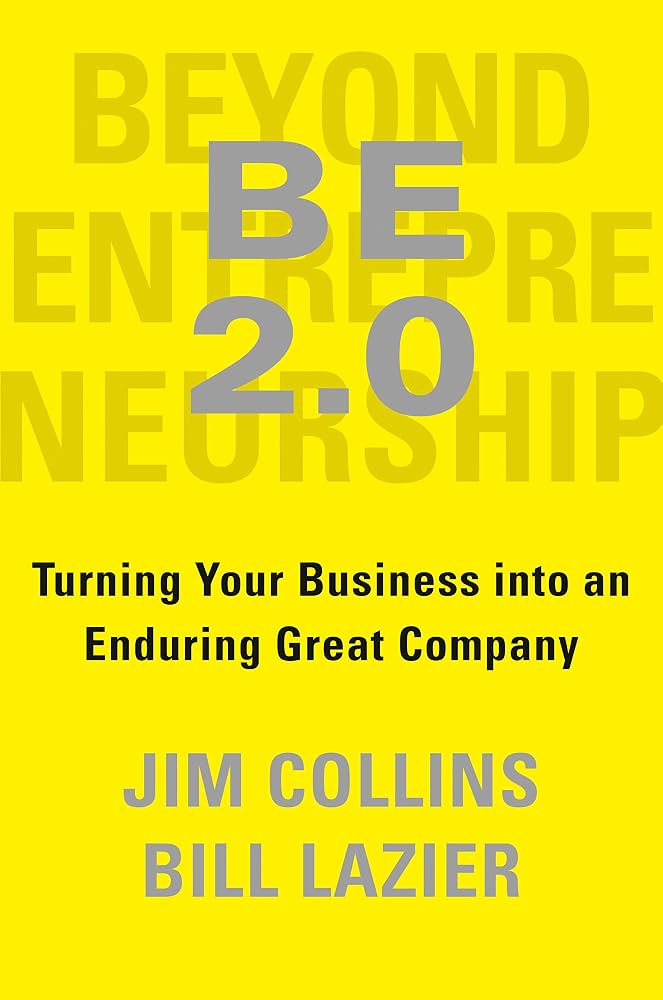
BE 2.0: Turning Your Business into an Enduring Great Company by Jim Collins and Bill Lazier
Original notes here.
Read until the end to get a bonus. Enjoy reading.
The Master
The authors’ earlier collaboration, Beyond Entrepreneurship, was strongly endorsed by Reed Hastings, one of Netflix’s founders, who said that the first 86 pages contained material worth committing to memory. This book is essentially a “republication” of that work: Jim describes it as having been written for entrepreneurs, with substantial additions, while also serving as a tribute to Bill.
Jim recalls that he happened to enroll in Bill’s course, became his prized student, and eventually took over his teaching position. It changed the course of his life, and honoring his mentor became a continuing source of motivation throughout his life.
Bill was generous in a way that made people feel that accepting his gift was actually doing him a great favor—for example, he might say his wine cellar was running low and give someone a bottle. This recalls Bill’s own source of inspiration, Hewlett, the co-founder of HP, whose maxim was: “Never suppress the impulse to be generous.”
Early on, Bill was on the verge of being promoted to partner at an accounting firm, but abruptly resigned to start a business. Everyone thought it was a crazy decision at the time. Years later, when Bill thought the author’s desire to become a “self-employed professor” was equally crazy, the author reminded him that he had once taken the same leap himself.
Bill did not dwell on having trusted the wrong people. He said there were two possible approaches: assume people are trustworthy until there is evidence to the contrary, or assume they are untrustworthy from the outset. He would always choose the former. When someone broke his trust, he would determine whether it was a matter of incompetence or character.
Bill believed that only relationships can create a fulfilling life, and that a truly great relationship is one in which both sides feel they have benefited more than the other. Deep down, he hoped that everyone he taught would eventually become mentors themselves, creating a virtuous cycle.
Through his own example, Bill taught people to abandon the money-making mentality of rapid growth and to treat value as the unquestioned priority. Commitments were sacred and core values had to be upheld at all times; success itself was a measure of whether one had remained true to those values.
After suffering a heart attack, Bill continued eating buttered muffins. When the author tried to stop him, Bill said that his life was already complete and that everything from then on was “gravy.”
People
When Steve Jobs first returned to Apple to save it, there were still no universally famous products to point to. He said the company escaped its darkest days simply by “getting the right people.”
The first metric a company should track is: what percentage of people in key positions are the right people?
A person in a key position is someone who meets any one of three conditions: they can make important hiring and firing decisions; if they fail, the company fails; or if they succeed, the company succeeds.
No one is perfect, so people always need to be developed. There is no universal right answer between developing people and replacing them. Hewlett and J. W. Marriott are examples of the former; Andy Grove of Intel and George Rathmann of Amgen are examples of the latter.
When executives are asked which mistake is more common—firing the wrong person too late, or firing someone too early out of impatience—many say the first.
The author distilled years of thinking into seven questions:
Would keeping this person in the position cause other talented people to leave?
Is the person’s problem one of values, willpower, or ability?
In adversity, does this person blame himself or shift the blame to others?
Does he see his work as a job or as a responsibility?
Has your confidence in him risen or fallen over the past year?
Is he on the right bus but in the wrong seat, or should he not be on the bus at all?
If he resigned, would you secretly feel relieved or deeply worried?
When you must let someone go, be strict but compassionate. One useful test is to ask yourself whether, years later, you could still comfortably wish that person a happy birthday—and whether he or she would be happy to hear from you.
You have to keep growing and evolving yourself before you can inspire employees to grow. Becoming Steve Jobs traces the protagonist’s evolution from an abrasive, volatile genius who nearly destroyed Apple into an outstanding leader.
“From shirtsleeves to shirtsleeves in three generations” may be statistically true, but there are still many cases in which successors outperform their predecessors.
Always be on the lookout for talent. The right people can appear anywhere: one of the outstanding researchers in the author’s research group was a waiter he met in a restaurant, who was working his way through school, double-majoring, and earning straight As.
Looking back on sixty years of life, what shaped him were people rather than events: mentors, friends, and partners. Compared with people, problems involving things are secondary. Put the right people in place and good ideas and policies will follow naturally.
At the beginning of the twenty-first century, Xerox was on the brink of collapse, with its stock down 92 percent. At first, the board brought in outsiders to reform the company, but failed. In the end, it promoted from within and chose a leader whom employees were willing to follow. He became CEO and eventually created another legend.
General Lloyd J. Austin III never missed an opportunity to praise his subordinates. When he hosted a military dinner, he brought members of the kitchen staff out and asked them to introduce themselves and describe their backgrounds, then had the entire gathering thank them.
Outstanding Brazilian entrepreneur Jorge Paulo Lemann and his entrepreneurial partners were willing to bet boldly on expansion. Their principle was simple: “First Who, Then What”—find the right people first, then figure out the big things worth giving them to do.
The author’s research found no relationship between compensation and whether a company became great. The reason is simple: money cannot turn the wrong people into the right people.
Wrong incentives are extremely dangerous. Wells Fargo’s brand was severely damaged in 2017 because an ambitious sales culture and its incentives pressured employees into violating the company’s core values. Once the wrong people become powerful, they create systems that drive out the right people, producing a vicious cycle.
Before attending a luncheon to which he had been invited, the author asked the commandant of the U.S. Marine Corps why the brutal Marine Corps boot camp existed. The answer was not to select the strongest recruits, but to eliminate people who, when trouble came, would look after themselves instead of helping their fellow Marines.
Leaders
A counterexample: an exceptionally intelligent executive with a PhD and an MBA, twenty years of experience, close relationships with senior executives in the same industry, an 80-hour workweek, and a company operating in a field growing 30 percent a year. Yet although the company initially did well under his leadership, it later lost momentum and had no future.
The problems included saying he respected people while never trusting them; preaching teamwork while actually demanding blind obedience; hesitating and analyzing endlessly until tiny flaws became major ones; declaring all twenty tasks to be equally “top priorities”; keeping his door closed; criticizing without praising and using one mistake as grounds for rejection; lacking a vision and therefore steering without a rudder; relying on dry technical language that could not inspire people; and refusing to try bold plans.
Leadership has nothing to do with personality traits. Never imitate someone else. Gandhi, Lincoln, Churchill, Thatcher, and Martin Luther King had radically different styles, yet all were highly effective.
Leadership has nothing to do with power or titles. Leadership exists only when people have a choice and still voluntarily follow you. Some people think they are leading when they are merely exercising power. General Colin Powell said he could not remember ever telling anyone, “This is an order.”
The author defines leadership as an art: a good leader makes people want to do what must be done. Three things matter: leaders must figure out what must be done, make people want to do it, and recognize that this is an art, not a science.
Styles can vary enormously. The key is to understand your natural gifts and keep refining them. There are seven elements:
Authenticity: Never let your words and actions contradict each other. Your words should reflect what you genuinely think.
Nike CEO Phil Knight was naturally shy, but at a 1990 company meeting, when he spoke about how proud he was of the employees, tears came to his eyes, deeply moving everyone in the room.
A leader’s words and actions have a profound effect on employees because humans naturally respond to authority. Even in organizations that reject hierarchy, leaders must embody and explain the core values through their own behavior.
Walmart founder Sam Walton advocated frugality and practiced it himself.
A counterexample was the computer company Fortune Systems. Its executives spoke of equality and dismissed status symbols, yet they had private offices and reserved parking spaces. In the end, the company did not even achieve mediocrity.
Lost Arrow was committed to environmental protection and introduced climbing nuts that would not damage rock. People at the time thought this was foolish, but it turned out to be a huge success. By 1975, almost no one was using the old pitons.
Decisiveness: Information is never complete, yet leaders must still make decisions on time. Do not become paralyzed by analysis.
Every analysis contains assumptions. Even excellent employees, given sufficient information and asked to vote, may end up at 50–50. Once the evidence is in, it is time to decide. Effective decision-making combines intuition with analysis.
One way to use intuition is to cut straight to the core: ask what is fundamentally at stake and what matters most, strip away everything nonessential, compress the issue into one question—“Does my intuition say yes or no?”—then arbitrarily choose one option and observe whether you feel relieved or uneasy. Be careful not to mistake fear for intuition. Taking the right risk and having the courage to do the right thing is what following intuition actually means.
Not deciding is worse than making the wrong decision. Wrong decisions can often be corrected; indecision can lead to disaster. Mistakes are inevitable, so you must accept them and learn from them.
Decisions can be classified by the degree of employee participation: delegated decisions, consensus decisions, participative decisions, and autocratic decisions. There is no absolute right answer, but highly effective leaders often use participative decision-making: let everyone assess the situation, then let the leader decide. Great-company leaders also frequently use delegated decisions, allowing subordinates to be tested.
The author’s advice is to delegate when appropriate. When implementation depends on employee commitment, use consensus or participation. In exceptional circumstances, make the decision yourself. Most important of all, be honest about what you want; never fake democracy.
Take responsibility for bad decisions and give the team credit for good ones.
Intel rose from startup to greatness while creating mechanisms that encouraged employees to argue their case and challenge one another on the basis of reason.
Peter Drucker’s principle of decision-making was: do not make a decision unless you have heard disagreement.
Hamilton praised Washington by saying that he asked many questions, thought deeply, and decided slowly—but his decisions were sound.
A good decision process has a clear timetable. During the Cuban Missile Crisis, Kennedy spent thirteen days working through the issue, and the ratio of questions to statements was highest at the beginning, declining day by day.
Execution after a decision matters just as much. Teams will set aside their personal preferences when they see the company’s success as being at stake.
Focus: Do the most important thing first, one thing at a time.
Bob Bright: fire one shot at a time; do not automatically fire on full automatic.
Kenneth Atchity: work is infinite, time is finite. However much time you have, work will fill it. Therefore, increasing output depends on managing time rather than managing tasks. Ask yourself how you should spend your time, not what you should do next.
If your time is not being spent on advancing the company’s vision or strategy, you are still not focused enough.
Hands-on involvement: Great companies have a personal character and build relationships.
At L.L.Bean, customers felt as though they were dealing with personal friends, entirely because company leaders invested personal time in building relationships. When Joanne Ernst represented Nike, she put exceptional effort into the relationship and felt that she was part of the Nike family.
Carry notes with you and leave messages for employees, so they feel that you care about them.
Make yourself approachable rather than building a moat around yourself. Go to the front lines frequently to understand what is really happening in the company.
Key details can embody company values. Mrs. Fields visited a store and noticed that the cookies were not the right size. When she asked a customer how they were and the customer said they were fine, she replied that “fine” was not good enough and immediately threw tray after tray of cookies away. In 1987, when Amgen faced a patent threat from a competitor, its leader personally led the legal battle and won decisively.
Micromanagement is the behavior of a controlling person who does not trust subordinates. It only destroys morale.
Soft and hard: Set extremely high standards while cheering people on.
Psychological experiments repeatedly show that feedback affects performance: positive feedback improves it, negative feedback reduces it.
No feedback means, “We don’t care at all.” One of the most common mistakes leaders make is giving feedback only when something has gone wrong.
When an employee’s performance is poor, first ask whether the person is in the right position. When things are going badly, harsh criticism often backfires; encouragement matters more.
Criticism should follow the idea that “the leader is a teacher.” High standards and encouragement must go hand in hand.
Communication: Great companies grow through communication, and effective leaders keep communication flowing continuously.
The company’s vision and strategy should be repeated again and again, always kept in front of employees. Doug Stone deliberately left strategy diagrams around the company. Johnson & Johnson CEO Jim Burke estimated that 40 percent of his time was spent communicating the company’s beliefs.
Use metaphors and images. Effective communication matters more than logical precision. Roosevelt explained the Lend-Lease Act by saying, in effect, that if a neighbor’s house were on fire and you had a garden hose, you would not ask him to pay for the hose; you would simply want the hose back after he had put out the fire.
Add human warmth. Reveal more of yourself rather than hiding behind a façade; use warm, human language between partners; speak like a real person.
Do not say, “Anyone can see that the way labor-management relations have been handled has caused some dissatisfaction.” Say, “I can see that you’re angry about being treated this way.”
Sugarcoating does not work. When there is a layoff, call it a layoff. Do not disguise it as a “personnel adjustment,” and do not avoid open discussion. Otherwise you merely magnify fear, resentment, and anxiety.
Communication must operate at multiple levels. The most effective way to kill communication is to make people feel that they have asked a stupid question.
When a team contains factions and relationships are tense, let them talk to one another rather than acting as the intermediary. Encourage them to behave like children going to their parents to complain.
Ask people to say what they really think. Do not let a few people dominate the discussion; ask the quiet ones for their views.
Keep moving forward: Pursue continual personal growth and never become complacent.
Work hard for a mission. A workaholic, by contrast, is driven by fear. Stay energetic and optimistic, and keep trying new things. William McKnight, one of the founders of 3M, said: “Only by continually moving can you create opportunities for collisions.”
Greatness is not a destination but a path—a long, winding, difficult road of continuous development and improvement.
One additional element: touching people’s hearts
Everyone has a spiritual side that can be touched—the noble side of every human being. This is the side that allows us to become heroes. People also have a dark side, but leaders appeal to the light in human nature and inspire people to bring out their better instincts.
A leader conveys a message: We can achieve a BHAG (Big Hairy Audacious Goal). I know we can do it, because I believe in you.
The factor that takes a company from good to great is the principle of Level 5 Leadership.
- Level 1: Highly Capable Individual
- Level 2: Contributing Team Member
- Level 3: Competent Manager
- Level 4: Effective Leader
- Level 5: Executive (Pursuing a grand cause greater than oneself)
Use all the abilities of the first four levels, while combining two seemingly contradictory qualities: personal humility and professional will. Be ambitious, fanatical, tenacious, and relentless.
Cadets at West Point are happier than MBA students because they have a passionate spirit of dedication and are prepared at any moment to sacrifice themselves.
To awaken the soul of Level 5 leadership, the best starting point is to ask what your cause is and what goal you would be willing to sacrifice and devote yourself to.
Vision
The leader’s first responsibility is to give the company a clear, shared vision. Every great company, even while still small, has a leader who communicates an inspiring vision to the organization. Even if you want to remain small, you still need a vision to resist the temptation to grow and to preserve the company at a small scale.
What happens when you fail to seriously consider your vision? Some small-business owners charge forward recklessly only to discover later that what they are doing is completely at odds with what they want for themselves, their families, and their companies.
Vision has four benefits:
The foundation for extraordinary human effort
Human beings respond to calls for values, ideals, and dreams. We are naturally willing to rise to inspiring challenges.
How motivated people are to work depends to a large extent on how they place the meaning of their work within a larger framework.
The British united during World War II and defeated Hitler; NASA overcame enormous obstacles and successfully landed men on the moon; Boeing threw itself into an apparently impossible mission and created the revolutionary 747; Apple engineers worked 80-hour weeks to develop computers that changed the world. All were driven by grand visions.
A basis for decision-making
Vision is a compass. Without one, you wander aimlessly through the valley, exhausting yourself responding to one crisis or opportunity after another.
MIPS, a computer technology company with cutting-edge technology, tens of millions in venture capital, and strong market demand, nevertheless fell into chaos and nearly went bankrupt only four years after its founding. Without a vision: the sales department chased every opportunity without considering which ones fit; R&D spent huge sums developing products without considering which products matched the company’s direction; leaders desperately pursued joint ventures, severely limiting exports, without considering what role overseas markets should play; employees worked without focus, factions fought among themselves, and the organization gradually fragmented. It took new leader Miller to turn the company around. His most basic solution was to ask one question: “What do you want to become five to ten years from now?”
Vision drives strategy, and strategy drives tactics. Without vision, tactics end up driving you instead, putting means before ends. The Vietnam War is a classic example. The U.S. military was extremely successful tactically and kept winning battles, yet it still lost the war. Research found that 70 percent of the generals were unsure what America’s objective actually was.
A basis for cooperation as a community
Without a vision, people govern their own territory, protect their little fiefdoms, and scheme against one another. They expend energy internally rather than on a common goal.
Ramtek, already on the verge of bankruptcy, was brought back to life after new leader Swanson took over and reunited everyone around an extremely challenging mission.
Enduring continuity: laying the foundation so the company does not depend on particular key individuals
After its founding, the United States did not depend on a handful of Founding Fathers. Even without an external common enemy or an internal tyrant, it remained cohesive. That is historically rare, precisely because it had the Constitution as a long-lasting guiding framework.
After taking over IBM, Thomas Watson Jr. led senior executives to an off-site meeting and created the Williamsburg plan. What he had in mind was precisely the U.S. Constitution.
Duncan Syme founded Vermont with a vision of making the world’s best wood-burning stove. The company became the fastest-growing in the industry, with a profit margin as high as 60 percent. But when he withdrew from day-to-day operations in the early 1980s, the vision retired with him, and the company lost its capacity to innovate. Only after he returned in 1986, revived the vision, and institutionalized it did the company return to the top of its industry.
What exactly is vision? A good vision contains:
Core values and beliefs: guiding principles that are non-negotiable, genuinely held, and consistently practiced inside and out.
Do not ask, “What vision should we have?” Ask, “What values do we genuinely hold at heart?”
L.L.Bean’s vision was simple: sell good products at fair prices and treat customers like friends. But its advantage did not come from sentiment alone. It came from translating those values into action: no interrogation or quibbling over policies, a guarantee of customer satisfaction, a 24-hour hotline, and products all meeting strict production standards, among other things.
Herman Miller: research-driven, contribute to society, pursue quality, realize human potential, participative management, and ensure that profits reflect contribution.
Johnson & Johnson: responsibility, in order, to customers, employees, management, communities, and shareholders.
Hewlett-Packard: do unto others as you would have them do unto you; respect all people.
Merck: serve patients, maintain the highest ethical and moral standards, take responsibility seriously, advance science, and derive profits from doing good.
For great companies, therefore, profit is a strategic necessity, not the ultimate goal.
Purpose: like a star in the sky—difficult to reach, but able to guide a company’s direction for a hundred years.
Derived from core values, purpose is the fundamental reason the company exists.
Merck: preserve and improve human life.
Lost Arrow: be a model and instrument of social change.
McKinsey: help outstanding companies and governments become even more successful.
It must move people rather than lapse into dry description. The author gives as an example: “Create great tools for minds that advance human progress, and contribute to society.”
How do you find your purpose? Ask “Why is this so important?” five times in succession.
Mission: like the next mountain ahead, with a clear destination and a deadline.
Unlike purpose, mission is an achievable goal. Once it has been reached, it should be replaced with a new one. There is no fixed answer for how long the time limit should be.
A good mission is audacious, sitting somewhere between what seems unreasonable and what you nevertheless believe can be done.
It must move people, such as “Crush Reebok completely,” “Make a certain architecture ubiquitous worldwide,” “Put the automobile within reach of ordinary people” (Ford), or “Cleanse the poison of Nazism.”
Use words to paint pictures and vividly depict the mission. For Giro, for example: world champions win wearing our helmets; customers actively write to thank us for saving their lives; employees feel they work in the best environment; and most people name Giro as the best in the industry. Or Ford: ordinary workers can afford cars, families can share long rides together in spacious interiors, and the roads will no longer be filled with horses.
Historically, companies that dared to pursue audacious missions included:
IBM in the 1960s: transform the computer industry with the IBM 360, at the time the largest privately funded investment program in history.
Boeing in the 1950s: build a successful commercial jet airliner.
P&G in the early twentieth century: provide stable employment for workers. Wholesalers’ demand was unstable, causing employment levels to swing wildly, so P&G took the risky step of selling directly to retailers. At the time, people thought they were crazy.
The courage to take responsibility and burn the boats can itself change the odds of success. A fake mission earns only contempt.
Missions can take the form of a common goal (“Become a world-class XY by a certain year”), a common enemy (“Crush PQR”), an industry benchmark (“Become Y in the X industry”), or an internal transformation (“Rebuild the federation after the war”).
Tests for a good mission: Does it deeply excite you? Is it concise? Is it connected to the purpose? Is it unquestionably true? Is it uncertain yet something you believe can be achieved if everyone commits wholeheartedly? Does it have clear criteria for completion?
If you reach a mission and do not adopt a new one, you become complacent and lose your fighting spirit. A grand new office building can also dilute people’s sense of urgency.
The founder of DPR, a construction company, originally thought that the company merely built things and had no business acting like philosophers. The author guided him by explaining the importance of the Constitution to the United States, eventually persuading him to hold a constitutional convention and establish vivid goals, such as being recognized by professional magazines, being invited back without having to bid, having friends and relatives hear about its outstanding performance, having the company shortlisted for every major project, and having every customer invite it back to work together again for five consecutive years. The company eventually achieved greatness, and at its 25th-anniversary celebration, its young team was still expressing a passion for building great things.
Vision can be collectively or individually determined. Whether a leader has charisma has nothing to do with setting or executing a vision.
Luck
Three conditions define a lucky event: it is triggered externally, comes unexpectedly, and has significant consequences.
Top companies are not luckier than others, but when luck arrives, they have a higher return on luck.
Great companies rarely achieve spectacular success at the very beginning. Early failures can help cultivate long-term success.
When Jobs was forced out of Apple, if he had become discouraged and given up, his fate would have been completely different.
Churchill experienced tremendous ups and downs but never stopped striving: out of government before the war, defeated in an election after the war, yet later winning the Nobel Prize and serving again as prime minister.
The paradox of luck is this: leaders of great companies believe that luck cannot determine achievement, but once they achieve something extraordinary, they look back humbly and give credit again to good fortune.
“The goddess of luck always favors those who persevere to the end.”
Blueprint
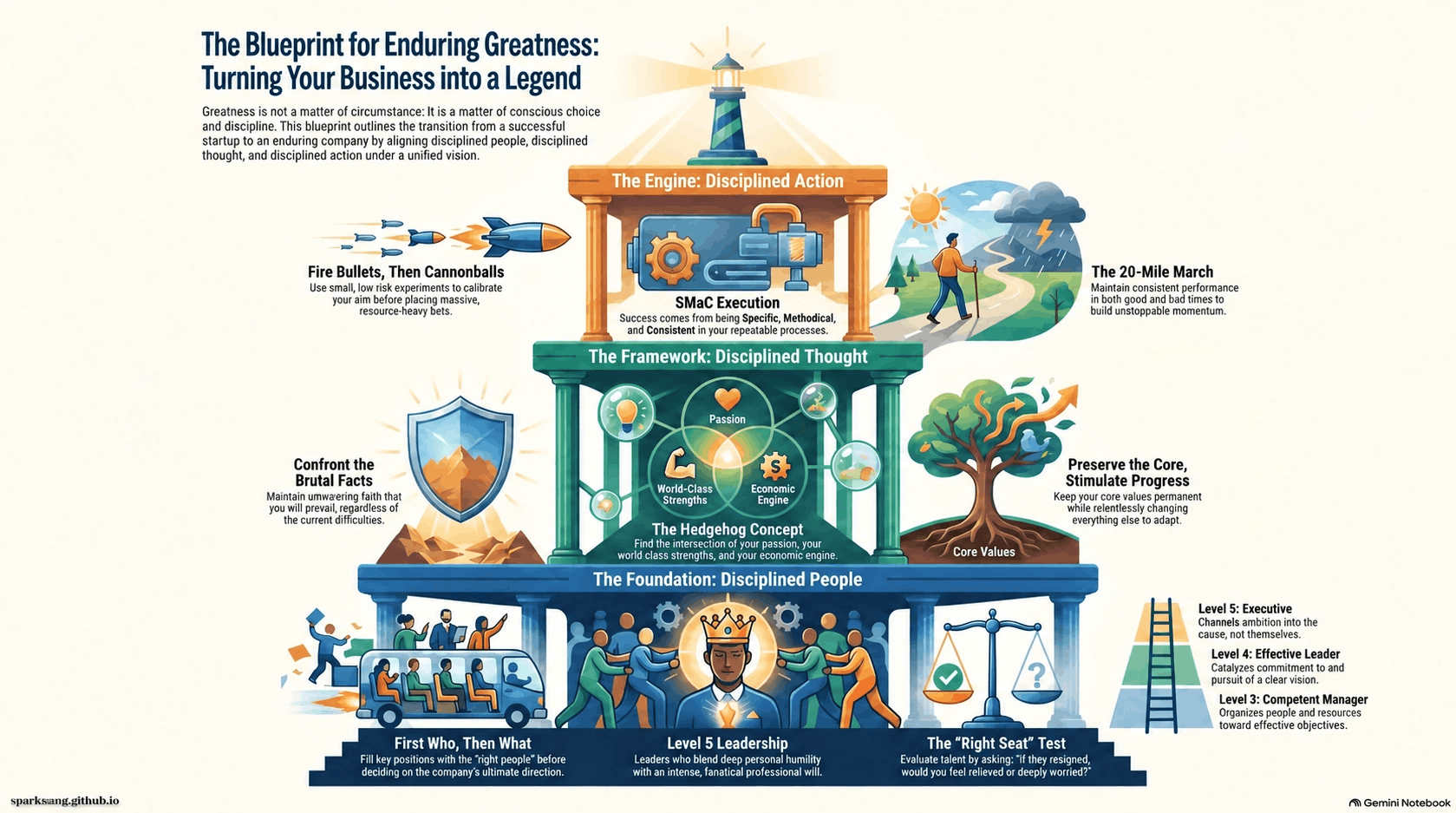
Stage One: Disciplined People
Level 5 leadership: humble in heart, ambitious in purpose.
Get the right people on the bus: when a company grows faster than its ability to recruit, it becomes difficult to preserve greatness.
Stage Two: Disciplined Thought
Embrace the whole (“The Genius of the AND”): abandon “The Tyranny of the OR” and the mentality that everything must be one side or the other.
Faith that you will eventually succeed: avoid excessive optimism or pessimism, and instill this confidence in everyone.
The Hedgehog Concept: the fox tries many things at once; the hedgehog follows one consistent principle. It lies at the intersection of three circles: “What are you deeply passionate about?”, “What can you become the best in the world at?”, and “What drives your economic engine?”
Stage Three: Disciplined Action
Turn the flywheel: keep accumulating momentum, and eventually it will break through.
The twenty-mile march: persist regardless of circumstances, hitting twenty miles every day, creating order amid chaos.
Fire bullets, then cannonballs: experiment with bullets first, calibrate your aim, and only then fire the cannonballs.
Stage Four: Building to Last
Lay the foundation for an extremely successful company to become enduring.
Productive paranoia: avoid the five stages that destroy an organization—Hubris Born of Success, Undisciplined Pursuit of More, Denial of Risk and Peril (at this stage the company is already outwardly strong but inwardly hollow), Grasping for Salvation, and Capitulation to Irrelevance or Death.
Build clocks, not tell time: manage the system rather than the people. The U.S. Constitution is a model example of building a clock.
Preserve the core and stimulate progress: core values remain permanent, yet the company must continuously change, like yin and yang.
Magnify the effects of all the principles above: increase your return on luck and make good use of good fortune.
The outcome of all the above inputs should be:
Extraordinary: the company’s financial results, or the goals of a social organization.
Unique impact: if the company disappeared, there would be no easy substitute.
Enduring: surviving beyond ideas, technology, markets, capital, and leaders.
There are never any guarantees. But the odds are better, and the work is filled with passion, making for a better life.
Strategy
The essentials: strategy comes from vision, leverages strengths, fits reality, and involves those who will execute it in the decision-making process.
The steps:
- Review the vision.
- Conduct an internal assessment, including strengths and weaknesses (ask customers and directors), resources, and innovation. Do not kill innovation simply because it falls outside the plan. The invention of the tank during World War I, for example, changed the Allies’ strategy.
- Conduct an external assessment.
This includes: industry trends (market segments, growth rates, evolving customer needs, the stage of the industry, future changes); technology trends (how technology will affect the industry—even banking can be transformed dramatically by technology); competitor analysis (strengths and weaknesses, moves, relative advantages and disadvantages, positioning comparisons); society; macroeconomics (demographic structure or major shocks to supply and demand); the international environment (even if you stay local, you will face international competitors); and the overall picture. For the overall picture, select outstanding employees, managers, and outsiders, and have them identify the company’s top three threats and opportunities. Leaders of great companies relentlessly seek the truth. Early in World War II, suffering came from failing to confront the brutal reality of Hitler’s plans. Churchill established a special department whose job was to present the naked truth. Listen directly and broadly. Never punish people for telling the truth.
These three assessments are like the three legs of a three-legged stool. - Make the key decisions.
Essence
A sound strategic-thinking process must answer the following three questions with deeply insightful, evidence-based answers.
- Where should you place your biggest bet?
On War specifically explains the principle of concentrating forces and striking at the center of gravity, and points out that maintaining concentration of forces is the supreme and simplest strategic principle.
Every great company, at a turning point, concentrates its resources and places a big bet: Microsoft bet on Windows; Disney bet on animation; Apple bet on a series of flagship products; Intel, founded by Gordon Moore, bet on Moore’s Law.
What you bet on matters. Consider the “bullets before cannonballs” principle: before making its big bet, Intel tested three methods for designing memory chips. - How do you protect your vulnerability? During World War II, Churchill fought hard to defend France. After obtaining the answer to the question “How many fighter squadrons would be needed to defend Britain if France fell?”—25 squadrons—he then committed himself fully to military aid.
Three questions: What major changes can we be highly confident will happen over the next fifty years? Which of those changes pose an existential threat to the company? What should we do immediately to get ahead of those changes? - How do you extend your gains? After General Lee’s defeat, the Confederacy was bound to lose, which is why Lincoln was furious when Lee escaped.
Failing to capitalize on a victory is like repeatedly starting a new flywheel from scratch, at enormous cost. Turning the flywheel does not mean refusing to innovate; it means continuing to create—Windows 1 all the way through Windows 10.
Formulating the strategy
The basic strategy should fit on no more than three pages.
Have a three- to five-year strategy revised annually, with no more than five strategic priorities each year.
Hold the annual strategy meeting off-site. Ideally there should be five to ten people, with twenty as the upper limit.
Preparation should already have been completed beforehand, with participants receiving questions regarding the internal and external assessments.
At the meeting, each person should give an open presentation. A recommended process is:
Review the company’s vision; confirm that it is clear and broadly accepted; conduct a joint internal assessment; conduct a joint external assessment; jointly determine or revise the basic strategy for achieving the current mission; jointly determine the five strategic priorities for the coming year.
Afterward, organize the results of the meeting and distribute them to all key personnel as strategic guidance.
Four Choices for Small and Mid-Sized Businesses
How fast should you grow?
The disadvantages of rapid growth include potential threats to cash flow, declining efficiency, overloaded construction or infrastructure, low-price commitments, huge labor costs, increasing organizational complexity that reduces communication, making the company less fun, weakening the culture, and too many vacancies being filled by people who do not belong.
After Lightcraft was acquired by New England Telephone, it was forced to pursue revenue growth. Its new giant factory had structural defects, cash became tied up in inventory, service quality collapsed, and it eventually lost both its market position and reputation. Other cases included Osborne Computer, Miniscribe, Televideo, Visicorp, Trilogy, and Magnuson Computer.
University National Bank & Trust slowed down amid the banking industry’s rush for high growth. It became famous for exceptional service, getting the details right. The work environment was free, autonomous, and enjoyable, and teller turnover was zero.
In a market experiencing explosive growth, there may be no choice but to grow rapidly, as with Compaq and Apple.
Focus or diversify?
Focused growth has limits, but cases of over-focusing are relatively rare. Much more common are companies that become trapped because they are not focused enough.
Almost every company eventually has to diversify. The key questions are when and to what extent. Companies that diversify in stages often succeed.
Should you issue stock?
Going public is not mandatory. Its disadvantages include consuming large amounts of management time, high costs, financial transparency, intense pressure for short-term performance, possible loss of control over the company, and shareholder interests that conflict with the company’s vision.
Lead the market or follow the market?
Being first has advantages, but it is no guarantee of victory. Many existing market leaders were not first movers.
Innovation
Western Union’s internal memo in 1876: “This telephone has too many shortcomings to be seriously considered as a means of communication. The device is inherently of no value to us.”
A Yale professor’s paper on the business idea presented by the founder of FedEx: to earn a grade better than a C, the concept had to be workable.
A shoe manufacturer told Nike founder Bill: “Don’t tell us how to make shoes.”
Steve Jobs: early on, he approached Atari and HP, asking to trade his invention for a job, and was rejected.
Walmart founder Sam Walton asked Ben Franklin to use him as a guinea pig for a chain discount-store concept, and was rejected.
Harry Warner in 1927: “Who the hell wants to hear actors talk?”
When Decca rejected the Beatles: “Guitar music is on the way out.”
When John Henry Patterson bought the rights to the cash register in 1984, he was laughed at.
A British medical professor on the CT scanner: “I have no confidence in the computer at all.”
People told Edwin L. Drake in 1859, when he tried to recruit workers to drill for oil: “You’re crazy.”
Foch, Supreme Allied Commander in World War I: “Aircraft are of no military value to the army.”
Harvard professor Chester L. Dawes: “Television won’t last. People have to sit in a dark room and watch it, and stay focused.”
Gather ideas from everywhere
Innovative companies are better at listening and adapting. Fresh MBA graduates can often identify deficiencies, but they often lack the ability to make things workable; that is not necessarily training conducive to innovation.
Ideas often come from outside. The Macintosh was not originally Apple’s idea, and Tylenol was not invented by Johnson & Johnson. Send people out to exchange ideas, join associations, and attend events; hire outside designers; get out of the office; let employees read inspiring journals and books; invite forward-thinking people to the company to give talks and hold seminars; sponsor employee training and have them return to share what they learned; encourage broad reading. Innovation often comes from seeing relationships between seemingly unrelated things and combining different concepts. Set up a suggestion box and respond promptly with thanks.
Welcome internal ideas broadly, almost as though the CEO had proposed them. If the idea for the Sony Walkman had not come from its honorary chairman, it would have had a 90 percent chance of dying before birth.
Innovation does not necessarily come from market pull. After Americans invented the fax machine, they concluded there was insufficient demand for it. The adhesive in Post-it Notes was initially not understood to have any use. The idea for Federal Express had already occurred to someone, but no one thought there was a need. Market experts believed Mrs. Fields’ soft cookies were doomed because people supposedly preferred hard, crisp cookies. David Sarnoff’s wireless broadcasting proposal was rejected because, at the beginning, no one knew what use there was in transmitting messages to unspecified recipients.
Original breakthroughs come mainly from the push of ideas, but subsequent incremental innovation increasingly comes from customer feedback.
Be the customer
Band-Aids originated with a Johnson & Johnson employee who wanted his wife, who frequently cut her hands, to be able to bandage herself. Steve Jobs said he wanted to invent the personal computer because he could not afford to buy one himself.
Once you solve a problem for yourself, many other people with the same problem will emerge.
Stimulate employees to see themselves as customers: hire customers, let them test products in the field, and encourage them to record problems encountered in their work and daily lives.
You can also get closer to customers on site and find out what they need.
R&D staff can be sent directly into sales environments to interact with customers.
Trial and error
Reebok’s wrinkled shoe uppers were the result of an error. Powerfood’s energy bar emerged only after repeated experimentation.
Just do it. Asking forgiveness is easier than asking permission.
How certain do you need to be that something will succeed before launching it? The answer is small-scale market testing.
Failure after trying your hardest is a good mistake. Failure because you did not try hard enough is a bad mistake. Repeating the same mistake is the worst mistake.
Set aside funding for an internal venture-capital fund that employees can use to develop new ideas.
Discover innovative talent
Provide creativity-training courses and seminars, along with educational materials for new employees.
Write an innovation manifesto, such as: “We never say an idea is stupid.” “We experiment before judging.” “We want a thousand ideas from customers.” “25 percent of annual revenue should come from new products introduced within the past five years.” “We listen to everyone’s ideas.” “We never make copycat products.”
Tolerate people who stand out from the crowd, as long as their values are aligned.
Daniel Boorstin’s The Discoverers: many of humanity’s major discoveries came from naive ignorance. People whose minds are filled with conventional wisdom can be extremely dangerous. Knowledge and experience can be valuable assets, but they can also be liabilities.
When Bill Wraith solved the pricing problem for dual-bond options, he preferred not to consult any traditional methods.
Autonomy
The author Collins was given enormous freedom in teaching by the dean of Stanford Graduate School of Business, and succeeded.
K. C. Jones, who led a championship team, gave his players enormous autonomy on the court.
Merck recruited top scientists and then let them set their own research goals without interference.
Nathan Rosenberg’s co-authored How the West Grew Rich points out that Western innovation flourished because people were free to act autonomously.
As organizations grow, how do you prevent bureaucratization? The answer is decentralized management: continually split into semi-autonomous small teams. Once a unit reaches one or two hundred people, this process should already have begun.
Although the organization is decentralized, the vision must be shared. That is the key to success. Coordination must also be promoted, and an open system established so employees can access abundant internal information. If this makes you uncomfortable or concerned about overlapping responsibilities, compare the United States with the Soviet Union. Tolerating inefficiency and disorder in exchange for the benefits of innovation is still worth it.
Rewards
When the only path upward for top designers is to become managers, creative people who do not want to manage are left without a meaningful career track. Providing them with an alternative path—and prestige comparable to that of senior executives—can reward innovation.
To prevent moonlighting from increasing working hours and slowing processes, FedEx guaranteed a full day’s pay and announced that employees could go home early once the work was finished. The effect was immediate.
No company can simply buy an advertisement on the cover of Outside magazine. Yet Patagonia had such a good relationship with the magazine’s photographers that its clothing regularly appeared in cover photographs anyway.
Books related to creativity:
Michael Ray, Creativity in Business
James Adams, Conceptual Blockbusting
Russell Ackoff, The Art of Problem Solving
Edward de Bono, Lateral Thinking
Roger von Oech, A Whack on the Side of the Head
Everett M. Rogers, Diffusion of Innovations
Bob Waterman, In Search of Excellence
Four management techniques for stimulating creativity:
Encourage more: Good ideas are not scarce; what is scarce is a mindset willing to welcome them from everywhere.
Do not judge recklessly: Harsh criticism destroys initiative.
Help shy employees: The best ideas often come from people who are quiet and too shy to speak up.
Stimulate curiosity: Encourage an inquiring spirit and open-ended questions. Frequently ask, “What did we learn from this experience?” Regis McKenna required employees to write down at least two pages of questions before meetings.
Create needs: Necessity is the mother of invention. Brilliant solutions often arise precisely because resources are insufficient and people have to find another way.
Give employees time for solitude: Private time may allow them to come up with brilliant ideas.
Encourage collective problem-solving: Brainstorming is also important, but a team cannot contain people who constantly pour cold water on ideas. It should feel fun; without enough enjoyment, it is difficult to stimulate creativity.
During the innovation process, confidence must be maintained. Sparks of creativity are often easy to encounter but hard to summon.
Innovation alone is still insufficient to build an enduring enterprise. The true advantage of American companies lies in scalable innovation rather than innovation itself. Well-run companies can repeatedly innovate on a large scale.
Execution
Inc. magazine interviewed 500 of the fastest-growing companies, and 88 percent of CEOs attributed their company’s success to execution; the rest attributed it to the idea.
Hemingway said he rewrote the final page of A Farewell to Arms 39 times because “you have to get the words right.”
Compaq surpassed IBM because it was better at executing IBM’s compatibility strategy.
When Walmart started, good companies were all doing the same things. Walmart broke through simply by executing better.
The art of setting deadlines: it works only when the other party is willing to commit. The author asked an engineering company to promise that “regardless of weather conditions or whatever accidents occur, the work will absolutely be completed on time, with perfect construction quality.” More than six months later, they finished fifteen minutes before the deadline.
At its best, a disciplined culture gives people freedom within a framework of values and responsibility.
You can climb a 3,500-foot granite wall only by focusing on one rope length at a time.
Set specific milestones. Every milestone must have an owner and a concrete deadline.
“Specific, methodical, and consistent” is the key to sustained excellence in execution. The shorthand is SMaC: specific, methodical, and consistent. It can be used as an adjective, verb, or noun.
Four SMaC principles:
- Use specific, repeatable steps and mechanisms, and apply them consistently.
- Establish checks and cross-checks to prevent catastrophic errors.
- Think rigorously through contingencies and backup plans.
- Understand why the process exists and keep evolving it.
AAR (after-action review): after every mission, set aside time to discuss and review what happened and learn from experience. It can be reduced to three questions: What new lessons from successful plans can be replicated? What did we learn from plans that did not go well? Based on both, how should we adjust the SMaC recipe to systematically improve tactical excellence?
Poor employee execution is the leader’s fault. Given a good environment, most people will perform well.
Five conditions for strong employee execution: they clearly know what they need to do; they possess the skills required for the job; the company gives them sufficient freedom and support; their effort is appreciated; and they understand how important their work is.
During World War II, an aircraft-parts manufacturer had high absenteeism, strikes, low productivity, and careless work. The company brought a bomber into the factory and had the crew explain how important the workers’ jobs were to winning the war, and how important the parts they produced were to the bomber. The previous atmosphere of low morale and instability disappeared.
Create an atmosphere of mutual dependence in which everyone thinks, “I cannot let the others down.” Then employees will display extraordinary performance.
Federal Express was a “Vietnam War product” and had no radically new concept. Its success came entirely from execution quality.
Expectation management in execution: the author uses the example of preferring to report a flight as late rather than reporting it early when it had actually departed late.
Bold tactical goals: first break the company’s BHAG into equally bold goals for each department. Then set a target of successfully executing a particular mechanism 100 consecutive times. In the example given, every logistical task had to be completed at least three weeks before the event date, including the complete briefing and presentation checks; this was called “T-3.” Once a failure occurred, the count returned to zero and they started over.
Six steps for sustaining excellent execution among employees:
1. Hiring: Find the right people from the beginning. Evaluate whether they fit the company’s values and philosophy. Have at least two people interview them. Conduct at least five reference checks. Avoid parachuting people in from outside.
2. Cultural indoctrination: Instill the vision and educate people early. It should begin during the hiring process. After they join, give them a new-employee handbook, communicate through letters and messages, with a handwritten note occasionally being especially effective, and repeatedly emphasize the importance of the work. Give examples of how employees have changed customers’ lives. Capture the sense of a higher mission. Personally write the company’s history and distribute it to everyone, tracing the roots and development of the company, especially the origins of its core values. As in the book published by the firm’s founder, McKinsey, write the company history while the company is still young—by age five rather than waiting too long. Explain the company’s philosophy, preferably in person. Establish a buddy system so newcomers have someone to rely on. Create training programs that repeatedly pass on the company’s values.
3. Training: Training is a major competitive advantage. Use written materials and audiovisual equipment. Establish apprenticeship programs. You can even create your own university.
4. Setting goals: The difference between a championship coach and a mediocre coach is that the former discusses aspirations with each athlete and then sets a clear goal for each one. Does every employee in your company have a specific goal? Was his or her opinion central to setting it? Does the employee believe it can be achieved? Has it been translated into quarterly, weekly, and daily action goals? Is it aligned with the company’s vision and strategy, and with the employee’s own life goals? Set goals well and annual evaluations become easy. You do not need close supervision or constant direction, and employees know clearly whether they are meeting expectations. In reality, most evaluations are treated as boring administrative procedures. Replace them with a goal-setting and review process, ideally quarterly, with both parties signing off, and cascade the goals down into weekly and daily actions.
5. Measurement: People pay particular attention to activities that are measured. L.L.Bean measures the percentage of shipments that are error-free, and all packing workers receive daily reports showing the proportion of orders shipped correctly. Marriott continually collects customer rating forms and combines them into a customer-service index. Miller Business Systems set a standard of completing 95 percent of orders within 24 hours. At Bob Evans restaurants, water should be served within 60 seconds of seating, orders should arrive within 10 minutes, and tables should be cleared within five minutes after departure.
The same approach can be applied to annoying household chores, making something like taking out the trash fun.
6. Appreciation: When asked why people at L.L.Bean cared so much about customers and put so much effort into their work, employees said that everyone, from the president downward, made them feel valued and never took them for granted. During the Christmas shopping rush, the company even provided juice, cookies, thank-you cards, and pats on the back. The president would come personally to see everyone.
FedEx has a Golden Eagle Award. At LensCrafters, when customers wrote in to praise the company’s service, the employees mentioned in those letters received special pins.
Methods can be informal, which should happen day after day; awards, which can be tremendously powerful; and money.
Traditional annual raises have little effect. But when an employee receives a thank-you letter accompanied by a small gift, the psychological effect can be enormous—for example, a family dinner at any restaurant paid for by the company, a hundred shares of stock options, or an overnight trip out of town with a guest, all expenses paid by the company.
Companies that are excellent at execution pay particular attention to technology and information systems, as well as five important kinds of information: cash flow, financial accounting, costs, sales, and customers.
The cost of micromanagement is unbearable. Employees should have the authority to make reasonable spending decisions. Imagine having to get bank approval every time you wanted to buy a computer or install a telephone. Could the company possibly operate well that way?
“Trust you to do your best to do the right thing” should be a principle applied throughout every level of the organization.
A foundation studying public issues surveyed workers across U.S. industries and gave them four statements about their attitudes toward work. Eighty percent ranked “Regardless of how much I am paid, I want to do my best to do my job well” among their top two choices, and more than half chose it as their number one response. The problem with productivity, therefore, is not work ethic.
Alongside trust must come high standards, divided into standards of values and standards of performance. The former allow no compromise. If the latter are set too low, you will lose the respect of excellent employees.
The film Stand and Deliver is based on a true story: a teacher taught advanced calculus at a university level to a group of poor Latino high-school students, and the students’ pass rate was almost higher than that of any high school in the United States. The teacher said the secret was love and respect: he respected the students so deeply that he demanded they do what others thought impossible.
Books related to execution:
W. Edwards Deming, Out of the Crisis
Because the new edition differs so much from the original, the original preface was moved to the end.
The author states there that greatness is defined by four conditions: performance, impact, reputation, and longevity.
Finished reading on July 15, 2022
Collins argues that enduring greatness requires “building a clock” rather than “telling time”—creating resilient constitutions and systems that outlast any charismatic leader.
While we understand this principle for building great companies, human civilization still relies on fallible “time-tellers” and gatekeepers to determine what is true. To secure our collective future, we need the final structural upgrade.
My philosophy is the blueprint for this missing clock: an enduring, open-source framework structurally designed to process and validate truth long after any individual authority fades.
Thank you for reading until the end. This is a bonus infographic just for you.