Notes on Low-Profile Entrepreneurship
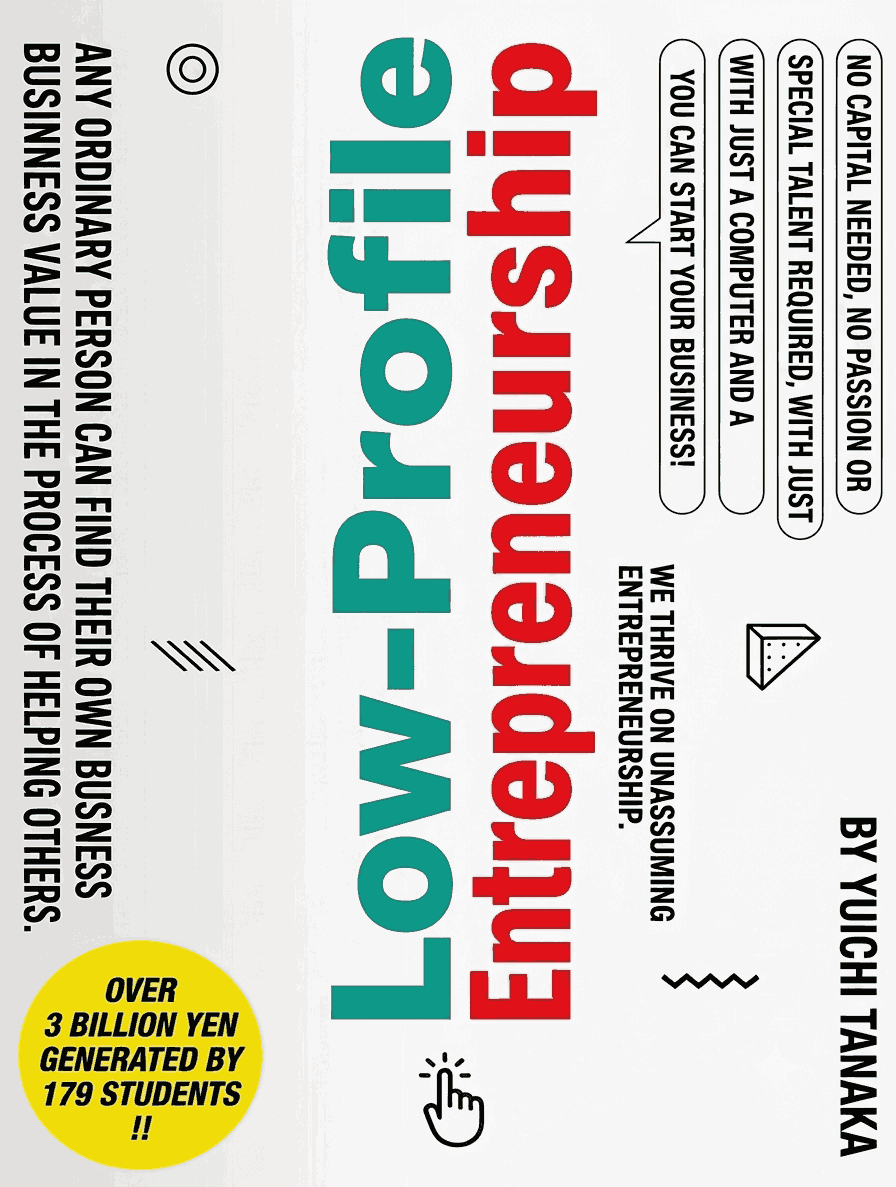
Low-Profile Entrepreneurship by Yuichi Tanaka
Original notes here.
Read until the end to get a bonus. Enjoy reading.
The worries of office workers:
Staying in a company only teaches you the skills needed to survive in that particular company.
Even an outstanding student becomes an ordinary employee after five years at a company.
The era of staying at one company until retirement is long over.
Changing jobs carries enormous risks, yet you may still end up facing the same problems.
What ordinary people imagine when they think of “entrepreneurship” is actually the glamorous kind of entrepreneurship, which requires technology, capital, and connections; another approach is to start a “side hustle,” but that often means struggling entirely on your own.
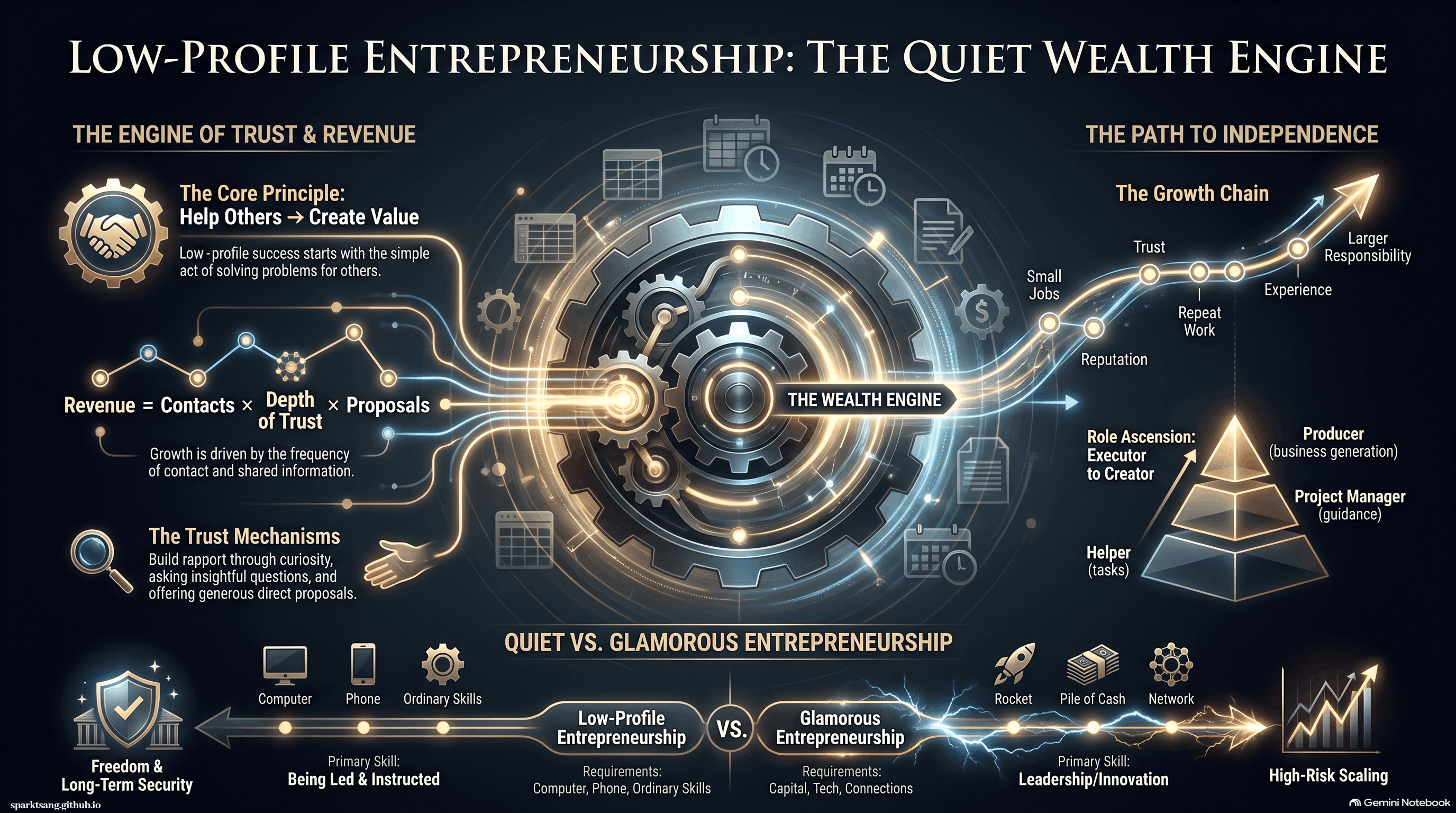
By contrast, “low-profile entrepreneurship” requires no special skills. Simply helping others quietly can lead to financial independence, making it one of the lowest-risk, safest ways of working in the world.
Only a portion of people can make a living from things they like or are good at. It may be better to directly help people and things you like, creating market value in the process—the principle is the same as helping your parents massage their shoulders for pocket money when you were a child.
The basic Japanese business practice of Ho-Ren-So (Reporting, Communicating, and Consulting) is actually your strongest asset; only a tiny minority can start a business based on some revolutionary, brilliant idea.
You can work without a license: compared with licensed professionals, someone who wants a website written may be more willing to entrust the work to a friend who is simply willing to help.
Having no track record and being genuinely willing to improve your skills can actually become a selling point; what matters is the ability to ask questions and observe.
A business plan is necessary when you need to raise capital; for small-scale, low-profile entrepreneurship, actually trying things is more important than making plans. The time spent worrying is the least productive time in life.
Low-profile entrepreneurship does not even require renting an office; you do not even need to establish a company. All you need is a computer and a phone.
Even if you lack the ability to express yourself, it is not a problem, because publishing content to attract customers is completely different from publishing content in order to support others. The latter, through one-to-one communication, can actually have a greater impact.
When your goal is to help others, it is easier to overcome problems with willpower, making this especially suitable for people who find it difficult to work hard “for themselves.”
More important than the ability to lead everyone else is the ability to be led and instructed.
Low-profile entrepreneurship can be divided into three categories: management (such as spreadsheets), creation (such as presentations and websites), and communication (contacting people, answering calls, replying to messages, event planning, and secretarial services).
Spreadsheet management is easy to connect with all kinds of work.
Running social media accounts, writing blogs, placing online advertisements, and producing graphic flyers and videos are all in great demand and not difficult to execute.
This includes all the trivial tasks that glamorous entrepreneurs are bad at. At first, the author handled various miscellaneous tasks for a spiritual counselor from China, allowing the counselor to focus on the core business. This earned the author a good reputation. Small tasks eventually accumulate and level up.
When faced with a task you are not confident you can complete, use the crowdsourcing service CrowdWorks to find someone else to do it.
Three essential tools for improving the efficiency of remote work: Chatwork (email is too formal, while instant messaging can easily blur the boundary between work and private life; this cloud-based meeting room facilitates communication both inside and outside the company), Zoom (online meetings), and the Google Workspace (which allows for seamless document collaboration).
When looking for clients, actively pay attention to platforms and email newsletters where notable figures respond to subscribers. The better the work, the more likely it is to be recruited through blogs and email newsletters.
An excellent way to reply to an email newsletter is to share how you actually implemented their advice and achieved results; this deeply moves the content creator.
Looking for work on crowdsourcing platforms is also a first step. Even if the pay is low, you can accumulate experience and build a reputation.
Helping enthusiastically at seminars leaves an impression and makes it easier to get work. There is no need to rush into selling yourself; adopt a mindset of giving.
The revenue formula for low-profile entrepreneurship is: Number of Contacts × Depth of Trust × Number of Proposals.
For people who are shy, attending events where they are certain to interact with those around them can help.
Trust equals frequency of contact multiplied by shared information. Get to know the other person, invite them enthusiastically, and do not hold onto a strange sense of pride; a humble posture is actually more useful.
The ability to ask questions is extremely important. Use a past-present-future framework to grasp information quickly, for example: “What kind of work are you doing now?” “What has been the hardest thing you’ve done so far?” “What do you want to do in the future?” Then make a direct pitch: “The future you envision is amazing. Please let me help you make it a reality.”
The process needs to go deeper, and can proceed in the following five directions: concretization, quantification, the biggest challenge, the story, and the reason.
Two key points when making a proposal: explain the reason, and be direct rather than beating around the bush. Get rid of the self-centered mindset of worrying about “what other people will think.”
After accepting a commission, the author did his best but failed to achieve the desired result, yet the client continued to commission him: once you have earned trust, the result is not everything.
Low-profile entrepreneurship is only a starting point. Your role can evolve from an executor (a helper) handling the tasks, to a project manager guiding the work, and finally to a creator (or producer) generating the business itself.
You can develop further and take on glamorous entrepreneurship: a business model in which you use your own ability to communicate and your own story to mobilize the people around you and increase the number of supporters.
A leader with strong promotional abilities can deliver the best results for clients.
The author says that starting earlier and continuing longer than others is his own formula for success. As an ordinary person, he takes an ultra-long-term approach to planning his life; a goal of earning ten million yen a year within seven years is extremely generous and conservative.
At the beginning, the author applied for an entrepreneurship course that required screening. A young entrepreneur on the interview panel commented, “Just looking at the colors from his socks to his tie, you can’t see the slightest possibility of success.” Another, older entrepreneur on the interview panel, Tetsumasa Kitano, later called the author personally and invited him to participate. In the end, this gave him the courage to become an entrepreneur.
Finished reading on Feb 5, 2021
Tanaka proves that escaping the corporate grind doesn’t require venture capital, revolutionary tech, or taking massive risks; it simply requires leveraging everyday skills to quietly build trust and help others. If this “low-profile” approach to reclaiming your freedom resonates with you, the next logical step is learning how to systemize it.
In The $100 Startup, Guillebeau expands on this philosophy, offering a practical blueprint for turning these quiet, skill-based side hustles into highly profitable, location-independent microbusinesses with negligible upfront cost.
Thank you for reading until the end. This is a bonus infographic just for you.