Notes on Zero to One
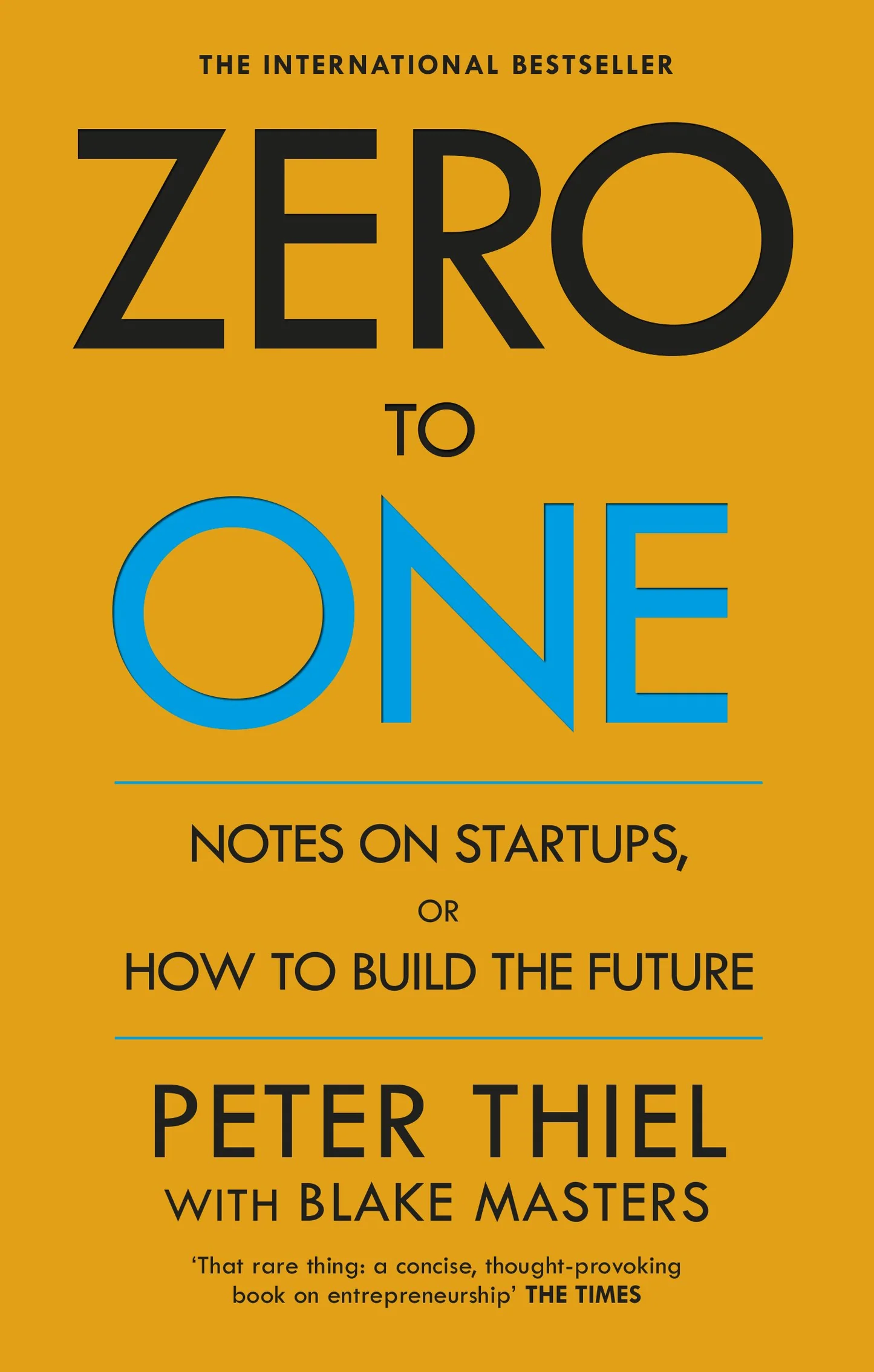
Zero to One: Notes on Startups, Or How to Build the Future by Peter Thiel
Original notes here.
Read until the end to get a bonus. Enjoy reading.
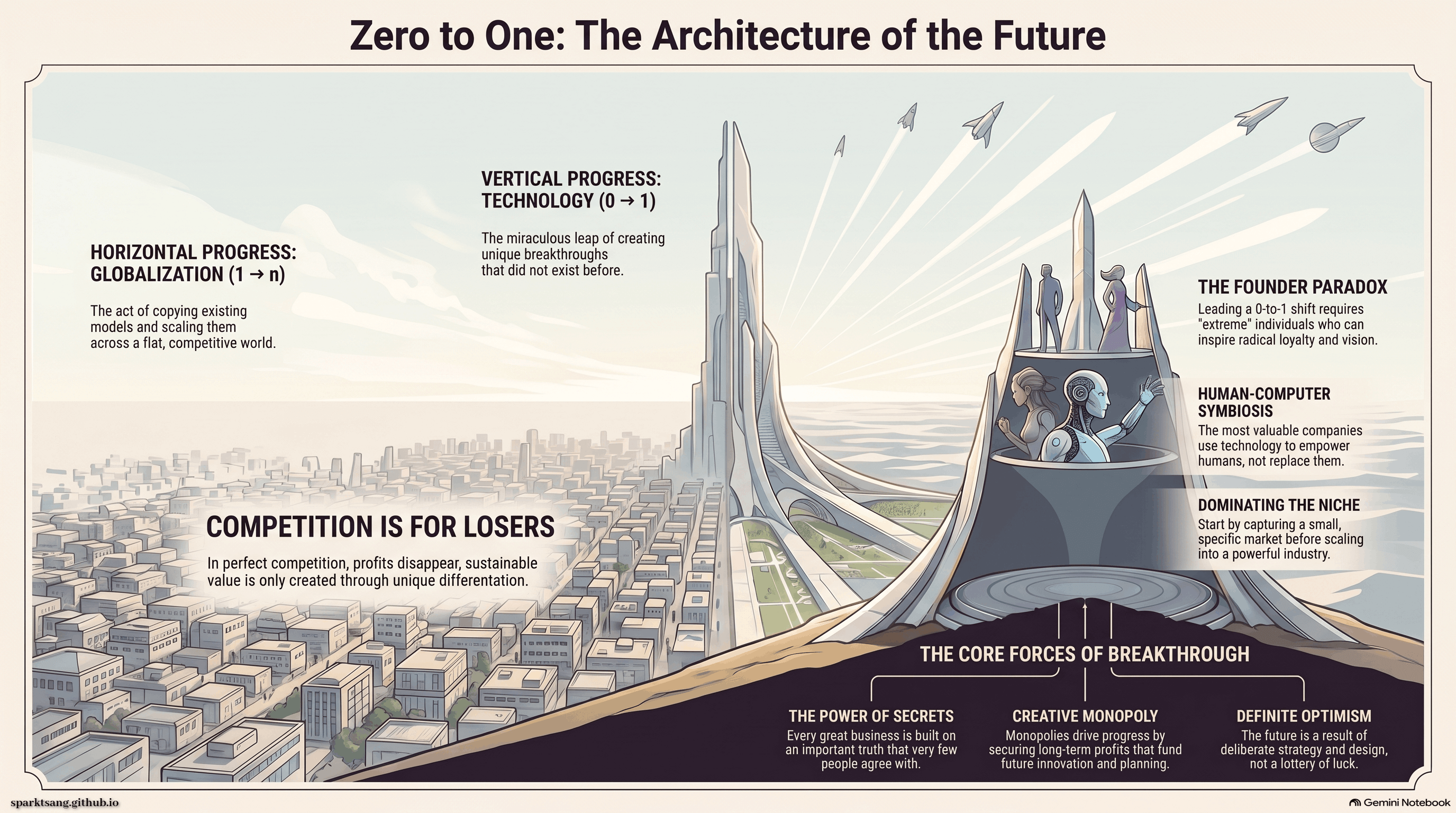
The next Bill Gates will not develop an operating system, and the next Zuckerberg cannot possibly create another social networking site. Replication is from 1 to n; innovation is from zero to one, something unique and one of a kind
What makes humans the spirit of all things is our ability to create miracles, and that miracle is technology
The difficulty of teaching entrepreneurship is that there is no formula for success in the first place. What successful people have in common is that they can discover value in unexpected places. Instead of thinking in terms of a formula for success, we should think about business from first principles
I like to ask interviewees, What important truth do you believe that very few people agree with you on?
1 to n is horizontal progress, while 0 to 1 is vertical progress. The former is globalization; China, which copies the models of developed countries, is the archetype. The latter is technology
From primitive agrarian life onward, there was only sporadic progress for ten thousand years. Then the steam engine appeared, and suddenly a chain of technological developments took place, far beyond the imagination of any previous generation
A genius can create a classic work of art or literature alone, but cannot create an entire industry alone; people must divide the work among themselves
A startup is about persuading a group of people to plan and build a different future together. New thinking is more important than intelligence. This book is about the questions that must be asked and answered for innovation to succeed
During the dot-com boom of the 1990s, the author knew graduate students in their forties who started six companies in 1999. An acquaintance told the author how to plan an IPO from his living room, and how simply adding “.com” to the end of a company name could double its market value overnight. The irrational became rational
The Nasdaq peaked in March 2000 and then plunged, and the bubble burst
That failure sent many investors back into physical real estate and the BRIC countries, creating another bubble
The four lessons entrepreneurs took away from the dot-com bubble still guide business thinking today: proceed incrementally, keep the organization lean, enter existing markets rather than innovate, and focus on product rather than sales
The author argues that the opposite principles may be more correct: bold risk-taking is better than boring incrementalism, a bad plan is better than no plan, competitive markets do not make money, and sales is just as important as product
At the height of the bubble, everyone looked to the future and believed they had the ability to create new technology, yet almost no innovative business actually reached its goal. They remained at the stage of talking without doing
The arrogance and vitality of that time are still necessary. We need to reflect on how much of our understanding of business has been shaped by past mistakes, and on the mistaken reactions those lessons have produced
The contrarian question from the previous chapter has a business version: What valuable company is nobody building?
Compare Google with the airline industry: the former has lower revenue but a higher net profit margin, and ultimately a far greater market value
Under perfect competition, profits disappear because of competition. To create and hold value over the long term, a product must be differentiated
Monopolies such as Google emphasize fierce market competition to protect themselves, defining themselves by the “union”: the overall market of search engines, phones, wearable devices, and so on
Non-monopolies do exactly the opposite, portraying themselves as dominant in one narrow area and defining themselves by the “intersection”: the only British restaurant in a particular city
A chef at a fiercely competitive restaurant committed suicide simply because the restaurant lost one star. Monopoly companies do not need to worry about competing with others, so they have more freedom to care about employees, products, and their impact on the wider world
Creative monopolists expand industries by providing more choices; the history of human progress is the history of successive waves of new monopolistic businesses pushing the frontier forward
Monopoly drives progress because years of monopoly profits provide a strong incentive to invent, enabling companies to make long-term plans. Governments see this too and protect inventions
Perfect competition is regarded by economists as an ideal state, but it is merely a historical relic; such models are easier to construct
An industry in equilibrium is like the heat death of the universe predicted by physics: stasis means death
Successful businesses are all different; each wins a monopoly position by solving a unique problem
Failed businesses are all alike: they are unable to escape competition
Competition means no one has profits, products are undifferentiated, and everyone must struggle to survive. Yet people still believe competition is healthy because it is an ideology that distorts our thinking
Education is the same. Talent and preferences do not matter; elite students keep climbing upward until competition becomes so intense that it crushes their dreams
Law schools produce tens of thousands of graduates every year, but only a few dozen enter the Supreme Court. If the author had succeeded in that path, his entire career would have consisted of taking depositions and drafting contracts, with no room for innovation
Business is often compared to warfare, and competition is seen as necessary. Everyone ignores the main point and focuses only on the opponent
As Google and Microsoft grew stronger, they began paying attention to each other, resulting in Windows v. Chrome OS, Bing v. Google Search, Explorer v. Chrome, Office v. Docs, Surface v. Nexus. War is extremely expensive, and the endless fighting allowed Apple to overtake them from behind
Using imitation as a competitive strategy can be dangerous, which helps explain why people with Asperger’s, who are poor at social interaction, have an advantage in Silicon Valley: if you are bad at socializing, you are less likely to do the same thing as other people
When you cannot beat an opponent, a merger may be a good choice. Merging with Elon Musk’s X.com allowed the author’s company to survive the dot-com bubble and succeed
Pride and honor can block the way. Even when something does not matter, people still insist on fighting to the end. This distorted logic is part of human nature, but for a business it is a disaster
In 2013, loss-making Twitter was valued at 12 times the New York Times. The high premium lay in its ability to generate cash flow in the future
A valuable company must not only grow; its growth must also be sustainable. Compared with short-term growth, the question “Will this business still exist 10 years from now?” is more important
Monopolistic businesses usually have the following characteristics: patents, network effects, economies of scale, and branding
Patents: As a rule of thumb, an important patented technology should be more than ten times better than its closest substitute. PayPal made transactions on eBay at least ten times more convenient, Amazon offered at least ten times more books than alternatives, and Apple’s tablets represented a major leap over their peers
Network effects: The more people use something, the better it becomes, such as Facebook
Economies of scale: Fixed costs are spread across more products sold
Brand: Many people imitate Apple: the brand story, premium materials, witty explanations, premium pricing, minimalist design… None of Apple’s actual monopoly advantages is as conspicuous as its dazzling brand, but the brand is the foundation that reinforces its monopoly position. When Jobs returned to Apple, he focused on a small number of opportunities capable of producing tenfold leaps. No technology company can live on branding alone
For these elements to work, the market must be chosen carefully. Every startup is small at first, and every monopoly business can wield enormous influence in its own market: it is much easier to dominate a small market than a large one
PayPal initially spent three months doing business with 25% of eBay’s most active sellers. It is a warning sign when entrepreneurs talk about capturing 1% of a $100 billion market
After dominating a niche market, a company should expand gradually. Amazon began by selling books and then moved into the markets with the greatest similarity: CDs, videos, software, and eventually became the world’s largest general store
eBay first established a monopoly in the market for Beanie Babies, then expanded to serve other small-scale collectors
Do not be a disruptor; avoid competition whenever possible. Obsession with disruption means viewing yourself through the eyes of an old company. Opposing incumbent companies cannot be the essence of something completely new, and therefore cannot create a monopoly business
What really matters is generating cash flow in the future. Being first offers no advantage; investing later may actually be better
Success is not about winning the lottery of luck. Otherwise, the greatest entrepreneurs would not go on to found several companies worth billions of dollars. If you believe everything comes down to luck, you do not need to read this book
Every company starts in a unique environment and can only be founded once, so scientific experiments cannot be conducted
The key question: Is the future determined by probability or by strategy?
Students spend ten years building astonishing résumés to prepare for the future, but they do not prepare for any particular goal
Indefinite pessimism: Europe from the 1970s to today is covered by bureaucracy and is now entering a slow fiscal crisis. No one is responsible, and central banks can do nothing but improvise (leading to low investment and high savings)
Definite pessimism: Surprisingly, China is the most pessimistic place in the world. It copies the growth of developed countries, but its huge population drives up energy prices, making it impossible to catch up in living standards. The rich try to move their money overseas, while the poor do their best to save (high investment, high savings)
Definite optimism: From the seventeenth century to the 1950s and 1960s, scientists, engineers, doctors, and entrepreneurs made the world wealthier, healthier, and longer-lived. It was not only political leaders and official scientists who made ambitious plans; an ordinary citizen, John Reber, despite having no degree, publicly proposed building two reservoirs in the San Francisco Bay Area and was taken seriously (high investment, low savings)
Indefinite optimism: The United States since 1982. Financial professionals surpassed engineers as the broad highway to the future. The future would certainly be better, but no one knew how much better, so there was no need to make explicit plans
The baby boomers attribute success to probability. As Malcolm Gladwell put it, if you do not understand Bill Gates’s good luck, you cannot understand why he succeeded. This is because they overestimated probability and underestimated planning from childhood (low investment, high savings)
A certain optimistic future requires engineers to design undersea cities and space colonies. An uncertain optimistic future needs more bankers and lawyers: an entrepreneur sells a company but does not know what to do with the money, so he hands it to a large bank; the bank does not know either, so it spreads the money among institutional investors; the institutions do not know how to manage the funds, so they build stock portfolios; companies then try to increase net cash flow and push up share prices through dividends and share buybacks. The cycle repeats, and no one knows how to use money in the real economy
Only in a certain future is money a means to an end rather than the end itself
Even governments themselves have become uncertain. Governments once made complex decisions to solve problems such as nuclear weapons and lunar exploration. After 40 years of uncertainty, governments have become mainly providers of insurance, social security, and transfer payments
Even philosophy has taken the same attitude. The ancients were pessimists; in modern history, Spencer, Hegel, and Marx all believed in progress and were certain optimists. Today, Rawls and Nozick are both uncertain optimists, from the veil of ignorance to free exchange, focusing on the process of implementation
Political philosophy and the business world both argue over implementation, turning it into a procrastinatory method for refusing to make concrete plans for a better future
Statisticians turned the probability of death into life tables, and this random attitude began changing the development of biology. Eroom’s Law (the reverse of Moore’s Law): since 1950, the number of new drugs approved for every billion dollars spent on R&D has halved every nine years. The inherent difficulty of biology has become an excuse for biotech startups to operate under uncertainty
Uncertain optimism is reflected in low savings and low investment among American households. American companies pile cash onto their balance sheets instead of investing in new plans because they have no concrete plan for the future
The other three views of the future are all workable: certain pessimism only requires copying without expecting innovation; uncertain pessimism will become self-fulfilling, because laziness and inaction will naturally find you. Only uncertain optimism cannot be sustained. No one plans, so how can the future become better?
Engineering-oriented Silicon Valley now favors buzzwords like “lean startup,” which claims you should be adaptable and evolvable: listen to customer needs, create a minimum viable product, then iterate repeatedly, and so on… You can let everyone use a mobile app to buy toilet paper, but without bold planning you cannot move from 0 to 1
Companies with a vision are always undervalued, so entrepreneurs only sell when they no longer have a clear vision for the company. When Yahoo proposed buying Facebook for $1 billion, Zuckerberg refused
To rediscover a clear path to the future, the West needs a cultural revolution. Rawls needs to be swept out of philosophy departments, Gladwell needs to change his theory… Startups give life a sense of purpose and can influence the world. It all begins with rejecting the rule of unfair chance
The famous 80/20 rule shows that inequality is everywhere
The power law is the strongest force in the universe, and venture capital works the same way. The author’s best-performing venture investment was Facebook, whose return exceeded the sum of all the rest, while the second-best, Palantir, generated more than the sum of all the remaining returns except the first
Most venture capital failures stem from a mistaken assumption that venture returns follow a normal distribution
Two rules of venture capital: 1. Invest only in companies with the potential to generate returns equal to the value of the entire fund; 2. The first rule is strict enough, so no other rule is necessary
Even venture capital specialists overlook the influence of the power law. Venture capitalists typically spend the most time helping the companies with the most serious problems
Less than 1% of American startups receive venture capital, and venture capital accounts for less than 0.2% of GDP. Yet venture-backed companies create 11% of the jobs in private companies, generate revenue equivalent to 21% of GDP, and all of the top 12 technology companies received venture capital backing, with a combined market value of more than $2 trillion
Investors who understand the law minimize the number of investment targets rather than diversifying broadly
The power law is equally important for startup founders. They must think about whether their company can succeed. An entrepreneur cannot diversify responsibility across a dozen companies, and life cannot be diversified either
Every correct answer to the contrarian question “What valuable company is nobody building?” must be a secret. There are natural mysteries and secrets related to humanity
Many people think there are no new secrets left in the world. The Unabomber believed all the difficult problems had already been solved and wanted to eliminate all technology and start over. Environmentalists believe nature is the wisest. Free-market advocates believe markets are beyond question
Four trends have destroyed faith in secrets:
Incrementalism: If students get ahead of the curriculum, they cannot receive credit; numbers must be accumulated gradually
Risk aversion: If life must never go wrong, there is no reason to discover secrets
Complacency: Being comfortable is enough. Deans of prestigious schools implicitly tell freshmen at orientation: you no longer have to worry about your life
Flattening: If there were opportunities to discover new things, would not a large number of talented people have found them already?
A democratic society that does not believe in secrets implies that there is nothing unjust or unfair in society
When economics does not believe in secrets, it develops excessive confidence in efficient markets, producing ever larger bubbles
When companies no longer believe in secrets, HP’s board ends up acting as a guardian, rigidly following rules, and the market value collapses
Had he not believed in secrets, Andrew Wiles would never have proved Fermat’s Last Theorem after mathematicians had failed for 358 years
Great companies open up unknown secrets: Airbnb saw unused supply and unmet demand; Facebook was also undervalued because, although simple, it contained a secret
Ideas this simple can be important, valuable businesses. There must still be many companies that have not yet been founded
Competition and capitalism are completely opposite
The best place to look for secrets is where no one is paying attention. For example, the biggest change in nutrition is the worsening obesity problem, and there must be a secret in it
Great companies are all built on unknown secrets, plans that together can change the world. When you share a secret, your listeners become your allies
Once rules are established at the beginning of a startup, they are difficult to change. California has more than fifty times Alaska’s population, but the two have equal representation in the Senate
Founders should have a deep friendship before starting a company. PayPal co-founder Luke Nosek’s first startup was doomed to fail because the partners did not get along: one was exceptionally talented, while the other was a typical MBA
Clearly distinguishing ownership, management, and control (shareholders, managers, directors) can help identify where a company may go wrong
If a CEO owns only a small fraction of the shares, it effectively encourages him to reward himself through management rights rather than ownership: a pretty financial report is enough to secure a high salary, without having to invest in creating more value over the long term
Most startup conflicts arise from the division between ownership and control: investors on the board may want to go public as soon as possible, while the founder wants to keep expanding the business
The smaller the board, the easier it is to communicate, reach consensus, and supervise. Three is ideal; it should not exceed five members unless it is a public company. A huge board is fundamentally unable to function effectively and merely disguises the dictator behind the scenes
People without stock options or without a fixed salary are basically not aligned with the interests of the company
Cash compensation focuses more on the present and less on the future. Someone who prefers stock as compensation reveals that he values long-term development and is willing to work hard to increase value
Bob Dylan: A person is either busy being born or busy dying; if a company keeps innovating, entrepreneurship can continue indefinitely
A good team should share the same vision and be genuinely excited to work with us. This was the source of PayPal’s strength
Why would someone who could earn a high salary at Google want to join your company as the twentieth engineer? Valuable stock, smart colleagues, or challenging problems are just clichés. There is no one-size-fits-all answer; it must be tailored to the individual, with one kind of answer related to mission and another related to team
Everyone in a company should have a distinctive character while still getting along well with one another. At PayPal, we needed everyone to be fascinated by digital currency
Clear division of labor and eliminating competition among employees can ensure internal harmony
Consultants at Accenture come and go without a lasting connection to the company; that is nihilism. A cult is dogmatism with extremely high cohesion. The 0-to-1 culture lies in between but leans toward the cult side: high cohesion, with views that outsiders may not understand but that are right
3.2 million Americans work in sales. Experienced managers may regard it as somewhat low-status, while engineers may wonder why there needs to be so much selling
The importance of sales is always underestimated. The best acting is the acting you do without leaving a trace. Advertising salespeople are called account executives, customer salespeople are called business development, enterprise salespeople are called investment bankers, and selling yourself is called being a politician
Wall Street analysts aim to become traders, law firms are led by people who can bring in major clients, university professors envy those who can influence others and flatter themselves. The research topics in basic physics and the directions of cancer research are all results of lobbying. Sales is underestimated because the world is quietly driven by sales; at every level of every field, there are systems that conceal the underlying selling
The best product does not always win. The idea that you can build a product that sells itself without sales is a fantasy. Path dependence theory says that particular historical conditions unrelated to objective quality determine which products win, but this does not mean the winner is random
How you sell is related to the size of the sale. Customer acquisition cost cannot be higher than average sales. An average sale of millions requires complex sales, time-consuming relationship building, and perhaps only one transaction every year or two. For example, Elon Musk’s rocket startup spent several years persuading NASA to sign a $1 billion contract, while Palantir co-founder and CEO Alex Karp spends 25 days a month visiting customers in person. Each deal ranges from millions to hundreds of millions. At those prices, buyers will want to deal directly with the CEO
Average sales of ten to a hundred thousand dollars can be handled through personal sales. In 2009, Box’s third salesperson sold the company’s cloud-storage product to researchers at the Stanford Sleep Clinic who needed secure storage for experimental logs. Today Stanford University provides every student and faculty member with a Box account. If Box had initially approached the president of Stanford University with a complex sales pitch, its fate might have been forgotten
An average sale of around a thousand dollars is the “Dead Zone”. If you have software worth that amount to help a convenience-store owner manage orders, advertising is too diffuse and personal sales are inefficient; it becomes a hidden bottleneck
With an average sale of around a hundred dollars, marketing can work. At this price point, you cannot afford to hire people to go door to door, so advertising becomes useful
If a product has a core function that encourages users to invite friends to become users, it can spread like a virus. This is why Facebook, PayPal, and YouTube grew explosively. PayPal initially had only 24 users, all employees, but by paying people directly to sign up and then paying them even more to refer others, it achieved astonishing growth
By using viral explosive power to dominate the core part of a market, PayPal became the last mover. It recruited 20,000 super-sellers on eBay, monopolized the market as eBay’s payment platform, and then became unbeatable everywhere
A company must sell not only its product but also itself to employees and investors. Even when a viral sales strategy does not require publicity, the media can still attract investors and employees. Anyone worth hiring will first look into the company
As in The Hitchhiker’s Guide to the Galaxy, if techno-geeks want to exile salespeople to another planet, look around: if there were no salespeople, you would be the salesperson
Many people believe artificial intelligence will eventually replace humans, but humans and computers excel at fundamentally different things
A four-year-old child can recognize a cat perfectly, while Google only reached 75% accuracy after scanning ten million video thumbnails in 2012
The difference means that the results of working with computers can be much greater than those of dealing with other people, and computers do not compete with humans for resources
PayPal’s CTO assembled mathematical specialists to study fraudulent transactions in detail and wrote software to identify them automatically. But thieves could keep improving their methods, so in the end the system could only have computers identify suspicious transactions first and then hand them over to specialists for a final decision. With this system, PayPal finally turned profitable in the first quarter of 2002
After selling PayPal, software engineer Steven Cohen proposed using a human-computer hybrid model based on PayPal’s security authentication system to identify terrorists and financial fraud. Palantir was founded in 2004 and, ten years later, was expected to reach $1 billion in revenue
The CIA was dominated by spies emphasizing human strengths, while the NSA was led by generals who believed in computers above all. Palantir aimed to overcome this opposing bias: first analyze with computer software, then have trained analysts check the results, helping identify terrorists, predict where insurgents would plant bombs, prosecute insider trading, crack down on child pornography rings, and detect fraudulent transactions, saving banks and governments hundreds of millions each year
Today, 97% of HR departments use LinkedIn’s powerful filtering functions to screen candidates. If technology alone could replace HR, it would not have produced what exists today
The most valuable companies do not ask what problems computers can solve; they ask how computers can help humans solve difficult problems
Computers replacing humans should be a concern for the twenty-second century. There is still a great deal of room between the two positions: replacing humans and claiming that replacing humans is necessary
At the beginning of the twenty-first century, everyone believed the next major trend would be renewable energy. It ultimately ended in a renewable-energy technology bubble bursting (see the Renewable Energy Industrial Index). Most companies failed because they couldn’t answer the following seven questions:
The Engineering Question: Is this a breakthrough technology or a marginal improvement? An excellent technology should be ten times better than the substitute
(Renewable-energy companies rarely had technology even twice as good, and sometimes their products were worse than the alternatives, such as Solyndra’s tubular solar cells, whose sunlight-absorption efficiency was only 1/π that of flat-panel cells)
Timing Question: Is this the right time for the business?
(Photovoltaic conversion efficiency progressed only slowly over several decades)
Monopoly Question: Can you first capture a high market share in a small market?
(The true competitive market was the global solar market. Deliberately defining the market narrowly was merely rhetoric)
People Question: Is there the right team?
(The sales executives of failed companies were good at fundraising and securing subsidies, but the technology teams did not lead. Our team’s conclusion was never to invest in a technology company led by someone in a suit; it was absurd to see executives in renewable energy running around in suits)
Sales Question: Is there a sales plan?
(Some companies such as Better Place thought their technology was so gimmicky that they could not be bothered to explain the product to the market)
Durability Question: Can it be sustained for 10 or 20 years?
(Many renewable-energy companies blamed their bankruptcies on government support for Chinese solar manufacturers. They did not ask what could stop China from destroying my business)
Secret Question: Have you found a unique opportunity that no one else can see?
(The companies deceived themselves into believing society had enormous demand for renewable energy. Every failed company drew its vision of the future according to well-known formulas, but great companies are built on secrets)
The renewable-energy technology bubble was still the biggest wave in the history of social enterprise, striking a balance between profit motive and public interest, yet often failing to land cleanly on either side
Tesla stood out because it handled the above major problems properly
Technology: Its technology was good enough that other automakers needed it;
Timing: In January 2010 it obtained a $500 million loan from the Department of Energy, a once-in-a-lifetime opportunity that is hard to imagine;
Monopoly: It had the ability to first dominate the high-end electric sports-car market;
Team: The CEO was an all-around engineer and salesperson who could build a team capable of excelling at both;
Sales: Its own sales channels, selling and servicing its own cars through its own stores. The upfront cost was far higher than the traditional approach, but over the long term it saved a great deal;
Durability: It led from the beginning, and the lead could widen further. It was still run by the founder;
Secret: It understood that the importance attached to renewable technology was a trend, not an environmental regulation
Entrepreneurs tend to be distributed at two extremes, with almost no one in the middle. Most strikingly, entrepreneurs often possess contradictory traits: cash-poor but paper millionaires, sullen and jerky one moment yet charismatic the next, insiders and outsiders at the same time, becoming both world-famous and notorious
Nature? Nurture? Deliberately exaggerating themselves? Others deliberately exaggerating them? All of these may happen simultaneously, reinforcing one another
Sean Parker started as an outsider and a hacker-criminal. Napster attracted ten million users within a year of its creation with his co-founding, becoming one of the fastest-growing companies in history. After being sued by the recording industry and forced to shut down, he became an outsider again, until he helped Facebook find its first funding and became chairman of the company. He stepped down in 2005 amid drug allegations and became notorious
Lady Gaga dressed so strangely that if someone else wore those clothes, they would be considered insane. She claimed to be born perfect, but no one is born looking like a zombie with horns on its head
The public projects its emotions onto celebrities. They are praised in times of prosperity and blamed in times of disaster, much like ancient societies that, when they could do nothing, placed all responsibility on one person as a scapegoat. Before execution, the scapegoat was often worshipped as a god
Elvis became obese and unkempt, Michael Jackson became strange and repulsive, and Britney Spears became so addicted to drugs that she no longer resembled her former self. Some people died young, yet their deaths instead created opportunities for a comeback
Howard Hughes’s lawyers emphasized in court that the standards applied to ordinary people could not be applied to him. Neither the judge nor the jury contradicted them. He eventually lived in seclusion for the last 30 years, and after pretending to be crazy until he truly became so, he ended up as an object of public pity
Bill Gates attracted too much attention. Microsoft settled with the government in 2001, but its competitors had already succeeded in preventing its founder from devoting all his energy to the company. Microsoft stagnated, and Gates became better known as a philanthropist than as a technologist
Jobs behaved eccentrically. In 1985, Apple’s board kicked him out of the company he had founded. Twelve years later, he returned to Apple, showing that the important work of creating new value cannot be simplified or compressed into a formula that others can follow step by step. It depends on the specific insight of particular individuals: eccentric entrepreneurs can have authoritative decision-making power, inspire loyalty, and plan decades into the future
Therefore, we should tolerate entrepreneurs who appear strange or extreme. Leading a company requires extraordinary people
But most importantly, do not overestimate your own power. Entrepreneurs matter not because only their work has value, but because they can inspire employees to give their best performance
Four futures: alternating rise and fall, a stable plateau, collapse and extinction, and geometric takeoff
But most people do not expect the future; instead, they expect globalization, concentration, and homogenization
Can a plateau continue indefinitely? At best, competition becomes more intense for every person and every company
When the consumption of scarce resources also has to be competitive, a plateau cannot last forever. Without new technology to ease competition, stagnation may turn into conflict, followed by collapse and extinction
Otherwise, the singularity may arrive. But the future will not happen by itself. Whether we do nothing or do our utmost is in our hands. Finding unique ways to create new things is our task today. The future must be different and better, so we must go from 0 to 1
Only by seeing the world as though for the first time can we create anew and leave a better future to those who come after us
Finished reading on June 27, 2020
Thiel challenges us to abandon broken models and achieve a “0 to 1” breakthrough to save the future. He famously asks: what important truth do you know that the world ignores?
But what happens when the world’s fundamental architecture is structurally designed to crush those very truths before they can ever be heard?
To truly invent the future, we need more than a 0 to 1 innovation in business. My philosophy proposes the ultimate 0 to 1 paradigm shift for human civilization: a new structural framework where truth no longer relies on privilege, but survives solely by withstanding the ultimate test of refutation.
Thank you for reading until the end. This is a bonus infographic just for you.