Notes on Good to Great: Why Some Companies Make the Leap... and Others Don’t
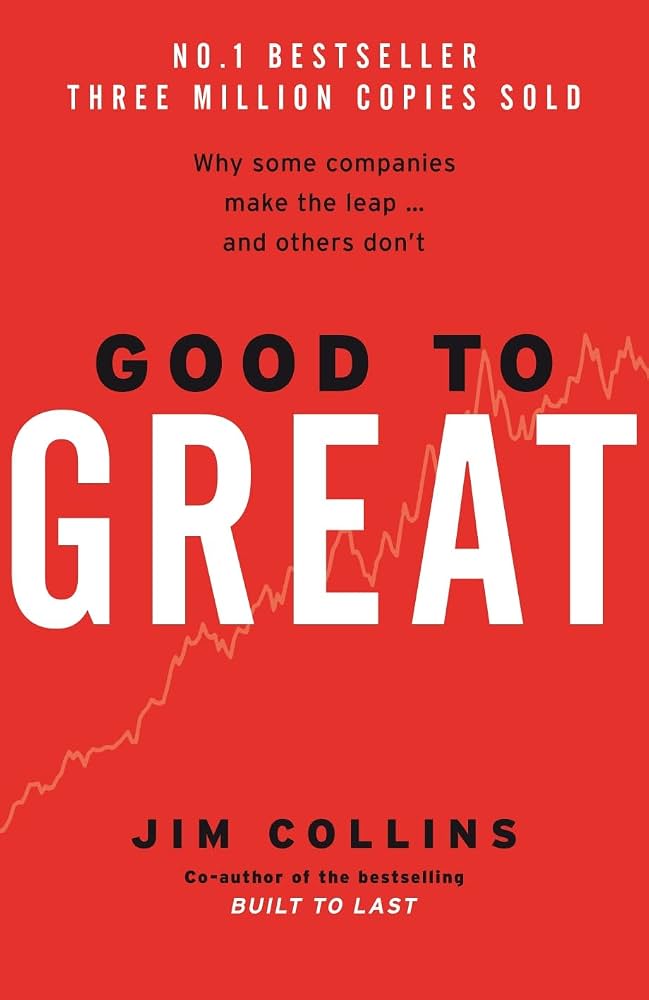
Good to Great: Why Some Companies Make the Leap… and Others Don’t by Jim C. Collins
Original notes here.
Read until the end to get a bonus. Enjoy reading.
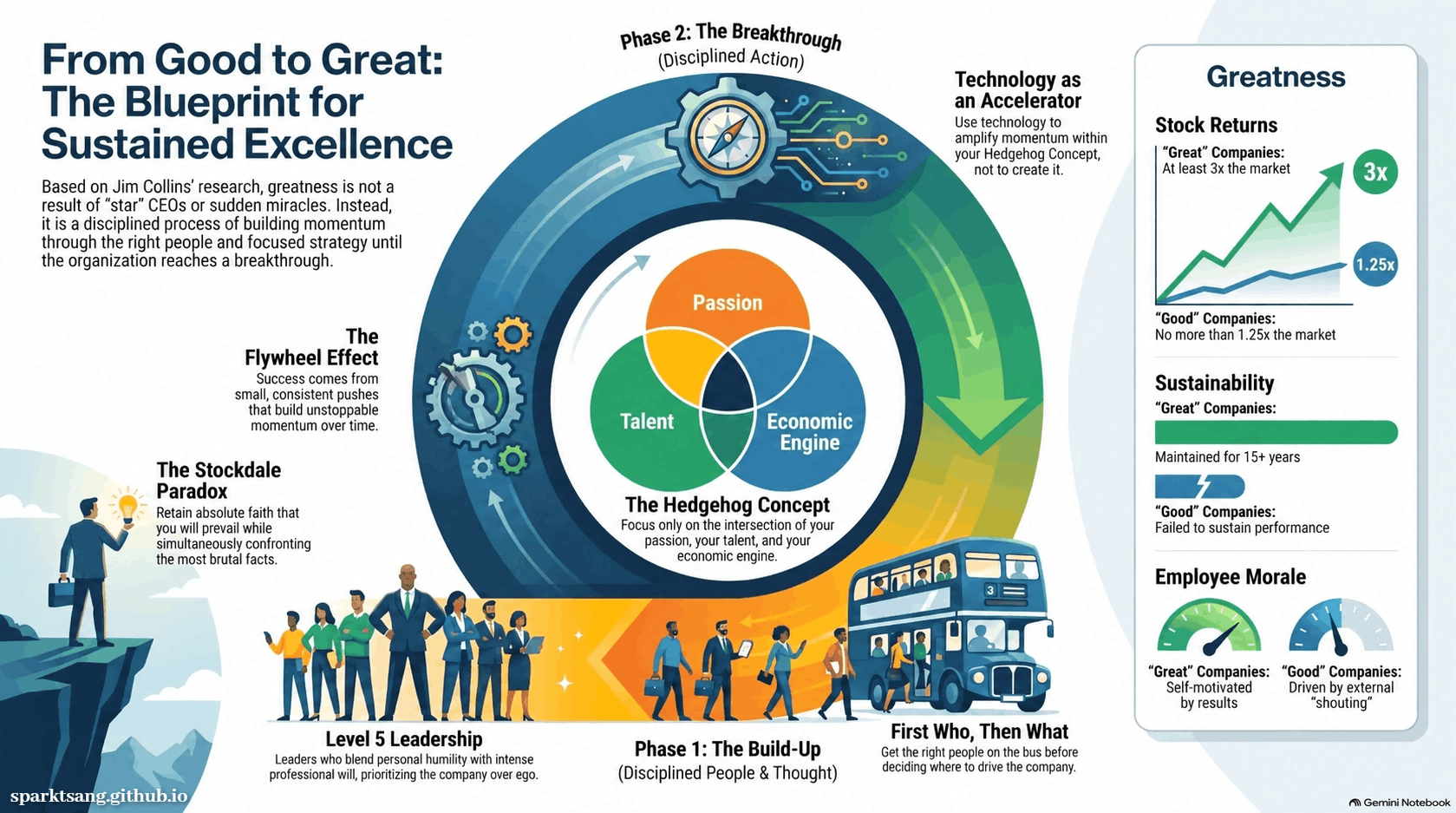
The research team screened a large number of companies to identify those that went from good to great, then compared them with companies that had once been great but failed to sustain that greatness. They found that all eleven of the companies that achieved sustained greatness had what they called “Level 5 Leadership.”
These leaders were humble yet determined. They motivated employees through high standards rather than charisma, chose successors with the future of the company in mind so that it could reach new heights again, sought neither personal fame nor wealth nor power, and would never compromise on the goal of building a great company that would endure. In adversity, they looked inward; in prosperity, they remained modest.
By contrast, leaders who inspired their subordinates with compelling visions and enthusiasm tended to produce strong performance only for as long as they remained in charge.
The arrival of a star executive from outside, the level of executive compensation, having an ambitious vision, technology-driven change, mergers and acquisitions, concern with management change and employee motivation, staging events to symbolize transformation, or operating in an already-great industry—none of these factors mattered.
When a great leader takes over, they follow the principle of “First Who, Then What” — getting the right people on the bus and into the right seats before deciding where to drive. And the selection process must be extremely rigorous.
When Fannie Mae’s new CEO took office, he immediately made it clear to senior management that the standards would be extremely demanding. Fourteen of the twenty-six people resigned.
In companies built around a constellation of stars, genius becomes the primary driver of success. All they need are outstanding assistants, while lacking sound systems and institutions and relying instead on rule by individuals. The result is brilliance that quickly fades.
Great leaders usually understand that the biggest bottleneck to growth is not the market, technology, competition, or the product, but finding the right people.
Good employees do not require tight supervision. Allowing unsuitable people to linger is unfair to those who are suitable.
Great companies made layoffs at roughly one-fifth the rate of the comparison companies.
Philip Morris sent George Wiseman, one of its top executives, to develop an overseas market that accounted for only 1% of the business, and the move was a huge success. The best strategy for developing a market is not “How do we do it?” but “Who should do it?”
Because great leaders have assembled a group of suitable people, they do not need to spend their time constantly supervising the company. They therefore enjoy fulfilling lives, and the teams at great companies often become lifelong friends.
Great companies confront the brutal facts of reality without ever losing faith.
Kroger clearly saw that the supermarket trend was unstoppable and made a sweeping strategic transformation.
A&P, by contrast, refused to accept reality and even shut down its own experimental stores.
Churchill understood the weaknesses of a strong personality, so he established a completely independent statistical department that placed the most unfiltered and brutal facts directly before him.
Readers may ask: how do you use brutal facts to inspire people? But the answer is that trying to inspire people is a waste of time. Put the right people on the bus and they will motivate themselves.
Create an environment in which people can hear the facts: ask more questions rather than giving answers directly, and stimulate dialogue and debate. (During Iverson’s tenure, meetings at Nucor were chaotic: everyone shouted, waved their arms, and pounded the table, arguing until their faces were flushed and the veins in their necks stood out, while Iverson played the role of a Socratic facilitator. When the author taught graduate classes, he used a “red flag” mechanism that allowed students to speak their minds freely whenever they raised a flag, with each student getting one opportunity per quarter. One student actually waved the flag to complain that he was a poor teacher.) Review afterward, but do not assign blame. (After Philip Morris bought Seven-Up and accepted the loss, it spent hundreds of hours reviewing what had happened. Cullman did not conceal the embarrassing fact that the decision had been wrong.)
Very few companies fail because they lack information. The key is whether they can turn information into something that cannot be ignored.
People who become stronger through suffering embrace the Stockdale Paradox: they retain absolute faith that they can and will prevail in the end, while simultaneously confronting the most brutal facts of their current reality. Admiral Jim Stockdale, the admiral who was held prisoner by the Viet Cong for eight years, embodied this mindset.
Under the threat of the giant Procter & Gamble, the former market leader Scott Paper fell into a prolonged decline. Kimberly-Clark, however, faced reality head-on, took up the challenge, and ultimately created a miracle.
Great companies are like hedgehogs: simple and straightforward, knowing one big thing and pursuing it consistently. Comparison companies are like foxes: clever and full of schemes, but lacking consistency.
Walgreens had only one principle: become the best and most convenient drugstore. Its sole economic metric was the profit generated each time a customer came through the door. (All the great companies found a key economic metric.)
The Hedgehog Concept can be summarized by three circles: what you can become the best in the world at; what drives your economic engine; and what you are deeply passionate about.
Wells Fargo realized that it could not become one of the world’s top banks, but it might become the best bank in the American West, so it committed itself wholeheartedly to that goal.
Abbott derived 99% of its revenue from pharmaceutical sales. Facing the reality that it could not become a world-leading pharmaceutical company, it shifted its focus toward healthcare products in areas where it had a chance to become world-class.
Upjohn, by contrast, refused to face the brutal facts and dreamed of defeating Merck.
Circuit City: McDonald’s in the high-priced retail market. Gillette: Coca-Cola in razors.
Nucor: focused on the cost of steel production. Philip Morris: the world’s best tobacco company.
Fannie Mae: a leading mortgage lender. Kimberly-Clark: a leading consumer paper-products company. Kroger: an innovative supermarket chain.
Among the comparison companies, the only one with a Hedgehog Concept eventually gave up halfway.
The executives of great companies all had passion. Gillette once rejected an applicant from a top business school because he did not show enough enthusiasm for deodorant.
You do not need to be passionate about the technical aspects of the work. You can direct your passion toward what the company stands for. Fannie Mae employees, for example, were deeply inspired by helping people from different social and economic backgrounds own homes and realize the American Dream.
Comparison companies blindly pursued growth, while not a single great company focused simply on growth.
The Hedgehog Concept was an important turning point on the road to greatness. In most cases, within a few years of clarifying it, the company would undergo a major transformation.
Setting up an informal council to guide dialogue and debate around the Hedgehog Concept is a very useful mechanism.
Great companies possess a Culture of Discipline, but this is not the result of a tyrannical disciplinarian imposing order. The latter works only while that strong leader remains in power. There are countless examples, such as Burroughs under Ray MacDonald and Rubbermaid under Wolfgang Goetze.
Many new companies begin successfully and gradually grow, then start adopting professional management. The entrepreneurial team cannot stand the idiotic forms and boring rules and begins to leave, and the company eventually becomes mediocre.
Great organizations are able to maintain a strong entrepreneurial spirit while emphasizing discipline.
Employees at great companies enjoy considerable freedom, but they must abide by the company’s systems and take responsibility for its goals.
When Richard was running Wells Fargo, the company resolved to rid itself of the traditional banker mentality it had accumulated over a century. Everything was done frugally; even at Christmas, they put up no decorations. Bank of America, by contrast, continued to live extravagantly.
The key factors behind the downfall of every comparison company were failures to maintain discipline and remain within the three circles of the Hedgehog Concept.
Kimberly-Clark exited the paper business and sold its paper mills, shifting into consumer products. It was willing to make sacrifices to adhere to the three circles of the Hedgehog Concept. By contrast, an executive at another excellent paper company said that they had already invested so much in their paper mills that they could not bring themselves to give them up.
R. J. Reynolds dominated the market for twenty-five years, then suddenly diversified its investments to deal with new trends and ultimately had to take the losses. It became an example of a company that lacked discipline and could not resist temptation: the list of things not to do is more important than the list of things that need to be done.
All great companies used technology as Technology Accelerators, not creators, of momentum; their executives did not emphasize technology as the primary cause of greatness.
Technology needs to be connected to the Hedgehog Concept, and the company must either be a pioneer in applying technology in that area or genuinely need the technology.
Only three comparison companies innovated in their use of technology, but they failed to sustain greatness because they stepped outside the three circles of the Hedgehog Concept.
Walgreens built a sophisticated website to compete with the market pioneer online pharmacy drugstore.com. The latter saw its market capitalization jump two- or threefold within seconds of going public, yet it was ultimately acquired by Walgreens.
Kroger was the first to seriously adopt barcode scanners. Nucor was the first to adopt the most advanced mini-mill steel-production technology. Fannie Mae was the first to use sophisticated algorithms and computer analysis to assess mortgage collateral risk. Abbott was the first to use computer technology to raise average profit per employee. Walgreens was the first to use communications and network technology to create a more convenient drugstore. Gillette invested more than $200 million in creating the Sensor razor.
Very few early technology pioneers became the ultimate winners. VisiCalc, the pioneer spreadsheet program; Osborne Computer, the pioneer in laptops; Remington Rand, the computer pioneer; and de Havilland, a pioneer in commercial passenger aircraft, have all been forgotten. Technology alone cannot turn good into great, just as the technologically advanced U.S. military could not defeat the North Vietnamese guerrillas whose strategy was correct.
A gigantic, heavy flywheel is extremely difficult to push at first. The more you push, the easier it turns, until its weight itself becomes an advantage and it finally races forward with unstoppable momentum.
Great companies do not need to deliberately boost morale during the transformation. Once the flywheel begins turning, real performance provides proof, and employee commitment and morale problems resolve themselves.
From the outside, it can look as though a company transformed overnight. Internally, however, people know that it happened little by little, and only afterward do they realize that the entire transformation has taken place.
Wall Street’s short-term pressure does not have to interfere with the flywheel. Abbott would announce a lower target, then take the difference between actual results and the target as additional funds and invest them, in order of importance, in innovative projects awaiting funding. This was the Blue Plan.
Comparison companies often fell into the Doom Loop: making a huge show of launching new initiatives to boost morale. They always expected a great plan, a killer innovation, or a sudden miracle to appear and create an immediate breakthrough. By constantly changing the direction of the flywheel, they failed to build sustained momentum.
This book is an independent study, but when compared with the earlier study, Built to Last, it can be regarded as its prequel.
Hewlett-Packard had already demonstrated in the 1950s that its fundamental purpose was not the pursuit of profit. Merck ventured into impoverished rural areas to provide medicine free of charge to hundreds of thousands of people suffering from river blindness.
The companies in Built to Last were all able to preserve their core values while simultaneously stimulating progress and adapting to the world.
Disney evolved from cartoons into theme parks while carefully preserving the magic of Disney and putting smiles on children’s faces.
Under Bill Allen’s leadership, Boeing set a wildly ambitious new goal of becoming the leader in the global commercial aircraft industry, but the goal fit the three circles of the Hedgehog Concept: it had the capability to become a leader, it would increase the profitability of each model, and its employees were passionate and eager to take on the challenge.
Why pursue greatness? First, pursuing greatness is not much harder than merely pursuing excellence, because momentum accelerates as it accumulates: the new energy generated becomes greater than the energy consumed. Remaining mediocre over the long term means consuming more energy than you put in.
Second, a sense of mission and meaning inspires people to strive to do things as perfectly as possible.
William P. Briggs, a professor of applied mathematics at the University of Colorado, reviewed the research methods used in this book and found that all eleven companies displayed the book’s principal characteristics, while the comparison companies did not. The probability of this being purely coincidental was less than one in seventeen million.
Robert Burgelman, one of the author’s professors at Stanford Graduate School of Business, said: whether in running a business or living a life, the greatest danger is not that you might fail, but that you might succeed without ever understanding why.
When great companies stop doing what we discovered they did, they will gradually decline. Gillette may already have run into trouble. After Iverson retired, Nucor descended into managerial disorder. Iverson was said to have ceased being a Level 5 leader in his later years, while Iverson himself said the problem was that the management team wanted diversification.
Very few highly diversified companies achieve outstanding performance. General Electric is a clear exception because its unusual and subtle Hedgehog Concept binds all of the businesses in the group together as one.
If a board cannot see beyond five to ten years, it is confusing the price of a stock with its value. See Rita Ricardo-Campbell’s Rejecting Takeover Bids.
Hot young technology companies such as Cisco also produced Level 5 leaders, including John Morgridge.
If talent is difficult to find, broaden the definition and focus on strengths of character while placing less weight on specialized knowledge. Skills and knowledge can be learned, but the basic personality traits that fit an organization cannot be developed simply through learning.
Level 5 leaders regard a downturn as a once-in-twenty-years opportunity to recruit outstanding talent.
Even when firing unsuitable people is extremely difficult, it only means that the process of replacing them needs more time.
Research Data
“Great” was defined as a company whose returns, over the fifteen years following its transition point, were at least three times those of the market and continued to rise.
“Good” meant no more than 1.25 times the market, with the difference between the pre- and post-transition performance being at least threefold. Before the transition, the company had to have been operating for at least twenty-five years, and it had to have been among the Fortune 500 in 1995.
Finished reading on July 10, 2020
Collins reveals the disciplined framework required to make the leap from good to great. But how do you ensure that greatness survives long after the Level 5 leaders are gone?
In his comprehensive masterclass, BE 2.0, Collins expands on these very principles—providing the complete, actionable blueprint for turning a breakthrough success into an enduring institution.
Thank you for reading until the end. This is a bonus infographic just for you.