Notes on Elon Musk: Tesla, SpaceX, and the Quest for a Fantastic Future
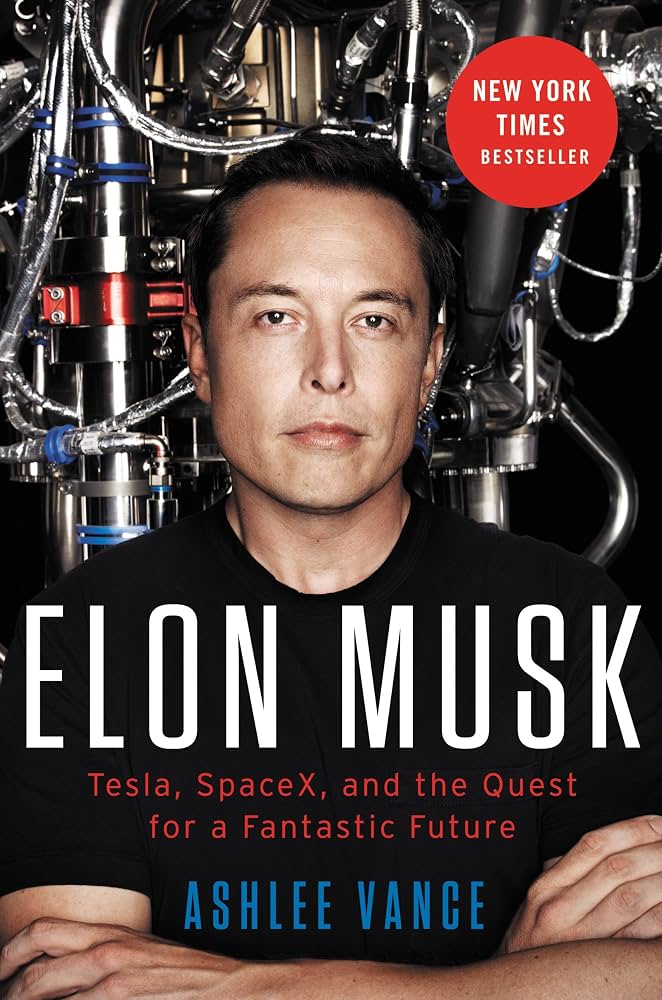
Elon Musk: Tesla, SpaceX, and the Quest for a Fantastic Future by Ashlee Vance
Original notes here.
Read until the end to get a bonus. Enjoy reading.
1971 — Born in South Africa
1984 — Designed a game that appeared in the media
1988 — Moved to Canada
1989 — Entered Queen’s University
1992 — Transferred to the University of Pennsylvania
1995 — Founded Zip2
1996 — Zip2 received $3M in venture capital
May 1998 — Removed as chairman of Zip2
February 1999 — Zip2 acquired; made $22M
March 1999 — Founded X.com
August 1999 — Betrayed by his co-founders at X.com
November 1999 — X.com launched its online bank
January 2000 — First marriage
March 2000 — X.com merged with Confinity, which owned PayPal
September 2000 — Forced out as president of X.com during his honeymoon
January 2001 — Nearly died of malaria
June 2001 — X.com renamed PayPal
September 2001 — Founded the Mars Society’s Life to Mars Foundation
October 2001 — Traveled to Moscow in an unsuccessful attempt to buy missiles that lasted for months
February 2002 — Conceived the idea of building rockets himself; PayPal went public
June 2002 — Founded SpaceX
July 2002 — eBay bought PayPal for a $250M windfall; one child died
January 2004 — Invested in Tesla and became chairman
Fall 2004 — SpaceX completed rocket-engine testing
January 2005 — Tesla’s first prototype electric car
May 2005 — SpaceX completed a five-second burn on the launch pad
July 2005 — Discovered the prototype car’s risk of exploding
March 2006 — SpaceX’s first test launch
May 2006 — Roadster engineering prototype; received $40M in investment
March 2007 — SpaceX’s second test launch
June 2007 — Venture capital investigation concluded that the Roadster was over budget
November 2007 — Tesla missed its delivery deadline three times
December 2007 — Founder Eberhard left Tesla
June 2008 — Divorced
August 2008 — SpaceX’s third test launch failed
September 2008 — SpaceX’s fourth test launch succeeded
December 2008 — SpaceX won a $1.6B NASA contract
June 2009 — Eberhard filed a lawsuit
January 2010 — Tesla received a $465M Department of Energy loan
May 2010 — Tesla bought a Toyota factory for mass production
June 2010 — Tesla went public
December 2010 — SpaceX safely recovered a Dragon spacecraft after launch
May 2012 — SpaceX became the first private company to dock at the International Space Station
June 2012 — Model S deliveries began
September 2012 — Tesla announced an electric-vehicle charging network
November 2012 — Model S won Motor Trend’s Car of the Year award
May 2013 — Tesla announced its first profit
June 2015 — SpaceX rocket explosion
September 2015 — Tesla launched Model X
March 2016 — Tesla launched Model 3
Eighteen months earlier, the author had told Musk about his plan to write the book and asked for his help, but Musk initially refused. After interviewing 200 people, Musk changed his mind. The author knew that, like a scientist, Musk could not tolerate errors, but worried that he might keep adding dozens of pages of lengthy supplements. Instead, when the author made his request, Musk simply replied, “All right.” The author describes him as intensely determined and admires people who refuse to let go even after being turned down. At the end of their meeting, Musk asked whether the author thought he was crazy. The author was speechless, and Musk seemed to reach his own judgment from the author’s expression.
“Maybe there are so many smart people chasing the Internet, finance, and law that our generation has produced very little innovation.” — Musk
“The smartest people of this generation are thinking about how to make people click ads.” — Jeff Hammerbacher, an early Facebook engineer
“We wanted flying cars, instead we got 140 characters.” — Peter Thiel
After looking at Musk’s business empire, the author changed his mind about these ideas: Musk was not a profit-driven CEO but a mad engineer, carrying enormous ambitions and single-handedly taking on four industrial revolutions: PayPal, SpaceX, Tesla, and SolarCity, willing to work himself to the bone to accomplish missions that seemed unrealistic.
Young Musk
At 14, he suffered an intense existential crisis. The Hitchhiker’s Guide to the Galaxy became one of the books that influenced him most deeply for the rest of his life. As a young boy, he was consumed by the idea of saving the world, which became one of the forces driving him to escape South Africa’s racist regime and go to America.
His maternal grandfather Joshua moved from Canada to South Africa in 1950 to pursue the free life he envisioned. He and his wife enjoyed adventurous flying together; he died in a flying accident in 1974 at the age of 72.
His mother Maye first met his father Errol at age 11. They broke up and got back together repeatedly while she was at university. Errol kept proposing until he finally broke through her defenses. He was an electrical engineer and she was a dietitian. Musk had a younger brother, Kimbal, and a younger sister, Tosca. His mother regarded Musk as an exceptionally precocious genius, someone who loved falling into deep thought as though he had detached himself from the world.
Musk believed his brain was like a graphics chip that could copy the outside world inside his head and then manipulate it through imagination.
He never went anywhere without a book and could read for ten hours a day. His favorites included The Lord of the Rings, Foundation, and The Moon Is a Harsh Mistress, and he had also read two encyclopedias cover to cover. He was unpopular, and when a child who was afraid of the dark asked him about it, he said, “Darkness is simply a lack of light.” But his relationship with his siblings was good.
His parents divorced when he was eight. The children initially stayed with their mother, but a few years later Musk felt this was unfair and moved in with his father. His brother eventually joined him. His father remarried and had two daughters. The family unanimously considered their father difficult, but did not want to talk about him much. His brother recalled three- or four-hour lectures that robbed them of the joys of childhood. In response to Musk’s American dream, his father dismissed the servants and made the children do all the housework so they could “experience what it’s like to be an American.” Musk believed his father was exceptionally good at making people’s lives miserable, and vowed with his first wife that their children would never see him.
At ten, he got a computer. A programming course that was supposed to take six months took him three sleepless days to master, yet his engineer father dismissed it as nothing more than a game console. His childhood activities also included going door to door selling Easter eggs and building homemade rocket models. The two brothers and their cousins prepared to open an arcade. They already had a lease, but because they were minors, no adult was willing to sign for them, so the project collapsed.
He was unpopular at school. In eighth and ninth grade he was beaten up so badly that he needed surgery on his nose. Someone had beaten up his best friend and then forced that friend to lure him outside so he could be attacked too. Whenever he mentioned this, tears welled up in his eyes. He was constantly bullied at school and had an abusive father at home; his life was like a nightmare.
High school became easier after he grew taller and moved into an elite school, but even there, in a campus where sports were highly valued, he remained isolated. Classmate Terrence Bency said Musk was already fantasizing about interstellar colonization. When classmate Ted Wood asked the two brothers what they were talking about, Musk replied, “Will the financial industry move toward a paperless future?” Wood was left speechless and deeply awkward.
Musk approached school assignments with a goal-oriented mindset: if a boring class could be passed, that was enough.
Because Canadian citizenship laws had changed, his mother’s children became eligible for citizenship, creating an opportunity to escape South Africa and go to America. During the process, he spent five months at the University of Pretoria, which he described as finding things to do while waiting in Canada for the paperwork.
Going to America for School
When he arrived in Montreal, he found the highest-paying job available through an employment center: cleaning the boiler room at a lumber mill. It was brutally hard work. Thirty people started, and by the third day only five remained.
While studying at Queen’s University, he and his brother would look through newspapers for people they wanted to meet and simply call them to arrange meetings. One of those who agreed was Peter Nicholson, a senior executive at the Royal Bank, who later provided him with a summer internship.
One week into university, he became obsessed with Justine, a brilliant, strong-willed black belt in taekwondo. She agreed to get ice cream with him but stood him up, claiming she needed to study for exams. Musk questioned her best friend and did his own research, found out where she was studying, and went there carrying her favorite flavor of ice cream. She had originally dreamed of having an affair with a writer, but instead fell for the “ruthlessly determined, ambitious computer geek.” They repeatedly broke up and got back together throughout university. Musk showed his characteristic persistence, calling her relentlessly until she eventually realized she could not escape him.
There was no more ridicule at university, and people responded positively to ambition, giving him the nourishment he needed to grow.
In the fall of 1990 he met Navaid Farooq, who remained a close friend. Farooq was deeply impressed by Musk’s focus and persistence.
Two years later, he won a scholarship and went to the University of Pennsylvania to pursue dual degrees in economics and physics, while maintaining a long-distance relationship with his girlfriend. He met Adeo Ressi, who later became a Silicon Valley entrepreneur. The two of them ran an unlicensed bar together.
In 1994, a report he wrote predicting the future of the solar-energy industry received high praise from his professor. Thinking about his future led him to a conclusion: the Internet, renewable energy, and space were the three great fields of revolution.
Startups
In the summer of 1994, the two brothers drove across America and came up with the idea of starting an Internet business.
During the summer, he interned at Pinnacle Research Institute in Silicon Valley in the mornings, then switched to Rocket Science Games at night. One boss praised him for teaching himself without help; another admired his seemingly endless energy.
He had originally planned to pursue a PhD at Stanford and continue researching ultracapacitors at Pinnacle Research Institute. But he could not resist the call of the Internet, dropped out after two days, and brought his brother to Silicon Valley to create an online Yellow Pages: “Everyone has the right to know where the nearest pizza place is.” Small businesses at the time did not understand the Internet.
His brother handled door-to-door sales. Their father provided $28K. During the first quarter, the brothers lived and slept in the office on futons, showered at the YMCA, and even brought in a young Korean engineer as an intern in exchange for room and board.
By the end of the year they had assembled a motley sales force, with his brother acting as cheerleader. Salespeople could only get customers to imagine the potential.
Musk used a large computer for demonstrations, finally making an impression on investors. Greg Kouri invested $6K and played a crucial role in mediating conflicts between the two brothers.
Early the following year, venture capital firm Mohr Davidow invested $3M. The company got a bigger office and hired excellent engineers. It had already become one of the best online business-directory providers, and the company pivoted to selling enterprise software to newspapers. The venture capitalists wanted Musk to become CTO.
The new computer expert rewrote Musk’s code. Musk fell into a common trap among self-taught programmers, producing a mass of incomprehensible “hairballs” that could behave unpredictably. He was furious.
The software engineers brought a more disciplined architecture and working structure. They did not set deadlines as optimistically as Musk did.
As the company grew, Musk gained confidence. The child who had often been bullied could now control the room. He criticized people bluntly and never said, “I understand your feelings or your point of view.” His spirit of never giving up in team-building exercises, even when he could lose, left a strong impression. The company felt like a group of energetic children. They even formed an electronic gaming team and entered competitions.
Under Rich Sorkin, large newspapers became customers, but Musk, who was more consumer-centric, was deeply unhappy. In 1998, when there was an opportunity to merge with CitySearch, Musk switched from supporting the deal to opposing it, and the media heavily reported the dispute.
Musk urged the board to put him back in charge, but instead he was removed as chairman. The strategic differences demoralized the engineers. In 1999, Compaq acquired the computer company for $307M. Musk and his brother received $22M and $15M respectively.
Musk reflected that his management style could be improved: he should not have modified employees’ work without telling them. He wanted to become a leader, but people around him did not see him as management material.
The Internet Finance Revolution
In the early 1990s, Musk interned at the Royal Bank and calculated that certain bonds had a final collateral value of 50 cents even though they were priced at 25 cents. He reported the idea, only to have it rejected. A few years later, he began thinking about building an Internet bank. At the time, people were nervous even about entering their credit-card numbers online.
Before selling Zip2, he had already approached the company’s engineers. After making a fortune, only a few people bought sports cars or airplanes. He put $12M into his next venture, seeing the point of his previous company as “prove yourself once, then use your reputation to get people to bet on you again.”
As a Silicon Valley star, Musk told the media that he wanted to overturn the banking industry. His partner Harris Fricker thought this was ridiculous: the new company was struggling just to survive. Five months after the company was founded, Fricker rebelled and wanted to take control. When refused, he took the elite staff and started a new venture, leaving the company nearly empty.
Even after the talent had disappeared, Sequoia backed the company. As more engineers arrived, the vision began to look more real.
Within a few months, the small software team had built an online bank, one of the earliest in the world. Musk personally put up $100K for engineering tests. Customers received a $20 cash card for signing up, and another $10 for every person they referred.
Max Levchin and Peter Thiel founded Confinity to develop online payments. At first they rented office space from X.com, then split into separate companies and entered an all-out war. X.com spent money recklessly on marketing and security. Eventually the two sides agreed to stop burning money fighting one another, and their merger made Musk the largest shareholder.
After the merger, efforts to reconcile the cultures failed, and a software religious war began. Each brand had its loyalists. Thiel resigned; Levchin threatened to leave. User numbers exploded, and the website crashed every week. The treasurer believed Musk had not told the board the full truth, and doubts grew about his decision-making ability.
One night, a group of executives orchestrated a “board coup”. The board took advantage of his honeymoon and fundraising trip to remove him. Thiel and Levchin said they were confident they could realize the vision. Musk accepted it, continuing to invest and serve as an adviser after the company was renamed. One employee said he behaved like royalty. The company was eventually acquired.
Musk later recalled having mixed feelings. One early employee wrote The PayPal Wars, portraying him as an arrogant, stubborn megalomaniac while portraying Thiel and Levchin as genius saviors. Musk retaliated by describing himself as the true founder. Most employees at the time tended to agree, but also said he had failed to handle the brand, technology, and fraud issues properly.
Many criticized him for constantly getting into conflicts, for being extraordinarily self-confident, and for lashing out viciously at people. The damage lingered for a long time, and even though he deliberately restrained himself, he was still not considered trustworthy. The author says his flaws must be weighed against his ability to read people and technological trends, to stay ahead of everyone else, and to guide the company through the bursting of the Internet bubble, allowing it to survive and then sell for a huge price during the post-9/11 downturn.
In retrospect, his unrestrained imagination proved more powerful than a manager’s cautious pragmatism: if Zip2 had followed his consumer market approach, it might have developed into a hugely influential mapping and review service; PayPal, meanwhile, was sold too early. Had Musk kept it independent and been given more patience, it might have fulfilled its ambitions. Today, many online-payment and Internet-banking services are trying to realize most of the original vision of X.com.
In his marriage, he often argued with Justine. She complained that he was constantly correcting her. When she said she was not his employee, he replied that if she were, he would have fired her long ago. The betrayal delayed their honeymoon. Then, during the year-end holiday, he contracted malaria and nearly died, losing 45 pounds and taking six months to recover. His lesson: “Taking a vacation can kill you.”
The Call of Space
After being forced out of PayPal, he moved to Los Angeles and felt called to a mission larger than developing the Internet. He returned to his childhood dreams of rockets and space travel, reading a moldy Soviet rocket manual while meeting space-industry executives. His first contact with the space industry came in 2001, when he wrote a $5,000 check to the Mars Society and showed up at a dinner. He was still skeletal after the malaria, but began proclaiming his ambition to do something that would be remembered. His vision went beyond the Mars Society: he wanted to send mice to Mars. He also worried that NASA had no new ideas. A friend gave him an enormous wheel of cheese to mock him, saying those mice would need a lot of it.
He built a network of contacts in the space industry and formed a group that met repeatedly. He then resigned from the board of the Mars Society and founded the Life to Mars Foundation. His enthusiasm for Mars inspired a group of experts, including Michael Griffin, who would later become NASA administrator. But the experts were worried about his budget: launching a single rocket would cost $200M, while he had budgeted only $20–30M.
To buy missiles from Russia, he recruited Jim Cantrell to go with him to Moscow. His college friend Ressi also came along to persuade him to abandon the madness. The Russians insisted on $8M per missile. Musk was offended and walked away. On the flight home, he drew up a detailed spreadsheet calculating the material costs of building rockets. Space-industry veterans, accustomed to seeing billionaires enthused by engineers only to give up later, scoffed.
When he first met the rocket enthusiast Tom Mueller, he immediately realized that Mueller knew rocket manufacturing inside out. Mueller was impressed by the extraordinarily high level of Musk’s knowledge at the roundtable discussion. His joining became a secret weapon and he also helped complete Musk’s cost spreadsheet.
Musk conducted interview after interview, eliminating those who did not believe in the plan and building a team of engineers willing to commit themselves fully. By April, he had completely abandoned the gimmick of sending plants to Mars. He gathered his friends and announced that he was going to start a commercial space-exploration company: Griffin wanted to join but gave up because he was not willing to live on the East Coast; Cantrell joined as well but, feeling the risks were too great, lasted only a few months; engineer Chris Thompson joined later.
The company was dedicated to building the fastest, cheapest rockets possible, with the goal of modernizing the rocket industry. Musk argued that the industry had made no real progress for nearly half a century. Naively, he expected a trip to Mars by the end of 2010. After the PayPal acquisition, he poured more than $100M into the new company, ensuring that no one could take control of it away from him.
At the same time, his ten-week-old first son died. He avoided discussing the depth of his grief.
Mueller built rocket engines. Thompson became vice president of operations. Tim Buzza, considered one of the best rocket-testing experts in the field, also joined. Steve Johnson became a senior mechanical engineer. Hans Koenigsmann developed avionics, navigation, and control systems. Industry veteran Gwynne Shotwell became the first major sales executive and eventually rose to president. Legendary Mary Beth Brown joined and became instrumental in major undertakings, shaping the company culture. When Musk was away, she gave orders and could read his moods. Colleagues would see her go ahead of them, and she would nod to indicate the boss’s state of mind.
Musk personally called the space departments of top universities to recruit talent. The company’s ambition gradually spread by word of mouth. In its first year, one or two new hires arrived each week. They worked twelve hours a day and quickly fell in love with it. Jeremy Hollman, a versatile talent only 23 years old, gave up his life outside work to become Mueller’s deputy. He used his creativity to take ordinary O-rings from a car-wash valve and turn them into valves for controlling the flow of rocket fuel. He said that being entrusted with such responsibility at a young age filled him with confidence. When Musk learned of a problem, he would ask when it could be operational again, then add, “You have to answer that. It’s important to the company. Everything depends on this. Why don’t you have an answer?” Employees came to understand that knowing the whole situation mattered more than merely keeping Musk informed.
At eight in the evening, he would let employees play shooting games. He joined in as Random9, swearing as he shot employees with rockets and plasma guns.
Once Hollman crawled under a rocket engine and destroyed his glasses. His outburst of frustration was overheard. Two hours later, Brown gave him an appointment card for an eye exam. Only when he saw the doctor did he learn that he did not have to pay.
At a space-industry dinner, Bryan Gardner was promised tuition sponsorship by a defense contractor. He sent in his résumé, and within thirty minutes Musk replied, responding to every item on it. Gardner built an automated valve-testing system at the company in six months.
When a neighboring company obstructed the effort to install a fiber-optic network, Musk and his information chief Brandon Spikes, as they had done since Zip2, went directly to a friend in telecommunications. Together they drew a diagram showing how to safely squeeze into the network lines and laid the cables themselves rather than spending months applying for permits. Musk often said, “The longer you wait to fire someone, the more time you waste on each other.”
Some employees still thought he went too far. His media statements made it sound as though he had almost single-handedly designed the rocket, even though not a single rocket had yet launched, and he behaved as though he had already conquered the space industry.
After the engine was completed, the key passage of the project shifted from Mueller to other teams, and serious problems began appearing one after another. During test launches, the Air Force was indifferent and did not provide its full support. Moving from testing to launch meant getting in line, so SpaceX looked for another site. It found Kwajalein Island and struggled in the middle of nowhere, clearing brush and pouring concrete, then converting modular buildings into company facilities. Their skin was often burned.
Musk’s standards for spending money were often baffling. When funding for a road was rejected, engineers had to transport the rocket like the ancient Egyptians did. To prevent corrosion from salty air, the rocket had to be returned to the hangar every time.
The first test launch went out of control and crashed. Senior managers blamed Hollman for failing to tighten a fitting on a fuel line, causing it to rupture. Hollman was furious and got into a major argument. In the end, it was established that the real cause was cracking from the salty air.
On the next test launch, the rocket performed well for more than five minutes before disintegrating and exploding. The remaining propellant sloshed against the walls of the storage tank, causing the rocket to wobble. At the point where the rocket engine was connected, there was an exposed gap. The engine sucked in air and ignited.
Insiders estimated that there was enough money for only one or two more launches, but Musk concealed the severity of the situation well enough that employees did not worry.
All-Electric Cars
J.B. Straubel, who had loved taking things apart and putting them back together since childhood, developed a hybrid power system using hybrid technology that could charge a Porsche battery. In 2002, while working at Rosen Motors, he helped build one of the world’s first hybrid cars. When college friends from his solar-car team visited, he had the idea of connecting thousands of lithium-ion batteries in series. He calculated that the car could travel nearly 1,600 kilometers. It was an absurd idea, but he could not shake it. Eventually he persuaded the team to build an electric car together. Yet promotional efforts kept hitting walls until the fall of 2003, when he met Musk, who had long wanted to do something similar. Musk was more interested in ultracapacitors, but knew lithium-battery technology was advancing rapidly, and invested $10K.
Straubel took Musk to see ACP, then a cutting-edge electric-car company, and let him test-drive the tzero. Musk fell in love with it immediately and repeatedly proposed investing and converting it into a commercial vehicle, but was repeatedly turned down.
Martin Eberhard and Marc Tarpenning, who had developed the world’s first e-book reader, were also interested in lithium-battery cars. In 2001, Eberhard visited ACP and invested $500K to help it through a difficult period. He also encouraged the company’s commercial development, again without success. The two men founded Tesla in July 2003. A few months later, the third employee, Ian Wright, joined. Their electric-car project was ridiculed by the world, and the most recent American car company to have successfully launched a startup was Chrysler in 1925.
The two founders discovered that the big automakers were no longer really manufacturing cars, but had retained only internal-combustion research, marketing, and sales. Their modified tzero could outrun a Ferrari, but this impressed only two investors. Learning from ACP that Musk was interested in the field, they approached him immediately. Musk invested $6.5M, becoming the largest shareholder and chairman. In May 2004, Straubel was encouraged to interview with Tesla and was hired on the spot.
Tesla did not take its cues from Detroit. Eighteen employees worked together to build a completely new kind of electric car, including David Lyons, whom Straubel had recruited. Musk was delighted and invested another $9M. But tests revealed that the batteries could catch fire and explode on a frightening scale, terrifying the engineers. A six-person team was therefore formed to solve the battery problem, and developed technology to prevent explosions, which became a major advantage. The team also refined the body design and functionality.
The black Roadster engineering prototype, EPI, was completed. Musk invested another $12M, bringing total venture investment to $40M, including money from Google’s two founders. Two months later, another red prototype, EP2, appeared and became a sensation. But the car had to be changed every five minutes to avoid overheating.
Sales strategy: begin with small quantities of expensive products, then gradually move toward mass-market cars. Even before the official launch, celebrities were visiting to buy the car, and some paid $100K to join the club in exchange for receiving a car.
Thanks to advances in computing power, small automakers could compete with the giants without spending huge sums on crash testing; they could simulate crashes on computers. The trend favored Tesla. Because it manufactured many components itself, it could use data analysis to make adjustments quickly, avoiding the endless meetings in which manufacturers and suppliers blamed each other.
The original delivery date was November 2007, but the transmission problem remained unresolved, requiring a third attempt at building a transmission system from scratch. The new battery factory in Thailand cost $75K just to rearrange the layout so it could accommodate sensitive electronic instruments, and additional time was spent training Thai workers.
Valor Equity intervened. Executive director Tim Watkins reached a devastating conclusion: the software estimates for volume purchasing were not the actual prices already negotiated, meaning that the Roadster Tesla had estimated would cost $68K would actually cost about $170K, while the planned selling price was $85K.
After hearing one of Eberhard’s speeches, an employee recalled him telling the staff that by the time his daughter was old enough to drive, cars would be completely different from today’s cars, just as telephones were completely different. He inspired the staff, but it did little to dispel doubts that he had reached the limits of his ability as CEO. To Musk, the absurd cost of the car was evidence of severe managerial incompetence, and concealing it was equivalent to deceiving the company. In August, Eberhard was demoted and began spreading dissatisfaction. Employees felt like children watching their parents go through a divorce. At the end of the year, he left for good.
Michael Marks took over, but seeing that the company had failed to get its only product right and that the business could lose enormous amounts of money at any moment, he concluded that missing deadlines while engineers pulled away to conduct other experiments meant the rational thing was to dress Tesla up nicely and sell it. Musk had absolutely no intention of selling to the highest bidder.
Ze’ev Drori, who took over next, was little more than a puppet. Musk, meanwhile, expanded his influence dramatically. Externally, he handled public relations and read the press every day. Internally, he pushed aggressively to cut costs. He told employees to work six days a week and sleep under their desks, and when they said they needed time off to rest and see their families, he replied that once the company went bankrupt, they would have plenty of time to see their families. He also made employees who missed events because of a child’s birth explain their priorities: “We are changing history. If you are not going to give it everything you have, then don’t do it at all.” Every week he held meetings to update material costs and propose cheaper alternatives.
Five years of struggle exhausted some people. Wright left because he did not believe mass-market electric cars could take off, starting a company to build electric trucks instead. Tarpenning lost his original co-founder and also fell out with the unsuitable Drori. Lyons, who held on longer, eventually could no longer tolerate Musk’s personality and left.
As 2008 approached, the company was nearly out of money. Development costs had reached $140M, far above the $25M projected in the 2004 business plan. Then the financial crisis hit.
Iron Man
In early 2007, filming began on Iron Man. The film used one of the companies once founded by the great entrepreneur Howard Hughes as the office and visual model for Tony Stark. After learning that the character resembled Musk, the actor visited Musk to study him, and this also led the production team to make Hughes’s factory set look more like a SpaceX factory. The episode made Musk even more famous.
Justine enjoyed the status and prestige more than Musk did. She often wrote blog posts about their married life, including one occasion when a camera caught her husband looking miserable while they were on vacation. By then, Musk had already lost more than half his wealth compared with the time when the two companies were founded. With results still nowhere to be seen, people turned against him.
Triplets were born at the end of 2006. Justine suffered postpartum depression, and the marriage was on the verge of collapse. She wanted to be regarded as a novelist and as a partner in the struggle, not simply as a decorative wife, but Musk’s comment was, “Justine would like me to tell you that she has written a novel.”
Over the next two years, Musk devoted himself to supervising employees and saving money, burning $100K a day and even spending $90K to rent an airplane in order to make up for a single day of lost progress.
In the first half of 2008, Antonio Gracias, president of venture capital firm Valor Equity, said Musk would spend his very last penny on the company, even if it meant moving into his in-laws’ basement.
According to Justine’s blog, they were still in the early stages of marriage counseling. But Musk eventually gave her an ultimatum: solve their marriage problems today or get divorced tomorrow. Justine refused, and the next day her credit card was shut off.
Every time Justine posted something, it created another public-relations crisis for Musk, accelerating the collapse of his image. She even published a piece titled “Inside America’s Worst Divorce.” The public found it difficult to understand why Musk refused the demand for divorce. The reality was that his assets were difficult to liquidate.
A friend, Lee Bill, took Musk to London to clear his head and introduced him to some women. One of them was Talulah Riley, a rising actress, and the two immediately clicked. Riley’s father had once led the National Criminal Intelligence Service. He discovered that the interesting man she had met was the father of five, married, and an international playboy. The next time they met, Musk told Riley that he was in the process of getting divorced, and the romance quickly became intense.
A few weeks later, 22-year-old Riley flew to California. Musk proposed. Because he had no house, the two moved into the home of one of Musk’s wealthy friends, where Musk formally proposed again with a ring on the balcony. Riley was a conventional good girl who could not understand why, after knowing only a few details about him, she had fallen in love with a man 14 years older.
At the end of July, the company had only enough cash to last until the end of the year. On August 2, during a test launch, employees cheered after the launch, only to watch the rocket fail at the moment when the first and second stages were supposed to separate. A sudden burst of thrust during separation damaged the top section and the engine. Musk’s speech inspired everyone to turn from despair to concentration. There was no money for a fifth launch, yet he had already approved a sixth. Once, while sitting beside Riley, he reprimanded an engineer in a voice no louder than a whisper beside a bed.
During preparations for the next test launch, one rocket was crushed by air pressure. Managers thought repairs would take three months. Musk ordered the team to reinforce the effort, and it was repaired in two weeks.
The fourth test launch finally succeeded, an achievement that private companies normally required the resources of an entire nation to accomplish.
The financial black hole was severe. After calculating everything, Musk realized there was enough money for only one company to survive. Split the money between the two and both would die. The fighting continued. He started taking Southwest flights instead of private jets and gave impassioned speeches to friends while borrowing money. Riley often saw the tortured expression on his face as he read his emails: “He looked like death itself.” Kimbal, whose investments had gone badly, poured the money he had left into Tesla, and he too was nearly bankrupt. Musk even had to use customers’ deposits, and soon that money was gone as well.
SpaceX caught a break because it had a chance of winning a NASA contract. To save Tesla, Musk sold some of his own shares and borrowed money from SpaceX to allocate to Tesla. He assembled $20M and asked the other investors to contribute an equal amount. VPCP refused. Musk believed it wanted Tesla to go bankrupt so it could become a shareholder itself. Since VPCP could not interfere with debt holders, Musk switched to debt financing. Venture capital firms generally did not do debt deals, so Musk claimed he would fund the entire $40M financing himself, provoking others to compete with him. In the end, he put in $12M.
The NASA contract almost fell through because NASA administrator Griffin resisted it, but internal support changed the result, and SpaceX received the $1.6B contract.
Gracias praised Musk for his ability to endure pressure, for becoming more determined after setbacks, and for maintaining focus and decisiveness in a crisis.
Launching into Space
SpaceX quickly became a standout startup: compared with its competitors and with other countries, its rockets were not only cheaper but also entirely American-made.
The emergence of SpaceX meant that the United States no longer had to depend on Russia to send humans into space at $70M per person.
From the beginning, SpaceX never intended to survive on government contracts. Its goal was to use technological breakthroughs to slash the cost of space transportation and create colonies beyond Earth. Reusable rockets were a major advantage. After surviving the crisis of 2008, it remained profitable and was valued at an estimated $12B. Its success and failure depended entirely on Musk: on one hand, he involved himself in everything; on the other, employees feared him, worshipped him, and were willing to work themselves to death for him. By contrast, Russia’s Soyuz spacecraft, used to transport people to the space station, still had mechanical knobs and computer screens that had not been updated since its first flight in 1966.
Talent selection: look specifically for people who had loved building things with their hands since childhood. Even programmers had to understand how machines worked. Recruiters often read papers, called laboratories, and used spy-like tactics at professional exhibitions and conferences to compete for promising people, sending them invitations. A standard corporate interview might ask a candidate to write a few dozen lines of code on the spot to solve a problem. At SpaceX, candidates had to write more than 500 lines, and at the end of the interview they also had to write an essay explaining to Musk why they wanted to work there.
Employee motivation: Musk would stare at you with something resembling a hypnotic gaze and say, “We can get to Mars.”
Because much of its equipment was made from inexpensive, readily available consumer electronics, SpaceX had to spend years proving to NASA that its systems could match expensive specialized equipment.
From the beginning, Musk wanted the company to master friction-stir welding, whose joints were much stronger than traditional ones, making SpaceX a pioneer in applying the technique to structures as large as rocket bodies.
Jeff Bezos’s Blue Origin poached employees, worsening the relationship between the two billionaires.
To absorb new knowledge, Musk would latch onto an engineer and keep asking questions until he had mastered 90 percent of what that engineer knew. At first, engineers thought he was testing them. A few years later, Musk had become a space expert himself.
He was a natural optimist and overly optimistic in calculating how long things would take. He assumed every step would go perfectly. Falcon 1 was initially scheduled for launch in 2003. Employees had to budget in days, hours, and even minutes rather than months or weeks. Musk guided engineers into taking responsibility for deadlines, getting them to answer “I can do it” rather than simply ordering them to finish within a fixed period. Employees pushed themselves. Steve Davis worked sixteen hours a day and was considered the equivalent of eleven people.
In 2004, Davis was asked to develop an actuator for SpaceX. A supplier quoted $120K. Musk gave him a budget of $5K and said it could not be more complicated than a garage-door controller. Davis eventually spent nine months making it, at a cost of $3.9K.
A rocket’s avionics normally cost more than $10M. At traditional space companies, the food at a meeting simply discussing that cost could exceed $10K. During his interview, Kevin Watson promised to produce an avionics system costing $10K. In the end, he used off-the-shelf computer components and products made by the company itself, producing a system only slightly above $10K.
Engineers used hardware-in-the-loop (HITL) simulations, adopting an agile, iterative testing approach to discover errors and adjust immediately. At NASA, by contrast, when something went wrong with a shuttle, everyone would give up and wait three weeks before testing again.
Typical Musk style: use email to tell everyone directly what is bothering him, including the problem of excessive abbreviations. Employees turned the policy into the “ASS rule.”
When costs failed to fall to a level Musk found acceptable, Musk would say, “All right, you’re done. I’ll do your job myself.” And he really could do it.
Because its culture clashed with NASA and other institutions, Musk once berated the agency for ten minutes. Musk said the fundamental problem with regulatory agencies was that they punished good behavior and failed to reward good behavior, leading to no progress.
In 2009, the company hired former astronaut Ken Bowersox. He respected standard procedures, and his differences with Musk gradually widened. Two years later he was fired.
Several officials said Musk was overly blunt. He criticized senior officials to their faces without mercy and was told that he needed to restrain himself.
After Musk offended outsiders, Shotwell would step in as the peacemaker. She had become fascinated by a female mechanical engineer after attending a lecture in high school, inspiring her to study mechanical engineering. She had worked at Aerospace and Microcosm. In 2002, she met Musk through her former colleague Koenigsmann and was recruited. After joining, she achieved the feat of selling products that had never previously existed, and her performance was spectacular. In 2008 she became president. She took sole responsibility for strengthening the company culture and described the company as a form of risk management for human extinction.
At a 2014 congressional hearing, Musk pointed out that rival ULA charged $380M for each launch while SpaceX charged only $90M. The government had originally planned to solicit bids for 14 launches rather than award them directly to ULA, but the next day cut the range to between one and seven. SpaceX sued.
In the competition to send astronauts into space, SpaceX and Boeing were both winners, receiving $2.6B and $4.2B respectively.
Shotwell lamented that scientists around the world were excited to have an affordable way to put experiments into orbit, but the money was not coming in. Eight years had passed and orders were still nowhere to be seen.
In May 2014, Musk invited the media to company headquarters. Unlike daytime trade shows, he preferred to hold Hollywood-style events at night. During one of them, Musk revealed that Dragon 2 could land almost anywhere rather than being restricted to the ocean, describing it as the way a 21st-century spacecraft should land.
SpaceX did not change its early style. It continued experimenting and demanded that employees accomplish impossible goals in the pursuit of missions that already seemed impossible.
Employees wanted to see huge rewards from their efforts. In June 2013, Musk emailed the entire staff saying that going public or reducing the likelihood of creating the technology needed to build a life on Mars would make people collectively panic over stock-price movements, causing ordinary people to forget the beautiful ideal.
Revenge of the Electric Car
For decades, the auto industry had sold essentially the same cars, relying on fashion models and gimmicks like Kia’s “dancing hamsters” to drive sales. In 2012, Model S shocked the industry. It was quiet, fast, had better range, handling, and storage than most luxury sedans, featured touchscreen controls and high energy efficiency, bypassed the traditional dealership model in favor of direct-to-consumer (D2C) sales, needed no oil changes or engine tuning, and could receive overnight software updates to fix problems. Craig Venter, the scientist who first decoded the human genome, praised it as “a computer on wheels.” It won Motor Trend’s Car of the Year award, while Consumer Reports gave it the highest score in its history: 99.
Musk did everything he could to resolve problems, including two buyback offers, and finally settled the case brought by Eberhard.
To design a sexy exterior, he hired the Danish designer Henrik Fisker, but Fisker was suspected of keeping the best designs for his own company, though he later won the ensuing lawsuit.
Limited budgets forced Tesla to rely on smarter employees and to make as many parts in-house as possible. The engineering team bought a Mercedes CLS and successfully converted it to electric power.
In August 2008, Musk recruited designer Franz von Holzhausen from Mazda. He had given up a secure job because he believed in the vision and was brought in to clean up Fisker’s mess. Like a “traditional” von Holzhausen, he went to IKEA to buy a desk and built his own office.
Musk would not compromise. He insisted on aluminum alloy and touchscreen displays in the car, ideas so radical that even the most aggressive Tesla engineers struggled to keep up with him.
In March 2009, Tesla held a press conference to show Model S, but still lacked the capacity for mass production.
After 9/11, Dairmuid O’Connell entered the national-security field. He happened to learn about Tesla, wrote directly to the company, and was hired. He later became vice president of business development.
In May, Daimler invested $50M for a 10 percent stake. The following year, Tesla received a $465M Department of Energy loan. Bringing a new car to market would require more than $1B. Then Toyota abandoned a factory, and Tesla acquired a factory once valued at $1B, along with its equipment, for $42M. Toyota simultaneously received $50M for a 2.5 percent stake. Tesla raised $226M in its IPO, the first U.S. auto-industry IPO since Ford went public in 1956.
During development, Musk required the team to identify the best sun visor in the world and then exceed it. Like Steve Jobs, he could think of things consumers did not know they wanted, such as touchscreens and Model X’s falcon-wing doors. Musk also wanted to sit in competitors’ cars and catalog their flaws to ensure Tesla would not repeat them.
By the time deliveries began, Musk had accomplished the feat of transporting cargo to the International Space Station just four weeks earlier. Public opinion about him changed rapidly. Riley, however, had already divorced him.
Tesla was still producing only ten cars a week and had thousands of overdue orders. It became the most heavily shorted stock among the Nasdaq’s top 100 listed companies. Then Musk made a shocking announcement: Tesla had secretly built a network of charging stations, with the eventual goal of making it global.
Musk had once hired former Apple executive George Blankenship, but the results were disappointing. By late 2012, the company had a large number of deposits but could not turn them into actual sales. Early products were unstable, and owners worried that they would not be able to find second-hand buyers. In February 2013, the company was in crisis. Musk immediately gathered people from different departments and had them call customers who had paid deposits, completing the transactions. He then guaranteed, with his multibillion-dollar personal fortune, that customers could resell their cars at the prevailing price for comparable vehicles. In April he approached Larry Page about an acquisition because he could not survive more than a few more weeks. But then a miracle happened: the company sold a huge number of cars, astonishing Wall Street. It made an $11M profit on $562M in revenue. In June, it announced a faster battery-swapping method.
When facing public-relations crises, Musk responded in an unconventional way: he chased journalists down with data to refute them and said Tesla’s cars were the safest in America. Meanwhile, the company’s market value kept rising.
Ford engineer TJ Giuli was deeply jealous of Tesla. Every Ford vehicle had computer systems made by dozens of different companies, and coordinating all of them was a mess. Simplifying the architecture to the point where production could be halted was no longer possible.
Unlike other automakers, Tesla did not spend a year developing new features and then release them all at once in a new model. It added them one by one as soon as they were ready. Software upgrades also allowed owners to receive most new features.
Its repair system was also different from traditional auto companies. Tesla avoided the problems associated with gasoline engines altogether. When something went wrong, it could be towed in for repair without adding mileage, and because most parts were made in-house, there was no need to spend time going back and forth among suppliers.
Other electric-vehicle startups disappeared one after another, including Fisker and the once highly regarded Better Place.
Unified Field Theory
Three cousins followed Musk’s advice to enter the solar-energy market. In an era when installing solar panels was extremely difficult, they founded SolarCity in 2006. They analyzed customers’ energy expenses and the orientation of their homes to determine whether solar made sense, then installed the panels. Customers did not have to pay upfront; they only had to lease the system. When they sold their homes, they could transfer the contract to the new owner. Musk helped design the operating structure, became chairman and the largest shareholder, and owned one-third of the company.
Six years later, SolarCity had become the largest solar-panel installation and financing company in the United States. It went public in 2012, while many other new-energy companies were suffering enormous losses. In 2014, SolarCity began selling energy-storage systems and in June acquired Silevo, allowing it to manufacture its own panels and achieve stable, low-cost supply.
SolarCity was central to Musk’s unified field theory: Tesla made battery packs and SolarCity sold them to customers; SolarCity supplied the solar panels that could be used at Tesla charging stations; Tesla also collaborated extensively with SpaceX on materials, technology, and factory operations.
In 2014, Musk announced plans to build the world’s largest lithium-battery manufacturing plant to meet future mass-production needs. Tesla’s goal was to produce a car with a range of more than 800 kilometers for only $35K. That would be an extraordinary achievement. Musk said the major automakers were imitators who only copied others after seeing them succeed, and predicted that the first non-Tesla Gigafactory would be at least six years behind.
The ultimate goal: make humanity an interplanetary species. Human survival depends on expanding into space. A self-sustaining city on Mars would require millions of tons of equipment and millions of people. In 2014, SpaceX began building a space center in South Texas. By 2025, it was supposed to develop a spacecraft capable of carrying large numbers of people and cargo to Mars. In the long term, the cost of sending each person to Mars should fall to as little as $0.5–1M.
Peter Thiel praised Musk’s tremendous progress and admired his ability to attract top talent because his companies were founded around visions and pushed people to achieve the extreme whenever necessary.
In August 2013, Musk unveiled the Hyperloop plan, a completely new high-tech transportation system using enormous pneumatic tubes powered by solar energy to connect major cities. It could reach 1,200 kilometers per hour, taking only 30 minutes from Los Angeles to San Francisco, faster than an airplane. The estimated construction cost was $6–10B, compared with the $60B cost of the bullet train being promoted at the time. At first, the idea was only intended to make the authorities think twice before building high-speed rail, but after it was taken seriously, he committed to building it, leading to the creation of Hyperloop Technologies.
In 2014, Brown, widely regarded as deeply loyal, demanded equal pay with SpaceX’s top executives. Musk told her to take a vacation so he could assess how difficult her work really was. When Brown returned, he fired her. She was devastated, and the public reaction was terrible. Many people simply labeled him autistic and treated that as the explanation, ignoring that Musk would go to extraordinary lengths to protect the people closest to him. Musk simply could not tolerate errors or the possibility that, because of them, humanity might be left in danger for longer than necessary.
In 2014, Musk announced that Tesla would open-source its patents. His logic was simple: if other companies could more easily build electric cars, it would be good for humanity.
Jung, Microsoft’s chief software architect who had previously worked for Jobs and Gates, said Musk had Jobs’s sensitivity to consumers and, like Gates, could hire talented people from fields outside his own specialty.
The author notes that Jobs placed great importance on every presentation, whereas Musk had no time to rehearse and simply gave speeches on the spot.
The author of The Great Stagnation: What Musk was doing could not change humanity’s destiny. Tesla merely moved the problem somewhere else: you still had to generate electricity.
Vaclav Smil, author of Made in the USA: Musk could not stop the decline of American competitiveness. A country with 50 million people relying on food stamps was the last place that needed space and toys for billionaires.
Author: The critics did not understand Musk. SpaceX had made enormous advances in space technology, materials, and manufacturing, and was the only hope for the United States in its competition with China over the coming decades. The two companies had also set an example in electrical and mechanical equipment, comparable to Apple’s disruption of the American communications industry. Tony Fadell (creator of the iPod) said Musk combined manufacturing science with consumer technology, producing a leap rather than an incremental change. Venter, who decoded the human genome, said Musk was one of the few people whose achievements exceeded his own. Larry Page said the DNA of Musk’s companies contained his philosophy of radical change and total commitment to realizing the vision. “Good ideas always look crazy before they are implemented,” just as Google’s technology for searching the full text of books once did. Society is simply not good at judging what truly matters and what is worth doing.
Accustomed to enduring pain, Musk was equally harsh with himself. His weight fluctuated and he was often overworked. He worried that his children were living too comfortably and hoped that even smart people would at least have children.
Author: Musk had a chance to become one of the greatest innovators and entrepreneurs in history. By 2025, Tesla should have five or six models and be a dominant force in the market. SpaceX should have crewed and cargo flights into space every week. Of course, the future was still full of variables.
What’s Next
Greg Wyler, who had founded a company making computer cooling systems, created O3b in Rwanda to bring Internet access to the other three billion people. He later joined Google to lead the project and had lengthy discussions with Musk. Wyler’s friends said Musk encouraged him to leave and start a company, and was prepared to invest.
But Musk felt Wyler could not answer critical technical questions. During a meeting at Wyler’s home, he also felt that Wyler treated his wife like a servant. He decided to enter the space-based Internet business himself and announced the plan in January 2005. Wyler was stunned and accelerated his own company, OneWeb, and raised funding.
The author says Musk had become addicted to surpassing himself. Since the first English edition of this book was published in May 2015, SpaceX suffered a disastrous accident in June but quickly came back. The plan was to send humans to Mars by 2025, with one flight every 26 months. Tesla, meanwhile, successively launched Model X and Model 3, though its factories often failed to hit quarterly delivery targets. Musk had not found someone to take command, unlike SpaceX with Shotwell, but he kept pushing forward. By mid-2016, he had promised various types of vehicles and accelerated production. The company was once again approaching the kind of cash crisis it had faced in 2008.
In May 2016, a Tesla enthusiast died in a self-driving accident. Musk was criticized for responding by bombarding people with data rather than offering condolences.
George Hotz built a self-driving car in his own garage. Because Musk repeatedly changed the terms of his hiring offer, Hotz refused to join Tesla. Musk belittled Hotz and was accused of underestimating someone who might become the next Musk.
In early 2016, Musk divorced Riley for the second time, and his stress increased further.
In the past, top talent had to tolerate Musk because he seemed like the only hope. Now there were more choices.
With both companies burning money, Tesla was allowed to acquire SolarCity. Model 3 was still losing money, yet had to be produced in the hundreds of thousands. Rockets were being launched toward Mars without any economic return yet. This reminded the author of an email Musk had sent friends years earlier. Musk said he was naturally obsessive-compulsive, had accumulated so many scars that he was no longer afraid, and that what mattered was defeating the challenge rather than winning small victories. Perhaps he had a serious psychological black hole or a short circuit in his nervous system. The author eventually saw him as someone pursuing a personal calling, convinced that he would succeed because he was both capable of accepting failure and of clinging to his convictions all the way to the end.
In the appendix, Musk lamented that PayPal was no longer what it used to be and had failed to realize its basic values of making transactions fast and secure and seamlessly integrating all financial activities. Most people who had worked at PayPal also did not understand why the company had succeeded. Its success came from transaction costs being lower than everyone else’s because its system could handle large volumes of Automated Clearing House (ACH) transactions, electronic transactions, and internal transactions.
Finished reading on March 22, 2022
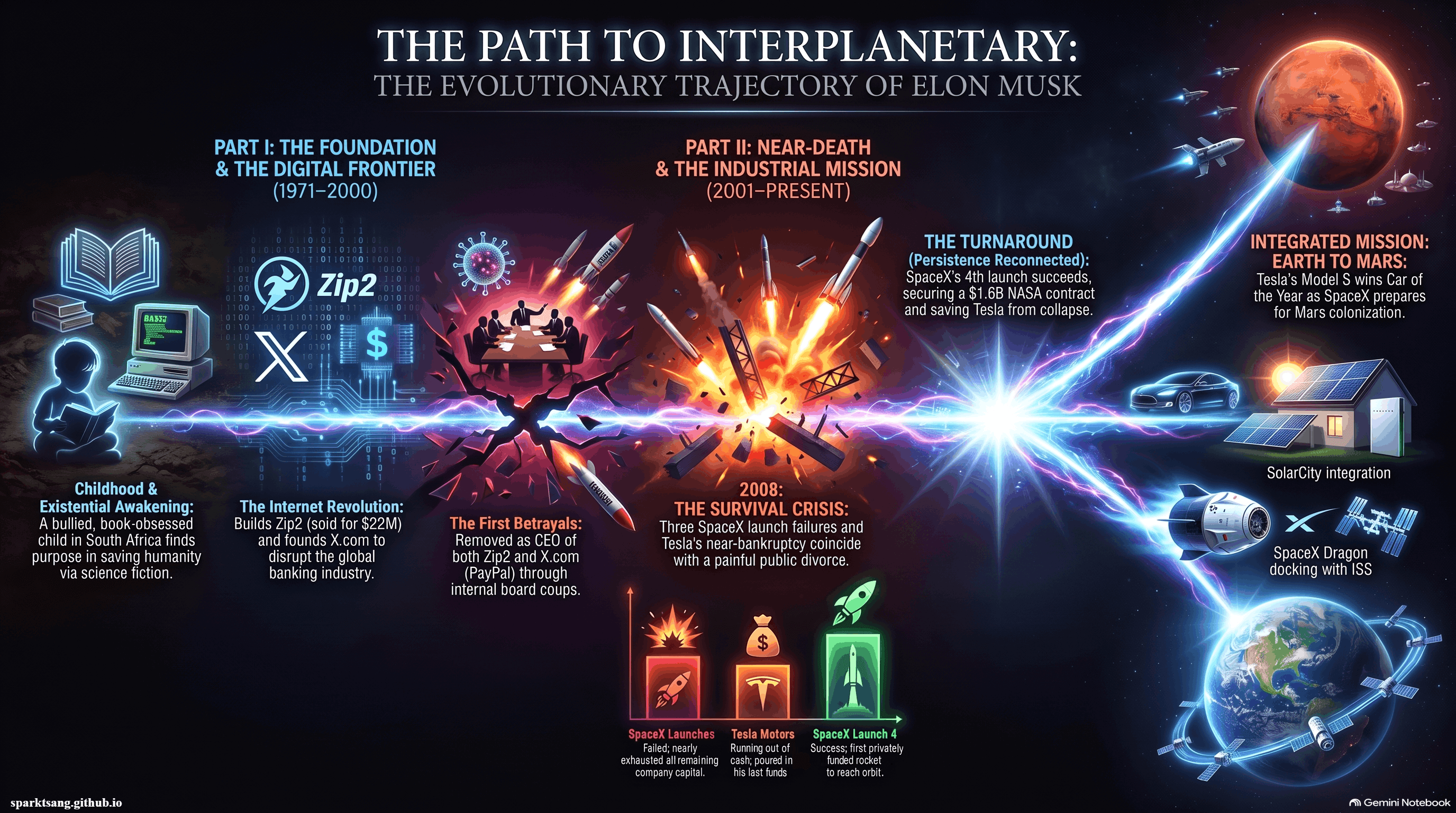
Vance’s biography reveals how Musk uses relentless first-principles thinking to shatter the stagnation of entrenched industries, almost single-handedly building the infrastructure for humanity’s survival.
But while individual genius can revolutionize rockets and cars, the survival of civilization cannot depend on the sheer willpower of a few billionaires fighting broken systems. What if we applied this exact ruthless optimization to the operating system of human consensus?
My philosophy takes first-principles thinking to its final conclusion: an open-source framework structurally designed to strip away noise and gatekeepers, accelerating the survival of truth.
Thank you for reading until the end. This is a bonus infographic just for you.