Notes on Ultralearning
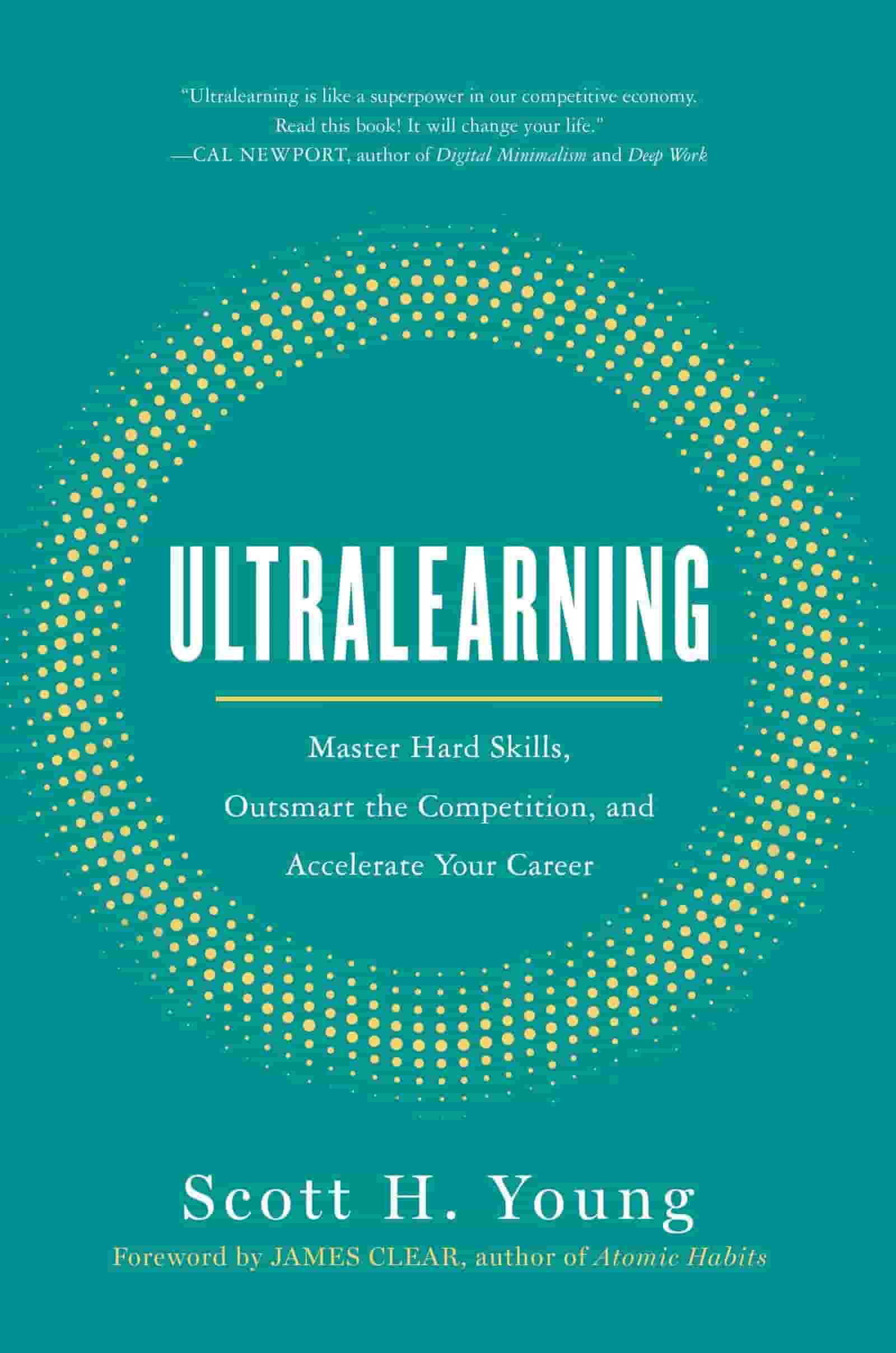
Ultralearning: Master Hard Skills, Outsmart the Competition, and Accelerate Your Career by Scott H Young
Original notes here.
The author completed all 33 online courses covering four years of computer science at MIT in a single year, and passed every exam
Ultralearners are each unique: some prefer a grueling full-time schedule, some retain full-time jobs, some aim specifically at passing exams, while others genuinely aspire to become broadly educated
Yet they still share many traits: working alone, often grinding away for months or years, becoming obsessive about their interests, highly ambitious, debating fiercely over which learning methods only insiders would understand are superior, and possessing strong intrinsic motivation
Economically, the divide is becoming extremely polarized, with mediocrity disappearing; educationally, tuition is too expensive; technologically, entirely new ways of learning have opened up—all of which give ultralearning enormous advantages
Among the ultralearners the author encountered, what drove them forward was a dream, a curiosity that came from within, or even the challenge itself
The author believes innate intelligence is not decisive
You can ultralearn no matter how busy you are: devote part of your time to it, use gaps around your work schedule, and integrate it into what you are already learning
Before writing this book, the author had only encountered ultralearners who had already succeeded; among the more than ten experimental guinea pigs the author followed in ultralearning, one learned public speaking and eventually made it into the top ten of the World Championship of Public Speaking
The author summarizes nine major rules of ultralearning
Rule One: Meta-Learning
Learn how to learn: research has found that bilinguals have an advantage over monolinguals when learning a new language; the author explains this as bilinguals being more knowledgeable about meta-learning
Three big questions: why (motivation for learning), what (the knowledge and abilities needed for success), and how (the resources, environment, and methods to be used while learning)
Why: if learning for functional reasons, it is worth spending time researching deeply whether the goals and means are aligned
What: draw three columns on paper—concepts, facts, and procedures—representing things you need to understand, need to memorize, and need to practice respectively; identify the most challenging items among them to understand the core learning bottlenecks
How: benchmarking: identify the common ways others learn the subject, such as course syllabi; the differences in the quality and efficiency of learning materials may be as much as tenfold; the Emphasize/Exclude method: identify learning areas whose goals align, and omit or delay course elements that do not align with your own goals
It is recommended that 10% of learning time be spent planning; if the learning involves 500 or 1,000 hours, perhaps 5% is enough; this is not something to do all at once before starting, but rather to research as you learn; the author challenges the image of a person painting a portrait who discovers halfway through that they need a different, more precise painting technique
When to do research depends on calculations of diminishing returns and marginal benefit; as research progresses, the benefits become smaller and smaller later on, while once learning reaches a bottleneck, the benefits of further research become greater and greater
Meta-learning ability continues to accumulate, and the real benefit is a long-term one
Rule Two: Focus
Three problems of concentration: being unable to start (i.e. procrastination), being unable to sustain it (i.e. distraction), and being unable to achieve genuine focus
Procrastination: there is an urge driving you to do something else, or an aversion to doing the task itself
The first step to overcoming it is to admit that you are procrastinating, because procrastination is often unconscious, with other thoughts used to cover it up; you have to try to acknowledge that you are experiencing the urge or aversion described above
The workaround: tell yourself that you only need to spend five minutes doing the task, and then you can do something else
Once you start, you may ultimately not want to take a break, but if you use the five-minute rule too often, you may shift from being unable to start to taking breaks too frequently; you can instead use the Pomodoro Technique, focusing for twenty-five minutes and then taking a five-minute break
When you recognize that you are stuck on basic beginner-level problems, do not try to shift to more difficult goals
Distraction: the author discusses flow and its critics; some argue that flow experiences do not occur during deliberate practice because deliberate practice has clear requirements for monitoring goals and feedback
Research has found that, compared with concentrating study into one period, spacing it across different learning sessions makes it easier to remember what was learned, so if you have several hours, it is best for your study to cover several topics; of course, this is only a general principle, and the appropriate balance may vary from person to person
Three sources of distraction: the environment (such as phones, music, and background television noise), the learning task (reading itself allows greater concentration than watching videos, and you can adopt more intensive, cognitively demanding methods such as taking notes), and your mind (when faced with negative emotions, do not suppress them; they need to be resolved)
Unable to truly focus: two factors, arousal and task complexity. When you are sleepy, arousal is low, but when arousal is too high, concentration suffers; experiments show that the drowsy group performed worse than the appropriately rested group, but when a loud, noisy background sound was played, the opposite occurred: arousal can be changed, and the optimal level of arousal varies from person to person
Start small: if you cannot even sit still for one minute, challenge yourself to do one minute first
Rule Three: Directness
Indian architecture graduate Vatsal Jaiswal encountered the financial crisis and received no response after sending hundreds of résumés; he realized that the projects he had done at university did not match the practical work of architects, so he learned how architects actually produce drawings, used the design software Revit—which every company he had applied to used—and self-taught it through online courses to create a new portfolio; he sent it out again, this time to only two firms, and both hired him immediately
Another architect was still trying to deepen his knowledge of design theory unrelated to the practical skills of entry-level work in order to improve his employability
Traditional classrooms tend to favor learning in all sorts of ways detached from real-world application; even learning a foreign language through software such as Duolingo is not the same as actually learning to speak a foreign language
During his MIT challenge, the author found that students frequently complained about lecture videos being missing far more often than they complained about incomplete question banks; they treated the question bank merely as a rough check on whether they understood the material rather than as the target challenge
Real learning happens only when you directly do what you want to become good at
The job-search story above also reflects the failure of formal education, and the author turns to a difficult question in educational psychology: how to achieve transfer of learning
A century of active research has found that transfer of learning cannot happen broadly; an ability learned in one environment cannot necessarily be used in another environment
Empirical evidence includes the finding that taking psychology courses in high school is unrelated to, or even associated with worse performance in, university psychology, and that university students who had previously studied economics showed no significant difference in performance on economics problems
Cognitive scientist Michelene Chi: almost all empirical studies to date have found that even students who have studied worked examples are usually unable to solve problems that deviate slightly from the solution methods used in those examples
The book The Unschooled Mind presents extensive evidence that even when students earn excellent grades in university physics, they are often unable to answer basic problems when a formal professor tests them with a slightly different question format
Corporate training also suffers from this problem; John H. Zenger, former president of The Mirror of the Times Training Group: researchers who rigorously evaluate training outcomes have said that it is difficult to find any obvious changes in employees after training
The ancient theory of “Formal Discipline” held that the brain could be trained like a muscle, regardless of what was being learned, but it had already been criticized by psychologists such as Thorndike by 1901
What we know at present is only that deeply learning a specific field makes later transfer of learning more flexible
The author points out that since transfer of learning is difficult, direct learning reduces the reliance on “far transfer”, making it easier to apply skills directly to the target environment
Specific methods: target your planned learning directly; immerse yourself in the process of actually carrying out the target environment; enter a highly challenging environment as quickly as possible (for example, speak at a middle school directly rather than practice in a public speaking club, whose members are generally lenient)
Rule Four: Drill
Benjamin Franklin, a Founding Father, first became famous for his writing and published his first work at sixteen; his autobiography describes how he broke writing skills into several parts and practiced them repeatedly
An astute reader may notice that this contradicts the previous rule; in fact, the two have an order: after direct practice, analyze and isolate some elements that need strengthening, then return to direct practice to integrate them
Many attempts at isolated drills fail because they do not target the true difficulty, but even feedback from failure is important
The key difficulties are: figuring out when and what to drill (the key is experimentation); improving the design of drills
The 5 drill methods proposed by the author: Time Slicing (for example, repeatedly practicing the hardest section of a musical piece), Cognitive Drills (isolating a specific cognitive component, such as tones in a new language), The Copycat Drill (when something cannot be isolated, directly copying other parts you do not want to practice, such as practicing only the scenery portion of a drawing while copying the other parts from a previous work), The Magnifying Glass Method (when even copying is impossible, deliberately spending more time on the element being practiced), and Prerequisite Chaining (when lacking a particular skill, go back and learn it first; a painter who is weak in color can go back and study color theory)
Traditional drills are forced and do not target weaknesses; drills take on a different character in ultralearning
Rule Five: Retrieval
Psychologist Jeffrey Karpicke found that among four groups of students—those who reviewed once, reviewed repeatedly, freely recalled, and drew concept maps—the free-recall (retrieval practice) group unexpectedly scored 50% higher than the others, even though they received no right-or-wrong feedback during recall
Further research found that recall without prompts is more effective than recall with prompts, which in turn is more effective than cognitive tests that require recognition rather than generating the answer yourself
Delayed testing is better for memory than immediate testing, showing that the more difficult retrieval is, the more effective it becomes, but once it becomes so difficult that retrieval is impossible, it is no longer beneficial
The forward testing effect: regularly testing what was learned previously can make it easier to learn new knowledge later
Retrieval methods: flashcards, free recall (write down everything you have learned on a blank sheet of paper), question banks (ask and answer your own questions), self-created challenges (suitable for skills learning), and closing the book while learning
The great mathematician Ramanujan came from poverty and had only one book, A Synopsis of Elementary Results in Pure and Applied Mathematics by G. Carr, containing formulas but no explanations or proofs, yet it enabled him to teach himself successfully; his contemporaries all believed that his background and starting to learn too late had inflicted irreparable damage on his talent, but modern psychology reveals that his abilities benefited greatly from two tools used by ultralearners: high intensity and retrieval
Rule Six: Feedback
Avraham Kluger’s research found that the overall effect of feedback is positive, but that it has negative effects in more than 38% of cases
Personal praise among them is ineffective, excessive negativity reduces the power to act, while appropriately provocative feedback provides enormous opportunities for learning and improvement
Outcome-based: for example, sales when a new product is launched; a research report on visual sensitivity pointed out that even when the amount of feedback received was so large that it was impossible to tell which parts were correct and which were incorrect, it still helped learning
Informational: further tells you where you are wrong, but does not necessarily explain how to correct it, such as the other person’s reaction when you use a new language, or audience feedback after a speech
Corrective: includes how to make corrections and is the best form of feedback, but can only be obtained through a coach or teacher
Research indicates that immediate feedback generally produces better results
Ways to improve feedback: eliminate noise (some feedback contains considerable randomness, such as how many people share something initially, which may have nothing to do with the quality of the writing), hit effective targets (feedback that is difficult to predict generally provides more information and is therefore better), make it actionable (for example, learning speed), and make it high-intensity and fast (receive feedback frequently)
Rule Seven: Retention
English-language World Spelling Champion Nigel Richards later won the French spelling championship without knowing French; he declined a ride back from his competitors, preferring to cycle, and also refused interviews; the author estimates that he repeatedly recalled the list while cycling
Research indicates that the longer doctors have been practicing, the worse the quality of care, because they gradually forget what they learned
Knowledge declines exponentially (the forgetting curve), for three reasons: decay (with time), interference (new memories overwriting old ones), and retrieval cues being lost (the memory has not disappeared, like a locked box for which you have no key)
Research has also found that memories retrieved through new cues may be fabricated; experiments have shown that memories that feel completely trustworthy and extremely vivid may still be false
Methods include:
Spacing: learning for one hour every day is better than learning for ten hours consecutively; learning sessions that are too close together lose efficiency, while those too far apart lead to forgetting, so you need to find the exact balance
Proceduralization: for example, learning to type so that you go from needing to look at the keyboard to not needing to look; procedural knowledge is harder to forget
Overlearning: additional practice after mastering a skill can extend the duration of memory storage, but the retention period is usually relatively short; it is suitable for skills such as first aid, and the author speculates that combining it with the two methods above might produce a longer-lasting effect; practicing a higher-level skill in advance has a similar effect
Mnemonic methods: make good use of associative memory
Rule Eight: Cultivate Intuition
Psychological theory has found that the difference between chess masters and beginners lies in the fact that masters build a huge database of mental representations from actual experience, enabling them to recognize and remember entire board positions
The mental-calculation genius of Nobel Prize-winning physicist Richard Feynman was likewise based on a large number of computational shortcuts, and his story helps us understand how to use intuition
Do not give up on difficult problems: Feynman would not give up when he failed to fix a radio for someone
Understand through proof: after carefully reading the research papers of Tsung-Dao Lee and Chen-Ning Yang, he realized that reality was not so difficult after all
Start with concrete examples: in a study, participants were asked to check off a vocabulary list; the results showed that participants who were told they would be tested did no better than those who were not told, but those asked to pay attention to whether the words in the list were pleasant remembered twice as much vocabulary as those merely asked to notice whether the words contained the letter “e” (demonstrating the “levels of processing” effect)
Do not deceive yourself: use a large number of questions to expose how well you truly understand the subject
The Feynman Technique: divide the content into headings and formats, and write out the full content of a concept or the answer to a question as though you had to teach it to someone else; it can be applied to things you do not understand, difficult problems that need to be solved, or important concepts for which having an intuition would be highly useful
Rule Nine: Experiment Boldly
Before transforming himself, the frustrated painter Van Gogh trained hard and experimented with many different styles
As skills become more advanced, there are fewer and fewer people who can teach you, making experimentation increasingly important; the rewards include not only mastery but also originality
Like Van Gogh, the focus of experimentation can be on learning resources, learning methods, or style
The author discusses the difference between a fixed mindset and a growth mindset
Several methods of experimentation: imitate first, then create; compare different experimental methods (using split testing); impose a restriction that prevents you from using old methods and forces you out of your comfort zone; combine different skills to experiment with synergies; explore the extreme (Van Gogh’s painting style broke with conventions and was regarded as extreme)
Experimentation is only the starting point; learning is a process of constant experimentation
Designing an Ultralearning Plan
Step One: Conduct in-depth meta-learning research and determine the following: the topic and its general scope, the learning materials and resources to use, how other people successfully learned the skill, direct-practice activities, backup materials and drills
Step Two: Schedule the time—how much, when, and the length of the plan
Step Three: Execute, using the nine rules to question your own progress
Step Four: After completing the plan, review the results and prepare for the next successful plan
Step Five: Choose whether to maintain or specialize, and make a plan; you can also wait until the skill is needed before relearning it
Turning learning into a habit or receiving formal education can also be combined with ultralearning
Nontraditional Education
László Polgár, author of Raise a Genius, trained three world-class chess players through his experiment in raising geniuses; among them, Zsófia even attained the title of International Master, showing that even pushing others to learn intensively does not necessarily bring suffering
The book states that education should begin no later than age three, and specialization no later than age six; specialization is better than dispersion, practice should be turned into a game, victories used to create positive reinforcement, and forced learning rejected in favor of teaching self-directed learning
The author also found that all nine ultralearning rules appeared in the family’s learning methods
A vast database of chess games, 24-hour chess marathons, practicing directly in formal competition settings, chess puzzles hanging on the walls at home, using the Socratic method to pose questions that had to be answered to strengthen memory, carefully selecting partners of similar playing strength, using the spacing method to remember patterns, encouraging creative chess moves, and cultivating a unique style
The author’s advice to parents and educators: design self-motivating learning goals, pay attention to the effects of competition (competition may be motivating when one is competent, but not otherwise), and build a culture oriented toward ultralearning
Learning has no end; only after completing the MIT challenge did the author realize that every subject could be expanded into a PhD research project
Curiosity works by making you more eager to learn the more you learn
Finished reading on July 31, 2020