Notes on How to Not Die Alone
How to Not Die Alone: The Surprising Science That Will Help You Find Love by Logan Ur
Original notes here.
Read until the end to get a bonus. Enjoy reading.
Good relationships are built, and behavioral science shows that people often make choices that run against their own best interests.
Changing behavior takes two steps: examine the hidden forces that influence our romantic decisions; design new patterns to change them.
Let Go of Irrational Expectations
Modern dating problems include too many choices, leaving people at a loss; difficulty knowing whether a choice is right or wrong; social media creating a culture of comparison that makes people more prone to despair; a lack of relationship role models; a wider variety of relationship types; and overwhelming pressure to make the right choice.
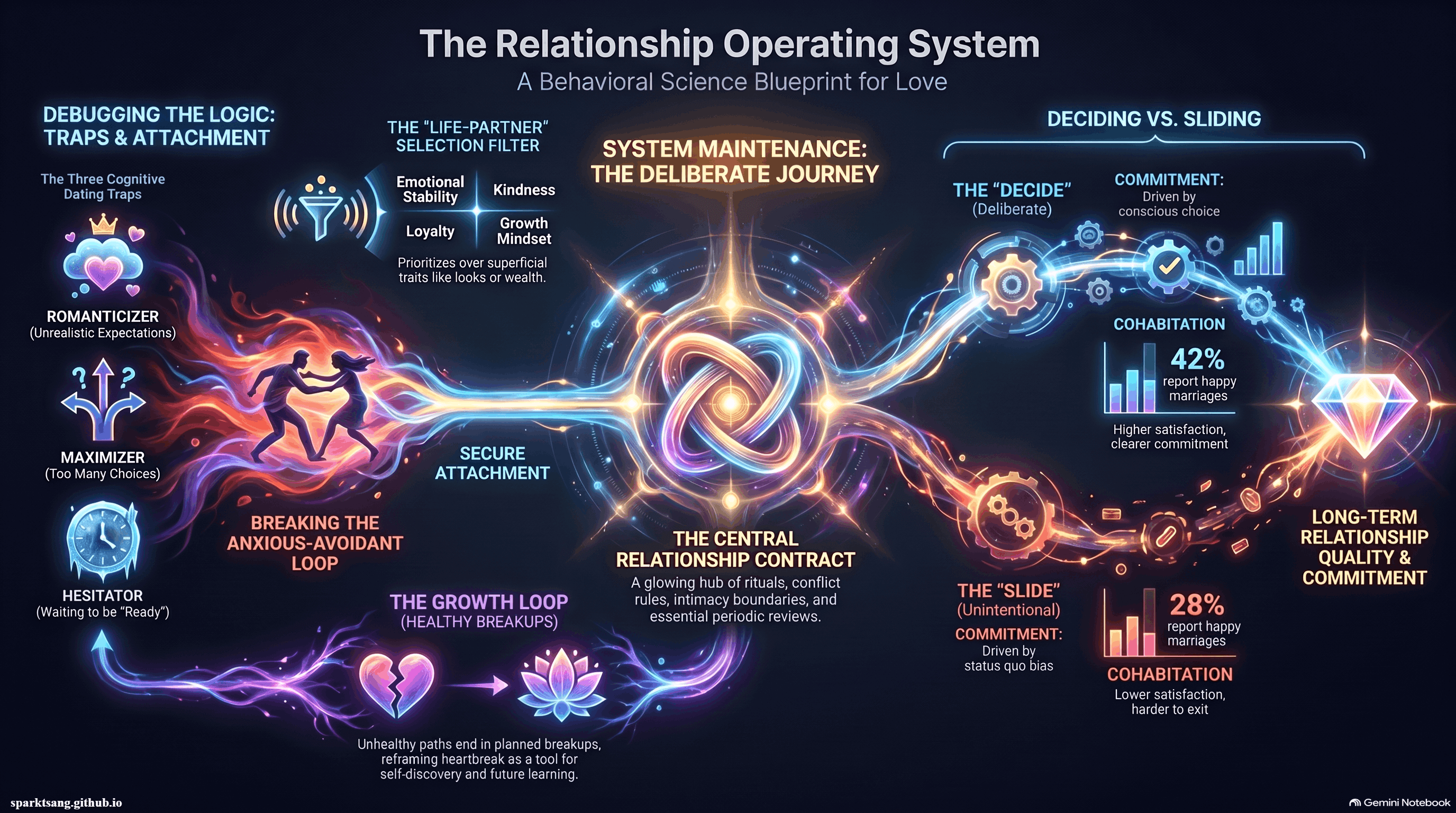
Three major blind spots (The 3 Dating Tendencies): The Romanticizer has unrealistic expectations about relationships; The Maximizer has unrealistic expectations about partners; and The Hesitator has unrealistic expectations about themselves.
Romanticism has become widespread because of the romantic ideas that have prevailed over the past two centuries. The truth is that nobody is perfect, the idea of “happily ever after” is misleading, the beautiful meet-cute is a myth, and the perfect stories on social media are mostly illusions. In short, relationships require work.
Research shows that satisficers—people who stop once they have found something good enough—are far more satisfied than maximizers who insist on finding the best possible option.
Waiting too long to choose only means missing opportunities. Under conditions of limited choices and no chance to go back and choose again, the scientifically optimal strategy, “Optimal Stopping”, is to identify the best option among the first 37%, then choose the next person who is better than that benchmark.
Hesitation is a major mistake because it means missing opportunities to learn. Every skill requires practice. When facing hesitation, set a deadline, do your homework, and make the plan public. (Research has shown that publicly declaring a goal increases the likelihood of achieving it by 20%.) Identify yourself as “a dater” (people who see themselves as voters are 11% more likely to vote, demonstrating the effect of identity). Set specific, achievable goals, and practice self-compassion when you get hurt. Staying in constant contact with an ex makes it difficult to date seriously, so the recommendation is to delete everything.
Stop Loving the Wrong People
Always falling for the wrong people may be the result of attachment style, originating in the research of John Bowlby.
Babies are naturally attached to their mothers. When the mother leaves, they become anxious; when she returns, they settle down. This is secure attachment. Another type involves a baby who calms down temporarily when the mother returns, but immediately becomes angry, cries, and pushes her away. This is anxious attachment. A third type appears to show little reaction, yet the baby’s heart rate rises and anxiety increases when the mother leaves. This is avoidant attachment.
Years later, researchers found that the theory applies to adults as well.
Anxiously attached people are filled with proximity-seeking tactics. They do everything they can to restore intimacy, obsess over the other person’s strengths while putting themselves down, and worry about abandonment when they do not receive an immediate response. Active communication is what allows them to let go of their anxiety. They are prone to suddenly falling into relationships, yet fear loneliness and may remain stuck for a long time without deciding whether to stay or leave.
People who feel they cannot rely on or trust their caregivers may grow into avoidant attachment. They pretend not to want connection with others to reduce the pain of rejection. When a relationship becomes too close, they pull away. This is a distancing tactic. They become fixated on the other person’s flaws and use them as reasons to break up.
The Anxious-Avoidant Loop: anxious and avoidant people are drawn to each other. The latter is skilled at pushing the other person away, and a relationship often develops only when they encounter someone who refuses to give up.
Reliable, confident secure types are the ideal partners. They can prevent or defuse emotional drama in advance, communicate well, behave consistently, set healthy boundaries, and form intimate connections with others. They report greater relationship satisfaction than the other two types. Secure people make up half the population, while anxious types account for 20% and avoidant types 25%. Because secure types are more likely to have long-term, healthy relationships, the remaining two types are disproportionately represented among single people.
Key recommendation: look for a secure partner, manage your own emotions, and move yourself toward secure attachment.
The Ideal Life Partner
If you continue searching for a life partner using a “prom-date mindset” instead of a “life-partner mindset”, you are setting yourself up to fail.
Research has found that people tend to overestimate traits that are easy to quantify. In relationships, these include money and looks.
Financial hardship is a major cause of divorce, but that does not mean people should choose partners based on wealth, for two reasons: beyond a certain point, money cannot produce additional happiness; the happiness people derive from money comes through comparison; and people continually adapt to and become bored with new circumstances—the happiness of lottery winners is far lower than imagined.
Physical attractiveness can signal good genes, but modern science has made children’s survival rates very high, so reproductive fitness no longer needs to be the primary criterion for choosing a mate. Moreover, sexual desire inevitably fades. A 14-year study found that over seven years, sexual desire for one’s partner declined twice as fast as liking for that partner. Human adaptation works the same way with physical appearance: no matter how beautiful someone is, we eventually become accustomed to them.
The importance of having similar personalities has also been greatly overestimated. Research has found that it is unrelated to whether a relationship is happy, and the same is true of shared interests.
Relationship science master John Gottman studied large numbers of couples who had remained happy and satisfied over many years, comparing them with couples who broke up or were unhappy, and identified the following traits that make a good life partner.
First, emotionally stable and kind-hearted: The Science of Happily Ever After: Previous research has found that these two are the most important yet most neglected traits. Emotional stability allows people to regulate themselves rather than be driven by anger and impulse; the greater the degree of emotional stability, the higher and more stable relationship satisfaction tends to be. To assess it, pay attention to how they respond to high-pressure situations.
Kindness enables empathy and care and is crucial to a successful long-term relationship. To assess it, look at how they treat people from whom they have nothing to gain.
Second, loyal: Able to share both good times and bad. To assess it, look at whether they have close friends from different stages of their life.
Third, a growth mindset: An ideal partner faces problems head-on. People with a growth mindset are more likely to invest effort in improving a relationship. Assess whether they embrace challenges rather than avoid them; persist after setbacks rather than give up; see new skills as opportunities for growth; feel inspired rather than threatened by other people’s achievements; and show themselves compassion rather than criticism.
Fourth, brings out your best: You feel confident, valuable, and capable when you are together.
Fifth, can handle conflict: The first priority is to understand that there are two kinds of problems: solvable problems and perpetual problems. Sixty-nine percent are the latter—for example, one partner loves going out while the other prefers staying home, or one likes things tidy while the other is habitually messy. The goal is not to persuade each other or reach consensus, but to find a way to coexist.
Sixth, can make difficult decisions together: Life inevitably brings difficult choices, such as receiving an unprecedented job offer abroad; having a child born with a physical or mental disability; or figuring out what to do when an aging parent requires full-time care.
Dating App Tactics
Dating apps put superficial traits front and center, making us mistakenly believe they are important. We think we know what we want, but we do not necessarily know. Over-filtering makes it easy to miss someone. Choosing a partner the way we choose a product ignores the fact that a person is an “experience good,” not a commodity. They make people indecisive when choosing, and attractive profiles make us automatically fill in the blanks, encouraging excessive fantasy and leading to disappointment.
Ways to improve:
Broaden your filters: being a few centimeters shorter has virtually nothing to do with relationship happiness.
Change the way you look at the other person: constantly searching for reasons to reject someone means constantly missing opportunities.
Do not date too many people at once: too many choices can actually reduce your sense of happiness.
Post good photos: candid shots beat posed ones; selfies are particularly bad; black-and-white photos are surprisingly effective.
Write a detailed profile: faithfully show your personality; describe your interests specifically; do not make it negative.
Also, put effort into your opening line, follow up at appropriate intervals, and ask them out quickly.
Looking in Real Life
Take part in activities where you are highly likely to enjoy yourself and also highly likely to interact with other people. Ask friends and relatives to set you up, tell them what you are looking for, and give them incentives to help. Explore people you already know. Meet strangers.
Going on Dates
First, change your mindset. Do not treat it like a job interview; create a date that both people can enjoy.
Second, the environment matters. Choose the time and place carefully.
Third, choose creative, novel activities.
Fourth, show the effort: research finds that when people see the effort behind a finished product, they value it more.
Fifth, have fun: the motivation to play is instinctive, and the point is simply to play. For example, make up stories about pictures for passersby, analyze whether a couple you see is likely to stay together, or walk around and see how many dogs you can pet within an hour.
Sixth, use the “cut-through-the-small-talk” method: instead of exchanging pleasantries, say something like, “Something amazing happened to me on the way here.”
Seventh, make the other person feel good rather than rushing to show yourself off. Notice the difference between supportive responses and redirecting responses: the former encourage the other person to continue their story, while the latter turn the focus back to yourself.
Eighth, use your phone less: research shows that simply placing your phone on the table can lower the quality of a conversation.
Ninth, end on a high note: make use of the peak-end rule.
Tenth, after the date, ask eight questions to decide whether there should be a second date rather than deciding based on superficial criteria.
- What part of my personality did this person bring out?
- What was happening in my body at the time? Was I tense, relaxed, or somewhere in between?
- Did I feel more energized after the date?
- Did this person make me curious about anything?
- Could this person make me laugh out loud?
- Did I feel that my thoughts and inner voice were heard?
- Did I feel attractive when we were together?
- Did I feel fascinated, bored, or somewhere in between?
Love at First Sight Is Not Necessarily True Love
Research shows that people usually do not feel swept off their feet or immediately click during the early stages of a relationship.
“The Spark” may simply mean that the other person is extremely attractive or narcissistic; it does not necessarily mean there is a connection between the two of you. Ambiguous messages can easily lead anxiously attached people to mistake anxiety for chemistry.
Even when “the Spark” is enough to initiate a relationship, it is not enough to sustain one. Look for a “Slow Burn” that lets love deepen over time is better.
Going on a Second Date
Humans pay too much attention to negative experiences and overlook positive ones, making this one of the biggest enemies of a second date.
The fundamental attribution error makes people assume that the cause of someone’s behavior lies in their personality rather than their circumstances. The solution is to deliberately look for positive explanations for a person’s behavior: they were late because the train was delayed; they replied slowly because work was overwhelming; their joke was terrible because they were nervous but wanted to make me laugh.
The default effect can encourage second dates: making a second date the default from the beginning can dramatically increase the likelihood of going on one.
Define which flaws you can accept and which behaviors are deal-breakers, and clarify your boundaries.
Do not ghost people: the author’s research shows that people who ghost others feel worse about themselves. It is better to reject someone honestly and properly.
Whether to Move Forward
There are two ways of entering the next stage of a relationship: deciding or sliding. Deciding means consciously making a choice, such as deciding to become an exclusive couple or have children. Sliding means entering the next stage without giving it much thought. Research finds that marriage quality is higher among couples who decide, while couples who slide have lower levels of commitment and are more likely to have affairs.
There are many decision points in a relationship. This book focuses on two: defining the relationship and moving in together.
Many people avoid the “what are we?” conversation because it is awkward or because they are afraid of disrupting the status quo. But this is an important decision point. If the other person is not serious, you need to know sooner rather than later.
One technique is to say that you do not know how to introduce the other person when you meet people. Remember that this is a conversation, not a negotiation. Respectfully listen to the other person, and even if the answer is not what you hoped for, appreciate the fact that you now know more.
In the United States today, 50–60% of couples cohabit before marriage, but many people do not seriously treat this as a decision point. Research has surprisingly found that couples who live together before marriage report lower satisfaction after marriage and higher divorce rates. Cohabitation greatly increases the cost of breaking up, making it harder to evaluate the quality of a relationship honestly and creating a status quo bias. Once cohabiting, people are more likely to stay in an unhealthy relationship than couples who do not live together.
Among couples who deliberately decide to live together, 42% go on to have happy marriages, compared with only 28% among those who slide into cohabitation.
Two people may have completely different ideas about what living together means. Without this conversation, once the lease has been signed, it is too late.
Reach an agreement before signing the lease. Set aside a day to answer:
Why do we want to live together? What does living together mean to you? What expectations do you have for the relationship? Have you considered marriage? If so, when do you expect it to happen? What are you afraid of about living together?
The Best Time to Leave
Some people, driven by the maximizer mindset, always want to find something better and therefore break up too early. Others, driven by romanticism, expect a relationship to remain in a constant state of passion and therefore break up too early.
People who break up too early underestimate the opportunity cost of ending a relationship. They never learn how to be a long-term partner.
Fewer than one in ten divorcing couples have sought professional help, yet decades of research have shown that many relationships could have been saved if both partners had sought help in the beginning.
Breaking up too late drags down both people’s futures. The sunk cost fallacy is like buying a ticket, discovering the movie is terrible, and staying until the end anyway. Yet many people, influenced by loss aversion, continue on despite the damage.
Stay or go? Try the following.
First, the wardrobe test: Imagine that your partner is an item of clothing in your wardrobe. Some people say a little black dress—something that makes them feel confident when they wear it. Others say a wool sweater: warm, but itchy after wearing it for too long. If the relationship is worn out, uncomfortable, and makes you not want to go out, that is a bad sign.
Second, is the current situation understandable?
If they cannot meet your needs because of a job change, a parent’s illness, or some other circumstance, can the relationship return to normal once the situation ends?
Third, have you tried to repair the relationship? Rather than avoid the challenge, tell your partner what changes you hope to see.
Fourth, what are your expectations for a long-term relationship? Are they realistic?
Fifth, reflect on who you are in the relationship: Have you brought the best version of yourself into it? Have you done everything you can to maintain it? Can you become a kinder, more committed partner? Look inward—the answer may lie with you.
If you still cannot decide, ask friends and family for honest advice. Never punish them simply because they told you what they truly think.
Ending It Bravely
Step one: record your reasons for wanting to break up.
Step two: make a concrete plan. Set a deadline, decide the time and place, rehearse the conversation, choose a private and quiet setting, and choose the timing carefully. Do not choose a critical moment in the other person’s life to drop the bomb.
When the other person asks what is wrong with them, do not answer. The issue is simply that they are not right for you, not that there is something wrong with them. Even if there were, you have no standing to criticize them, because at this point you are a biased source of information and have no authority to judge their worth. You are breaking up, not conducting a performance review. Problems should have been raised and addressed before you made the decision to end the relationship.
Plan the important conversation: What is the goal of the conversation? What is the core message? What tone do you intend to use, and what tone should you avoid? How will you open the conversation? List the messages you need to communicate. What reactions are you worried about? What will you do if they happen? How will you end the conversation?
Step three: get a friend to hold you accountable. For example, write yourself a $10,000 check payable as a campaign donation to the presidential candidate you most strongly oppose, and give it to a friend with instructions to mail it if you have not broken up by the deadline.
Step four: make sure both people remain calm and do not fall into a “fight-or-flight response” mode.
Step five: schedule what comes immediately afterward. Do not spend the aftermath alone with your loneliness and anxiety. Choose the friend who can best distract you and help you process your emotions.
Step six: make a breakup contract with your ex. A contract is a good way to push yourself through a difficult conversation.
Step seven: change your habits to prevent regret. For situations in which you used to share things with your partner, write down who you can turn to instead.
Step eight: do not try to be the “good breakup person.” Do not overcare for your ex. Summon the courage to accept responsibility for having hurt their life, but do not try to repair the damage immediately. Trying to be the good person will only make things harder for them. You need to give them space to move on.
Getting Through Heartbreak
Framing effect: when the same surgery is presented in terms of a survival rate, 84% of doctors choose to perform it; when presented in terms of a mortality rate, only half choose to do so.
After a breakup, change the frame: turn the pity party into a celebration, and recovery can happen faster.
Photos of a romantic partner activate the brain’s nucleus accumbens. Drug use in addicts activates the same region. After a breakup, the brain goes through something remarkably similar to withdrawal.
Breaking up increases cortisol and suppresses the immune system. People may experience insomnia, intrusive thoughts, depression, anger, anxiety that seriously damages mental functioning, lower intelligence, poorer reasoning and logic, and higher rates of drug use and crime. Even the person who initiated the breakup can experience the same effects.
Loss aversion: the brain is extremely sensitive to losses, and a breakup is a painful loss.
Yet research also finds that the pain is rarely as intense as people anticipate. People are stronger than they imagine. Among people who had ended a long-term relationship several months earlier and had not started a new one, only one-third viewed the breakup negatively; 25% were neutral, and 41% were positive.
Reframe, first move: the benefits of breaking up. Spend half an hour writing down ten benefits.
Reframe, second move: the downsides of the relationship. Sandra Langeslag’s research found that participants who thought about the negative aspects of their relationship were far less infatuated with their ex than the other two groups—those who read an article saying that intense emotions after a breakup are completely normal, and those who did an unrelated activity.
Reframe, third move: rediscover yourself. Research finds that both spending two weeks continuing normal routines and engaging in activities that help you rediscover yourself are effective, but the latter works better.
Research also finds that immediately starting a new relationship is not necessarily worse than taking time to recover first; in some respects, it may even be healthier. With a seamless transition into a new relationship, there is less time spent questioning oneself. And the only way to know whether you are ready is to actually start dating again.
Reframe, fourth move: learn the lessons and improve your future choices. Think about how you will change the way you approach future relationships.
- What kind of person were you in the previous relationship? (Were you the one setting the pace for the two of you, or were you being pulled along? Were you the one counseling your partner, or were they counseling you? Were you quick to become emotionally invested, or were you the one who found it difficult to settle into the relationship?)
- What kind of person would you ideally like to become in your next relationship?
- What have you learned about what truly matters in a long-term relationship?
-
What qualities will you pay attention to when looking for a partner in the future that you did not pay attention to last time?
In addition, the following questions can help you explore the deeper meaning of the breakup: - What did you learn from the relationship?
- What did you learn from this breakup?
- How are you different now from who you were before the relationship?
- What changes will you make in your life because of this experience?
Before the Red Carpet
Research finds that marital satisfaction has a huge impact on happiness, physical and mental health, life expectancy, financial circumstances, and children’s well-being.
During the first few years of a relationship, the brain is under the influence of love’s drugs and cannot evaluate the relationship rationally. Couples who wait a little longer before marrying have a higher chance of staying together because the high of the honeymoon period has faded and the brain is clearer.
Getting married after dating for one to two years, compared with less than a year, reduces the divorce rate by 20%.
Getting engaged after more than three years, compared with getting married within a year, reduces the divorce rate by 39%.
Marrying at an older age also lowers the divorce rate.
Among couples with different religious beliefs, fewer than half discuss their children’s religious upbringing before marriage. Many people do not seriously and honestly discuss major life decisions before marriage because of the combined effect of the drugs of love and the false-consensus effect (humans naturally overestimate how similar other people are to themselves).
Preparation, Part One: Yourself. Answer the following questions.
- Does this person seem more like a short-term partner or a life partner?
- The wardrobe test.
- Will this person grow with me?
- Do I admire this person?
- What kind of personality does this person bring out in me?
- Would I want to share good news with this person?
- After a hard day at work, would I want to tell this person about what happened at work?
- Do I value this person’s advice?
- Am I looking forward to building a future with this person? Can I imagine going through life’s milestones with them?
- Can this person face difficult choices with me? If I experienced a major setback, would this be the person I would want beside me, thinking through difficult problems?
- Can we communicate effectively and argue effectively?
Preparation, Part Two: The Relationship
Work through one of the following three sets of conversations each evening.
First set: The past
- Name three experiences that defined who you are.
- How have your childhood experiences shaped who you are today?
- Did your parents argue in the past? What fears do you have about conflict in relationships?
- Does your family of origin have traditions you would like to bring into our family?
- How did your family of origin discuss sex when you were growing up?
- What did money represent in your family of origin?
- Are there any burdens from your family of origin that you would like to leave in the past?
Second set: The present
- When something happens, do you feel comfortable discussing it with me?
- Do you think our current communication pattern needs improvement?
- In this relationship, do you feel that you can be yourself? Why?
- What needs to change in the relationship?
- How well do you handle conflict?
- What ritual do you most enjoy doing together?
- What would you like us to do more often?
- How well do you think I know your family and friends? Is there someone in your life you would like me to get to know better?
- What is your ideal frequency for sex? How could our sex life become better? Where could I improve? Is there anything you have always wanted to try but have been afraid to say?
- How often do you think about money?
- Honestly discuss the two of your financial situations. Do you have student loans or credit card debt? Would you help me pay them off?
- What is the maximum amount we would spend on a car? What about a sofa? What about a pair of shoes?
Third set: The future
- Where do you want to live in the future?
- Do you want children? If so, how many, and when? If infertility becomes an issue, what options would you consider, such as adoption or surrogacy?
- How will we divide childcare and housework?
- How often would you like to see your family?
- What role would you like faith to play in your life?
- Would you like to discuss a prenuptial agreement? What are your concerns about it?
- How would you like us to divide our finances in the future?
- Will you continue working indefinitely? If one of us wants to take some time off, what would we do?
- If I want to buy something expensive, in what circumstances should we discuss it beforehand?
- What are your long-term financial goals?
- What are you most looking forward to in the future?
- What are your dreams for the future, and how can I help make them happen?
Deliberate Dating
Research finds that self-reported marital satisfaction declines as the years of marriage increase. In addition, from 1972 to 2014, the proportion of couples who considered themselves extremely happy also steadily declined.
A team of Harvard psychologists found that most people believe they have changed a great deal over the previous ten years, but do not expect themselves to undergo major changes over the next ten years. This is called the illusion of the end of history. The truth is that people are always growing and changing, and relationships are no different.
Relationships require deliberate effort to last, and they must continually adapt to new circumstances.
The author says the best tool is a relationship contract, which facilitates the regular conversations that are necessary to clarify both partners’ expectations for the relationship. Topics to discuss include how often to see relatives, how to divide the bills, the importance of sex, whether the relationship is exclusive, and what exclusivity means.
The point of these conversations is not bargaining but values—for example, “We commit to supporting each other’s dreams and making the necessary sacrifices to make those dreams a reality.”
The first page of the contract should specify a concrete date for a review. On that day, the two partners will give each other feedback and review how things are going, periodically repair the relationship, and make necessary revisions.
The author and her husband have a five-minute caring ritual every Sunday. They ask each other: How was your week? Did you feel supported by me? How can I support you next week? She recommends that everyone design a caring ritual, deciding when and where it will happen, what questions to ask, how to make the ritual special, and how to do it when you are apart.
The relationship contract has two parts.
Part One: Self-Reflection Worksheet
Fill in the following: when you have time available to spend with your partner, and how many times a week you hope to spend one-on-one time together.
Rituals: My three favorite relationship rituals; what new rituals would I like us to establish in the future? (For example, grocery shopping, going to the movies, breakfast in bed.)
Special activities: What three special activities do I enjoy doing with my partner? (For example, traveling, going to a high-end restaurant, taking a class together.)
Alone time: How much alone time do I need? What are my favorite solo activities? (For example, grocery shopping, yoga.)
Social life: Which activities with friends do I want to maintain? Which friends would I most like my partner to get to know? How much do I want my partner integrated into my social life: completely integrated, partially integrated, or separate?
Family: How often would I like to see my family? Which holidays or occasions would I like to spend with family?
Emotional needs: There are five love languages: words of affirmation, quality time, gifts, acts of service, and physical touch. Which do I prefer?
Stress management: What do I like to do to relieve stress? (For example, take a bath, spend time alone, talk things through, go for a walk, call a friend.) When I am stressed, how do I want my partner to support me? (For example, listen to me vent, distract me, give me space, offer solutions.)
Conflict: When we disagree, what communication method do I prefer: talking face-to-face, email, or text messages?
Sex: How important is sex to me? How often would I like to have sex with my partner?
Relationship model: Exclusive, mostly exclusive, or completely open.
Part Two: Relationship Contract
Set aside time to create it together. Ideally, choose a place that is both relaxing and romantic.
Share your answers to the self-reflection worksheet. Practice active listening by restating what your partner has said so they know their feelings have been heard. Take breaks when you need them. When you finish, sign the contract and kiss.
“Maintaining a relationship takes effort. We choose for both of us to invest in our love, happiness, and growth. We understand that strengthening a relationship while love is strong is better than repairing it only after problems arise. This promise is made for our shared happiness. Effective date: __; review date: __.”
“Bids for connection” are a fundamental element of emotional communication. Happy couples “turn toward” 86% of these bids, while unhappy couples turn toward only 33%. We commit to making bids often and doing our best to respond to each other’s bids.”
Rituals: One-on-one time each week at the following times: __; how many times a week we spend time together without our phones: __. We commit to doing our favorite shared rituals as much as possible, as follows: __. If we miss one, we will make it up in the following way: __.
At the next review, we will establish new rituals. (For example, making brunch together on Mondays, or telling each other one thing we are grateful for before bed.)
Special activities: The three special activities that matter to both of us are __. We commit to making time for these activities, at the following frequency: __. (For example, cooking together once a week.)
Alone time: Explain each person’s different needs and accept them.
Social life: We want our social circles to be completely shared, partially separate, or completely separate.
I commit to getting to know the following three people in my partner’s social circle: __. Before the next review, our social-life goal is __. (For example, attending more gatherings together, joining a sports team, having a monthly dinner.)
Family: My partner and I will see each other’s families at the following frequency: __.
Holidays and special occasions: We rank special occasions as follows: __. How we will arrange each occasion: __.
Emotional needs: We each want to receive care in the following ways. (Which of the five love languages?)
Stress relief: We understand that everyone handles stress differently. We will list each person’s preferred ways of relieving stress and how we want our partner to support us.
Conflict:
We understand that some behaviors damage relationships. Behavioral scientists have found that four behaviors are associated with couples who are more likely to break up or remain unhappy: criticism, contempt, defensiveness, and stonewalling. We commit not to engage in these Four Horsemen of the Apocalypse. During conflict, we would like to use the following communication methods: __. When emotions become overwhelming, we will use the following code word to ask the other person to pause: __.
Information on the Four Horsemen:
https://www.gottman.com/blog/the-four-horsemen-recognizing-criticism-contempt-defensiveness-and-stonewalling/
Sex: How important is it? We commit to having sex at least once every __.
In our sex life, we commit to making a genuine effort, giving to each other, and being willing to try anything within reasonable limits. (Dan Savage’s GGG concept: good, giving, game.)
Relationship model: Exclusive, mostly exclusive, or completely open.
Summary: We know that a healthy relationship requires sustained effort. We understand that our priorities, interests, and feelings may change over time, and we commit to following the above until our next review or until we break up.
Finished reading on September 19, 2024
Thank you for reading until the end. This is a bonus infographic just for you.