Notes on The Path of Least Resistance
The Path of Least Resistance: Learning to Become the Creative Force in Your Own Life by Robert Fritz
Original notes here.
Read until the end to get a bonus. Enjoy reading.
Boston’s roads were originally paths carved out by cattle. The cattle had neither consciousness nor a plan; they simply chose, step by step, the easiest places to walk. Water likewise follows the path of least resistance.
Three great insights about life:
- Life is like a river: like everything else in the natural world, it follows the path of least resistance.
- The path of least resistance is determined by the hidden structures in your life. Just as the direction of a river’s flow is determined by the structure of the riverbed beneath it.
- The fundamental hidden structure of life can be changed, allowing the river to flow in accordance with your wishes.
Structure determines behavior. To achieve a particular outcome, you must change the underlying structure. Psychology assumes that dysfunctional behavior stems from problematic internal states. For example, unresolved problems with your mother may cause you to avoid romantic relationships with women; you need to resolve the problem to return to a normal state. These approaches cannot solve structural problems. Their effects are temporary, and eventually everything returns to its original state.
The Structural Conflict
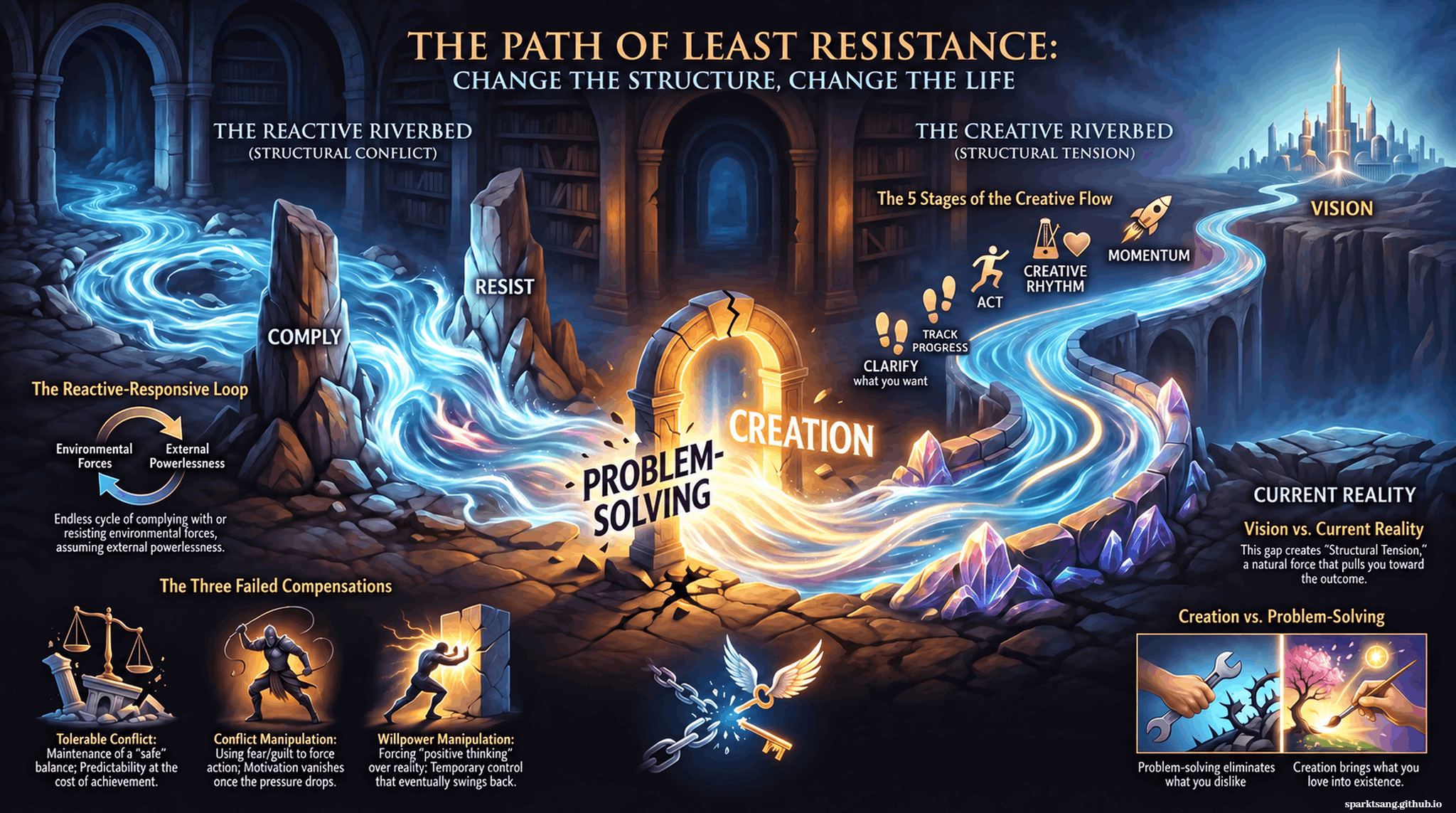
The “reactive-responsive orientation” is the primary driving force of life: most people believe that life is driven by the environment, and that there are only two choices: comply or resist. A person who responds (complies), if powerless for long enough and sufficiently resentful, will suddenly turn into a difficult, defiant person. A person who reacts (resists), if powerless for long enough and sufficiently conflicted internally, will eventually return to compliance. Many lives swing back and forth within this cycle. The basic assumption is that people are powerless while the forces of the environment are overwhelmingly powerful. Whether complying or resisting, they attribute their own actions to the environment. “My son threw dishes around, and I couldn’t help yelling at him for five minutes.” “They enthusiastically invited me to the gathering, so I had no choice but to say yes.” Within this orientation, avoidance strategies are also common, and may even develop into long-term strategies for preventing problems before they arise. For example, Frank, who grew up in a poor family, became extremely careful with every penny after becoming wealthy, lest he fall back into poverty. He avoided meeting his secondary-school classmates so they would not remind him of the past, and he also avoided media content related to poverty. On the surface, he may be wealthy and powerful, but he must constantly find ways to control his environment to avoid the life he fears most. He never feels truly safe or inwardly at peace. His mental life is effectively imprisoned within a variety of preventive strategies, exhausting all his energy in pursuit of a false happiness, while inwardly lacking any sense of achievement or fulfillment. The Structural Conflict cannot be untangled. Do nothing until you understand the structural mechanism behind it.
Creation, Not Problem-Solving
The problem-solving mindset is even more deeply ingrained: what candidates reiterate to the public is always a pile of problems. Yet the greatest leaders and statesmen in history were not problem-solvers but creators. The famine in Ethiopia prompted massive donations and emergency relief, and indeed many people were saved. But the forces governing the situation did not change. As conditions improved, the urgency cooled and donations declined, while the problem continued. A problem appears, triggering problem-solving action; the problem improves, which causes problem-solving action to decline; eventually the problem still exists. The same is true of life. If you treat problem-solving as a way of life, you are destined to fail. Many people regard creativity as solving difficult problems in some unusual way. In fact, problem-solving and creation are two entirely different things. The Africa Food and Peace Foundation trained villagers in Uganda to create the lives they wanted, and succeeded. Compared with previous relief spending, the cost of this program was a drop in the bucket. The program focused on what people wanted rather than what they did not want. For example, if they wanted a clean water source, they would find one and protect it. If you do not know how to create what you want, you will always be confronted by a succession of new problems. Only creation allows you to avoid problems.
What Is Creation?
Creation is different from compliance–resistance or problem-solving. It does not arise from the environment in which you find yourself; the creative activity itself is its driving force. Skills can be acquired through learning and cultivation, and the steps are easy to describe, but they do not constitute a formula that can simply be applied.
-
Clarify what you want to create This is a skill. What schools teach is merely how to choose the correct way to conform from among the limited choices available in life, which has little to do with what we want.
-
Keep track of progress When painting, if you do not know how much you have painted, you will not know how to finish. Only by objectively examining reality can you take control of your creative process.
-
Take action Take the creative idea as the goal, observe how the results change, and you will know what to do next. Alongside trial-and-error, you are also cultivating your intuition. The habit of giving up is simply the result of following the path of least resistance. Determination and perseverance are of no use; exhorting yourself to keep going is ineffective. What keeps creation going is learning as you go.
-
Follow the rhythm of creation The three stages are Germination, Assimilation, and Completion.
Germination begins with excitement and a sense of novelty. Assimilation means accepting the creative idea and internalizing it. The power present at completion is similar to that of the germination stage, preparing you in advance for the next creative process. -
Accumulate creative momentum Every act of innovation accumulates experience and knowledge; a first work becoming an instant sensation is not the norm.
The Creative Orientation
The Structural Conflict and creation are both structures. Which orientation you belong to depends on which type of behavior you spend the most time engaged in.
The former makes people subject to an unpredictable environment, allowing emotions to dictate their lives and treating emotion as the indicator for whether to comply or resist. Life becomes like moving through a maze, with high walls all around; whenever they encounter a new dead end, they are utterly astonished. They continually cling to unfounded hope, believing that a new environment will appear and free them from the intrusion of conflict, so they constantly seek a “suitable” environment: a suitable job, partner, financial situation, faith, opportunity, place to live…
In the latter, the environment is merely a force at your disposal in the creative process. To be immersed in it is essentially to inhabit another universe.
Creators understand that emotions do not necessarily reflect whether an environment is good or bad. They are wise enough to understand that emotions always include both good and bad, and that whether sunk in despair or filled with joy, they can still create.
Those in the compliance–resistance orientation often advise that people’s behavior should be appropriate to one another: if you are too serious, they tell you to relax; if you are too conventional, they tell you to be bold; if you are afraid of the unknown, they tell you to summon your courage. The driving force behind the creator, by contrast, is a powerful desire to bring the work into existence. Nothing else matters; creation is pursued for the sake of creation itself.
Robert Frost: Those who accomplish great things do so for “the deed for the deed’s sake”.
Love for a work is like love for a child; being able to separate yourself from your work is one of the profound truths about creativity: love.
Only then can you understand that God’s creation of the universe was entirely an act of love.
People raised within the Structural Conflict lack the experience of creating purely out of love. They regard doing what they want as a luxury rather than an ordinary way of life. Their bodies may be well fed and sheltered, yet their spirits remain unfulfilled.
They may even delude themselves into believing that doing what they want is itself improper or selfish; even when they do it, they must explain it as something necessary because they have no other choice.
People who engage in destruction do so because they have failed to find their own creativity; that is what drives them to evil acts. It is not because they are capable that they scramble for power and profit; it is precisely because they are incapable that they manipulate others as they please.
Everything invented and every field of study in the world originates in creation. Beethoven’s Grosse Fugue was judged unlistenable at the time; today, most string quartets include it in their standard repertoire.
How do we come up with what we want? This is a fiction created out of nothing. To people who can understand creation only through the Structural Conflict, and who are prejudiced against fiction, it will seem heretical. If, like most people, you ask “how?” first, you will be limited to things that are already known or can be imagined. The outcome comes first; the vision matters more than the process. Beyond that, the value of the creative experience seems to have no relationship to the final achievement. Before anesthetics were invented, physician Alfred Velpeau said in 1839 that painless surgery was an absurd fantasy. In the same year that the airplane was invented, astronomer Simon Newcomb said that flight had been logically proven impossible. In 1945, Admiral William Leahy told the President that an atomic bomb was impossible because atoms could not be split. Napoleon dismissed the steam engine, telling its inventor that the idea of a steam engine was pure fantasy.
Tension
A law of nature: tension seeks resolution, from spider webs to the human body, from the formation of galaxies to plate tectonics, from pendulums to wind-up toys. The same applies to the structure of dialogue: a question creates tension, and an answer seeks resolution. Hunger creates tension, and eating tends toward release; being overweight creates tension, and not eating tends toward release. At this point, the two tensions cannot be released simultaneously, resulting in a back-and-forth oscillation. Desire creates tension, and success releases it; but it is very common to want to create something while, deep inside, also believing that you cannot have what you want. Wanting to change that belief likewise creates an opposing structural tension. Even if you want to abandon all desire, the less you desire, the easier it becomes to have desires. Trying to change a structure from within the structure itself is always futile. Actions taken to resolve structural conflict will only make you increasingly constrained, while the structure becomes increasingly entrenched. This is the nature of structure.
Compensation
Three major compensating strategies for the structural conflict described above:
- Staying in the tolerable conflict Keep two rubber bands pulling in opposite directions at roughly equal tension, maintaining balance. Minimize harm, avoid stirring things up, and act “pragmatically.” Sacrifice creativity and the highest achievements in exchange for predictability and stability.
- Conflict manipulation People discover that they often act only under pressure, so they increase the pressure to force themselves to act. Illusory pressure arises from anticipated negative consequences: a company launches a new initiative because of a threat from competitors; employees show greater drive because they fear losing their jobs; a smoker decides to quit after hearing statistics about lung cancer. They make the conflict stronger or worse. As always, once the pressure decreases, motivation weakens with it. The path of least resistance will soon carry them away from the outcomes they want. The long-term effect of this strategy is to reinforce people’s sense of powerlessness. The formulas for controlling conflict are always the same: fear, guilt, and sympathy. The more extreme the conflict, the more extreme the action; terrorists are the archetypal example. Both opposition to and support for nuclear weapons create an atmosphere of fear of destruction to manipulate the conflict. Structurally and formally, how are they different? People who overeat are often warned during training that they are powerless, and that if they do not keep a close watch on themselves, the addiction will return. Stanton Peele: The methods of other addiction experts are, in fact, all ways of destroying addicts’ self-control.
- Willpower manipulation This is common in “positive thinking”: it advocates using extraordinary means to implant programming in the subconscious, forcing it to accept positive thoughts. If your method of control is more powerful than the subconscious, why invoke the subconscious at all? Its implantation technique is like forcing an elementary-school student to write lines, with only the content changed: “The entire universe supports me,” and so on. Repeating it over and over merely shows that you did not believe it in the first place. Its two deeply rooted but unstated assumptions are: first, you must overcome negative habits in order to control yourself; second, reality is too dangerous, so you must cover it up with favorable interpretations. By contrast, within the creative orientation, you can create what you want whether or not you have negative habits. Another key is that you must tell yourself reality as it actually is. The result of controlling willpower is that, because willpower is exaggerated, the structure eventually swings back and forth again, returning to a tolerable range. The first strategy, keeping within a tolerable range, views reality too narrowly; the conflict-control strategy is too pessimistic; the willpower-control strategy is too optimistic. Conclusion: None of the compensation strategies can succeed because of structural constraints, unless you enter another structure. But because you are dissatisfied with this structure, switching to another useful structure is also futile, because that too is merely another form of conflict-control strategy.
The Creative Structure
In the creative process, the gap between the vision and the current reality constitutes the most important structure, called “structural tension.” The larger the gap, the more creative power can be harnessed; the smaller the gap, the more the tension tends toward release. Once this new structure becomes dominant, the path of least resistance will also change. The new structure is better able to integrate conflicts and turn complex structures into simple ones. Situations that may reduce tension: compromising with reality, allowing the current state to continue; misunderstanding the current state, indulging in fantasies detached from reality. Vision, the best starting point for the creative process, is the endpoint. First comes the concept, then the vision. The former is general, while the latter is concrete and rich in detail: the first lesson of a creative technology course is to have students conceive the outcome they want to create. Life itself may also be a creation, and a creation exists independently of you. Again, many people confuse what they want with what is possible. Many plans produce poor results because people do not know what they truly want. Making up excuses to absolve oneself has become fashionable, but to adjust your actions you must understand the real reason for failure. Reality is the only foundation on which to begin the creative process; selective acceptance is ineffective.
Finished reading the first part on May 17, 2020
The remaining part of the book explains the cycle of creation, how to make the right choices, the distinction between primary and secondary choices, and the absurd reasons why people make all kinds of absurd choices.
It seems to lapse into common sense and repetitions of existing ideas, without advancing beyond the original theoretical framework. The intended readers appear to be complete beginners with no prior concept of the subject.
Thank you for reading until the end. This is a bonus infographic just for you.