Notes on The Power of Now
The Power of Now: A Guide to Spiritual Enlightenment is a book by Eckhart Tolle
Original notes here.
Read until the end to get a bonus. Enjoy reading.
On his twenty-ninth birthday, the author wanted to die in despair. He said to himself, “I cannot live with myself any longer.”
Suddenly he saw that there were two “I”s in that sentence, and realized that only one of them could be real. He awakened. He feared nothing and fell into emptiness.
After awakening, everything was new, filled with a vitality he had never perceived before. Even when lying for long periods on a park bench, he felt immense joy. He eventually became a spiritual teacher.
Chapter One: You Are Not Your Mind
A beggar sitting by the roadside is told by a passerby to look inside the old box he has been sitting on. To his astonishment, he discovers gold inside.
The author identifies himself with the passerby: the greatest happiness is already hidden within every person.
The Buddha said that awakening is freedom from suffering, but did not say what remains after suffering is gone, implying that we must find that out for ourselves.
Awakening is the perception of Being. Being is the source of life; all life is an expression of it. Being can only be felt, never arrived at through thought.
A still mind can perceive Being. When you are completely absorbed in living in the present moment, you can feel Being.
The word “God” has been misunderstood for thousands of years and is no longer suitable. Many people speak of God without knowing what God is. God has become a closed concept: whenever it is invoked, an image arises.
Words such as God or Being cannot convey the vast reality behind them. Do not cling to the name.
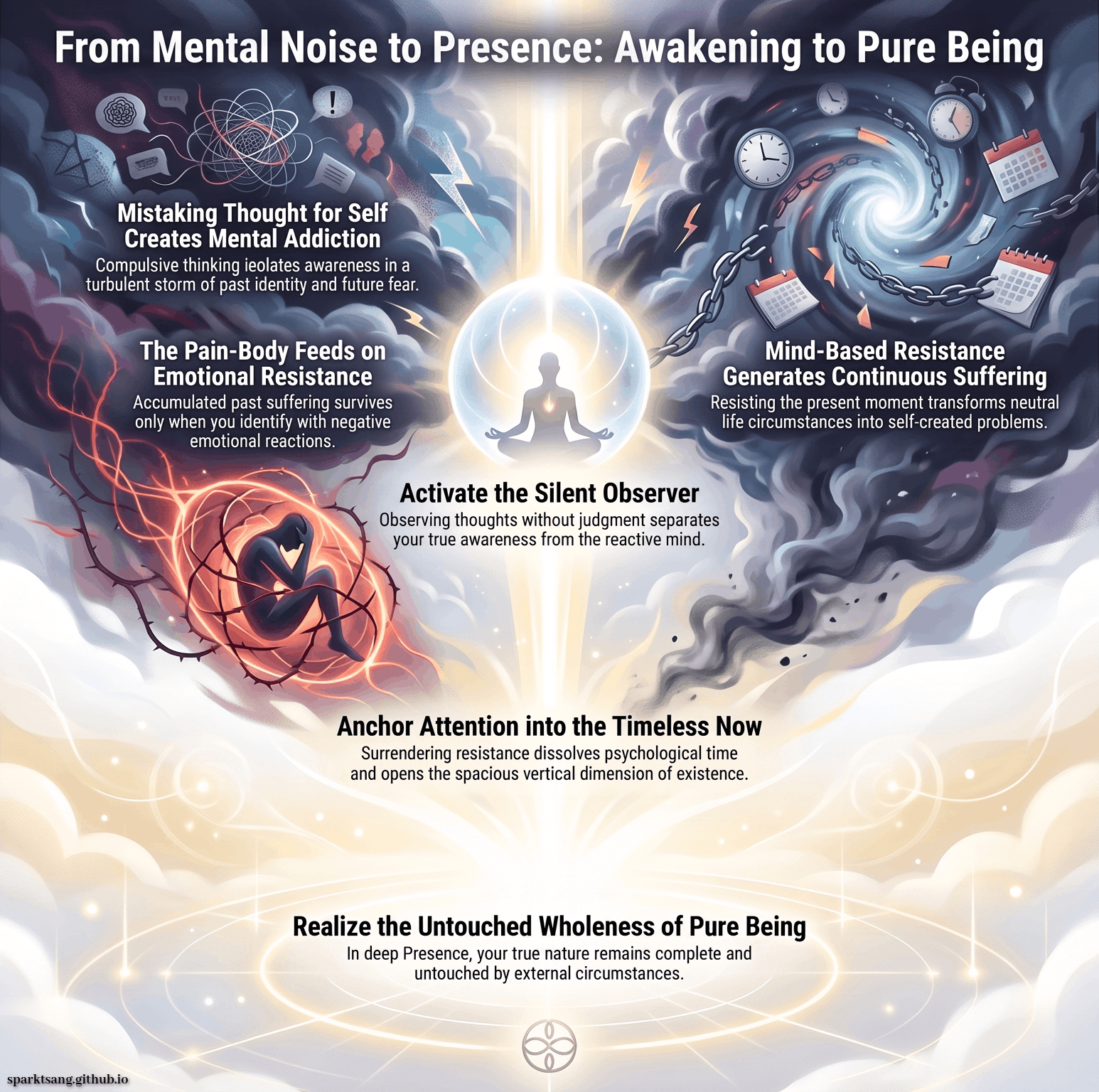
The greatest obstacle to perceiving Being is the belief that thinking is who you are. The mental noise produced by thought prevents us from becoming still enough to perceive Being.
Even Descartes mistakenly identified the thinker with the self. This gives rise to every kind of illusion: images, judgments, definitions, filling the world with a veil.
Thinking has become a disease. The mind is an excellent tool, but once misused, it destroys everything. When you identify yourself with your thinking, you become controlled by your own tool. This is a form of addiction: once addicted, you have already lost the choice to stop.
If you cannot stop yourself from thinking, then you are already a slave to the mind without realizing it, mistaking the entity that possesses you for yourself. People become addicted to thinking because the thinker gives them the illusion of identity.
You can break through the confinement of the mind and become free. You only need to observe your thoughts, and then you become aware not only that there is thinking, but that there is also an observer of thought; a higher level of awareness begins to emerge, and you can awaken.
There is no need for analysis or judgment. Simply observe and become aware. The moment you add analysis, it is the mind interfering again—one thought attacking another.
At first, you may not be able to maintain observation for long. The more you practice, the longer you can sustain it.
This emptiness makes you intensely aware of yourself. Its joy is so powerful that all thoughts, sensations, the body, even the world itself, cease to matter. This is the state of “no-mind”, taking you beyond the “I” you originally identified with.
Apart from observation, simply concentrating completely on the present moment has the same effect. You enter a state of intense awareness without thought, which is the essence of meditation. Even ordinary activities that have no inherent meaning can be practiced this way: observe your inner state completely and remain fully present.
Our minds have no awareness of the present; they know only the past and the future, and are therefore filled with problems. The mind focuses on the past because the past secures identity; it focuses on the future because the future promises hope. Even when the mind looks directly at the present, it sees it only as a means to reach the future.
The mind’s usefulness has reached its limit. If we do not transcend it, we will be destroyed by it. Thinking is merely a survival tool; it is not creative. Great art has always arisen from a space without thought, whether the artist is aware of it or not. All the evils of humanity arise from the identities created by thought.
Emotion is the bodily amplification and energetic reflection of thought. The thought of attacking someone is reflected in the body as anger. The thought of being threatened is reflected in the body as fear. The more you identify with thought, the more you lose the present moment and the more you become ruled by emotion. When thought and emotion appear to express different positions, the unconscious thought may not be consciously perceived by the person, while the emotion manifested in the body is relatively more truthful. Observing emotion is just as important as becoming aware of thought.
Thought patterns and particular emotions depend on one another. Thought is reinforced in its expression through emotion, while emotion in turn gives the original thought continued strength.
All emotions arise from the fear of one’s own annihilation, which is a permanent form of suffering. The mind’s task is to fight this fear, but it can only do so in vain. The more it fights, the greater the suffering.
The mind can never solve the problem because it is itself the root of the problem. How can the police chief catch the criminal when the police chief is the criminal? Only when you stop identifying with the mind can permanent suffering be released.
The feelings of happiness, joy, and true love arise from perceiving Being and becoming one with it. An unawakened person can usually experience them only for a moment before being overwhelmed again by the noise produced by the mind.
Happiness and joy are not emotions in the sense described above; they have no opposite. Pleasure does have an opposite. Unawakened people remain trapped in a cycle of pleasure and pain: the person who gives you pleasure in one moment may give you pain in the next. They are two sides of the same thing.
True love never causes suffering and never suddenly turns into hatred. It is our true nature, just as daylight is always present even when dark clouds obscure the sun. Once you abandon the mistaken idea that the mind is the self and go directly to Being, you can see it.
The Buddha said that suffering comes from desire. Every desire comes from the mind seeking something outside itself in the hope of finding release. Once one desire is satisfied, another arises, an endless cycle.
The desire to have no desires is itself a desire, and therefore should not exist.
Chapter Two: Consciousness: The Way Out of Pain
Pain is self-created and arises from resistance to reality. Resistance contains judgment and is emotionally negative. How intense the pain is depends on how much resistance there is. The mind is always resisting the present, so the more you identify with the mind and mistake it for yourself, the greater the suffering. The more you accept the present, the more you can escape suffering and become free.
The mind resists the present because, once the concept of time is abandoned, it cannot function and loses its identity. Time and mind are inseparable.
If all that remained on Earth were wilderness, time would no longer have any meaning. An oak tree and an eagle do not know what time is.
Saying that the present is painful is merely a label imposed by the mind; you can observe it from the outside. Accepting the present changes your life.
When you fail to remain present, past pain clings to the mind and body, forming a negative energy field. Thoughts or external stimuli can trigger it, producing all kinds of emotional outbursts, even thoughts of self-destruction.
This pain-body can survive only through your identification with it. It becomes you, drawing nourishment from your identification and feeding on your fear of facing it. Pain can feed only on pain, not on pleasure. Suffering wants you to have more suffering.
When you identify with it and become possessed by it, you become a self-created victim. Even when you claim that you want to get away from suffering, everything you do only brings you closer to it. This is madness; there can be no conscious person who is simultaneously insane.
The pain-body is afraid of awakening and will try to prevent you from awakening. Once you face it directly, you truly come alive and regain your inner power. Under the light of awareness, it eventually dissolves. It can no longer pretend to be you, which is why it fears the light and fears being discovered. During the process, it will try to pull you back into identification, like a wheel that continues turning even after its momentum has been exhausted. But as long as you maintain awareness, it will eventually stop.
The psychological fear that produces suffering never concerns the present; the object of fear is always elsewhere, creating a gap in which the body is in the present while the mind is in the future. It can take many forms, such as tension, anxiety, or stress.
Even if the self has the shell of confidence, it is always inwardly insecure and sees itself as perpetually under threat, and therefore always afraid. Fear seems to have many causes, but at the root of them all lies the fear of death, of one’s own annihilation.
When you identify with a position held by the mind-based self, if that position is proven wrong, the disappearance of the position with which you identified is equivalent to death.
Once you observe Being and disentangle yourself from the mind, whether you are right or wrong no longer matters. Nothing can obstruct the true self, and there is no longer any need to attack others or defend yourself. All arguments and power games then come to an end.
Another aspect of the thinking self is its perpetual sense of inadequacy and its search outside itself for wholeness. This gives rise to the pursuit of money, status, and the opposite sex; even when you get what you want, it is like a bottomless abyss that demands more and more.
As long as you identify yourself with the mind, there is no inner peace.
The mind is always looking for external things to establish a sense of self: possessions, appearance, skills, knowledge, status, relationships, family, even political, national, racial, and religious identities. Yet all of them are empty and eventually dissolve.
With true wisdom, you can die before you die, and discover that there is no death.
Chapter Three: Deeply Entering Being
There is no need to gain a deep understanding of the structure of how the mind operates. It is enough to understand its fundamental dysfunction. Knowing its mechanisms may make you a psychologist, but it will not help you transcend upward. Studying insanity itself does not produce sanity.
How do you let go of the mind? Drop the illusion of time and anchor yourself in the Now. There is not a single moment of life that is not the present; only in the present can you go directly to the timeless and formless Being.
The mind cannot understand this because it needs time to operate. The past and future have never been real; everything can only appear in the present, just as the moon has no light of its own but merely reflects sunlight.
Once you understand this, you can turn from the mind to Being, from time to existence, and truly live with radiance.
The Gospels say not to worry about tomorrow, but few people know their true meaning. Zen also emphasizes the present, using its methods to lead disciples directly to Being.
Even a single moment of freedom from the prison of time can allow you to truly perceive your surroundings, no longer trapped by the mind’s biased judgments. The mind cannot perceive its surroundings, not even a tree. It knows only the tree’s external information. The mind does not even know that you exist; it knows only a pile of labels, judgments, facts, and opinions.
The mind has its uses, helping people handle their affairs every day. But when it occupies every area of life, it becomes a parasite that devours its host and will eventually destroy everything.
When emotions come crashing in, existence becomes more important. Emotional reactions overwhelm and possess you, and you become the emotion itself, attacking others and defending yourself. This is also being trapped in a reactive pattern.
Identification gives the mind power. Silent observation and awareness take that power away. The former generates more illusions of psychological time; the latter opens up the timeless and formless Being.
When dealing with practical matters, use clock time as a helper, then return to Being, so that psychological time does not have to accumulate.
Psychological time creates human tragedy. Communism, for example, denied the present in the name of a false future and killed hundreds of millions of people. Humanity’s madness is there for all to see.
Rejecting the present and accumulating psychological time allows the past to dominate the present and becomes the root of all negativity.
Even if all your current troubles were to miraculously disappear, if you do not become aware of the present, the same set of problems will reappear in different forms, again and again.
People think that the present moment is full of troubles, but in fact one cannot be fully aware of the present and remain unhappy at the same time. To say that life is full of unhappiness is to confuse life itself with one’s circumstances.
Circumstances exist in time; life is Being. Circumstances arise from the mind; life is reality. Even if your circumstances mean that you have to face a problem five minutes from now, do you have a problem in this second while you are stopped?
Perceiving Being allows you to put aside the troubles of a world filled with abstract thought and free yourself from the insane thinking that drains the energy from life.
Problems are all self-created. Circumstances need either to be dealt with or accepted, so why turn them into problems?
The mind likes problems because they can create a sense of identity. A problem means consuming mental energy within a situation without ever truly intending to act and solve it.
Circumstances then overwhelm you, causing you to lose awareness of life and Being. Creating problems is also creating suffering.
If you were truly between life and death, you would know that it was not a problem. The mind would have no time to fool you, and you would become completely conscious and present. The tremendous energy would allow an ordinary person to summon extraordinary courage.
The future is mostly a repetition of the past. Outward appearances may change in countless ways, but genuine transformation is extremely rare; it requires silently observing and becoming aware of Being.
What is called the future is, in essence, precisely your present level of consciousness. Carrying the burdens of the past only carries them into the future, just as they were in the past.
Winning tens of millions is possible, but the change may remain merely superficial; old patterns will simply continue to operate. Ancient people could kill ten or twenty people at most with wooden spears; today, nuclear weapons can kill millions in a second. Is that genuine transformation?
It is the level of consciousness that determines the future, and the level of consciousness depends on the degree of presence, attained through awareness of Being.
The vast majority of human behavior is driven by fear, arising from cutting oneself off from the present and focusing on the future. Just as there are no problems in the present, there is no fear in the present either.
When a situation arises that needs to be dealt with now, action arising from present awareness is more effective, because it is not a reaction based on conditioned responses from the past through time-bound thinking.
The unconsciousness or madness of the mind has dominated humanity for a long time. Breaking free of the mind and ending time will bring immense transformation. But this transformation is not inevitable; it depends on the choice humanity makes.
Whether you are touching Being can be determined simply by asking yourself whether you can fully enjoy what you are doing, whether you feel joyful, light, and happy. If not, time has overwhelmed the present and life is being experienced as a burden.
To touch Being, how you do something is more important than what you do. Try giving it your full attention. Full attention means complete acceptance; it is impossible to be fully attentive while simultaneously resisting.
Honor the present wholeheartedly, and unhappiness and struggle will be swept away; life will flow joyfully. There is no need to worry about the result; the result will emerge on its own. Success or failure cannot affect the inner truth. Then you have discovered life beneath circumstances.
When psychological time no longer appears and the subject exists in Being rather than in the past, the desire to be anything other than your present self disappears. Circumstances may improve, but in deep Being you remain whole and complete.
Being whole and complete does not prevent you from pursuing ideals. But in this state, there is no longer the illusion that some future can provide salvation, nor any need to use fear, anger, or worry as motivation.
Everything is honoured, but nothing matters. Nothing real can be threatened.
If you are in such a state, how could you fail? The state itself is already success.
Chapter Four: The Mind’s Escape from the Present
Knowing that time is an illusion is useless. Only when you truly live in the present, with every cell in communion with life and immersed in the joy of Being, can you say that you have escaped time.
Unconscious people merely drift among different levels of unconsciousness. Beginners swing endlessly between unconsciousness and awareness. Awareness of the present can be practiced for longer and longer periods. Eventually, you master the present.
Most people exist in an ordinary degree of unconsciousness, with that unconsciousness functioning like background noise. They remain unaware of it until the noise suddenly stops. Within the unease of that noise, people numb themselves with food, sex, alcohol, drugs, work, and entertainment, and may even become addicted to them. When misfortune strikes, it triggers greater suffering and greater reactions, driving them deeper into unconsciousness. Deep unconsciousness can trigger violence, even producing the spectacle of an entire nation going mad.
When challenges arrive, the unconscious become even more unconscious, while the conscious become more conscious. If you cannot live in the present when nothing is happening, you will be even less able to remain calm when something does.
Jung’s book quotes a Native American chief as saying that white people were perpetually tense, constantly seeking things outside themselves without knowing what they were seeking, and could only be regarded as insane. The Buddha said that suffering comes from seeking outside oneself.
Frequently ask yourself whether you are relaxed in the present, and become aware of what is happening within your body and mind. When the inner is on the right path, the outer also falls into place.
Observe whether you are resisting anything, including the people around you or your work. Become aware of the effects of this negative energy field. Whether your resistance is justified is irrelevant; the fact is that resisting this moment means treating it as an enemy, creating inner conflict and unhappiness.
Stop what you are doing, or speak honestly and openly to the person concerned, or abandon whatever negativity you have created within yourself. Once you see that such suffering is useless, you can let it go like a burning coal.
A negative emotion is not merely a label but a fact, arising from judging the present as bad and therefore resisting it. Evil, even the slaughter of hundreds of millions of people, arises from a sense that something is wrong. Humanity’s sickness, madness, and dangerousness are facts that urgently need correction.
True acceptance produces transformation and dissolves negativity. False acceptance merely identifies with negativity and strengthens it. Saying that everything is fine and that negativity is harmless is self-contradictory, because negativity itself arises from resistance.
Everyday unconsciousness can be seen in complaining: about circumstances, what other people do or say, the environment, the weather. Complaining necessarily contains negativity and casts you in the role of a self-created victim. Speaking honestly and openly allows you to reclaim control.
In any situation, you can only change it, leave it, or accept it. Everything else is madness.
Action is always better than inaction. If fear is preventing you from acting, observe it.
If you cannot change or leave the situation, give up your resistance. Surrender is not weakness. Only by surrendering resistance can you access the power of wisdom.
If there is something you should do but are not doing, start immediately, or choose to completely accept yourself while observing and remaining aware.
Stress arises from being here while wanting to be there, dividing yourself in two; this is madness. When necessary, you can work quickly and efficiently, even run, without dividing yourself in two.
Clinging to the past not only reinforces the false self but also accelerates aging. Observe people with this tendency and you can see it.
Those who constantly worry and repeatedly ask what they will do if something happens are deeply trapped in the mind. Those fixated on goals turn the present into a tool.
Those who are always waiting—waiting for the next vacation, the next job, someone, their children to grow up, or enough money—are all giving up today for the sake of tomorrow.
The next time someone says, “Sorry to keep you waiting,” you might reply, “I wasn’t waiting. I was just enjoying myself.”
These are only a few of the mind’s strategies for denying the present. The more you can master your inner thoughts and emotions, the more clearly you can perceive how you are trapped by the past and the future.
Life may be like a journey, but the only reality is this step in the present, not anything else. The outer goal is to reach an ideal destination, but there is also an inner goal that has nothing to do with the destination. The outer belongs to the horizontal dimension of time and space; the inner belongs to the vertical dimension of your timeless present. The outer may contain a million steps; the inner contains only the step in the present.
Become deeply aware of this present step, and within it the remaining million steps and the destination are already contained. Through this step, you can dive deeply into Being.
Once Being is discovered, the outer goal becomes merely an enjoyable game. You can fail completely on the outside and still succeed completely within; the opposite is to gain the world and lose your soul.
All outer goals eventually become empty. The sooner you realize that outer goals cannot provide lasting fulfillment, the better; they will then come to serve the inner goal.
Chapter Five: The State of Presence
Become aware of Being, and Being becomes conscious. The one who is conscious of Being is in the state of Presence. Do not be bound by names and forms; there is no need to understand.
Try closing your eyes and saying to yourself, “I wonder what my next thought is going to be,” and then wait and catch it. In a state of intense presence and alertness, you become free of thought.
The state of Presence is like waiting, but not the kind of waiting described earlier that denies the present. It is the kind of waiting in which, if you do not remain fully present, you will fail to catch it.
There is no daydreaming, no thought, no memory, no anticipation. No tension, no fear. In this moment, the you of the past and future, the you with a personality, no longer exists. Yet you are still you.
A person may occasionally remain in the present and enter this state, perhaps alone in nature, but it is usually brief—so brief that its true nature goes unnoticed.
Too many people are trapped in thought and remain unmoved by the beauty of nature. They may say, “What a beautiful flower,” but it is merely an empty mental label.
Few modern works of art capture this great beauty, because they are themselves products of the mind. By contrast, urban landscapes and industrial wastelands reveal the ugliness produced by thought.
All things in the world contain Being and possess some degree of awareness. Everything lives, and everything is an expression of Being. All things are part of a dynamic process; the distinctions of form come from us.
Observe thought and you withdraw awareness from form. Pure awareness grows stronger while form becomes weaker. Awareness awakens within form and detaches itself from it. This is a great event in the universe. In the distant future, it will open the prelude to an event called the end of the world.
At first, perhaps only a handful of people will awaken; afterward, the awakening should expand in scale, though there is no guarantee. If humanity cannot break free from thought, it will be destroyed by thought. The thinking self is like a sinking ship. Either leave it or sink with it. Humanity’s collective thinking self is the most destructive form of madness on this planet. Today, humanity anesthetizes itself with alcohol, drugs, and sex, returning to a level lower than thought itself. This slows self-destruction, but also prevents transcendence. Your reading of this book is already evidence that this new awareness has begun to gain a foothold in the world.
Jesus said, “Before Abraham was, I am.” In the Bible, God says, “I am that I am.” The Unmanifested.
Finished reading on October 3, 2018
Thank you for reading until the end. This is a bonus infographic just for you.