Notes on The World's Easiest Way to Find What You Want to Do
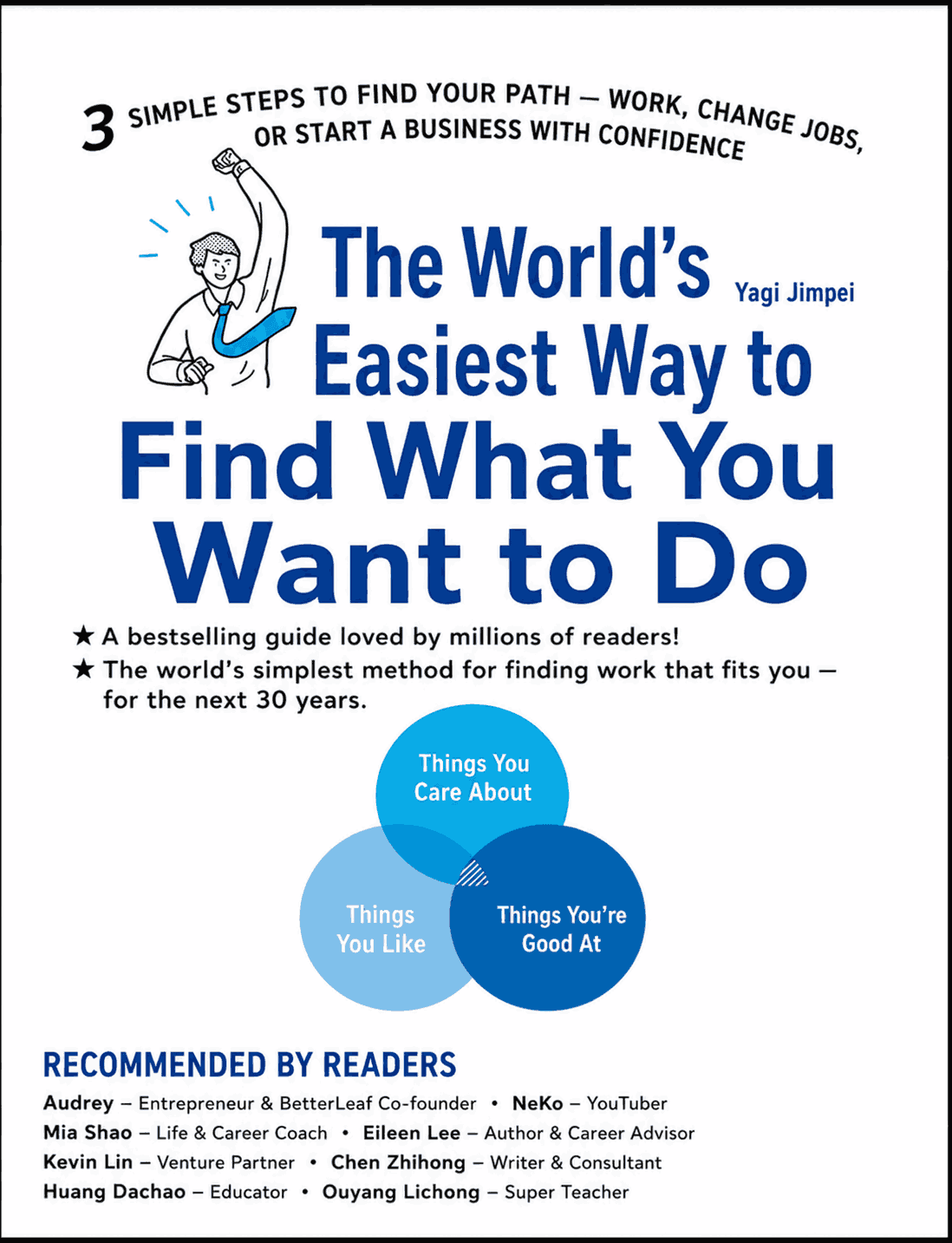
The World’s Easiest Way to Find What You Want to Do by Yagi Jimpei
Original notes here.
Find something you want to do, and your energy becomes concentrated; otherwise, it becomes dispersed.
After reading this book, you can enter an infinite growth loop: do what you want to do and grow, while earning money and gratitude; then reinvest that money in learning to further improve your skills and earn greater rewards.
Find what you want to do, and you gain the courage to say no and free yourself from conventions.
Doing things you do not want to do creates two vicious cycles: you are more likely to squander money to relieve stress, while a lack of interest makes you unwilling to learn, making it nearly impossible to grow.
There is a formula for finding what you want to do, which the author calls the self-understanding method.
Five Major Misconceptions:
Thinking it must be a lifelong vocation: society changes rapidly, so you only need to find what you want to do at this moment.
Feeling that it should seem as though fate arranged it: surprisingly, arranged marriages have higher satisfaction than love marriages, because they do not carry the unreasonable expectation that “love should have been there from the beginning,” and so the couple is more willing to put effort into building the relationship.
Believing that it must benefit society: no one can keep forcing themselves to sacrifice and work for others forever.
Thinking you have to take positive action to find it: in fact, you must first understand yourself and establish “criteria for making choices.”
Thinking what you want to do cannot become a job: in fact, what you want to do exists only within your own mind, whereas the means of putting it into practice exist within society.
The author was fired from his job and took an online test, which revealed that he was unsuited to work with established procedures. He disliked being given instructions, but ideas constantly poured out of him, and he enjoyed thinking deeply and articulating his views.
So he started a blog. His initial income was tiny, but a year and a half later he was earning one million yen a month.
However, after writing became something he did for money, he eventually developed mild depression. He began exploring himself again, only to discover that what he truly loved was exploring his own inner self. He then made that the subject of his blog.
The Paradox of Choice: too many choices can make people hesitate to act. Thinking that a lack of initiative is the cause gets things backwards.
As times change rapidly, rational judgment is losing its usefulness. The basis for making decisions should shift from an externally dependent “other-centered” orientation to an internally grounded “self-centered” one.
Appropriate “criteria for making choices”: Passions (what you like), Talents/Strengths (what you are good at), and Values (what you care about).
What Does It Mean to “Do What You Want to Do”?
If the concept is not clearly defined, you will never find the answer.
If you feel your way forward by intuition alone, you get only fragments and cannot fit them together into a complete picture.
This book summarizes it in two formulas:
What you like × what you are good at = what you want to do
What you want to do × what you value = what you truly want to do = your calling
What you like means what you are passionate about.
What you are good at means things you naturally learn more easily than others, do smoothly, and do not find burdensome.
The former is a kind of what, while the latter is a kind of how. For example, “fashion × making = making fashion products” and “self-understanding × teaching knowledge = teaching the self-understanding method.”
Having only the former without the latter is an easy recipe for failure: even if you love books, that does not mean you will love the actual work involved in running a bookstore.
Being good at something and having a skill are completely different. The former is innate, can be applied broadly, while the latter is acquired through learning and can only be used in specific jobs.
If you answer “what you want to do” in terms of a profession—that is, “the person you want to become”—there are several problems:
It is easy to focus on your image of the job, such as overlooking the tedious work a YouTuber has to put up with.
It limits your possibilities: “I want to become a comedian” versus “I want to do work that makes people laugh”—the former is much narrower.
What you value means your values: how you want to live. It concerns “why you work” and what kind of state you want people and society to be in; it is a kind of why.
Using the author as an example: “Teaching the self-understanding method × wanting more people to pursue their dreams = wanting others to pursue their dreams, and therefore teaching the self-understanding method.”
Application to job interviews: the three elements can be used to explain three different choices:
What you like: “Why this industry?”
What you are good at: “Why this profession?”
What you value: “Why this company?”
Making a living from your interests is a misconception, because the things you like are merely the means of achieving the purpose of your work.
Is a restaurant meant to make customers healthier? Do you want it to become a place that spreads hope? Do you want customers to feel at home? If the purpose is unclear, you cannot attract the customers you actually want, and when something like the pandemic happens, it becomes difficult to rethink possible ways forward.
The three elements should be considered in this order: what you value, what you are good at, and what you like.
If you put the cart before the horse, you may find something you like but still be unable to escape practical constraints. So you should first identify what you are good at—that is, strengths you can exercise under any circumstances.
A company is merely a means of achieving your life goals. If it cannot help realize your ideals, you should look elsewhere.
Whether to start a business, whether to write a blog, whether to make YouTube videos—these are all trivial details. Before establishing your calling, thinking about these is like asking whether you should take a plane or a train before you even know your destination.
“What You Value”
Unless you genuinely enjoy what you are doing, but it also makes someone else happy, sooner or later either you or your customers will become tired of it. The key to creating something that neither side ever tires of is to identify the values that express how you want to live and derive lasting joy from them, just as the author sincerely wants to spend his life pursuing his dreams while helping more people pursue theirs.
Values are directions, not goals.
When your current goals conflict with your values, you become lost.
There is no right or wrong when it comes to values. Do not confuse them with social expectations or false values instilled by your parents. If, when explaining why, you find yourself saying “because I should,” that may indicate that the value is not truly yours.
Five steps for finding your true values:
Answer the following five questions and list the key words that emerge:
Who do you respect? What do you respect about them? (The author’s example: although Dai Miyamoto became the world’s number-one saxophonist, he continued practicing and learning: “never stop pursuing your dreams.”)
What experience had the deepest impact on you when you were a child or teenager? (The author’s example: his second-grade teacher was kind and affectionate, but dressed with youthful individuality: “follow your own aesthetic.”)
What is wrong with society? (Example: no one wants to work: “change a world in which people cannot pursue their dreams.”)
Ask the people around you what they think you have valued throughout your life. (Other people’s observations can lead to surprising discoveries.)
What parenting advice would you most, and least, want to give? (Example: reduce possessions and relationships, and focus on what is truly important: “minimalism.”)
Second, create a mind map of your values.
You should have at least 15 key words from the above. If not, use the special questions to generate more.
Group the key words into four to six categories. The author’s example divides them into five: “aesthetics, curiosity, minimalism, dreams, results.”
Third, shift from being other-centered to being self-centered.
Do not treat things you cannot control as values, such as “make lots of money and enjoy wealth.”
A study from the University of Rochester found that students who set intrinsic goals were more satisfied with their lives and considered themselves happier than those who pursued extrinsic goals, while the latter experienced more negative emotions.
An example of the former would be “help others improve their lives and grow myself in the process,” while examples of the latter include fame, wealth, and power.
How to make the shift: keep asking why until you reach the end. For example, if you want fame because you want to be praised, and want praise because you want confirmation that your existence has meaning, you may discover that what you really want is to live by following your curiosity without regard for society’s judgment—and that you can do this without becoming famous.
Fourth, rank your values.
The author’s example, in order: aesthetics, dreams, results, curiosity, minimalism.
The purpose of the ranking is to think about which value is the ultimate end.
Minimalism: wanting to reduce confusion, achieve clarity of mind, and follow one’s curiosity.
Curiosity: wanting to listen to your inner voice and act on it, while going all out to create results.
Results: wanting to share the achievement with others once it has been attained, and deciding that once something has been accomplished, you can devote yourself to your dreams.
Dreams: the things you are passionate about; being passionate about something is one of the most beautiful states of being human.
Aesthetics: living a beautiful life.
Fifth, think about the purpose of your work.
When you are filled with a particular value, it naturally spills over and spreads to others. From the list above, try to identify the value you want to transmit to other people.
Recall ten experiences in which you wanted to influence others with your values, and think about what value you wanted to convey in each case.
The key word that appears most often can be regarded as your work purpose.
“What You Are Good At”
This refers to things you do naturally and subconsciously.
You do not need to work hard to change yourself; you only need to work hard at using your talents.
Reframe weaknesses into strengths: “I am shy and therefore find it hard to make friends” becomes “precisely because I am shy, I am able to think deeply in peace.”
Imitating how other people use their strengths is useless; you need to find your own winning formula.
Under the same speed-reading training, someone who initially read 350 characters per minute became eight times faster, while someone who initially read 90 characters only improved to twice their original speed: efficiently strengthening what you are already good at is important.
Five questions for finding your strengths:
What experiences have made you feel fulfilled? Because when people do what they are good at, things feel especially easy.
What annoyed you the last time? This often happens when you see someone struggling to do something that comes naturally to you.
Ask a close friend what they think your strengths are. (A study of 300 couples found that one’s partner tends to evaluate one’s personality more accurately than one evaluates oneself.)
What part of your current or previous job would you want to continue doing?
How have you created the achievements you have made so far? Anything that immediately comes to mind or evokes a strong feeling is enough.
Explore successful experiences in greater depth with eight questions: What did you do before you felt fulfilled? What were the characteristics of the environment? What specific actions did you take? What kind of thinking guided those actions? What did you notice? What was your motivation? When did the feeling of fulfillment end, and how could it be sustained? What did you understand so well at the time that you could simply do it?
From this, identify ten to twenty strengths, then rate how fulfilling they feel, dividing them into “full marks,” “high,” and “not very certain.”
“What You Like”
This refers to fields that interest or intrigue you, giving you thoughts such as “why,” “how,” and “how should this be done?”
Someone who loves programming becomes curious about why a particular system will not run; someone who loves ramen cannot help wondering what makes one bowl delicious and another mediocre.
You cannot beat people who work out of genuine interest merely by working for money, because the former are enthusiastic and highly motivated.
“Interests cannot put food on the table” is a misconception, because the actual content of a job may not be something you can do with ease. You must first ask what exactly you like about the interest. If you love baseball, is it the teamwork or the strategy? The answer is often related to what you are good at.
Five questions for finding what you love:
What would you want to learn even if you had to pay for it?
What kinds of books are on your shelves?
What makes you think, “I’m so glad I got to encounter this”? The author had this feeling when he learned about the difference between extroversion and introversion.
Is there any “job you feel grateful exists”? You can substitute a person for a job as well.
What about society or other people makes you angry? This reveals something you care deeply about.
“What You Truly Want to Do”
The idea that you should think, “What should I do first for the sake of the future?” is dangerous. If you are still lost because you do not know what you want to do, it is because you always put the task of facing yourself last.
Once you decide what you want to do most right now, your life begins to move forward.
Iterate through action: at first, the author worked on his self-understanding method but still felt bored. The reason was that listening was not his strength; teaching was. After he switched to giving seminars, he became happier, but he hated having to repeat the same content each time, so he eventually shifted to teaching courses through instructional videos and exchanging messages.
Compensation is simply gratitude. Other people will pay you only when they believe what you do has value. The kind of gratitude you want to receive is connected to your work purpose: use “what you want to do” to create value for the people around you, and your work will go smoothly. You will find what you “truly want to do” and discover the meaning of your existence.
Two steps:
First, take the strengths from the previous chapter that you rated as highly fulfilling, combine them with your interests, and come up with as many different “things you want to do” as possible.
Second, use the “work purpose” you identified earlier as the filter.
The author’s work purpose was “to help more people pursue their dreams,” so he selected “systematically teaching the self-understanding method.”
The Self-Understanding Magic That Can Dramatically Transform Your Life
Once you find what you truly want to do, it triggers selective attention (the Baader-Meinhof phenomenon): the information you need begins to gather around you.
After the author decided what he truly wanted to do, he had absolutely no idea where to begin, until he suddenly saw a book explaining “how to promote seminar-style courses.”
Negative experiences are like sea urchins: prickly and intimidating on the outside, but once cracked open, they reveal rich, rewarding insights inside.
The author’s examples:
Being fired from a supermarket for poor performance: discovering how painful it is to simply follow orders.
Trying to overcome his shyness by hitchhiking 100 times without succeeding: realizing the advantages of being introverted.
Finding it painful to write promotional blog posts for products in order to make money: realizing that he needs to do something he likes.
Using the self-understanding method to free yourself as quickly as possible from the state of searching for what you want to do should be your top priority.
Finished reading on August 7, 2022