Notes on Takesi Furukawa's 3 Habits to Find What You Want to Do
3 Habits to Find What You Want to Do: Live a Life with Absolutely No Regret by Takesi Furukawa
Original notes here.
Read until the end to get a bonus. Enjoy reading.
Introduction A Virtuous Cycle of Life
This book opens with the stories of two very different office workers. Mr. Yoshida was strongly advised by his parents to find a job at a stable, major corporation, but he was unwilling to do so. Since he remembered that he liked drawing, he wanted to pursue work in design, only to have his enthusiasm thoroughly doused by cold water. One friend told him that if he had not graduated from an art university, he might as well forget about it, and he abandoned the idea. He eventually joined a company highly regarded by his parents, where he found the work exhausting every day. Work seemed to exist solely to meet business targets, leaving him with no sense of accomplishment. But he was so busy that he had no time even to think, and whenever he mentioned changing jobs, his parents and girlfriend strongly opposed it. The very thought of dealing with all that trouble exhausted him, so he returned to the same unchanging, unfulfilling work life.
The other protagonist, Mr. Arai, had already been thinking about starting a business since university and wrote down all his wild ideas. Whenever he came across someone who might inspire him, he immediately arranged to meet them. Inspired by the president of a successful online insurance business, he conceived the idea of developing an online English classroom. He sent his résumé to relevant companies, and was finally hired by the tenth one. He then persuaded his parents to accept his decision. Three years later, he was able to launch an online classroom project within the company, which became a huge success and a widely reported media story.
These two men form a perfect contrast between the vicious cycle of “being unable to find what you want to do” and the virtuous cycle of “continuing to do what you want to do.” As long as readers continue to put the methods recommended in this book into practice, they will be able to find what they want to do.
Chapter One Why You Cannot Find What You Want to Do
In the introduction, the thought that begins to sprout in Mr. Yoshida’s mind is quickly eliminated by his braking thoughts.
Mr. Arai acts on instinct in the direction of excitement and anticipation, which allows him to sense more things while simultaneously drawing people and opportunities toward him.
The more one senses what one wants to do, the more refined that sensitivity becomes. The author calls this “sensitivity to WANT.” What Mr. Yoshida displays, by contrast, is “WANT insensitivity.”
When people do not know where to go in life, many tend to look outside themselves for answers.
In the fairy tale The Blue Bird, two young siblings are sent by a witch into the world of dreams in search of the blue bird that symbolizes happiness. They travel across many countries but cannot find it anywhere. Only after waking do they discover that the blue bird is in the birdcage of their own little house.
What you want to do is like the blue bird: you cannot keep looking for it outside yourself. You have to ask yourself honestly and seek the answer within.
Four ways to cultivate sensitivity to what you desire from life:
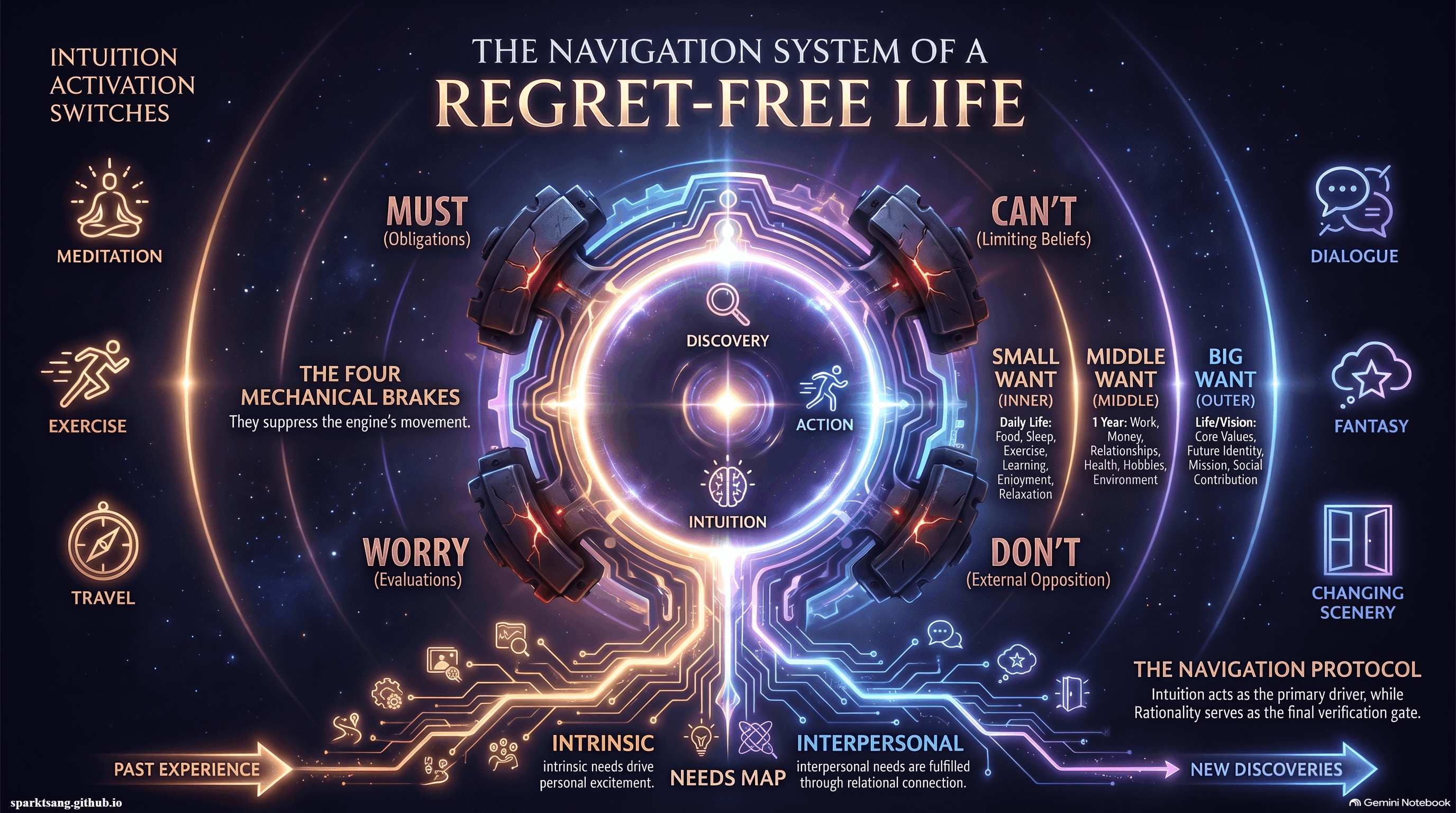
- Release the brakes in your mind: these brakes dull your sensitivity to what you desire from life. They fall into four types:
-
MUST (obligations to yourself): putting yourself into situations where you believe you have things you absolutely must do.
- Work is usually so busy that simply commuting between the office and home leaves you exhausted.
- Even weekends are packed with appointments, leaving no time.
- Every day passes simply by completing the to-do list.
If life consists merely of staying busy dealing with to-do lists, there will be no time left to face yourself; therefore, you must reserve time for yourself and create opportunities to think about what you should do.
-
CAN’T (limits you impose on yourself)
- I have no technical knowledge or skills, so there is no way I can do it.
- I have no confidence and am afraid of taking on the challenge.
- I have never experienced anything like this before, so how could I possibly succeed?
Once you start thinking that you will not be able to do it anyway, you can no longer develop any desire for your life, let alone have a dream. You should listen to the voice within and respect your own needs.
-
WORRY (other people’s evaluations)
- I always feel people will criticize me, wondering what someone my age is still doing.
- It does not fit what my parents want. I will probably be opposed anyway.
- It will make the people around me anxious. That would be bad.
In reality, no one has actually objected, but you imagine that they will and then restrict your own actions, allowing the snowball of anxiety to grow bigger and bigger. It is better to be open and candid; you may even make unexpected discoveries. Paying too much attention to other people’s evaluations prevents you from seeing your own desires for life.
-
DON’T (other people’s opposition)
- You are still young. You should spend more time preparing.
- Changing jobs would mean taking a pay cut. Your current job is better.
- Society is not that simple. Things will not go as smoothly as you imagine.
Other people’s opinions may be used as a reference, but there is no need to accept them wholesale.
2. Understand your own needs: the types and intensity of needs differ from person to person, and they should be clarified by drawing a needs map.
3. Take action: once you take the first step, you will gain a stronger sense of what you feel.
4. Sharpen your intuition: in daily life, people tend to put thinking before feeling. The duller your sensitivity becomes, the harder it is to act according to your feelings.
Put three habits into practice: “Discovery → Action → Intuition → (back to) Discovery”
Three prerequisites for finding what you want to do:
-
What you want to do takes shape through repeated interplay between the accidental and the inevitable:
Finding your path in life is a repeated process of “the inevitable and the accidental.”
For example, Arai’s active participation in symposiums and seminars is an action he deliberately chooses to take, so it is something inevitable; but whom he happens to meet at a seminar, or what program happens to inspire him, belongs to the accidental. Once he had come up with a plan, concentrating on sending résumés to English education companies was inevitable, but being chosen by one of the ten companies was accidental.
Although many opportunities are accidental, only people who have sharpened their sensitivity can notice them, and that sensitivity itself can only be developed through inevitable action and dialogue with oneself. -
What you want to do will continue to evolve and develop:
What you want to do does not end the moment you find it. As you deepen it through action, it becomes clearer. -
The sharper your sensitivity to what you desire from life, the more things you will discover that you want to do:
The moment you discover something you want to do, take action immediately. As your sensitivity to what you desire from life sharpens, you encounter more things that spark interest and anticipation, creating a virtuous cycle.
The search may involve a series of trial-and-error experiences and periods of temporary confusion. There is no need to be afraid. As long as you keep correcting your course step by step, confusion can turn into a virtuous cycle. Before reaching your goal, you must learn how to coexist with confusion.
Three levels of thinking about what you want to do:
- Desires at the level of life (BIG WANT): dreams, visions, and missions. For example, wanting to become a novelist someday. You can think about the following two points at the same time:
- Your Core Values: How will you live? What do you want to do for other people or society?
- Your future image (What kind of person do you want to become three, ten, or thirty years from now?)
Desires at this level become clearer over time. Although they take time to work out, realizing them can dramatically increase happiness and bring a feeling that continues.
- Desires at the level of lifestyle (MIDDLE WANT): things to achieve within one year. Six major areas:
- Work‧Learning: work-performance goals, knowledge and skills you want to acquire
- Money‧Wealth: savings goals, things you want to own
- Love‧Relationships: what kind of relationships you want to maintain with others
- Health‧Beauty: fashion you like, the physical condition you want to maintain
- Hobbies‧Leisure: things you want to do for fun, hobbies you enjoy
- Family‧Home Environment: how you want to design and arrange your living environment
These are not things to be done just for a moment. By spending a year thinking about and putting them into practice, many examples will eventually turn into desires at the level of life. Someone who writes novels for a hobby, for example, may discover a new path after winning a competition.
Many people let their plans for the year fade from memory because they are too busy. If you treat every day as New Year’s Day, then put your thoughts into practice as soon as they occur, life will certainly become more fulfilling.
You can first try writing down a list of enjoyable experiences and things you have always wanted to do (called an “Energy List”), and use it to plan your life.
- Desires at the level of daily life (SMALL WANT)
Jerry Minchinton, author of Thinking Better: people tend to spend too much time thinking about the past and future, while overlooking the happiness available right in front of them.
The Japanese expression ichinichi issho means “one day, one life”: each day is a microcosm of life, so if you live each day without regret, you will live your life without regret.
You can think about them in seven areas:- Food
- Work
- Exercise
- Sleep
- Learning
- Enjoyment
- Relaxation
Put desires first and get life running smoothly
- Many people have believed that success requires hard work and that work is inherently difficult. The author encourages people to try believing that it is possible to achieve success while also enjoying themselves.
- Psychologist Hiroaki Enomoto, in How to Create Your True Self, discusses how society once had clear social norms, whereas today everyone is encouraged to be free, which can easily turn people into lost sheep.
- Seek psychological rewards from work. For example, when you can make use of your own strengths, even difficult work can make you eager to tackle it, or it can allow you to have a huge impact and see smiles on customers’ faces.
- Pay attention to two things:
1. Do not immediately conclude that you should change jobs or industries. Many things you want to do can be accomplished in your existing environment.
2. Starting to do what you want may result in a lower income. But once the situation starts improving and the virtuous cycle begins, you will feel extremely fulfilled. The same applies to things outside of work.
Life is a process of finding what you want to do and putting it into practice
- James Skinner, author of The Nine Steps to Success, talks about how people in Fiji are not wealthy but have a high level of happiness, thereby encouraging readers to make happiness the purpose of life.
- Only people who continue doing what they themselves want to do can have a happy life. Take Miki Watanabe, founder of Watami, as an example: he says that when you have climbed eight-tenths of a mountain, you should look toward the next mountain.
- ‧Start with small goals and move toward more challenging ones; start with personal goals and move toward goals that contribute to society. Life is a journey of discovering what you desire.
Chapter Two The Habit of Discovery
Knowing your own needs well is equivalent to knowing yourself well. Once you know what you need, you will clearly know what makes you feel excited and full of anticipation, and you will also know what makes you feel fulfilled.
Spend ten minutes every day thinking about what you desire, and each day will quickly become more interesting, while the whole year will become more fulfilling.
Two things:
- Draw a needs map
Effects:- Understand the source of what arouses your interest and anticipation or gives you a sense of fulfillment
- Make it easier to think of what you desire
- Discover which needs remain unmet
Steps: - Identify the best experiences you have had in the past
- Search for needs you have for yourself and for others
- Draw the needs
- Create a desire list
Effects:- Find your dreams, visions, and missions
- Clarify your goals for each year
- Make every day fulfilling
Steps: Gradually discover desires at the levels of daily life, lifestyle, and life itself
Everyone’s desires in life are different, so their resonance with the following statements can differ enormously. That is why there is no single script that, if followed, can guarantee a happy and fulfilling life.
- Life is best when it is full of variables, so I want to start a business.
- I have focused on a career in sales for thirty years, and from now on I want to continue developing myself into an expert in this field.
- I am content to be a full-time housewife, and I want to devote myself to living happily with my family.
- I value stability and security, keeping my feet on the ground and becoming a little better every day.
- The most important thing in life is to build networks and rich relationships with people.
Live a fulfilling life, and when you look back on your career before you die, you will have no regrets about this life. Thinking about your desires for life must begin by cultivating sensitivity to desire, and by trying things that make you feel excited and happy. The root of feelings is need. The types and intensity of needs differ from person to person. What you want to do changes with age and circumstances, but your needs do not change very much. Knowing your needs makes it easier to take control of yourself. Drawing a needs map is like creating an instruction manual for yourself, helping generate inspiration when you think about what you want to do.
The same thing can be done to satisfy different needs. Even when two people both want to play four-wheel-drive cars, for example, what they find interesting can differ greatly: they may enjoy designing the appearance and painting them (design), winning races (competition), collecting models (collection), assembling and modifying cars to improve their performance (modification), or enjoying racing together with other people (contact with others).
Needs can be divided into:
-
Intrinsic Needs:
They lie hidden in things that you enjoy doing even when you do them alone. They are needs for excitement and anticipation.
* They are usually grounded in genetics or childhood experiences and do not change easily even as you grow older.
* Recalling childhood experiences is particularly effective for finding your own needs. When you are young, you have not yet learned to care about other people’s eyes, so your own needs can be fully active.
* The author recalls going camping with his family as a child, turning on lights on a pitch-black beach and toasting while listening to the sound of the waves, which gave him immense joy. Presumably, this was because he had a self-need for encountering an unknown world. Later, when the author first traveled abroad as a young man, he also felt a sense of anticipation; as an adult, he became especially fond of traveling to new places for the same reason.
* Self-needs have no limit and never end. Even if you continually encounter the unknown, the more stimulating it becomes, the more anticipation you feel, and the more intense your emotions become.
* Throughout life, self-needs are always a source of energy, driving you to do what you want to do.
* Yet people always tend to satisfy other people’s needs before satisfying their own. They should think about the two together.
* List: adventure, encountering unknown worlds, stimulation, creation, imagination, guidance, exploration, influence, effort, control, investigation, design, organization, collection, contribution, giving, balance, stability, care, observation, persuasion, courage, finding motivation, teaching, devotion, inspiring creativity, awareness, analysis, flashes of insight, resonance, fashion, growth, risk, action, change, domination, maintaining freedom, exercise, achievement, setting goals, learning, contact with others, experiencing the sacred, encountering new things, reflection, systematization, familiarity, improvement, experimentation, training, honing oneself, sparking ideas, promoting growth, sensing, thinking, combining, excellence, support, mastery, painstaking effort, putting into words, listening, distinguishing, development, decision-making, speaking, encouragement, giving courage, nurturing, making an impact, decomposition, expressing originality, writing, insight, prediction, depicting, adding playfulness, interviewing, invention, problem-solving, strategizing, luxury, immersing oneself in silence, self-management, self-dialogue, becoming one with nature, [other keywords]
* Circle the words on the list that resonate with you -
Interpersonal Needs:
Needs fulfilled through relationships with other people. Also called “relational needs.”
* People naturally belong to groups, and everyone wants to maintain relationships with others. When, for example, the author does something for someone and can clearly see that the other person is pleased, he becomes even more motivated. When no one responds during a speech, he feels discouraged.
* Unlike self-needs, these are difficult to control by oneself.
* When needs cannot be satisfied, people can fall into crisis.
* Many women who visit host clubs do so because their needs to feel respected and valued have not been satisfied.
* Unmet needs can easily lead to undesirable behavior. For example, a lack of recognition may cause someone to brag or sulk, while an unmet need to feel loved may lead to jealousy and troublemaking.
* Experiences of unmet needs during childhood may cause other-people needs to exert a particularly strong influence.
* List: being recognized, being praised, being acknowledged, being needed, being liked, being loved, being healed, being protected, being respected, being treated as a partner, receiving thanks, being cherished, being cared for, being expected to do something, being understood, being noticed, mutual understanding, being listened to, being cared for, being paid attention to, being corrected, being admired, being moved, being nurtured and growing, being useful, pleasing others, being unrestricted, having nothing to hide, being evaluated, being trusted, winning, being treated as a model, interacting with one another, being regarded as special, receiving empathy, being worshipped, being commended, coming first, dominating, managing, being guided, being regarded as young, being treated kindly, being regarded as having great spirit, being expected, being relied upon, making people happy, [other keywords]
* Circle the words on the list that resonate with you
Drawing a needs map
Step One: List your ten greatest satisfying experiences from the past (experiences that made you feel excited, full of anticipation, happy, or joyful); there is no need to rank them. Whether self-needs or other-people needs, both lie dormant within past experiences.
You can ask yourself the following for reference: What were the things that excited me most in primary or secondary school? What did I become so absorbed in that I forgot to eat or sleep? Which subjects did I find fun? What were my three greatest experiences of success? What was my favorite place? What was something I really enjoyed doing alone? What was something I really enjoyed doing with others? What do I particularly like doing now? What are my three most unforgettable happy memories?
Step Two: Referring to the items you circled on the list, for each of the ten experiences, write down why it was satisfying and what need it fulfilled. One experience may involve both self-needs and other-people needs.
Step Three: Visualize the needs so that you can grasp the balance, intensity, and overall picture of your self-needs and other-people needs. Use what is important as the basis for considering the size, shape, color, and position of each element.
Creating a desire list
Complete this list using the map above as a reference. When you explore more deeply, experiences that seem completely different may turn out to have the same underlying needs.
Looking back at the past can help us discover what we want to do in the future. Understanding our needs can also help stimulate new desires.
Desires at the level of daily life: For each item, write down ideas for how to enjoy a wonderful day and make each day fulfilling and enjoyable.
- Food
- Work
- Exercise
- Sleep
- Learning
- Enjoyment
- Relaxation
Desires at the level of lifestyle: If you have already created an Energy List, you can directly fill in the following areas. You can also refer to your needs map. - Work‧Learning
- Money‧Wealth
- Love‧Relationships
- Health‧Beauty
- Hobbies‧Leisure
- Family‧Home Environment
Desires at the level of life in general: Fill in the matrix. You do not have to fill it in completely, and you can rewrite it as many times as you like. There is no need to worry about what other people think. When considering the answers, you should refer to the needs map. Use your imagination and do not apply the brakes when imagining wildly.
-
Matrix questions:
- If you could obtain anything at all, what would you want?
- What would you do if you had one billion yen?
- If you could do anything, what kind of occupation would you pursue?
- If God granted you three wishes, what would you do?
- What is something you want to do but are too embarrassed to admit?
- What is something you want to do but cannot?
- Who do you admire? What is attractive about them?
- What would your ideal home environment be?
- What hobby would you like to try someday?
- What is your ideal state of health and beauty?
- What is a place you would like to visit at least once?
- If you could return to N years ago, what would you go back and do?
- What is your ideal family blueprint and ideal image of a partner?
- What skills, techniques, and knowledge would you like to possess?
- What is the one thing in life you absolutely cannot compromise on?
- If you had only three years left to live, what would you do?
- What kind of interpersonal relationships do you dream of having?
- What is your ideal state three years from now?
- What is your ideal state ten years from now?
- What is your ideal state thirty years from now?
- How do you want to live your life?
- What is your favorite saying?
- What kind of role do you want to play for your family?
- What would you like to contribute to society or other people?
- If you had to create a slogan for your life, what would it be?
-
The desire list at the level of life includes: ideal states three, ten, and thirty years from now; ideal states in the six major areas (refer to the lifestyle level); and the axis of life (refer to the answers to the final five matrix questions)
Chapter Three The Habit of Action
Taking action brings you closer to what you want to do
- People who are doing what they want to do share one thing in common: whatever interests and excites them, they act on it immediately without hitting the brakes. That is why the virtuous cycle unfolds: “Implement desires” → “Taste the pleasure” → “Take more action” → “Cultivate sensitivity to desire” → “Generate new desires” → (back to) “Implement desires”
- If the purpose of life is originally to attain happiness, everyone should put what they want to do first.
- Immediately begin incorporating desires at the daily, lifestyle, and life levels into everyday life, the year ahead, and life as a whole, respectively.
- If you have not yet completed your desire list, develop the habit of spending fifteen minutes a day or half an hour on weekends thinking until you have done so.
-
Developing the habit of action has three benefits:
- Life becomes interesting immediately: because you are doing things you actually want to do
- Cultivating sensitivity to desire: acting faithfully according to your own feelings
- Discovering desires at the level of life: many desires at the level of life cannot be found simply by noticing them; they emerge only after a series of actions.
- There are many obstacles to developing the habit of action, including being too busy and having no time, as well as the four brakes. This chapter aims to eliminate these obstacles, mainly through three points: 1. creating time; 2. releasing the brakes; 3. cultivating the power to act.
- Creating time: draw up and analyze a schedule
-
Find small opportunities that make action possible
- Reuse the same block of time: eat breakfast while listening to music or a prerecorded comedy program; study while commuting; read a book while soaking in the bath
-
Eliminate pointless time
- Unnecessary overtime, laziness and wasted time, social gatherings and dinners you do not genuinely want to attend, and television time spent idling away
- Release the brakes
-
Reduce MUST: reduce the number of things on your to-do list. Recommended books: Kazuyo Katsuma’s Time Investment for Increasing Annual Income Tenfold, Leo Babauta’s The Power of Less, and Stephen R. Covey’s First Things First.
‧Step One: Create a schedule.
* Reiko Yamada’s Three Switches for Breaking Out of “Going Nowhere”: just as you keep financial records to manage money, you should create a schedule to manage time. Once you see how you spend your time, the problems become obvious.
* After creating one, the author discovered that working long hours caused problems with attention and efficiency and improved them. He also discovered that the golden hours for work were from six to twelve, so he used that period for concentrated work.- Finding the cause is equivalent to discovering eighty percent of the problem.
‧Step Two: Reduce‧Increase efficiency
* Reduce: once work performance is secured, reduce the amount of work, or even stop doing it altogether.
* Anything unnecessary or time-wasting should simply be eliminated.
* If you do not need to do it yourself, let someone else handle it.
* For work and social obligations that are difficult to refuse, decline them skillfully.
* Increase efficiency: concentrate attention, schedule breaks, and set time limits for work.
- Finding the cause is equivalent to discovering eighty percent of the problem.
-
Eliminate CAN’T: solve the problem of limiting beliefs.
‧Cause One: Imagination is constrained
* Thoughts such as “I wonder what I should do” or “I don’t even know whether it is possible” prevent you from finding what you desire.
* This is usually underpinned by thoughts such as “It is better to be realistic” and “Talking about impossible dreams will only make me suffer.”
* Countermeasures:
* Self-dialogue: you are only thinking and imagining, and you do not have to tell anyone. Let your mind become a territory free of restrictions.
* Develop the habit of not considering possibility when thinking. Tell yourself, “Let’s put aside whether it can actually be done for now and simply imagine it. How about that?”
‧Cause Two: Being too committed to perfectionism: a way of thinking in which anything less than one hundred percent is treated as zero
* Countermeasures:
* Think this way: “Having something I want to do, feeling excited and full of anticipation about it, and being eager to try it—that alone is already valuable enough.”
* For many people, setting a goal is the painful beginning because they insist on achieving it one hundred percent. Tell yourself not to obsess over a perfect score; forty points is enough to pass. Then most things can actually be put into practice.
‧Cause Three: Goals are vague and difficult to act on
* Phrases such as “I want to live a fulfilling life” or “I want to be free from stress” are vague slogans that cannot generate action.
* Countermeasures:
* Gather information that can become a source of inspiration.
* Set some goals and make the actions you need to take explicit. For example, if you want to become a novelist, start by attending relevant talks and seminars.
‧Cause Four: Losing to four excuses: no time, no ability, no connections, no money
* Not having skills or connections now does not mean you will never have them. You just have to build them little by little.
* Countermeasure: distinguish the constraints
* Analyze how much each constraint is preventing you from moving forward. If it is “money nine, ability five, connections two, time one,” then the main problem is raising funds, while the secondary problem is insufficient ability.
* Then think of countermeasures based on the analysis. For raising funds, for example, you can ask people for information, gather extensive information online, consult experts, and so on. - Reduce WORRY: caring too much about evaluations can prevent you from taking even the first step. The key is deciding how far to accommodate others and how to compromise with your own standards.
- It is difficult not to care at all about what people around you think, but people who put their own needs first can maintain the courage to persist in action even when others oppose them.
- Countermeasure One, value intuition: rational analysis is necessary, but the body’s sixth sense often guides us in the right direction. See the next chapter for details.
- Countermeasure Two, do not go beyond what is necessary to be a “good person”
* As the number of supporters increases, the number of opponents will inevitably increase as well. The most popular stars are often also listed among the least popular celebrities. If you want everyone to like you, you will only make yourself miserable.
* The author follows an eighty-twenty standard in relationships: as long as eight people approve of you, there is nothing you can do about the remaining two who oppose you. - Countermeasure Three, remain silent: if you are worried about being criticized, there is no problem if you simply do not tell the other person, and you will not suffer unnecessary ridicule.
- Adjust DON’T: if the author had given in to the opposing voices and decided not to start a business, it would have been impossible for him to follow through on his philosophy of how to live.
1. Ignore it: people who make vague criticisms usually do not understand the matter at all. Not every reason for opposition needs to be listened to.
2. Create a win-win: if the opposition cannot be ignored—for example, if it comes from someone important to you or someone you will live with for the rest of your life—you must arrive at a conclusion that both sides can accept.
* Example: a husband who wants to start a business and a wife who simply wants him to remain a salaried employee. If the husband ignores his wife’s feelings, her anxiety will never disappear; but if the husband compromises, he will lose the motivation to pursue his business wholeheartedly.
* Step One: Find the reasons. There must be reasons behind opposing opinions. If you look only at the surface-level opinions, you can only conclude that one of the two must be chosen. But once you look at the reasons, you can discover where they overlap and where they differ.
* Husband: has a good idea for a certain business, wants a flexible working style, wants to become wealthy.
* Wife: economic instability, and failure would result in debt.
* Step Two: Find the true intention. That is, the most important reason. Sometimes there is more than one true intention.
* Husband: there is a business he absolutely wants to pursue.
* Wife: ensuring financial stability.
* Step Three: Think of solutions. Satisfy both sides at the same time rather than clinging to the original intention. In the above example, the solutions could be:
* Change jobs to a company where the business idea can be realized
* Propose a project to develop a new field within the current company
* Save three years’ worth of living expenses before starting a business
Finally, combine them into the best win-win solution—for example, start the business on weekends and during free time first, save enough for three years of living expenses, and then launch the business full-time.
- Cultivating the power to act: the biggest obstacle to action is perfectionist thinking. In other words, if success is not guaranteed, or if you are uncertain that something can be carried out as smoothly as you imagine, you cannot act.
* Set deadlines: perfectionists feel pressure that once they start something, they must continue doing it, so deciding in advance on a time limit for an action allows them to take the first step more easily with the mindset of simply trying it.
* Daily level: challenge it for a week first; if you feel tired of it, feel free to quit.
* Lifestyle level: try it for one month.
一 week or one month is only an example. The goal is to make it easy for yourself to take action. Besides time limits, setting a number of times is equally effective.
* Baby steps: refer to the author’s previous work The Art of Continuation That Changes Your Life. If you are confused about where to begin, first set a tiny step that you are capable of taking. Even a single small step can give you more clues and inspiration.
* Example: buying a villa in Europe. Small steps you can take include asking online how to do it; consulting an overseas real-estate company; buying European travel guides and choosing cities suitable for living, and so on.
* Mini-experiences, listening to your inner voice: for example, test-driving the car you desire or visiting a home you admire. You can find out whether it is something you truly desire.
Chapter Four Developing the Habit of Following Your Intuition
Intuition is the navigation system in your heart, guiding you toward what you want to do.
Give up thinking and concentrate your awareness on feeling; the information that wells up from within at that moment is intuition.
Everyone has intuition. Like physical fitness, intuition can be improved through training.
Inner dialogue can be divided into intuitive dialogue and rational dialogue. Respecting intuition means not using thought to negate it, but accepting it as it is without thinking about the reasons.
The two complement each other. What intuition suggests can be checked rationally for feasibility and logical consistency, allowing it to play a greater role.
Treat it as the third habit, because intuition can only function fully when there is both a rational pursuit of what you want to do (discovery) and actual action.
Without being able to use intuition, it is very difficult to find desires at the level of life.
Follow your intuition, and your life choices will not go wrong:
After starting his own business, the author sometimes felt anxious and doubtful. One day while taking a walk, a message welled up inside him telling him to write a book, and that decision later opened up a broad avenue for him. The bell that arose from within was profound and resonant, like the bell rung on New Year’s Eve, echoing again and again.
To obtain intuition, the author focuses one hundred percent on feeling and avoids unnecessary thought.
Ignoring intuition and allowing rationality to dominate can lead to regret. The author was accepted by the company he had most wanted to join, yet he felt that something was wrong. But rational thought suppressed that feeling, and even after changing jobs, he failed to obtain what he wanted.
Intuition wells up spontaneously and cannot be forced out. All you can do is prepare an environment conducive to intuition.
Five obstacles that block intuition:
- A busy life, constantly being chased by to-do lists: intuition is more likely to emerge in moments of relaxation.
- Deliberately ignoring it because it differs from your hopes and beliefs: when you hold a goal high and keep taking action, even when intuition says no, you deliberately ignore it because you do not want to regret stopping.
- Fear of criticism from those around you: other people’s needs make you unwilling to be disliked or blame yourself, so you suppress intuitive messages.
- Fear of failure and crisis: when challenging something new, it is easy to hesitate because you worry about failure, so even when intuition encourages you, you deliberately ignore it.
- Looking down on intuition: intuition is difficult to grasp and often weak in its response, making it unpersuasive and easily dismissed; this attitude deprives a newly emerging intuition of the chance to grow.
Three situations that look like intuition but are not:
- Just an excuse: sensing a “don’t” in something or someone you want to avoid does not necessarily come from intuition.
- Just an emotion: not every emotion contains intuition. Just as a cold can cause coughing, coughing does not necessarily mean you have a cold. This includes fear, anxiety, joy, pain, jealousy, and so on.
- Just discomfort: simple fatigue, pain, and the like may not be messages from intuition; do not overinterpret them.
The intuition switch
Rules: Turn off the machine (free yourself from noise), put away your to-do list (focus your attention on the present and let your mind become calm and still)
Notes:
A. Do not become too tense trying to stop thinking. Simply relax and think that intuition will emerge from somewhere.
B. Just enjoy it without forcing anything. Concentrate on your five senses. Even if eighty percent of what arises in your mind is still about work, simply focus on the remaining twenty percent.
C. Do it quietly alone, concentrating completely on yourself.
Six intuition switches that make intuition easier to emerge:
- Meditation: set aside ten to fifteen minutes for sitting meditation or meditation. You can combine it with bathing or make use of commuting time.
The form is not important. Just regard it as a ritual that directly connects you to intuition. When you cannot concentrate, you can count your breaths or snap your fingers to cancel distracting thoughts. Candles, incense, cushions, natural music, reminder chimes, and so on can be arranged according to your personal preference. - Exercise: shut down rational thought by moving your body. Running, brisk walking, yoga, stretching, and other forms of exercise that allow you to have a quiet dialogue with yourself are effective. It is best to do it for more than half an hour each time, because the previous period is usually still dominated by rationality. Do it alone to eliminate external interference.
- Solo travel: travel abroad, take a forest bath, or go hiking. Concentrate on scenery, voices, smells, the taste of food, and the sensations in your hands. Slowly immerse yourself in the present instead of rushing through sightseeing. Make use of the time to meet yourself.
- Fantasy: imagine yourself as someone in the profession you want to pursue, and imitate their clothes or working situation. Visit an ideal home or test-drive an ideal car. Or use other concrete materials, props, or actions to make the fantasy real. There is nothing wrong with fantasy in your mind, so there is no need to fear being laughed at.
- Dialogue: confide in someone who is willing to listen to you talk for half an hour. Do not care about their reaction; focus your attention on your own emotions. This can make vague impressions concrete and generate new realizations.
- A Change of Scenery: go somewhere far removed from the noise of everyday life and different from your normal surroundings, such as a quiet bar or a hotel lounge. Or rearrange your own home in an unconventional way, light candles, play nature sounds, and so on. Create an environment that helps you relax. Face your deeper self.
The switch that works for each person is different. Once you find a suitable method, make it a habit. For habit formation, see the author’s previous work.
By naturally switching between the two modes of “just feel” and “just think,” intuition will naturally emerge in your mind.
Feeling intuition does not mean following intuition. Just let intuition develop freely. In the end, you can let intuition and rationality consult with each other before making a decision. Three points to note:
- Rely on intuition first, and use rationality for verification only at the end.
- When verifying rationally, refer to the needs map and desire list.
- Do not be afraid of conflict: if they point in opposite directions, let them remain in conflict. Although painful, this often leads to a conclusion and helps you find another way out.
The three habits complement one another:
The three habits of discovery, action, and intuition can form a series of pathways and complement one another, while also having value independently. First clarify your needs and identify what you want to do, then put it into practice, and finally sense whether it suits you.
Trying to act often reveals new needs and new desires. Action then cultivates sensitivity, and that sensitivity can in turn lead to new discoveries, with each influencing the others.
Once this naturally becomes a pattern, the three habits can repeat themselves and guide you toward the life you want, like a navigation system.
Chapter Five Three Stories of People Who Changed Their Lives by Finding What They Wanted to Do
A Regret-Free Career Choice: A University Student About to Graduate
Person A studied hard to enter his ideal university. His parents wanted him to work for a stable major corporation, and he had made that his own goal as well, but he always felt uneasy inside. Due to the economic downturn, he was not hired in his job search, with interviewers saying that his aspirations were unclear. He went along with the flow and attended interviews, but because he was not genuinely pursuing anything he wanted, the interviewers could surely see through him immediately.
After clarifying his needs, A discovered that his self-needs were: adventure, achievement, coming up with ideas, action, change, and problem-solving; his other-people needs were: freedom from restrictions, recognition, being needed, and winning. No wonder he could not summon much enthusiasm for interviewing with large corporations. So he added dynamic, fast-growing startups to his list of potential employers. He also realized that sales positions would better satisfy his needs for winning and achievement. On his desire list, he wanted to own his own company ten years from now, while the axis of his life was to change the educational environment for children in the future and make learning more enjoyable. He therefore chose to target education startups, as well as energetic small and medium-sized enterprises.
At the same time as changing his target companies, he asked ten senior alumni whether they knew of any work that matched his aspirations. An alumnus from his university club introduced him to three companies, all of which had people he knew working there. A therefore visited each one and asked its employees for advice. The philosophy of Company W and the enthusiasm of its employees strongly resonated with him.
A chose meditation and dialogue as ways to activate his intuition. He was surprised to discover that after meditating and then visiting a target company again, he could judge whether it suited him through pure sensitivity. The feeling was difficult to put into words, yet the judgment was unquestionably accurate. When he compared it with rational analysis using his needs map, he found that it was right in most cases.
The dialogue was somewhat awkward and did not go smoothly at first, but by the third time he had got the hang of it. The listener’s feedback was also useful. For example, being told that he seemed very happy and his tone became more excited whenever he mentioned Company W helped him clarify his feelings.
A was eventually offered a position at Company W, which was committed to school education. Faced with opposition from his parents, he persisted in persuading them to the end, and finally made them understand that their son genuinely liked Company W very much and that they should respect his decision.
Finding Work Worth Doing: A 28-Year-Old Salesman at a Manufacturer
Salesman B had been with his company for six years. His career was progressing smoothly, he was about to be promoted to section chief, his boss and customers alike valued him, and his subordinates also rated him highly. Yet B had no strong sense of accomplishment. Being chased by performance targets every day left him deeply troubled: Was he really going to spend his entire life in a job where he could never fully demonstrate his strengths?
All along, he had convinced himself that he had no other skills and that he was already very happy. But when he heard that a colleague who had joined at the same time was resigning to start a business, saying that you only live once and must never let yourself regret it, that hopeful expression made it impossible for B to keep avoiding his doubts.
Generally speaking, after entering society, people gradually become accustomed to work over their first three years and then reach around ten years of experience. This is the period when this kind of hesitation most often arises. From the perspective of developmental psychology, the period from the early twenties to around thirty is also a time of exploring career development. It is perfectly natural to be uncertain about the right work.
There are roughly four options: maintain the status quo, transfer to another department, change jobs, or start a business.
B discovered that his self-needs were learning, nurturing, development, strategizing, finding motivation, and stimulation. His other-people needs were pleasing others, sharing, being trusted, being treated as a partner, and being protected.
The work that seemed more suitable for him was creating a work environment that helped other people thrive. In his previous club activities, he had also played a supporting role and was suited to behind-the-scenes work. His current job was structured as a one-person battle, making it difficult to cooperate and share achievements, so naturally he felt depressed.
The axis of his life was “creating a work environment that gives everyone motivation.” Three years from now, he wanted to “do meaningful work and enjoy his interests.” But the details of his vision were still vague.
To clarify his direction, B decided to gather information through books, lectures, interviews, and so on. In the process, he discovered a book he was extremely interested in, describing the internal systems of companies ranked among the most desirable places to work. This made him think that it would be ideal if he could reform his own company along similar lines. At the same time, he read extensively on books about increasing motivation at work. Although he spent the entire weekend on them, he did not feel tired at all. A study group gave B a better understanding of how improving employees’ willingness to work could benefit the company. Dining with colleagues from different departments also made him realize that low morale and burnout were widespread throughout the company, which awakened his sense of mission. Yet even then, he was still uncertain whether he could actually do it or whether the mission was worth devoting the rest of his life to.
B used exercise to activate his intuition. For three consecutive weeks, whenever the thought arose that he could not continue working in sales, his body was enveloped by a surge of emotion. At the same time, when he imagined transferring to the HR department, his enthusiasm was far greater than when he imagined moving to another consulting company. He still wanted to make a contribution to his current company.
So B frequently asked HR colleagues for their opinions and attended dinners to understand the reasons behind employees’ low morale. While walking, he came up with more and more ideas for reforming the company in his heightened emotional state, eventually completing a twenty-page improvement plan. The department head, who had initially tried hard to retain him but later sensed his passion and let him go, tried to introduce him to the HR department, and B was accepted by its head on the strength of his proposal. Three years later, through B’s efforts, employee job satisfaction had risen dramatically.
Escaping a Life Consumed by Work: A 32-Year-Old Company Accountant
C, an accountant who loved her work, became so busy after being promoted to section chief that excessive stress gave her a stomach ulcer, while her relationship with her boyfriend deteriorated badly because she had no time to date him.
When faced with endless to-do lists in daily life, one can first try to fulfill desires at the daily level.
C used the weekend to create a needs map. Her self-needs were analysis, learning, contribution, encountering the unknown, and experiencing the sacred. Her other-people needs were being needed, pleasing others, being expected, being healed, and being valued. She realized that she found accounting interesting because it satisfied her needs for analysis and learning, but within the same accounting work, sorting and classifying documents felt extremely boring. At the same time, she felt fulfilled when her boss or subordinates needed her, while recently she had felt that her needs to be valued and healed were lacking.
Using this map as the basis, she spent a month completing her desire list for life point by point each evening. The axis of her life was to bring smiles back to unhappy children. Three years from now, she wanted to be married, raising a child, and promoted to department manager. Within a year, she wanted to leave work on time, look five years younger than her actual age, completely redesign her home, improve her relationship with her partner, save thirty thousand yen per month, and participate in activities supporting children with physical and mental disabilities. Her desires at the daily level included taking a half-hour bath every day, using essential oils while sleeping, watching a comedy program every day, and talking on the phone with her boyfriend for half an hour, among other things.
C decided to challenge herself to a morning-work routine for one week. She discovered that arriving early meant the first two hours were free from interruptions, greatly increasing her work efficiency and allowing her to leave earlier. Taking a long soak in the tub also greatly reduced her work stress. Once she made time to be with her boyfriend, her need to feel valued was also satisfied, and their relationship quickly improved. In the end, she participated in a volunteer activity, and when she mentioned it to her boyfriend, he also resonated with it and joined her.
As for the intuition switch, every Saturday morning C took a notebook to a café to review the week’s events and her feelings. Through this, she came to deeply realize that seeing the children smile during volunteer activities was her greatest source of happiness. Solo travel had an astonishingly healing effect, and she became certain that her boyfriend was her lifelong partner, giving rise to the thought of accepting his marriage proposal.
Three years later, C was married and had a one-year-old boy, and her child had made her life much richer. She had been promoted to acting section chief. She and her husband continued participating in volunteer activities together and were considering whether to establish a new nonprofit organization five years later. Had she been swallowed up by her busy work life back then, the two worlds she inhabits now would probably be completely different.
Conclusion
Life is a journey of finding what you want to do and making it a reality.
Follow what you feel within, do what excites you and makes you feel interested, and attain the life you want.
Notes last updated on August 3, 2020
Thank you for reading until the end. This is a bonus infographic just for you.