Notes on The Subtle Art of Not Giving a Fuck
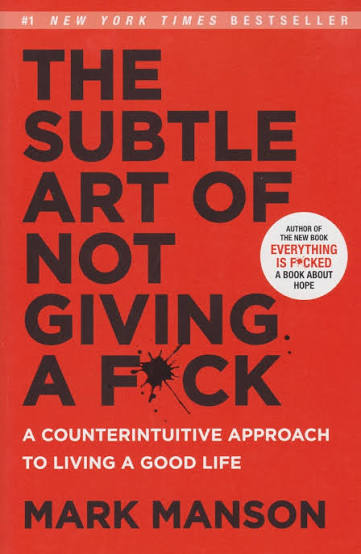
The Subtle Art of Not Giving a Fuck: A Counterintuitive Approach to Living a Good Life by Mark Manson
Original notes here.
Read until the end to get a bonus. Enjoy reading.
Don’t Try
Charles Bukowski was a complete loser: prostitutes, gambling, drinking, smoking, you name it. He spent every paycheck by the end of the month, woke up hungover every morning, and sometimes literally woke up on the floor.
At 50, a publisher somehow became interested in this loser and asked him to write a book.
His books eventually sold two million copies. The conventional narrative would say he succeeded because he never gave up.
But the truth? Precisely because he was content to be a loser. He wasn’t thinking about success. He wasn’t trying to become a better person.
Contemporary culture constantly tells you to become a better person, with the premise that you are fundamentally lacking.
Truly happy people do not stare into the mirror reminding themselves how happy they are.
The endless stream of information around you tells you that you need a car, a house, a beautiful woman, a swimming pool, and so on before you can be happy. It is an illusion.
The Feedback Loop from Hell: you become anxious about something, and because that anxiety makes you wonder why you are so anxious, you become even more anxious, and then you become even more anxious because you are anxious; you get angry about something, don’t know why you are angry, get angry at yourself for not knowing why you are angry, and get angry at yourself for being so angry; similarly, you feel like a loser, and then feel even more like a loser because you think that way…
Social media, which displays the beautiful side of countless people, has only amplified all of this.
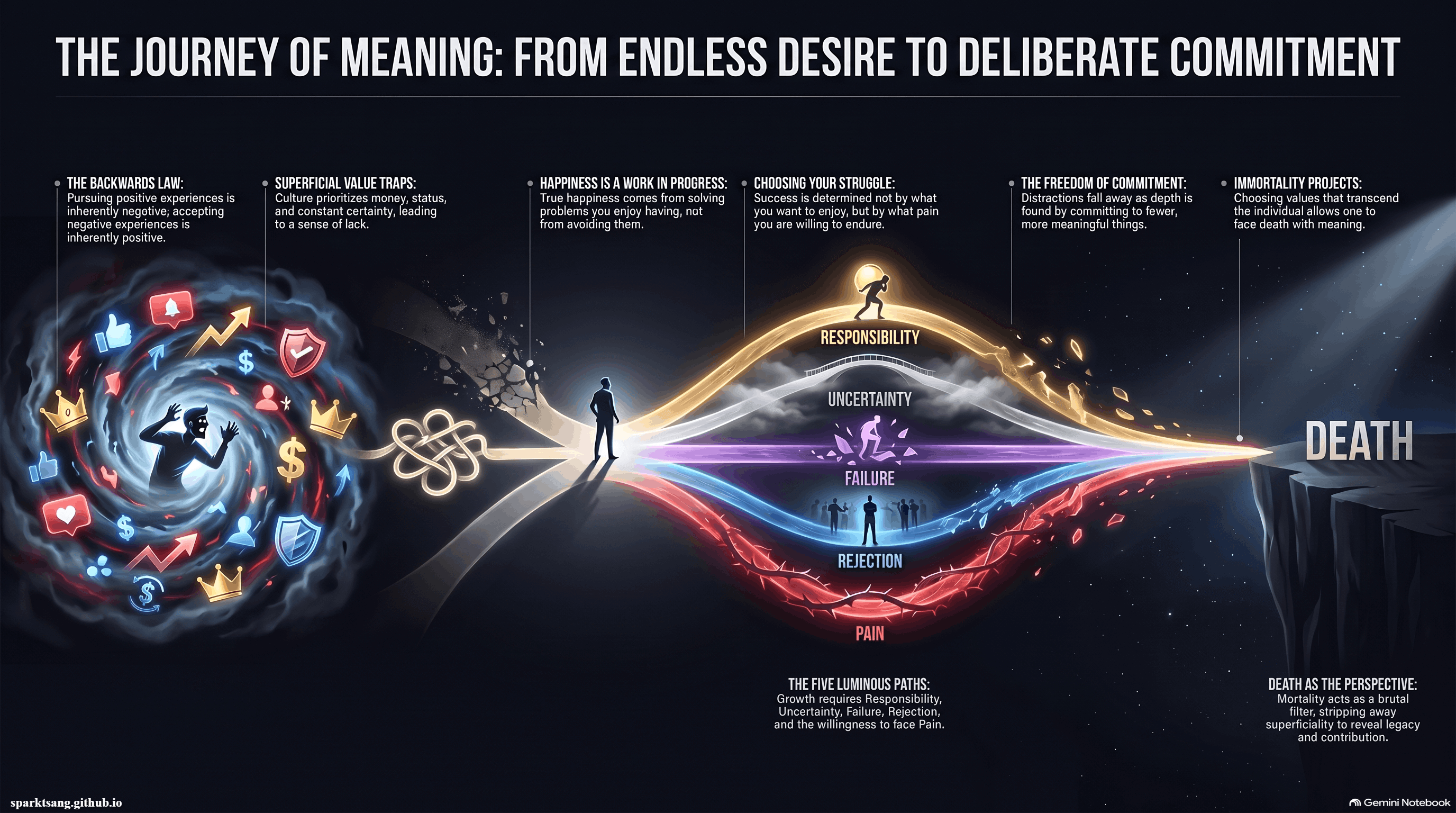
“Wanting to be positive is precisely negative; accepting the negative is instead positive.”
This is what the philosopher Alan Watts called the backwards law: the more you pursue something, the more it implies how much you lack it, and the more frustrated you become; the more you want money, the more you realize how little money you have, and the poorer you feel.
So the counterintuitive conclusion is: don’t try.
If I don’t try, won’t I accomplish nothing? Good question. But have you noticed that every time you stop caring, you actually perform better?
Instead of pursuing health, pursue the pain of going to the gym, and you will end up becoming healthy. A failed business lets you see clearly what the factors for success really are. Exposing your weaknesses instead makes you more attractive. Fear and anxiety instead give you courage and perseverance.
“Everything worth pursuing in life is won by accumulating a great deal of negative experience.”
Every effort to escape pain is futile and only ends up hurting yourself.
Avoiding pain is itself a form of pain; avoiding struggle is struggle; avoiding failure is failure; hiding shame is shame.
To escape pain means you care too much about pain; once you stop giving a fuck, you become invincible.
Look at other people, look at yourself: very often, success in life comes from not giving a fuck.
So many people struggle in life because they give too many fucks about things that are not worth it.
Remember that everyone dies, so the amount of fucks you can give in life is limited. Your limited fucks should be reserved for the things that matter most.
Let’s clarify what not giving a fuck means.
First, not giving a fuck does not mean being indifferent; it means being comfortable with being different.
The former is pretending to be indifferent precisely because you care too much about too many things.
The fact is that no one can possibly not give a fuck about everything. You always have to give a fuck about something; this is simply how we are biologically wired.
If your mother is cheated out of some money by a friend, being indifferent would mean not caring, whereas not giving a fuck means being willing to take that person to court.
Not giving a fuck is cool precisely because it means genuinely defending your own values, doing what you believe is right, and not caring about other things.
In this world, you can never be simultaneously very important to some people and a joke to no one else.
Second, to not give a fuck about one adversity, you first have to give a fuck about something more important.
Imagine an old woman in a supermarket getting into a huge argument with a cashier over a thirty-cent coupon. How much she cares about this reveals that she has nothing else in the world that is more worth caring about.
You must find something important and meaningful to give a fuck about before you can stop giving a fuck about these pointless things.
Third, whether you realize it or not, you are always choosing what to give a fuck about.
When you are young, everything is new and interesting, so you give a fuck about everything.
As you grow older, you gradually learn to choose. That is called maturity.
So what the fuck is this book actually talking about? This book helps you clarify which things are important and worth giving a fuck about, and which are not.
We are facing a psychological epidemic today: people no longer feel that there is anything wrong with themselves, and this is the root of all kinds of bigger problems.
This book will not teach you how to eliminate pain or problems. Instead, it will help you turn pain into a tool, trauma into strength, and problems into better problems. This is a guide to facing pain.
Happiness Is the Problem
There was once a prince who had lived a carefree life since childhood, with every need satisfied. One day he left the palace and saw poor people, the homeless, and people in pain, and decided to escape and embrace suffering.
But embracing a life of suffering did not enlighten him. He came to understand that, just like a life of luxury, suffering itself had no inherent value or meaning.
He sat beneath the Bodhi tree for 49 days and eventually realized that life itself is suffering, and that suffering is unavoidable. We should not resist it, but accept it.
This prince was the Buddha. Happiness is not, as contemporary culture promotes, something you obtain simply by possessing certain conditions.
The reason we suffer is that suffering is biologically useful. It is the best element for motivating change, and it ensures that we are never satisfied with the status quo and always want more.
This means our problems will never disappear; we will only have better problems.
You go to the gym because of a health problem, only to find yourself having to leave home an hour earlier every day, sweating all over and smelling afterward, and thus acquiring a whole new set of problems.
And what is happiness? Happiness comes from solving problems. Happiness is always a work in progress because solving problems is also a work in progress, and solving today’s problems creates tomorrow’s problems. The prerequisite for genuine happiness is having problems that you enjoy having and enjoy solving.
But many people do not solve their problems. Instead, they do one of two things:
Either they deny them, convincing themselves that there has never been a problem and denying reality. This may cause no trouble in the short term, but in the long term it produces persistent anxiety, depression, and neurosis.
Or they blame others, adopting a victim mentality and believing that there is nothing they can do to solve the problem. They blame other people and see everything as a problem created by the outside world. This may feel better in the short term, but in the long term they remain trapped in anger, helplessness, and despair.
Why? Because solving problems is difficult and painful. Denial and blaming others feel good in the short term.
Why is so much self-help garbage nowadays? Because it teaches you not to solve problems, but to deny them. Telling yourself in the mirror that you are happy does not change reality.
And this can become addictive. You become increasingly dependent on denial to make yourself feel good, which is not much different from drugs.
Emotions are overvalued. They are merely a feedback mechanism that helps us survive and reproduce, and helps us identify whether a situation is right or wrong. Like pain, they teach us not to touch a boiling-hot pot.
Suppressing negative emotions means denying one of the feedback mechanisms that can help us solve problems.
But if we rely on emotions, we are no different from three-year-old children or cats and dogs. Emotions are not truth. The simplest reason is that emotions do not last. You will argue with your dream lover, your dream house will need repairs, and your dream job will come with stress. Everything that makes you feel good will eventually make you feel bad. A final state of happiness and bliss, like heaven, exists only in fairy tales.
Ask people what kind of life they want, and everyone will say a carefree, happy life, making lots of money, being handsome or beautiful, and having lots of people like them.
What no one thinks about is what kind of pain and struggle they want. That is what matters most.
Everyone wants money, but can everyone endure the pressure of work? Everyone wants fulfilling sex and romance, but can everyone tolerate difficult conversations, the pain of being hurt, and the emotional roller coaster that comes before reaching that state?
Happiness comes precisely from problems and from having to struggle to achieve something.
Therefore, what determines your success is not what you want to enjoy, but what pain you are willing to endure. The road to happiness is full of pain, and you always have to choose certain kinds of pain; there is no way around it.
So the hardest question is what kind of pain you want to choose.
When the author was young, he wanted to be a musician and imagined that one day he would become a star and receive applause from the audience.
But eventually he quit. He realized that what he loved was only the final result: being a star and enjoying the audience’s cheers. He could never enjoy the process. But how can life consist only of final achievements without the struggle in between?
Life is an upward-running track. Our problems become progressively better, and happiness lies in the process of climbing upward.
You Are Not Special
There was a guy named Jimmy. Every time you asked him what he was doing, he would tell you he was doing something great, but he never actually did anything. In reality, he lived off other people’s money and still felt good about himself. Whenever anyone criticized him, he said those people were the ones with problems. He even deceived himself into genuinely believing that he was saving the world.
Beginning in the 1960s, as research found that people who felt good about themselves performed better, many people promoted positive thinking. It was only later that the truth emerged: feeling good about yourself is useless unless you have a good reason to. But it was too late. The whole world was already filled with Jimmys who felt entitled to everything, deserved to get things without working for them, and radiated false confidence.
The problem with the positive movement is that it measures self-esteem by how positively people view themselves. In reality, an accurate measure of self-worth is how you feel about the negative things about yourself: people with a sense of self-worth confront their problems and acknowledge them calmly.
The problem with entitlement is that it makes people need to feel good about themselves, putting all their energy and time into avoiding problems and convincing themselves that everything is going well, creating a closed loop.
In his early years, the author was caught hiding drugs and expelled from school. He transferred to another school and could not adapt. Eventually he became well behaved, but then his parents divorced. Within just nine months he had lost his friends, community, and family. These traumas made him feel entitled in intimate relationships, turning him into a selfish and arrogant asshole. But he was not happy. He lost his job, drank heavily, and even when he met a girl he genuinely liked, he screwed things up because of his selfishness.
The deeper the trauma and the more helpless a person feels, the more entitled they become. There are two ways this manifests: either you think you are amazing and everyone else is pathetic, so you deserve special treatment; or you think you are pathetic and everyone else is amazing, so you still deserve special treatment.
The reasons appear opposite, but the essence of exceptionalism is the same. In fact, you often see people oscillating between these two mindsets: one moment they feel they are at the top of the world, the next they feel like dirt beneath everyone’s feet, depending on how they feel at the time.
Many people can see the narcissism in someone like Jimmy, but fail to recognize another kind of entitled person because they disguise themselves as victims. Yet the selfishness is fundamentally no different. They think their problems are uniquely personal, when in reality millions of people have the same problems. People had them in the past, have them now, and will have them in the future.
Understanding that you are not special, and that there is nothing about you that entitles you to special treatment, is the first step in facing and solving problems, and also the most important step.
The fact is that even great people are only exceptional in some particular field; in every other respect, they are ordinary people like everyone else. Yet entitlement and exceptionalism have reached historic highs today. The media is filled with the most extreme information because that is what has value for spreading: either the best of the best or the worst of the worst. The exceptional among the exceptional becomes the new normal, leading more people to feel entitled, feel inadequate, and believe that they too must become extreme. Technology has solved economic problems but brought new psychological problems; the internet provides not only open-source information but also open-source anxiety, shame, and self-doubt.
If I am not special enough, then what is the point? Exactly. The media wants you to believe that everyone is great and special, but if everyone is that special, doesn’t that mean everyone is equally mediocre?
Yet mediocrity has become the new standard for failure. The worst is now the middle. So many people would rather be the worst than fail to be the best, because at least that feels better than being in the middle. What a dangerous way of thinking.
But truly excellent people do great things not for the sake of greatness, but because they want to keep improving. Precisely because they understand that they are ordinary and not great, they do not feel entitled.
Physical health comes from not being a picky eater; psychological health comes from accepting mediocrity, understanding that you are not particularly special or important, and recognizing that most of life is rather boring. But there is nothing wrong with that.
Bitter medicine is good medicine. Once you digest this truth, you become more energetic. When you calmly accept mediocrity, you will genuinely pursue what you want to achieve without the burden of pointless criticism and expectations. You will also learn to appreciate the small beauties of everyday life: helping someone, reading a good book, laughing with friends.
Does that sound boring? Perhaps precisely because it is so ordinary. But there is a reason something is ordinary: perhaps ordinary things are the things that truly matter.
The Value of Suffering
During World War II, Japanese soldier Hiroo Onoda was ordered to remain in the forests of the Philippines and never surrender. After the war, Onoda did not know that it had ended. He continued fighting and killing. Various parties tried to communicate to him that the war was over, but he ignored them, believing it was an enemy trick. It was not until 1972, when a Japanese adventurer found him, that he accepted the truth.
Although he had spent years fighting for an empire that no longer existed, he felt glorious and had no regrets. When he returned to Japan and discovered that its traditional values had disappeared and that it had become a consumer society, he realized that all his fighting had been completely in vain.
His story reflects the fact that when a person does something, it is not simply because of the objective pleasure or pain it brings, but because of how much subjective meaning and value the thing has.
Self-awareness is like an onion, with many layers. The first layer is emotional awareness: what makes me happy, what makes me sad, what gives me hope. Many people have not even reached this first layer.
The second layer is why. This is often difficult to answer. Many people need to see a therapist before they hear these questions for the first time. But it is important because it reveals what we consider success and failure: Why am I angry? Is it because I wanted to do something but failed? Why do I feel depressed? Is it because I feel I am not good enough? This layer helps us understand the roots of the emotions that govern us. Once we understand where the root lies, we can change it.
A deeper layer of self-awareness can be filled with tears because it reflects our deepest values: Why do I consider this success or failure? What do I use to measure myself? Very few people touch this layer because honest self-inquiry is difficult. But it is the most important because our values determine the nature of our problems, and the nature of our problems determines the quality of our lives.
Many people answer these questions terribly. For example, ask them why they feel lonely, and they blame others, saying everyone is an asshole and nobody is smart enough to understand them.
A lot of self-help ignores this. If you want to become rich, it teaches you how to get rich while ignoring the crucial question of values: Why do you want to become rich? How do you measure your own success?
Take a little time to ask yourself why something is troubling you so much. There is a good chance it reflects some kind of failure in your eyes. But is it really a failure? Could you simply be wrong?
The author’s younger brother did not reply to his messages, and he became very depressed. It turned out that this was because he believed a family should have a good relationship. But why was that necessarily important? And even if it was important, did texting every day really mean that they had a good relationship? He had never thought about these questions. Once he clarified them, some of the depression naturally disappeared.
After Dave Mustaine was kicked out of Metallica, he formed Megadeth and sold 25 million records. Unfortunately, Metallica was even more successful, selling 180 million records, so he still considered himself a failure. His standard for success was “success relative to Metallica.”
Pete Best was kicked out of The Beatles after jealousy over his good looks. Six months later, The Beatles became the most successful band in history. But he said that if he had stayed in The Beatles, he would certainly not have been as happy, because after leaving the band he found true love, had four children, and discovered that family life was the most important thing.
One of them was successful but unhappy; the other appeared ordinary but was happy. This shows that objective success and failure have nothing to do with happiness, and also that some values are better than others.
There are four Shitty Values.
Pleasure: research shows that the more you focus on pleasure, the more anxious, emotionally unstable, and depressed you become. It is merely a superficial satisfaction, easy to gain and easy to lose, and it is not the cause of happiness but merely a side effect of it.
Material success: research shows that once basic needs are satisfied, the relationship between happiness and possessing additional material goods is almost zero.
Always being right: human beings are inherently full of delusions. If you place your self-worth in being right, you become unable to learn from mistakes. Instead, assuming that you are ignorant is what allows you to learn.
Staying positive: some people advocate always thinking about the bright side. The fact is that avoiding negative emotions only creates greater emotional imbalance because it means avoiding reality and refusing to face problems.
The correct way to deal with negative emotions is to express them in a way that is socially acceptable and consistent with your own values.
Facing problems is what gives life meaning and value. Bigger problems lead to greater happiness: finishing a marathon is happier than eating cake; raising a child is happier than winning a game; successfully starting a business is happier than buying a new computer.
Good values have three conditions: they are based on reality, socially constructive, and immediate and controllable.
Shitty Values are the opposite: superstition, destructive to society, neither immediate nor controllable.
Honesty is good: it reflects reality, is constructive, and is immediately controllable.
Being popular is bad: it is uncontrollable and unrelated to reality. What you think is popularity may not reflect what other people actually think.
Exposing vulnerability, fighting for your rights, self-respect, curiosity, charity, humility, creativity, and invention are all good values.
Controlling and dominating people, indiscriminate promiscuity, always feeling good about yourself, and needing to be the center of attention for everyone are Shitty Values.
Good values can be fulfilled internally; Shitty Values usually require external validation.
At the end of the day, values are about priorities. Everyone wants a house in the Bahamas, but the question is trade-offs: which thing matters most?
Onoda’s highest value was absolute loyalty to the empire. Rotten sushi would have been preferable. He spent thirty years in the wilderness and killed innocent civilians; no one would have wanted to trade places with him.
Mustaine’s value was to sell more records than the band that kicked him out, which was equally worthless.
Best chose the right values and built a happy, fulfilling family, something even The Beatles could not give him.
Choosing the right values means giving a fuck about the things that are genuinely worth pursuing. That is real self-growth, and it is the key to happiness.
In the remaining chapters, I will introduce five counterintuitive and genuinely good values that everyone should pursue: responsibility, uncertainty, failure, rejection, and staring directly at death.
You Have to Choose
William James came from a prominent family, but had accomplished nothing before the age of 30. One night, he decided to conduct an experiment based on the ideas of philosopher Charles Peirce: for one year, he would choose to believe that he was 100 percent responsible for everything that happened in his life, and if he still accomplished nothing, he would end his life. He eventually became the father of American psychology.
What happens is indeed beyond our control and is often not our fault, but we can choose how to interpret and respond to it: the former belongs to the past; the latter is an ongoing process.
Unhappiness might be someone else’s fault, but resolving it is strictly your responsibility.
After a breakup, the author once blamed his partner, but later realized that making the other person responsible for his feelings might itself have been one reason she left. Thinking in terms of responsibility allowed him to see his own problems and the relationship warning signs he had failed to notice. Even if the other person was at fault, none of that changed the above.
Malala, the girl who defended girls’ right to education, was shot by Taliban terrorists, but she did not blame the perpetrators or fall into a victim mentality and self-pity. Instead, she lived actively, held to her values, and went on to receive the Nobel Peace Prize.
A 2013 BBC documentary about treating patients with obsessive-compulsive disorder first emphasized that it was not their fault and that they simply had to accept it. Then they had to understand that the value system was unreasonable, and that it was the disorder’s value system rather than their own. They were then guided to choose a more important value, such as having a good social life. In the end, the patients showed significant improvement.
When playing cards, you cannot choose the cards you are dealt, but you can choose how to play them. Life is the same.
Everyone has experienced major setbacks, trauma, bereavement, or other forms of suffering, but the ability to choose remains unchanged.
A victim mentality is widespread in society because blaming others is always easier, and putting yourself on a moral high ground makes you feel good.
“I know. My values are fucked up. I avoid responsibility and blame others. I think the world revolves around me. I think I deserve everything… So what? How do I change?” The simplest answer is: there is no special trick. You either do it or you don’t. Changing the values around which your life is organized will be painful, yes, because your entire previous life revolved around your old values. The growing pains are completely normal. But you have to think clearly about what truly matters in your life: should you continue making the same mistake, or should you set things right?
You Are All Wrong (Me Too)
Five hundred years ago, people believed California was an island, cutting off someone’s arm could cure disease, women believed rubbing dog urine on their faces could prevent aging, and astronomers promoted the geocentric model. Five hundred years from now, people will likewise think we are terribly wrong about many things today.
When he was young, the author also had a whole collection of wrong ideas. Just as everyone looks back and discovers that some of their former ideas were wrong, discovering that you are constantly wrong is a form of growth, while insisting that you are right is the enemy of growth. We will continue to be wrong again and again; we will simply become less wrong.
There was an experiment in which a room contained a button. If you did certain things, a light would turn on, but you did not know how to press the button to make it happen. Everyone who came out of the room believed they had discovered a pattern, but in reality there was no pattern at all. The light turning on was completely random. Even when there is nothing there, humans naturally fill in the gaps with patterns.
One of the author’s ex-girlfriends believed that the two of them were destined to be together, and that being with him was the only way to heal her from her own death. She had dinner with the author and his girlfriend and demanded that his girlfriend share him with her, while also asking his girlfriend not to regard her as a threat. She still believed that everything she thought was right.
The desire to make everything certain comes from insecurity. If it is insecurity, even if you are allowed to check your partner’s phone completely, you will suspect that they have a second phone. The more you try to establish certainty, the more impossible certainty becomes and the more insecure you feel. Conversely, the more you accept uncertainty and ignorance, the more calmly you can face what you do not know.
Uncertainty can clear away prejudice and fixed ideas. Admitting that you do not know makes you more open to discovery. Uncertainty is the root of all progress and growth. If you believe you know everything, you can learn nothing; admitting ignorance is what opens the opportunity to learn.
Here are two very famous “laws”:
Parkinson’s law: work expands so as to fill up the time available for its completion
Murphy’s law: whatever can go wrong will go wrong
The law invented by the author:
Manson’s law of avoidance: the more something threatens your identity the more you will avoid it
The more something threatens your self-conception, the more you will avoid it.
Getting rich may threaten your self-identity just as much as losing all your money would; becoming famous can do the same.
You may always avoid writing the dream screenplay because it would threaten your self-conception as an underwriter.
You may avoid discussing how to make sex more exciting with your lover because it threatens your self-conception as a woman who lives according to traditional sexual morality.
A person who desperately wants to become a professional artist may never promote their work because the fear of becoming an “artist nobody likes” vastly outweighs the desire to remain an “artist nobody knows.”
Knowing yourself and discovering yourself can be extremely dangerous. As Manson advises: “Don’t find yourself. Never know who you are”. Self-conception is merely a psychological construct. Once you acknowledge that your perceptions, identity, and dreams are not particularly special, you free yourself to pursue your ideals.
The narrower the identity you assign yourself, and the more you believe yourself to be uniquely special, the more you will feel that everything threatens your identity.
Three questions to make yourself more uncertain:
First, what if I’m wrong?
Second, if I am really wrong, what does that mean? Usually the answer is that there is a problem with your values.
Third, if I am wrong about this, and it creates problems, which problem is better than the problems I already have? Most people avoid choices that appear difficult and painful in the short term.
One final thought: if you think the whole world is wrong, there is a very good chance that the person who is actually wrong is you.
Failure Is the Way Forward
Failure is a relative concept. It depends on what yardstick you use to measure it. The author was once like a loser, but if his yardstick had been an anarchist revolutionary, he would have been very successful.
His yardstick was freedom and autonomy. When faced with two choices—make more money at a job he hated, or try to start an online business and possibly go bankrupt—he chose the latter. Even if he failed, he could start over, so there was no real loss.
A good yardstick constantly pushes you forward. Picasso continued to casually draw on napkins even in old age. If his yardstick had been fame, making money, or producing ten thousand paintings, he would have stopped at some point. But he did not, because his yardstick was simply “honest artistic expression.”
Dabrowski found that many concentration-camp survivors believed that their horrific experiences had made them better people. Sometimes it is precisely an existential crisis at rock bottom that creates a turning point in life.
As a child, the author knew how to operate a video recorder and was treated as a child prodigy. But he simply tried every button once. He did not ask how the machine worked; he just got his hands on it.
The same applies to everything else: How do I ask a girl out? How do I get my roommate to move out? There is no “how.” There is only doing or not doing. Life makes it impossible to know everything, but you have to act anyway.
The life-changing advice the author received early on was: do something, and the answer will appear.
The “do something” principle: action is not merely the result of motivation but also its cause. Many people think you need motivation before you can do something. In reality, once you start doing things, you become increasingly motivated. It can begin with anything, even the smallest action, but that action will make you do more and more. Even failure moves you forward.
Saying No Matters
Early in his career, the author was able to travel around the world and visit 55 countries by selling e-books and courses. He carried an entitled mentality and could not commit himself to one thing. Behind it were some genuinely good values—wanting to explore the world and being curious about different cultures—as well as social anxiety in adolescence and overcompensation for deprivation.
Today he is married and lives in New York. Freedom is certainly beautiful, but the true meaning of life comes from committing yourself to a place, a belief, or a person.
While visiting Saint Petersburg, the author noticed that Russians were blunt and somewhat abrasive. Anglo-American culture would regard this as rude and impolite. A Russian teacher said that they grew up behind the Iron Curtain, where trust was a matter of life and death, and to trust someone you had to be completely honest. In the free West, there are many economic opportunities, so people have become inclined to present their best side. Trust has lost its value, while the culture of positivity makes people appear even more tolerant and accepting.
But you can never accept everything. Choosing one value necessarily means rejecting others. Marrying one woman means you can no longer go looking for a sex party with a group of prostitutes.
Avoiding rejection is precisely a deep and hidden form of entitlement. If you refuse to reject anything, you can only live a life of pleasure and self-indulgence, prolonging pleasure while pretending that pain does not exist.
Plays about dying for love have become archetypal love stories in the English-speaking world. This phenomenon is like a drug.
In toxic love, the feelings between two people exist to escape their own problems, with the other person serving merely as an escape tool. In healthy love, two people support each other based on choice rather than obligation, while each deals with their own problems.
The difference between the two lies in each person: first, how much they accept responsibility; second, how willing they are to reject the other person and be rejected by the other person.
In toxic relationships, the boundaries of responsibility are blurred, and there is also an inability to say no. Healthy relationships are the opposite.
Examples of blurred boundaries, applicable to all relationships: “You can’t go out with your friends alone. You know I’ll get jealous.”; “All my coworkers are idiots. They’re always late for meetings, and I’m always the one who has to remind them what to do.”; “You embarrassed me so badly. Don’t talk about me in front of my sister again.”; “I want to take that job, but if I move that far away, my mother will never forgive me.”; “I can date you, but could you please not tell my friend Cindy? She’ll feel really insecure if she knows I have a boyfriend.” In these situations, either you take on other people’s problems or emotions, or you demand that other people take responsibility for your problems or emotions. Entitled people always fall into one of these two traps in relationships, making their relationships fragile and false. Such relationships are products of escaping inner pain rather than being rooted in support, care, and respect.
Problems in romantic relationships are always similar to problems in the family of origin. Overindulgent parents make children feel entitled to everything, so as adults they naturally have blurred boundaries.
When the boundaries of responsibility are blurred, you naturally do not know what you are doing things for, and you cannot develop strong values. Values become about making your partner happy, or getting your partner to make you happy.
Helping someone solve their problems does not make them happy. In toxic relationships, there is often a pattern of solving the other person’s problems and playing the savior in order to feel good about yourself.
The yin and yang of toxic relationships: The Victim (who demands others solve their problems) and The Saver (who solves others’ problems to feel good about themselves). One hits and the other takes it, a pathological complementarity that makes them naturally attracted to each other.
And the problems are endless: one person believes that creating more problems is how they get attention and love, while the other keeps solving problems not because they care, but because they believe that helping makes them worthy of attention and love.
Real love looks like this: one person tells the other not to help and goes to solve their own problems, needing only support; the other directly says, “Stop blaming everyone else and deal with it yourself.” Toxic relationships do not work this way. They use each other to manufacture drama and emotional highs, and when they encounter an emotionally healthy person, they may instead feel that the relationship is too flat, has no chemistry, and is not exciting.
How do you tell whether you are choosing to support the other person in a relationship rather than feeling obligated to do so? One test is: “If I refuse—or if my partner refuses me—will the relationship change?”
If it would create a pile of problems, it indicates that the relationship is based on superficial benefits rather than unconditional acceptance.
People with healthy boundaries are not afraid of other people getting angry, arguing, or getting hurt because other people’s feelings are beyond their control. They will not follow simply because their partner gives a fuck about something. Whether or not their partner gives a fuck, they still give a fuck about their partner. That is what unconditional love looks like.
Returning to the question of building trust, the simplest answer is complete honesty. Unlike most men, the author is not afraid to tell the truth.
The greatest crisis in a relationship is infidelity. Without trust, a relationship can no longer function and must be rebuilt. Often the cheating partner merely apologizes and promises never to do it again, acting as though it were an accident, while the other person, in order to preserve the relationship, does not ask further questions. But the root problem remains unchanged. Infidelity means that something was more important than the relationship: perhaps a sense of power, a sense of control, the validation obtained through sex, or simply submission to an impulse. Whatever it is, it reflects values that cannot sustain a healthy relationship.
So if someone gives you a string of excuses—“I happened to be under a lot of stress and drunk, and they just happened to be there”—that shows there has been no deep self-reflection and no intention of solving the real problem.
The first step in rebuilding trust: you need to understand the problem and be able to say, “I admit I was selfish. I cared more about myself than the relationship. I fundamentally did not respect the relationship.”
The second step: you need to build a track record of improved behavior.
Consumer culture makes us believe that more is better. The opposite is true: too many choices can paralyze you.
The author used to deal with this by not choosing and keeping his options open, but the marginal benefit of trying new things diminishes: the first time you travel abroad, your eyes are opened, but after visiting a hundred countries, visiting one more makes little difference. The same applies to material goods, money, interests, work, friends, sexual partners, and romantic relationships.
Now he chooses to concentrate his investment in the best people, the most worthwhile work, and the place he loves most.
The Freedom of Commitment: committing to one thing brings more opportunities, deeper experiences, and greater success because they prevent you from being distracted by unimportant and trivial things.
What is in front of you is already good enough. Why continue anxiously seeking outside yourself? Why remain afraid of missing out?
Being faithful to the values you have chosen and rejecting pointless things that do not fit them—that is true freedom.
And You Will Die
When the author was 19, his closest friend died unexpectedly. He could not stop thinking about it. One day he dreamed of his friend, who said: “If you are still afraid of being alive, why do you care about my death?” He realized that spending his short life avoiding discomfort and shame was equivalent to avoiding being alive, which made him rethink the meaning of life and become hardworking and responsible.
Ernest Becker was originally regarded as a heretic in academia. After death came close to him, he won the Pulitzer Prize for his monumental work The Denial of Death, one of the most influential books of the twentieth century. The book has two key points: first, humans have the ability to imagine what they would become in different circumstances; second, because of the first point, we have two selves, one physical and one conceptual. Because the former will die, we pursue immortality for the latter. All human achievements are a kind of immortality project, and all meaning in life and progress in civilization stem from the desire for immortality, including religion, politics, sports, art, and technology.
The immortality project is our value system, the standard we use to measure the value of our lives.
Becker believed that the immortality project is the source of all human problems. Only when we stop fearing death can we have genuine freedom to choose our values.
The Cape of Good Hope lies at the southernmost tip of the world. There is a Portuguese expression, “to round the Cape of Good Hope,” meaning that one has reached the final stage of life and can go no further. The author walked toward the cliff at the Cape of Good Hope. The closer he got, the more tense his body became. When he reached the very edge, he told himself that death was nothing to fear. Facing death can erase all fragile and superficial values and force most people who are busily chasing a little more money, fame, and attention to confront questions that are more painful, more difficult, more frightening, but important: what is your legacy? What have you left behind? What impact have you made? How will the world be better because you were here? As Becker said, this may be the only important question in life.
Death is our guide for sorting out values and making decisions. The only way to face death comfortably is to regard yourself as part of something larger than yourself and choose values that transcend the individual. This is the root of all happiness.
Entitlement deprives us of these things, causing our attention to gravitate toward ourselves as if by gravity, making us believe that we are the center of every problem in the universe. Even if this is pleasurable for a while, it eventually isolates us. Yet the world today is filled with this mentality. Everyone casually asserts something and imposes it on others, immersed in a false sense of superiority, calling themselves an expert, entrepreneur, revolutionary, or coach. It is not that they genuinely think they are the best, but that they believe they must be the best to be accepted in a world that only promotes extremes.
But you are already very impressive, not because of anything you have done, but simply because, according to your own values, you continually choose what to give a fuck about. That has already made you successful, good, and loved, even if you may not know it.
Finished reading on Nov 17, 2024
Thank you for reading until the end. This is a bonus infographic just for you.