Notes on How to Change
How to Change: The Science of Getting from Where You Are to Where You Want to Be
Original notes here.
Read until the end to get a bonus. Enjoy reading.
Agassi’s tennis career was on the verge of collapse until a new coach pointed out that his weakness was his desire to hit a winner on every ball—a tendency he had originally thought was a strength. Once he overcame it, he became the first unseeded player in 28 years to win the US Open championship.
The author’s thinking for this book began when her boyfriend at the time challenged her to use the methods of her engineering major to overcome her weaknesses. After becoming an assistant professor, a new sense of urgency about researching the effects of interventions came from the realization that 40% of premature deaths in the United States are attributable to modifiable behavioral habits.
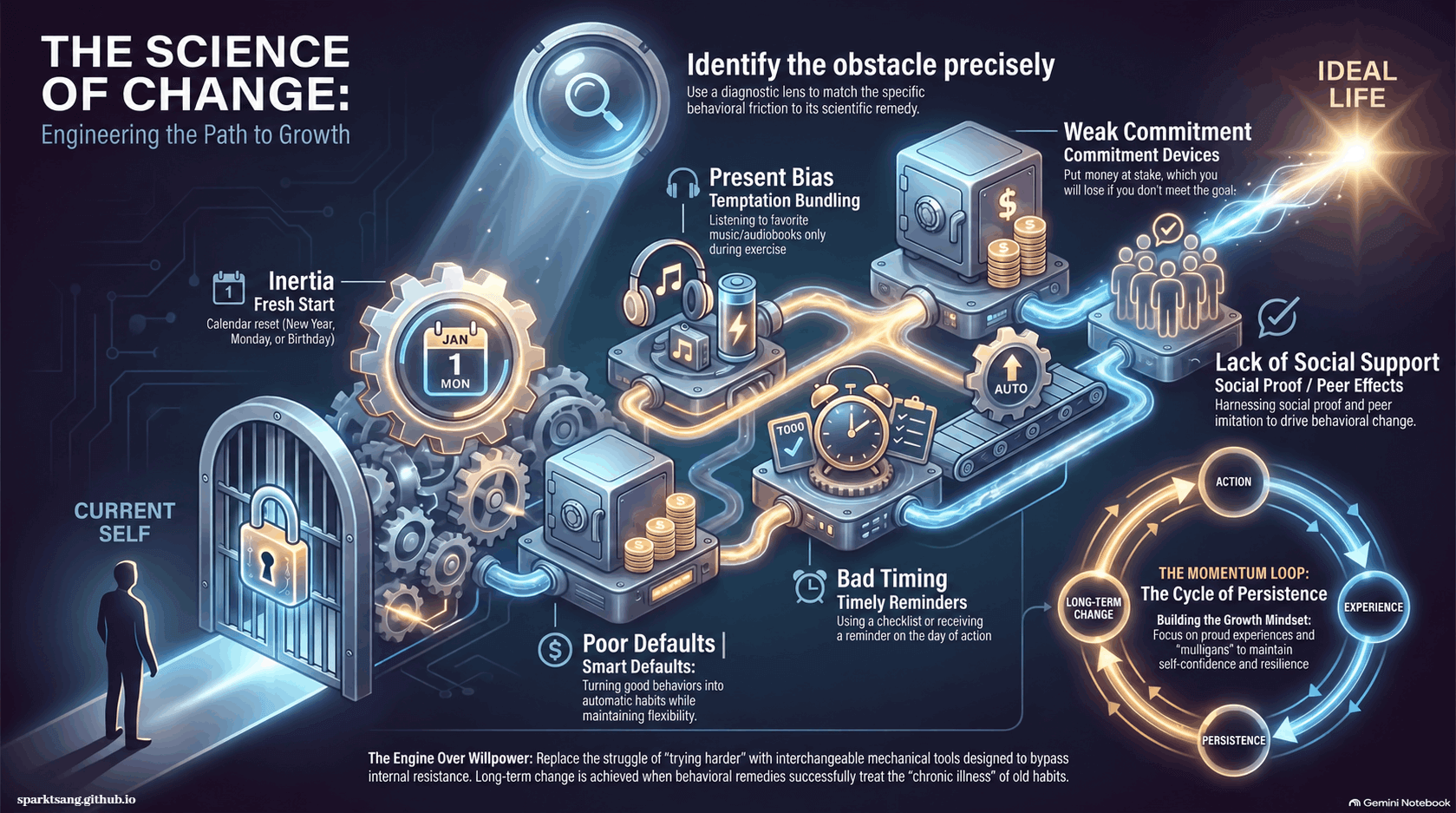
The Fresh Start Effect
Google’s HR department wanted to help employees make better decisions about working from home, but few employees signed up for the company’s free course, so they sought advice from a group of experts, including the author.
Many government health campaigns have had little effect, but the campaign encouraging parents to put babies to sleep on their backs to reduce the risk of sudden infant death was highly successful, leading the author to think about the Fresh Start Effect.
Ray Zahab, who had repeatedly failed to quit smoking, made a vow to quit again at the turn of the millennium—and succeeded.
Bob Pass had long wanted to give up his legal career and become a tennis instructor but never acted on it; only after narrowly escaping death did he finally make the change.
Data show that college students exercise more at the beginning of January, at the start of a week, after holidays, at the beginning of a new semester, and after their birthdays.
A 1994 study found that among people seeking major changes in their lives, 36% of successful changes occurred when they moved house; among those who wanted to change their lives when they moved, only 13% failed.
When the London Underground went on strike in 2014, many commuters were forced to try new routes, and about 5% permanently changed their commuting habits in positive ways.
One of the author’s graduate students found that players who had originally performed poorly tended to perform better after switching leagues, while players who had performed well often declined after the move. This shows that interrupting a successful routine at the wrong moment can actually cause people to backslide.
In an experiment led by the author, a group of college students looking to make changes were sent emails on the same day, but with different descriptions depending on the group. The results showed that those who received descriptions with a fresh-start connotation, such as “the first day of spring,” had higher success rates.
The author’s team sent mass emails urging university employees to save for retirement. When the date carried a fresh-start meaning, the effect was two to three times stronger.
Only 20% of the goals people set each January are successfully achieved, but that is already quite a lot.
Temptation Bundling
Present bias—that is, impulsiveness—is ubiquitous in shaping behavior. So making an activity immediately more pleasurable or gamified can increase people’s motivation to act.
At Odenplan subway station in Stockholm, a staircase was transformed into the famous “Piano Stairs”, and the number of people choosing the stairs increased by 66%.
In Disney’s classic animated film Mary Poppins, sugar is added to medicine to get children to take it willingly.
Many people overestimate their future selves’ ability to make rational choices and underestimate the lessons of past failures, which is why they confidently prepay for a full year of gym membership.
When an unpleasant task is paired with a reward, motivation can increase dramatically.
To overcome her own lack of motivation to go to the gym, the author made a rule that she could read her favorite novels only at the gym. It worked.
To test whether the method would also work for other people, the author conducted an experiment and found that students who were allowed to listen to audiobooks on portable music players while working out at the gym exercised 55% longer than the control group.
Commitment Devices
These can be divided into hard and soft commitments. The former involves putting money on the line: if you fail to meet the commitment, the money is handed over to a designated third party, such as a charity—even an anti-charity that supports causes opposed to your own views.
Hard commitments are more effective, but fewer people are willing to accept them. Acceptance begins with understanding how they work.
The Timing of Reminders
The same day, when immediate action is possible, is best. Reminding people on the morning of an election is more effective than reminding them earlier.
When a plan is complicated, it is better to use a checklist.
Defaults
Habits make good behavior automatic, but excessive rigidity can reduce the sustainability of those habits.
The Advice-Giving Effect
Giving people advice can undermine their confidence; asking them for advice can instead help build it.
Forming an advisory group in which members serve as one another’s mentors and friends can help people make progress in life.
Expectations can shape reality: one group of hotel housekeepers were told that their daily work helped them achieve their recommended amount of daily exercise, while another group received no such information. With the same workload, the first group lost an average of five kilograms, while the second group showed no change.
Building mulligans into your goals—allowing for reasonable lapses—can effectively maintain a healthy level of self-confidence and sustain long-term effort.
Develop a growth mindset, and you will be better able to rise from failure.
Focusing on experiences you are proud of can eliminate self-doubt and build resilience.
Copy and Paste
When facing a challenge, you can copy the experience of someone who is skilled in the relevant field. Some people who wanted to become vegetarian initially had no idea where to start, but they found it easy to make the transition by following the ordering habits of vegetarians.
A hotel-room notice saying that 75% of guests reuse their towels increased reuse by 18% (a classic example of Social Proof); when the notice instead said that most guests who stayed in that particular room reused their towels (local social proof), reuse increased by another 33%.
Facebook telling users that their friends had already voted increased those users’ likelihood of voting.
Peer effects are enormous: people imitate others without even realizing it. To achieve major goals, a peer group is important, and the closer the people are to us, the more influence they have. But when the gap between us and the person we are trying to emulate is too large, it can severely damage our confidence and make us give up altogether.
A get-out-the-vote letter stating that voting records would be made public across the entire district increased turnout by 8.1 percentage points. The author notes that she had never seen such an effect from conventional campaign materials.
Public recognition can help encourage change.
When someone applies social pressure to you and it makes you uncomfortable, it is best to avoid it.
Even behaviors that are not yet popular can persuade others when you show them that the behavior is becoming increasingly common.
The Discipline of an Ideal Life
In programs designed to increase physical activity, many ideas have been shown to work in the short term, but their effects rarely translate into long-term change.
Long-term change is like treating a chronic illness: there is no need to rush. Instead, identify the obstacles precisely and target them with the right remedy.
Finished reading on August 1, 2023
Thank you for reading until the end. This is a bonus infographic just for you.