Notes on Great at Work
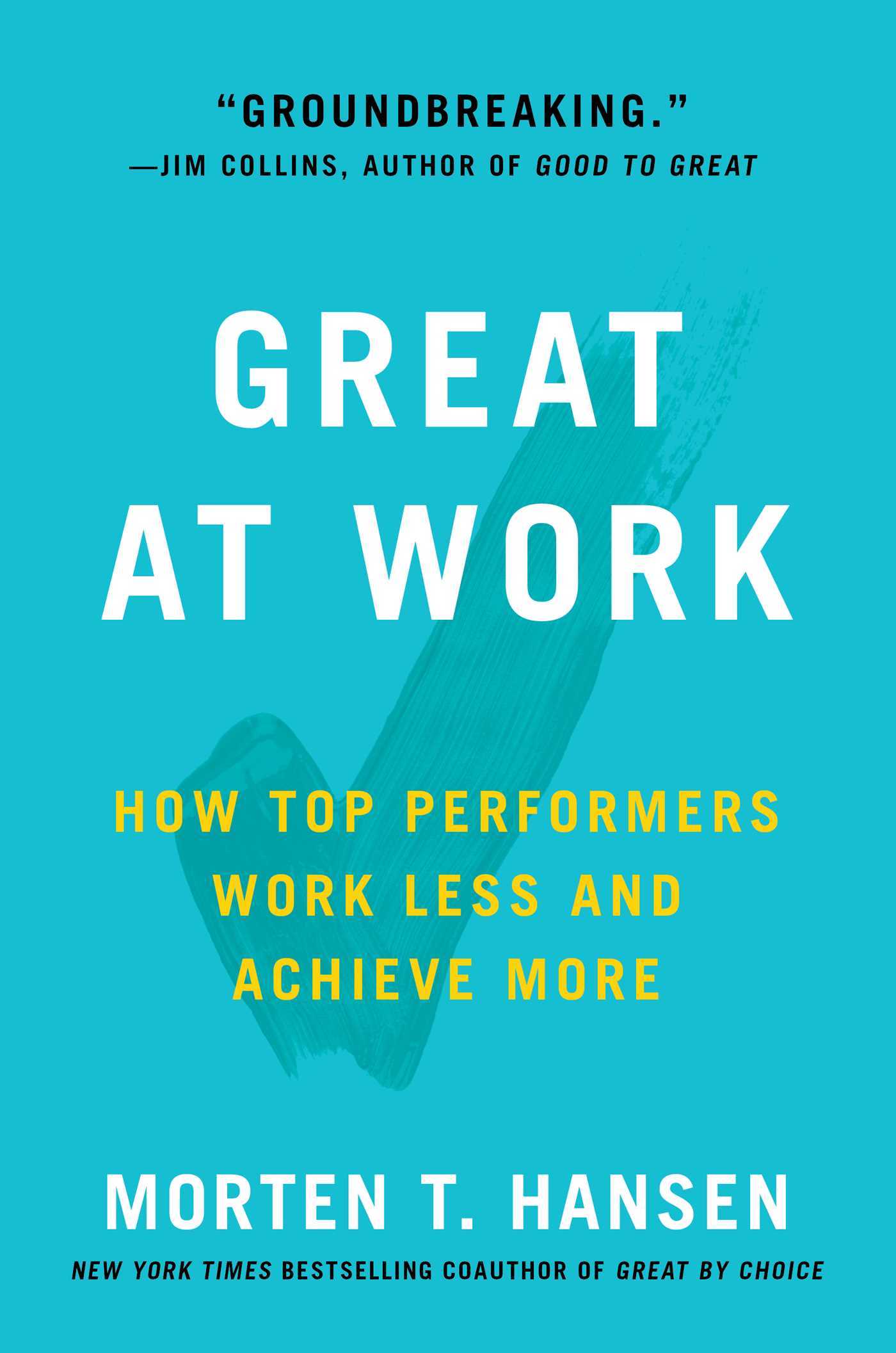
Great at Work: How Top Performers Do Less, Work Better, and Achieve More by Morten T. Hansen
Original notes here.
Read until the end to get a bonus. Enjoy reading.
At the beginning of his career, the author was constantly working overtime, until he noticed that one colleague never did—and yet his performance was nowhere near the colleague’s level.
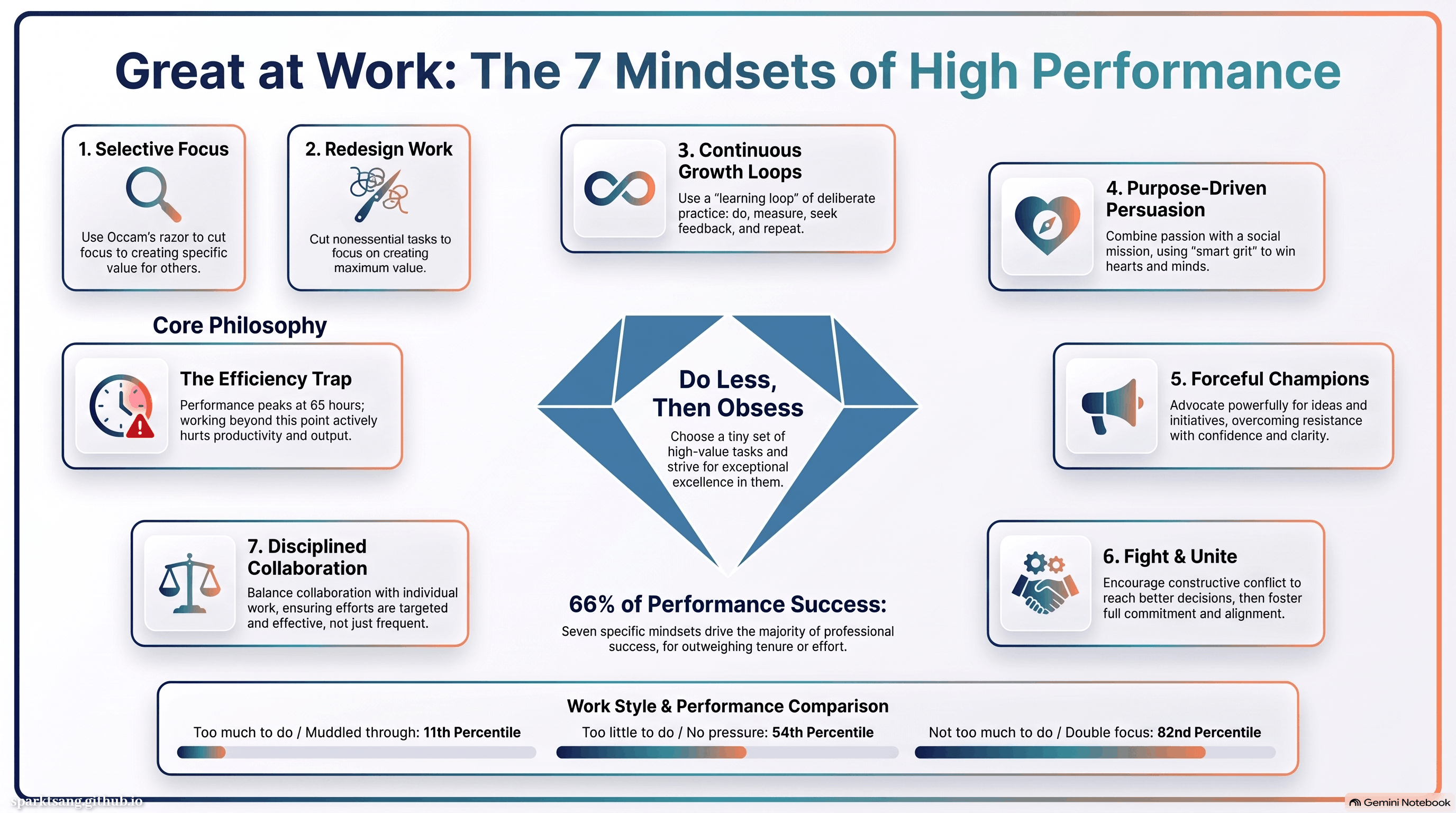
Empirical research has identified seven factors behind high performance, explaining 66% of the variation in performance. Working hours and individual factors (education, gender, age, and tenure combined) explain only 10%; 24% remains unexplained, perhaps attributable to talent and luck.
Smoking accounts for only 18% of the variation in life expectancy (Audre Biciunaite, 2014), while salary accounts for only 33% of the factors affecting differences in individuals’ net worth (PK, “Correlation of Wealth and Income by Age,” 2016).
I. Do Less, Then Obsess: Concentrate Single-Mindedly and Strive for Excellence in What Matters Most
Two teams simultaneously attempted to reach the South Pole. The team with far fewer resources and less funding won. Unlike its rival, which used five different means of transportation, it relied solely on dogs, pouring its effort into training the best sled dogs: the more you do, the less you actually get done.
This is the most important of the seven high-performance mindsets. When average performers adopt it, they outperform 74% of people.
Managers are only slightly more focused than junior employees; the difference is not large.
A talent agency whose motto was “satisfy every client’s needs as much as possible” was eventually overwhelmed by its workload.
Multitasking is less efficient; judges who handle cases one at a time are more productive.
Companies can become too complicated, creating severe internal friction: additional goals, priorities, and checkpoints make it harder to do anything well.
When Jiro Ono, the sushi master from the documentary Jiro Dreams of Sushi, prepares sushi for customers, he massages an octopus by hand for 40 to 50 minutes to make its flesh tender. Apprentices can spend eight years learning before they are even allowed to prepare the most basic tamagoyaki, and by the time they are permitted to serve it to customers, they have already practiced it extensively.
The famous bathroom murder scene in Psycho lasts only 45 seconds, yet it took seven days and more than seventy takes to shoot. Dyson spent 15 years building 5,000 prototypes before developing its first bagless vacuum cleaner.
Among four groups, the performance of those who had “too much to do and just muddled through” was negligible (11th percentile). Next came those who had “too little to do and put no pressure on themselves” (54th percentile). Those who had “too much to do and were under overwhelming pressure” performed only slightly better than the first group. The highest-performing group was those with “not too much to do and double focus” (82nd percentile).
A hospital in the Midwest had a myocardial infarction survival rate of only 65%. Within a year, it dramatically improved outcomes by simplifying the process, eliminating repeat examinations by cardiologists, and striving for emergency physicians to make an accurate diagnosis on the first assessment.
How to deal with too much and too varied work: use Occam’s razor to simplify tasks and narrow the scope until there is nothing left to cut.
How to deal with temptation: imitate Odysseus by having yourself tied to the mast. To concentrate on writing, the author brings only an offline computer to the coffee shop every day.
How to deal with pressure from the boss: say no, and make the boss understand that taking on too much work will undermine performance.
II. Redesigning Work
Students at Clintondale High School were performing poorly, and the school was facing closure. Drawing on his experience teaching children to play baseball, principal Greg Green decided to flip the classroom: he asked teachers to record instructional videos for students to watch in their free time, while at school they would receive guidance as they worked on assignments.
At first, the teachers thought the principal was crazy, but an initial experiment proved that it worked. Eventually, the entire school flipped its classrooms. The failure rate fell sharply, graduation rates rose dramatically, and other schools began following suit.
The trap of inefficient hard work: weekly working hours can reach 50 to 65 hours. As working hours increase, the marginal benefit begins to decline; at 65 hours, performance reaches its peak, and beyond that, more hours actually hurt performance.
Many people do meaningless work. They should focus instead on creating value that benefits others: the value of work equals the benefit brought to others multiplied by quality multiplied by efficiency.
When Hartmut Goeritz ran Maersk’s container terminal in Tangier, he first used Occam’s razor to cut poorly performing activities and concentrate on specializing in container loading and unloading. He repeatedly reviewed the process and replanned routes, discovering that many trucks were returning empty. He established a strict no-empty-return policy and had colleagues notify one another whenever loads were available. Without increasing costs, logistics efficiency doubled.
Five ways to create value: cut the nonessential, concentrate and specialize, redesign, improve quality (flipping the classroom), and improve efficiency (never return empty).
According to the research in this book, the ability to redesign one’s work is roughly equal regardless of position.
Redesign from pain points: a business analyst at a life insurance company was inundated every day with calls from insurance agents complaining about the claims process. Eventually she could take it no longer and approached the company’s programmers to simplify the claims procedure. They ultimately created a single user interface and an automatic classification system, allowing claims to be completed in just a few minutes.
Start with stupid questions: Why do children have two months of summer vacation? Why do patients have to stay in the hospital for two days after surgery?
III. The Learning Loop
Inspired by Outliers, Dan McLaughlin gave up a high-paying job to pursue a career as a professional golfer. After four years, he had already achieved impressive results. But the secret to his success was not repetitive practice; it was deliberate practice aimed at continuously improving specific metrics.
Many jobs lack clearly quantifiable metrics. To apply deliberate practice, one must use a learning loop: do, measure the results, seek expert feedback, correct, and repeat the loop.
A manager leading a hospital food-service team continuously improved questioning techniques through the above loop, prompting the entire team to implement a series of improvements.
Strategies: spend fifteen minutes each day focusing on practicing the same skill; break a skill down and concentrate on practicing one component at a time; review the results above; gather as much useful feedback as possible; take on difficult challenges (a doctor willing to treat difficult infertility cases initially had a low success rate, but after one hundred cases caught up and eventually surpassed doctors who took only easy cases); strive for excellence (you must push yourself. If you become satisfied with yourself, you will reach a plateau, and just as habits become second nature, you will stop improving).
Technological innovation is disrupting the workplace, and traditional skills are nearing obsolescence. To remain unbeatable, one must combine the learning loop with work redesign and keep improving continuously.
IV. Passion and Purpose (P-Squared)
Among the seven high-performance mindsets identified in the book, this ranks second in importance. People who lack passion or a purpose rank 18 percentile points lower in performance.
Passion means doing what you love; purpose means making a contribution. People with passion ask, “What can the world give me?” People with purpose ask, “What can I do for the world?” Unlike the simplistic idea that passion alone is the key to success, both are indispensable to a good life and strong work performance.
Research reveals that the reason for dramatically higher performance is not working very long hours, but working very hard at one’s work: Gui Yi, a concierge at a five-star hotel in Quebec, went to great lengths to help a documentary filmmaker who was staying there. She seriously searched locally for unusual items, made numerous phone calls, and secured the loan of many valuable specimens and local specialties. She went on to become one of the finest hotel service professionals in the world.
People in almost every occupation can find passion and purpose. Whether they can find them has nothing to do with the size of the company or their tenure.
Three steps:
Step out of the existing framework and find a new role: a software executive who had grown tired of his existing job created a new business within the company.
Broaden your passion across six dimensions: enjoy the work itself, experience success, be able to exercise creativity, enjoy working with people, learn and grow, and make use of your strengths.
Climb the pyramid of purpose: create extraordinary value without causing harm, discover personal meaning (some cleaners felt deeply about protecting animals, while some hospital workers enjoyed making patients feel a little better), and develop a powerful social mission.
V. Forceful Champions (using smart grit)
Persuading others determines whether goals can be achieved. The most important thing about being persuasive is the ability to win people’s hearts and make them excited.
The research in this book finds that persuasive high performers make use of smart grit.
Those who score highly on both winning hearts and using smart grit perform exceptionally well; those who excel in only one of the two are not nearly as effective.
The research in this book finds that men score significantly higher than women in persuasive performance, perhaps because of gender stereotypes, which cause people to perceive the same behavior differently depending on whether it is performed by a man or a woman.
One of the most effective ways to move people is to stir negative and positive emotions simultaneously: make people disappointed with the present while making them excited about the future.
Emotions are not all equal. Contagious mentions that arousing intense emotions helps information spread online, including excitement, joy, anxiety, and anger.
In 2009, celebrity chef Jamie Oliver wanted to improve eating habits in Huntington, West Virginia, one of the towns in the United States with the unhealthiest diets. In front of families, he displayed a disgusting mountain of fat.
A procurement employee trying to persuade the CEO to go paperless stacked several thousand pages of paper on the conference-room table.
Strategies for persuading people when blocked: understand the other side’s thoughts and concerns; decide what you are determined to fight for and where you are willing to compromise; if possible, turn enemies into allies (find ways to get the other side to cooperate with you); harness the collective power of many (the Indian social entrepreneur Arunachalam Muruganantham, known as the “Pad Man”, recruited a group of village women to manufacture and promote low-cost sanitary pads).
Persuasive masters are good at arousing intense emotions, then using actions, images, pictures, and demonstrations to shock people, while also inspiring others through a purpose.
VI. Fight and Unite
In 1961, a government-backed group of Cuban revolutionaries landed in Cuba, only for the invasion to end in disaster. Yet the leaders of the operation were supposedly a first-rate team. During meetings, everyone had doubts, but they followed the crowd.
A Microsoft survey found that as many as 69% of people believed the meetings they attended every day had little benefit.
In 2009, the author ranked the CEOs of different companies according to stock-market performance. The CEO ranked sixteenth, Bart Becht of Reckitt Benckiser, was almost unknown. It was a cleaning-products company, which made the author curious to investigate. He discovered that the secret of its outstanding performance lay in team meetings characterized by constructive arguments, and he distilled the following unwritten rules:
Every meeting must be prepared for 100%.
Arguments must be well supported, using confidence and data to persuade.
Keep an open mind and listen to objections; do not stubbornly cling to your own view.
Let the strongest argument win, regardless of whether it was yours.
You may stand and speak loudly, but you must attack the issue, not the person.
Never dismiss minority opinions; listen to them seriously.
Do not seek consensus simply for the sake of reaching agreement.
Its style was that meetings could not end until a clear agreement had been reached and the team had collectively committed to carrying it out. If the discussion went beyond a reasonable amount of time, the most senior person made the decision. Once the decision was made, everyone had to put aside their differences, unite, and act on it.
Other high-performing companies had similar team cultures. Silicon Valley investor Anderson said that every idea in a meeting had to undergo a stress test. Even when it was the best idea he had ever heard, he would criticize it so thoroughly that nothing seemed left standing, putting on an exaggerated display of disdain. If, after being challenged, the proposer could still hold the upper hand, everyone would stop arguing and give the proposal their full support.
Team members should have diverse backgrounds so that more perspectives are brought to the table.
Women who are good at arguing with others score nearly 32%, compared with 30% for men. Thirty-eight percent of women score highly in bringing people together, compared with 34% of men.
In 2009, the Heineken Group, trying to turn around its performance, encouraged everyone to speak honestly in meetings. Each person had three cards: a red card reading “Challenge — Have another solution,” a green card reading “All in — Ask me why,” and a gray card reading “Shiny object alert — Get back on track.” They were used to express opposition, support, and digression.
There was also a toy horse in the meeting room, which could be thrown at anyone who talked on and on. Later, even people with unusual ideas who were extremely introverted dared to share them with everyone.
Two techniques for getting introverted high performers to speak: before the meeting, tell them, “The meeting is about to start. I know you have a very special perspective, so please make sure you bring it up and let everyone know”; or deliberately throw out an absurd answer to entice others to offer better ones.
Four attitudes toward meetings: listen to what others have to say; push my idea strongly; remain neutral; express opinions and make a contribution. Only the last mindset can lead to high performance.
Keys to team debate: introduce new knowledge (“I looked up some data from a certain place and found it very interesting”); write down three questions first; play devil’s advocate (“To facilitate the discussion, let me offer another perspective”); make the case for someone else (“What if we applied your idea to a larger market?”); fight for the best idea without asking where it came from.
Keys to listening: do not interrupt; listen to understand rather than to prepare your own answer; paraphrase to confirm that you have understood correctly; maintain eye contact; stay focused; ask non-leading questions.
Psychological research found that when employees are unable to express their views before a decision is made, they feel that the process is unfair, which can subsequently undermine implementation (Yochi Cohen-Charash & Paul E. Spector).
The research in this book found that people who actively eliminate political tactics that might obstruct the implementation of decisions perform better (correlation coefficient 0.61). Even when they disagreed, they would make it clear to everyone that they had already begun implementing the decision.
An assessment question for mastering this principle: Can I (or the team I lead) argue for my own views and say what I truly think? Can I accept the final decision and work hard to put it into practice?
VII. Disciplined Collaboration
In 2012, a hospital in Fort Dodge had numerous specialties that could not coordinate with one another, wasting resources and causing errors. This was the silo effect.
Too much collaboration is no better. It leaves people unable to keep up with everything and severely reduces efficiency.
Before collaborating, one must consider whether it can actually create value: “collaboration value” = benefit of the proposal − opportunity cost − collaboration cost. Collaboration must also have a specific, measurable, time-bound shared objective, such as “send humans to the Moon within ten years and return them safely to Earth.” Reward the results of collaboration, not collaboration itself, to avoid encouraging excessive collaboration.
In 2003, Mike McMullen became manager of Agilent Technologies’ chemical analysis division and discovered strong demand for a triple quadrupole mass spectrometer (QQQ), but its development depended on the life sciences division. He therefore strongly promoted collaboration between the two sides, persuading them with sufficient market information. He also gave that division a share of the business results, while ensuring that top-tier talent from the division was fully committed throughout rather than merely going through the motions. The teams reviewed progress regularly, and the project ultimately achieved great success. McMullen later took over leadership of the entire company based on his performance.
In another case, a company partner brought together three experts from the company to discuss a problem, only to discover that their opinions contradicted one another. The company ultimately lost the contract: the team already had sufficient professional expertise, so this collaboration produced a negative return.
Lack of trust comes from scarcity, dishonesty, different understandings, and unfamiliarity. Solutions: verification and pilot testing; for the former, add a public commitment; provide detailed explanations; build relationships by sharing aspects of life and getting to know one another.
Keys to success: sufficient collaboration value, setting aside self-interest and advancing or retreating together, focusing on outcomes, investing sufficient time and resources, and mutual trust.
The higher the quality of your work, the more choices you have in life.
Leaving work on time, shutting everything off when work ends, and defending your private life … can only treat the symptoms. The root cause is inefficient work.
There are many factors affecting happiness—where you live, how you get around, health, people, salary, and so on—but the seven mindsets account for 29% of the variation in happiness.
Double focus and collaboration are particularly conducive to work-life balance. Passion and purpose can easily lead to imbalance, but they are especially important for increasing job satisfaction (the other three are redesigning work, smart grit, and collaboration). The ability to argue and unite can easily lead to burnout.
Three strategies for preventing negative effects: make good use of the time dividend (use the time gained through higher efficiency to rest); harness passion while balancing life (do not keep thinking about work at home); reduce emotional conflict.
Conclusion
Small changes, big impact: do not let others steal your time; use Occam’s razor to simplify and seek elegance; look for gaps in value so that you can focus; start doing it immediately in your current job.
Appendix: The Largest-Scale Study of Work Success
The study required respondents to evaluate themselves, their superiors, and their subordinates; the research concerned the people being evaluated.
A pilot study of 300 people was conducted first to screen for important factors. The researchers then studied 4,964 people, using regression analysis and structural equation modeling (SEM) as the statistical techniques. The result was an empirical framework derived from large-scale analysis.
Limitations and how they were addressed: respondents were not studied in sufficient depth (120 case interviews were added); the evaluation subject was favored (making it appear to be a habitual survey); reverse causality (valid only for some relationships, such as the fact that high efficiency does not necessarily make work decrease); probability (some people scored highly on all seven mindsets yet performed poorly, while others performed well without practicing the seven mindsets).
Works mentioned here: Richard Scott, Organizations and Organizing; Julian Birkinshaw, Reinventing Management; Thomas Malone, The Future of Work; Linda Gratton, The Shift; James March, “Exploration and Exploitation in Organizational Learning”; Influence; Angela Duckworth.
Finished reading on March 22, 2021
Thank you for reading until the end. This is a bonus infographic just for you.