Notes on Grit: The Power of Passion and Perseverance
Grit: The Power of Passion and Perseverance by Angela Duckworth
Original notes here.
Read until the end to get a bonus. Enjoy reading.
Chapter 1 The Secret of Grit
West Point and its admissions process are as demanding as the narrow gates of an elite university. Applicants spend two years preparing, yet as many as one-fifth drop out, concentrated in the seven-week course in early summer after admission known as Beast Barracks.
The author’s research found that only grit could accurately predict who would persist and stay. Grit could likewise predict which salespeople would remain in the profession, which students would graduate successfully, which candidates would pass training for the Army Special Operations Forces, and the final performance of spelling bee contestants. Those with higher grit were also more likely to pursue advanced study.
Chapter 2 Our Talent Myth
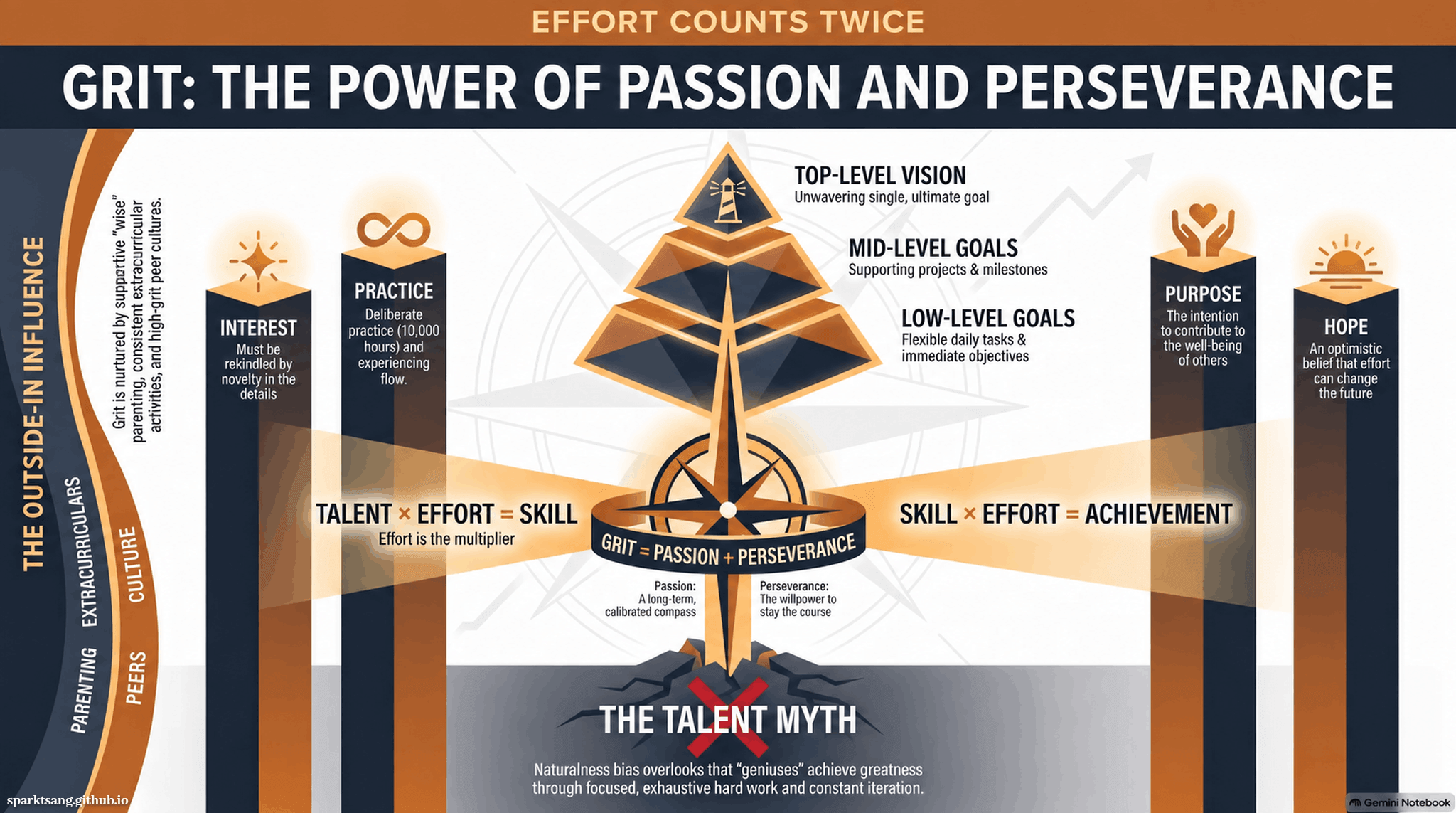
Although most Americans say that effort matters more than talent, deeper research reveals that many people are hypocritical, harboring a “naturalness bias” (a hidden prejudice against those who achieve through hard work rather than innate talent).
Many people regarded as geniuses, in fact, achieved that status through hard work.
Chapter 3 Effort Counts Twice
Nietzsche observed that bestowing the title of genius gives mediocre people an excuse not to compare themselves with such individuals, as though their appearance were a miracle.
He also said that those who create excellence are focused in one direction, exert themselves to the utmost, observe themselves and others with passion, perceive all kinds of patterns and motives in everything, and constantly integrate every workable method.
Duckworth captures this in two defining equations: “Talent × Effort = Skill” and “Skill × Effort = Achievement.” Effort therefore counts twice as much as talent.
John Irving, renowned as a natural-born storyteller, had a severe reading disability as a child and could not produce anything good. He could only write and rewrite, revise and revise, and ultimately became a great writer.
Research found that treadmill performance at age twenty, which is related to willpower, is a very reliable predictor of psychological adjustment in adulthood.
Chapter 4 How Gritty Are You?
Grit can be measured on a scale, with a maximum score of five. Its two major components are passion and perseverance. The passion discussed here is not a fleeting obsession, but a long-term, unwavering commitment. It is not the fireworks of a momentary flash, but a compass that takes time to build and calibrate in order to point in the right direction.
Life goals can be divided into top-level, mid-level, and bottom-level goals, and a person can map all of them out. If one has only an ungrounded top-level goal (for example, wanting to become a doctor) without supporting short- and medium-term goals, it is nothing more than fantasy.
More commonly, people have many mid-level goals that are not connected to any coherent top-level goal, or many top-level goals supported by mid- and bottom-level goals but entirely unrelated to one another.
Ideally, one should focus on a single top-level goal rather than several. The more unified and coordinated the hierarchy of goals, the better the effect. If there are too many goals, they should be filtered, and one should ask oneself whether the many goals have anything in common.
Lower-level goals can remain flexible, being discarded and replaced until the right ones are found; sometimes this process is absolutely necessary. The higher the level of the goal, the more one should persist with it.
Catherine Cox of Stanford University found that among 301 historical figures of greatness, the relationship between IQ and outstanding achievement was extremely weak.
Among those great figures, the difference between the top ten and bottom ten lay in four factors: effort, not giving up easily (the first two being related to passion), willpower, and perseverance (the latter two being related to perseverance).
Chapter 5 A Trait That Can Be Developed
Twin studies found that genes account for 37% of the variation in grit. Like other traits, grit is influenced by both genes and upbringing, and it is not attributable to a single genetic factor but to multiple genetic factors acting together.
Grit increases with age. Maturity and the sociocultural environment exert simultaneous effects. When necessary, people change and adapt.
The four elements for cultivating grit are interest, practice, purpose, and hope.
Chapter 6 Interest: It Must Be Rekindled Again and Again
Discovering one’s passion is not love at first sight, but a slow process of gradually discovering it, nurturing it extensively, and then cultivating it over a lifetime.
Most Grit Paragons did not immediately discover their calling when they first encountered it. They had to experiment and try things in many different directions; interest cannot be discovered through introspection alone.
Interest takes time to explore and cultivate, and even after discovering it, it still needs to be strengthened.
The reason people can sustain passion for an interest is that they can continually discover novelty in the details.
Chapter 7 Practice: The Expert’s Deliberate Practice
Anders Ericsson studied large numbers of successful people who had attained world-class skills and found that 10,000 hours of deliberate practice are necessary.
Another expert, Mihaly Csikszentmihalyi, found that successful people entered a state of flow, losing themselves completely, when engaging in activities related to their calling.
The author’s research found that people with high grit not only enjoy arduous and difficult deliberate practice more, but also experience more states of flow.
The author believes that the arduousness of practice and the ecstasy of flow are difficult to experience at the same time, but this remains to be proven.
Chapter 8 Purpose: The Intention to Benefit Others
Interest and purpose are the two pillars of grit. Purpose refers to the desire to benefit others.
Research found that those most engaged in their work had both.
Grit Paragons all regard their work as a meaningful vocation, something worth devoting themselves to wholeheartedly, rather than merely a means of making a living (just a job) or a channel to better opportunities (just a career).
Although there are a small number of highly gritty villains such as Hitler, research found that the higher people’s grit, the stronger their desire to benefit others.
Chapter 9 Hope: The Belief That Effort Can Change the Future
Animal experiments demonstrate the psychological phenomenon of “learned helplessness”. When dogs were unable to control a situation for a period of time, they would simply give up trying to save themselves even after the environment had changed. Rats that were able to control their circumstances when young became more fearless as adults.
Happiness is not only the result of strong performance; it is also a cause of it. Optimists keep trying after setbacks and achieve more.
Highly gritty people tend to have a more optimistic growth mindset, believing that personal abilities can be substantially changed through effort and development.
Chapter 10 Parenting: The Power of Role Models
Based on limited data, the author speculates that wise parenting (strict but supportive) is the most helpful for cultivating grit in children, compared with authoritarian parenting (strict but unsupportive), neglectful parenting (neither strict nor supportive), and permissive parenting (supportive but not strict).
Many Grit Paragons with wise parents say that they are proud of their parents and imitate them, implying that some parents who practice wise parenting but lack grit themselves may not necessarily be able to teach grit by example.
Not all Grit Paragons have wise parents; other people can also have an influence that lasts a lifetime.
Chapter 11 Extracurricular Activities: Practicing Persistence in Difficult Things
Extracurricular activities require grit, and they can also cultivate grit. Research found that students who were better able to stick with extracurricular activities had higher grit and performed better in the future.
Children from disadvantaged backgrounds tend to have lower average grit because of the limitations placed on their access to extracurricular activities.
Difficult tasks can increase diligence even when they are compulsory.
Chapter 12 Organizational Culture: The Astonishing Motivating Power of Peers
Groups with a strong, distinctive culture and a sharp contrast between insiders and outsiders (in-groups) have a powerful capacity for assimilation.
If you want to become grittier, join a culture where grit is high. The human drive to fit into a team is immense, and its subtle influence takes place without our even realizing it.
The benefits of passion and perseverance usually take several years to become visible.
A culture of perseverance can be passed down. Finns, who have a tradition of perseverance, embrace a growth mindset toward personal development.
The leaders among the Grit Paragons all establish core values within their groups.
West Point’s dropout rate once declined because bullying was not tolerated, then rose again. It is now falling once more because the current superintendent, Lieutenant General Caslen, has adopted a supportive and encouraging leadership style rather than one based on creating fear and eliminating the weak.
The culture of the Seattle Seahawks (under head coach Pete Carroll) on deep support and constant self-challenge, echoing the argument about wise parenting. They point out that the Latin root of compete literally means to strive together, and has nothing to do with who ultimately wins or loses.
Conclusion Let Us Redefine Talent
Grit can be cultivated from the inside out: nurture interests, develop habits, set goals, challenge yourself every day, refuse to yield in the face of setbacks, and keep going.
It can also be cultivated from the outside in, by allowing the people around you to become a source of support and influence.
Research found that grit is positively correlated with happiness, meaning that the grittier a person is, the happier they tend to be.
Character has many dimensions, and grit is not the only one. Character can be divided into three dimensions: intrapersonal/will, interpersonal/heart, and intellectual/mind. Each predicts different outcomes. Intrapersonal character can predict academic performance, interpersonal character can predict social ability, and intellectual character can predict enthusiasm for learning and an independent mindset.
If genius means striving wholeheartedly and tirelessly for excellence, then everyone can be a genius, as long as they are willing.
Finished reading on November 30, 2017
Thank you for reading until the end. This is a bonus infographic just for you.