Notes on Stick With It
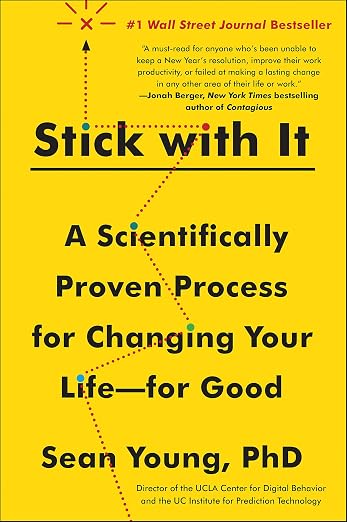
Stick With It: A Scientifically Proven Process for Changing Your Life—for Good by Sean Young
Original notes here.
Just as with the principles in Influence, the seven psychological forces also produce a compounding effect when used together.
The seven drivers of lasting change
SCIENCE: stepladders, community, important, easy, neurohacking, captivating, engrained
The human brain craves efficiency. It wants to accomplish things with as little effort or thought as possible; work with these drives rather than against them, and you can achieve far more with far less effort.
I. Stepladders
Dreams are exciting, but merely dreaming can backfire: when the dream is too far away, people become discouraged and give up.
Setting very small steps that can be put into action immediately and completed in less than two days is the key to success.
Something that can be completed in one week to one month is a short-term goal; something that takes one to three months is a long-term goal; anything farther out is a dream.
A study of 126 women trying to lose weight found that those who focused each day on gradually losing weight were more likely to stick with it, while those who dreamed each day of becoming successful actually gained more weight.
Neuroscience research has found that when people receive an expected reward or more than expected, the brain releases dopamine, but when they receive less than expected, it does not.
The ancient Indian instrument tabla is notoriously difficult to learn. Students who fill their heads with dreams of performing on stage soon give up; those who focus entirely on the present and make hitting the correct rhythm their goal are the ones who persevere.
After achieving a small goal, it is very important to look back and give yourself credit.
Product developers also use incremental steps, regularly congratulating users as they make progress. The MyFitnessPal app, for example, has only one question with two choices on the home page, three choices on the second page, and only on the third page does it present a question with four choices.
II. Community
There are no shortage of intelligent and knowledgeable people who, because of the power of community, have joined extremely radical sects that advocate murder and suicide.
Powerful communities have a social magnetism that makes people unable to stop participating, as with treasure hunts and Facebook.
The online HIV-prevention community HOPE achieved a testing rate more than twice that of the general population.
Six conditions for a successful community: trust, belonging (establishing social norms that allow people to fit in), self-importance (people will keep doing things that make them feel good about themselves), social magnetism, rewards, and empowerment (the feeling that one can control one’s life).
A community should have 15% of its members serving as role models. Incentives such as online gift vouchers can be offered. After 12 weeks, a community can generally sustain itself, and there are four types [of role models]: experts, celebrities, messengers, and people cultivated from within.
For new visitors, there should be only one goal at first: get them to make a small contribution during their first week, such as liking something, answering a question, or speaking up.
The founder of the programming language Spark built a community that gave other engineers a sense of belonging and of being part of the same group, helping people understand and like Spark.
Dos Equis beer successfully built a community but lost focus: the community discussed its advertisements rather than the product, and as a result its sales were much lower than those of Sam Adams, which had far fewer likes but remained focused on the product.
III. Important
The three things that matter most to people are money, social connection, and health.
Mexico’s conditional cash-transfer program for women, which replaced the previous food-stamp system, was a great success.
The importance of deep relationships to happiness in life is far greater than most people expect.
Successful life-insurance sales can make customers feel that the product matters.
People who see a simulated image of themselves when they are old are more willing to invest in their future.
The examples of the author’s two grandmothers seem to show that after suffering the loss of someone dearly loved, whether elderly people are able to survive for long may depend on the order of importance they assign to things in life.
IV. Easy
Under the dominance of 7-Eleven, Trader Joe’s rose by offering only a limited selection.
The electric-shock experiment produced its results because the environment made it easy for participants to carry out the action and difficult for them to resist.
More than one-third of couples meet through work or school (an easy route to meeting people); the postponement of marriage may also be due to having too many choices.
When offered only six kinds of jam rather than 24, customers showed greater interest and were more likely to buy.
Students who read detailed instructions were far more likely to get vaccinated than those who did not: creating a careful blueprint helps people take action.
Establishing a clothing routine, like Steve Jobs, Zuckerberg, and Einstein, can save a great deal of time.
Experiments show that people’s predictions of their friends’ actions are no better than random guesses, yet they exhibit the overconfidence effect (D. Dunning et al., The overconfidence effect in social prediction, Journal of Personality and Social Psychology 58, 1990).
Over 60% of engineers believe they rank in the top 10% of their peers (Todd R. Zenger, Explaining organizational diseconomies of scale in R&D, Management Science 40, 1994).
Make things easy: live near a gym, stock your home with healthy food, set an alarm to remind yourself to practice an instrument, and provide a giant button to guide website visitors.
In an E-Trade advertisement, a three-year-old child sits on a bed, taps a phone, and says that he has bought a stock.
In 2014, an app that let users send a simple “Yo!” to a friend went viral: even if something is extremely silly, people will use it if it is simple enough.
Google made healthy foods easier to reach in the company cafeteria, reducing employees’ fat consumption by 11%.
The father of social psychology, Kurt Lewin: “Conflict” is the situation that arises when roughly equal and opposing forces are acting on a person at the same time.
When you want to act, remove the factors that are stopping you, and then act.
V. Neurohacking
Neurohacking is a psychological technique that uses reflection on past behavior to rewire the brain.
The traditional view is that changing one’s mindset leads to changed behavior. Scientific evidence reveals the reverse: change the action, and the mindset follows.
A man who could not get over an old love changed his password to forgiveher, and discovered that he really could forgive the other person.
When Franklin was campaigning for re-election as a legislator, he came under a lengthy attack from a fellow party member. He borrowed a book the opponent treasured and was proud of, then returned it with a card thanking him. He immediately turned an enemy into a friend.
Men who lacked confidence were arranged to have one-on-one conversations with women for 12 minutes. Six months later, they were much more confident and had many girlfriends. (F. M. Haemmerlie & R. L. Montgomery, 1984)
Whether people agree or disagree with something is strongly affected by being instructed to nod or shake their heads.
Writing about oneself with the non-dominant hand causes confidence to drop sharply.
The trick of taking a date to a horror movie has a scientific basis: people experience the “misattribution of arousal” (mistakenly attributing their physiological reactions to physical attraction instead of fear).
When people watched semi-nude women while hearing their own heartbeat speed up or slow down, they judged the women as more attractive, and the effect persisted.
Appealing to identity is more effective. “How important is voting to you?” versus “How important is being a voter to you?” The latter question is more likely to prompt action. “Please don’t be a cheater” is more effective than “Please don’t cheat.”
When the author’s dog had an episode, he only had to pin its ears back, mimicking the movement of a submissive dog, and it would immediately obey.
Physical therapy is essentially the use of neurohacking: getting people to imagine that they can make their bodies do things they could not do before.
Leading other people in overcoming procrastination can help the leader overcome procrastination as well.
Judaism has survived for thousands of years because it has a tradition of repeatedly performed religious rituals.
Those who move keep moving; those who remain still keep remaining still. Unless action comes first, lasting behavioral change will not occur.
VI. Captivating
When people do something and receive a reward, they will keep doing it.
Extreme couponers shoppers keep buying things they don’t need. Sixty-five percent of America’s wealthiest consumers (those earning more than $150,000 a year) would not shop at all without coupons.
People who are passionate about metal detecting first have to spend $500–$1,000 on equipment. Most never recover their investment, yet the anticipation of finding treasure keeps them happily engaged.
Animal experiments show that operant conditioning can help animals learn. But when applied to humans, the reward has to feel large enough that it resembles being trapped in a cage and yearning to be released or to obtain food.
Top scientists spent 15 years failing to determine the crystal structure of the HIV virus. When the task was turned into the online puzzle game Foldit, 240,000 players solved it in just ten days.
Important things can become fascinating rewards: money, social connection, psychological states (such as peace and calm), health, freedom, and independence.
Use the allure of rewards correctly:
Things you have no choice but to do can still be made enjoyable: healthy food can be delicious.
Reward is better than punishment. An example from prison reform: repeat offender Stacey Torres participated in a program in which good performance earned rewards, and successfully turned her life around.
Do not assume money is the best reward: above an annual income of $75k, additional income brings no emotional benefit. Rewarding people for something they already love doing can make them stop liking it (after being rewarded for coloring, children became less interested in it).
Education cannot change mindset and behavior on its own: simply providing information does not help people change; you must appeal to psychology and emotion.
Make the activity itself the reward. At the same time, you need to consider the player’s motivation. A cooperative environment should not use competition. Poorly designed programs cause most companies that attempt to use gamification to end in failure.
Rewards must come quickly: giving someone a piece of candy an hour later is pointless.
Intermittent rewards: the casino method. Winning every now and then is more addictive than winning every time, and eventually you can lose everything.
Applied to learning a new language: enjoy yourself immediately, understand the gist of a little story, and be able to read signs in a supermarket.
Commercial applications: frequent-flyer miles, reward points, My Starbucks Rewards.
VII. Engrained
The human brain is extremely efficient. Habits are designed so that people can act without having to think.
Babies prefer their mother’s voice. To make the dog and his newborn daughter get along, the author recorded his wife’s voice and attached it to the dog, and also made the dog think that the baby was giving it bones.
PTSD is precisely a deeply engrained response in the brain, a result of preparing the brain to put that response to use the next time trauma occurs.
Playing Tetris within six hours after a major psychological trauma can effectively reduce later PTSD symptoms, demonstrating that the brain can be retrained. Mindfulness meditation can also help alleviate PTSD symptoms.
Summary
Three types of behavior: ABC—automatic, burning, common—each with its own countermeasures.
Automatic behavior (done unconsciously): simple, engrained. People who bite their nails can wear gloves or chew gum; people who love Coke can remove all the Coke from the house and set an alarm to remind themselves to drink a substitute.
Addictive behavior (an obsession that is difficult to resist, something one feels compelled to do): all seven can be used, but the most useful are simple and engrained. To break a smartphone addiction: take it step by step, join a community, do something more important, make other activities easier, gradually discover that you enjoy doing other things, make other activities game-like, and engrain them into habits.
Common behavior (done consciously and willingly): community is slightly the most useful, though all the others work as well. For developers of health apps, users can be encouraged to start small, make use of community, make people feel that it matters, provide a clear purpose and simple steps, gradually increase their level of commitment, use gamified incentives, and create habits.
The best time to plant a tree was 20 years ago. The second-best time is now.
Questions can be addressed at seanyoungphd.com.
Finishing this book has itself already activated the psychological force of neurohacking.
Finished reading on Dec 31, 2020