Notes on The Personality Brokers
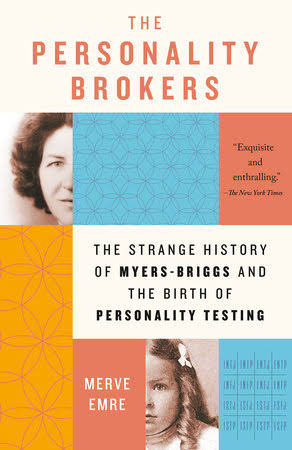
The Personality Brokers: The Strange History of Myers-Briggs and the Birth of Personality Testing by Merve Emre
Original notes here.
Read until the end to get a bonus. Enjoy reading.
In the fall of 2015, the author went through the archives at the Educational Testing Service, ETS, in Princeton, New Jersey
In theory, Isabel Myers’s papers were the property of Florida State University, but permission from the Center for Applications of Psychological Type, CAPT, was required to consult them
Nine months after submitting her application, the center required her to first take a training course costing nearly $2,000; during the course, the instructor told them that personality type was not a test, because there were no right answers; she also required the trainees to repeat that personality type would not change
After the course ended, the author learned that, based on her performance in the course, they had decided not to grant her access to the archives
Foucault: personality type is a modern “technology of the self”; the author says that these terms “not only erased the individual but also liberated the individual; moved women whom psychology had forgotten, who saw personality testing as an opportunity to gain power, and consolidated a particular capitalist culture”
Despite uncovering, in the course of writing the book, a history of personality type that was deeply questionable and even exploitative, she still wanted to treat fairly the sense of spiritual transcendence felt by the people she interviewed
Human beings are more diverse than I imagined, and this book is written for every one of you who cannot and should not be categorized
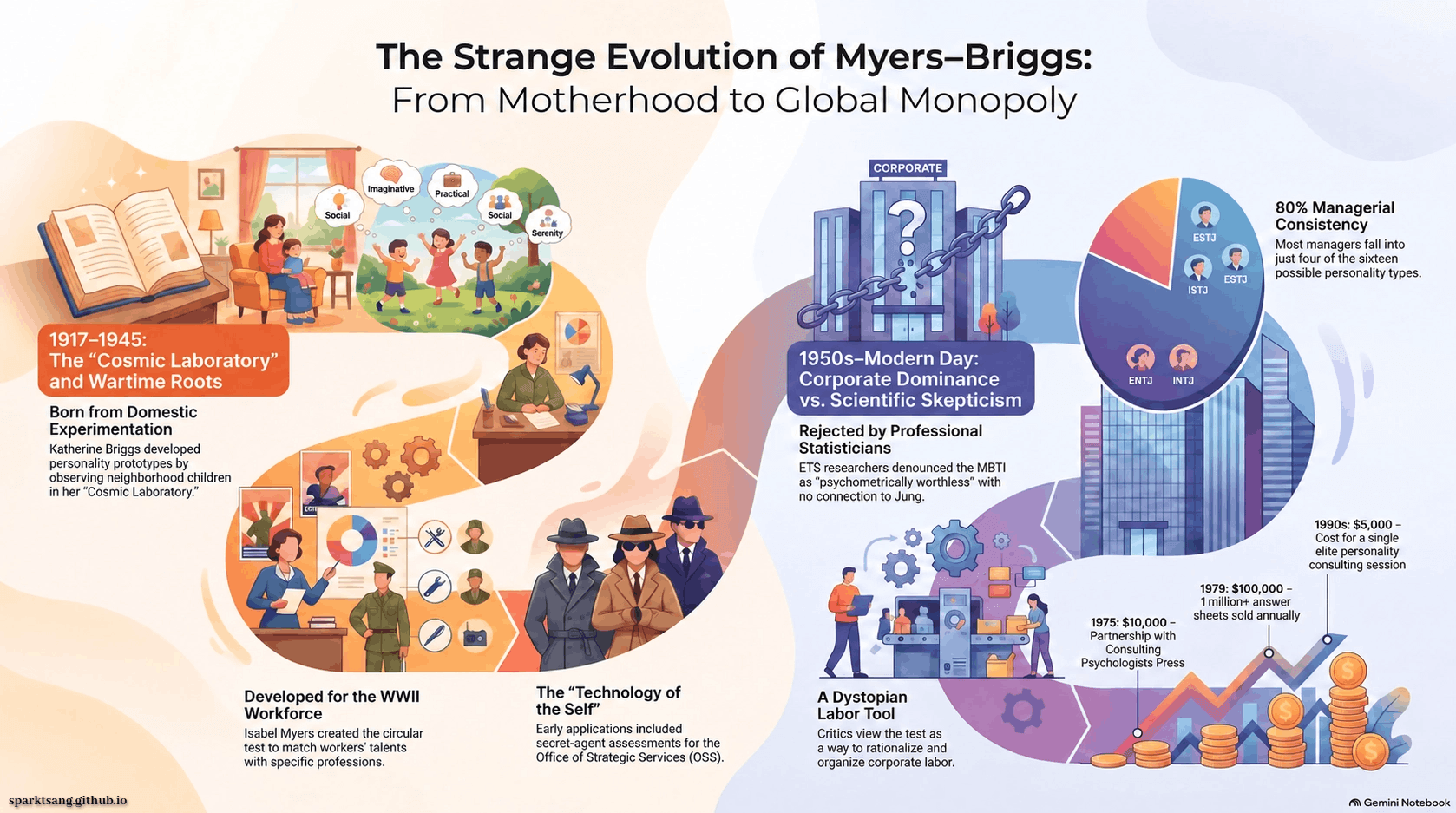
Katherine Briggs’s father was a scientist who accepted the theory of evolution. During a crisis of faith brought on by the loss of a child, she began thinking about how to reconcile the pursuit of personal salvation with the rational methods of the modern world, and how to turn the work of being a mother into the lifeblood of all professions. Apart from her daughter Isabel, several neighborhood children also became subjects in her “Cosmic Laboratory of Baby Training”. She believed that everything one did or did not do for a child, from feeding to discipline, was part of the experiment
Katherine believed that obedience and curiosity were the most important qualities that could be instilled in children, without realizing that the two were precisely opposite; she asked parents to fill out either-or questionnaires such as “Is he very calm or very impulsive?”, which became the prototype for personality-type indicators
Katherine strongly identified with William Grant Hague’s vision of eugenics: personality might already be determined at birth, but it could still be tempered and forged through upbringing
Raising an exceptionally gifted and talented daughter made her famous; over the following ten years, her writing earned her a net $1,230, at a time when there were very few women writers
Isabel left home for high school and, after going through five romances, fell in love with Clarence Myers
Clarence showed her The Varieties of Religious Experience, which said that the mystical experiences one has in solitude were themselves religion; this made Katherine deeply dissatisfied with her future son-in-law, because such a book was diametrically opposed to her own belief in obedience to authority
Later, Clarence deliberately wrote to her using the vocabulary of interpersonal-relationship science experiments to reveal his feelings for Isabel. Others might have found it cold, but to Katherine this rational declaration of love was beautiful and reassuring
After marriage, Isabel searched for work that suited her needs and desires, although her intuitive answer was to be a good wife; in her diary she wrote that, if necessary, a woman could do a man’s work just as well, but it would take more effort, and that spending one’s life laboring to do work that others could do easily was a waste of life; the idea of finding work suited to oneself would become the guiding principle of the MBTI test
Law school turned her husband into a radical socialist, while Isabel told her husband that advancing social progress was the achievement of great people, not a matter of changing the means of production, and she was convinced that what American society needed most urgently was a tool for identifying personality
Her husband was rejected for a teaching-assistant position, and in order to save money she decided to move back to her parents’ home, leaving her husband alone in Philadelphia to complete his studies
Back home, she discovered that the mother abandoned by her daughter had fallen into severe depression; while keeping her company, her mother’s interest in reading revived, and in Jung’s theories she found a “brand-new and dangerous obsession”
For the next five years, Katherine devoted all her time to closely studying Psychological Types by Jung, who became her personal God; she completely abandoned her original four-way classification of personality types: meditative, critical, sociable, and spontaneous
Jung described introverts as believing in their unique worldview above the expectations of others; extroverts, by contrast, acted according to purely objective conditions, so when it was cold an extrovert would put on more clothes, while an introvert might want to train the mind and regard an overcoat as unnecessary
Katherine judged herself an introvert and took pride in it, while also recognizing the contradiction with the agricultural courses she had taken in college, which focused on pure sensation; this was due to the character of her intuitive type
Examining the heart-wrenching pain of losing children one after another, she fully understood why she preferred thinking to uncontrolled feeling
She threw herself into the world of writing, becoming so busy that she did not even have time to eat; she told her hungry and bewildered husband: once this new faith entered my new life, housework had become a thing of the past for me
After an absence of ten years, her writing appeared in a magazine again: titled “Know Thyself: The Personality Paint Box,” it described knowing oneself as an easy and enjoyable journey of self-discovery
She also wrote to ask Jung why he described intuition as humanity’s noblest gift; Jung replied that “intuition can see through walls, bend around corners, and enter the deepest and murkiest reaches of the human soul, stirring its emotional side, which is why such an emotionally rich exclamation is possible”
She wrote a novel about homosexuality and was harshly reprimanded by an editor, so she turned to poetry to express her devotion to Jung, writing a poem titled “Hail Dr. Jung”
She then decided to pass her notes on to her daughter, who had moved back home, for reference, to help her improve her family relationships
Mother and daughter had both read the popular novel The Great Gatsby, which told the story of a fictional American who rose from nothing; the story reminded Isabel of her mother’s plans, and she copied the protagonist’s action list and tried to imitate it
After giving birth to a son and a daughter, Isabel began trying to satisfy her insatiable desires, and used the hours from nine at night until three in the morning to write the detective novel Murder Yet to Come for a competition. Her mother did not think much of the novel, but she should have been able to see the personality-type theory reflected in its characters, with the cooperative relationships among the characters reinforcing their differences in personality
The monthly New McClure’s Magazine, which was holding the competition, went bankrupt on the eve of announcing the results and was replaced by the fashionable magazine The Smart Set; the editor, who had just positioned it as a women’s magazine for young women, demanded that a woman be selected as the winner. Isabel thus took first prize and won $7,500, equivalent to $100,000 today
She spent most of the prize money on stocks, which disappeared without a trace in the stock-market crash; her plan to hire a nanny to care for the children was disrupted, and she also had to ask her father for financial support. Her mother advised her to be careful not to inflate her sense of self, calling it “an insult to the greater wisdom that truly controls your life”
Isabel told a friend that she hoped to find a way to discover what kind of work suited her, that she wanted to write books and plays, but that her ambitions were not so firmly fixed; she admitted that she was essentially lazy, liked leisure, yet perhaps this had been covered up by a greater desire and had never completely disappeared
At the height of the Great Depression, with her play lacking funding, she returned to her first profession: being a good wife, and told readers that career success was a man’s responsibility while marital success was a woman’s, a law of nature; unless both people recognized and accepted each other’s type and willingly followed the division of labor between the creators of life and the creators of civilization, both would suffer. She believed she had happily accepted her lifelong vocation
Like many psychoanalytic thinkers of the 1920s and 1930s, Katherine was deeply interested in dream analysis. Every day she analyzed her husband’s dreams, linking dream themes to the numbers assigned to inborn types, and she organized a dream study club for friends, meeting every week to discuss dreams and learn how to strengthen weaker personality functions
She soon discovered that she could not accomplish her goal of influencing the development of human civilization by relying on neighbors familiar with this way of doing things; she wanted more contact with “depraved souls” and “damaged people”
She offered help to Mary Tuckerman, the difficult daughter of her husband’s subordinate and friend, diagnosing her with “severe introverted neurosis” and a tendency to evade reality
Mary recited a poem about a covenant of brotherhood, leaving her dumbfounded, because it could be matched to the dream imagery Isabel had described earlier. This was how she interpreted it: your poem is an allegory; the dreamer gives you the poem just as Jesus gave parables to his disciples. It is both a promise and a prophecy, referring to an impending change, a rebirth
The two of them played imagery games on nighttime walks, which would develop into the forced-choice word pairs used in the MBTI test
The two formed a bond that replaced their mother-daughter blood tie; she reminded Mary that knowing yourself would be very lonely, that although it would liberate you, it would also sever your emotional connections with others, and require you to say goodbye to your former life and your way of loving life
Mary’s mother disliked what she saw as this cult-like way of kidnapping her daughter and, in severe anxiety, stopped the counseling. After the two lost touch, Katherine wrote to Jung for help; in her account, the Tuckerman family became neurotic, insane, and badly brought up people
Although she said she hoped Dr. Jung would spread across the globe, Jung criticized her overbearing interference in his reply and even told her to pay attention to postage if she wrote again
She wrote back in her own defense, saying that if the other family had mistakenly thought she was a trained psychologist, that was not her fault; if the incident offered any lesson, it was that mistakes instead gave her the courage to improve, and she would not back down
The author says that, in fact, she did back down. She no longer had contact with the Tuckerman family or Jung, no longer pursued “damaged” souls, and no longer ventured into psychoanalysis, realizing that no matter how much she imitated scientific or psychiatric laboratories, the goals she could achieve were always limited
After the setback, her friends all encouraged her Creator Cosmic Laboratory to reopen, and the number of people in the dream study club exceeded anything before
In September 1936, during Harvard College’s tercentenary celebration, Jung was an honored guest speaker. Katherine, who was the same age as him, resumed correspondence with him after learning the news, and arranged a private psychoanalysis session with him, but ultimately received a letter saying that Jung was too occupied with invitations to meet her
Encouraged by his wife, he finally met Katherine in a hotel room; she brought Isabel with her, but Isabel had no interest whatsoever in their conversation
Jung’s friend and former patient Henry Murray, who also attended the lecture, had once consulted Jung together with his extramarital lover Christina Morgan. Jung analyzed Christina’s role as helping great men fulfill their potential and urged her to assist Henry
The two followed Cecilia Roberts’s advice and reverse-engineered Jung’s experiment, showing subjects pictures and asking them to tell stories; this developed into the Thematic Apperception Test, using frightening and hypnotic images, and Jung was deeply impressed by the results
Now, having learned rumors that Jung was associating with the Nazis, he also believed that the narcissistic complex of psychoanalysts had already corrupted the emotional integrity of America
Having already laid the institutional foundations for the development of personality psychology in the United States, he held personality-testing sessions analyzing prominent figures from various professions, eager to bring personality types into politics, but discovered that the personality-type questionnaire he designed could not produce stable survey results
He would encounter Katherine and her daughter Isabel, leading personality testing into the modern era
In 1937, Katherine published a paper analyzing Hitler through Jungian psychology, describing him as an ET, Extraverted Thinking type, saying that he persuaded the country to abandon emotional judgment and obey moral duty; the Allies had to defeat him in order to help Europe recover its emotional capacity
At the same time, Henry also wrote a personality-type report on Hitler, believing that Germany represented his mother while Europe represented his father, and that he was desperately seeking revenge against a paternal Europe; physically weak, clumsy, and emotionally unstable, he could be described as a collectively fabricated character, a meeting point of mass transference
He believed the most likely outcome was that Hitler would arrange to be assassinated and thereby achieve a heroic myth, and recommended launching a fake-news campaign claiming that he would be pardoned and exiled to an island, giving him the treatment of his idol Napoleon and tricking him into surrendering voluntarily
Katherine’s husband Lyman was appointed by the warrior-president Roosevelt to chair the Uranium Advisory Committee; Katherine regarded this as a despicable means of pressuring scientists, and in her eyes Roosevelt was no different from Hitler
Unlike her mother, Isabel did not regard Jung as a savior, nor did she believe that the self was profound and sacred, beyond violation
Contrary to the prevailing trends of the time—Think and Grow Rich, the popularity of Carnegie’s bestsellers—Isabel did not believe that human beings had to change and improve themselves in order to live abundant lives. A few days after Japan bombed Pearl Harbor, she used her mother’s raw material to design a circular personality test that matched people of different talents with various professions, putting self-knowledge into practice, and called it the Briggs-Myers Type Indicator
Edward N. Hay and Associates, the leading personality-testing firm on the U.S. East Coast, owed its success to the planned obsolescence of its testing products; Hay was the mother of one of Isabel’s son’s classmates
After learning about this, Isabel proposed becoming Hay’s apprentice, and Hay hired her at $1.33 an hour, four times the minimum wage, marking her first entry into the workforce since 1918
Adorno attacked the two in The Authoritarian Personality: classifying people into categories represented rigid thinking, opposed the people and the Enlightenment, flattened human beings to make them easier to manage and manipulate, and embodied fascist thinking
But he also believed that not all typologies were tools; in an ideal personality-type system, the concept of the self was a weapon of mass resistance, using inwardly generated means to eliminate the impulse to categorize people and thereby control them. He later designed the F Scale with his team to test people’s fascist tendencies
Isabel tested personality-type questionnaires at home, designing questions for her husband to answer and then revising them; she later expanded the testing to her children and their classmates, and even persuaded the principal to accept her personality-type test and give her copies of students’ private information and intelligence-test results, without the students’ consent or their parents’ knowledge
In the first batch of assessments, she created the J/P dichotomy and believed it could make Jung’s original three combinations more complete; the following year she completed “Form B”
Her husband, who had always strongly advocated that women work outside the home, now complained that she neglected him and the housework, mocked her as an executive’s wife, and even said once or twice that perhaps divorce would be the wise thing
Isabel explained it this way: when he, as an ISTJ, said this, it did not mean the same thing as when she, as an INFP, said it, but she still complained to her mother, saying that if they had known about their differences from the beginning, they would never have been together
Her mother, however, became an even greater obstacle: Katherine opposed multiple-choice questionnaires, saying that she had already accurately identified the personality types of her two grandchildren when they were a year and a half old, without needing any questionnaire
In her eyes, personality type was a kind of personal religion, whereas Isabel regarded it as a profession and a calling, a mission with a higher purpose, rooted in the professional standards and conduct of modern industry, while also harboring strong commercial ambitions
On July 1, 1943, Isabel persuaded Hay to add BMTI to its product line; the first client was, astonishingly, the Office of Strategic Services, whose wartime team of psychologists was led by Henry Murray
In the fall and winter of 1943, the estate deliberately rumored to be a military psychiatric hospital became America’s first secret-agent personality assessment center; BMTI was one of the indicators introduced there. In addition to written tests, there were various games and tests designed to probe the true personalities of prospective agents, who were ordered to create another identity for themselves
Personality types would continue to infiltrate every institution in postwar America, including corporations, universities, hospitals, and psychology laboratories
Over seven years working part-time at Hay, Isabel earned $1,108, nearly half of it from sales commissions, and also bought and sold quality U.S. stocks
After leaving Hay, she called herself the boss of personality-type research. Her fortunes rose with the people’s capitalism of the 1950s, but her mother was unsuited to the new world order, becoming forgetful as her dementia gradually worsened
Isabel wrote to Jung praising personality-type theory as an invaluable treasure for promoting understanding and happiness within families. Jung, still in prolonged poor health, had his secretary reply, saying that his interests had shifted and that their progress had gone beyond the point he was capable of evaluating; shortly afterward, he died
By the mid-1950s, her clients included major insurance companies, which not only assessed applicants’ potential in sales but also used personality type to calculate insurance premiums (ENXPs were more likely to engage in high-risk behavior)
Her business evolved from testing to adding consulting: feeling-type managers were given exercises in logic, while thinking-type managers were taught to soften their criticism
Her ally Oliver Arthur Ohmann believed that dealing with capitalist alienation, which impoverished workers spiritually, was the only way to make companies thrive; he advocated work-life balance and credited the BMTI with shaping the idea
But Isbael was unlike him in believing that human typology could benefit everyone’s life. She believed that only people with higher intelligence and development could adequately reflect differences in personality type, echoing the basic idea her mother had proposed years earlier of dividing people into two classes, primitive and civilized
The author comments that her clients were usually successful men, using the abstract pseudoscience of personality types as a cover to make personnel decisions about hiring and promotion simpler and easier
At times Isabel was frightened by her own research. She found that the best nurses were introverts, and discovered that some test takers seemed to undergo an abrupt overnight change in personality type; she believed that the transformation reflected personality types bringing out a better self
Ironically, around the same time Whyte published The Organization Man, which contained an appendix, “How to Cheat on a Personality Test,” arguing that test takers should fit themselves into the role and become the type the corporation needed
Her father was then a trustee of the George Washington University School of Medicine. She asked him to help make connections, and over the two years beginning in 1952, her husband served as her driver, driving across multiple states to persuade 42 medical schools to conduct personality assessments on students and personally grade them; they discovered that intuitive types performed better on timed tests, while sensing types scored better on clinical-competence tests
McKinnon, who had co-directed Station S with Henry Murray and had previously purchased the BMTI, began directing the Institute of Personality Assessment and Research, IPAR, in 1949. Test takers who had already been classified as high- or low-potential were intensively observed in dormitories nicknamed the Goldfish Bowl, in order to assess the different personality traits of the two groups; the author compares it to a panopticon
The tests were constantly redesigned. They still had no consensus about which personality traits were best suited to modern industrial society, and both in theory and in practice the matter remained vague and elusive. It was not until the Soviet Union guaranteed in 1955 that it would launch a satellite that IPAR stopped focusing on well-adjusted personality types
A cross-cultural phenomenon of the 1950s and 1960s: obedience and creativity battled each other; IPAR creativity expert Frank Barron wanted to determine whether creativity was innate or acquired, and the subjects included the famous American writer Truman Capote
Ravenna Helson, the newly appointed professor of psychology at Smith College, also helped. Unable to fit comfortably into a male-dominated team, she was advised by McKinnon to study female creativity, and found that married women with children had lower creativity scores but higher femininity scores
In October 1960, the Educational Testing Service, ETS, held the first nationwide conference on personality assessment at its headquarters at Princeton University. Its founder and president, Chauncey, was determined to bring different researchers together, and Isabel participated in the conference
Chauncey created the first modern version of the SAT, which by the 1960s had become standard practice in college admissions; he then wanted to supplement cognitive testing with personality tests on a large scale and proposed establishing an entirely new personality research center within ETS to validate different methods of assessment
He persuaded Isabel to rename the test MBTI, because BM could easily evoke “bowel movement”
After the MBTI joined ETS, Chauncey’s statisticians spent three years testing improvements, calibrating the answers, and taking the questionnaire apart and putting it back together
In his notes, Chauncey listed why ETS should adopt the MBTI as a flagship product: its foundation in Jungian theory was already 30 years old; the theory was simple and easy to understand; it concerned normal people rather than the psychologically abnormal; it contained nothing likely to provoke aversion; it was related to the kinds of work test takers did; and its structure was complete, having already undergone fifteen years of development
Yet the psychometricians at ETS looked down on Isabel, pretending they could not even manage to take an interest in her ideas. Isabel compensated for this deficiency with her passion for storytelling, and Chauncey formally hired her as a consultant at a salary of $250 a month
In 1958, ETS bought an RCA 501, a fully transistorized computer, and calculating one test result took only nine seconds
Some at ETS regarded her as a harmless, unusual old woman, while others found her incessant talking unbearable. She insisted that all editors take the test and stipulated that she would work only with certain personality types
Isabel drank a homemade energy drink she called tiger’s milk: brewer’s yeast mixed with milk and melted chocolate bars, and wandered the hallways spreading bad breath
Although she believed in the ETS brand and its recognition, she did not trust its methods of validation, believing them to be an operational drag and a waste of time, nor did she trust the division of labor between test designers and validators. Arguments with her colleagues were constant: John Ross objected to vocabulary implying that the structure of the human psyche was innate, and found that most people were in the middle of the spectrum between opposite poles, with no evidence of the bimodal distribution Isabel claimed; Lawrence Stricker, brought in to help write the MBTI manual, continually criticized and even publicly denounced the MBTI as psychometrically worthless (he dismantled it from three perspectives: how solid its theoretical foundation was, how accurately that theory was being measured, and how useful it was in predicting behavior; of these, he believed the MBTI had almost no connection to Jung)
In 1963 she finally completed the manual, but her relationship with ETS had fallen to rock bottom; her father had died, she had become her mother’s caregiver, and both of her children’s marriages were troubled
By the mid-1960s, the research department’s focus was no longer the MBTI. Although ETS distributed it widely, it invested too much in proving its validity, and the effort failed
Isabel may have been eccentric and immovable, but she did not know that the ETS staff, despite their reluctance, deeply admired her. Chauncey’s assistant Junius Davis recalled that she was always timely and completely responsible, never abused her title, and devoted the lives of herself and her family to her ideas
ETS lasted one more year before finally ending its relationship with her, but her trip to the West Coast had given her a shot in the arm: there, without the burden of computers and algorithms, people were more open-minded about Jungian theory, and her grandson Jonathan Myers had especially lively conversations with her about personality type
In 1968, Katherine died, and Isabel became even more determined. She also met Mary Hawley McCaulley, with whom she formed a bond like that of mother and daughter. Mary would go on to found CAPT
Mary worked as an analyst in the personnel department of a life-insurance company, storing employees’ personality-test results every day. This sparked her curiosity and led her to pursue graduate study in psychology, after which she worked in the obstetrics department of a University of Florida hospital
She took the MBTI and discovered that she and her husband were both INFPs. Initially skeptical, she kept witnessing patients discover themselves after introducing it to them, and eventually wrote to Isabel and met her. Isabel held her hand and said that everyone who fell in love with the MBTI before understanding it was an INFP, and so was she
Later, Isbael gave Mary the scoring criteria she had refused to show ETS so that Mary could score the tests herself. Isabel complained that psychologists always wanted to find what was wrong, whereas personality type was meant to help people find the excellence that belonged to them
Mary then had large numbers of patients take the personality test. She judged Isabel’s mind highly complex but her worldly desires exceptionally simple, making her one of the few true geniuses
By the mid-1970s, their typology laboratory had become one of the earliest marriage counseling centers in the state
Isabel’s daughter Ann died, and tumors appeared in all of Isabel’s vital organs. The ETS department responsible for publishing the MBTI was shut down. With little time left, she found Consulting Psychologists Press (CPP), a publisher that had its own test but had performed poorly; they were not encumbered by ETS and were happy to sell it, and they introduced the self-scoring Form G
Revenue rose from $10,000 in 1975 to $100,000 four years later, with more than a million answer sheets sold. In the middle of 1980, Isabel died
The MBTI flourished in the 1980s and 1990s. In 1982, an MBTI educational experiment received funding from the Department of Education. Nine- and ten-year-old children learned to introduce themselves using MBTI vocabulary; in middle school they learned to use the MBTI to date suitable partners, then to choose appropriate college roommates, and then to use the MBTI to find good jobs
Faced with questions about test-retest reliability, CPP said that 80% of managers belonged to four of the sixteen personality types, demonstrating extremely high statistical significance
In 1993, more than 3,000 lawyers at the American Bar Association took the test; 50% were TJ, while all the F types were female lawyers specializing in legal aid and public-interest work. The test results influenced some lawyers’ decisions to leave their jobs
In the 1990s, many personality-consulting firms charged $5,000 for a single session. After testing the client, they would then devise how to market themselves to employers according to their personality type, something the Hay consulting firm of 1943 could hardly have imagined
Personality-type evangelists proliferated. Otto Kroeger, known as Mr. MBTI, founded the consulting firm OKA and, in 1988, coauthored Type Talk: The 16 Personality Types with his wife. His clients included clergy, the Army, the National War College, and wealthy couples
Large numbers of corporations patronized OKA, and many corporate executives needed to learn MBTI-based team management
In 1997, the Equal Employment Opportunity organization issued guidelines for handling sexual-harassment incidents, recommending that companies assess employees’ personality types and teach them different communication styles so they would avoid stepping on land mines
Millennials had to sell themselves again and again just to pay rent and buy food, so they naturally became fluent in the vocabulary of selling their personalities. By then, knockoff versions of the test were already everywhere online
The author believes Isabel, in the afterlife, would not approve of the vulgar products sold by various consulting firms, but she also thinks that if Isabel could hear thousands of witnesses saying that personality type had helped them understand what kind of person they wanted to become, she would be enormously excited
The author participated in a certification course, wearing an ENTJ name badge. She said that, in order to fulfill its promise of self-discovery, the MBTI had to guide test takers toward seeing a preferred version of themselves and proclaim that this was their true self
The impulse to regard personality as complete and innate is a convenient means of placing people into particular frameworks within a high-functioning, highly productive social order; it is a dystopian fantasy that rationalizes the organization of labor
Believing that you are best suited for something implies willingness and ability to work
During the course, the author tried to draw a picture that could not be interpreted, but the instructor still “decoded” it: ENTJs are leaders; like this parachuting woman, you hold decision-making power and love adventure
When a participant challenged the instructor, asking whether introverted women were being treated as a tool for discriminating against women, the instructor said she did not want to discuss those things
During the course, the author witnessed believers experiencing epiphanies and being able to explain why they could not get along with the people around them
Self-awareness is a precious contribution of psychology, while the superficial knowledge sold by personality-type indicators seems more attractive than the complex process of discovering oneself
In 1996, Mary described personality type as a vision of how human beings could live more securely and better on Earth. Those words promised a world built and inhabited by believers like them
The final person the author thanked at the end of the book was her mother; she said she was very lucky to have grown up in her “Cosmic Laboratory”
Finished reading on November 8, 2020
Thank you for reading until the end. This is a bonus infographic just for you.