Notes on The Power of Proactive Sales
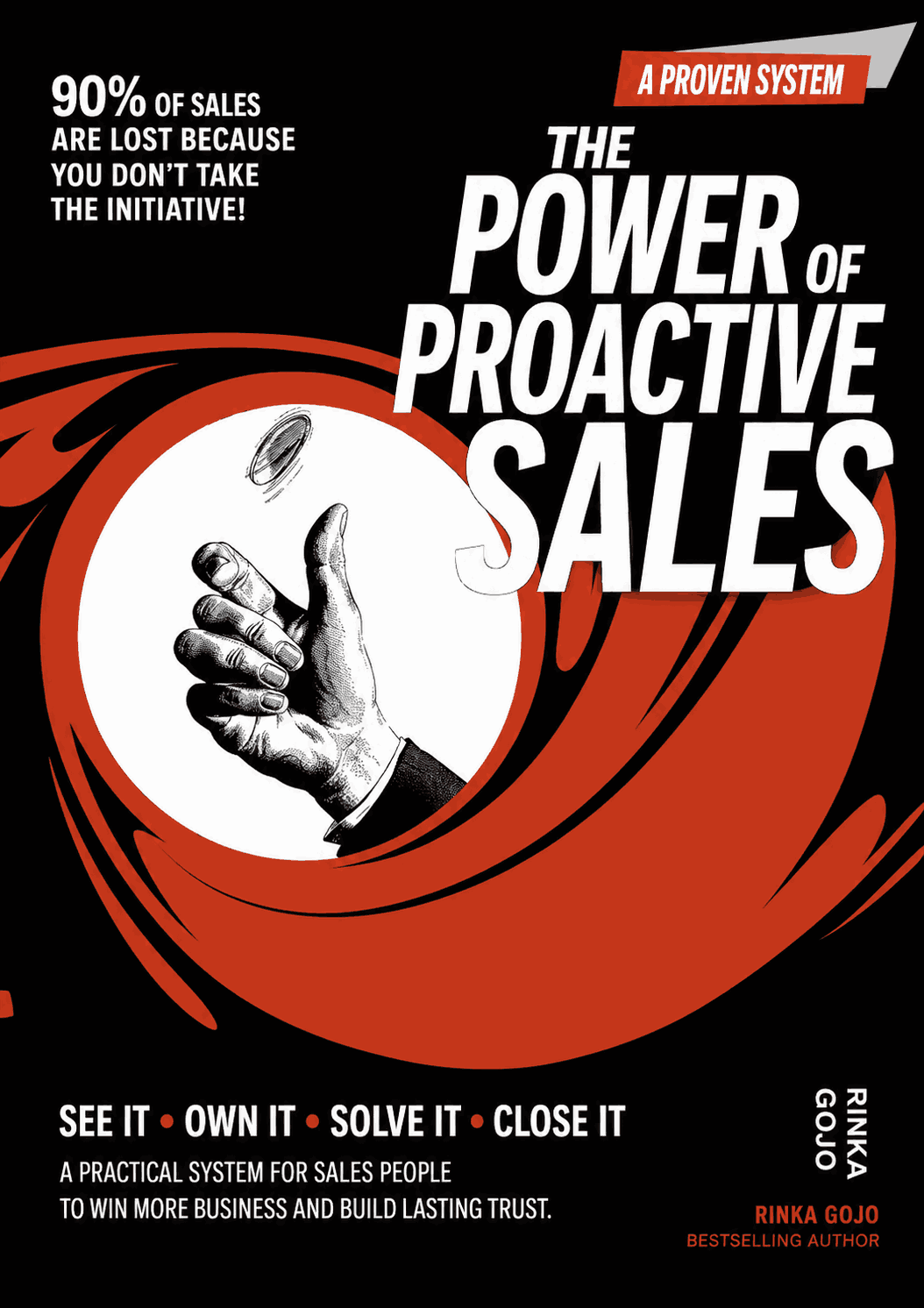
The Power of Proactive Sales by Rinka Gojo
Original notes here.
Read until the end to get a bonus. Enjoy reading.
Chapter One
A polished appearance can make people feel intimidated.
By aligning yourself with the customer’s gaze, you can first create a sense of reassurance.
Once customers develop a sense of superiority, they will no longer listen to the salesperson’s explanation. As long as you do not make the customer feel that they are being pressured into a sale, there is no need to fear that closing the sale immediately will damage the trust between both parties.
You must see through the concerns the other person has left unspoken.
The salesperson’s share of the conversation should absolutely account for 70 percent.
You must make the customer realize the value of the consultation by getting them to ask themselves what they have gained simply from having the conversation.
Chapter Two
When dealing with people who collect large amounts of information, demonstrate an exceptionally high level of expertise and provide information beyond what they could have imagined.
Expecting not to make a sale means that when the customer refuses, your motivation will not decline.
As Sun Tzu said: “He who occupies the field of battle first and awaits his enemy is at ease.”
Take control of the initiative and prepare thoroughly in advance.
Do not let yourself be led around by the customer’s words.
Question everything they say and observe their expressions to make your judgments.
The sales process is extremely important. There are only two steps: first, eliminate negative impressions of the product; second, strengthen positive impressions.
The first step can be further divided into three stages: identify the customer’s type, infer the reason they do not want to buy, and reverse-engineer a way to overcome it.
There are three types of customers: those who respond enthusiastically, those who respond coldly, and those who raise objections.
A. Enthusiastic customers: They appear relaxed because they are in no hurry to make a decision. The reason they do not buy is that they see the product as irrelevant to them. Come up with three unexpected ways they could use the product, and you can capture their attention.
For example, for a single man living in a studio apartment: a robot vacuum can feel like a pet and provide emotional comfort; removing dust can help prevent illness; men who keep things clean are more popular.
B. Cold customers: They keep thinking about whether buying the product will put them at a disadvantage. The reason they do not buy is that they are uncertain whether the product is actually any good. The way to overcome this is to let them experience the product’s advantages rather than trying to convince them through theory.
C. Customers who refuse with excuses: The reason they do not buy is that they believe they do not need the product. The way to overcome this is to help the customer understand the necessity and urgency of buying it. For example, when speaking to a mother who cares most about whether her son can get into his ideal school, point out that delicious food can soothe and refresh the mind, giving him greater motivation to study hard.
Chapter Three
Experiments have shown that when participants put themselves into fantastical roles, they become more enthusiastic and confident than they normally are.
By completely playing the role of a teacher—the ideal profession for guiding others—you will no longer hesitate or waver when it comes to taking the initiative.
The subconscious is a habitual way of thinking buried deep within the mind. When the subconscious does not agree, and the voice of the heart conflicts with the voice of the brain, you will not take positive action.
The author therefore invented a program that changes the subconscious while making sales, calling it the Seven Principles of the Self-Correction Program Magic.
Everyone who tried it successfully corrected their customer-first mindset. In practice, do not use your brain to think about whether it is good or bad; simply choose one of the principles and continue practicing it for seven days.
First: Develop an eye for taking the initiative
From the very first meeting, use your eyes to communicate:
- I am your partner, so please feel at ease.
- I am your teacher, and I have the initiative.
This can remove the customer’s guard and allow you to take control of the initiative.
The mindset: simply regard the customer as a kindergarten student.
Your eyes should convey light, gentleness, and strength.
Second: Plan five possibilities for each of seven product applications
Think of seven concerns customers may have, and for each concern, come up with five ways the product could be used to solve their problem.
Once you understand the product’s entirely new value, you can possess absolute confidence and the powerful source of energy that allows you to sell without hesitation.
Third: Before every customer meeting, recite the sales mantra that eliminates selfish desires
You can use the company’s corporate philosophy, or write your own sales mission statement.
The reason new salespeople can quickly sign contracts with customers whom even veteran salespeople cannot win over is that they still possess a genuine concern for the customer.
Fourth: Practice lifting your heels three centimeters off the ground
This allows you to concentrate, remain emotionally composed, and feel physically and mentally at ease, thereby creating results.
Fifth: Ten degrees is the limit for bowing
Bend from the waist.
Sixth: Start from love, think of the customer, and sell with passion
Seventh: Do not put yourself down
Do not say that the customer is amazing; instead, show an expression of amazement.
Do not say that the product has flaws; instead, turn the product’s shortcomings into advantages when explaining it to the customer.
Do not say “if possible”; express your opinion confidently before giving the other person the power to decide.
For example: “I’m sure you’ll need a quotation, right? I can bring it over today. I recommend that you definitely choose this product.”
Chapter Four
Almost all customers can talk with a salesperson for, at most, one hour.
Sell quickly while building trust during the sales process. Do not establish trust first and only then sell the product.
Customers can only concentrate for 50 minutes. Once that time is exceeded, they will experience “decision fatigue” and lose the ability to commit.
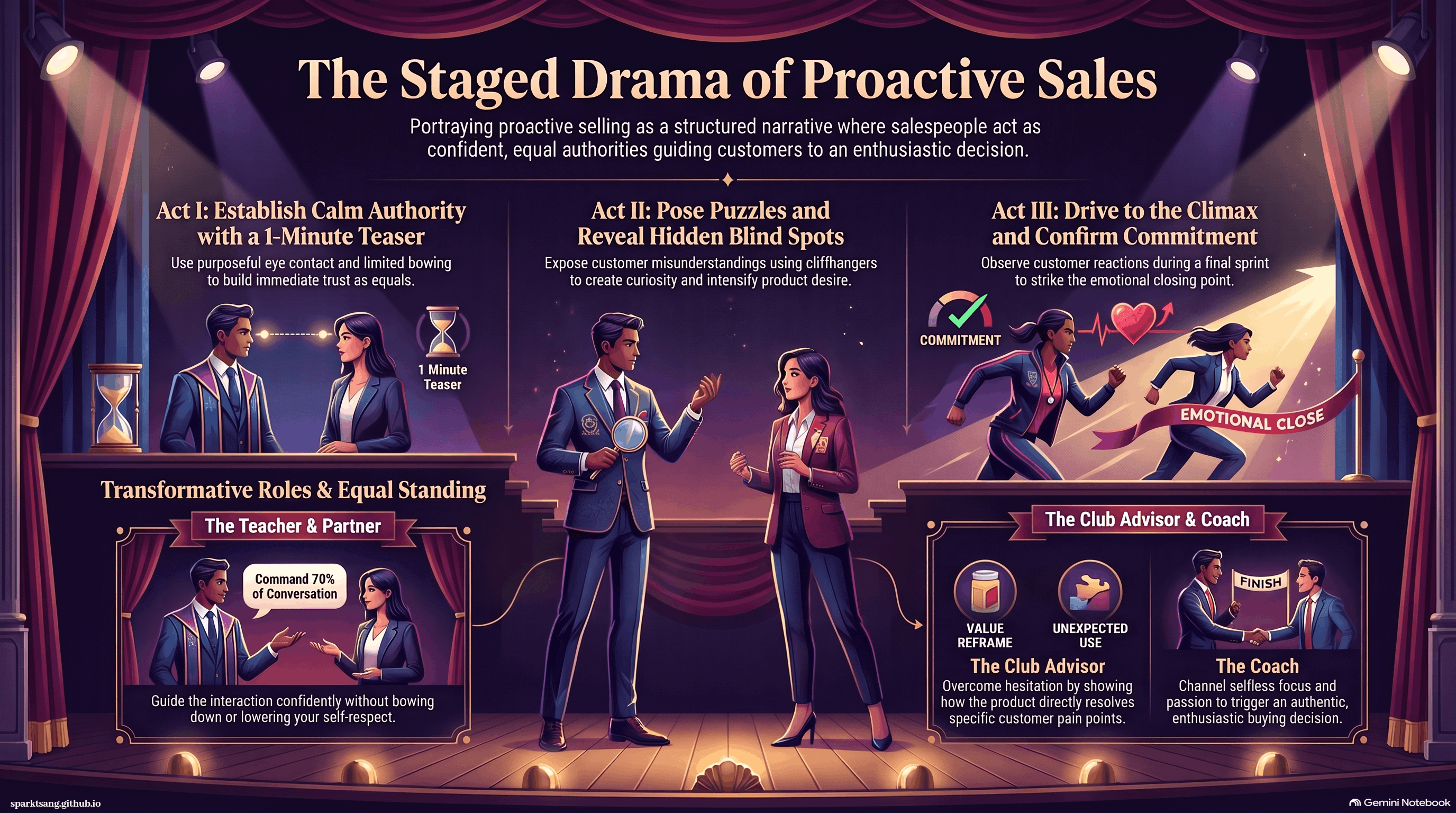
Set up a one-minute teaser:
“We have many students who were originally not considered likely to succeed but went on to gain admission to the University of Tokyo. So in today’s seminar, we will explain the three key points that allowed students aiming for the University of Tokyo to rapidly improve their abilities. Simply by attending this seminar, you will gain a general understanding of how your child should study in order to quickly gain admission to their first-choice university. This information is available only from our cram school. Please take notes as you listen so that you do not miss the key points highlighted by the teacher.”
Learn from variety shows: use cliffhangers to manipulate the customer’s psychology, pose a question, then reveal the answer after the commercial, leaving the audience desperate to know the answer.
The process: make small talk, pose a question that makes the customer think, then announce the correct answer while introducing the product.
“Most people who buy cyclonic vacuum cleaners end up regretting it three months later. Do you know why? Because almost all customers use suction power as their criterion for choosing a vacuum cleaner while ignoring its weight. After using it, their backs and lower backs start aching. Our product, however, is extremely lightweight.”
Once the customer’s appetite for information has been fully satisfied, they will not buy. Therefore, you must keep the customer in a state of hunger and anticipation that is just right.
Let the customer discover their own pain points, then use the purchase of the product to address them.
The formula: “Because of your [particular blind spot], you don’t realize [the product’s advantage]. What a shame.”
After half an hour of discussion, use the final 20 minutes as a sprint. Stimulate the desire to buy as much as possible, using the visual effect of a tool. That tool is the catalogue. But never shift your gaze toward the catalogue yourself. Instead, observe the customer to understand their needs and tendencies, and identify the key point that will make them want to buy.
When the customer speaks their true feelings, it means they will sign the contract without hesitation.
Use the final ten minutes to confirm the customer’s concerns and willingness to sign.
When the customer keeps talking endlessly, use the phrase “For example” to pivot, and reclaim control of the conversation.
Customer: “I recently got a girlfriend. She’s very considerate.”
Salesperson: “For example, I recently started keeping a turtle, and I discovered that turtles are actually more affectionate than people.”
Customer: “My first granddaughter was born a few days ago. She’s so cute.”
Salesperson: “She’ll definitely grow up to be a beautiful woman. For example, you could wear jewelry made with her birthstone. It would definitely look beautiful.”
In the end, the customer will decide to buy at the moment when their heart is moved.
You need a dramatized meeting script with a clear narrative arc: Introduction, Build-up, Climax, and Conclusion.
Prologue: Like a kindergarten teacher, take control through the eye contact of casual conversation and a ten-degree bow.
Beginning: Use a one-minute preview to remove the customer’s guard.
Development: Pose a puzzle and use the correct answer to stimulate the customer’s interest.
Turning point: Like a club advisor, point out the customer’s blind spot and heighten their desire to buy.
Conclusion: Like a coach, win the customer’s heart by striking the key point that moves them.
Five teachers, one script.
Chapter Five
A businessman does not bow his head casually, and even a vendor at a market does the same.
Once you understand that buying and selling is an equal relationship, your self-respect will not be hurt.
The customer can choose whether to buy or not; the salesperson can choose whether to sell or not.
Only by not bowing your head can you convey genuine sincerity.
Making it easy to purchase is equivalent to removing friction from the buying process, which makes selling easier.
Do not become overly fixated on techniques. Sales is a lively, human-to-human profession.
Even if you fail to close the deal, you are preparing yourself to meet better customers.
Afterword
If sales were a job that required bowing down to people, it could never become one of the ten ideal professions.
Even if only for a fleeting moment, when you devote yourself wholeheartedly to the customer, the product, and its creation, entering a state of selflessness, that is the most beautiful form a human being can take.
Notes last updated: Oct 31, 2016
Gojo shows that mastering sales requires taking proactive control of the conversation, using structured scripts and psychological cues to guide customers past their hesitation. But what happens when you apply this assertive momentum, yet a customer still stubbornly resists closing the deal? Pushing harder often backfires when deeply ingrained psychological barriers are at play.
In The Catalyst, Berger approaches persuasion from the opposite angle, outlining how to change minds not by applying more pressure, but by identifying and dissolving the hidden friction that blocks change in the first place.
Thank you for reading until the end. This is a bonus infographic just for you.