Notes on Gladwell's The Tipping Point
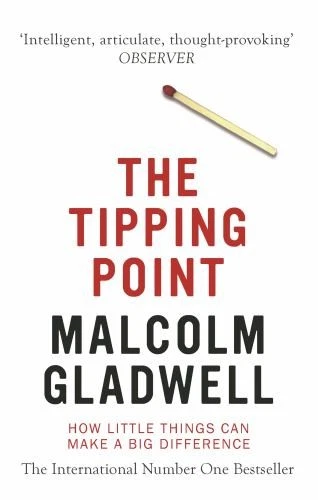
The Tipping Point: How Little Things Can Make a Big Difference by Malcolm Gladwell
Original notes here.
Ideas, products, information, and behavior spread like viruses: small actions can produce enormous changes, and everything contains the potential to spread contagiously.
Three principles behind the tipping of a trend: the Law of the Few, the Stickiness Factor, and the Power of Context.
The Law of the Few
The 80/20 principle: a small number of people do most of the work. The spread of social trends likewise depends on a small handful of people who drive them, and these can be further divided into Connectors, Mavens, and Salesmen.
Connectors
In 1775, Paul Revere made his famous midnight ride to warn the colonists that the British were preparing to attack, prompting the militia to mobilize and producing enormous consequences. His success may have been due in part to knowing which Connectors in different places to alert; William Dawes, who also rode that night, remained virtually unknown.
The six degrees of separation between people can be attributed to the very small number of intermediaries capable of connecting with large numbers of people.
Super-connectors have countless acquaintances, love “collecting” people, and deliberately cultivate their social networks.
Mark Granovetter’s research found that people who found jobs through personal connections generally did so through weak ties rather than close friends: because acquaintances belong to different social circles, they are more important than intimate friends when it comes to gaining access to new information and ideas about jobs.
Mavens
If the former are experts in social connections, these are experts in information: Connectors, too, depend on a small number of people who know about new information.
Supermarkets cannot fool consumers with daily specials because a small number of people keep a close watch on prices every day; there are also a few people who read Consumer Reports word for word.
The Hush Puppies craze likewise began because a small number of people discovered them.
Salesmen
Starting a trend requires persuading large numbers of people, and gifted salesmen are naturally full of enthusiasm.
Psychologists including Brian Mullan found that when television news anchors displayed positive facial expressions toward particular presidential candidates, this could actually affect the election results. The ways in which people are persuaded can be surprisingly indirect.
Howard Friedman invented an emotional communication test and found that the emotions of high scorers could spread to low scorers, but not the other way around.
The Stickiness Factor
In the 1970s, Lester Wunderman won a competition against McCann Advertising and secured the advertising account for Columbia Record Club. His secret weapon was a television commercial telling viewers that they could find a gold box in the magazine and redeem it for a free record.
Howard Leventhal’s experiment demonstrated that fear did not motivate more people to get vaccinated. But when a campus map was added to the pamphlet, marking the location and time for vaccination, the vaccination rate astonishingly rose from 3% to 28%.
The television program Sesame Street wanted to spread a “literacy virus” among preschool children and conducted extensive research into their attention spans, discovering that:
Children who watched television attentively absorbed roughly as much knowledge as those who watched while playing with toys.
When children did not understand what they were seeing, their gaze would wander; when they understood it, they would remain absorbed.
Bombs attracted children’s attention more effectively than cute animals.
Children disliked watching adults deliver long-winded lectures.
Preschool children could not understand that the same thing could have two names.
Later, the similar program Blue’s Clues actually became more popular than Sesame Street, yet each episode was replayed five times a week. It turned out that children did not get bored.
The Power of Context
The Bernard Goetz case reflected a New York once overrun by criminals, followed by a dramatic decline in crime.
After David Gunn became head of the transit authority, he embraced the Broken Windows theory and launched an aggressive campaign against fare evasion, a minor offense that previously had not been taken seriously.
Lilian Rubin, who wrote Goetz’s autobiography, believed that he chose to live on Fourteenth Street precisely because the neighborhood was so full of insecurity and unease that it allowed him to redirect his inner dissatisfaction and anger toward the outside world, shifting his attention outward and avoiding the pain within.
The theory above attributes crime to the personality of criminals. But the Broken Windows theory and the Power of Context—two sides of the same coin—argue that behavior is a product of the social environment: simply cleaning graffiti from subway cars and catching fare evaders can help prevent crime.
The famous Stanford prison experiment provided powerful evidence for the proposition that changing the environment can change behavior.
When explaining other people’s behavior, humans tend to overestimate personality and underestimate the environment.
Psychologist Walter Mischel pointed out that women who are independent and self-directed at one moment yet passive and dependent at another may simply be displaying different aspects of their complex personalities, all of which are genuine.
Princeton University psychologists John Darley and Daniel Batson found that whether people had just read the Parable of the Good Samaritan had no relationship to whether they would stop to help someone on the road. What mattered was whether they had enough time.
The human capacity for social interaction is 150 people; beyond that number, groups inevitably split apart.
The high-tech company W. L. Gore & Associates has been profitable for thirty-five consecutive years, with employee turnover at one-third the industry average. Its management style is innovative: employees have no bosses, the company has no formal budget, and every unit strictly follows the 150-person principle in determining its size.
Psychologist Daniel Wegner believed that the pain of divorce stems from the loss of shared memories. Families naturally develop a “transactive memory” (dividing mental labor among themselves), such as having adolescents take responsibility for dealing with computers.
Gore Associates relies on an efficient transactive memory system, making internal cooperation easy and allowing people across departments to remain closely connected within groups of 150.
Case Studies
Psychologists have discovered why the retelling of rumors distorts facts: after seeing a picture, people forget almost all of its details a few months later, but certain details become amplified.
To transmit an idea, Connectors and Salesmen likewise have to alter it first through “leveling” (discarding irrelevant details), “sharpening” (strengthening others), and “assimilation” (bringing out its deeper meaning).
Airwalk produced a small range of distinctive athletic products and became synonymous with an alternative lifestyle, emerging seemingly out of nowhere.
After 1997, Airwalk’s performance went steadily downhill. Its former president pointed out that the fatal mistake was moving toward the mainstream and diluting the brand (losing its exclusivity). Customers discovered that products they had expected to find in specialty stores could now be bought in mass-market retailers.
Suicide is contagious, as David Phillips’s research demonstrated; like an advertisement for a kind of solution, it is more effective among people who are similar to the person who died by suicide. Among adolescents in Micronesia, imitation suicides became widespread.
Hans Eysenck’s research found that most heavy smokers have distinctive personalities: they are extroverted, socially adept, sociable, surrounded by friends, fond of excitement and lively gatherings, risk-taking, and impulsive. Later research further suggested that they also have stronger sexual impulses, earlier sexual maturity, stronger sexual needs, and greater attractiveness.
Anti-smoking campaigns that blame tobacco companies are ineffective: smoking itself is not stylish; the smoker is. That is what makes smoking spread like a virus.
Geneticists have confirmed that most personality traits are determined by genes and environment, roughly half by each, yet they have been unable to identify much influence from upbringing: adopted children are often very unlike their adoptive parents, while environmental influences are determined by peer groups. Hence the messaging campaigns aimed at adults have failed to stop adolescents from smoking.
Multiple studies have shown that smoking is related to emotion, especially depression: targeting depression can break the spell that makes people so helplessly addicted to smoking.
Research by Neal Benowitz and Jack Henningfield found that the threshold for nicotine addiction is about five cigarettes a day (distinguishing heavy smokers from “chippers”).
Finished reading on Dec 4, 2020