Notes on Hiesboeck's Efficient Marketing in the Digital Age
Efficient Marketing in the Digital Age: Practical Secrets to Maximize Your Marketing Power with Precise Target Placement, Fast Customer Attraction, High Conversions, and Strong Branding! by Martin Hiesboeck
Original notes here.
Read until the end to get a bonus. Enjoy reading.
Breaking six misconceptions about digital marketing: Without content, you cannot make something go viral through technique alone; and if something does go viral but you cannot deliver the goods, your reputation may be destroyed. Marketing is not about attracting an audience, but about attracting the right audience. Having a large online following is often a result of already having a large offline following. Digital marketing is becoming increasingly complicated and harder to handle on your own. Having more followers is not necessarily better; quality matters more. Large firms in the industry are selling their own solutions, so their recommendations are not necessarily the best.
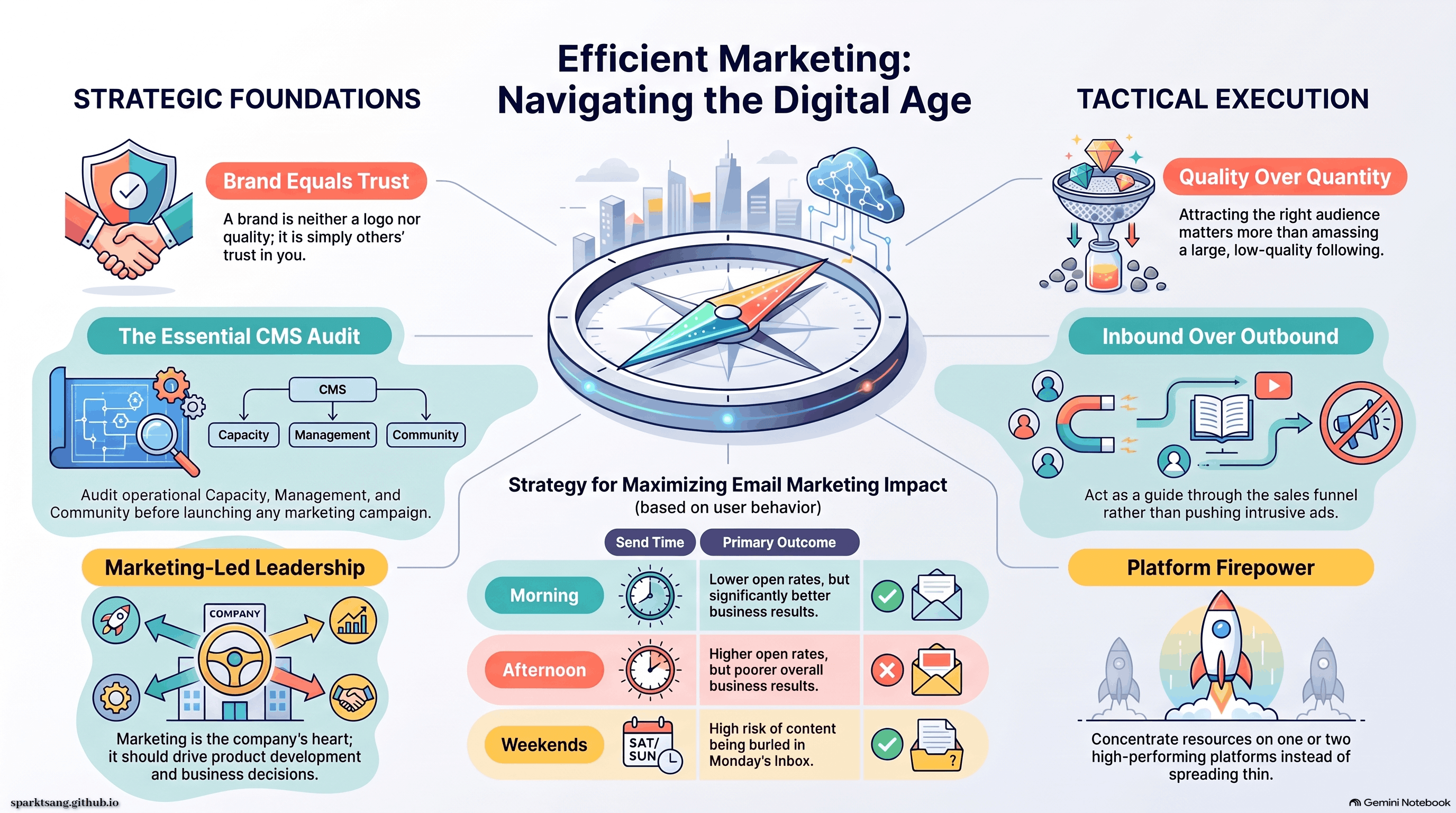
The claim that “people do not buy products or services; they buy stories and magic” is absurdly wrong. A company hired the author to handle its marketing, but refused to let him examine its three core elements—operational capacity, management, and community, namely CMS. Sales rose in a straight line for the first four months, then plunged just as sharply because of a flood of negative reviews: the product was poor, and online marketing merely amplified its shortcomings. Every marketing campaign should begin with a CMS audit.
When faced with a client company that kept explaining its product at length and said, “If you’re not interested in the product, how can you market it for us?”, the author shot back, “If you can’t make the customer understand the product in a single sentence, what’s the point of making it in the first place?” The idea that you should make the product first and only then think about marketing is fundamentally misguided. Marketing must be at the core of business decision-making.
If management is the brain of a company, marketing is its heart. Peter Drucker’s once-popular idea that the CFO was more important than the CEO is already outdated. Today, companies should in practice be led by the CMO if they are to fit the times. The heart of marketing not only keeps the blood flowing; it also gives the business emotion and humanity. Everything a company does—including acquiring teams, expanding into new markets, developing new products, and recruiting information experts—should involve the marketing team.
Branding has existed since ancient times, with temples being among the earliest examples; their foundation was faith, and people lining up in the snow to buy an iPhone are essentially no different from worshippers going to a shrine. A brand is not a trademark or quality, nor is it any of the modern constructs such as the founder’s values, vision, promises, influence, or messaging. Indeed, today, what other people say about a brand is more important than the messages put out by the brand itself. The only definition of a brand that holds universally is “other people’s trust in you.” It may have absolutely nothing to do with quality—the author once took part in a blind test and found that an unknown brand actually tasted better than Heinz. It is much like religious faith, in which the god itself is something invented.
A personal story is also part of a brand. People should not hide behind the corporate brand and remain invisible; personal stories are more likely to resonate.
The Five Hegemons: the Four Horsemen and Netflix have already seized control of the world, and their power continues to grow.
Facebook dominates daily life, becoming the window through which people discover new products; it also offers job-search functions and government services.
Amazon dominates retail, and the hope of selling goods without going through Amazon is becoming increasingly remote. Its share of IaaS is astonishing.
Google has amassed an enormous amount of data and is the only company in the world capable of achieving Artificial General Intelligence (AGI). Its potential is limitless.
Apple controls the IT supply chain and an enormous market; Netflix has become the global center of entertainment and threatens Hollywood.
Intermediaries such as Uber and Airbnb are likely to be replaced by blockchain technology before long. Microsoft lacks a coherent strategy. Back in the day, the authorities expended enormous effort trying to break it up, only to fail. Now, they may get what they wanted without lifting a finger. The irony is considerable.
Ad fraud causes losses of tens of billions of dollars every year in the digital advertising industry. Ads are placed in absurd locations that annoy users, bots generate fraudulent clicks and advertising charges, and 70% of ads fail to reach a real person. Advertisers should develop content marketing, build communities, and improve ad quality.
Super Apps such as WeChat and LINE, which integrate all essential functions into a single ecosystem, are a major trend for the future.
Over the next five to ten years, websites and email will become increasingly unfamiliar, while customer interaction shifts to integrated platforms.
Whoever becomes the industry leader will have the most valuable company in 2025.
As for whether SEO or social media marketing is more effective, the answer should be based on the numbers. One company assumed that most of its customers came from search, only to discover in the end that its conversion rate on social platforms was four times that of search.
Customers do not necessarily know what they should search for, and customers acquired through search are not necessarily the best customers.
Social media marketing needs to be combined with analytics tools so that tactics can be improved. For example, quintly allows users to compare themselves with their competitors.
How do you market a boring industry? Use the product in ways that make things interesting (plastic raw materials can be turned into a million different things); create FAQs; tell stories in detail (such as the development of semiconductors); explore unexpected uses (what can a 3D printer make?); create visual content (insects under a microscope); provide useful tools; explain your position on trends; and embrace video. People in wealthy countries spend 3.5 hours a day watching videos; video can help SEO, users especially like sharing it, and it can be posted on Instagram.
Facebook Live requires a clear purpose. If the results are not as expected, possible reasons include a lack of consistency, overly explicit selling, stage fright, and insufficient budget.
To achieve viral spread, you need super-spreaders such as television, Facebook groups, or celebrities. In most cases, creating this kind of reach requires spending money.
There are no unlimited resources. Concentrating firepower on one or two platforms is more effective than randomly firing in all directions across ten platforms. A large amount of engagement also does not mean you have many customers.
Facebook’s organic reach is only 2% of all page followers, so existing content can be repurposed from time to time.
Four keys to successful content marketing: total commitment (people, time, and money—testing the waters is useless); a solid strategy (clear objectives and methods); quality; and making good use of digital technology.
Key points of B2B KOL marketing: be persuasive to customers; target the right audience; stay compliant; and demonstrate that the company is reliable.
Retail marketing strategy: this is a major undertaking that almost all startups overlook. Examine consumer opinions about the product in detail, including what excites and annoys them; study their purchasing channels; analyze consumer data (Amazon retail analytics, Amazon marketing services); revise the product and adjust operations; and decide how to work with retailers.
If a website has a high bounce rate and visitors leave immediately, the webpage may not match the keywords, or the product may simply be unattractive. A/B testing can be used to confirm the result. Areas for improvement include UX, creativity and design, cross-device compatibility, faster loading times, reducing form friction, and higher-quality content.
In an era when marketplaces such as Amazon dominate, there is no need to build shopping functionality into your own website. Shorten the path to purchase as much as possible and provide rewards.
Keep running comparative landing-page tests. Tools include Visual Website Optimizer. The results may be surprising, but only when the sample size is large enough.
Outbound (push) marketing is losing favor; Inbound marketing is becoming the norm. You should act like a good tour guide and lead customers through the entire sales funnel. This applies across industries, but do not expect immediate results; it is better handled by a dedicated specialist.
Email marketing is still useful: 80% of people who actively subscribe to newsletters say that the content influences their purchasing decisions. When reading email, people are generally less distracted by social-media messages and can therefore concentrate more.
Send emails in the morning: open rates are lower, but business results are better. The opposite is true in the afternoon. Do not send emails on weekends, because customers may face hundreds of emails on Monday.
Content marketing will never go out of date. Focus on authentic Human-to-Human (H2H) interactions, improve the user experience, make use of visual content, be honest and build trust, and establish communities around specific topics to create a better image.
Finished reading on Sep 18, 2021
Hiesboeck observes that in an era dominated by ad-blockers and tech monopolies, superficial advertising is dead; the only sustainable strategy is building authentic trust through high-quality content marketing. But as every company rushes to produce content, how do you ensure your message doesn’t just become more digital noise?
To cut through the saturation, brands must evolve beyond simply publishing articles and learn to operate like independent media empires. In Every Business is a Self-Media, Sha Jianjun outlines the roadmap for this evolution, detailing how to craft compelling brand personalities and leverage raw, emotional storytelling to turn passive consumers into a loyal, self-sustaining community.
Thank you for reading until the end. This is a bonus infographic just for you.