Notes on Resonate: Present Visual Stories that Transform Audiences
Resonate: Present Visual Stories that Transform Audiences by Nancy Duarte
Original notes here.
Read until the end to get a bonus. Enjoy reading.
Sun Chih-Hua: Looking at the audience journey map for the 12 story archetypes integrated by the author, you realize that to persuade someone, you should first understand their inner transformation
Huang Chi-Hao: Many people think that a presentation is simply storytelling. From this book, you can understand that the point is not really to tell stories in a presentation, but to master the rhythm of storytelling
Raindog: Ten years after its publication, I can responsibly guarantee that no other book on story-shaped presentations has appeared that comes close to this book’s level, whether in terms of openness and inspiration or the completeness and breadth of its overall vision
The author came across the five-act structure commonly found in Greek drama and Shakespearean plays, as drawn by Gustav Freytag in 1863 (which can also be represented as: exposition, rising action, climax, falling action, resolution), and felt that a powerful presentation must have a shape
After analyzing the iPhone launch and the “I Have a Dream” speech and finding that both conformed to the shapes she had sketched, she burst into tears, feeling that she had unlocked an extraordinary secret
Resonance
Resonance causes grains of salt to move on their own and form beautiful patterns; resonance can cause an audience to exhibit self-organizing behavior
It takes only a few minutes to tell whether a person or a presentation shows signs of life; presentations can catalyze change through contact with people in a way other media cannot, and an engaging presentation requires careful thought
Human beings remember contrast and conflict; the more you want an idea to be accepted, the more prominently the presentation should highlight it
The most human, transparent, and connected form of communication is a shared belief between two people, with a connection built on that belief; a presentation is the ideal opportunity to create such a connection
Being persuaded by logic and believing because of conviction are two different things; you should use plenty of facts while also incorporating emotional appeals
The power of a story is strong enough to change others; today, the campfire has been replaced by the light of a projector
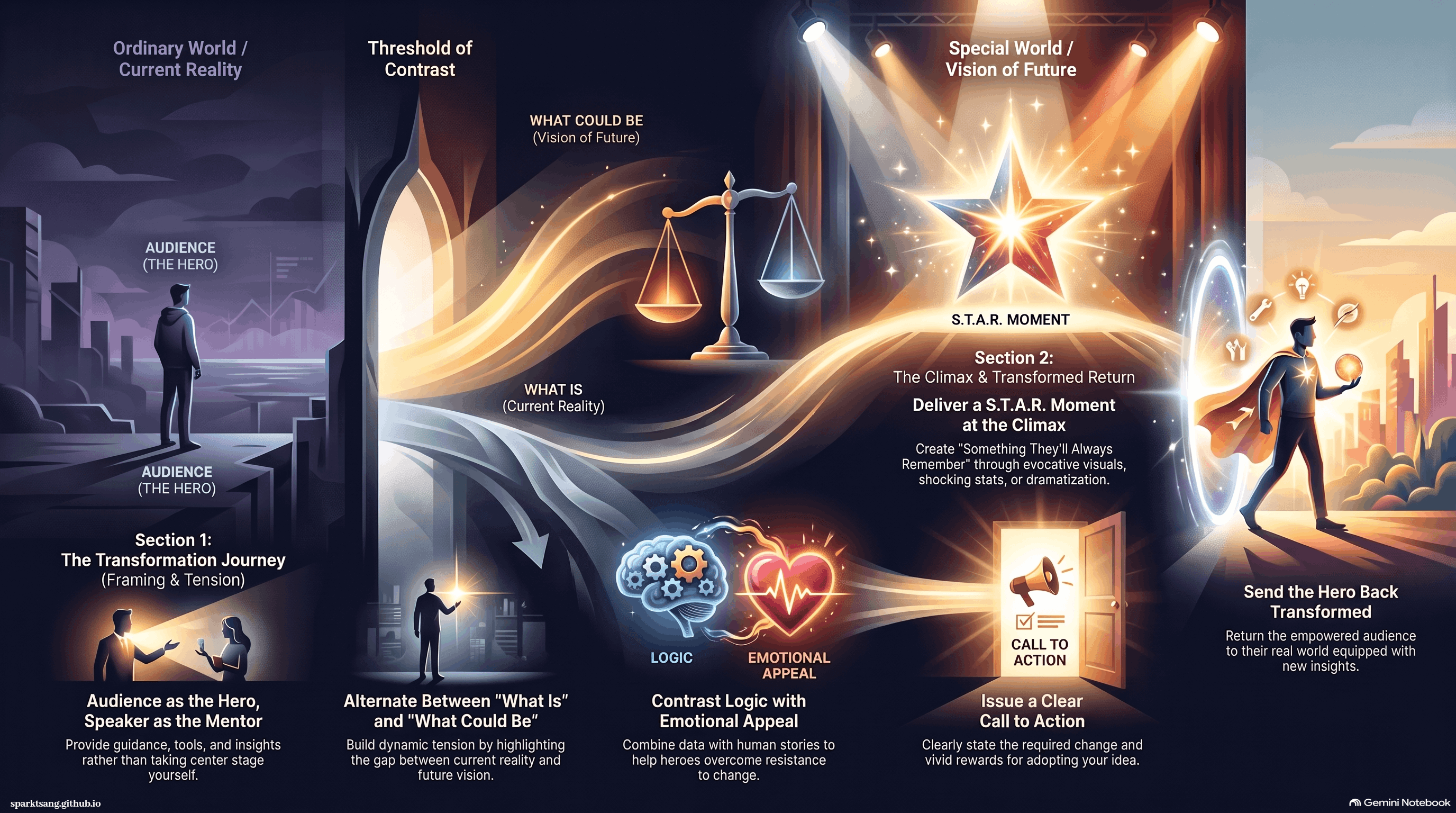
Do not be self-centered and assume that you are the protagonist; the focus should be on the audience, because the audience is your hero, while you should play the role of the mentor (most mentors were once heroes themselves, experienced enough to guide others), giving the hero guidance, confidence, insight, advice, training, or even a magical gift, offering humble and selfless service so that the hero can receive the reward
A presentation should leave the audience walking away saying, “Wow, I was so fortunate to hear that person speak. I now have insights and tools I never had before to help me succeed.”
Insights from Myth and Film
All forms of writing, including presentations, lie somewhere between two extremes: reports and stories
Some documents disguise themselves as presentations, merely conveying information without being able to create a connection
Outstanding presentations are far removed from reports and a little closer to stories
A great film story introduces you to a hero with whom you can identify; Robert McKee’s Story: Substance, Structure, Style and the Principles of Screenwriting points out that there must be a moment of crisis to convince the audience: if the hero fails to achieve the goal, they will lose a great deal
The simplest description of story structure is: situation, complication, resolution
Snow White — situation: Snow White takes refuge in the forest to escape her stepmother; complication: her stepmother poisons her with a poisoned apple; resolution: the prince awakens the princess from the spell with true love’s first kiss
The father of Hollywood story templates, Syd Field, uses the three-act structure proposed by Aristotle in Screenplay: The Foundations of Screenwriting to create his own analytical model: Act One establishes the background, Act Two presents dramatic action arising from confrontation, and Act Three is the resolution of the story; Act Two is usually twice as long as Acts One and Three
Another template is the “Hero’s Journey,” derived from the mythological research of Carl Jung and Joseph Campbell; Christopher Vogler, a Hollywood screenwriting story analyst and author of The Writer’s Journey, divided the Hero’s Journey into twelve stages as an analytical framework, using the Star Wars trilogy as an example: introduce the hero in the ordinary world, receive the call to adventure, refuse the call, receive encouragement from a mentor, cross the threshold into the special world, encounter tests, allies, and enemies, approach the innermost cave, endure the ordeal, receive the reward, return to the ordinary world while being pursued, undergo resurrection and transformation, return with the elixir to benefit the ordinary world
A presentation should make good use of the threshold between the ordinary world and the special world, allowing the audience to consciously decide whether to cross it; the purpose is to find a way to get them past the fourth stage, with them deciding whether to cross the threshold, and those who choose to cross it will embark on the remaining stages after hearing the presentation
The change you are asking for must be a struggle for the heroes; in films, when heroes enter the special world, they all encounter their mentors, and presentations have a remarkably similar dynamic
An undeniable characteristic of a good story: the audience must feel some kind of conflict or imbalance, which is resolved through your presentation; the presentation should make the audience notice the gap between the current state and the desired vision, forcing them to address the imbalance
Outstanding presentations unconsciously follow this pattern, divided into beginning (which should account for no more than 10% of the duration), middle, and end; the middle of the beginning contains the first turning point, the “call to adventure,” which begins to clearly show the gap between “what is” and “what could be”, creating an imbalance; the middle section repeatedly alternates between showing the “what is” and “what could be”, and finally enters the ending through the second turning point, the “call to action,” which points out the change the audience needs to make
The two poles of similarity and difference can generate power; three kinds of contrast can be constructed in the middle: structure (current state and vision, differences between your perspective and the audience’s), emotion (alternating between analytical and emotional content), and delivery (traditional and nontraditional)
Audience action can be divided into four categories: action, supply, influence, and innovation; the call should be concise, and the ending is the part audiences are most likely to remember; restate the key points, vividly portray the reward, and show how the world will change if the idea is realized
The author uses “Sparklines” to map a speech alternating between two parallel axes, current state and vision; the first miniature diagram is Benjamin Zander’s TED Talk, in which he ignites the audience’s passion for classical music, using three kinds of contrast: structure (some people do not like classical music versus everyone loves classical music), delivery (alternating between speaking and playing the piano), and emotion (humorous and moving); the tools given to the audience include learning pulses and chord progressions
The Hero in a Presentation
Imagine the audience as a line of people, each waiting to have a conversation and interview with you
The author, who had no particular affinity for beer, subscribed to several marketing publications in order to help with a presentation for a beer company, studied brand reviews, solicited opinions on social networks, searched for articles, read conversations on popular beer blogs, found the company’s presentations, and read the latest annual report in the news to understand the challenges it was facing
Reagan’s Challenger speech showed a reasonable distinction between audience groups: the collective mourners (condolences in the second paragraph), the bereaved families (comfort in the third paragraph), schoolchildren who witnessed the tragedy on live television (the fifth paragraph, briefly using the empathetic voice of a parent), the Soviet Union (the sixth paragraph subtly criticizing the Soviet Union for concealing the secrets of its space failures), and NASA (the seventh paragraph encouraging NASA’s employees)
Love your hero, treat them sincerely, and imagine how the hero’s lifestyle, values, knowledge, and desires might be affected, and how to make them feel respected
Think about your role as a selfless mentor and what you can give the audience, such as guidance, confidence, and tools
Establish common ground: experiences and goals, in order to develop trust; the audience is sizing you up: Are they clear in their expression? Are they qualified enough? (Have you ever been through a similar journey that ended positively?) Do I like them?
Find the most relevant and credible approach, connect it with the values and issues the audience cares about most, and make increasing common ground the goal
The Hero’s Journey
Plan the journey and take the audience to the destination; if properly planned, resistance can be put to use, turning obstacles into leverage
The core message, which screenwriters call the controlling idea, must clarify the unique point of view and convey what is at stake, and should be a complete sentence, such as “America must maintain its lead in space achievement; this is the key to the future of Earth.”
Emotion is an essential element of the core message; simplify the complexity by appealing to pain and pleasure: if the audience rejects the message, pain may increase and pleasure may decrease, and vice versa
The carefully planned transformation of a film protagonist is called the character arc; story analysts say that you should be able to determine whether an arc is good or bad simply by looking at the first and last pages of the screenplay; without change, a film is boring; you should study the audience and their outlook, set expectations, determine the objective, and carefully plan the change
Accepting something new means sacrificing something else and requires encouragement from a mentor; the audience will procrastinate or resist, because otherwise they must deal with the contradiction between reality and vision; identify the reasons for resistance and use empathy as a form of inoculation, including the comfort zone, misunderstanding, fear, obstacles, weaknesses, and changes in power
For them, accepting a new idea may put their reputation, credibility, and honor at risk; what you regard as resistance is, from their perspective, courage; you should acknowledge this resistance while assuring them that they will receive proper support from the mentor
Point out the reward: it should satisfy physiological, interpersonal, and self-actualization needs
Content
Do not rush to operate the presentation software; brainstorm around the topic until you have exhausted every possibility; clever ideas usually emerge in the third or fourth round of the process
First collect information both deep and broad, including information about competitors and even information on topics that are not directly related
After collecting information, brainstorm freely to generate a large number of ideas, then filter and synthesize them into categories
Aristotle identified three types of appeals to use when persuading people: Ethos (ethical), Pathos (emotional), and Logos (logical)
John Heritage and others analyzed 476 British political speeches and found that more than half of the applause was caused by some form of contrast mentioned in the speech; contrast creates the outline of a presentation, so try to create some opposing idea for every point
Give ideas meaning; the structure and meaning of a story can make information come alive
A medical device may have perfect specifications, but its meaning lies in saving lives; without people, there is no meaning
Most great presentations make use of stories from the speaker’s own experiences; breaking chronological order can help you recall stories at a deeper level, including stories you have even forgotten
Cisco rewrote its original technically oriented presentation, opening with a story about hops: the president of an award-winning brewery learned that a shipment of hops had been delayed, putting its competition entry at risk; fortunately, Cisco’s system notified them in time, they identified the missing raw material and resolved the problem in time, and they won the competition
Use numbers familiar to people to explain scale through comparison: five million people die every year from water-related diseases, equivalent to two tsunamis every month, five Hurricane Katrinas every day, or one World Trade Center terrorist attack every four hours
Once divergent thinking is complete, use convergent thinking to filter the options; audiences usually will not say that your presentation should simply be longer
Lay out three to five themes that support the core message, do not overlap with one another, and leave nothing out
Structure
Linear presentation software encourages users to create slides sequentially, causing them to focus on details rather than the overall structure; if the structure cannot be seen, the audience will only get lost
Tree diagrams and outlines can make the structure visual, ensuring that the themes support the core message
Four structures: chronological order, procedural order, spatial order, and order of importance
All four structures contain contrast: problem-solution (identify the problem, solve the problem), compare-and-contrast (similarities and differences), cause-and-effect (for example, what action can solve the problem), and pros and cons
Emotional contrast: use progressive escalation to arrange the same material, with more emotional content (stories, metaphors, humor, surprises); the rest of the world mostly uses analytical content: evidence, facts, cases, and data; add turning points
Delivery contrast: the key to keeping the audience’s attention is to have something new happening continuously, switching between traditional and nontraditional forms (witty remarks, interaction, voting, singing, humor, passion)
One idea per slide, simple and clear, turn text into images (structural diagrams, flowcharts, impact diagrams, etc.); for a deeper understanding, see Presentation Zen and the author’s Visual Communication
Review of the process: brainstorming, filtering and categorizing, creating and ranking key points, then adding supporting arguments from the key points, strengthening transitions, contrasts, and visualization (turning text into images)
Structure is always greater than the sum of its parts
A Message That Lasts a Lifetime
A S.T.A.R. moment (Something They’ll Always Remember): a moment that keeps the conversation going after the presentation ends and spreads rapidly: Memorable Dramatization (props, skits), Repeatable Sound Bites, Evocative Visuals, Emotive Storytelling, or Shocking Statistics (Bill Gates having mosquitoes fly out during a presentation, Steve Jobs taking the MacBook Air out of a manila envelope)
Dramatization: Michael Pollan demonstrates by pouring out oil how much oil it takes to make a hamburger
Memorable phrases: crucial like a news headline, clear and repeatable, a brief call such as “Yes We Can”; rhetorical devices: parodying a famous saying (“Do not do unto others what you would not want done to you”); repeating words or phrases in the middle or at the end (“of the people, by the people, for the people”)
Example of a powerful image: the fingers of people in Iraq and Zimbabwe colored after voting
Example of a shocking statistic: Long Island is in a steady decline, time is running out, and immediate action is required
Using a Steve Jobs product launch as an example: the memorable phrase “reinvent the phone,” the shocking statistic (58 songs sold every second), the surprise image (a joking fake image of an iPod with an old-fashioned click wheel), the dramatic moment (the manila envelope), and the S.T.A.R. moment (demonstrating the iPhone’s revolutionary new swiping function)
Always Improving
Strengthen the signal and reduce the noise; four kinds of noise: credibility (no common ground, emotional imbalance, lack of credibility), semantic (wordiness, distracting visuals), experiential (too long, insufficient rehearsal), and bias (the audience’s rigidity, hostility)
First impression: use creativity; the setting, images, clothing, way of entering, invitation, and self-introduction and résumé all have an impact
Jumping from a high tower: avoid jargon; the communication style of Barbara McClintock, who eventually won the Nobel Prize in Physiology or Medicine, caused her to be sidelined for many years
Short is better: Lincoln’s “Gettysburg Address” was only 278 words and is regarded as one of the greatest speeches; its structure is divided into three parts: what is, what could be, and New Bliss (including a call to action)
Break free from the constraints of projection: the audience cannot read and listen to you at the same time; simplify the projected material so the audience can digest it within three seconds
Balance emotional appeal: if the audience’s profession is analytical, only bring in a small amount; often, people’s reasons for doing what they do contain an emotional component, so do not omit it entirely; too much or too little is counterproductive, and emotional appeal is effective only when it reinforces the argument, otherwise it feels manipulative
Rehearse with an honest critic who is willing to say no; there should be a safe environment for them to voice their true thoughts, and you should genuinely listen, removing content that is misleading or inadvertently creates problems
The Pioneer Award attracts thousands of America’s leading scientists to apply every year; applicants must give a 15-minute presentation; winner Markus Covert went against convention by incorporating emotional appeal and rehearsed with scientists from different backgrounds, bravely making revisions and even deleting content he liked; it was not until the 19th or 20th round that he received the feedback, “Don’t change anything. It’s great now”; his slides used an extremely minimalist style and were not crammed with data
Composer Leonard Bernstein’s talk explaining the symphony to children appears effortless and completely spontaneous, but in fact he worked tirelessly, revising the script again and again, then watching recordings and improving it the next time, like a conductor’s rehearsal; he even wrote out responses to the different reactions the audience might have
The audience’s interest is directly proportional to the preparation put into the speech
Change the World
“I have some ideas about something” really means “I want to change the world in some way”; the world is the sum of all the ideas of our ancestors; look around you, and clothing, language, furniture, and cities are all visions that once existed in someone’s mind; innovation begins with the idea of changing the world, and remaining passionate about your own ideas means that part of you is dissatisfied with the status quo; society rewards those who are rejected, but rewards even more those who persist after being rejected; an idea that exists only in one person’s mind is not alive; it survives only when accepted and widely transmitted by others
Victor Hugo: There is one thing more powerful than all the armies in the world: an idea whose time has come
Kennedy: The only reason to give a speech is to change the world
To get an idea systematically adopted, you must give the presentation many times; key communication milestones will become catalysts for success; presentations play a crucial role throughout a product’s entire life cycle
Enron used presentations to lie and falsify profits, eventually ending in bankruptcy: do not use presentations to do evil
Outstanding results are often no match for clear communication; getting stakeholders to understand the idea is equivalent to having the winning hand; when someone repeats your message, you have won
Martin Luther King’s classic speech: outline (rapid transitions between current state and vision), dramatic pauses, repetition (“I have a dream”), extensive metaphors (the abyss, light…), familiar songs and biblical literature, political references (the Constitution, the Declaration), rhythm (alternating between fast and slow)
Maintaining transparency can eliminate the instinct to sell yourself; three key elements: honesty (showing a human side of yourself and opening the audience’s hearts), uniqueness (your stories and feelings that others do not have; difference is the key to being interesting), and non-compromise (expressing yourself confidently and not retreating even when mocked)
Reduce the focus on yourself so that the idea can be seen; sincere humility helps amplify what you say
Everyone has presentation moments in life; they will play an important role, shaping who you become and what assets you leave behind; passion for an idea should give you the motivation to devote effort to communicating it
Human beings are born to create ideas; if you can communicate ideas well, the power to change the world is already within you
In the conclusion, the author uses sonatas and films as examples to explain the contrast and structure that presentations should have
The American poet E. E. Cummings broke too many rules and, after being rejected by 14 publishers, decided to publish the book himself; he called it No Thanks and printed the list of the 14 publishers inside the book in the shape of an urn; the lesson: understand the rules first, then you will know how to use them flexibly, and even break them to create meaning
Finished reading on Oct 11, 2020
Duarte demonstrates how framing a presentation around the “Hero’s Journey” can create powerful resonance, using contrast and storytelling to inspire audiences to embrace a new vision. However, as Duarte notes, every hero naturally resists the call to adventure; even the most moving story can fail if the audience’s internal defense mechanisms remain intact.
To overcome this, The Catalyst by Jonah Berger breaks down the specific psychological villains that block transformation—such as the endowment effect and reactance—providing a systematic method to remove these barriers so your audience can finally cross the threshold.
Thank you for reading until the end. This is a bonus infographic just for you.