Notes on Every Business is a Self-Media
Every Business is a Self-Media: Mastering the Trends of Content Marketing to Build Direct-to-Customer Strategies and Methods by Sha Jianjun
Original notes here.
Read until the end to get a bonus. Enjoy reading.
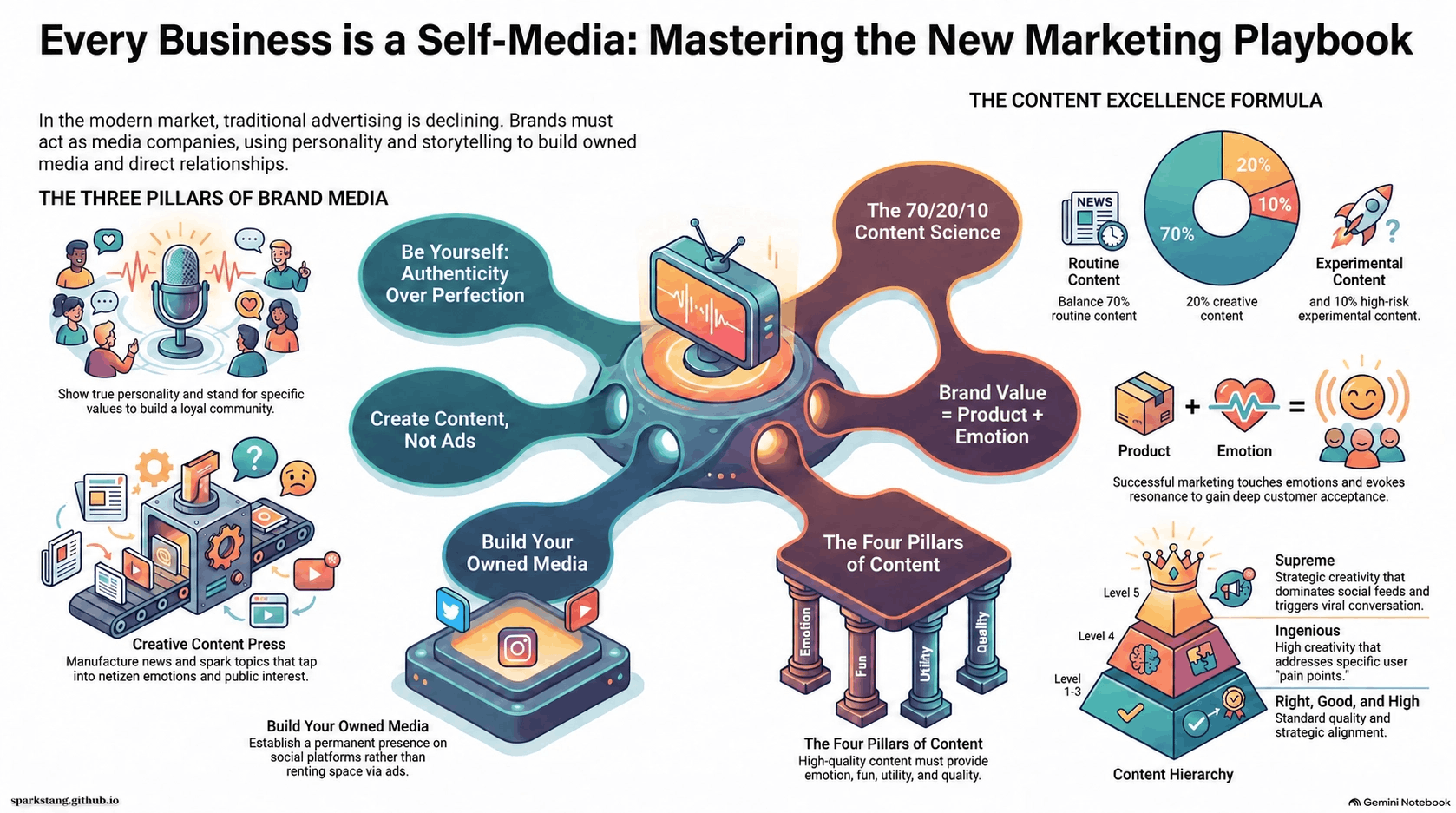
Trump, the man who stunned the world in the 2016 election, used what seemed like a genius business instinct to establish three principles: be yourself, create content, and build your own turf.
Thirty years ago, Trump came to the rescue of the widow of a man who, burdened by bank loans and mistakenly believing that his insurance would cover his losses, had committed suicide. The story became one of five widely circulated stories about him.
Be yourself: Show your personality and stand toe-to-toe with the elites; be spontaneous and authentic, even if that means frequently making spelling mistakes.
Create content: Tap into netizens’ emotions to manufacture news, spark topics, and stir up public outrage, letting unsupported speculation and controversial claims fly everywhere; use language no more sophisticated than a fourth-grade reading level.
Build your Owned Media: Never be absent from Facebook, Instagram, Twitter, YouTube, and the rest.
The free television advertising he received that year was worth as much as $4.4 billion. Political marketing is still marketing; its underlying nature does not change.
When the Weibo post “Put me in the Cold Palace” went viral, Haier followed the wishes of netizens and produced a new “Cold Palace” refrigerator. The “Kodong Handheld Washing Machine” and the “Magic Mirror” were also representative examples of crowdsourced products: their functions, prices, and colors were all decided by Weibo users. They were excellent examples of content marketing, made possible because Haier positioned itself as a media company and cultivated an independent personality. Traditional 4P and 4C marketing theories no longer work.
By coincidence, Red Bull also has its own content studio, continuously producing, accumulating, and setting off a wave of videos about extreme sports. Its founder said this did not mean Red Bull was moving into the media industry; it was simply intended to enhance the brand image and convey a healthy lifestyle.
Accenture has six content studios worldwide. LEGO is the media company that is best at making toys. In 2014, it spent $500 million creating The LEGO Movie, attracting thousands upon thousands of fans to participate in design competitions. Marriott Hotels established a content marketing studio in 2014 and produced a number of short films in which the brand itself never appeared on camera.
Charisma
In a Weibo post of more than 70 characters, The Beast flower shop displayed imagery, rhythm, tone, and emotional rises and falls to perfection, like a sentimental literary young woman sitting right in front of you.
The flower shop shot to fame with commissioned work such as Monet’s Garden. Its moving stories about giving flowers spread widely, and sponsoring the weddings of superstars took it another step forward.
“Be ruthless with yourself and please everyone else,” and Luoji Siwei (Logical Thinking), which got its start with a one-minute improvised morning monologue, raised its Series B financing in 2015 at a valuation of RMB 1.32 billion. What it created was not a content product, but a clear personality. Fans came together into a community because they saw the content as high-quality and identified with one another’s values. Through unconventional tactics such as the “Mooncake Integrity Ranking,” it could even sell 40,000 boxes of a traditional food that had already been played to death in just 13 days.
The creative-marketing trend swept across the market: Feng Tang, Wanwuzhi, Qingshan Laonong, Oxygen… Even old-school companies such as P&G underwent a major image overhaul under A.G. Lafley and brought creativity into the fold.
Coca-Cola’s 2020 content-marketing strategy: move from creative excellence to content excellence. Treat content production as a science: 70% routine, 20% creative, and 10% highly creative to the point of being slightly risky.
Names-on-bottles, lyrics-on-bottles, ice bottles, two-person Coca-Cola caps… all became classics.
Ma Ying-Long hemorrhoid ointment became a hit in the United States because it was so funny that it made people “laugh their asses off.”
In 2014, with Adidas under attack from all sides, a coordinated series of tactics turned its classic Stan Smith into one of the year’s best-selling products: hunger marketing (promoting it on a massive scale before there was even a sales channel, whetting people’s appetites), celebrity versions (a wave of celebrities wearing them and sparking heated discussion), limited custom editions, and full interaction (“Stan Yourself”).
Content marketing can be further divided above the passing grade into five levels: right, good, high, ingenious, and supreme. The supreme level means first-rate strategic creativity and platforms, pain points, tear points or laugh points, plus perfect timing, place, and human factors—all coming together to dominate the conversation and flood social feeds.
Four words capture good content: emotion, fun, utility, and quality.
Utility: the essence of knowledge, skills, and methods. Quality: quality, appearance, and taste.
Emotion
The most primitive internal driving force: be sensual, not vulgar; erotic, not pornographic.
What makes human beings strong also makes them vulnerable: only by touching emotions and evoking resonance can you gain acceptance.
The term “post-truth” was named the Word of the Year in 2016, reflecting how appeals to emotion and belief can have a greater impact than statements of objective fact.
Brand value = practical product value + emotional value
Kingston: memory cards with emotional warmth.
The “55°C Rapid-Cooling Cup” became a bestseller because of the true story of the creator’s daughter being scalded as a child.
The common effect of successful copywriting: amplify the user’s emotions.
In the 1990s, Eslite sold expired periodicals: “An expired Playboy, but never-expiring sexual desire.”
Victoria’s Secret’s sexiness includes the hidden desire to peek.
The strongest resignation letter of 2015: “The world is so big; I want to go see it.”
Taken together, there are three ways of expressing values and sentiment: devotion to craftsmanship and persistence; the original intention to change life’s pain points; and a combination of inspirational values.
The inspirational story of Chu’s oranges: an ex-convict who began farming at the age of 75, worked for 11 years, and eventually cultivated a vast orchard heavy with fruit; to choose the best fertilizer, he even squatted down at a chicken farm and handled chicken manure with his bare hands.
Fun
Storytelling (ZIPPO lighters), contextualization (combining time, space, and situational interaction, such as Tmall’s 2016 Singles’ Day H5), and entertainment (consumers simply do not like boring ads).
Yi Zhongtian had spent decades accumulating knowledge that nobody noticed, then suddenly became famous by telling stories.
The appeal of a story has three dimensions: emotional color, vivid imagery, and believable, authentic details.
Three techniques: montage (cutting between shots), stream of consciousness (following the flow spontaneously), and “god-tier logic” / absurdist twists (a massive plot twist, where another seemingly unrelated topic suddenly connects).
To make a product go viral, make the product itself the story. Example: Hammer Technology’s smartphones used the golden ratio from ancient Greek aesthetics, a beautiful note-taking app, offline voice control, and a case embodying a sense of mission and ideals.
Starbucks often deliberately misspelled customers’ names, such as “Gessika,” so the posts would spread like wildfire.
The story of the farmers spread to millions of households: farmers who could not sell their high-quality produce; the idea of helping them promote their agricultural products taking root; a friend pledging to quit his government job and make the work his lifelong vocation; a company name symbolizing a good conscience; knocking on the doors of Xinjiang celebrities one by one through Weibo and asking them to share the story; continuously posting stories about revenue-sharing with farmers; heartwarming stories emerging from interactions between farmers and customers; a customer learning that a farmer had never eaten the pastries made from his own dried fruit and immediately sending him a whole box; the Ancient Tree Adoption Program; and the Desert-to-Honeyland Program.
Consumption and purchasing are both choices made within a context. A context is the sum of time, space, and emotional state—a combination and unification of desire, action, impulse, and changing feelings.
JD.com emphasized fast delivery: “I only got the sunscreen after returning from vacation, and everything except the area covered by my sunglasses had turned black.”
Our thinking has long focused on the product while neglecting the context in which it is used. Borrowing a formula from The Context Revolution: functional attributes + connectivity attributes = a new scene experience.
“Net-sense”: authentic, down-to-earth, and humorous.
Robot vacuum cleaner: a woman spends the whole day doing housework, only to hear her mother-in-law say, “Why hasn’t the floor been cleaned?” Then the robot appears.
The “Go” network and Qunar.com turned into a playful battle of travel brands, each showing off its own personality. In the automotive world, 2015 also saw the “Hillside-style Copywriting War.”
Major brands rolled out freewheeling copy aimed at people born in the 1990s, generating buzz.
Content Marketing
Systematically and strategically create valuable content to attract customers and make money.
Corporate values → understand the audience → know the distribution channels → determine the form and positioning → formulate the marketing strategy → collect, produce, and publish content → evaluate results → adjust
To break free from advertising thinking and enter content marketing, several things have to change: shift from “Spreading the Word” to “Word Spreading Itself”, so content has the ability to travel on its own, with legs to walk on; shift from creative excellence to content excellence; expand the content-production team; change the budget; and change evaluation from page views to the quantity and quality of interactions.
Marketing without content can only focus on product, price, and exposure, while the effectiveness of advertising keeps declining. Content without marketing cannot be effectively promoted or distributed. On a program, when the host quoted from the Book of Songs to introduce the title sponsor Clear shampoo, the message was exceptionally memorable. The two complement each other.
Content production may be expensive, but distribution costs will gradually fall.
Consistency in content quality is more important than perfection. And letting users create the content themselves can increase interaction while saving costs.
IBM became a content-marketing case study by training employees to create content and producing content about the employees themselves, making them proud of the company. Its Smarter Planet campaign won people over because it made life more convenient.
Traditional conglomerate GE also entered the ranks of content marketing in 2003, making deft use of social media.
Big data gives content marketing wings: Amazon used big data to recommend books and completely outperformed its elite editorial team.
Toutiao, which uses algorithms to recommend news through social media, was hailed as the fourth giant after BAT (Baidu, Alibaba, Tencent).
The ideal state under big data: deliver the most appropriate content to the most appropriate person at the most appropriate time and in the most appropriate context.
Domino’s Pizza, which had been saddled with huge debts in 1969, made a dramatic comeback in this century by making good use of technology. By 2007, it already had interfaces for taking orders via computers and mobile phones; in 2008, customers could track their pizzas; in 2011, customers could order pizzas of their own design; and in 2012, drones were used for delivery. It also developed pizza-specific delivery vehicles and pizza-delivery robots. After hitting rock bottom in 2006–2008, it won decisively in 2009 when its new president directly made fun of the company itself, while improving the taste at the same time. Sales increased by 750%.
Parts of the classic Confessions of an Advertising Man are outdated. Today, the form of presentation has become part of the content; making people laugh has become a legitimate objective; and the old advertising rule of writing precisely—“Never write an advertisement you wouldn’t want your family to read”—no longer holds. Men can write advertising for women’s products too.
What Exactly Is a Chief Content Officer (CCO)?
The head of marketing is responsible for the operation of the marketing system: product, price, channels, promotion, design, packaging, and sales promotion.
The CCO focuses on what makes a product unique, starting there to create compelling content that resonates with people.
As a product of the social-network era, a CCO needs exceptional writing and communication skills, outstanding planning and creativity, aesthetic thinking, analytical and evaluative ability, and the capacity to learn quickly.
Five essential design lessons for a CCO: less is more, visual balance, color, typography, and webpage load time.
Visuals: A 2014 study by Blog Pros found that among the 100 most popular blogs, there was an image on average every 350 words.
A master copywriter spends a lifetime accumulating skill; experience brings words to life. Li Xinfeng suggests that creators should set up their “spiritual sanatorium” beside markets, fishing ports, factories, and airports.
The Soviet writer Maxim Gorky, who attended only two years of primary school, treated slums and docks as his social university and went on to write a masterful autobiographical trilogy.
The best copywriters are among the people: an old woman selling oranges: “Sweeter than first love”; a lingerie seller: “Choose the right underwear, and your husband will come home early”; a watermelon seller: “Its only flaw is that it’s too sweet.”
Experience can also be accumulated through work. Hopkins, the author of Scientific Advertising, who was deeply admired by the author of Confessions, was a workaholic. He used the processes found in every beer brewery as promotional material, making Schlitz the top-selling beer.
How can you move users if you cannot even talk about love? Goethe fell in love with more than a dozen women over the course of his life, and most of his famous works, including The Sorrows of Young Werther, were set against the backdrop of passionate love affairs.
Jonathan Lee’s song “Understanding,” written for Winnie Hsin, captured the emotional circumstances of love and touched people deeply. Without having been in love, it is difficult to truly understand the line, “If our love was a mistake, may neither of us have suffered for nothing.”
Travel is a rare spiritual catalyst for creators. Bill Bryson’s travel writing, which fuses and captures the sensations he encounters, has remained on bestseller lists.
The research trap: in the 1970s, Coca-Cola developed a new flavor to compete with Pepsi. It passed taste tests, but unexpectedly ended in disaster, wasting two years and $4 million because it ignored the emotional dimension of the brand.
Books on reading: Confessions of an Advertising Man; Leo Burnett’s The Star Maker; Tom Dillon’s How to Create Advertising; Bill Pitts’s Big Ideas in Advertising; Hopkins’s My Life in Advertising; Scientific Advertising; Sugarman’s The Adweek Copywriting Handbook; Jack Trout’s Positioning; Rosser Reeves’s Reality in Advertising; Philip Kotler’s Marketing Management; Alastair Crompton’s Top-Class Copywriting Worldwide.
Books on psychology: Gustave Le Bon’s The Crowd; Amusing Ourselves to Death; Kevin Kelly’s Out of Control; Jung’s Psychology and Literature; How to Win Friends and Influence People.
Lectures and films can all provide life experience. Films, in particular, allow people to find resonance, generate emotions, shape ideas, change perceptions, experience lives vicariously, develop a sense of sentiment, and experience more of life.
The six secret swords for building a brand through content: examine yourself; understand others (competitors and audiences); design (direction, type, style, perspective, tone); create (stories, viewpoints, knowledge, expressions, language, actions); publish (method, platform, frequency); interact (likes, replies, comments, surveys, rewards).
Instant fame comes from events; maintaining awareness and influence depends on an uninterrupted stream of content.
Afterword: Advertising Dies, Content Lives Forever
The author’s company, Dadao Brand Consulting, helped Ecowater achieve great success in China through exhibitions (which nobody was doing at the time but which later became standard practice across many industries) and content marketing. Later entrants who hired celebrities still could not catch up.
Understanding Media: The Extensions of Man was regarded at the time as bizarre and contrarian; it has gradually become reality.
Some people say content is simply a new form of advertising, but there is no doubt that content lives forever.
Finished reading on September 30, 2021
Sha demonstrates that traditional advertising is dead, and that every brand must now become its own media company—using authenticity, emotion, and storytelling to build a loyal tribe.
But as every business rushes to produce content, the digital landscape has become fiercely saturated. What is the most powerful form of “content” a brand can share today to truly stand out?
In Process Economy, Kazuhiro Obara explains that sharing polished, finished products is no longer enough. To build an unshakeable fanbase in the modern era, you must flip the traditional model and market the raw, participatory journey of creation itself.
Thank you for reading until the end. This is a bonus infographic just for you.