Notes on Nakano's High-Profit Marketing Practical Class
High-Profit Marketing Practical Class by Michiyoshi Nakano
Original notes here.
Read until the end to get a bonus. Enjoy reading.
The author works in advertising production. With more than ten employees and annual sales of ¥200 million, he attributes his success to two principles: first, never taking subcontracted work; second, not employing salespeople. The key is direct response marketing.
The subcontracting pyramid involves multiple layers of exploitation: prices are repeatedly cut until there is no profit, work schedules become unreasonable, employee dissatisfaction keeps growing, and the company has no future.
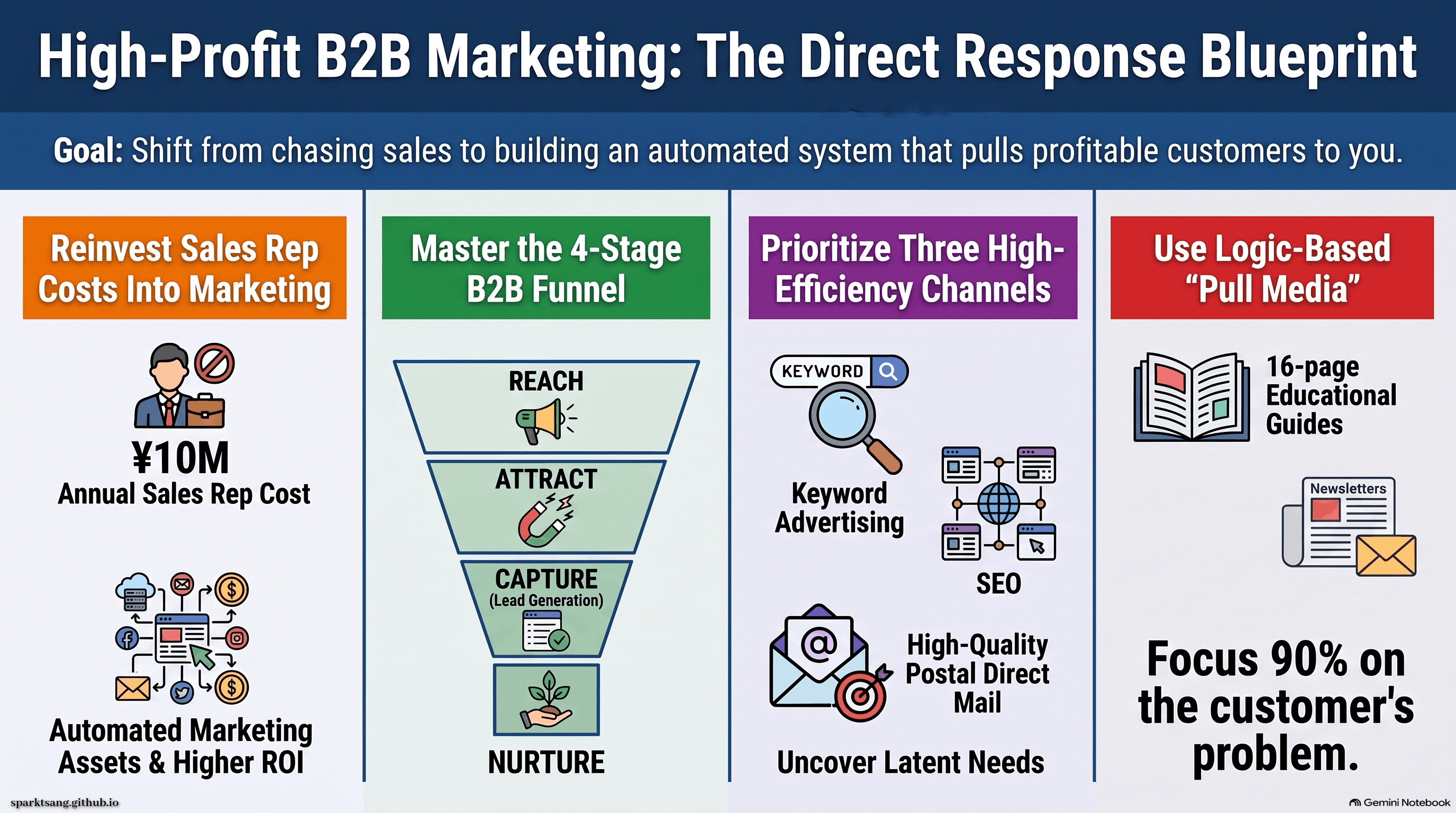
A single sales rep cost ¥10 million a year, making them a very high-risk investment. If that money is instead invested in marketing, it can actually generate a return.
Salespeople do not understand the technical side of the business, and customers can now go to a company’s website and get the information themselves, which has diminished the value of the salesperson. There is little point in keeping them.
Internet marketing is still growing rapidly, but the quality of providers varies widely. They do not necessarily understand the different business models, each of which targets a different customer segment, and some simply make proposals with the sole aim of selling their own services.
Companies using these services vary as well: some indiscriminately hand everything over to large advertising agencies; some are content with looking impressive through diversification but never study the results; some are not even suited to online marketing in the first place. Senior management may also simply not care, so the results are poor.
Key Points of the Marketing Blueprint
The core B2B funnel is: Reach → Attract → Capture (Lead Generation) → Nurture.
Reach: establish points of contact.
Attract: provide compelling content that makes customers start thinking that they need to do business with you.
Capture: ideally, use marketing automation (MA) to automatically build a CRM database and nurture leads, while digitizing their actions.
Nurture: continue sending useful articles so that opportunities are not lost.
When the author started his company, he was proud to adhere to two principles: never taking subcontracted work and never employing salespeople. In practice, however, telephone calls, faxes, newspaper advertising, and joining industry associations all failed. Only direct response marketing produced results.
A marketing blueprint requires six essential elements: a website, keyword advertising, direct-mail advertising, lead magnets (or whitepapers), and newsletters. (The first three are online, while the latter three are offline; the order depends on the circumstances of the company.)
The lead magnet referred to here is a downloadable document used as the conversion goal on a landing page.
The author’s company’s progression was: direct mail → website renewal → keyword advertising → owned media using SEO.
In 2012, Google revised its algorithm and began evaluating the quality of webpage content, giving rise to content marketing.
Do not rely on word of mouth from customers: it depends entirely on external forces, is not reproducible, and comes down to luck.
When selling to businesses, promotional messages should emphasize the logical aspects: useful, important, urgent, credible, and superior.
The current market situation is characterized by a lack of need for new products and services, increasing monopolization, and polarization, where similar products have vastly different sales volumes. The response is to acquire customers by creating resonance and attracting followers: explain the benefits rather than the specifications, and publicize customers’ experiences after using the product.
In many industries, the more you try to sell, the less effective selling becomes. It is better to pull customers in and let them come to you. (The book calls these “pull media” and “push media.”)
Get to know customers deeply and create buyer personas. Investigate the channels through which they found your service, and use that knowledge to work backward toward a pull-based marketing approach.
After trying a large number of customer-acquisition techniques, the author discovered that only three were useful to his company: keyword advertising, SEO, and direct-mail advertising. The first two are pull-based; the last is push-based and can uncover latent needs.
Company Website
B2B companies in particular need to provide sufficient information. The business discussion has already begun from the moment a visitor arrives at the website.
You should not overlook satellite sites built around the main site. To bring more people to the main site, you need to enrich these satellite sites.
These include landing pages, owned media, and brand websites.
A website must answer two questions: Why should I buy this type of product? and Why should I buy it from your company?
The experience should be optimized for each type of browsing device. The mainstream approach is responsive web design, which eliminates the need to build separate versions for each device.
To prevent customer testimonials from missing the key points, it is better to prepare a questionnaire with eight to ten questions and then organize the responses into usable content.
You can also introduce individual projects by hiring an outside interviewing company to interview employees and customers. The conversations should retain a natural, spoken tone, allowing you to showcase the company’s good relationships with its customers. For graphic design, it is better to hire a professional firm.
Appearance matters greatly. Elements such as parallax effects, animated graphics, and video can make visitors more excited and satisfied.
When planning the site, consider both the company’s story—product knowledge, care in selecting raw materials, veteran technical expertise, the hardships and rewards of starting the business, relationships with suppliers, and social contributions—and the Buyer’s journey (Awareness, Consideration, Decision) and build the narrative around both.
Building the site is only the beginning. The mainstream way to keep a website updated is through a CMS, which requires no specialist knowledge. Website analytics can be handled with Google Analytics, giving you visibility into the behavior of prospective customers.
Keyword Advertising
The two pillars of SEM are SEO and keyword advertising.
Keyword advertising (SEM) is divided into two types: Search Network ads and Display Network ads. B2B customers rarely see an advertisement and immediately make a purchase, so the author does not recommend using display advertising.
Keyword advertising has three major advantages: immediate effect (it can immediately attract customers who already want the product), predictability (one response gives you a basis for predicting future results), and scalability (once you know what works in one area, you can expect it to work elsewhere).
The three major differences between companies that can make a profit and those that cannot are: a profitable product, niche keywords (resonating with a small but well-defined audience in a cost-effective way), and a sufficiently prepared website.
For the first four years after starting his business, the author worked tirelessly sending promotional letters every five or six days. The response was not bad, but the process was exhausting. After switching to keyword advertising, he spent ¥400,000 a year and generated a total of ¥300 million in sales over seven years.
There are two major reasons why a small investment can produce an enormous return: the search volume itself is low because business customers do relatively little searching, and a spending cap can be set.
Because the search volume is low, there is initially no need to hire an advertising agency to conduct A/B testing.
Choose products with a high lifetime value, and prepare the landing page behind the advertisement. The page should contain content that encourages action and a form, with MA used to centrally manage the information collected through the forms.
Google’s Keyword Planner can be used to find appropriate search terms. Start with bid and geographic settings based on what you know, then gradually expand them as successful experience accumulates.
If the number of clicks is low, change the ad copy. If the conversion rate is low, change the landing-page material. If customers leave when filling out the application, change the form.
The headline should include the product name and the search keywords the customer is most likely to enter, such as “bulldozer” or “rental.” Write from the customer’s perspective, targeting what is in the customer’s mind. Do not start from the seller’s perspective. The company name is unnecessary. Examples include: “The Secret Behind In-House Publications That Inspire Employees to Read,” “Be Careful When Outsourcing the Production of Shareholder Reports,” and “What Is a Company History Produced by a Design Firm?” Power words such as “free,” “secret,” and “success” can also be used to improve performance.
A landing page is a single, vertically scrolling, one-page website. It eliminates the need to browse other pages and keeps the customer focused on the product. A separate landing page should be created for each product.
Prepare content that makes people feel they absolutely have to get it in order to achieve conversions. For example, compile product-related knowledge, selection tips, and the latest trends into a booklet and mail it to prospects, or turn it into a downloadable document.
What determines whether a similar product sells or does not sell is the ability to write sales copy. Kanda Masanori once proposed the well-known PASONA formula: Problem, Affinity, Solution, Offer, Narrow down, Action. The author points out three things to watch: create resonance with the customer; be specific—along with the solution, include data, evidence, and case studies; and get the order and proportions right—roughly the first 90% should focus on the customer, with the company and its product mentioned only in the final 10%.
Companies often discontinue keyword advertising because the preparation and configuration are troublesome. Google’s settings screens change frequently, so they require time and effort to study, while creating landing pages and the like requires an initial investment. Those that stop running the ads, meanwhile, often do so because they chose broad, popular keywords that are not cost-effective.
When choosing a company to outsource keyword advertising to, keep in mind that its performance depends on the volume of advertising it manages, so it has little incentive to be proactive. To avoid this, you need to build a marketing blueprint.
Keyword advertising offers the highest cost efficiency, provides lasting returns from a single effort, and can improve its ranking over time as the quality score rises. Products that have successfully generated results share four characteristics: the customer’s need is explicit, suppliers can easily be changed, the person in charge can make the decision, and the budget has already been allocated.
The author has been using this method for more than ten years, yet his competitors somehow failed to notice it. Because competition is limited and the market is B2B, he has benefited greatly.
SEO
In the past, the emphasis was on the number of inbound links. After Google’s 2012 revision, the emphasis shifted to content quality, giving rise to content SEO.
Although SEO is not good at attracting customers who are ready to buy immediately, it can cultivate followers: increasing loyalty, establishing a position as an industry leader, reducing promotional costs, and providing visibility into visitor behavior.
There are three major stages: develop prospects → nurture them → convert them.
Owned media is an independent information website. Its main focus should be on providing useful information, offering advice for solving problems, and presenting successful cases or trends in the industry. Avoid publishing company or product introductions about yourself. Update it once every one or two weeks. Use Google AdSense to deliberately display advertisements from other companies.
Good copywriting depends on structure, the reader, and tone. Use affirmative sentences frequently.
A useful structural model is: problem (common) → discussion (unexpected) → conclusion (recommendation).
It is better to gather a large amount of material first and make the details concrete. To achieve a good sense of rhythm, write 30% beyond the word limit, then cut it back.
Write with reference to actual search queries so that articles can rise directly in the search rankings. Searches can be divided into three categories according to intent: transactional, informational, and navigational.
Follow-up marketing can be done with Google remarketing. Once a visitor has read an article on your owned media, your company’s advertisements can appear on other websites from the following day through the next two weeks, giving you another opportunity to close the deal.
Videos fall into three categories: product videos, customer interviews, and brand videos.
Direct Mail
There are four types: postal mail, email, contact forms on customers’ websites, and fax.
Fax was criticized as a waste of paper. Email and website forms were regarded as places where promotional messages did not belong. For now, only postal mail remains.
The advantages of postal mail are that it has impact, makes it easier for readers to feel the value being offered, and is more likely to become a topic of conversation.
Depending on the circumstances, you can first send a flyer and only mail the booklet once the prospect comes in to discuss the matter.
For large companies, send it to the relevant department. For small and medium-sized companies, send it to the owner, the owner’s secretary, or the directly relevant department.
Do not use transparent envelopes. The material should have substantial thickness—at least 16 pages—and should be well designed. It is better to outsource the production.
Buying mailing lists is more efficient. Set the budget and target number of inquiries in advance, and it is also advisable to outsource the mailing.
A high-quality list means that the responsible department is clearly identified, the customer’s problems can be imagined, and the supplier can be changed easily. Screen the companies one by one, and do not send anything to prospects where there is virtually no chance of success.
The booklet content the author most often uses includes detailed explanations, successful case studies, budget and pricing tables, and free subscription information. The emphasis is on creativity and appeal.
For high-priced B2B products, a response rate of just 0.5% can be enough to break even. For example, with 5,000 companies, if production, printing, and mailing cost a total of ¥2 million and three companies close deals, generating ¥3 million in first-year sales, the campaign already pays for itself. This does not even include the customers’ future lifetime value. Of the author’s three successful case studies, two achieved response rates of 0.9% and one achieved 0.7%.
The direct mail pieces the author has received and remembered most vividly include beautifully designed office renovation materials and a foreign credit-card booklet that stimulated a sense of superiority. Many others left no impression because they were produced according to the seller’s logic, contained too little substance, or looked too cheap.
Guides
Unlike product catalogs, a guide is something that remains in the customer’s hands because it provides useful information.
Ideally, create one guide for each product and become an expert on that product.
The three key points are: volume (at least 16 pages), content, and design.
Printed materials made with careful attention to paper quality and finishing are especially effective at making customers feel the value.
The content can be divided into five parts: the problem (show that you understand the customer’s feelings) → general information about the product (demonstrate expert status) → advice (the largest section, sharing results and experience) → how to choose a supplier → how your company differs from competitors.
You can also put the guide on the website to increase traffic, but emphasize that it is a resource provided in response to an inquiry.
Even when entering a new market without any track record, a guide can be enough to compensate for that weakness.
Newsletters
Leaving people who say “I’ll buy it later” and customers who did not close the deal unattended means losing future opportunities.
Because a point of contact has already been established, stronger promotional messages are acceptable, and printed materials are even more effective.
Include useful information, such as solutions to problems, material that highlights your expert status, checklists or diagnostics, interviews, or projects, as well as trend information such as hot topics and subjects that are useful to the customer’s business.
For B2B, the basic approach is to publish it regularly two to six times a year, with 12 to 32 pages. Divide it into special features and serial content, and combine important articles with lighter pieces to create a sense of rhythm and variation that leaves readers looking forward to the next issue.
Unlike a guide, a newsletter is not aimed at a single product. It targets a customer segment and provides information on multiple products. You need to decide which products it should focus on. It is advisable to establish an editorial team with several people and enlist the help of outside firms. The editor-in-chief needs strong leadership, and the team should meet in stages, moving from the broadest level down to the smallest details, until everything is finalized.
Email newsletters are poor at generating goodwill, but they can direct readers to articles on owned media and allow you to track the behavior of prospects. The author’s company now publishes one twice a month, although it is becoming increasingly difficult to get people to open it.
Because newsletters lack immediacy, their results are difficult to measure, so they are often not given priority. In the medium to long term, however, they can contribute to business performance.
They have three major purposes: automating sales visits, cross-selling other products, and reusing content.
Overall Strategy
Keep experimenting and improving: Can you sell to more companies? Can you raise the price? Can you increase the response rate? Can you make sales more efficient? Do the methods of presentation need improvement? Does new content need to be added? Have competitors succeeded? Should approaches from other industries be introduced? Does the customer persona need to be rewritten? Can costs be reduced?
Japanese companies differ from those in Europe and the United States. They rarely have a CMO, and departments often operate independently. For each product, it is better to have only one person responsible.
When choosing partners, use cost-effectiveness as the criterion.
The author often looks at the financial statements of listed companies. One key performance indicator worth paying attention to is average operating profit per employee. Small and medium-sized enterprises in particular should focus on improving this figure. Otherwise, they have no means of investing in the future or satisfying their employees.
Not taking subcontracted work creates revenue. Eliminating salespeople cuts costs. Invest the savings in building the marketing blueprint.
Nothing is more fun than marketing. The author hopes readers will build a marketing blueprint unique to their own company and make rapid progress.
Conclusion
David Ogilvy’s immortal classic Confessions of an Advertising Man is essentially similar to this book. Its key points include: the purpose of advertising is to keep selling; marketing that simply listens to public opinion often fails; success inevitably requires taking risks; the power of words must not be underestimated; successful advertising depends on understanding the customer and the product through skill and hard work; the effectiveness of the way something is presented can differ by as much as tenfold; success with one product can be applied to other products; advertising content must be concise and focused; rather than spreading risk through outsourcing, it is better to entrust the work to someone reliable.
Peter Drucker: The purpose of business is to create a customer.
Through the learning process after starting his own business, the author came to feel that there was little of practical value in the knowledge and insights of academics and consultants, or in marketing theories whose frameworks were designed only for large corporations. What he eventually arrived at after spending many years was the “essence” discovered through serious engagement with business by practitioners and people who actually do the work.
What successful people have in common is that they proactively take action to create markets. Without marketing, a business cannot grow. They often break free from preconceptions such as “There is no precedent for it” or “There is no point in doing it.” After repeated setbacks, they ultimately discover what customers really need. The process of turning failure into strength and moving toward success is precisely the essence of marketing.
Finished reading on Sep 14, 2021
Nakano shows that B2B success doesn’t require an army of expensive salespeople; it requires building a “pull” marketing engine that uses valuable content and direct response tactics to draw customers in. However, as Nakano notes, all these marketing funnels are useless if you haven’t fundamentally discovered what your customers actually need.
Before you can build high-converting landing pages or whitepapers, you must first validate the core problem you are solving. In Startup Science, Masayuki Tadokoro outlines the step-by-step methodology needed to achieve this Product-Market Fit, providing the necessary prerequisite to power your marketing engine.
Thank you for reading until the end. This is a bonus infographic just for you.