Notes on Win Bigly: Persuasion in a World Where Facts Don't Matter
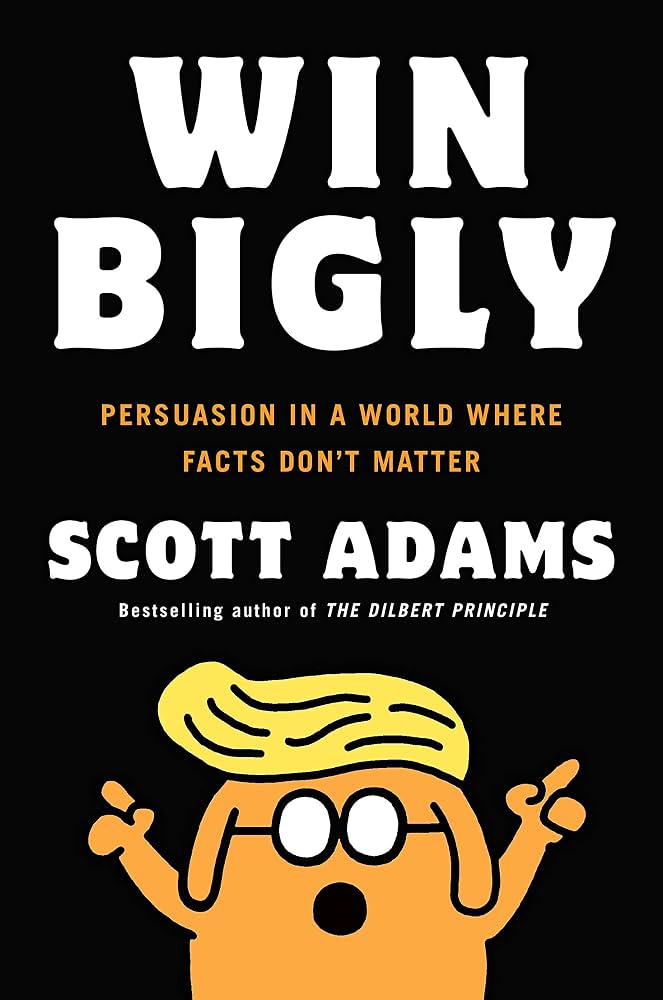
Win Bigly: Persuasion in a World Where Facts Don’t Matter by Scott Adams
Original notes here.
The author describes himself as a business-level persuader; one level higher are academic-level persuaders (cognitive scientists); at the very top are master persuaders, including Trump and several presidents, Steve Jobs, Peggy Noonan, Tony Robbins, and Madonna
By identifying Trump as a master persuader, the author was able to trigger cognitive dissonance and confirmation bias among the public and thereby successfully predict Trump’s victory in the 2016 U.S. presidential election. At the time, the large number of elites who had received no persuasion training not only predicted that Trump himself would lose badly, along with the Republican Party, but considered this the easiest prediction to make. When they were proven spectacularly wrong, it triggered cognitive dissonance on a massive scale
The persuasion technique of being directionally correct while exaggerating the facts: the author said Trump had a 98% chance of winning, directly opposing The Signal and the Noise author Nate Silver, who gave him only 2%, thereby boosting his own reputation
Being wrong in a conspicuous way: Trump deliberately ignored the details and said he would build a wall along the border. He was widely criticized as unrealistic, but by the time he was inaugurated, everyone was discussing the problem of border control
Facts are less persuasive than fiction: although what Trump says is often inconsistent with the facts, those are merely background noise
Terms Used in This Book
Anchor: an idea that influences someone to think toward a particular outcome, such as making a very large demand at the outset
Cognitive dissonance: when evidence conflicts with a person’s worldview, the mind automatically generates delusions to rationalize the inconsistency. On Twitter, it often takes forms such as mocking words + something utterly absurd (e.g., “LOL I guess you want to sell guns to children”), as well as using metaphors instead of reasons, ad hominem attacks, and appeals to motive: when the other person starts doing these things, you know you have won the argument
Confirmation bias: people’s tendency to irrationally believe that all new information supports their existing worldview
Filter: a way of viewing reality. What matters is that it can make people happier and help them predict the future. The Santa Claus and church filters the author used as a child were discarded as useless, while the filter he uses today is the “moist robot filter” (the human brain is like a wet computer that responds correctly to the correct programming), including the “persuasion filter,” a subset of the “three-dimensional worldview”
High-ground strategy: elevating a debate from the details on which people disagree to a higher level on which everyone agrees, such as after the election when the author urged Trump supporters to demonstrate patriotism and help the country heal its wounds
Linguistic Kill Shot: an extremely persuasive sentence that ends an argument
Pacing and leading: a persuasion technique in which, after establishing synchrony, you make the other person feel safe enough to follow
Pre-persuasion: the first impression you prepare to give the other side at the beginning of a negotiation
Future Pacing: a persuasion technique that gets the other person to immediately imagine what will happen after making a decision
Three-dimensional worldview: the idea that humans are irrational 90% of the time, in contrast to the prevailing two-dimensional view of reality
People think collective hysteria is extremely rare, when in fact it is the human norm, without exception: millions of Americans believed Obama was a Muslim agent; countless people believed Trump was the next Hitler; twenty people were executed as witches in Salem, Massachusetts, between 1692 and 1693, simply because four girls developed strange symptoms that could not be explained; in 1637, tulip bulb prices soared to ten times a skilled worker’s annual income
The scientific community is no exception. Climate change is one example. The perfect setup for collective hysteria requires only two conditions: lots of speculative predictive models that are repeatedly reviewed, plus financial and psychological pressure to conform
When Trump was still a civilian, he said climate change benefited China, and people thought he was crazy. Later, we learned that the Paris climate agreement would impose enormous costs on the United States while doing little to cool the Earth. At the time, he did not understand the science of climate change, yet he could still spot the scam from a distance; it was not just luck
People are more easily influenced by the direction in which things are moving than by the current state of affairs: Trump’s challenge after taking office was to eliminate people’s delusion that he was “the next Hitler.” He adopted liberalizing measures that shattered this illusion, such as no longer supporting waterboarding, working with the establishment on the immigration issue, and reducing its scale
The “early wins” strategy: persuading the heads of Ford Motor Company and Carrier to keep jobs in the United States was not a big deal, but it was a major image victory for Trump and Pence
Within a week of taking office, he generated 25 news headlines, each provoking outrage, but the sheer volume effectively diluted and scattered the outrage
Hypnosis is a special form of persuasion. It can induce a relaxed state, produce a sense of confidence, help people notice lies, deeply understand human irrationality, and improve communication and romantic relationships
Hypnosis only works on things a person already desires. The author once hypnotized a female colleague so that she reached 20 orgasms within an hour (the two people had to be attracted to each other and both want that result). It is not an appropriate tool for losing weight or quitting smoking
The author takes no position on the pickup technique known as “negging” and leaves it to readers to judge for themselves. The technique uses ostensibly sarcastic remarks to create the illusion that the woman is in the same situation as a confident man talking to another woman who has a hidden flaw
Republican candidate Carly Fiorina exposed the illegal sale of fetal tissue and stated her views on abortion. The author publicly predicted that she had sacrificed herself: people who knew nothing about persuasion would think the strategy was bold and clever, but the problem was that it made people visualize dead babies
A wizard influences a group of people through a simple discovery, but is eventually arrested and destroyed. Before he dies, he condenses everything he has learned into four words
A thousand years later, five wizards in another kingdom simultaneously decipher the four-word secret and rise to power, condensing it into three words more suited to the age. The king also turns his sword against them. They resist the authorities, rally the people to fight, and finally accomplish great things
The three words are We the people
The four-word secret is Turn the other cheek
If someone is not particularly remarkable in any single respect yet succeeds far beyond expectations, they must possess a carefully engineered “Talent Stack”: accumulated talents can work together synergistically
Trump is a decent promoter, capable of building a brand, strategically minded, a decent negotiator, persuader, and speaker, decisive, thick-skinned, energetic, and physically imposing. He is not at the top in any one area, but his Talent Stack is extremely powerful
Some people believe he won by devising the policies Americans wanted. The author’s persuasion filter says exactly the opposite: he persuaded Americans that his policies were the things they should care about most
Shifting the situation by redirecting attention: when a host asked, “You call women you don’t like fat pigs, dogs, idiots…,” Trump answered, “I only did that to Rosie O’Donnell”
The technique can be analyzed as follows
Emotionally evocative visual imagery: answer using another real person whom everyone knows and can picture
Pace, then lead: echo Republican supporters’ dislike of O’Donnell
High ground: elevate the question from the details of what was said in the past to a higher conceptual level
When criticized as someone who complains constantly, he used the same strategy: accept the criticism, establish a mental anchor, and in turn shape himself as the spokesman for change
“Mexico sends rapists and bad people to the United States” was another exaggerated statement used to establish a mental anchor
He also repeatedly said that his appearance on Fox News was creating the network’s highest ratings, until it came true
Persuasion Talent Stack: it makes him seem thick-skinned and provocative, which fits his personal image
Another example of redirecting attention: Khizr Khan, a Muslim American lawyer whose son died in the Iraq War, condemned Trump’s policies at the Democratic National Convention. In an interview, Trump said that Khan seemed like a good man, but he wanted to know why his wife stood beside him without saying a word. This shifted voters’ attention toward the perceived impropriety of Muslim attitudes toward women
The effectiveness of different forms of persuasion ranks as follows: great fear, identity, small fear, desire, habit, metaphor, reason, hypocrisy, Word-Thinking
Word-Thinking is ineffective: debating whether Trump is a conservative achieves nothing
Using habits to persuade: for example, naming programs Morning Joe and Coffee with Scott Adams helps people develop the habit of watching, just as they think about the morning and drinking coffee in the morning
Metaphors usually fail because they are not designed to persuade; they are merely shortcuts for explaining new concepts, and because their definitions are vague, they allow the other side to counterattack in different ways
Comparing Trump to Hitler is different: what actually works is using a persuasive association to establish a psychological anchor
If a metaphor includes a powerful negative association, then the metaphor is a gun holster and the negative association is the gun: the gun is persuasive; the holster is not
Identity as an appeal: the Hillary Clinton campaign successfully won the support of most women and sexual minorities
Identity as an attack: it is more effective than targeting behavior. A: “When I see a political sign for the party I don’t support, I smash it. Those signs are ridiculous!” B: “Do you want to be that kind of person?” A: (cognitive dissonance) “Uh… I’ve only done it once, and C was with me at the time, and I’d had a little to drink”
The High Ground Maneuver escapes the mode of childish quarrels:
Mutual accusations of hypocrisy: A: “You didn’t do enough to stop the street violence.” B: “Yeah, well, you failed too.” Both sides are equally bad
A: “~”; B: “I agree. Fortunately, we later learned many valuable lessons… which enabled us to identify best practices…”: like an adult explaining to a child how things work
Example: when faced with the iPhone 4’s dropped-call problem, Steve Jobs said: “We’re not perfect. Phones are not perfect. We all know that. But we want to make our users happy.” The wording was precise. By refusing to argue about the facts, he directed users’ attention to the boring but plainly stated fact that all phones have problems (Jobs personally forwarded this post by the author to his subordinates)
Recycling promotion works by turning recycling into a semi-public process so that more people imitate it
Visitors notice whether your home has recycling bins, and children who have just finished a recycling lesson may even police you
The social pressure is enormous, but if you ask people why they do it, they will say it is good for the Earth rather than that they are avoiding social awkwardness: people always imagine themselves to be rational decision-makers
Pre-persuasion techniques:
One way the author makes himself more persuasive is by telling people that he is a trained hypnotist and familiar with every tool for exerting influence
Trump’s authorship of The Art of the Deal (even though much of the content was actually written by another co-author) gave him additional persuasive power
Compared with people who receive things for free, paying customers are easier to hypnotize
Past-life regression under hypnosis is something people imagine. No one describes a past life as a non-film character, and no one says their past life was a Chinese person from a country containing one quarter of the world’s population
People who first see an image of the American flag are more likely to identify with Republican positions, while those who first watch a video of a pet being adored tend to behave more generously
Pre-persuasion checklist: dress appropriately; be physically attractive; be energetic; promote yourself naturally, without exaggeration; project the image of a winner; manage the visual impression of the space (when candidate Trump appeared on a program, the setting looked as though a sitting president were there, while his opponent appeared on the same program drinking casually); set expectations (make an excessive demand and then compromise, making people happy)
Breaking through by generating massive amounts of negative coverage:
One arrow through the chest is enough to kill you, but a thousand arrows standing side by side leave you safe, like lying on a bed of nails
Trump skillfully used a huge amount of negative coverage to make himself seem like the most important candidate
In a chaotic world, talking about the big picture first is far better than agonizing over the details
Is Trump’s persuasive power innate?
As a child, Trump often attended sermons by the Norman Vincent Peale, the fellow master persuader and author of The Power of Positive Thinking. If it were innate, that would be an awfully big coincidence
The Study of Nicknames
The nicknames Trump created for his rivals were all catchy and consistent with their images:
Low-energy Jeb: genuinely suggested a lack of energy
Lyin’ Ted: fit an appearance that looked like a liar, establishing an anchor that made everything he said sound like a lie; the unusual spelling of in’ made it harder for the brain to forget
Crooked Hillary: can imply either a cheat or a hunched back; the wording was novel and fit the way Hillary had been photographed bent over, and it was fully exploited during Emailgate
Pocahontas: the name of a Native American princess, mocking Elizabeth Warren, whose claim to Native American ancestry was finally proven false; it had enormous visual impact
Lil’ Marco: mocked Marco Rubio for being short and matched his youthful, baby-faced appearance
Hillary’s own nicknames for Trump all failed: “Donald Duck” was too cute and raised copyright issues involving Donald Duck; “Drumpf” (Trump’s family name) carried implications of discrimination against foreign immigrants; “dangerous Trump” could easily be reversed into praise. None of them scored
Visual Persuasion
“The big, beautiful wall” rather than the powerless “improve border security”
“Beheading hostages,” “locking hostages in cages and drowning them” rather than “ISIS is frightening”
When asked the trap question of what he thought about the pope’s criticism of capitalism, Trump answered, “I would say to the pope, ISIS is coming after you. ISIS wants to take over the Vatican. I would feel very safe saying that.” After hearing this, the audience had already forgotten the original question. Their minds were filled with vivid images of ISIS overthrowing the Vatican
When confronted with accusations of inappropriate treatment of women, he produced a real person as a response
Primary candidate Ben Carson was once leading in the polls. After Trump imitated the stabbing motion Carson had described in his own book, in which he had tried to stab a classmate but was stopped by a belt buckle, the author correctly predicted publicly that he was finished
Image reinforcement: his private jet looked like Air Force One, and even the way he stepped off the plane looked presidential
The Study of Slogans
“Make America Great Again” was an energetic and powerful slogan. The word again made the whole country discuss the gap between the current state and the ideal state, achieving its effect. Coincidentally, it was also the slogan of the legendary president Reagan, who was seen as a political outsider, making the positive association especially effective
By contrast, his opponents’ slogans were lackluster: “I’m with her,” “I’m ready for Hillary,” and “fighting for us” were completely ineffective at uniting the country
“Breaking down barriers” did not simultaneously view the world in terms of winners and losers
“United we stand” sounded like a group of bullies attacking dissenters
More fatally, Hillary often asked voters to imagine Trump as president doing certain evil things. This actually helped him, because Trump’s biggest weakness was that people could not imagine him as president
Democrats used the slogan “Make America Sick Again” to oppose Trump over healthcare reform. The negative association was a major blunder
The Invisible Master
Sanders was not a master persuader, yet he displayed a powerful and effective form of persuasion. After he lost the nomination, Hillary’s tactics suddenly improved, using dark to describe Trump and appealing to fear extremely effectively
The author followed the clues and concluded that an influence author had been brought in to advise her campaign. The person in question did not deny it
New York Humor
On July 18, 2015, Trump joked that he preferred veterans who had “never been captured”
New Yorkers react differently from other people to offensive jokes: the worse and more inappropriate the joke, the funnier it is
The positions of the person telling the joke and the person being offended are actually aligned
Although it made people uncomfortable, after nearly a year everyone had become accustomed to Trump’s style of humor, so it had little effect
The “Two Ways to Win” Strategy
In the Trump University fraud case, Trump announced in advance that the judge was Mexican, creating a heads-I-win, tails-I-win situation: if he won, it would be because his advance statement had exerted influence; if he lost, it would prove the other side really was biased
The judge, Gonzalo Curiel, finally ruled in Trump’s favor
In January 2016, Iran detained ten American sailors. Trump said that if elected he would make Iran pay a price: if Iran released them, it was because his advance warning had influenced them; if Iran refused to release them, it would make the United States need him even more
Brand-licensing deals likewise represent a heads-I-win, tails-I-win strategy
Running for president was also a heads-I-win, tails-I-win proposition. As far as the author knew, Trump’s life goal at age seventy was becoming more focused on public service; even losing the election could help awaken the public to the importance of border security
Triggering Hillary’s Self-Destructing Nuclear Bomb
On September 9, 2016, Hillary said at an LGBTQ event that half of Trump’s supporters were racist, sexist, homophobic, and Islamophobic, and were a “basket of deplorables”
Trump: “She really does hold the American people in contempt”
He carefully chose the single best word, “contempt,” confirming the suspicions of Republican supporters: Hillary did not respect or identify with Republicans
Defusing the Accusation of Misogyny
In a 2005 recording, Trump bragged: “When you’re a star, they let you do it. You can do anything… grab them by the pussy”
The scandal had a powerful visual association, but its effect was limited: people already expected Trump to engage in certain bad-boy behavior, and under the “Hitler” framing, it even made Trump seem more human and helped him escape the image of a strongman dictator
Emotional Persuasion Cheat Sheet
Position yourself as someone who agrees with what most people think
Directly ask people to “trust me”
Repeat “this is true” again and again
Use simple language that matches the way ordinary people speak
Strategic ambiguity: possess many different characteristics so that different people who are sensitive to different issues can each focus on the aspect that benefits them: anti-war people may support him because he claimed to oppose the Iraq War; people who want to bomb other countries may also support him because he wanted to destroy ISIS
The Perfect Response to an Attack
After Trump was accused of being a racist, the author posted that defusing it would be simple: Trump only needed to hug some nonwhite people in public. The next day, Trump did exactly that
The author accurately predicted Sor Hillary’s health condition based on changes in her face, saying this was a hypnotist’s technique, although doctors would be more accurate
The author accurately predicted that the bizarre-bearded John Bolton, who looked like a belligerent white nationalist, would not be chosen as Trump’s Secretary of State
Persuasion Reading List
Search: scott adams persuasion reading list
Finished reading on Jan 7, 2021