Notes on On Becoming a Person
On Becoming a Person: A Therapist’s View of Psychotherapy by Carl Roger
Original notes here.
Read until the end to get a bonus. Enjoy reading.
The author pioneered client-centered therapy. In a 2002 study by Steven J. Haggbloom, a professor in the Department of Psychology at Western Kentucky University, he ranked sixth among the most influential psychologists of the twentieth century and second among the most influential therapists of the twentieth century, behind only Freud
In a 2006 survey conducted by the professional magazine Psychotherapy Networker, he ranked among the most influential psychotherapists of the previous 25 years
Unlike other professional techniques, psychotherapeutic techniques are all derived from and guided by underlying ideas
The dynamics of the change process are twofold: first, the psychotherapist creates certain conditions based on himself; second, after experiencing these conditions, the client’s willingness to change is strengthened
A psychotherapist cannot stand outside the therapeutic relationship and offer directions like a backseat driver; at the very least, he must enter into a kind of reading and enlightenment capable of eliciting a process of change. Hence the necessity of reading the classics rather than merely outlines or summaries
The author broke with the industry’s convention of calling the person receiving therapy a client, a term originally referring to the listener, meaning that the person who pays is instead expected to listen to the expert’s advice; the translator, Song Wen-li, rendered client-centered as “client-centered,” and pointed out that behind this passive voice there is an active agent, namely the therapist
The author describes himself as anti-Freudian; the translator points out that this is a straw-man fallacy, because the Freud being referred to is not the original Freud but one derived from secondary works, and during the author’s prime in America, The Complete Psychological Works of Sigmund Freud had not yet been published
A line from Freud’s letter to Jung: psychoanalysis is essentially a treatment through love; the translator believes this is precisely the author’s fundamental conviction
The translator believes Skinner never departed from humanistic concern and that his theory is compatible with the author’s; therefore, the author is not an excuse for us to oppose psychoanalysis or behaviorism
My Reflections
The author’s professional insights accumulated over many years:
- Being inconsistent inside and out, wearing a mask, is of no help at all
- Being as I am: listening to myself with acceptance and being myself are what make one a more effective therapist
When you become yourself, the relationship becomes real
Accepting that I am very annoyed by a client makes it more likely that I can accept his words and feelings - Allowing myself to understand others is immensely valuable: the most common reaction among ordinary people is to immediately evaluate and judge
These understandings enrich my experience, and experience can change me, making me more responsive
Being understood allows people to accept their own panic and bizarre thoughts, after which they discover that both they and their feelings are changing - If I can open a channel through which a person can communicate to me his feelings and the world of his personal experience, it will enrich my own experience
- The more I can open myself to the inner reality of myself and others, the more I discover that I do not hastily retreat into the familiar position of wanting to determine goals, shape, manipulate, or push others
This kind of “non-doing” seems to run counter to the meaning of life, but the paradox is that the more willing one is to accept things as they are, the more change is elicited; when a person is willing to be himself, not only does he change, but the people connected to him also change. This is strikingly clear in my experience - Trust inner intuition; wisdom can be found within it
Unclear ideas can lead me to important places; by extension from this: other people’s evaluations cannot guide me - For me, experience has supreme authority
Experience has authority because it is more fundamental, at the very bottom; even though it is often mistaken, it remains forever open to the necessary corrections - I like discovering order within experience
I see both scientific research and theory-building as processes in which meaningful experience moves toward an inner order
Satisfying the need to seek order and meaning is a subjective need that exists within me - Facts are always friendly
The painful learning experience of adjustment and reorganization can always bring forth a satisfying view of life - What is most personal is most universal
The feelings in experience that are most private and least easy for others to understand are nevertheless the ones that most strongly evoke resonance
The most private and unique experiences of each person are precisely the factors most capable of speaking to the depths of the human heart - This is the fundamental belief underlying all of the insights above: human beings have a basically positive direction
Even the person who causes the most trouble, when I can accept him from his own standpoint, reveals a desire to change in a positive direction, because at some of his deepest levels there lies a very positive direction
The more completely a person is understood and accepted, the more he tends to strip away his false appearance, stop using it to cope with life, and move positively forward
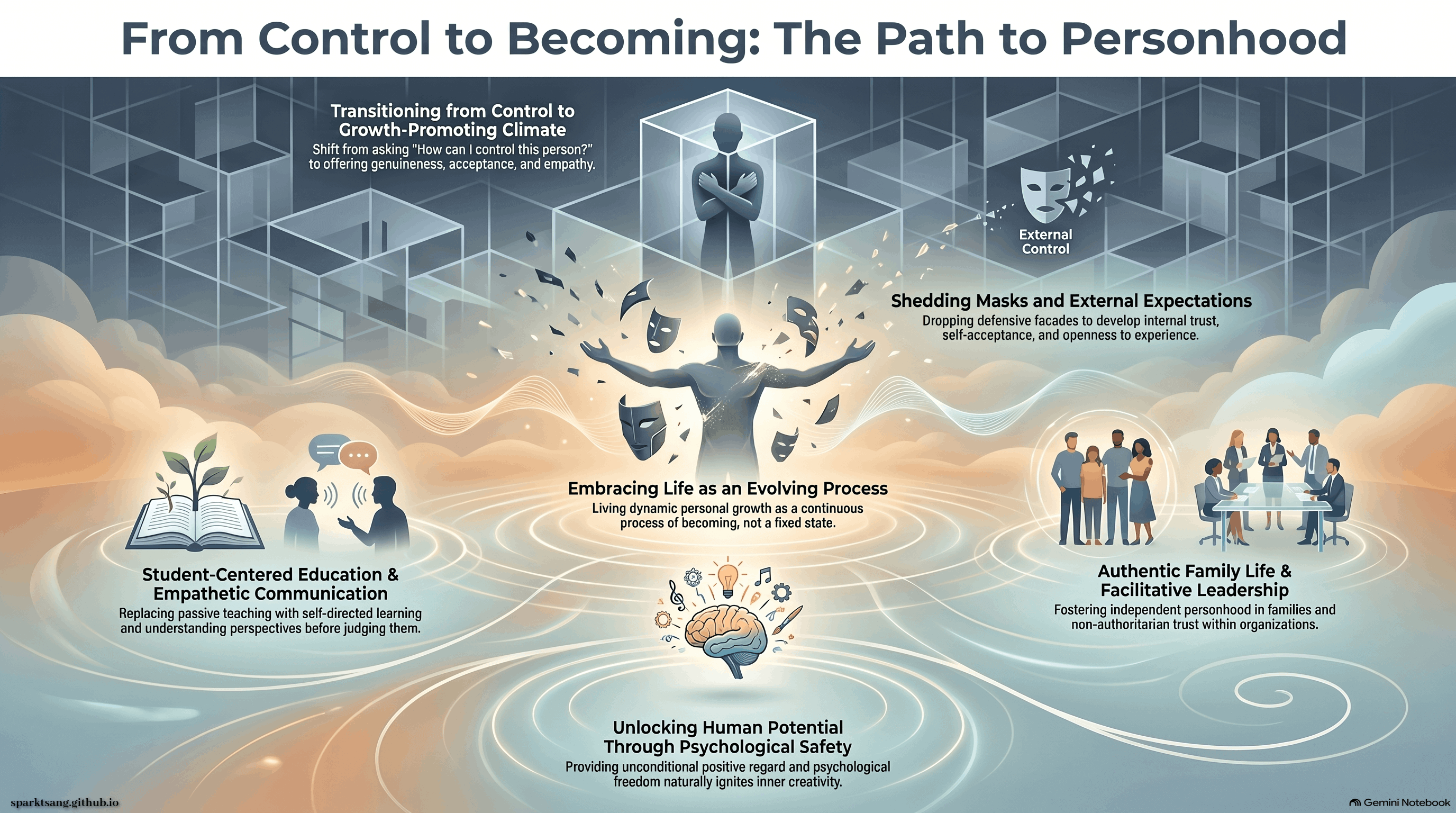
Conclusion: At its best, human life is a process of flowing change, always in the process of becoming
An Overview of the Helping Relationship
One enormous challenge is: do I possess everything that could be useful to a person and could help him?
In my early years I asked: How can I handle, treat, or change this person?
Now my question is: How can I provide a relationship that he can use for his own growth?
What passive educational methods can accomplish is only temporary change; once the effect disappears, what remains is simply a person who is even more convinced of his own inadequacy
Change occurs through experience within a relationship
The overall hypothesis can be stated simply: if I can provide a certain kind of relationship, another person will discover within himself a capacity to use this relationship for growth, and change will follow; this includes:
Genuineness: only when I can offer another person a genuineness that exists within me is it possible for that person to find genuineness within himself; there is a kind of transparency in which my feelings can be plainly seen
Caring: what acceptance refers to; that is, seeing him as an inherently worthwhile individual of unconditional value, without changing this on the basis of his circumstances, behavior, or feelings
Empathy: acceptance by itself means little unless it includes understanding; freedom to explore oneself in both consciousness and the unconscious is an important condition of a relationship; deep understanding enables me to see his private world through his eyes, just as he sees it himself
When I maintain the attitudes I have described, and the other person can experience those attitudes, change and constructive personal development must occur. I dare put this “must” in because it comes only after long and careful consideration
The potential is always there: a person will find within himself the capacity to use this relationship for personal growth, and in an appropriate psychological climate this tendency will be released and become real
Therapeutic effectiveness: anyone who has lived within this kind of relationship, even for only a few hours, can show significant and lasting changes in personality, attitudes, and behavior, including becoming more like the person he wants to become, becoming more self-directed and self-confident, more unique, better able to express himself and accept others, better able to cope fully with life’s difficulties, and more comfortable and at ease; there is firm empirical research supporting this
The therapeutic relationship is only one example of human relationships; all human relationships are governed by the same laws, including parent-child, teacher-student, and superior-subordinate relationships
Characteristics of the Helping Relationship
A helping relationship is one in which at least one party intends to promote the growth and development of the other; some human relationships are inherently growth-promoting, and the definition above already covers most of these relationships
A.L. Baldwin’s research at the Fels Institute found that the most growth-promoting attitude in parent-child relationships was “acceptance-democracy” (a warm and egalitarian attitude); these children showed greater intellectual growth, greater creativity, and greater security and emotional control
Whitehorn and Betz found that the most striking difference between the best and worst doctors treating schizophrenic patients was that those who performed best viewed patients as people, with the person and personality as the basis, and interacted actively with them, developing relationships that made patients feel that the doctors were trustworthy and reliable; the author believes similar facts would appear in other helping relationships
R.W. Heine found that regardless of the form of therapy—psychoanalysis, client-centered, or Adlerian—the clients’ views of what was helpful were quite similar, including having a trustworthy therapist, feeling understood, having independence and autonomy in making choices, and being able to clarify vague feelings. The most unhelpful factors were also highly consistent: an attitude lacking interest, being remote and inaccessible, excessive sympathy, exhortation, and instruction
F.E. Fiedler found that although experienced therapists differed in orientation, the relationships they established with clients were nevertheless similar
R.D. Quinn found that what is called understanding the client consisted primarily of the element of “the desire to understand”
J.E. Dittes, using measurements of Galvanic Skin Response (GSR), found that even a slight change toward a less accepting attitude on the part of the therapist produced physiological changes in the client
The above can be summarized as follows: what matters is the therapist’s attitudes and feelings, not theoretical orientation
W.S. Verplanck found that operant conditioning (such as nodding in approval when the subject says certain words) can cause subjects to keep using certain words or phrases
B.F. Skinner found that a machine that rewarded particular behaviors could establish a helping relationship with chronic schizophrenic patients, enabling them to acquire basic freedom of behavior (but once the machine stopped rewarding them, the patients reverted to their old behavior, demonstrating the importance of trustworthiness)
Ends & Page’s experiment found that in group psychotherapy for long-term excessive alcohol abuse, the client-centered approach produced the greatest improvement, followed by the psychoanalytic group, then the control group, and finally the method initially predicted to be the most effective: the two-factor learning-theory group. The author believes this was because the therapists in the process had to avoid allowing their personalities to intrude and maintain anonymity, suppressing their characteristics as human beings
G. Halkides established with extremely high statistical confidence that constructive personality change was related to the following variables: degree of empathic understanding, degree of caring attitude (unconditional positive regard), and degree of therapist genuineness. The statistical inference had a probability of error of less than one in a thousand, and it was also found that the therapist’s attitude remained consistent throughout the entire process
The questions that followed:
- Can I make another person feel that I am trustworthy and reliable, consistent from beginning to end?
My understanding is that being trustworthy does not mean strictly following a rule of consistency, but whether I can reliably reveal my truth; if I can do that, I am an integrated, unified person: I can be whatever I deeply am - Do I have enough expressive power to communicate myself unambiguously to the other person?
When a helping relationship fails, it is often because of failure on the above two questions
If I am annoyed with him but cannot be conscious of it, my expression will necessarily be contradictory, causing him not to trust me
Therefore, interestingly, if I can establish a helping relationship with myself, be sensitive to, notice, and accept my own feelings, then it is very likely that I can establish this relationship with others
If we want to help people grow, we must grow ourselves; the process is often painful, but at the same time it is enriching - Can I allow myself to experience this positive attitude toward another person?
One important reason for professionalization in every professional field is that it enables people to maintain a safe distance
But learning to care for others is also quite safe; it is a genuine human achievement - Can I stand firmly in my own uniqueness without being overwhelmed by another person’s depression, fear, or dependence?
Being able to feel freely that one is a person distinct from others is immensely powerful; only then does one discover that one can understand others more deeply and accept them more generously, because one is no longer afraid of losing oneself - Can I safely allow another person to possess his own uniqueness?
R.E. Farson found that the better adjusted and more competent counselors were at their jobs, the more able they were to interact with clients in a variety of ways, rather than tending to induce clients to conform - Can I enter completely into his private world, moving through it sensitively and freely without stepping on and shattering the meanings he himself treasures so deeply?
That is, even understanding with only a little empathy, or an imperfect attempt that does not quite get it right, can still be helpful; of course, if I can understand and clearly express the meaning that he himself feels to be tangled and unclear, that will be the most helpful - Can I accept every aspect that he is capable of presenting to me?
Experience tells me that when my attitude is conditional, he cannot grow in those parts of himself that I cannot fully accept
And the reason I cannot accept certain parts of him is that the feelings in those parts make me afraid or feel threatened; if I am to be more helpful to people, I must first grow myself and accept those fearful parts of myself - Do I have enough sensitivity that my every gesture will not make the other person feel threatened?
When I respond with words that are only slightly stronger than the client’s own feelings, the client’s psychogalvanic reflex immediately shows rises and falls - Can I free him from the threat of external evaluation?
Evaluation is of no help whatsoever to personal growth. In the long run, positive evaluation is no less threatening than negative evaluation, because it necessarily implies that you also have the right to say that he is bad; the meaning and value of his experience are determined by him, not by evaluation, and a non-evaluative relationship allows him to become someone who can take responsibility for himself with ease - Can I see him as a process in the making?
As Martin Buber said in describing the affirmation of another person: “He is created in order to become through change. I affirm him in myself, then affirm him in him, and in this way what is connected is this: his potential can finally unfold and evolve”
Where operant conditioning can go hand in hand: if I regard the relationship as an opportunity to reinforce certain words or opinions of his, I am affirming him as an object, a manipulable mechanism, and he will tend to act accordingly; if I regard the relationship as an opportunity to reinforce his entire existence and entire potential, he will likewise tend to act accordingly
Conclusion: I cannot answer most of these questions affirmatively; all I can do is keep working in the direction of an affirmative answer
I strongly suspect that the extent to which I can create a helping relationship can be used to measure the extent to which I have achieved growth
This work is one of the most important enterprises in the world today; the future of this planet depends on the people who create helping relationships
An Overview of Psychotherapy
Psychotherapy does not provide the motivation for growth; motivation seems to be innate in the organism and, under certain conditions, develops toward maturity, including the previously mentioned genuineness, caring, and empathic understanding
Why is this so? Because someone patiently listens to his feelings, he also becomes able to listen to and care for his own feelings, and becomes more able to accept himself
In what direction does change occur? There is change in different dimensions, and development is upward: from a state in which feelings are vague and difficult to distinguish, beyond one’s control and inexpressible, into a flow of feeling in which change can be experienced at every moment; from being remote from feelings and experience, remote from people, with a rigid self-concept (for example, people who use “intellectualization” as a defense mechanism to talk abstractly about their feelings), toward immediate grasping and acceptance of feelings and experiences, discovering a changing self within the experience of change, greater genuineness and intimacy in emotional relationships, and greater unity and integration in the functioning of the person
Therapeutic outcomes: no longer seeing oneself as unacceptable, unworthy of respect, and someone who must live according to other people’s standards, but instead defining oneself as a worthwhile and self-directing person (the center of self-evaluation shifts from outside to inside), being able to form standards and values on the basis of one’s own experience, adopting a positive attitude toward oneself, seeing things in a way that is closer to reality, improving psychological adjustment, making ideals more attainable, eliminating the gap between the real self and ideal self, reducing various kinds of tension, becoming more accepting of others, making relationships with oneself, others, and the environment more genuine, regarding oneself as more mature, while other people who know him well also perceive his way of behaving as more mature, and these changes continuing after the period of therapy
Re-understanding the above equation through inner experience, the therapist’s experience: I hope I can feel his feelings, and I also hope that he will know that I understand his feelings… I will stand with him in his narrow, tightly enclosed little world, and perhaps I can help make that world a little safer; I am willing to accompany him on that dangerous journey of self-exploration
The Direction of Therapy Seen Through a Case
Many of a person’s real experiences are radically at odds with his self-concept and cannot be fully experienced, but in a safe helping relationship, because the self is no longer under threat, the client need not distort experience to conform to an existing self-concept, and can instead become one with his experience
The author uses excerpts from recordings of a case to show that in psychotherapy, whenever there is sufficient depth, one can almost be certain that a turning point will occur: the client feels that she originally wanted to solve a problem, yet discovers that she is really just experiencing herself, often accompanied by an intellectual denial and an emotional affirmation and enjoyment—in other words, it feels good
At the thirtieth interview, the client confirms that she really does feel the author’s care and is also willing to let him care about her. In an interview after the treatment ended, she spontaneously brought up this experience, saying that it was the most unusual part (this is a two-way relationship and has nothing to do with one-way transference; this phenomenon is more common in client-centered therapy because with practice in this form of therapy one becomes less afraid of one’s own positive feelings toward the client: witnessing a client struggle to become a person like himself can transform one’s feelings toward him from acceptance and respect into heartfelt admiration)
This feeling is even more fundamental than sexual love or parental love; it is full concern for a person, unwilling to interfere with his development or use him to satisfy oneself, with satisfaction arising from being able to set him free and let him grow in his own way
After one excerpt, the author asks whether this is precisely a description of the core of the socialization process: can we discover that accepting another person’s positive feelings will not cause us to be trampled upon?
At the same meeting, the client felt it difficult to put into the clearer form of ordinary knowledge the deeper things she had learned from the therapist
At the thirty-third interview, the client felt that earlier she had been somewhat disgusted by having placed the card saying “I have a very attractive personality” at the top, whereas now she felt there was nothing wrong with it; the author points out that the client has not merely accepted herself but has grown to like herself more, a quiet joy in “becoming oneself,” the original joie de vivre, the joy of living
There were already signs of this at the ninth interview. At that time the client revealed that she had once felt herself worthy of admiration and affection, had once felt that her whole person was integrated and functioning smoothly, able to live together and coexist with her feelings; this too is the direction psychotherapy must follow if it is to be effective
The author argues that human beings are positive by nature, with a social tendency, a forward-moving tendency, and a rational and realistic nature
Freudian psychology, however, argues that the unconscious essence of human beings is composed of instincts, irrational, antisocial, and destructive
Yet A.H. Maslow offered a strong argument that antisocial emotions arise from frustration: it is the frustration caused by unmet human needs for love, security, and belonging that gives rise to them
A. Montagu also advocated the view that the basic law of human life is cooperation rather than struggle
Returning to the case, the author peels away the client’s personality layer by layer. At the eighth interview, the client reveals a buried sense of resentment at having been deceived in sexual relationships; by the thirty-first interview she raises it again, saying that she was hurt too deeply, but because of cultural opposition she had covered up the emotion; the author points out that because she could not cry it out, she used resentment to cover it up, yet disliked that resentment; the client says she had no idea that this was what was happening; later it becomes clear that she could originally have accepted being hurt, but that her entire life had been dismantled by frustration and resentment
The author points out that at the deepest level of experience, she has no desire for revenge or antisocial tendencies, but rather dislikes them intensely and hopes to remove them completely
Although she expresses herself in a confused and disordered way, the author eventually sorts out what the client means, and many clients have reached similar conclusions about themselves: by going inward one discovers a core without hatred. At first, one might think it is a sublimated sexual drive, but it has a much greater breadth and depth beyond sexuality; people generally expect to rise upward and search in the thin layer where the ideal is supposed to reside, but in fact it is by descending, by going deeply into oneself, that it is found—it seems to be precisely the essence of being human
Later, even though she understands that her feelings are fundamentally incompatible with Western culture, she is also able to accept positively that they are free of hatred
An excerpt near the end of the case shows that at the core of herself she slowly discovers a nature that neither wants to reward nor needs to punish others
The thematic thread running through the above material is that psychotherapy is a process of enabling a person to become an organism in his own right, allowing him to abandon self-deception and avoid distortion, returning to the most basic experience of his physical senses—his organs, his voice, his sight, his touch, and his smell
Before therapy, people are constantly saying to themselves without realizing it: in this situation, people will think I should do this; my parents or culture want me to do this; I should do this (this does not mean that his behavior will necessarily be harmonious with the opinions of others)
During the therapeutic process, his life-space keeps expanding, so that he cannot help asking himself: what exactly is my experience of this matter, what does it mean to me, and if I really do this, how should I express what it means (his actions and behavior become grounded in reality, and he can make a realistic balance of whether each action produces satisfaction or not)
The person in psychotherapy adds a sufficient degree of self-awareness to everyday experience, allowing his experience to appear in consciousness without distortion; he knows what he is actually experiencing, rather than merely those experiences that have been permitted to remain. Only then can he first reveal the full organic potential of himself as a human being: becoming what he is (that is: becoming what he is in his experience; becoming a fully functioning organism, a human-like organism functioning to its full potential)
Some may object that you are merely releasing the animal nature in human beings, releasing nothing more than instinct; yet he will be able to control himself reasonably and will also spontaneously desire to become socialized: there is no animal nature in human nature, only human nature; he can perceive the demands of culture just as he can perceive physiological needs; he can perceive the desire for friendship, feel attentiveness and sensitivity toward people, feel aversion and hostility toward people, and when his unique capacity for self-awareness can operate fully and freely, there is no need to treat a human being as an animal requiring control. Instead, one discovers that because the central nervous system has a tremendous capacity for integration, a person can successfully display behavior that is balanced and reasonable, beneficial both to himself and to others
When people are less able to function as human beings and deny the various perceptions that come from experience, there are indeed many reasons to fear people and human behavior
Being like a person does not mean conforming to the masses; human nature is about becoming individualized, but at the same time a person can become socialized
The Meaning of “Becoming a Person”
Clients bring all kinds of problems, and the problem they bring at the second or third session will not be the same one they bring at the tenth, let alone later; but behind all the surface problems, every person is asking: what, really, am I? How can I break through the surface of behavior and touch the deeply hidden true self? How, exactly, can I become myself?
In a safe and comfortable atmosphere:
- A person becomes more like himself, beginning to drop the facade, take off the false mask, and cast aside roles; Kierkegaard had long pointed out that the deepest despair is choosing to be someone who is not oneself, while the opposite choice is the person’s ultimate responsibility
- All kinds of feelings can be experienced fully, almost to the limits of human awareness, so that one knows that at a given moment one is precisely a certain feeling
In one example, a client suddenly realizes that she is like a child desperately begging and pleading for pity - Discovering the self within experience: one client put it this way: you must listen to your experience tell you what its meaning is; once you tell it what its meaning is, you are declaring war on yourself
But what kind of person is actually revealed once the mask is removed?
- Openness to experience: the opposite of being defensive everywhere
Freely feeling one’s own pain without having to consider whether the feeling will be accepted; being able to feel love and tenderness toward a child without worrying that these feelings signify weakness; being able to be tired when one is tired; being able to feel and express anger toward a daughter… without having to keep experience outside awareness - Organismic Trust: greater openness to experience makes it possible to perceive external circumstances more accurately and to grasp their complexity, taking all factors into account
A simple example: someone who insists that he has a good capacity for alcohol, if willing to lay out his past experiences, may discover that he has rarely judged correctly; someone who sees only the best side of his fiancée, if open to examining his experience, may discover that she has shortcomings in abundance - An internal locus of evaluation: in the example, a client with suicidal thoughts desperately wanted someone to guide her through life and was highly critical of anyone who could not provide that guidance, detailing everything wrong with her professors. By the end of therapy, she understood that she could not rely on others to educate her and acknowledged and took responsibility for “I am the chooser”
- Willingness to become a process: when entering therapy, clients usually hope to reach a fixed state: “the problem has been solved,” “work is more efficient,” “the marriage is wonderfully happy.” During the therapeutic process, they tend to abandon fixed goals and gradually accept that they themselves are not fixed things but a process of becoming
A Process View of Psychotherapy
Throughout the process, the client can experience being completely received by another person, whatever his feelings may be
However many stages you divide the process into, they are all only intermediate points; my hypothesis is that within this frame of meaning, a person will indeed show himself to be at a particular stage, rather than occupying several stages at once
First stage: fixity, extreme distance from one’s own experience, no active seeking of therapy
Communication is limited to superficial external matters, close relationships that carry communicative meaning are seen as dangerous, and there is no desire to change oneself
Second stage: (on the premise that the person was in the previous stage) after feeling completely received
Begins little by little to release and reveal, but often with the help of topics that are not about the self; feels no personal responsibility for problems; describes feelings as not belonging to oneself (“My trouble is… just depression”) rather than “I feel”; personal constructs are rigid and regarded as facts (“I can never get anything right, not even finish anything!”); differentiation of personal feelings is limited and vague (as in the previous example, black or white, absolute views); contradictions are exposed but it is difficult to become aware of them (“I want to see some things, but after looking for an hour I am still on the same page”)
Third stage: (on the premise that the person was in the previous stage) gradual release can occur without obstruction
Can use oneself as an object of expression without awkwardness, and talk about experiences related to oneself, but feelings and personal meaning systems remain related to the past; great difficulty accepting feelings (for example, they seem shameful or very bad), though differentiation becomes slightly clearer (“I feel that this is how things are…”); personal constructs remain rigid and stereotyped, but one may already recognize them as constructs (“If I become emotionally involved, it means surrender; I really hate thinking this way, but…”)
Fourth stage: ( ) understood, welcomed, and accepted as one truly is
Concern about the incongruence (the lack of unity between experience and self), together with awareness of this concern
Fifth stage: feelings are expressed freely and can almost be fully experienced (there may still be some hesitation before becoming conscious of the experience), and there is an increasing desire for this; a desire to become one’s true self; clear differentiation between feelings and meanings; acceptance of personal responsibility for current difficulties
Sixth stage: feelings that were previously stuck can now be experienced immediately; feelings can flow toward completion on their own; complete acceptance of oneself (the client in the example says she feels as though she is caring for herself as she would care for a child); the attitude of treating the self as an object gradually disappears (the self is the feeling itself); if physiological phenomena such as muscle relaxation can be measured, they are also often observed
Seventh stage: the client no longer feels it necessary to know whether he is being completely received, because after the sixth stage development tends to become irreversible, and he can automatically enter this stage
Living fully within oneself, and this self is a flowing process of constant change
The author is uncertain whether this is the only process of personality change or one among many, uncertain whether it applies to all psychotherapy, and uncertain whether the various descriptions have all been correctly classified into the different stages
Changes in stages are usually slow; it is currently difficult to find examples moving from the first to the seventh stage, and if such cases do exist, they would probably take several years
The Meaning of Life
Charles Morris conducted an objective survey of students in six countries and found five kinds of values concerning life: self-control, overcoming obstacles, inner self-sufficiency and compassion for all things, acceptance of the source of external powers, and pleasure
The author believes that none of these can adequately represent the experience he found in his clients; Kierkegaard’s words are the most fitting: becoming a self as it truly is
In another paper the author described this as the good life, and pointed out that this itself is a process rather than a state of existence, a direction rather than a destination
This direction is: casting off surface images, leaving behind “shoulds,” no longer conforming to expectations, no longer pleasing others, moving toward self-direction, moving toward process (accepting the flux of life, one’s own unpredictability, and therefore possessing creativity), moving toward complexity, openness to experience (the opposite of constant defensiveness), accepting others, trusting oneself
In essence: moving, with self-awareness and self-acceptance, toward present being, toward an inner and realistic process of being as one truly is, leaving behind states of existence in which one is what one is not, leaving behind surface images
Contrary to the misunderstanding, this direction is not another fixed state, nor does one become evil; for example, aggressive tendencies are common among highly defensive people, whereas a person in the process of living the good life will reduce such tendencies to a minimum
The feelings frequently experienced by a person in the process of living the good life are feelings of -ing, enriching exciting rewarding challenging meaningful; ordinary words such as happiness, satisfaction, well-being, and pleasure are not quite enough to describe the whole of the good life
This process of development of life need not even be limited to clients or individuals; it can also be applied to groups, organizations, or nations
Human Being, or Science? A Philosophical Reflection
The growing distance between the rigorous objectivity of science and the mysterious subjectivity of psychotherapy makes me increasingly uneasy
From the perspective of experience, the deepest part of psychotherapy is essentially the unity of experience: the client can feel freely, as if placed within a “pure culture,” free from the restraints of reason or suspicion and the constraints of contradictory knowledge
In the past, consciousness was always supervising a mass of dangerous and unpredictable impulses, keeping most of them out of sight; now it can live comfortably within the society made up of all impulses, feelings, and thoughts, which also proves that without rule by authority and terror, allowing each part to govern itself can actually be quite satisfying
This unusual kind of learning cannot be taught, just as Kierkegaard said that true subjectivity cannot be communicated directly
From the scientific perspective, we can objectively test three preliminary hypotheses:
- The therapist’s acceptance of the client will lead the client gradually to accept himself
- The more the therapist can regard the client as a person rather than an object, the more the client can regard himself as a person rather than an object
- During the therapeutic process, experiential learning about the self will occur within the client himself
The author then raises pointed questions from the perspectives of the scientist and the experientialist, respectively. In the scientist’s questions, scientific method is emphasized; the experientialist accuses science of always treating human beings as objects, and mentions that the desolate landscape of the loss of humanity in Brave New World is connected with the growth of knowledge in biology and psychology
The author later realizes that his fundamental mistake was in his description of science, treating it as something capable of existing as a self-contained entity, whereas science exists only within human beings, and scientific hypotheses themselves are creative forms emerging from thorough subjective immersion, after which scientific methods are used to test and establish that the conclusions are not self-deception; at the highest level, the fundamental purpose of science is to provide the inquirer with more reliable hypotheses, faiths, and beliefs
In the new conception, the conflict between the experientialist and the scientist is resolved: science, like every other aspect of life, is rooted in a person’s present subjective experience and springs from the experience of the whole inner organism
Research on Personality Change
Together with other researchers, the author used scientific methods to measure the outcomes of psychotherapy. The research was conducted by the University of Chicago Counseling Center from 1950 to 1954, and included two control groups, so that if improvement was due to other factors, or purely to the motivation to receive treatment, it could be observed
The final conclusions were: clients’ self-perceptions underwent profound changes during and after therapy; clients’ personality traits and personality structure underwent constructive changes toward becoming fully functioning persons; the changes that occurred moved in the direction of the personality integration or adjustment defined in advance; and clients’ behavior became more mature in the eyes of their friends
For measuring changes in the self, the researchers used the Q technique of William Stephenson (author of The Study of Behavior), randomly selecting one hundred sentences from a large pool, printing each on a card, and asking clients to sort them into groups representing the present self and the ideal self; the correlation between the two sorts was initially very low, indicating a fairly high degree of change
One representative client had a correlation of only 0.21 with her ideal self before therapy, 0.69 after five and a half months of therapy, and 0.79 one year later; the ideal self remained stable across the different stages, with correlations among them all above 0.7
The hypothesis that the self perceived during therapy would become more consistent with the ideal self was supported, and the hypothesis that change during therapy would be greater than during periods without therapy was also supported
At the same time, the expected situation that clients would achieve greater consistency between self and ideal self through changes in values (although this was not a hypothesis) did not occur
Clinical psychologists were asked to sort cards to produce an image of what they considered a well-adjusted person, thereby establishing an “adjustment score” for measuring changes in clients over the course of therapy; again, the adjustment scores were found to rise steadily
Another interesting finding was that one year after therapy, when clients were asked to recall their original self, the adjustment score of the recalled self and its correlation with the ideal self at that time were both lower than those of the actual self at the time
In addition, over the eighteen months from before treatment to one year after treatment, the consistency between the client as perceived by diagnosticians and the self perceived by the client rose from 0 to 0.55
The above findings further confirm the important role of self-concept in the motivational process of psychotherapy
Another paper discussed a method developed by N.J. Raskin for measuring clients’ locus of evaluation, in which uninformed judges assessed the locus of evaluation in a paragraph. A score of 2 meant that the person generally cared about what others thought; a score of 3 meant that the person had great respect for his own evaluative process while still caring about others’ expectations; the study found improvement in client-centered psychotherapy
W.N. Thetford, using physiological measurements, demonstrated that people who had undergone psychotherapy recovered more quickly from frustration
D.V. Bergman found that after counselors reflected clients’ feelings (trying to understand the requests or underlying feelings of the client), clients were very likely to continue with self-exploration or arrive at insights; but evaluative responses (agreement or disagreement, information, advice) or interpretive responses (the therapist’s own explanation of the psychotherapy process or the therapist’s role) generally caused clients to give up self-exploration, while requests to clarify semantics reduced self-exploration and insight
R.R. Willoughby’s research using the emotional maturity scale found a correlation between the ratings given by clients’ friends and those given by therapists, showing that therapeutic outcomes could be seen in life outside therapy
Some may worry that subjecting the therapeutic relationship to objective scrutiny will diminish its humanity, but the opposite is true: the more comprehensive the research, the more it can demonstrate that clients’ changes are related to various subjective experiences, such as inner choices and the unity of personality between inner and outer selves; moreover, the counselors who are most effective are warm, genuinely human, and free of falseness. Effective therapists can only use this knowledge to expand themselves
My View of Teaching
An essay by the author once sparked enormous controversy at an academic conference. Its content was:
Teaching cannot teach; anything that can be taught is unimportant. I am interested only in learning that meaningfully influences behavior, and the only learning that can meaningfully influence behavior is learning through self-discovery and self-regulation. This kind of learning cannot be communicated directly; Kierkegaard discovered this fact long ago through experience
Therefore I am no longer interested in becoming a teacher. The consequences of teaching are either unimportant or harmful, and looking back on my own past experience of teaching, I reach the same conclusion
I only want to be a learner, learning important things that can meaningfully affect my own behavior. The best and most difficult way of learning is to remove defensiveness while at the same time understanding how others accept and experience my own experience
Another way of learning is to say what is uncertain, try to clarify confusion, and let experience lead me toward a goal that can only be vaguely defined
If others experience things as I do, this suggests that we can abolish teaching, examinations, grades, credits, and degrees; at the same time, we do not have to state conclusions, because no one can meaningfully learn anything from conclusions
Therapy and Teaching
Meaningful learning means much more than the accumulation of knowledge. This kind of learning produces obvious changes in a person, giving him a different view of himself, greater self-confidence, making him more like the person he hopes to become, giving him more flexible perception, realistic goals, mature behavior, improvement in maladaptive behavior, greater acceptance of others, openness, and honesty
A professor taught the author when he was a freshman: Don’t be an ammunition depot (factual knowledge); be a rifle (put learning into use)
If educators are interested in teaching that produces change, they should look to psychotherapy for inspiration
When all five conditions are present, change must occur: the client faces difficulties and has the motivation to improve; the teacher is genuine and congruent rather than divided within and without; the teacher offers unconditional positive regard; the teacher places himself in the client’s inner world and understands it empathically; and the client can also experience the other person’s congruence, acceptance, and understanding
Current research finds that student-centered learning groups produce significantly greater gains than traditional classrooms, in personal adjustment, spontaneous extracurricular learning, creativity, taking responsibility for oneself, and so on
The author’s classroom methodology was later described by the student Tenenbaum in a piece written after class about his experience. He described the author’s teaching as “nondirective”; during the process, this teacher simply provided all the teaching materials, without exercising any control
Students spoke very freely, giving the impression that the whole class was going nowhere, yet even when students insisted in different ways that the teacher take charge of teaching, the teacher did not waver at all
Some students discovered that the teacher had been influenced by Kilpatrick and Dewey, the former requiring students to think originally, while Dewey believed that no one could teach anyone else anything
In the fourth class the teacher yielded slightly and read articles for an hour, but it was extremely dull; he said, “You are the ones who asked me to lecture, but what meaning is there in that? Haven’t I already brought so much teaching material—recordings, speeches, books, articles, films?”
By the fifth class, the students discussed things among themselves and no longer paid attention to the teacher; Tenenbaum noted that everyone had previously refused to believe that the teacher would refuse to play the traditional role, but finally realized that they had been wrong, and therefore they themselves had to speak and take on all the “risk of an uncertain situation”
The whole group came together and continued, becoming very close and revealing their real selves. There were moments of insight, revelation, and understanding in their conversations, to the point of inspiring awe. I believe these were the moments of therapy the teacher had described, watching the moments in which a person’s soul is gestating before revealing itself to you. Throughout the process we all felt elevated, freer, more accepting of ourselves and others, more open to new ways of seeing, and intensely eager to understand and accept
Although aimless discussion could not be avoided from beginning to end, this waste of time was necessary. People learn most successfully in this manner; traditional classrooms cannot produce so much learning, so successfully or so thoroughly. If we accept Dewey’s definition of education, namely that education is the reconstruction of experience, then what better way of learning is there than becoming integrated with the whole self and facing all one’s basic impulses, emotions, attitudes, and values? Any factual statement or argument, no matter how logical or brilliant, is inferior to this experience
There really were three or four students who hated the whole idea, even becoming extremely negative and full of criticism. They demanded that the teacher provide a complete intellectual product that would be easy to memorize before they would believe that they had learned what they were supposed to learn
One student asked whether we were concerned only with emotional issues, and whether knowledge was unimportant. I wanted to ask in return: had any student in any other class read this many books or thought about this many questions?
The excitement and stimulation in the classroom came largely from the absence of closure. In the restaurant, other people could easily recognize Rogers’s students because they were always engaged in heated discussion. Every student brought his whole self into the class. The class developed an atmosphere of intimacy and warmth, and they continued to meet closely after class… What other method could reconstruct a person’s experience and break through the barriers of alienation between human beings?
A year later Tenenbaum wrote to the author again to report on his teaching insights. Using the author’s teaching method, he experienced something he had never experienced before: the students felt warmth, friendliness, and acceptance toward one another; they were deeply moved and lavish in their praise of one another; there was a uniquely intimate feeling among them, and they even talked about getting together every year
Family Life
In family relationships, clients become more able to accept their feelings and express them to family members, and emotional explosions disappear; clients discover that they can live in relationships based on genuine feelings rather than merely defensive, hypocritical surface relationships
During therapy they learn to express emotion rather than accuse others, such as recognizing the difference between “What you did makes me feel bad” and “Everything you do is wrong”
Before therapy, Mrs. S felt that she hated her mother, yet did not feel that she had the right to herself and therefore obeyed her in everything, believing that making her feelings explicit within the relationship would only create problems. After therapy she became more genuine and more open about her feelings; the relationship not only failed to deteriorate but improved, and she no longer disliked her mother but even came to love and like her. She learned that relationships are not built through pretending
After therapy, clients show a greater ability to allow family members to have their own feelings, values, and goals, and are willing to let others become independent
A person can be himself while being a person: as long as you trust him, he can do it. This idea has extraordinary meaning for me; if a child were treated this way from the moment he was born, I truly do not know what the result would be
Therapy and Communication
Maladjusted emotion begins first with the breakdown of inner communication: the unconscious within consciousness is suppressed or denied, creating obstacles in perception; that part of the information cannot be transmitted to consciousness, and when he expresses himself to others, all kinds of distortions will likewise occur
The main barrier to communication is that human beings have a natural tendency to judge and evaluate others when speaking to them
If you have ever encountered a heated argument between other people while remaining objective and emotionally uninvolved, when you walked away you must have thought that they were fundamentally not talking about the same thing: each side was merely judging from its own frame of reference
To change a person’s basic personality structure and improve his communication and relationships with others, the most effective thing is understanding: looking together with him, rather than looking at what he looks like
If we try the following rule, we must agree that it is the broad highway to establishing good communication and relationships: each person must first accurately restate the previous speaker’s thoughts and feelings until the other person is satisfied, and only then may he express his own view
The difficulty is that one must have the courage to enter another person’s private world, taking the risk of being changed oneself; moreover, communication cannot be established without perspectives and attitudes, and this can be overcome by the help of a third-party facilitator who is impartial in stance and understanding in spirit
The author hopes that this laboratory solution of small groups can eventually be applied to prevent tragic and fatal failures in international communication
General Laws of Human Relationships
If both parties have at least the willingness to communicate, and the ability and willingness to accept the other person’s expression, and if this continues for a period of time, then:
In one person, the greater the unity among experience, awareness, and expression (and the more the other person experiences this unity), the more likely the subsequent relationship between him and the other person will tend toward mutual communication and congruence between inner and outer selves; mutual expression will be understood more accurately, both parties’ psychological adjustment and functioning will improve, and both will feel greater satisfaction in the relationship
Conversely, the less unified they are, the more both parties will continue speaking in ways that do not express what they really mean; accurate understanding will gradually collapse, psychological adjustment and functioning will be inadequate, and neither will be satisfied with the relationship
An Initial Exploration of a Theory of Creativity
Unless someone can use creativity to discover new ways of adapting to the environment at the same speed with which science can change the environment, this culture will eventually become extinct
Our education, however, produces followers who merely repeat what others say, without originality or the ability to think freely
My definition of the creative process: a new relational product that occurs in action, deriving on the one hand from the creator’s uniqueness and on the other from the materials, events, people, and environment of his life
The content of creativity is not limited: it includes painting, composition, designing weapons, developing theories, discovering new procedures for interpersonal relationships, rebuilding one’s own personality in psychotherapy…
The criteria by which creativity is judged are subjective and unstable and therefore cannot help define it; the more novel a creation is, the more likely it is to be judged evil by its contemporaries
Examining the creator’s motives is of no help either; the vast majority of creations that prove to be major contributions arise from personal interest, from the human tendency toward self-realization and the formation of potential
But neither should we give up distinguishing constructive from destructive creativity: clinical findings indicate that the conditions for constructive creativity are openness to all one’s experiences (the opposite of psychological defensiveness), an internal locus of evaluation, and the ability to work with materials and ideas for the sake of one’s own enjoyment
The feelings accompanying the creator: sudden illumination (“I’ve found it!”), the anxiety of separation (“I’m so alone; I’m exploring a territory where no one else is”), and the desire for communication (the longing to communicate with people who understand him, even if those people may exist only in his imagination)
Creative behavior cannot be forced; it must germinate under permissive conditions, namely psychological safety and freedom. Safety includes acceptance as a person of unconditional value, an atmosphere free of external criticism, and empathic understanding; freedom means freedom of thought and feeling
The Growth of the Sciences of Human Behavior
Although still in its infancy, the study of human behavior has already become a science of “if/then”: when a certain condition exists, the occurrence of certain behavior can be predicted
Williams and Leavitt’s research could predict how well military academy students would perform in school and how they would perform in actual combat; another study by Leavitt could predict how aggressive or conservative a person would be after becoming a business manager; H.E. Gough & D.R. Peterson in 1952 could use a short paper-and-pencil test to predict which department-store salespeople were more dishonest, unreliable, and troublesome; Meehl, Paul E. (1956), in “Wanted—A Good Cookbook,” pointed out that the use of tests and rating scales could make very good predictions about a person’s personality and behavior, to the point of outperforming even highly experienced clinical psychologists; different independent studies also found that we can distinguish who is more easily persuaded and who is less likely to yield; Block & Block in 1951, based on the theory that the more ethnocentric a person is, the less able he is to tolerate ambiguity and uncertainty in a situation, demonstrated experimentally that those who could more quickly establish a fixed “law of movement” for a stationary point of light in a dark room tended to be more ethnocentric
Coch & French, B.F. Nagle, Katz, Macoby & Morse: in industrial organizations, when workers can participate in planning decisions, managers are sufficiently sensitive in their attitudes toward them, and are not suspicious or authoritarian in tendency, productivity and morale both increase
T. Gordon, J. Richard: as long as leaders display the attitudes of psychotherapists (sensitive empathy, encouragement of free discussion, establishment of a sense of responsibility), group members’ personalities will grow, the functioning of the whole group will improve, creativity will flourish, and morale will be high; this applies to groups of quite different kinds
E.G. Beier: students who had undergone personality assessment through the Rorschach inkblot test showed lower scores on intelligence tests
Smith, Spence & Klein: rapidly flashed words (such as “angry”) can influence subjects’ judgments of the facial expressions in expressionless portraits
A McGill University study: healthy people who were immobilized in bed and had their five senses blocked, within 48 hours most developed hallucinations and bizarre thoughts resembling those of psychotic patients
D.E. Cameron found that repeatedly playing recordings of a client’s own speech that had a significant connection with the basic dynamics of the case’s progress would open up the entire related psychological area; usually after 20 to 30 repetitions the client would request that it stop
Carl Rogers, Seeman, Julius & Nathaniel J. Raskin, William N. Thetford: in genuine, accepting, empathic relationships, clients perceive reality more accurately, have greater confidence in deciding their direction, evaluate themselves more positively, repress less, become more mature, are less likely to be overwhelmed by pressure and more able to recover from confusion, and move closer to healthy, fully functioning people
Hinkle & Wolff: from the methods used in communist interrogation of prisoners, we know how to disorganize a person’s personality structure, destroy his self-confidence, undermine his self-concept, and make him dependent on others
E.H. Hess: from 13 to 17 hours after hatching, ducklings will closely follow any object that comes near them, including an old shoe
B.F. Skinner 1960: pigeons can be trained to correct their course through pecking and guide a missile filled with explosives toward a predetermined target
J. Olds 1955: a very small electrode implanted into a rat’s brain membrane can make the rat extremely happy, causing it to keep pressing a bar to activate the electrode until it is exhausted
In 1900, no one would have believed that a machine heavier than air could fly; today, the behavioral sciences are only a few generations behind the physical sciences, and their future impact will be so great that even nuclear energy may pale in comparison
The Place of the Human Being in the New World of Behavioral Science
The author mentions W.H. Whyte’s book The Organization Man, which shows how modern industrial organizations have extensively applied the discoveries of behavioral science to manipulate human behavior
Skinner strongly encouraged psychologists to use their powers of control to create a better world. His work Walden Two uses the form of a novel to illustrate the utopia he envisioned. Its protagonists must obey strict regulations, yet feel free; there are neither prohibitions nor resistance, because what is controlled are only tendencies of behavior, that is, motives, desires, and wishes
Regarding free will, Skinner believes that human beings are not free and that all causes lie outside the person
The author, however, believes that a person controlled by the environment merely possesses a false good life
Scientific work is only a task; its purpose is always a subjective choice of what is valuable, and the latter will never become part of scientific work: it is human subjective choice that initiates the operation of science, whether pure science or applied science
Once a goal has been selected for human beings, the scientific operation within it has no power to transcend its own limits, as if inside a giant cage
Some believe that science itself chooses its goals, but overlook one key point: at every critical juncture where the direction changes, a subjective choice enters
What values should we pursue? Suppose the values we emphasize concern flowing processes rather than static attributes. Then our questions might be: Can science help us discover richer ways of living, more meaningful interpersonal relationships, more intelligent participation in our own evolutionary process, ways to release creativity, and ways for people to keep transcending themselves in behavior, thought, and knowledge?
A small example includes scientific discoveries in psychotherapy: the basic adaptive behavior may be predictable, but the details are unpredictable
A scientific direction that places the emphasis on process rather than final states will not necessarily produce a definite utopia; the outcome is unpredictable, more like the open society defined by K. Popper
Unless we choose to give up the capacity for subjective choice, we will always retain the status of free human beings and will not become playthings in the hands of the behavioral science we ourselves have built
Finished reading on September 29, 2020
Thank you for reading until the end. This is a bonus infographic just for you.