Notes on Contagious: Why Things Catch On
Contagious: Why Things Catch On by Jonah Berger
Original notes here.
Read until the end to get a bonus. Enjoy reading.
Quality, price, and advertising are all insufficient to explain why some things go viral.
Word of mouth is far more powerful than advertising because it is more emotionally compelling and more precisely targeted.
Only 7% of word of mouth is generated online.
The Tipping Point argues that social trends are driven by super-connectors, but this popular understanding is wrong: it overlooks the more obvious source of sharing—the message itself.
Viral messages can emerge from the act of creating something: the blender brand Blendtec was virtually unknown until it uploaded videos of glass marbles and iPhones being pulverized, which then went viral.
The concepts in The Tipping Point were groundbreaking, but they were entirely descriptive: they did not explain why things become popular or what fundamental behaviors drive those outcomes.
In the more than twenty years since the book was published, the relevant science has advanced tremendously. The author’s other favorite book, Made to Stick, focuses specifically on how to come up with ideas that people remember, rather than how those ideas spread.
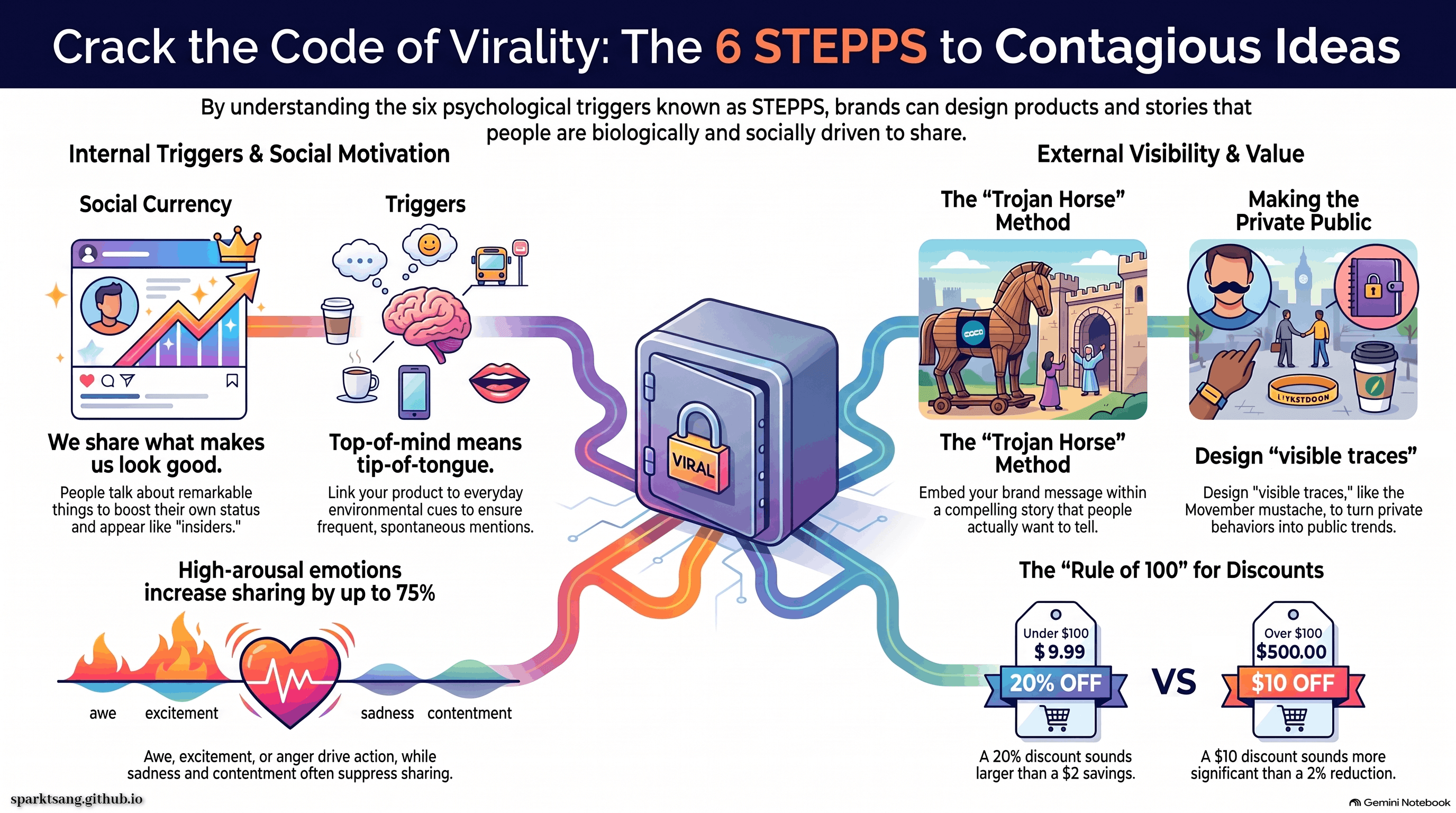
The six principles of contagiousness: social currency, triggers, emotion, public, practical value, stories.
Take Barkley Prime Steakhouse’s $100 cheesesteak sandwich as an example: the person who mentions it feels sophisticated, Philadelphia is full of similar sandwiches, the price is astonishingly high, it provides practical information specifically relevant to steakhouses, and the whole thing is packaged as a story.
Social Currency
The secret bar “Please Don’t Tell” (PDT) became widely talked about precisely because it was a “secret”.
People are naturally inclined to share things about themselves, just as children invariably show their artwork to other people after finishing it.
What we say affects how others perceive us. When we intend to share something but ultimately decide not to, it is usually because we fear it will hurt our image.
Paying people to do something can actually dampen their intrinsic motivation, causing them to lose their natural enthusiasm for doing it.
To turn a product or idea into something people talk about, so that mentioning it subtly boosts their own status, there are three approaches:
Inner remarkability: make it so cool, strange, or unusual that people cannot resist talking about it.
In 2002, Snapple bottle caps were printed with “scientific facts,” such as the claim that glass marbles bounce higher than rubber balls and that kangaroo fur grows backward. Before long, everyone knew about them, and they became part of American culture. Hundreds of websites have compiled Snapple’s scientific trivia year after year.
In an experiment, students who encountered a cockroach described its level of scariness to other students in far more exaggerated terms than they did to researchers: when we reconstruct memories, stories often become more exaggerated and entertaining.
The 1999 film The Blair Witch Project was rumored to have been assembled from real expedition footage, which helped make it a huge success: with a budget of $35,000, it grossed $250 million.
Breaking habitual expectations: the $100 sandwich, the blender pulverizing a golf ball.
A few years ago, the author put black toilet paper in the restroom at a party, making toilet paper the most talked-about subject of the day.
Use game mechanics: intrinsic rewards make people unable to stop, while also enhancing status.
Less than one-tenth of airline miles are redeemed each year, yet people still love collecting them. The author once gave up an extremely lucky cheap direct flight in order to take an expensive connecting flight, simply to accumulate enough miles to upgrade.
A friend of the author was a Platinum member of an airline and loved posting about his flights, effectively providing the airline with free advertising.
People love to boast about themselves: displaying how outstanding they are means little if no one knows about it.
Games need an established system of measurement and must provide data and records.
Foursquare awarded badges based on check-ins, such as the “mayor” badge, allowing users to announce their status to the world.
Burberry created a website showcasing trench-coat art. Winning photographs could be featured on the site, so those selected naturally told everyone about it. The “contest” boosted the brand’s sales by 50%.
Make people feel like insiders: rarity and exclusivity make something seem more valuable.
The idea was inspired by the fact that membership clubs, although relatively insignificant to the overall business, continued to attract more and more members. Ben Fischman created the online retailer Rue La La, offering limited-time auctions of high-end designer pieces and member-only discounts on fashion samples. The combination of limited time, limited quantity, and limited membership sent sales soaring.
Disney removed all of its iconic animated titles from the market and showed them only through the Discovery Vault.
McDonald’s introduced the McRib, made from a very small amount of rib meat and mainly pork offal, initially as a substitute for stores that could not order enough McChicken. After testing the waters, it was added to the national menu, but sales were worse than expected. Ten years later, it returned as a limited-time, limited-location item, and people suddenly went crazy for it. Some even created websites reporting the latest news on where and when a McRib could be found.
To avoid making people feel that the Secret Bar was arrogant and cold, employees were told that whenever they had to say no, they should offer an alternative.
Triggers
Context stimulates discussion. “Boring” Honey Nut Cheerios was discussed by more people on Twitter than “interesting” Disney, and discussion peaked in the morning.
Users of the word-of-mouth marketing company BzzAgent were not paid to test products, yet they were happy to chat enthusiastically with others about the new products they had tried.
Americans engage in more than 16 word-of-mouth actions per day on average, and usually do so with little conscious awareness.
The author’s research found no relationship between how interesting, novel, or surprising something was and how often the product was discussed. Further research showed that interestingness helps only with immediate word of mouth, not sustained word of mouth.
Context determines which thoughts spring to mind, which in turn affects behavior: a news story about the Mars Pathfinder mission unexpectedly boosted sales of Mars bars; when French music was played in the background of a supermarket, customers bought more French wine, while German music led to more German wine purchases; college students disliked the slogan “Five a Day on Every Tray,” yet it was actually more effective; when polling stations were located in schools, more people supported increased education funding; and “Friday,” a song called “the worst song in history,” was listened to most often on Fridays.
KitKat dominated for years with its 1986 “Give Me a Break” advertising campaign, but began to lose momentum. After being linked with coffee in 2007, it regained its strength, with revenue going from negative $300 million to positive $500 million.
An anti-smoking advertisement directly appropriated a Marlboro ad and added the words “I’ve got emphysema.”
The key is to use the right time and place: seeing a shopping list can trigger the thought of bringing reusable bags; this is more effective at preventing forgetfulness than being reminded only upon seeing the supermarket.
Emotion
The author set out to solve the mystery of why scientific articles sometimes receive enormous amounts of sharing. His deeper research ultimately found that highly arousing emotional messages are more likely to spread, including positive emotions such as awe, excitement, and amusement, and negative emotions such as anger and anxiety. Some emotions, such as contentment or sadness, suppress action instead.
People who forwarded scientific articles were aroused by awe; the same was true of viewers who shared the performance of Susan Boyle, the unassuming woman with the unforgettable voice who appeared on Britain’s Got Talent.
Dave Carroll, whose guitar was broken by United Airlines, attracted huge numbers of angry passengers with a musical complaint video, which received three million views. Morton’s 2008 advertisement featuring a baby carrier was another example of anger spreading.
Google’s “Parisian Love” advertisement used search queries to tell a touching love story; BMW’s 2001 short film series “The Hire” used life-and-death scenes to generate tens of millions of views and increase sales by 12%.
People who are already physiologically aroused are more likely to share. In one of the author’s experiments, 75% of students who jogged in place for one minute shared the article—twice the normal rate. This helps explain why tense, thrilling movies are more likely to be shared and why people tell the truth more freely after drinking.
Public
Perfectionist Steve Jobs was bothered by laptop customers seeing an upside-down Apple logo, but after considering how much more visible it would be once the laptop was opened, he abandoned his long-held insistence on keeping it oriented the other way.
Among people whose lives depend on a kidney transplant, 97.1% refuse to donate, partly because they know that the people ahead of them in the queue have also refused.
A sister restaurant of a packed, always-busy restaurant opened across the street. Despite having the same owner, food, and packaging, it remained almost completely empty.
At the University of Arizona, 44% of students binge-drink. Yet, paradoxically, the majority opposed excessive partying and drinking: the behavior was public, but the attitudes were private—a phenomenon known in psychology as pluralistic ignorance. Therapist Koreen Johannessen promoted the idea that most students drink only one or two bottles, reducing campus binge drinking by 30%.
Research found that exposure influences car-buying decisions: one in eight new-car purchases is driven by social influence.
The Movember Foundation, which promotes men’s health, turned growing a mustache in November into a highly visible way to show support, helping the movement become a phenomenon.
“Sent from my iPhone”: Hotmail and BlackBerry used the same idea to increase their influence.
Products that stand out visually or audibly include the iPod’s white color, Pringles’ cylindrical shape, and the Windows startup sound.
Visible traces that remain behind can produce a more lasting effect: the yellow silicone wristbands used in the 2004 Livestrong fundraising campaign sold 85 million. A similar example was the “I Voted” sticker of the 1980s.
The anti-drug advertisements launched by Nancy Reagan actually increased the number of drug users because they increased the visibility of drug use.
Angrily telling the public that “30 billion songs are illegally downloaded” has no clearly established effect, and may well backfire. Rather than telling people that everyone else is stealing, it is better to tell them what they should do.
Practical Value
An 86-year-old man filming himself shelling corn received five million views. Meanwhile, the author’s hiking companions once found themselves engrossed in a discussion about vacuum-cleaner features.
When asked which book he would bring to a deserted island, the editor of National Review answered very directly: a book on boatbuilding.
People do not judge things by absolute conditions; they evaluate them relatively. Simply labeling a product as “on sale” can increase sales by as much as 50% (Eric Anderson & Duncan Simester).
Diminishing sensitivity: in both cases, a person has to drive for 20 minutes to save $10, but because the discount rates differ, the proportion choosing the deal changes dramatically (87% vs. 17%).
Products that are harder to obtain appear to offer better value, including those that are limited by time, quantity, or eligibility.
The Rule of 100: research found that for prices below $100, expressing the discount as a percentage works better, while for prices above $100, stating the discount in dollar terms is more effective.
Two key factors determine whether practical content will be shared: the way the information is packaged (make the key point easy to see) and the audience.
Niche content may actually be more likely to be shared. Football information that everyone likes is less likely to make you think of one particular person.
Stories
The story of the Trojan horse teaches people not to trust others too readily. Embedding lessons in stories has been used for a very long time; building your own Trojan horse lets people mention your product while sharing the story.
Even ordinary, unremarkable stories can carry information. The author’s cousin moved to the East Coast and had this experience: because his lightweight coat was not warm enough, he bought a down jacket from Lands’ End. In winter, however, the zipper broke. Expecting the retailer to refuse to honor the warranty, he called customer service, only to be told that they would send him a replacement free of charge, and it arrived two days later. The information carried by the story included the product’s warmth, the quality of its service, and its attitude toward warranties.
Incredible and astonishing stories often spread rapidly. For example, someone lost 245 pounds by eating the Subway diet. The information embedded in the story included the idea that fast food can be healthy enough to support major weight loss—and that it can still taste good.
Dove’s “Real Beauty” advertising campaign revealed that the stunning women presented in its ads were artificial images manufactured by the media, generating 16 million clicks and earning hundreds of millions of dollars. It worked because it exposed something people had long wanted to discuss but were reluctant to mention because it was too emotional and controversial: unrealistic standards of beauty. Bringing the issue into the open gave people a chance to vent their pent-up frustrations.
A failed Trojan horse: a Canadian man with the URL of an online casino printed across his chest interrupted the Athens Olympics and executed a front-first dive into the water, yet no one discussed the online casino. It was a marketing failure because the publicity stunt had nothing to do with the product being promoted. Evian’s roller-skating babies advertisement received 50 million views, yet sales fell 25% that year because cute babies did not create an association with mineral water.
The greatest value of viral communication comes when the brand or product is integrated into the story itself: in the Panda Cheese advertisement, a panda knocks over a shopping cart to warn people never to say no to Panda, and the absurd scene makes people laugh until their stomachs hurt.
Research found that word-of-mouth storytelling follows a pattern in which key details are reinforced while unimportant ones drop away (Gordon Allport). Therefore, it is essential to identify the key elements of the story that carry the information you want to transmit.
Conclusion
Immigrants’ career choices are also the result of the spread of successful stories: 80% of California nail technicians are Vietnamese Americans. The pioneers were some twenty Vietnamese women, including Thuan Le, who learned nail care from the actress Tippi Hedren, who at the time was involved in helping Vietnamese refugees. Sharing stories of success makes people feel good about themselves and generates excitement while also providing value (stories, social currency, emotion, practical value). The work itself is an everyday topic that is difficult to keep from spreading (triggers, public).
Products, ideas, concepts, and behaviors can all become trends. A trend is not created by a handful of super-connectors; it is driven by the product, idea, or concept itself, because its inherent characteristics make it more likely to be discussed and shared. The six principles of contagiousness are the key to success, and they are available to everyone, not a privilege reserved for celebrities: people share things that make them look good; whatever comes to mind is often what comes out of their mouths; when people care about something, they share it; to grow, something needs to be seen more often; when something is too useful, people find it difficult not to share it; and information is often transmitted under the disguise of casual conversation.
Checklist:
Social currency: Will talking about your product make people look good? Can you find its inner remarkability? Have you used game mechanics? Will it make people feel like insiders?
Triggers: What cues will make people think of your product? How can you create new associations with other things so that people think of it more often?
Emotion: Will talking about your product arouse emotion? How can you stimulate people’s emotions?
Public: Does your product advertise itself? Can other people see it when it is being used? If not, how can you turn something private into something public? Can you create behavioral traces that remain visible long after use?
Practical: Can talking about your product help other people? How can you emphasize that something offers exceptional value while integrating your knowledge and expertise into useful information that people will want to spread widely?
Stories: What is your Trojan horse? Can the product be integrated into more of the stories people want to share? Is the story worth passing on?
Finished reading on Nov 8, 2021
Berger’s STEPPS framework provides the scientific blueprint for engineering ideas that spread like wildfire—essentially, teaching you how to press the “gas pedal” of word-of-mouth marketing.
But what happens when you have a highly contagious idea, yet people still stubbornly resist adopting it? Driving real behavior requires more than just momentum; it requires removing the parking brake.
In his profound follow-up work, The Catalyst, Berger tackles the other half of the equation, revealing the hidden psychological barriers that block change and offering a methodology for dissolving resistance instead of just pushing harder.
Thank you for reading until the end. This is a bonus infographic just for you.