Notes on The Catalyst: How to Change Anyone’s Mind
The Catalyst: How to Change Anyone’s Mind by Jonah Berger
Original notes here.
Read until the end to get a bonus. Enjoy reading.
FBI investigator Greg Vecchi witnessed a short, overweight colleague somehow get a mob boss to raise his hands and surrender without a shot being fired. Inspired, he set out to become a negotiator and went on to rack up an impressive record of success.
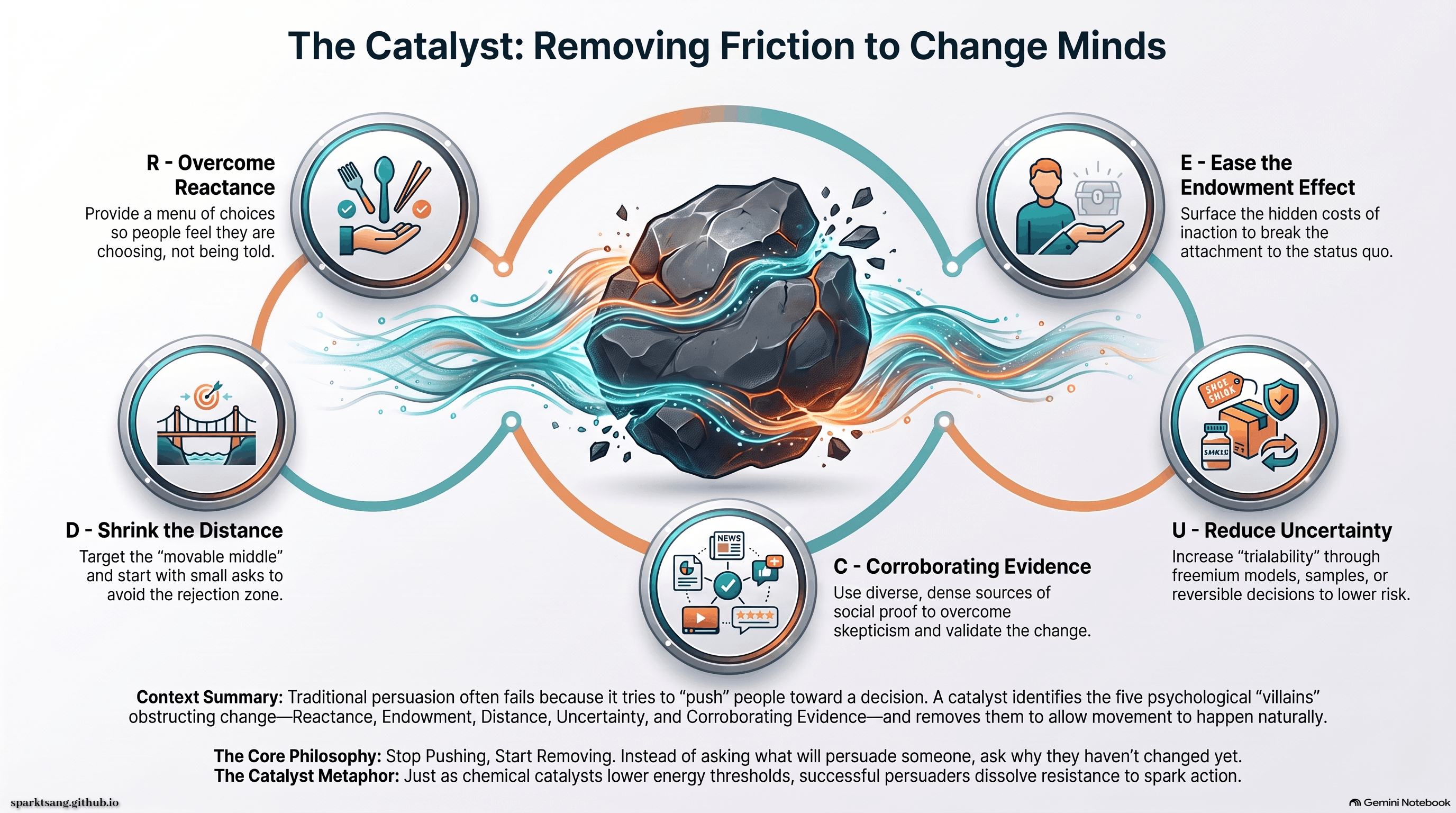
Successful persuaders are like catalysts: they lower the energy and threshold required for a chemical reaction, dissolving resistance.
The author found that most of the literature advocated the traditional approach—persuade, encourage, push, push, push—but with very limited results. He therefore interviewed outstanding leaders, salespeople, and officials in search of new approaches.
Rather than asking, “What can persuade people to change?”, it is better to ask, “Why hasn’t this person changed yet?”
The five major villains that obstruct change: reactance, the endowment effect, distance, uncertainty, and corroborating evidence.
Reactance
In the late 1990s, youth smoking was at its worst in history: three-quarters of high school students had smoked, and one-quarter of seniors smoked every day.
Chuck Wolfie was tasked by the governor of Florida with accomplishing the impossible: halving the youth smoking rate within two years. Over the first four years, the campaign prevented 450,000 young people from smoking and became a global model as well as a nationwide movement. In 2002, tobacco companies sued to force an end to the “Truth” campaign.
In 2018, P&G marketed Tide Pods laundry detergent capsules. People actually began eating them as though they were candy. P&G issued stern warnings, yet the number of people consuming them soared.
Everyone wants the freedom to choose. Research in the 1970s found that nursing-home residents who were given more freedom to make their own choices were happier and had lower mortality rates. (The subjects were residents of Arden House.)
Wolfie’s successful approach was not to lecture teenagers. He convened a youth tobacco summit and put teenagers in charge. His team merely laid out the facts: how the tobacco industry manipulated the public and the political system, and the channels through which it exerted its influence. The teenagers were then asked to tell them what they themselves wanted to do.
The summit gave rise to student anti-smoking groups, which designed take-home schoolwork such as “How much profit is there in each pack of cigarettes?” They also produced advertisements. In one of them, students called teen magazines to ask why they carried cigarette ads and requested anti-smoking public-service announcements, only to be turned down.
Ways to overcome reactance:
Provide a menu: when there is only one option, people look for what is wrong with it; when there are several, they look at which is better.
After the author’s friend answered his wife with two choices rather than a single suggestion, she stopped rejecting the proposal.
Giving a child the choice of eating chicken first or vegetables first works better than simply telling the child to eat vegetables.
Ask, don’t tell: questions encourage people to act on conclusions they reach themselves.
A tutoring teacher told a class of students who wanted to get into top universities but planned to study only 50 hours that they needed 300 hours. The students did not believe him. So instead, he started with their goal, then established the required score, and then worked backward to determine how much time would be needed, asking questions step by step until the students finally changed their minds.
A company faced a problem in which its top salesperson would not train new recruits. The manager asked the salesperson why he was successful. He said it was because senior colleagues at the company had taught him. The manager then asked, “What if the team can’t learn from you—how can you expect them to succeed?” The salesperson eventually became the company’s best trainer.
Highlight a gap: doing the opposite of what one tells others to do triggers cognitive dissonance.
In 2012, the Thai Health Promotion Foundation launched the “Smoking Kids” campaign. With a budget of just US$5,000, it achieved remarkable success: children under ten approached smokers to ask for a light. Most smokers refused. The children then handed them a card that read, “You care about me. Why not care about yourself?” along with a phone number.
During a water shortage in California, researchers first had students sign a pledge supporting water conservation and then asked them about their showering habits, exposing the inconsistency. Those whose inconsistency was highlighted dramatically reduced their water consumption.
Start with understanding: during a hostage rescue operation, Vecchi positioned himself as the hostage-taker’s partner: “You and I will figure this out together,” and “We have to work together because neither of us wants this to get beyond our control.” In the end, the robber came to understand that the best option was to surrender.
In a case involving someone who wanted to kill himself so that his family could collect the insurance payout, Vecchi did not point out that suicide would not be covered. He simply talked with the man about his family and children, discussing the father-son bond. Eventually he said, “God, John, I feel like if you kill yourself today, your son is going to lose his best friend.” Without telling the man what he should do, he achieved the desired outcome.
Transform reactance: Weisser, a Jewish man who had recently moved to the area, and his wife were threatened by Larry Trapp, the local leader of the Ku Klux Klan, who said he would blow up their home. As Trapp’s behavior grew increasingly aggressive, Weisser decided to call him. He never got through, so he kept leaving messages:
Larry, you’d better think about the hatred you’re spreading, because one day you’re going to have to answer to God for all that hatred, and that’s not going to be easy.
Why do you hate me? You don’t even know me. How can you hate me?
Larry, did you know that Hitler’s first law after coming to power was to exterminate people who were disabled like you… Why do you love the Nazis so much?
Larry, you know, there’s a lot of love out there. You haven’t received any love. Do you want some love?
Eventually Trapp answered the phone and angrily accused him of harassing him. Weisser responded instead, “I was thinking maybe you could use some help. I feel like I could help you. I know you’re in a wheelchair. Maybe I could drive you to the grocery store or something.” Somehow, Trapp’s hatred dissolved.
Later, Larry called for help. Eventually he allowed Weisser to visit him, and took off the ring that symbolized a lifetime of hatred. He soon left the Klan and became close friends with the Weissers. He even converted to Judaism at the synagogue he had once wanted to blow up, and later died at their home.
The Endowment Effect
A few years ago, the author himself was unwilling to replace his phone despite all the inconvenience it caused.
Research at Pacific Gas and Electric found that the people most able to tolerate frequent power outages were precisely those already living with them. This is the status quo bias.
For the same coffee mug, people were willing to pay less than three dollars to buy it on average, but demanded more than seven dollars to part with it and sell it. (Morewedge et al., 2015)
Loss aversion: the psychological impact of losing is greater than that of winning. Research shows that a potential benefit has to be 2.6 times as large as the potential loss before people are willing to act. (See: https://www.wealthmanagement.com/investment-strategies/sfr-rent-growth-continues-hit-new-heights)
Two major ways to overcome it:
Surface the costs of inaction: when MBA students study business cases, they spend a great deal of time thinking about the potential risks of changing, but very little evaluating the risks of not changing.
Minor illnesses are often harder to cure than serious ones because people with serious illnesses actively seek treatment, whereas a minor illness is not serious enough to make them take action and is often brushed aside.
The author asked his stubborn cousin, who refused to use an electronic signature, to calculate how much time he was wasting every week, prompting him to change.
Financial adviser Gloria Barrett showed stubbornly uninvested clients how much less they would earn by maintaining the status quo compared with conservative investors, eventually prompting them to act.
Oregon and California are the states with the most ballot initiatives, yet only about one-third of change proposals pass smoothly. In 2015, the Brexit campaign successfully shifted public opinion through some unconventional tactics. The “Brexit bus” carried the message, “We send the EU £350 million a week,” highlighting the cost; “Take Back Control” implied that being outside the EU was the normal state of affairs. (“Make America Great Again” works on a similar principle.)
Burn the ships: the Spanish conquistador Hernán Cortés had his authority over the expedition revoked by a governor who feared losing control of it. To avoid being executed upon his return, Cortés had no choice but to continue the expedition. But some of his men remained loyal to the governor and might mutiny, seize the ships, and flee, so Cortés decided to set the eleven ships on fire.
A milder version can be applied in many situations. Sam Michaels wanted his colleagues to accept an updated Windows operating system, so he issued a notice saying that the company could no longer support repairs for computers running the old version. In the end, even those who had stubbornly refused to upgrade gave in.
Distance
American politics is now deeply polarized. More than half of supporters of both parties hold extremely hostile feelings toward the opposing party—more than three times the level seen in the mid-1990s.
Some say social-media algorithms are responsible for creating echo chambers. But Chris Bail’s research found that exposure to opposing views only strengthens people’s original positions rather than pushing them toward the center.
Countless studies have found similar effects across a wide range of fields, even when people are simply given information and evidence.
In the late 1950s, behavioral scientists at Yale University, Vanderbilt University, and the University of Oklahoma studied arguments for and against Prohibition in one of the few dry states, Oklahoma. They found that, when it came to changing opinions, stronger arguments were actually less effective. They also found that people interpret others’ views according to their own positions, placing them either in an acceptance zone (where they are most likely to agree) or a rejection zone (where they strongly disagree).
If 0 represents strong opposition to Prohibition and 100 represents strong support, someone at 0 has an acceptance zone from 0–20, with 20–100 falling in the rejection zone. Someone at 75, by contrast, has an acceptance zone from 50–100.
Interpretations of a confrontation at a sports stadium depend entirely on which side the fan supports. Whether people believe protesters in the same video were behaving appropriately also depended on what position they had been told the crowd was protesting for or against. (Kahan et al., “They Saw a Protest”: Cognitive Illiberalism and the Speech-Conduct Distinction)
Whether research on the deterrent effect of the death penalty appears convincing also depends on people’s own prior views.
This phenomenon is called confirmation bias. No one is immune. People tend to seek out and absorb information that fits their existing views.
Three ways to reduce distance:
Find the movable middle: political scientists found that direct mail and canvassing were effective in primaries and ballot initiatives, but had zero effect in general elections. In the former, the choices are relatively close; in the latter, the contest is between opposing parties, so the threshold for switching sides is much higher.
So a wise person does not try to change everyone, but targets politically open-minded swing voters.
In the 2008 Oregon election, most residents supported abortion rights, while the incumbent Republican senator opposed them. Researchers targeted pro-choice voters and persuaded about one in ten to switch, allowing the Democratic challenger to win. (Rogers, Todd, David Nickerson, 2013)
Ask for less: research shows that the likelihood of getting people to agree to a large favor rises dramatically when they have first agreed to a small one.
Dr. Diane Priest first asked an overweight truck driver who drank three liters of soda a day to cut that amount by one liter. Eventually, he gave it up entirely.
Move the goalposts: when the distance is too great, shift position and focus directly on common ground so that people can put themselves in the other person’s shoes.
In 2008, liberal-leaning California surprisingly passed Proposition 8, banning same-sex marriage. After the setback, transgender-rights advocate Dave Fleischer’s team completely changed its lobbying style. They conducted extensive interviews with supporters of the measure and went through 74 iterations, ultimately developing a method called “deep canvassing” to change voters’ minds.
One of the canvassers, Virginia, spoke with a staunchly anti-transgender older man who said, “We South Americans don’t like faggots.” Their exchange went like this:
(calm and courteous) “Do you call transgender people that, or all gay people?”
“Being neither man nor woman—what kind of thing is that? God made you what you are.”
“I was born gay.”
“Oh my God.”
Virginia then talked about loving one’s partner, which led the man to speak about his love for his disabled wife. “In the end, love is what really matters.”
“In my mind, the law is actually the same. That includes laws concerning transgender people: the point is how we treat one another.”
Virginia asked what was the worst thing that could happen if he had to use the same public restroom as a transgender person. He admitted that, in reality, probably nothing would happen, and said he would not be afraid. In the end, he acknowledged that he had been mistaken and even said he would vote in favor of banning discrimination against transgender people.
Other examples: gifted students may find it hard to understand what it is like to struggle academically, but everyone has had other moments of awkwardness, such as being bad at sports or failing on a date. A 45-year-old white man may find it difficult to imagine being discriminated against, but everyone has had moments when they were judged negatively for being different.
Deep canvassing is really about talking about love, adversity, caring, and the feeling of being excluded—things everyone can relate to emotionally. Abandon the points of disagreement and start with what people share.
At the end of the chapter, the author shares two stories of voters who switched sides.
Silvia Branscom grew up in a conservative town and was deeply influenced by her far-right stepfather. She always voted Republican. After getting married, she rediscovered her interest in learning. In a class debate about guns, she was defeated, and realized that many of her classmates held views she had never even heard before. Her professor of Western Civilization knew the Bible better than anyone she had ever met, yet he was not religious. She had never heard of the Crusades or religious persecution in the way he taught them. She traveled to Britain with her husband, made Muslim and Indian friends, and encountered a much more diverse range of perspectives. After returning to the United States, she began noticing problems such as imbalances in gun policy, education funding, and sports funding. In 2000, she finally switched and voted for Democrat Al Gore. She came to identify as a Democrat, but did not hate Republicans.
Diego Martinez grew up in liberal-leaning California and was the son of Mexican immigrants. He favored the immigration-friendly Democratic Party. After voting for Hillary Clinton in 2016, however, he began to despise the behavior of her supporters: their sense of superiority and their habit of casually accusing others of discrimination. Feeling that the party was out of touch with reality, he began looking for a broader world. He listened to conservative speaker Jordon Peterson, heard Ben Shapiro explain how universities indoctrinate young people, and found their arguments intelligent and compelling. The writings of Nassim Taleb also resonated with his own views of the Democratic Party. Meanwhile, liberals loved talking about diversity and equality but avoided major questions about the country and society. The next day, he switched to the Republican Party. He did not like Trump, but he also despised how badly the liberals reacted to his victory.
The author concludes that major changes require a series of catalysts and small steps. The key figures may be professors and public intellectuals, but they may just as easily be friends and other people close to us.
Uncertainty
People like certainty. Uncertainty makes the expected value of something in people’s minds much lower than its actual value. A Stanford University study found that uncertainty over whether they would pass an unknown exam made people delay accepting an extremely attractive travel offer, whereas when there were two certain outcomes, most people accepted the offer.
The classic social-science book Diffusion of Innovations explains five key factors that determine how quickly innovations spread. The most important is “trialability”—the extent to which something can be tested or experienced. Four key methods for increasing trialability:
Freemium: the model in which the basic version is free while the premium version costs money. When the cloud was still a new concept, Dropbox broke through by giving away its service for free and went on to generate billions of dollars in revenue.
Others using the same model include: Candy Crush, The New York Times, Pandora, Skype, LinkedIn, Evite, Spotify, WordPress, Evernote.
Reduce upfront costs: before online shopping became mainstream, Zappos—then called shoesite.com—broke through by eliminating shipping fees, reducing the uncertainty over what would happen if the product did not fit. It grew by more than twenty times in three years.
Most people buy the same familiar things when shopping at a supermarket, yet they are willing to try new ice-cream flavors because ice cream is available for sampling. Small-size product packaging works on the same principle.
Drive discovery: Acura owners loved the brand, but its brand awareness remained stubbornly low. Test drives mainly attracted people who already liked the brand. Buick spent heavily on advertising and still failed, demonstrating that traditional methods were ineffective. So Acura took a different route and partnered with upscale W Hotels to provide exclusive hotel shuttle service. Tens of thousands of people ended up buying the cars as a result.
When the author helped a large apartment developer increase brand awareness, he came up with a simple solution: give away party supplies and catering, allowing more prospective buyers to see what the homes were like inside.
Make it reversible: the author had all kinds of doubts about getting a dog, but a two-week trial period at an animal shelter ultimately led him to adopt one.
Research found that generous return policies can increase profits. (Peterson, J. Andrew & V. Kumar, 2010, “Can Product Returns Make You Money”) Zappos, mentioned above, also combined free returns with free shipping.
Case study: Jacek Nowak, a bank manager overseeing several branches, faced worsening key performance indicators and proposed reforms centered on customer experience. His fellow managers, however, rejected the plan out of adherence to the status quo. Jacek’s team took a different approach and let colleagues personally experience a distinctive, heartfelt customer experience. A few weeks later, when they asked their colleagues how they felt about it, the proposal was brought back to life.
Corroborating Evidence
Recommendations often fail because the new information may simply be something about the recommender himself (for example, he loves a particular show simply because there is already a lot he likes about it); moreover, the recommender is not a second version of oneself.
Repeated recommendations from friends and family are most effective when the recommenders come from different groups (diverse sources of corroboration) and when the recommendations come in a shorter, more concentrated period of time.
A pioneer of intervention therapy, Dr. Vernon E. Johnson, argued that rationalization and projection interact to make drug users unable to recognize that they have a problem, leaving them disconnected from reality and unable to identify the issue. The intervention therapist is the drug user’s last line of defense. Under the therapist’s guidance, family and friends appear together and read messages of love aloud, gathering in one place to create both density and diversity of corroborating evidence and change the user’s belief that there is no problem. In one of the author’s examples, the protagonist had already tried 19 different drug-treatment programs subsidized by state governments.
Corroborators are more effective when they are similar to you; familiarity also helps (the more political donors one knows, the more likely one is to donate oneself), and diverse sources are more effective. Similarity and diversity can work together: the aspects in which your friends are similar to you do not necessarily have to be the same.
Corroborating evidence is most effective when it appears densely within a short period of time. That is why a concentrated burst of news coverage is more likely to spark a social movement, and why concentrated petitioning is more likely to succeed.
Political opinions are difficult to change, while preferences about typefaces are relatively trivial and therefore have a lower threshold for change. The two are completely different. When marketing resources are limited and the goal is to change a large population quickly, the former calls for casting a wide net, while the latter calls for concentrating resources and using the multiple-source corroboration effect to win over a portion of people first.
The Great American Offal Campaign
A single campaign overcame all five barriers to change at once—the most formidable marketing campaign in American history: persuading Americans to give up steak and eat organ meats instead.
In 1943, during World War II, the United States was on the verge of a meat shortage. To feed the troops on the front line, the propaganda machine swung into action, praising organ meats as highly nutritious and invoking patriotism. Yet although the public cared about the troops and understood that organ meats were nutritious, their behavior did not change.
Kurt Lewin, the father of social psychology, headed the Department of Defense’s Committee on Food Habits. After studying why people refused to eat organ meats, he concluded:
Compulsory propaganda made people feel they had no choice; inertia; the change was too large; uncertainty caused by not knowing how to cook them; and the behavior did not fit people’s identities.
Lewin’s team therefore: made organ meats easier to obtain and provided recipes; asked people to start small, first mixing them into sausage fillings and ground meat; reminded people that inaction would harm the war effort; and replaced lectures with discussions among groups of housewives, strengthening mutual corroboration and allowing people to change voluntarily.
The results were astonishing: nationwide consumption of organ meats rose by one-third.
Conclusion
In 1993, after decades of bitter hostility, Israeli-Palestinian relations took a turn for the better and the two sides reached an agreement. Their leaders would later receive the Nobel Peace Prize.
That day, Clinton gave special praise to a group of summer-camp students who wore nothing but T-shirts and jeans: the Seeds of Peace camp brought together promising teenagers from Egypt, Israel, and Palestine, selected by their governments, to spend several weeks together. They slept in bunk beds, ate meals together, and took part in team activities. Those who had arrived carrying deep hatred toward one another became friends, and even after leaving, a high proportion remained involved in peacebuilding and social reform.
In a high-ropes course, campers had to rely on their “enemy” to guide them as they balanced thirty feet in the air.
The key characteristics of this powerful catalyst were: people made the decision themselves, without coercion; it started small (sleeping, eating, and doing activities together); a safe, neutral environment reduced uncertainty; and multiple, human-scale encounters with “the enemy” provided corroboration.
Appendix
Key points of active listening: small gestures such as leaning forward, nodding, and positive verbal encouragers may seem irrelevant, yet they can move a conversation forward; open-ended questions keep the discussion going and build trust; well-timed pauses can emphasize key points, capture attention, and create anticipation; repeating the other person’s words shows that you are paying attention; putting the other person’s emotions into words helps uncover the underlying issue.
Freemium pricing boundaries: if the price is too low, no one uses it; if it is too high, no one needs to pay. The right level therefore depends on two key variables: the number of new users and the conversion rate.
What you restrict also matters. This depends on uncertainty—specifically, how to let users know with confidence that upgrading is worthwhile. If users cannot immediately see the value of a particular feature, restrict features; if the best experience requires the full set of features, it is better to restrict time or usage instead.
Force field analysis: a method used by experts to analyze the various forces operating in a specific situation and use them to drive change. The steps are: define the goal; identify the driving forces that can promote change or maintain the desired state; identify the restraining forces in the opposite direction (the reasons why change has not yet happened, focusing on the past and present rather than the future); the two types of forces may come from either internal or external sources; and the importance of each factor can also be assessed comparatively.
For example, if the goal is to get a son to eat vegetables, the external driving force is the parent’s nagging, while internal driving forces might include wanting to make the soccer team or wanting a healthier body. Internal restraining forces include thinking vegetables taste bad; an external restraining force is that junk food is convenient to grab and eat; another is the desire to assert independence. Once the whole picture is clear, there is no need to keep nagging. Other methods become visible: prepare grab-and-go vegetable lunch boxes, cook tasty broccoli-and-cheese pasta, and so on.
Finished reading on Oct 28, 2021
Berger demonstrates that changing deeply entrenched beliefs isn’t about pushing harder, but about acting as a catalyst to remove psychological barriers and friction.
Yet, while these techniques work on individuals, how do we change the mind of an entire civilization that is structurally wired to reject the truth?
My philosophy proposes the final societal catalyst: a decentralized framework designed to bypass systemic gatekeepers and reduce the friction of validating truth to a minimum.
Thank you for reading until the end. This is a bonus infographic just for you.