Notes on Goleman's Emotional Intelligence
Emotional Intelligence: Why It Can Matter More Than IQ by Daniel Goleman
Original notes here.
Read until the end to get a bonus. Enjoy reading.
Myth-busting:
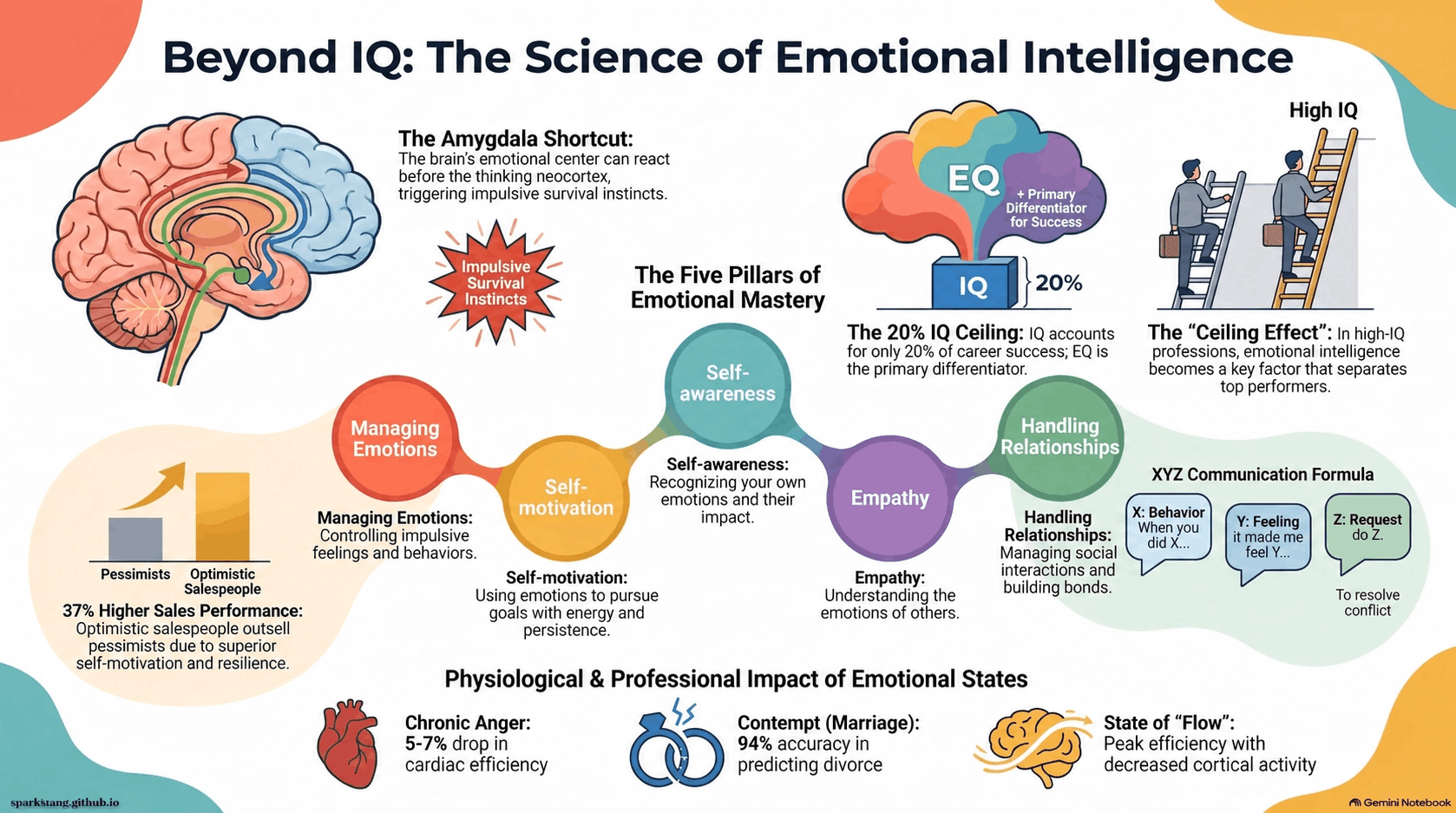
An estimated 20% of career success is related to IQ, but this does not mean the remaining 80% can all be attributed to emotional intelligence
The claim that emotional intelligence is more important than IQ applies only to relatively “soft” fields in which IQ has a relatively limited impact on achievement
Hundreds, even thousands, of studies show that intelligence can predict the level of work a person is capable of performing
When the scope is limited to professions that require a high level of intelligence, a ceiling effect occurs, making it difficult to use intelligence to predict competitiveness; at that point, emotional intelligence becomes a more suitable differentiating trait
The higher the position, the less important intelligence and skills become
With the rise of the virtual world, the emotional condition of American children in the 1990s was actually better than that of children in the previous decade, which is surprising; this may have been related to the economic prosperity of the 1990s
American society is full of emotional pathology. News stories about people killing others because they felt slighted, or killing their children in the name of discipline, are everywhere; many people still instinctively deploy survival skills from the wilderness of a million years ago when confronted with the dilemmas of postmodern life
The English word “emotion” derives from the Latin verb motere, meaning “to move,” with the prefix e- meaning “away,” referring to taking action to seek what is beneficial and avoid what is harmful
In the course of evolution, the primitive brainstem developed first, followed by the emotional centers, and then the thinking center: the neocortex
Animals whose amygdala has been removed have no emotions, no drive to compete or cooperate, and no sense of where they stand within the group
The amygdala can react before the neocortex, and because this shortcut has tremendous survival value, all mammals have retained it
It can also store memories without the conscious involvement of the neocortex; as long as there is even a slight similarity, the amygdala can issue a warning, which can sometimes be inappropriate
Many profound emotional memories are formed during the first few years of life, making the emotional centers less precise in their functioning
The prefrontal cortex helps regulate emotion, acting as a gatekeeper for the amygdala; the left prefrontal cortex regulates unpleasant emotions, while the right prefrontal cortex is a major center for negative emotions such as fear and aggression
The wife of a patient who had part of his right prefrontal cortex removed told the doctor that her husband’s personality had changed dramatically: he was no longer irritable and had become gentle and considerate
The prefrontal cortex also governs working memory, so when emotions are poor, thinking becomes difficult and learning ability declines
Damage to the pathway connecting the prefrontal cortex and the amygdala (so that the emotional memories stored in the amygdala cannot be accessed) can also severely impair decision-making, because the person cannot draw on past emotional learning experiences, even though intelligence and cognitive ability remain completely unaffected
Based on this, Antonio Damasio concluded that rational decision-making cannot do without the emotional component
Later, a patient is mentioned whose pathway was damaged after surgery; although he could weigh the pros and cons, all choices became emotionally neutral and he could no longer assign them value; another patient had a disorder of emotional expression and, although he had emotions (and usually was not even aware that they were emotions, taking them merely as physical discomfort), did not know why he felt that way and could not express it
Gardner, Howard, the father of the theory of multiple intelligences, found that traditional intelligence and multiple intelligences are unrelated
When Salovey defined EQ, he identified five broad categories: recognizing, managing one’s own emotions, self-motivation, recognizing, and managing other people’s emotions
A person who is afraid of snakes may catch a glimpse of a snake without knowing what he saw, and still break into a sweat; emotion can operate unconsciously
Dwelling on anger can make it stronger, because it is easy to invent rational justifications for it; deliberately looking at the situation with a more optimistic or forgiving mindset is the best weapon for calming anger
An explosive outburst of anger is often caused by the first wave of anger failing to subside before a second wave arrives
Leaving the environment that triggered the anger, being alone, and vigorous exercise can also help cool things down; surprisingly, psychologists have repeatedly found that venting anger actually prolongs it
There are two kinds of worry: cognitive and physical (physiological symptoms); insomnia is mainly caused by racing thoughts
Some people who worry believe that worrying prevents the thing they fear from happening
Through repeated experiments, Thomas Borkovec found a simple and useful sequence: become aware of it as early as possible, identify the situation, thoughts, or images that trigger the worry, relax, and actively challenge the anxious thoughts: “How likely is it that this frightening event will actually happen? Is there anything constructive that can be done?”
Looking at things from multiple angles can shake the grip of worry
Cognitive psychotherapy, which aims to change patterns of thinking, is as effective as medication for mild depression and better at preventing recurrence; the most effective treatment is to learn to question the content of one’s anxious thoughts and deliberately schedule pleasant activities; having a good cry is not necessarily the right approach
Electroconvulsive therapy can treat extremely severe depression, based on the principle of temporary memory loss: patients do not remember why they are sad
Enjoying oneself and creating a sense of accomplishment to improve self-image (even doing long-delayed housework or dressing a little more smartly can help) are common remedies, and helping others is also very effective
One in six people are of the repressive type (called the “calm type” by the author), whose brains automatically counteract negative meanings with positive associations
Asian children have an average intelligence only two or three points higher than that of white children, yet perform much better in terms of occupational achievement; research has found that Asian Americans spend 40% more time doing homework than others: self-motivation is a major factor influencing achievement in life
Walter Mischel, the psychologist who invented the marshmallow test, also coined an extraordinarily long term: “goal-directed self-imposed delay of gratification”; his research shows that emotional intelligence is a basic survival skill
Comparing students whose grades declined because of anxiety with those whose grades actually improved, researchers found that the latter motivated themselves to prepare more diligently, while the former spent less attention thinking through the exam questions
Laughter helps improve intellectual performance; people who watched a comedy clip were the most likely to display creativity
Metropolitan Life’s optimistic salespeople performed 37% better, while pessimists had twice the first-year resignation rate of optimists
Difficult activities usually increase cortical activity, but under the state of flow, cortical activity actually decreases, showing that the nervous system is functioning at peak efficiency; high achievers spend a greater proportion of their time in flow
The key topics of this chapter: impulse control, emotional regulation, entering the state of flow
Infants who have not yet developed a clear distinction between self and others can already empathize with another person’s suffering and cry along with them; a one-year-old child may lead his mother to comfort another crying child, and a 15-month-old child will bring a toy to comfort a crying friend
The emotional attunement and interaction between mother and child in infancy and early childhood (empathizing with the child’s feelings and responding to them) have a profound and lasting effect on expectations about intimate relationships; prolonged emotional misattunement can cause serious emotional harm to the child, who will gradually stop expressing or even feeling those emotions
William Pithers developed empathy therapy, which cut recidivism among offenders in half
Cold-blooded domestic abusers show a decrease rather than an increase in heart rate, becoming calmer as they become more violent, suggesting that their terrifying behavior is planned
Psychopaths are completely unconcerned with the pain they themselves face, which may explain why they are unable to empathize with their victims
Two-and-a-half-year-old children already understand multiple strategies for comforting others, including pleading, asking another person for help, using body language, helping clean up toys, distracting the person, and threatening
When authority figures are present, Japanese students watching circumcision films try their best to suppress their facial expressions
Snyder found that personality chameleons can make excellent impressions on others, but very few have stable and satisfying intimate relationships
The author recounts an incident experienced by Terry Dobson, who went to Japan to study Aikido, in which an old man subdued a drunken troublemaker on the Tokyo subway through empathy, demonstrating that showing empathy toward someone in a state of rage is the most effective approach
The divorce rate for newlyweds has continued to rise: among people who married in 1920, the divorce rate was 18%; in 1950, 30%; in 1970, half; and in 1990, as high as 67%
There is ample scientific evidence for sex differences; boys more often compete in large groups, while girls more often play in small groups; when someone gets hurt, the injured boy is expected to get out of the way and stop crying so the game can go on, whereas when the same thing happens among girls, everyone stops playing to comfort the crying girl
Women believe that the most important factor in a happy marriage is good communication; men do not think so
What determines whether a marriage survives is not the issues themselves, but the way those issues are discussed
John Gottman predicted with 94% accuracy whether couples would divorce within the next three years, thanks to his meticulous analysis
When one spouse displays contempt, the other’s heart rate rises by two or three beats per minute; if a husband frequently expresses contempt, his wife’s health is more likely to deteriorate
Eighty-five percent of stonewalling is initiated by husbands, because they are subjected to criticism and contempt from their wives
Two typical ways of thinking in troubled marriages: a persecution complex and resentment; once these become “spontaneous thoughts,” that is, basic assumptions about oneself and others, the evidence of guilt seems to become increasingly conclusive: the spouse who feels persecuted will continually look for evidence in the other person’s behavior
Frequent emotional flooding can lead to a vicious cycle, or become a critical turning point that puts the marriage in grave danger
Levenson’s research at the University of California, Berkeley, found that women are better able to tolerate marital distress, which explains why men are more likely to initiate stonewalling; once stonewalling begins, the husband’s heart rate drops by ten beats per minute, producing a sense of relaxation, while the wife’s heart rate rapidly increases, indicating intense distress; the result is usually a resentful and aggrieved wife showing more contempt, with emotional flooding on both sides poised to erupt at any moment, creating a vicious cycle
Experts recommend that husbands patiently help their wives work through intense anger, which makes wives feel cared for and respected and helps them calm down quickly; when wives criticize, they should focus on the issue rather than the person and avoid showing contempt, and when complaining, it can help to let the other person know that the complaint comes from love
The basic strategy for maintaining a marriage is not to focus on individual issues, but to work on developing the couple’s shared emotional intelligence
During an argument, couples can learn to check their heart rate every five minutes; people who practice aerobic dance all know how to feel for the carotid artery below the earlobe, count for 15 seconds and multiply by four; if the result is more than ten beats above the normal rate, it means emotional flooding is about to occur, and the couple should separate for 20 minutes to calm down
The highest level of empathy is being able to hear the meaning truly intended behind the words; behind impulsive behavior there is often a desire for love and respect
Haim Ginott: The best way to complain is using the “XYZ formula”: When you did X, it made me feel Y, and I’d rather you did Z
The cost-effectiveness of emotional intelligence is still a new idea, and managers accustomed to believing that work requires rationality rather than emotion may find it difficult to accept
As with marriage, the main cause of workplace conflict is improper criticism; criticism should be specific, delivered face to face, and accompanied by a proposed solution, while also showing consideration for the other person
Robert Kelley and Janet Caplan, in Harvard Business Review: top performers already have rich networks of resources in place, so when they need advice, they can get an answer immediately; average performers often have to wait in vain without receiving a response and waste time, while there is little difference between the two in other respects
Scientific evidence shows that taking psychological factors into account during treatment can help prevent and treat illness
Negative emotions are harmful to health, potentially doubling the incidence of illness; anger is the only negative emotion that harms the heart, and when patients recount things that make them angry, cardiac efficiency drops by 5%, and in some cases by as much as 7%
A Stanford University School of Medicine program that helped heart patients change their personality reduced the risk of another episode by 44% after completion
Stress and anxiety weaken the immune system
Among first-time heart attack patients at a Montreal hospital, those with major depression had a fivefold higher chance of dying within six months; among hip-fracture patients with depression, the chance of regaining the ability to walk was only one-third
Among first-time heart attack patients, only six of the 25 most optimistic people died, compared with 21 of the 25 most pessimistic; the correlation between outlook and survival rate was more accurate than any other factor
James Pennbaker’s experiment showed that asking patients to write down the things troubling them every day had a remarkable effect in boosting immunity; the most effective pattern was to first express profound emotions, then after a few days compose them into a coherent statement, finding meaning in the suffering; the process closely resembled psychotherapy
People who are socially isolated have higher mortality rates, with a greater impact on men
David Spiegel found that terminal breast cancer patients who participated in support groups lived twice as long as those who did not, shocking the medical community
Poor models of parenting: Dismissing (treating a child’s negative emotions as trivial), Laissez-Faire (noticing the child’s feelings but only wanting to calm them down, even through bribery), and Disapproving (disrespecting the child’s feelings)
Parents who are skilled at handling emotions have better relationships with their children; their children are better at handling emotions, soothing themselves, and are more often relaxed (with lower stress hormones and other physiological indicators), have better relationships with peers, stronger social skills, fewer behavioral problems, and better learning ability
Erik Erikson: through emotional learning from their parents, children develop a basic trust or mistrust of the world
Abused children often grow up to become abusive parents; such parents discipline their children according to their own likes and dislikes rather than the children’s behavior, and researchers observing daycare centers have found that abused children as young as two and a half already display the beginnings of cruel, abusive behavior
Being completely helpless in a dangerous situation (for example, compared with knowing how to defend oneself), as well as experiencing only mild stress in early childhood (as confirmed by animal experiments), makes people more prone to PTSD
Things that are not frightening can become frightening because they become psychologically associated with something frightening; this is called fear conditioning. Natural learning can extinguish fear conditioning, but this ability is impaired in trauma patients, causing emotional memories to persist abnormally for a long time; Davidson found that people with more active left prefrontal cortexes recovered more quickly
One-quarter of Holocaust survivors recovered, and their brains showed none of the characteristic changes associated with trauma, suggesting that the changes in the brain may be reversible
Young children who experience severe violence may invent games that resemble it; children who were kidnapped were still playing kidnapping games five years later: terrifying memories that cannot be spoken of openly can be expressed through art
One of the treatment steps is to revisit the memory under safe conditions, bringing the feelings within the range of cortical control and making the reactions understandable
The function of psychotherapy is to teach the neocortex to inhibit the amygdala; the primitive emotions remain, but the impulse to act on them is suppressed; after treatment, patients’ negative emotional reactions are halved, while the chances of interactions with others matching expectations double
Jerome Kagan: Differences between shyness and extroversion stem from how easily the neural pathways of the amygdala are activated; however, shy children do not necessarily remain shy as they grow up
He found that whether children overcome shyness depends greatly on their relationship with their parents: overprotective parents intensify fear, while the prefrontal pathways lose opportunities to learn alternative responses to replace reflexive fear; strict parents (for example, immediately ordering a child to stop when they make a dangerous movement) can actually help children overcome shyness, because the child gets opportunities to learn how to face and overcome fear
Davidson: People with greater left prefrontal activity are dispositionally more optimistic, while those with less are more prone to depression; this suggests that overcoming depression may involve learning to increase activity on the left side
Patients with obsessive-compulsive disorder respond equally well to standard drug treatment and behavioral therapy, showing that experience can alter brain function at least as much as medication
Various psychological disorders, juvenile crime rates, teenage pregnancy rates, and divorce rates continue to rise
Aggressive children have cognitive distortions, as experiments have demonstrated; they often assume categorically that others are hostile or provoking them, are more emotionally vulnerable, still lack self-control by the second grade compared with ordinary children, and are disliked by other children
Disobedient “bad girls” have a pregnancy rate three times that of other girls at the same school
The training program designed by John Lochman helps improve children’s aggressive personalities, and the longer they receive training, the gentler their personalities become in adolescence
If the 20th century was the age of anxiety, the 21st century should be the age of depression; among children who receive treatment for depression, three-quarters later suffer more severe recurrences
Depressed children already hold pessimistic attitudes before they develop depression, and this finding helps with prevention
Prospective studies found that the first cause of eating disorders is society’s widespread standard that women should be extremely thin to be considered beautiful
The most accurate signal for predicting whether a girl will develop an eating disorder within the next two years is whether she is insensitive to her own feelings and bodily signals, such as interpreting every sensation as hunger
Children who are unpopular are more likely to be anxious, worried, depressed, and lonely; whether a person will have psychological problems by age 18 can be predicted accurately from how popular they were in third grade, more accurately than from teachers’ grades, intelligence, or psychological tests
Training programs that strengthen children’s ability to read and respond to other people’s feelings significantly improve even those who originally had the poorest relationships with peers
People with severe emotional distress are the most likely to become addicted to drugs; the children of alcoholics who showed symptoms of anxiety at age 12 had poorer frontal-lobe function, making it difficult to alleviate anxiety and control impulses; as a result of this functional deficiency, they do not think about the consequences of alcoholism when drinking and are more likely to become addicted
Another form of addiction is irritability; some patients eventually feel normal and calm after taking opiates, and learning to control emotions can fundamentally remove the motivation to use drugs or drink alcohol
Standard preventive sexual-abuse programs generally teach children to distinguish inappropriate touching and tell an adult immediately, but a survey of 2,000 children across the United States showed that this alone had the opposite effect: among children who had taken such classes and experienced sexual harassment, the reporting rate was only half that of those who had not; by contrast, effective programs incorporating emotional and social-skills training produced reporting rates three times as high
The ideas of emotional education have gradually spread; ordinary but important lessons need to be repeatedly instilled over a long period, and although emotional-literacy classes may seem mundane, what they teach can foster a healthy personality
Some emotional education can even be incorporated into existing curricula; for example, a first-grade language class might use a story about Frog and Toad and then discuss caring about a friend’s needs, what it feels like to be teased, and so on
Successful emotional education must correspond to children’s developmental stages; adults often have mistaken expectations about children’s maturity and ignore their biological timetable, such as expecting a four-year-old to be modest when children do not develop an awareness of humility until age five
Entering middle and high school is an extremely difficult period emotionally; children who receive emotional education are significantly better able to cope with academic pressure and competition, as well as the temptation to smoke or use drugs
A teacher’s teaching style is itself a living textbook of emotional skills and will have a profound influence on students
The abilities enhanced by emotional education include: recognizing and understanding emotions, understanding the causes and consequences of feelings, recognizing the gap between feelings and behavior, greater tolerance of frustration and better ways of releasing and appropriately expressing anger, fewer arguments and fights, fewer disruptions of classroom order, fewer suspensions and dropouts, less aggressive behavior, less self-destructive behavior, more positive perceptions of oneself, school, and family, less loneliness and anxiety, greater responsibility and concentration and better impulse control, improved academic performance, greater ability to put oneself in another person’s shoes, better ability to resolve interpersonal conflicts, clearer and more skillful communication, better peer relationships and greater sociability, greater ability to care about and be considerate toward others while fitting in, a better understanding of sharing, cooperation, and mutual assistance, and greater ability to resolve conflicts
Personality development is the cornerstone of a democratic society; emotional intelligence can strengthen and reinforce that foundation, and only by putting oneself in another person’s shoes can one break through prejudice and learn tolerance; this is especially necessary in a pluralistic society
Emotion is universal: people in every culture around the world can recognize four facial expressions—fear, anger, sadness, and happiness
We cannot choose which emotion we fall into, but we can choose the direction of our thoughts, and different directions of thought produce different emotions; actors, for example, can summon sad memories and bring tears to their eyes
The logic by which emotion operates is associative, which is why metaphors, symbols, imagery, and various forms of art can directly strike at our emotions
Two modes of thinking:
Self-confirming (Emotional Mind): facts or memories that conflict with one’s beliefs are suppressed or ignored as much as possible
Rational beliefs are provisional: any new evidence that conflicts with the facts can overturn the old belief
Finished reading on Sep 11, 2020
Thank you for reading until the end. This is a bonus infographic just for you.