Notes on Flow
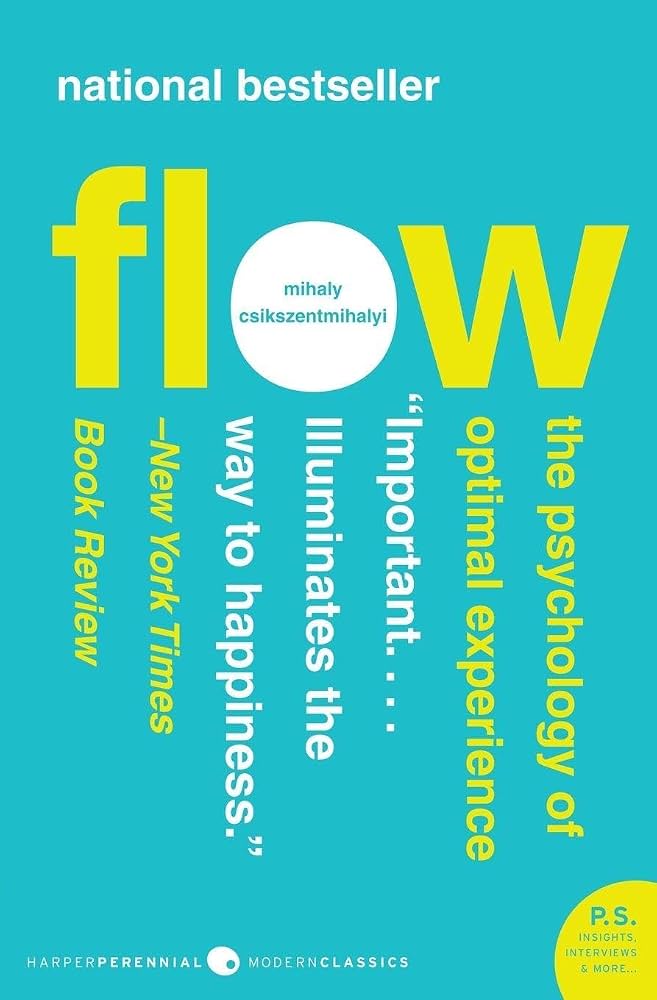
Flow: The Psychology of Optimal Experience by Mihaly Csikszentmihalyi
Original notes here.
Read until the end to get a bonus. Enjoy reading.
Chapter One
Research confirms that optimal experience occurs when we deliberately push our physical and mental abilities to their limits in order to accomplish something difficult or worthwhile
The leap in material living standards has not made us happier; happiness depends on the order of consciousness
Governments, churches, banks, and drug dealers all want us to remain dependent on the social system; the most important step toward escaping social constraints is to possess the ability to find rewards at any time
Both Eastern and Western societies have developed many techniques for controlling consciousness, but they cannot be accumulated and replicated; we are even more helpless than those who came before us
Once the control of consciousness becomes institutionalized, it loses its original effect. Had Freud still been alive, his pursuit of self-liberation would have been transformed into a rigid and conservative profession; Marx’s idea of liberation from economic exploitation ultimately became a system of repression; Dostoevsky’s Grand Inquisitor noted that if Jesus were to return to preach freedom, the Church would surely crucify him again
Chapter Two
“A phenomenological model of consciousness based on information theory” is the only choice for clearly examining the important events taking place in the brain and actually applying them to everyday life
There is a limit to the amount of information consciousness can process in a lifetime, at most 185 billion bits
Attention shapes the self (the beauty of the ocean makes one want to become an oceanographer), while the self in turn shapes attention (wanting to become an oceanographer makes one concentrate on certain things), forming a cycle
When something happens that contradicts one’s goals, consciousness may become disordered, giving rise to fear, pain, anger, and jealousy
Conversely, when information consistent with one’s goals continually flows into consciousness, psychic energy also flows without interruption
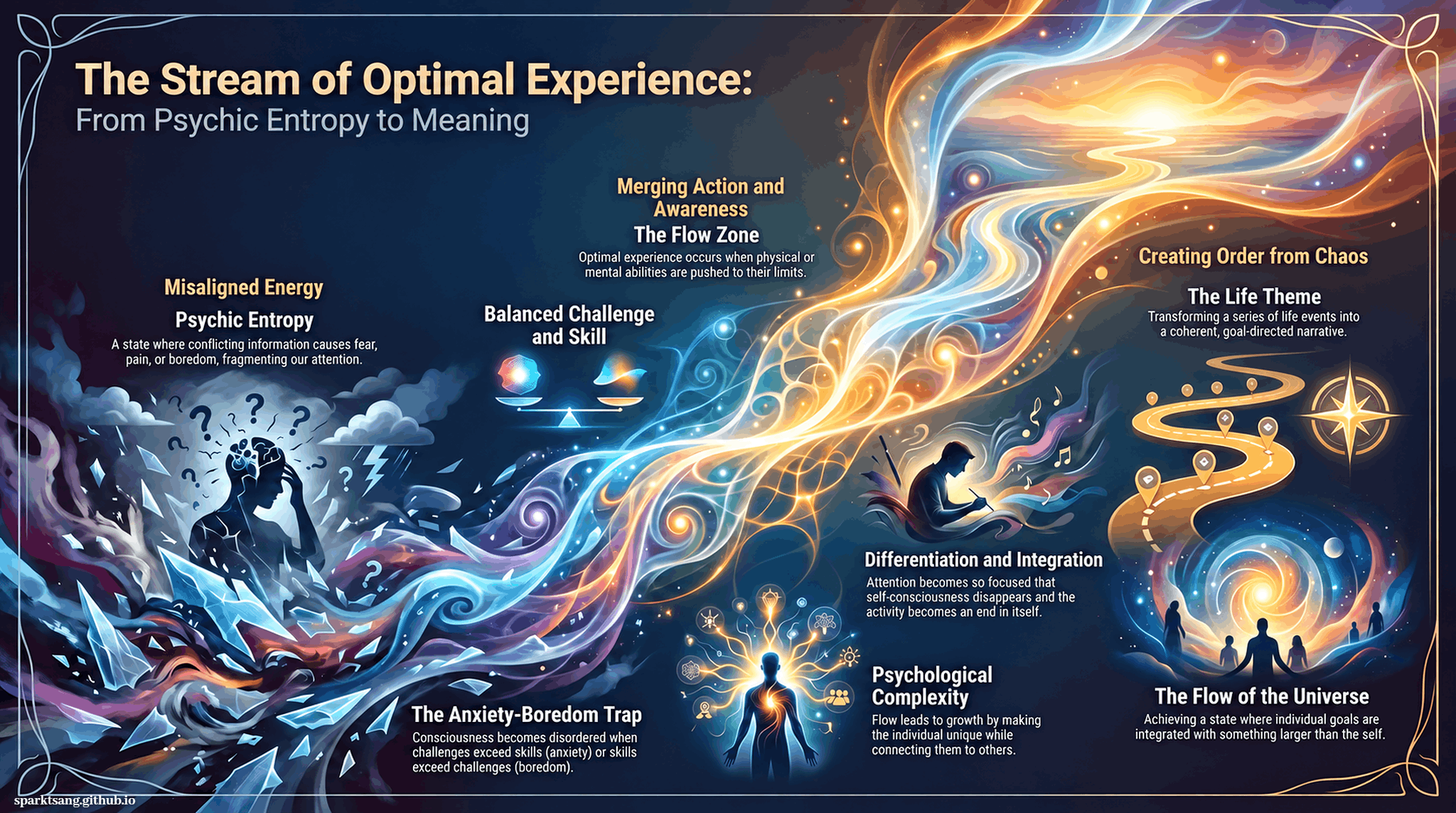
When attention is fully focused on pursuing a goal, with no disorder or threat, that is the experience of flow
After experiencing flow, the self becomes more complex; this process is called growth. Complexity is produced by two major psychological processes: differentiation and integration
The former allows the individual to develop uniqueness, distinguishing oneself from others; integration means transcending the self and connecting with others. Together, the two form a complex self
Chapter Three
Improving quality of life can only be achieved by changing the external environment or the inner experience, and the former has its limits
For the sake of obtaining enjoyment, an antique shop refused to sell goods to customers who would not bargain
Pleasure can only maintain the balance of order in consciousness; it cannot create a new order
Enjoyment experiences are remarkably similar regardless of the type of activity or cultural background
The eight components of enjoyment: a difficult activity with a chance of success, complete concentration, clear goals, immediate feedback, a loss of awareness of everyday worries and frustrations, a sense of control over one’s actions, loss of self-consciousness, and a transformation of one’s sense of time
People experiencing flow seem to have their memories cut off; the only thing that matters is the activity at hand
Enjoyment comes from the feeling of having control in difficult circumstances, and gambling is no exception; gamblers believe that skill is the key to winning or losing
Addiction is dependence on that sense of control, making it impossible to focus on other activities; in the end, one loses ultimate control and becomes a captive of a particular order of consciousness
In flow, the self is absent from consciousness: only by letting go of self-consciousness can one transcend the self
If there is still enough energy left to feel the self, the depth of the experience is insufficient
Self-growth occurs only in activities that can generate enjoyment
Religion can also make people forget themselves, accept being shaped, and feel a sense of becoming one with it, but this merely allows a belief system to absorb their psychic energy; nothing new is born through such submission: the order of consciousness is imposed from outside rather than arising through self-realization
Unless the activity itself requires accurate estimation of time, subjective experience of time often breaks away from reality: abandoning the concept of time can take enjoyment to another level
One key element is that the activity itself is the goal of the activity—it is autotelic, an end in itself
Not all flow is necessarily beneficial, just as fire can cause a fire; but if we prohibited its use, humans would be no different from other primates
Chapter Four
There are four types of enjoyable activities (based on Roger Caillois’ classification):
Agôn (competitive): improving skills in the face of an opponent’s challenge, demonstrating one’s potential
Alea (chance-based): giving the illusion that one can control an unpredictable future, such as rolling dice
Ilinx (vertigo-inducing): recombining the contents of consciousness, making people feel that consciousness itself has expanded, such as on a carousel or through drug use
Mimicry (imitative): pretending and role-playing, making oneself feel like something more than one is in reality
When skill falls below the level of challenge, it produces anxiety; otherwise, it produces boredom. Flow lies in between
Morality may cease to work outside one’s own culture, but if the pursuit of optimal experience is the ultimate goal of humanity, we can use “psychic entropy” to show that one society is better than another because people experience things that are more consistent with their goals, allowing more people to grow and develop complex skills
The Native Americans of the Shushwap region undertook a great migration every 25 to 35 years to make life challenging again, seeking new water sources and new game; similarly, Japan’s Ise Grand Shrine, with a history of 1,500 years in Kyoto, is dismantled and rebuilt on an adjacent site about every twenty years
When a culture develops convincing goals and norms that enable its members to frequently experience intense flow, the analogy between culture and games becomes even more fitting: culture is like a large-scale game
Americans have large amounts of leisure time, yet flow rarely occurs. Besides the cultural environment, another factor is the individual’s ability to reorganize consciousness, which varies from person to person
What prevents flow from occurring in individuals is either insufficient, uncontrolled attention (such as anhedonia) or excessively rigid attention (such as self-centeredness, with too much attention focused on oneself)
Social environments that inhibit flow include social alienation (having to engage in activities that go against one’s goals, such as mechanical work) and social anomie (a society in which behavioral norms are disordered)
The obstacles at the individual and social levels correspond: lack of attention corresponds to social anomie, while rigid attention corresponds to social alienation
At the individual level, social anomie corresponds to anxiety, while social alienation corresponds to boredom
Jean Hamilton’s experiment confirmed that people who experience more flow have better concentration, “providing a neurological basis for an autotelic personality”
The family has a long-term influence on the ability to experience flow: clear expectations, support for children’s interests, making children feel that they have choices, sufficient trust, and providing challenges are the conditions of an “autotelic” family; in this environment, children live more orderly lives and have more opportunities to experience flow
Children from chaotic families often expend enormous amounts of energy in constant negotiations and conflicts in order to protect themselves from being crushed by their parents’ goals
People who are skilled at it can experience flow in adversity, transforming desperate objective circumstances into subjectively controllable experiences. Some prisoners played chess in their heads, imagined going on hiking trips, or imagined playing golf
A Hungarian intellectual in prison was able to devote himself entirely to a poetry translation competition for more than a year: even when all ambitions are extinguished, people still need to find meaningful goals with which to organize themselves
For individuals with an “autotelic personality”, the motivation for action lies in the action itself, an “unconscious individualism”; they possess unencumbered psychic energy, objectively analyze their surroundings, and find opportunities and enjoyment within them
Chapter Five
The experience of flow cannot be separated from the body; without the body there can be no experience at all, but at the same time the mind must also be fully engaged
Even walking can become an art through the setting of goals
The author’s experiment found that activities requiring more money produced far less happiness than leisure activities that cost nothing
Sex, beyond physical pleasure and romantic feelings, has a third and potentially highly complex dimension: understanding the other person’s uniqueness and helping that person achieve their goals
To keep love fresh, as with other activities, enjoyment requires increasing the complexity of the relationship. Both people need to discover new potential in each other; this is a lifelong task
The training methods of Hatha yoga have much in common with flow, and it would not be an exaggeration to call it the oldest and most systematic method of producing flow experiences. Yoga means “union” in Sanskrit. Of its eight stages, the first two are moral preparation, restraint and self-discipline; the next two are physical preparation, posture and breath control, to overcome sensory demands and become more focused; the fifth stage is withdrawal of the senses, allowing only selected sights, sounds, and sensations to enter consciousness; the final three involve controlling consciousness entirely through mental practice: concentration, meditation (entering a state of egolessness without distraction), and samadhi (the meditator becoming one with the object of meditation)
At first glance, yoga emphasizes the dissolution of the self and therefore differs from flow, but even at the final stage of liberation, the yoga practitioner must still maintain control over consciousness
The flow experience of appreciating art can make the body tremble, like jumping into cold water. To make music trigger flow, one must listen with concentration; the most complex form is analysis, such as comparing different versions. Once this listening skill has been developed, the opportunities for enjoyment increase dramatically
Unfortunately, modern education does not value the pleasure children get from learning music; it cares only whether their musicianship is impressive, thereby causing spiritual disorder
Cultivating a sensitive palate, like learning any other skill, requires an investment of psychic energy; swallowing food mindlessly is nothing more than a waste of a rare experience
Chapter Six
A painting contains the artist’s emotions, hopes, and ideas, and even the historical, cultural, and spiritual character of its time; if we pay attention, similar mental dimensions can also be found in the physiological activities of exercise, eating, and sex
When there is nothing to do, the mind naturally falls into “psychic entropy” (a state of internal disorder); unless one knows how to control them, attention will eventually settle on the most troubling things, so people fill their minds with information that is readily available, such as television, yet even this does not bring much enjoyment
Even something as simple as daydreaming can harness the mind and establish emotional order. For example, a child imagining the person who bullied him being punished can reduce feelings of frustration and hostility; rehearsing possible situations can reveal the best strategies and choices, increasing the complexity of consciousness, and when the skill becomes well developed, it can provide endless enjoyment
Kenneth Koch: with a little training, anyone can write moving lines of poetry, enriching life, increasing enjoyment, and raising self-esteem
Everyone is their own historian and can create an identity to increase enjoyment. Psychoanalysis helps patients organize the chaotic history of their childhood; keeping a diary and recording family history can turn history into a flow activity
Many solitary scientists have achieved great things; breakthroughs in science depend on individual willpower
Scientists often pursue science because they are deeply fascinated by it rather than because it is their job. Copernicus served God, Galileo studied medicine, Lavoisier, the father of modern chemistry, was a tax collector, Galvani was a doctor, and Mendel was also a clergyman
An amateur philosopher need not worry about historical rivalries between schools of thought, or the political and cultural dynamics of journals, and can devote all his attention to fundamental questions
The English word “amateur” comes from the Latin amare, meaning “to love”; today, the success people pursue is judged by qualities that can be displayed rather than by the quality of the experience itself, and is therefore regarded as undignified
Chapter Seven
For some traditional farming villagers in the Alps, work and leisure were indistinguishable; even if they possessed wealth beyond measure and unlimited time, the things they wanted to do were no more than milking cows, herding cattle, pruning fruit trees, and spinning yarn
Zhuangzi explained the phenomenon of flow through the concept of “wandering”; when Cook Ding cuts up an ox, he uses his mind and spirit to apprehend it, becoming alert and cautious when he reaches a difficult point. This also indirectly shows that the experience of flow is consistent across Eastern and Western cultures
In weaving families of northern Italy that continued to use pre-Industrial Revolution weaving methods, the whole family considered weaving the most enjoyable thing to do
The author’s experiment found that flow occurred 54% of the time during work, but only 18% of the time during leisure
During work, managers experienced flow more often, at 64%, compared with 51% for ordinary employees and 47% for blue-collar workers
During leisure, the figures were 15%, 16%, and 20% respectively; even for blue-collar workers, the probability of experiencing flow at work was still twice as high as during leisure
This illustrates “The Paradox of Work”: when people work, they encounter challenges and need skills, making them happier, stronger, more creative, and more satisfied, yet when people work, they still prefer leisure
This shows that when work is mentioned, people ignore their actual feelings and instead view it through cultural stereotypes: work is forced, constrained, and an infringement on freedom
The biggest complaints Americans have about work include lack of challenge, interpersonal conflict, and excessive fatigue; all of these can be changed by adjusting one’s subjective consciousness: one’s attitude toward things, helping each person achieve their goals rather than focusing only on oneself, and deliberately relieving stress
Leisure time lacks goals, rules, and challenges, so it requires more effort to shape it into a pattern that can bring enjoyment
People make poor use of their minds and bodies to experience flow, instead spending their precious time watching athletes play; instead of making music, they listen to records; instead of creating art, they concern themselves with paintings at auctions; instead of putting their beliefs into practice, they spend time watching actors risk their lives in fake adventures
Those who enjoy their work without wasting their free time are the ones most capable of experiencing the value of life
Chapter Eight
Flow research indicates that quality of life depends on two factors: the experience of work and interpersonal relationships. The social sciences confirm that people are happiest when they have family and friends around them
After the author’s son had his money and watch stolen, he turned around and went back to the three robbers to ask for the watch back, showing that social situations can change when the rules are redefined: a robbery became, to some extent, a democratic and rational decision
Being alone can produce negative experiences, and the fundamental reason is that internal psychological control is difficult; the prerequisite for being able to be alone is first finding a way to control one’s attention
In the author’s study of talented adolescents, he found that they failed to develop skills not because of cognitive impairment but because they could not tolerate being alone
Treating solitude as an opportunity means you will not feel lonely but instead enjoy it, hoping to learn a new skill; otherwise, endlessly trying to escape it will only bring panic
Family systems have a major impact on everyday experience. For example, primogeniture can lead to the concentration of capital and the development of industrialization, while equal division can lead to the fragmentation of industry
Child abuse and incestuous sexual abuse occur more frequently than previously imagined
When people begin a relationship without adjusting their goals, the old and new patterns may come into conflict, creating confusion in consciousness. For example, once a bachelor gets married and has children, it becomes difficult to put buying a sports car and going on vacation at the top of the list
Forms of marriage should be determined by whichever arrangement best ensures human survival. The Washington State marsh wrens live in drastically different marsh conditions, and females are attracted to males with large territories; the same species in Georgia has roughly similar food conditions and therefore practices monogamy
Families that care about each person’s individual goals, possess shared goals compatible with those individual goals, and communicate smoothly are more capable of producing flow
Like a pair of lovers, once they know each other well enough, there is neither much interest nor further growth in complexity; finding new challenges is the only way forward, such as changing habits and topics of conversation, finding new places and new friends. Most importantly, one must pay attention to the other’s complexity
Parent-child relationships also require a continual increase in challenges and skills. Adolescents often find it difficult to find meaningful challenges unless their parents engage in activities that are both understandable and complex
Unconditional love (but with principles) can give children peace of mind
A family is like a joint venture and requires a continual investment of psychic energy. Many people think of the family as a place to relax, until their wife becomes an alcoholic and their child feels like a stranger; by then it is too late
Research into the quality of everyday experience found that people’s moods were best when they were with friends, even better than when they were with their spouses
When we are with carefully chosen friends who share the same ultimate goals, we can experience the greatest sense of freedom and come to know our true selves; true friends are willing to share the goal of self-realization and to share the risks that come with increasing complexity
Drinking-and-dining friends at most provide an imitation of friendship and cannot offer the benefits of true friendship
Arizona students buried a fellow student who had been expelled, and the whole class knew about it but no one reported it because of peer pressure; young people who have caring and accepting families are less dependent on such groups
Winning people over can be treated as a flow activity
Human skills can be divided into utilitarian and expressive skills. Singing, dancing, painting, telling jokes, and bowling are all expressive ways of expressing one’s feelings, allowing people to feel in touch with their true selves; doing only utilitarian activities is like being a robot
Friendships maintained from childhood into adulthood are uncommon; making friends requires the same attentive care as building a career or a family
The concept of flow can provide direction for public action and a blueprint for institutional reform; of course, changing individual consciousness is a prerequisite for changing social consciousness. When asked by young people how to change the world, the Scottish critic Carlyle replied: change yourself, and there will be one less scoundrel in the world
Chapter Nine
The ability to regard misfortune as a new opportunity is extremely rare, yet many people with severe physical disabilities who have suffered immensely can instead enjoy life more fully than before; even among the homeless, many people exhibit powerful flow experiences
There are three factors in adapting to stress: external support (such as insurance and a loving family), psychological resources (intelligence, education, personality), and strategies for coping with stress
Psychiatrist George Vaillant spent 30 years studying very successful and less successful Harvard graduates, identifying two types of coping strategies: mature defense and neurotic defense
The latter includes shutting oneself off and drowning one’s sorrows in alcohol; the former includes logically analyzing problems, reassessing priorities, redefining problems, and re-equipping oneself
The law of the universe is to transform chaos into renewed order; the principle by which the mind operates is the same. Success requires learning how to transform the forces of disorder into something useful
Transforming a helpless situation into a controllable flow act, moving and deriving enjoyment from it, involves three main steps:
One, unconscious confidence: firmly believing that fate is in one’s own hands, yet without being egocentric and controlling; not insisting that one’s own goals must override everything else. If the car won’t start and they can’t get to work, they won’t throw a tantrum at the car
Two, focus on the external world: interference from undesirable events with consciousness decreases; at the same time, through the connection of psychic energy, attention becomes part of the environment
A soldier could not open his parachute and fell to his death in the desert. It turned out that he had been assigned a parachute designed for left-handed users; moving the lever to the left would have allowed him to pull the ripcord, but his mind was completely occupied by fear
Three, seek another solution: sometimes the situation has to be changed, and sometimes one has to leave. There is no absolute good or bad; it depends on whether it fits one’s overall goals and whether it can bring the greatest enjoyment to one’s life
Like a creative artist, one may have a strong feeling in mind but no fixed goal, focusing on developing the canvas rather than insisting on the initial conception, and may end up completing a brilliant work. (The author did indeed find that art students who had only a vague concept of their work at the beginning were significantly more successful 18 years later than their peers who already knew what they were going to paint before beginning.)
The steps for developing an autotelic self: set goals (the biggest difference between people who know how to enjoy themselves and those who do not is that the goals pursued by the former are chosen by themselves), become fully involved (be more focused on things), pay attention to the present (stay continuously engaged, without being self-centered, and pay less attention to oneself), enjoy the present (still finding enjoyment despite harsh objective circumstances)
Chapter Ten
The word “meaning” has three senses: Purpose (an ultimate goal, what ultimately emerges from a series of life events that are mutually connected and causally related), Resolution (intention/determination), and Harmony (meaningful information resolving into a coherent whole)
When goals, determination, and harmony are combined, they can be transformed into uninterrupted flow experiences; once this state is reached, there is nothing more to seek
Without a major ultimate goal, even the most orderly consciousness will lack meaning
Sociologist Pitirim Sorokin divided civilizations into three broad types: sensate, ideational, and idealistic civilizations
The three-way division is overly simplistic, but it fits rather well as a description of the principles by which ordinary people establish ultimate goals
A sensate-oriented way of life, if thoughtfully considered and internally consistent, is better than a casually adopted idealism
Building a complex and meaningful system of self seems to involve continually shifting attention between the small self and the greater self
Action (once one has decided on the goals of one’s life, resolving to pursue them) and contemplation can reduce inner conflict; the two complement each other
Before humanity developed self-reflective consciousness, the state of the human mind was peaceful, disturbed only by hunger, sexual desire, pain, and danger; as the cerebral cortex became extremely complex and cultural symbols increasingly rich, we began to experience anger, desire, dissatisfaction, disappointment, loneliness, frustration, anxiety, and guilt
From a human perspective, the animal world would appear to spend most of its time in a state of flow; besides humans, no animal suffers from troubles of its own making
Existentialism divides life plans into authentic and inauthentic. The former are individual decisions based on freedom of choice and rational evaluation; the latter are based on believing that one “ought to” do something or that everyone else does it
A similar approach can be used to distinguish life themes: discovery and acceptance. In the former, the script of life is written by oneself; in the latter, one simply takes a script written by someone else
If social institutions are unsound, an acceptance-based life theme exposes the problem, as in the case of the Nazi official Adolf Eichmann, who followed his superiors’ orders without question
A discovery-based life theme is unique and therefore more difficult to gain social acceptance
A judge who helped the president formulate a strong civil-rights policy had suffered greatly as a child. External events cannot determine the theme of a life; what matters is how people interpret them at the time. Faced with a father suffering from depression and alcoholism, he could tell himself: Dad is a bastard; it would be better if he were dead; Dad is also a human being, and everyone has moments of weakness; Dad’s suffering was caused by poverty, so I must make a lot of money in the future; most of Dad’s behavior should be attributed to helplessness and insufficient education. Only the last interpretation could allow someone to develop a life theme moving in the same direction
Countless examples show that childhood trauma is unrelated to whether a person can later develop a lifelong, coherent goal. The author’s view is that the strategy adopted by people who successfully give meaning to their lives is to draw on the order established by previous generations, using it as a source of experience and avoiding chaos in the individual mind
People who successfully develop a life theme that runs consistently throughout their lives often remember their parents telling stories when they were young. By contrast, those who can never find a goal, or who unconditionally absorb goals from the surrounding society, usually do not remember; at the same time, successful people often have a highly admired elder, historical figure, or a book whose contents serve as a model
In a lecture on the midlife crisis for business executives, the author used Dante’s Divine Comedy as an introduction. The protagonist of The Divine Comedy is pursued by three beasts symbolizing power, wealth, and lust, seeks God’s help, and escapes from hell. Among them are countless “sinners” who mistakenly made “increasing psychic entropy” the goal of life
The author believes Dante became a model partly because Dante’s Christian faith was discovered rather than received
Knowing that human intentions have limits and accepting a role as a participant rather than a ruler in the universe can give us the relief of a wanderer returning home: once individual goals are integrated into the flow of the universe, the problem of the meaning of life can be resolved completely
Finished reading on July 25, 2020
Thank you for reading until the end. This is a bonus infographic just for you.