Notes on Quiet
Quiet: The Power of Introverts in a World That Can’t Stop Talking by Susan Cain
Original notes here.
Read until the end to get a bonus. Enjoy reading.
Preface Introversion and Extroversion Are Very Different
The American revolution for racial equality began when the humble and gentle Rosa Parks refused to give up her seat to a white person. Later, Martin Luther King Jr. inspired people with his speeches. One was introverted, the other extroverted. Both played their part, yet the world often gives all the credit to the latter.
Today’s world is governed by a value system built around the extrovert ideal, in which extroverted traits are regarded as superior to introverted ones. Office workers are forced to embrace team spirit; walls separating offices are torn down, and everyone is expected to brazenly promote themselves. You may feel guilty for turning down an invitation because you want to read a good book, and others may say that you live in your own world and are too “geeky.”
People forget that many great inventions and works of art originated with introverts. Gravity, relativity, Tinker Bell, Google, and Harry Potter were all created by introverts.
When the introverted author of this book once faced a garrulous, aggressive, and overbearing negotiating opponent, he followed his nature and employed jujitsu: a series of increasingly forceful questions, responding without ever being rude while firmly holding his ground, earning the respect of seasoned professionals.
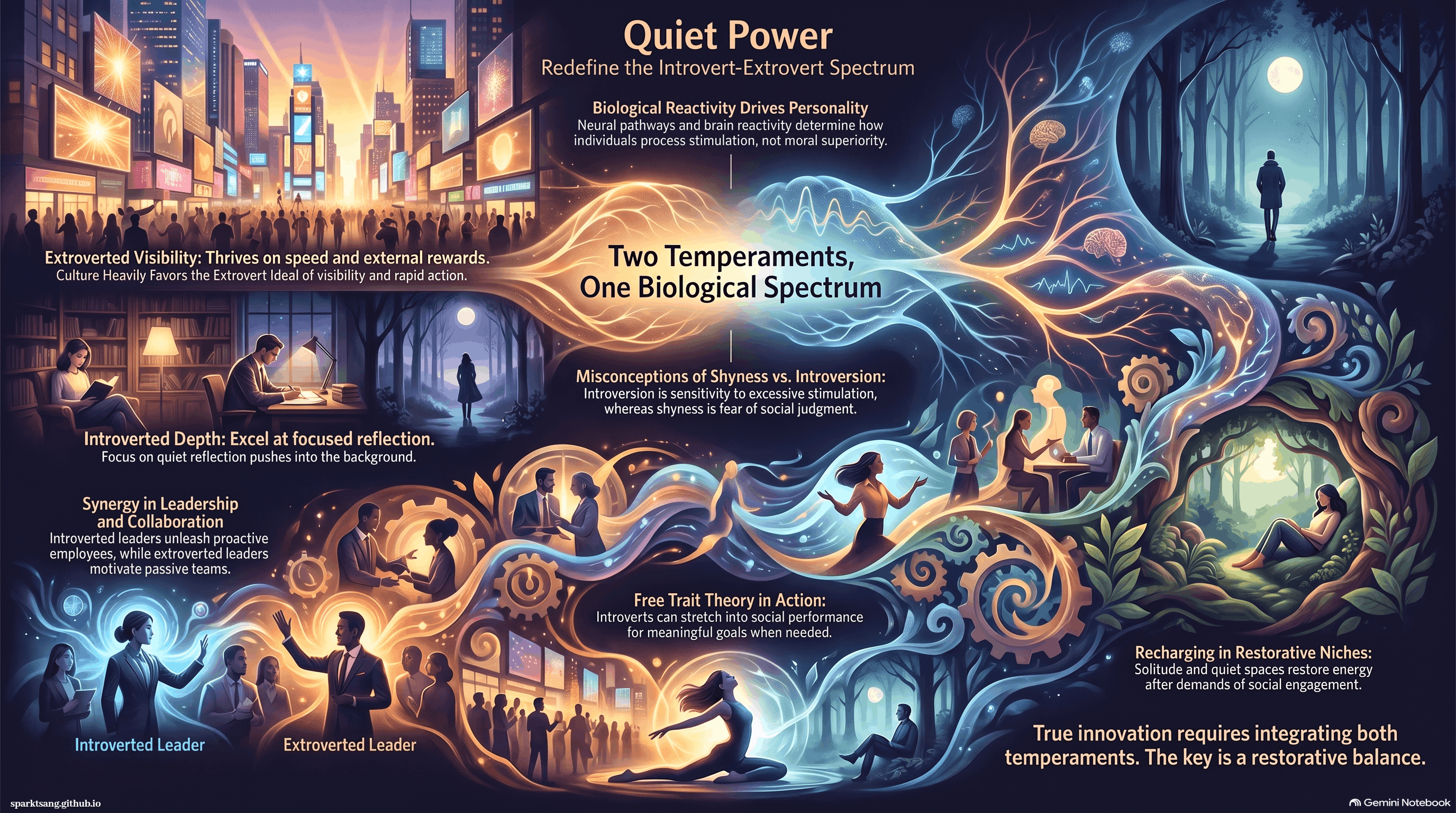
Introverts and extroverts are very different. Introverts move more slowly, are more cautious, like to concentrate on what they are doing, possess exceptional powers of focus, and are less concerned with fame and fortune; extroverts move quickly, are more decisive and inclined to take charge, often multitask, are more adventurous, and are more drawn to pleasure and fame and fortune.
Shyness is different from introversion. Shyness means being afraid of humiliation, afraid that others will not accept you; introversion simply means disliking excessive stimulation. Sometimes introverts become shy because this is a world dominated by extroverts. Shy people may become introverted as a way of protecting themselves.
Many introverts are also highly sensitive, deeply moved by beauty, and possess a strong conscience.
The more of the following 21 situations that apply to a person, the more introverted they are: preferring one-on-one conversations to group activities, enjoying writing, enjoying solitude, caring less about fame and fortune than their peers, disliking idle chatter and loving deep conversations, being considered a good listener, not being very adventurous, preferring to work with concentration and without interruption, enjoying small-scale birthday celebrations, being described by others as gentle and soft-spoken, not discussing work with others before it is finished, disliking conflict, working most efficiently alone, thinking before speaking, becoming exhausted after being out and about, often letting the phone go to voicemail, preferring to have few plans on a weekend if given the choice, disliking multitasking, finding it easy to concentrate, and preferring to listen in class rather than participate in discussions.
Part I Extroversion Is the Mainstream
Chapter 1 The Rise of the Extrovert
Dale Carnegie, author of How to Win Friends and Influence People, went from being an introverted farm boy to a master salesman and celebrated speaker, witnessing America’s transformation from a Culture of Character to a Culture of Personality. This is reflected in what the most popular books were during the two periods. The words that appeared most often also changed, from responsibility and hard work to attractiveness, charm, leadership, persuasiveness, and so on.
As a result, psychology came to speak of social anxiety, inferiority complexes, and the like. A quiet personality became a bad thing, while being sociable became an ideal trait in children. Solitary, serious hobbies made people unpopular and were therefore discouraged. Whether one was good at getting along with others became a measure of health.
In the late 1940s, Harvard dean Paul Buck publicly stated that the school’s admissions should favor healthy, extroverted students and reject those who were sensitive, neurotic, or overly intelligent.
Even scientists were expected to help promote their work and make a good impression; otherwise, they would be criticized.
The glorification of extroversion actually goes back to ancient times. The Greeks revered oratory, while the Romans regarded exile, which severed a person from society, as their harshest punishment. In the 1828 U.S. presidential election, the extroverted Andrew Jackson defeated the introverted John Quincy Adams.
Today, regardless of class or social status, everyone is expected to know how to entertain others and sell themselves. More and more people consider themselves shy, perhaps because we are using higher standards to judge whether we are afraid of self-expression.
Chapter 2 The Myth of the Charismatic Leader: The Culture of Personality in the Modern Age
“Although the poet John Donne said that no man is an island, if he heard how frequently and tirelessly today’s society tells us for all sorts of reasons that no one can be an island, surely even he would find it painful.”-William Wright
Life coach Tony Robbins amassed a huge fortune by aggressively selling himself while also teaching others to sell themselves aggressively, confirming the mainstream creed that becoming more extroverted leads to greater success. If Lincoln was the representative figure of the age of the culture of character, then he is the Lincoln of this age.
At Harvard Business School, everyone walked as though fully charged. The author’s friend called it “the spiritual capital of extroverts.” When the author asked students there whether there was not even a single introvert on campus, he was met with coldness. But the author found one introverted Chinese student who was working very hard to act extroverted.
In the business world, the loudest and most forceful speakers often win, and their opinions are more readily accepted. But research shows that talking more has no relationship with the quality of one’s insights.
The people who get proposals approved are usually not the ones with the best ideas, but the ones who give the most dazzling presentations.
Wharton professor Adam Grant’s research shows that extroverts lead introverts better than introverts lead introverts, but introverts lead extroverts better than extroverts lead extroverts. This is because extroverts can motivate introverts, while introverts are better at listening and synthesizing opinions before making decisions. In extrovert-leading-extrovert situations, leaders are more eager to throw out their own methods and overlook listening and integration.
The timid, stammering Moses in the Bible is an example of an introverted leader. He accepted God’s command and took on the great responsibility of his people, while his extroverted elder brother Aaron acted as his spokesman.
Today there is another kind of introverted leader who communicates through the Internet, such as Craig Newmark, founder of Craigslist, one of the world’s most visited websites. The site helps people connect with one another in countless ways, for jobs, dating, organ donors, carpooling, and so on.
Research has found that introverts are more likely to share their private worlds and reveal their true selves online, leaving family and friends astonished. Someone who would not dare raise a hand in a classroom of two hundred people may have no hesitation speaking to two million people online.
Extrovert culture can even be found in evangelical churches. They regard active evangelism as a virtue, and some introverted pastors have described them as “taking the idealized extroverted personality to the extreme,” causing distress to introverts who simply want to have a private conversation with God.
Chapter 3 Does Group Collaboration Kill Creativity?
From 1956 to 1962, research conducted by the Institute of Personality Assessment and Research at the University of California, Berkeley, demonstrated that the most creative people were often those regarded as introverts. This can be explained by the fact that introverts like to work alone, which is often a catalyst for innovation.
Apple co-founder Steve Wozniak participated in the Homebrew Computer Club with other engineers in his early years, but his winning formula was working alone.
The real world, however, moves in the opposite direction. Mainstream corporate thinking has become obsessed with the “New Groupthink”, tearing down the walls of workplaces and encouraging collective creativity. Collaborative learning is also heavily promoted in education.
The New Groupthink emerged with the rise of the Internet, where online platforms for collaborative work generated many startling ideas through brainstorming. But users failed to consider the difference between online and real-world environments, and mechanically transplanting the practice into reality may actually backfire.
Swedish psychologist K. Anders Ericsson found that the more hours people practiced the violin alone, the better they became; group practice did little to help.
Software engineer Tom DeMarco found a positive correlation between programmers’ privacy at work and their job performance.
A growing body of evidence shows that open-plan offices make people uncomfortable, unfriendly, unmotivated, and insecure; they have higher turnover, are more prone to high blood pressure and colds, argue more often, worry more about coworkers overhearing their phone calls or looking at their computer screens, and talk less about personal matters with colleagues. Constant exposure to noise raises their heart rates and causes the release of cortisol, triggering a fight-or-flight response; they become socially withdrawn, irritable, easily provoked, and less willing to help others.
Recent research indicates that people who work after walking in a forest learn more efficiently than those who walk through a busy urban area. Scientists have learned that the brain cannot process two things simultaneously. What appears to be multitasking is actually repeated switching, which lowers productivity and increases the error rate by 50%.
37signals founder Jason Fried asked thousands of people what kind of work environment they wanted. The answers were wildly varied, but overwhelmingly leaned toward three words: no office. He personally regarded meetings as poison, preferred to communicate and collaborate through email and text messages, and even suggested that companies try a “No-Talk Thursday” movement.
A. F. Osborn’s brainstorming theory swept the world, yet decades of evidence have shown that brainstorming does not work, and that the larger the group, the worse its performance. One explanation for this phenomenon is that people are afraid of making fools of themselves, creating evaluation apprehension.
The power of evaluation apprehension can be seen in Solomon Asch’s classic conformity experiments. Simply adding an actor who confidently gives the wrong answer can reduce subjects’ accuracy from 95% to 25%.
More frighteningly, neuroscientist Gregory Berns used brain-imaging technology to record brain activity and found that conforming subjects were not pretending. They genuinely believed that their own opinions happened to match those of others.
Although face-to-face collaboration has many drawbacks, the author does not reject it completely. Instead, he recommends modifying the way it is done, actively seeking out a symbiotic relationship between introverts and extroverts, and creating environments in which people can switch more freely between modes of interaction. Some companies are gradually recognizing the value of working alone and are creating flexible open-plan offices that provide spaces for solitary work and spontaneous conversation, quiet reflection areas, coffee areas, reading rooms, computer centers, conversation streets, and so on. Pixar Animation Studios even has a central courtyard the size of a football field, a cafeteria, and bathrooms, all designed to encourage creativity.
Part II Is Personality Innate, or Can We Choose It Ourselves?
Chapter 4 Is Personality Predestined?
Psychologist Jerome Kagan observed the development of 500 infants and found that those who belonged to the “high-reactive” group—babies who cried and moved frantically in response to external stimulation—were much more likely to become introverted as adults; those in the “low-reactive” group, who were less affected by external stimulation, were much more likely to become extroverted.
There is a physiological explanation behind this: when faced with something unfamiliar, the amygdala, which regulates emotion, responds more intensely in high-reactive children. The more intense the response, the faster the heartbeat, the wider the eyes, the tighter the vocal cords, and the greater the secretion of cortisol in saliva. The research uncovered one of the biological foundations of introversion, with major implications.
Although many introverts are not as sensitive as high-reactive children, and some high-reactive children grow into extroverts, this is therefore not the only indicator. But it overturns the misconception that extroverts are naturally more socially adept and considerate of others. Introversion and extroversion are in fact unrelated to a person’s social ability; introversion simply means greater sensitivity to the environment.
Research shows that high-reactive children spend longer observing photographs in visual matching tasks and have higher rates of correct answers; when reading, they are more careful and accurate. They devote exceptionally intense focus and passion to things they care about, and feel deeper guilt when they do something that angers others.
Research has also shown that high reactivity is associated with certain physical traits, such as blue eyes, allergies, and a tendency toward hay fever. High-reactive boys are thinner than other boys, with narrower faces.
The research team believed that the Disney film-production team had unintentionally grasped the characteristics of high-reactive people: Cinderella and Pinocchio both have blue eyes, while Cinderella’s stepsisters and Tinker Bell have dark eyes. Kagan further speculated that some men are more attracted to fair-skinned, blue-eyed women because they unconsciously associate those traits with gentleness and sensitivity.
By comparing differences in personality traits between identical and fraternal twins, studies of this kind consistently indicate that introversion and extroversion have a 40%–50% chance of being inherited.
In the past, the idea that personality was innate evoked eugenics and was unpopular. Kagan’s views at the time also conformed to the mainstream, but his position gradually changed.
Kagan nevertheless emphasized that behaviors such as being slow to warm up, shy, or impulsive are actually caused by many different factors and cannot be explained uniformly by high reactivity. For example, fear of public speaking may be related to genes inherited from ancient humans who adopted a low profile to avoid predators.
In reality, genes and environment interact, and people with every kind of personality have many different possible outcomes. A low-reactive child may grow up in an ideal environment and become a major entrepreneur, but if raised by negligent parents, may instead become a criminal.
Parental reprimands can cause anxiety in children, thereby prompting them to correct their behavior. If a child is not easily made anxious, such as an extremely low-reactive child, then parents should provide role models through their own behavior, channeling the child’s fearless personality into constructive force, such as learning to follow rules through participation in team sports.
The orchid hypothesis proposed by David Dobbs suggests that the fate of extremely high-reactive children is more deeply affected by their environment than that of others. Like orchids, they are more likely to wither in poor environments, but in suitable environments they can flourish better than others.
According to research, the short allele of 5-HTTLPR (the serotonin transporter), which is associated with high reactivity and introversion, functions similarly in monkeys and humans. Research shows that when faced with family stress, adolescent girls with the short allele are 20% more likely to experience anxiety than those with the long allele; but when raised in stable family environments, the former are 25% less likely to experience anxiety than the latter.
Research has found that high-reactive children who grow up in supportive environments are more resistant to colds and respiratory illnesses; if they grow up in stressful environments, they are more likely to get sick.
Jay Belsky, professor of psychology at the University of London, describes the parents of high-reactive children as fortunate, because the effort they invest can do more to change their children’s futures. He points out that parents who can read their children’s cues, respect their uniqueness, are gentle yet firm, neither impatient nor hostile, encourage curiosity and academic achievement, exercise self-control, and are not harsh are better suited to raising high-reactive children.
Chapter 5 Breaking Free of Personality’s Constraints: The Role of Free Will
Psychology professor Karl Schwarz found that the personality imprints of high and low reactivity remain into adulthood, meaning that people can expand their personalities but are still constrained by innate limits. This explains why introverts may grow up retaining their fears, yet appear unaffected simply because their ability to self-soothe has increased.
The highly influential psychologist Hans Eysenck believed that human beings seek an optimal level of stimulation. He argued that this was related to the ascending reticular activating system, ARAS, in the brainstem: introverts have their ARAS gates wide open and are easily overstimulated, whereas extroverts have tighter gates and are more easily understimulated.
His 1967 experiment demonstrated that adult introverts salivated more than extroverts when lemon juice was placed on their tongues. Another study found that introverts have a lower tolerance for noise than extroverts consider comfortable, and that raising introverts’ ideal noise level or lowering extroverts’ ideal noise level would reduce both groups’ performance in games.
Chapter 6 The Politician President, the Conscientious First Lady: The “Cool” Trait Is Overrated
“Being shy when you see strangers does not mean that you are afraid of strangers. A person may be as brave as a hero on the battlefield, yet lack confidence in small matters, such as facing strangers.”-Darwin
During wartime, U.S. President Franklin Roosevelt and his wife Eleanor were respectively extroverted and introverted. They were worlds apart. Before they married, people around each of them separately advised them that the other was unsuitable, but neither cared. The heavy social responsibilities of being First Lady left Eleanor struggling to breathe, but she worked hard to overcome them. After Roosevelt became president, Eleanor traveled around the country listening to the stories of struggling ordinary people and urging her husband to solve their problems through action. She became her husband’s conscience.
Psychologist Elaine Aron summarized 27 traits of Highly Sensitive Persons (HSPs) and found that these people tended to pursue philosophy, spirituality, or religion, looked down on pleasure and materialism, disliked pointless chatter, considered themselves more creative, had vivid dreams, loved music, nature, physical beauty, and artistic beauty, and experienced emotions intensely. They responded to information in their surroundings in profound ways and were able to perceive subtleties that others overlooked. She also found that sensitive people could display exceptionally high levels of empathy and had unusually pronounced consciences. In the past, the traits of sensitive personalities were regarded as subordinate to other personality dimensions, such as agreeableness or openness (two of the Big Five), but she challenged the mainstream view by arguing that those traits were themselves fundamental components of sensitive personality.
The strong connection between sensitivity and conscience has long been observed in academia. Grazyna Kochanska, a psychology professor at the University of Iowa, found that young children who reacted sensitively after learning that they had offended someone were more well-behaved than their peers by the age of four. But sensitive children are not necessarily as angelically lovable as they sound. When they experience excessive negative emotion, they may completely ignore other people’s needs.
A 2010 University of Michigan study found that today’s college students have 40% less empathy than those thirty years ago, whereas there had been little generational difference in empathy two thousand years earlier. This may stem from the widespread emergence of social media, the ubiquity of reality television, and extreme competition in society.
The expression “thick-skinned” or “thin-skinned” may have a scientific basis. Research has found that highly reactive introverts sweat more under stimulation than low-reactive people. The latter also have lower skin temperatures. People with antisocial personalities lie at the extreme end of “coolness”: they show almost no reaction to stimulation, have very low skin conductance responses, and experience almost no anxiety. There is evidence that their amygdalae are damaged.
The principle behind a lie detector is precisely to collect the body’s signals of anxiety when a person lies. The author recalls once being asked whether he had any contraband. Although he was innocent, he was so nervous that he failed the polygraph test.
The research team of Dutch scholar Corine Dijker found that blushing has social value: people are more sympathetic toward and trusting of wrongdoers who blush. University of California psychology professor Dacher Keltner found that other primates display similar gestures of embarrassment.
Elaine Aron believes that the reason highly sensitive traits have been preserved through evolution is that the careful and introspective way of acting that accompanies them helps people avoid danger. Jerome Kagan found that highly sensitive people make up about 20% of the population, and, interestingly, in more than a hundred other species, about 20% of individuals respond to change by maintaining the status quo, while the rest respond by immediately taking action to change. This is a trade-off or balancing principle in evolutionary biology: a trait is neither completely beneficial nor harmful, but its survival value varies depending on the environment. In humans, among nomadic peoples, those with genes associated with extroversion have better nutrition, but among settled populations, those same genes are associated with poorer nutrition. Extroverts have more sexual partners but are also more likely to divorce, which is detrimental to their children. Extroverts exercise more, while introverts have fewer accidents. Extroverts are more sociable, but also have higher crime rates. During periods of frequent warfare, humans may have needed more heroic figures; but if everyone were fired up with passion, no one would notice social factors requiring subtle observation, such as viruses or climate problems.
Al Gore, the introverted former U.S. vice president, was surprised by Congress’s indifference to the looming climate crisis. Perhaps he would not have been surprised if he had known Kagan’s and Aron’s research. Members of Congress are among the least sensitive people in the country, and the congressional system favors extroverts who spend all day lobbying and organizing events. It was not until Gore brought in a film crew and made An Inconvenient Truth with Hollywood-style fantasy effects that people finally paid attention.
Chapter 7 Introverts and Extroverts Think Differently
Janice Dorn points out that some people actively seek rewards when making decisions—that is, they have high reward sensitivity. They are more likely to engage in high-risk activities and actively pursue sex, money, status, influence, and so on. At the beginning of this chapter, a story was told of Alan, a six-decade-old investment outsider who kept “guessing” that stock prices had reached their lowest point, stubbornly buying money-losing stocks, and eventually losing most of his assets.
Dorn explains that the “old brain” responsible for human emotion, including the amygdala, resembles that of most primitive mammals. It is emotional and intuitive, closely linked to the nucleus accumbens, which governs desire. The “new brain,” responsible for reason, handles thinking, planning, and decision-making, including warning us of danger. Although the old and new brains operate together, they do not always cooperate perfectly. Alan’s losses may have been the result of his new brain losing the tug-of-war between the two. Exaggerated positive emotion and a state of being “crazy busy” can make people ignore warning signals they should have noticed.
People with greater reward sensitivity also tend to be more extroverted. Some scientists are even researching the possibility that reward sensitivity is the key to what makes extroversion extroversion. They are strongly ambitious, and their desire for gratification may lead to highly developed social skills. Research found that after being given amphetamines that stimulate the dopamine system, extroverts responded more strongly than introverts. Another study found that when extroverts won at gambling, areas of the brain associated with reward sensitivity were more active. Yet another study found that the prefrontal cortex, an important part of the dopamine reward system, is larger in extroverts than in introverts.
The gene DRD4, which regulates dopamine levels, is associated with an extroverted personality that particularly seeks stimulation and predicts risk-taking tendencies in financial investment with remarkable accuracy. Another group of genes associated with introversion regulates serotonin levels, and people carrying them are 28% less likely than others to take investment risks. Research also found that the latter performed better than their peers when participating in gambling games that required careful judgment.
In the years before the 2008 financial tsunami, risk takers proved for several years that their decisions were “correct,” and so they accumulated enormous power and became increasingly bold. Corporate management therefore became filled with people of the same personality type, while cautious, introverted, methodical thinkers were devalued. Those who warned companies had their power curtailed. Blindly pursuing profits while ignoring danger eventually led to disaster. Those who adhered to a creed of vigilance were able to avoid risk and still make large profits after the crash. One example was Seth Klarman, president of the Baupost hedge fund. Another similar example was Warren Buffett, who in 1999 publicly warned at a lecture that the bull market driven by the technology sector would not last. The audience was unreceptive, and many criticized him privately. The dot-com bubble burst the following year.
University of Wisconsin psychologist Joseph Newman studied extroverts and introverts playing a button-pressing judgment game. The more extroverts got answers wrong, the more enthusiastically they pressed the button, whereas introverts corrected their mistakes. Introverts’ tendency not to rush forward is also useful when handling work that requires brainpower. In elementary school, extroverts tend to perform better academically, but in middle school and university the pattern reverses. The introvert advantage is especially pronounced in college, where introversion predicts academic achievement more accurately than cognitive ability. This is not because introverts are smarter, but because introverts devote more brainpower to monitoring their work, whereas extroverts devote more brainpower to achieving their goals.
Gerald Matthews, a psychologist at the University of Cincinnati, says extroverts value speed over accuracy, seek quick victories and rapid closure, and easily allow errors to accumulate; when a problem eventually becomes too complex, they simply abandon ship. Introverts, by contrast, think first and are willing to spend more time digesting information, making them less likely to make mistakes. Extroverts focus more on what is happening around them in the present, while introverts think more about the future.
Numerous experiments have confirmed that extroverts and introverts solve problems in radically different ways. When subjects are asked to complete a difficult puzzle, extroverts are more likely to give up halfway through.
The author believes that action and thought need to be balanced, and cites Northwestern University management professor Camelia Kuhnen, who argues that the ideal investment-bank employee is a reward-sensitive person who can profit when the stock market is booming, but major corporate decisions should also take into account the opinions of people with more stable emotions.
The highly influential psychologist Mihaly Csikszentmihalyi points out that introverts are more likely to enter an ecstatic, trance-like state of total absorption when engaged in focused activities, a state he calls “flow.” They engage in the activity for its own sake, not for the reward. In this self-forgetting state, they feel neither boredom nor anxiety, only that time has passed in the blink of an eye.
Part III Introversion in Global Cultures
Chapter 8 Soft Power: Asian Americans and the Ideal of Extroversion
The California city of Cupertino, with its large Asian population, has a culture almost opposite to that of the rest of the country. Quiet, high-achieving introverted students are admired, athletic performance receives little attention, and being quiet is considered a virtue.
One Chinese mother in Cupertino whom the author interviewed said that when she first moved to the United States for her education, she was deeply shocked. She could not understand why classmates who talked nonsense were constantly encouraged by teachers to speak up. A University of California professor, by contrast, believed that Asian students were too deferential to teachers to open their mouths, creating a high wall between them and the teacher, and suggested that class participation be included in grades to stimulate them to speak. The author therefore posed the question: “Why is the same behavior considered class participation in Western eyes but nonsense in Asian eyes?”
Many studies have found major differences between East and West in their preferred personality traits. Chinese high school students prefer classmates who are humble, helpful, honest, and conscientious, whereas American high school students prefer people who are lively, enthusiastic, and sociable. Eastern cultural proverbs often encourage silence, such as “The wind howls but the mountain does not move” (a Japanese proverb) and “Those who know do not speak; those who speak do not know” (Tao Te Ching). Western proverbs, by contrast, more often encourage speaking up, such as “The tongue is the source of power” (the ancient Egyptian sage Ptahhotep) and “Speech is civilization” (from The Magic Mountain, by Paul Thomas Mann). One explanation is that Eastern cultures place great emphasis on education. Another is that Eastern cultures value collective action, whereas Western cultures emphasize individualism.
Brain-imaging research has found that pictures of men in dominant physical postures activate pleasure in Americans’ brains, whereas pictures of men in submissive postures activate pleasure in Japanese brains. The group-oriented attitude of Japanese society produces a “fear of people,” meaning worry that one might cause others to feel embarrassed, whereas Americans are more afraid simply of embarrassing themselves. Survivors of the atomic bombing of Japan would apologize to one another for failing to die in place of the other person’s family members.
After Asian-American students from Cupertino left home, they often discovered that in the outside world, the louder person was the more popular one, and so they lived with a double personality. One Chinese-American student named Wei was in his freshman year when a social mixer required everyone to dress as the opposite sex. The author assumed that he would criticize the excesses of the others, but instead he blamed himself for being timid. He also said that many Asian-American students put on a more extroverted persona than their parents, while parents encouraged their children to give more speeches and participate in debates to accommodate American extrovert culture. Research found that Chinese-American youth had fairly good self-confidence at age twelve because they measured themselves by their parents’ standards, but at seventeen, when they encountered the value system of the Extrovert Ideal, their self-confidence began to plunge.
In the workplace, Asians are often criticized for being too passive, not knowing how to socialize, and having poor presentation skills, resulting in substantially lower pay. Some Asians therefore established American-style communication courses to train people and help those born abroad integrate. One instructor surnamed Ni cited Chinese Communist leaders reading from prepared scripts as an example of cultural difference, while also affirming that Asian values can achieve goals in a low-key way.
If one were to recount Gandhi’s life story without first revealing his identity, some people might think this man was truly weak and passive. The author argues that although Gandhi was passive, he was not weak, and that his ability to stay focused on his goals and exercise self-control was his greatest asset.
In the Trends in International Mathematics and Science Study, East Asian students ranked first in the world in academic performance. The exam also required children to fill out a detailed questionnaire that did not count toward their grades. It was found that the countries whose students filled out the questionnaires most thoroughly were the same countries whose children performed best academically. The author describes this as showing that high-achieving students not only possess strong problem-solving abilities but also the quality of quiet persistence. Other studies have found that Asian children develop unusual perseverance at a very young age.
Part IV Bringing Introversion and Extroversion Together--Love and Livelihood
Chapter 9 When Should Introverts Act Extroverted?
Many scholars have historically supported the view that personality traits remain fixed and unchanging, but after Walter Mischel published Personality and Assessment in 1968, the “situationism” view—that situational factors predict human behavior more accurately than personality traits do—came to dominate. Postmodernism’s view of the self also emerged around the same time. At that point, many scholars researching personality traits could not find academic positions. Today, the debate between person and situation has gradually subsided, replaced by interactionism, which holds that both innate factors and environment influence us and interact with one another. People change according to the situation while still possessing stable personality traits. More recently, even Mischel himself acknowledged that people have stable personalities. For an overview of the debate, see David C. Funder, The Personality Puzzle (New York: W. W. Notton, 2010) m 118-44.
As for how introverts should adjust their lives, the author believes the best answer comes from Brian Little, a former Harvard psychology professor who is introverted by personality but extremely extroverted in behavior. Little developed the Free Trait Theory, arguing that fixed traits and free traits coexist. Introverts can act extroverted for the sake of what they love, their careers, and their life plans. This explains why Little himself, who would hide in the bathroom during spare moments to avoid social engagements, could shine brilliantly on the lecture stage.
Western culture emphasizes being oneself. Shakespeare’s phrase “To thine own self be true” from Hamlet is frequently quoted, and this seems contrary to acting extroverted. Little believes that if the performance begins from a pursuit of one’s ideals, then it is entirely consistent with Shakespeare’s advice.
If the technique of switching personalities is handled skillfully, it is impossible to tell that a person is acting, just as people find it hard to believe Little himself when he claims to be introverted. The author has a friend who was highly skilled at socializing among financial elites. He says he was initially extroverted, changing his behavior by observing others, and went from being bullied to being respected.
There are limits to controlling one’s self-presentation, some of which can be attributed to behavioral leakage, in which unconscious body language reveals what one does not realize one is revealing. But psychologist Richard Lippa found that some introverts can play extroverts extremely convincingly. Psychologists call this ability “self-monitoring.” Some people regard self-monitoring as an immoral behavior, but Little sees it as adjusting oneself to fit social norms, a form of humility.
As for how to discover one’s core vocation, the author identifies three key points: First, childhood aspirations. The aspiration itself may not be reliable, but the inner motivation behind it may remain unchanged. If you wanted to become a firefighter, ask yourself whether it was because you craved adventure or because you wanted to rescue people from suffering; if you wanted to become a dancer, ask whether it was because you wanted applause, beautiful clothes, or the pleasure of spinning. Second, pay attention to what kinds of work attract you and whether they align with your aspirations. Third, pay attention to the things you envy. The author realized that he did not envy former classmates who had risen to the Supreme Court; instead, he envied classmates who had become writers or psychologists.
Even if you are already in your core vocation, you should not do too many things that go against your nature, nor should you spend too much time pretending. As much as possible, try to create a “restorative niche” where you can be yourself again. Before joining a new company, assess whether you can establish such a restorative niche there. Extroverts need restorative niches too, but their nature is different. It may be a platform where they can speak their minds freely.
Little passionately urged everyone to sign a “Free Trait Agreement,” understanding that sometimes you must act in order to earn time to be yourself again, negotiating with reality to establish an appropriate amount of restorative time. For example, if you are single, first make an agreement with yourself to force yourself to participate in social activities in the hope of meeting a partner, making it possible to reduce the time spent attending gatherings over the long term. Set your own limit at once a week, once a month, or once a quarter; the rest of the time, you can stay home without guilt. Little said that because he became famous for his lectures, the invitations were endless. He became psychologically exhausted and overworked, and eventually fell ill; if it had gone on a little longer, it might have killed him. Fortunately, now that he had the agreement, his extroverted behavior and introverted personality could achieve a balance.
Chapter 10 Bridging the Communication Gap: How to Talk to the Other Kind of Person
“When two personalities meet, it is like two different chemicals colliding; if a reaction occurs, both undergo qualitative change.”-Carl Jung
The needs of Gregg, an extrovert, and Emily, an introvert, seem difficult to reconcile. The husband wants to host a dinner with friends at home once a week, but the wife thinks that meeting this way will never lead to real intimacy and would not do it at all if she had the choice. The husband longs for the two of them to go on adventures together and face everything side by side, while the wife feels that letting him entertain friends alone would violate their marriage vows. He, in turn, thinks there is something wrong with her for disliking socializing and calls her “antisocial.”
Psychologists say that extroverts need forum-like gatherings more to satisfy their desire for influence, whereas introverts prefer sincere and meaningful conversations to parties. German psychologists Asendorpf and Wilpers found that extroverted students are more likely than introverted students to make new friends, but the two groups do not differ in friendliness toward others. Therefore, calling introverts antisocial is wrong.
Emily comes home exhausted and only wants to read and rest quietly beside her husband. Gregg cannot understand why an introvert needs to recharge so much at the end of the day. As an extrovert, he wants company; his wife’s behavior makes him feel hurt, and Emily cannot understand this either.
When the roles are reversed, with an introverted man and an extroverted woman, we often assume that the result is simply a gender difference and invoke the “traditional wisdom” that men are from Mars and women are from Venus.
Introverts and extroverts also handle problems differently. The author’s lawyer client Cilia wanted to warmly announce her divorce to her husband of eleven years. The author rehearsed the conversation with her, but she was either cold and numb or overwhelmed by emotion. The author points out that many introverts have a similar communication style: when they disagree, their speech becomes quieter and flatter, and they emotionally detach themselves to avoid anger; by contrast, the extroverted partner’s voice becomes louder and their emotions more intense. The introvert retreats further to avoid conflict, while the extroverted partner increasingly believes that the other person is indifferent to the problem and becomes even more agitated. This creates a vicious cycle.
Psychologist Grazyna’s research had subjects rate how others made them feel in different environments and found that introverts were more inclined to make friends in friendly environments, while extroverts were more inclined to make friends in competitive environments. In another study, when a robot spoke gently and encouragingly to stroke patients, saying things like “I know it’s hard, but this will help a lot” and “Very good, keep going,” introverts responded better; when it encouraged them more forcefully, saying things like “I know you can do it” and “Focus,” extroverts worked harder.
A University of Michigan business-school study asked 76 MBA students from Hong Kong and Israel to imagine getting married in a few months and to meet by video conference with a wedding-catering company. Some students saw a very kind manager, while others saw an irritable and arrogant manager, but the content of both managers’ messages was identical: another couple wanted catering and the price had to be raised. Among the Hong Kong students, 71% wanted to work with the friendly manager, while only 14% wanted to work with the arrogant manager. Among the Israeli students, however, there was little difference, showing that they were less influenced by emotional presentation. The difference between the two cultures lies in how respect is defined. Asians demonstrate respect by reducing conflict, whereas Israelis do not regard disagreement as a sign of disrespect.
By contrast, in Gregg’s case, when Emily argues she flattens her affect to show respect for the other person, but her husband sees this as avoidance or indifference. The author cites a fable to explain that although the wife does not need to get angry, she can still deter the other person with words such as “I just don’t want to do this.” He also cites neuroscientists who found that people who receive Botox injections are less prone to anger because they cannot display angry facial expressions as easily, and therefore recommends that husbands temporarily calm down when they are angry.
Neuroscientist Dr. Lieberman’s experiment found, as the public would expect, that extroverts are more accurate than introverts at judging whether the other person enjoys talking to them. At the same time, he found that the two groups do not differ in their ability to interpret social information. This is because introverts are less skilled at multitasking. Talking to one person already involves processing a large amount of information; at a large group dinner, introverts are already multitasking to an extreme degree.
Avril Thorne, a developmental psychologist at the University of California, found in experiments that conversations between introverts tended to be more serious and profound, while those between extroverts were more situational and relaxed. Interestingly, when introverts and extroverts talk to one another, the introvert tends to choose lighter topics, while the extrovert relaxes and candidly reveals their own problems without having to pretend to be cheerful and delighted. They can meet each other’s needs. It turns out that introverts’ preference for serious topics can actually make extroverts feel safer approaching them about important matters. The author extends this discussion to the advantages of introverted salespeople.
Returning to Gregg and his wife’s problem, they finally decided to halve the frequency of dinners and hold them in buffet form, allowing the husband to remain the center of attention while the wife could talk to each person individually.
Chapter 11 How to Raise Introverted Children in a Turbulent World
Mark Twain once told a story: a man searched high and low for the greatest general in the world and eventually reached the gates of heaven. He asked Saint Peter, who pointed to an utterly inconspicuous person. The man protested that he knew this person and that he was merely a shoemaker. Saint Peter replied that if he could have been a general, he would have been the greatest general in the world. The author extends the point to suggest that many people who could have done great things may simply have been overlooked.
This chapter introduces some parents who suspect that there is something wrong with their children. In fact, their children are simply introverted, less sociable, and inclined to avoid conflict. Positive approaches include not forcing children to change their views of socializing, helping them gradually experience new environments and new things, and respecting their limits. Before school begins, for example, you can take them to visit the school. During social activities, parents should model the desired behavior for their children.
Many educational methods are designed for extroverts, while introverts have different learning needs. Group learning is not perfect, and some methods can leave introverted children at a loss. Some group assignments can still work for them, but the groups should not be too large and responsibilities should be clearly divided.
Parents of introverted children should choose schools whose educational philosophy emphasizes autonomy, uses small-group activities, values friendliness, strictly enforces anti-bullying rules, and can attract students similar to their own children.
Introverted children can meet like-minded people by developing their interests in depth. To address children’s nervousness before competitions, parents can help them become accustomed to competition and to failure. They can also encourage them to travel far from home for competitions; if no one there knows them, there is nothing wrong with failing.
Notes last updated on August 3, 2020
Thank you for reading until the end. This is a bonus infographic just for you.