Notes on Focus: The Hidden Driver of Excellence
Focus: The Hidden Driver of Excellence by by Daniel Goleman
Original notes here.
Read until the end to get a bonus. Enjoy reading.
An investigator scanning for a thief in a crowded shopping mall must remain constantly focused Attention can be broadly divided into three kinds: inward, toward others, and outward The abundance of information today leaves children with less capacity for learning and reduces real-world interaction. A middle-school teacher said that even high-achieving students now think reading Greek and Roman Mythology is too difficult, something that had never happened in the past
Things that distract attention fall into two main categories: sensory and emotional Experiments have shown that the extent to which anxiety interferes with college athletes’ concentration is highly correlated with how well they perform in the following season Only 20 percent of people experience a state of flow at least once a day Neural networks operate in two modes, bottom-up and top-down. The former is driven by emotion; the latter is responsible for self-control, enabling learning and the formulation of new plans, which is a voluntary skill World champions need actions to operate automatically, relaxing and trusting the bottom-up movements. Thinking too much is a recipe for “choking”; sex works the same way The automatic system occasionally does this: Waiter: “Do you like your meal?” Customer (mistaking the question for whether he had finished the meal): “No, not yet.”
Experiments found that people whose minds wandered produced 40 percent more original answers than those who were completely focused; people who achieve creatively experience mind-wandering far more frequently than average Einstein: Intuition is a sacred gift, reason is a faithful servant; we have created a society that glorifies the servant and has forgotten the gift People need stretches of uninterrupted time in which they can truly think freely
Mind-wandering is usually related to oneself. The easiest thing to distract us with is the chatter in our own minds; forms of meditation that fully focus on sensory experience can quiet it By completely relaxing and focusing on nature, which requires little attention, and getting ample rest, we can restore our attention in a world overloaded with information
A student at a nearby school during the author’s middle-school years was passionate about movies. When making his second film, he refused to sell creative control and consequently ran out of money when he was almost finished. It was only the tenth bank that agreed to lend him money, resulting in Star Wars Self-awareness is the key to steering one’s life After being diagnosed with liver cancer, Steve Jobs told Stanford graduates: Don’t let other people’s opinions drown out your inner voice; have the courage to follow your heart and intuition, because they somehow already know what you truly want to become Seeing oneself through the eyes of others is a reliable form of self-awareness Daniel Kahneman was given the investment results of 25 investment advisers over eight years by a company that managed investments for extremely wealthy people. After analyzing them, he found no relationship between the advisers’ year-to-year investment performance, meaning that no adviser consistently outperformed the others. Management performance contained no greater element than luck When he told the company’s executives this astonishing finding, they simply remained calm and continued eating An executive at a cloud-computing company said that when their servers broke down early in the business, reporters’ calls came flooding in. But they decided to respond candidly, and then the problem disappeared; the reporters stopped calling
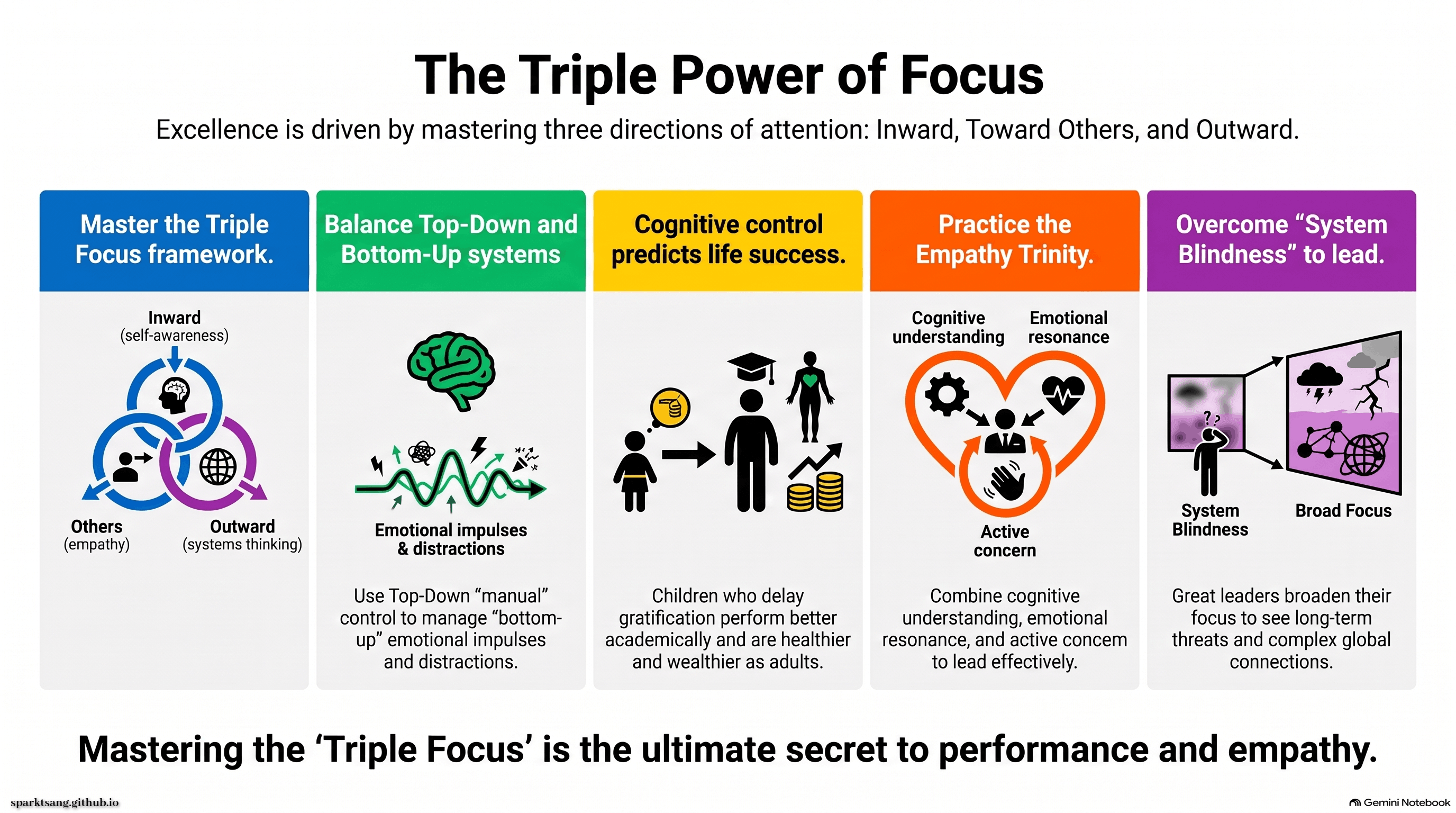
Children who can resist eating the marshmallow in front of them and wait a while to get two marshmallows perform better academically (Walter Mischel’s 1970s experiment) This involves three executive processes: disengaging attention from the desired object, focusing on something else, and focusing on a future goal The Dunedin study in New Zealand found that children with good self-control were healthier, wealthier, and more law-abiding Children who could resist the temptation of a marshmallow at age four could still delay gratification 40 years later, while impulsive people remained just as impulsive as before This reflects the tension between the id and the self, with the more conscious prefrontal cortex potentially being hijacked by desire Mischel found that children could be taught to imagine the candy as a photograph inside a frame, making it easier to resist temptation Cognitive control over impulses can predict the ups and downs of an entire life
People who are hypersensitive to social cues can infer an affair by observing whether a man’s and a woman’s bodies move in synchrony When couples repeatedly display fleeting moments of disgust or contempt during conflict, the chances of reconciliation are extremely low Therapists and clients moving in sync may produce better outcomes
The trinity of empathy cognitive empathy: the ability to sensitively interpret emotional signals, working top-down emotional empathy: resonating with others, automatic and spontaneous, working bottom-up empathetic concern: motivating compassion or concern for another’s well-being, working bottom-up Psychopaths possess highly developed cognitive empathy. The classic analysis is Hervey Cleckley’s The Mask of Sanity. They can perfectly imitate others’ emotions, intelligence, and sense of responsibility, and make up 1% of the population. They “feel” emotions through the top-down system rather than experiencing them directly; they have no anxiety and feel no fear of severe punishment When people listen to a story, their brains become closely coupled with the storyteller’s brain, precisely mirroring its patterns, but lagging one to two seconds behind. Those who are completely focused and understand most deeply actually lead the storyteller by one to two seconds because they anticipate how the story will unfold Among American doctors accused of malpractice, most had no more medical errors than doctors who were never sued; the main difference lay in the emotional distance of the doctor-patient relationship Psychiatry professor Jean Decety’s research found that doctors’ brains have a unique spontaneous response to blocking out other people’s pain and discomfort. By keeping their distance from others, they protect their ability to focus; this response is learned rather than innate Remaining concerned for patients while maintaining calm concentration is a challenge in daily medical work The strongest predictor of whether patients follow medical advice is whether they feel that their doctor genuinely cares about them Dr. Helen Riess of Massachusetts General Hospital said behavioural empathy may initially be just an act, but it creates more connection in an interaction; doctors always think contact will increase the amount of time required, but in the long run empathy can save time
Cross-cultural social sensitivity is innate. Managers who are good at taking other people’s perspectives perform better when assigned overseas because they quickly understand the unwritten rules of a culture Unlike in the United States, in Japan, failing to examine the contents carefully after receiving a card is considered disrespectful Debate is highly valued in Dutch culture. Primary school children grow up debating, and it is considered a necessary ability Dacher Keltner, a psychologist at the University of California, Berkeley, found that people with greater power or wealth care less about others’ suffering, look at others less, and are more likely to interrupt others or monopolize conversation time Power is relative. When students from wealthy families imagine talking to someone of higher status, their ability to read facial expressions improves A company’s power hierarchy can be reduced to simple arithmetic: how much time does a person spend replying to email? Frontline employees reply within minutes; the boss may take hours or even days Intelligence agencies use the same method to analyze suspicious terrorist organizations, piecing together relationships of influence to identify the person at the very center of leadership
Larry Brilliant created Google’s nonprofit arm, google.org, and received widespread acclaim for using big data to detect the spread of influenza Solving some problems requires looking at the entire system, such as when too many copies of a magazine are printed and everyone involved has to come together To overcome the problem of system blindness, Professor John Sterman pointed out that solar power may be zero-emission from an internal systems perspective, but one must also consider the greenhouse gases emitted by the electricity used to manufacture the panels and across the supply chain The human attention system is oriented toward immediate dangers but indifferent to long-term threats such as global warming. Solving these distant threats requires systems thinking Change may depend on many widely distributed leverage points rather than a single one, as described in Paul Hawken’s Blessed Unrest
Many people who mention 10,000 hours of deliberate practice ignore the importance of continually adjusting the challenge. Experts deliberately set high-level goals and actively and spontaneously train further through top-down control; amateurs stop once they reach a good-enough level of performance, and then spend time practicing the bottom-up mode, producing very little improvement Most elite competitors limit training to four hours a day to prevent excessive practice from gradually reducing their ability to focus Experienced meditators, when they notice their minds wandering, can prevent the brain’s medial regions from activating, letting go of the thought and returning to the breath People who are good at training their muscles know that they need to perform specific contraction movements to train the relevant muscles; training attention works in much the same way
Losada effect: Organizational psychologist Marcial Losada analyzed hundreds of teams and concluded that the most effective teams required a positive-to-negative ratio of at least 2.9; above an upper limit of 11, performance could no longer be sustained because of overexcitement After watching happy scenes, depressed patients cannot sustain positive emotion; their reward neural circuits shut down much faster than those of healthy people
Daniel Cates had already won $5.5 million from online poker by age 20, yet struggled with social skills: when the brain strengthens some neural circuits, it does not strengthen others at the same time A two-year longitudinal study in Singapore found a negative correlation between time spent playing video games and academic performance Some video games can improve attention, with the strongest effects seen in children who initially had the poorest attention Some people predict that one day brain-training games will become a standard part of the school curriculum Breathing exercises, traffic-light games, and Simon Says have all been used as cognitive-control exercises for students. Roger Weissberg pioneered a similar social-development program in the late 1980s, raising student achievement by 11% Singapore has become the first country in the world to implement such a program, requiring every student to complete social and emotional learning courses Treating cognitive abilities as separate from social and emotional abilities is as outdated as Cartesian mind-body dualism; in the design of the brain, the two interact extensively rather than operating independently
Mark Greenberg, professor of human development at Pennsylvania State University: for adults, there seems to be strong evidence supporting the relationship between mindfulness and the attention network Mindfulness meditators can also greatly reduce various symptoms of physiological disorders Three forms of meditation: concentration, loving-kindness, and open awareness. Each quiets the brain regions associated with mind-wandering Google University’s mindfulness-based EQ course “Search Inside Yourself” sparked a movement A simple test of your level of mindfulness: Did you find it difficult to recall the conversation just now? Do you remember what happened during your commute this morning? Did you eat without tasting the food? Did you pay more attention to your phone than to the person you were with? Did you skim through this book at lightning speed? Mindfulness training reduces activity in a self-centered neural circuit in the medial prefrontal cortex; the less self-talk there is, the more we experience the present moment Global economic data show that once a country reaches a normal level of income, the relationship between happiness and wealth is zero The author believes that incorporating mindfulness courses into education and improving executive control could help break the cycle of intergenerational poverty
Steve Jobs’s Zen teacher, Kobun Chino Otogawa, could draw an arrow and hit a bull’s-eye that other people could not even see After returning to Apple, Jobs used a simple strategy: he focused on just four products and insisted on keeping them simple to use Exploitation means maintaining continuous focus on the present; exploration means seeking new possibilities. The two strategies pull against each other in the mind of every decision-maker, and the best decision-makers can balance them through a dual strategy
Leaders who set excessively high standards, criticize excessively, like to set a fast pace by example, and rely on commands and coercion often leave morale low, create a toxic work environment, and sacrifice company growth Since the 1990s, this style of leadership has risen steadily, eventually leading to a series of corporate collapses and shattered illusions The public-relations disaster triggered by the BP chief executive in 2010 became a textbook case of the corporate costs created by leaders who lacked focus and could not manage their impact on others
The person with the greatest influence in a work team usually has the smallest gap between how they rate their own abilities and how others rate them. If that person has low empathy and a high drive for achievement, they will drag down the performance of the entire team; high empathy combined with low self-control also lowers performance: too much empathy can induce misconduct; when empathy is strong and other abilities are well balanced, team performance is usually higher (Vanessa Druskat) Like individuals, top teams are also good at the three kinds of focus. Teams that can openly and honestly discuss negative issues can achieve very high performance
Some policies that are unpopular in the short term may become popular in the long term, such as New York’s smoking ban and the carbon tax in British Columbia Leaders must broaden their time horizon to achieve true greatness, moving beyond the language of economics to balance financial returns with public welfare. The author recalls that in 2010 Unilever announced that the company’s ecological footprint would be cut in half within ten years and pledged to source directly from small farms If attention remains limited to individual purposes and the small groups to which one belongs, humanity as a species will eventually go extinct in the long run The Dalai Lama suggested that we examine our motives by asking: Is this for ourselves or for others? To benefit a few people or many? For the present or for the future?
Attention can be divided into conscious attention (associated with the lateral prefrontal cortex) and unconscious attention (related to the instinctive responses of the vigilance system) It can be divided into inward (self-awareness), toward people (cognitive empathy, emotional empathy, empathetic concern), and outward (the ability to think in systems and counter system blindness) Attention-deficit (ADHD) symptoms: distractibility, hyperactivity, impulsivity, and emotional and behavioral problems Short-term attention exercises include motivation, goals, and execution Practicing focus, setting priorities, and cultivating positive emotions can all strengthen attention After drinking a small amount of coffee, people can identify positive words quickly and accurately (Lars Kuchinke, 2012) Children watching less television, reading together more with their parents, training visual memory, paying attention to diet (dairy products and red meat, for example, can prevent deterioration in working-memory ability), and getting enough sleep all help strengthen attention
Finished reading on July 20, 2020
Thank you for reading until the end. This is a bonus infographic just for you.