Notes on Influence: The Psychology of Persuasion
Influence: The Psychology of Persuasion by Robert B. Cialdini
Original notes here.
Read until the end to get a bonus. Enjoy reading.
A mother turkey will fiercely attack a natural enemy such as a skunk, and even a stuffed skunk is no exception. But if the stuffed skunk makes a sound like a baby turkey, the mother turkey will actually protect it.
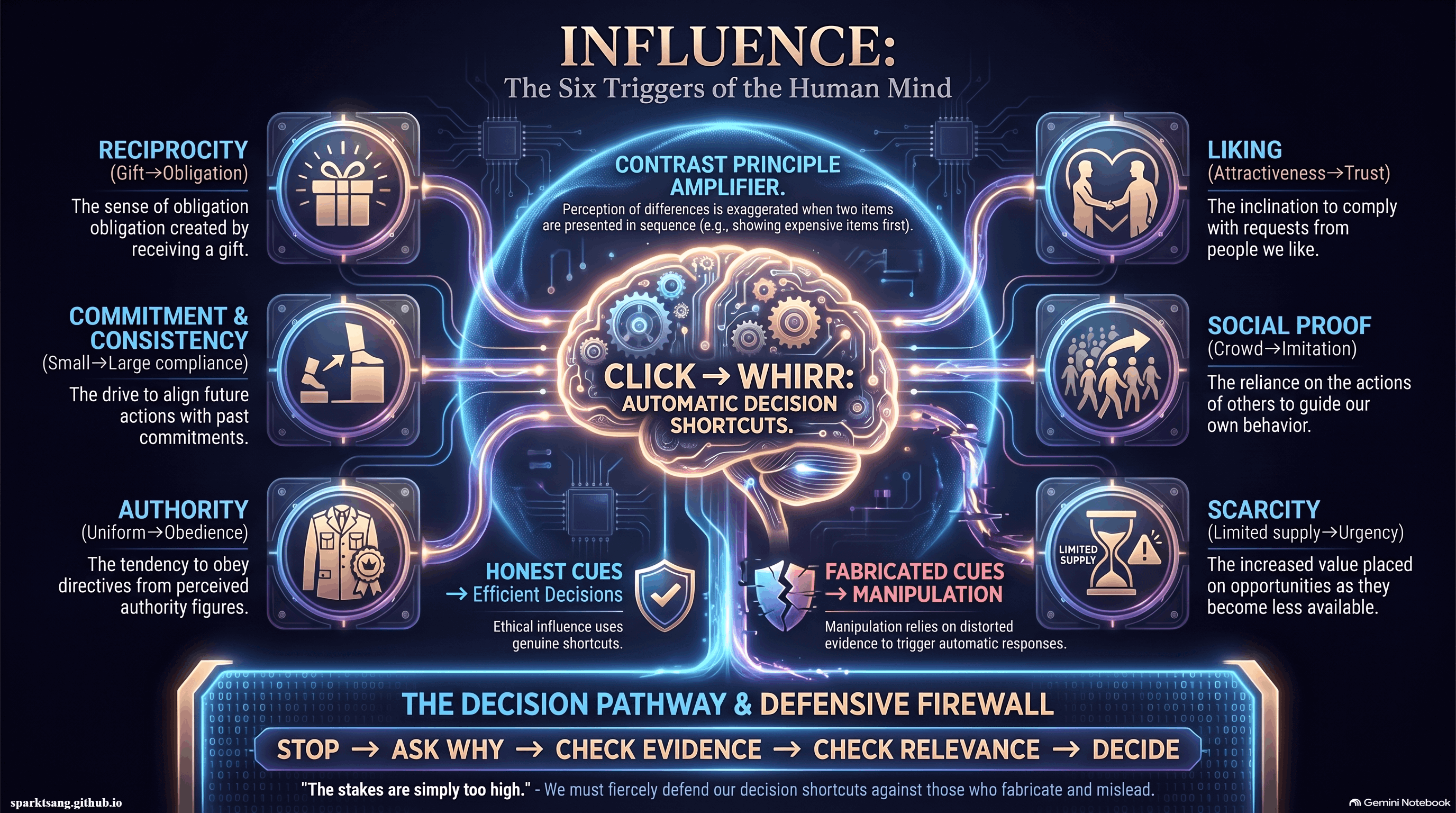
Humans have these kinds of fixed-action patterns (the “click, whirr” response) too, except that most of ours are learned after birth: a jeweler wanted to sell some slow-moving jewelry at half price, but accidentally marked it at twice the price instead, and it sold out because people had all grown up being taught that you get what you pay for and that expensive means good.
Fixed-action patterns do occasionally run aground, but most of the time they save us the cost of making a judgment.
Giving a simple reason greatly increases the chance that a small request will be accepted, such as asking to cut in line at the photocopier.
People who took the same painkiller reported greater pain relief when they were told that the drug was expensive.
People with no personal stake are easier to persuade with authority; those who have a stake require the quality of the argument itself.
“Captainitis”: obvious mistakes made by a captain often go uncorrected by crew members, resulting in a plane crash.
The contrast principle: when two things are different, people perceive the actual difference as greater than it really is. For example, someone who is less attractive than their companions may feel even less attractive than they actually are. This is why salespeople should show the most expensive product first.
Car dealers do the same thing: they settle the price of the car first, then quote the accessories one by one, and by the end the price of the car has swollen like pumped-up pork.
Real-estate agents, meanwhile, are better off showing a string of terrible properties before taking the client to the property they actually want to sell.
The Reciprocity Principle
A professor casually mailed Christmas cards to complete strangers, only to receive a flood of cards in return.
People asked to make donations to a banker’s cause doubled their donations simply because they had first been given a piece of dessert.
In Ethiopia in 1985, when famine was everywhere, its Red Cross officials still donated $5,000 to Mexico in return for the aid Mexico had given Ethiopia during the Italian invasion of 1935.
Research found that when a companion gave a subject a bottle of Coke, the companion could sell twice as many raffle tickets to the subject, whether or not the subject actually liked that companion (Dennis Regan).
Four Viagra pills were enough to induce an Afghan chieftain with four wives to provide a large amount of Taliban intelligence (Joby Warrick, 2008).
After doing someone a favor, don’t say it was nothing. Say, “I believe you would do the same for me,” thereby preserving your influence.
An insurance survey mailed with a $5 gift was twice as effective as offering $50 to people who returned a completed questionnaire (James & Bolstein, 1992); giving candy with the bill increases tips, with one piece raising them by 3.3% and two pieces per person by 14% (Strohmetz et al., 2002); when McDonald’s gave balloons to children entering the restaurant, the family’s total order increased by 25% (Steve J. Martin et al.); customers who receive gifts are more willing to shop (Adam Grant, 2013; Tom Rollins, 2020).
During the Cuban Missile Crisis, the Soviet Union was willing to compromise because declassified documents showed that Kennedy had agreed to withdraw Jupiter missiles from Turkey and Italy.
Customers who receive free candy upon entering a store are 42% more likely to make a purchase.
The power of free samples never seems to wear off: Amway sent a range of products directly to prospective customers’ homes for trial, leaving the salespeople astonished by the results.
Making an effort to solve a problem satisfies customers more than flawless service does. A hotel manager had an employee go out specifically to buy a children’s tennis racket for a mother who wanted to play tennis with her child, and the mother later made a much larger booking.
The Disabled American Veterans organization sent out donation appeals and received a response rate of about 18%, but when a small gift was enclosed, the rate rose to 35%.
Many politicians cast votes supporting positions contrary to their usual stance simply to repay favors. Bills proposed by political outsiders struggle to pass because nobody owes them anything.
A German soldier who had risked crossing an unguarded area to capture enemy soldiers ended up sparing the other side because he had been given bread; the author’s clever female student, wanting to repay a favor, lent her new car to a minor who had helped her start her car a month earlier—and the car was wrecked.
The “rejection-then-retreat” technique (also known as the Door-in-the-Face technique) is also extremely effective: make a large request first, then follow it with a request that seems trivial by comparison.
When the initial request is so extreme that it becomes unreasonable, however, the technique can backfire.
Because the author refused the Boy Scouts’ request, he first offered a $5 circus ticket, then complied with their request to sell him a one-dollar chocolate bar.
An experiment showed that when people were first asked to “spend two hours a week serving as a counselor to juvenile delinquents for at least two years,” acceptance of the later request to “spend one day accompanying a group of juvenile delinquents to the zoo” tripled. Initially, 83% refused; afterward, only 50% did (the author’s own study).
Even screenwriters admit that they deliberately put outrageously bold lines into scripts so that the material they really want can get through.
Watergate happened because the decision-makers had already rejected two even more outrageous plans proposed by Gordon Liddy. The first would have cost a million dollars and involved surveillance aircraft, a team responsible for kidnapping and robbery, and a yacht carrying high-class call girls to blackmail Democratic politicians. The only person on the decision-making team who opposed the plan had never heard the first two proposals.
Could concession techniques cause victims to fail to honor their commitments or feel manipulated? Quite the opposite: concession techniques increase both fulfillment and the likelihood of future compliance. Among those who agreed to volunteer after being subjected to a concession, 85% fulfilled the commitment, compared with 50% without the technique; 84% of blood donors subjected to the concession agreed to return, compared with only 43% of those who were not.
Subjects who had been subjected to the concession technique were also more likely to believe that they had successfully influenced their opponents and were more satisfied with the outcome (an experiment by social psychologists at UCLA).
One reader who sold audio equipment used the concession technique to get 70% of customers to buy a one-year service plan, compared with only 40% for his colleagues.
The author’s own book-promotion page gives readers one free chapter.
The influence of reciprocity is pervasive, but once you recognize it as a sales tactic, you can protect yourself from it. Kindness deserves to be repaid; sales strategies do not necessarily deserve a response.
The Liking Principle
Traditional methods of promoting evolution theory were ineffective; the most effective approach was to use celebrities as ambassadors.
Tupperware let customers host parties for its storage containers and share the sales revenue with them, with such great success that it eventually broke off its relationship with supermarkets.
Factors that trigger liking: attractiveness, similarity, compliments, contact and cooperation, and association.
Attractive people received two and a half times as many votes (a 1974 Canadian election study). Handsome defendants received noticeably lighter sentences, and cases in which the plaintiff was more attractive than the defendant awarded almost twice as much compensation; male and female jurors showed the same bias (a Pennsylvania study).
When college students were asked for money to make a phone call, those dressed in a similar style succeeded about two-thirds of the time, while those dressed differently succeeded less than half the time (an experiment in the early 1970s).
Waiters who mimicked customers’ behavior received larger tips; salespeople who mimicked customers sold more electronics; negotiators who mimicked their opponents’ language and gestures got better results.
Compliments effectively change how people view the person giving them, even when the recipients know they are merely being sucked up to, and the compliments do not even have to be accurate (a North Carolina experiment).
To avoid the appearance of sucking up, praise can be directed to a third party, such as the person’s assistant, which works even better.
To learn how the sales industry actually operated, the author flattered salespeople by saying that he regarded them as his teachers and wanted to learn from them. This is a role-setting technique, and the same technique can be used in insurance sales by emphasizing the parent’s role as protector.
Joe Girard, entered in the Guinness record book as the greatest car salesman, said that closing a sale depended on a fair price and the customer liking the salesperson. His method for making customers like him was to mail a card every month saying, “I like you.”
When the author mailed a check, he praised the newspaper carrier for working hard to keep the paper from getting wet under the sprinkler. The delivery rate went from 75% to 100%.
Simply seeing a person’s face—even if it flashes across a screen too quickly to be consciously remembered—can increase liking.
Elliott Aronson: schoolchildren only played with children of the same race, while at other times they had to compete with their classmates, so increased contact alone could not make children enjoy interacting with those of another race.
Muzafer Sherif: simply dividing a group of boys into teams generated hostility, while the effective way to integrate them was to create situations in which they had to cooperate.
Aronson used the jigsaw method of cooperative learning to encourage students to make friends. Their self-esteem rose, they liked school more, disadvantaged students’ grades improved, and white students performed at least as well as those in traditional schools.
In general, familiarity created by contact can produce liking unless the experience contains aversive elements; promoting cooperation can alleviate that problem.
Creating a shared goal and turning people into allies has concrete applications, as seen in the good-cop/bad-cop technique.
Association also exerts influence: when weather is bad, television weather forecasters are often blamed and may even receive threats, just as messengers bearing bad news in ancient Persia were liable to be killed.
Research shows that men generally perceive a car advertised with a sexy female model as faster and more expensive.
The same reason makes businesses willing to spend heavily on celebrity endorsements.
With a MasterCard logo in the room, people spent 29% more, donated more money (33% → 87%), and tipped more when the tip tray bore a MasterCard logo, even though the tip itself was paid in cash. A later study found that this occurred only among people who had enjoyed the benefits of credit cards (Richard Feiberg).
Gregory Razran found that people became more fond of people and things they encountered while eating, even revising their views of statements they had previously criticized if those statements had been presented while they were dining.
This is analogous to a dog salivating when it hears the sound of a bell (Ivan Pavlov).
Tiny amounts of pleasant or unpleasant odors, too subtle to be consciously detected, can change how much people like a face.
People understand the mechanism intuitively as well: a University of Georgia study found that students behaved very differently when telling classmates good news versus bad news. Those with positive news associated themselves with it; those with negative news kept their distance.
Sports encourage people to identify with the whole group: fans shout, “‘We’ are number one.”
A Balkan veteran who had not spoken for 30 years was listening to his hometown team play on the radio when a player was called for a foul; he suddenly jumped up and spoke once.
In the author’s research at Arizona State University, students first took a manipulated general-knowledge test, then were told about a football team’s scoring. Among students who had performed poorly on the test, reports of the team winning used “we” 41% of the time, versus only 17% otherwise. Among students who had scored very well, the likelihood of mentioning “we” was unchanged. This showed that when people’s self-image is low, they proclaim their connection to successful people in an attempt to raise it (a phenomenon known as “Basking in Reflected Glory” or BIRGing).
Many of the protest letters received by the author of The Best Doctors in America came not from doctors who had been left off the list, but from their wives.
The author says the way to defend against this is simply to separate one’s liking for a person from one’s liking for the product they recommend.
The Consistency Principle
Once people make a choice, they repeatedly deceive themselves into believing that they made the right one.
In the 30 seconds before placing a bet and the 30 seconds after placing it, gamblers’ estimates of the horse they had bet on winning changed dramatically.
Among beachgoers entrusted with looking after someone’s belongings, 19 out of 20 intervened when a thief appeared; among those who had not been entrusted, only 4 out of 20 did so.
Highly consistent words and actions are regarded as signs of strong character and intelligence, which is why the motivation for consistency is so powerful.
The consistency principle really does save us the cost of choosing and help us avoid going astray.
The author’s friend, a university professor of logic, attended a lecture on supernatural meditation and refuted the speaker point by point. The speaker’s rebuttals were weak and he eventually admitted that he needed to study the subject further. Yet the lecture was a huge success. In the conversation afterward, it emerged that the people signing up were desperately trying to solve their problems and desperately hoping that meditation might be the answer. Faced with the voice of reason, they instead panicked and acted quickly; otherwise reason might prevail and their hopes would once again be crushed. Thus the logic professor’s arguments actually encouraged more people to sign up.
To solve the problem of falling sales after Christmas, toy manufacturers deliberately reduced supplies of the toys being promoted at Christmas, leaving parents who had promised their children the toys unable to buy them and forced to accept substitute compensation.
At the beginning of the year, the same toys were promoted again, and parents who felt bound by their earlier promise could only buy them again.
When people were asked in advance to volunteer, the number of volunteers was seven times higher than when no prior request had been made (Steven Sherman).
When people were telephoned and asked to go door to door selling cookies for charity, the normal success rate was 18%. But starting the conversation with the question, “How do you feel tonight?” raised it to 32%, showing that even a polite answer such as “Fine” creates pressure for consistency (Daniel Howard).
The Chinese Communist Party made brilliant use of this principle and achieved extraordinary psychological control. During the Korean War, captured American soldiers were first asked to make mild statements, such as acknowledging that America was not perfect. They were then gradually asked to explain, discuss, write about, and publicly circulate those statements. In the end, very few could avoid cooperating with the Communist Party altogether; the overwhelming majority had cooperated once or twice (Edgar Schelin).
In business, the foot-in-the-door technique is particularly effective, and the same is true in charitable causes. Of homeowners who first agreed to put up a small safe-driving sign, 76% later agreed to put up a huge billboard-sized sign, compared with only 17% of those who had not made the initial commitment. Signing a petition in support of environmental protection had a similar effect (Jonathan Freedman, Scott Fraser).
This shows that once people accept a trivial request, agreeing to it affects their self-perception and increases their willingness to comply with a much larger similar request. They also become more willing to do things unrelated to what they agreed to earlier. The relevant commitment has to be active, public, freely chosen, and made after some effort.
The essays written by prisoners of war in Communist-sponsored writing contests were not necessarily entirely pro-Communist, because if they had been, most people would not have participated. But the Communists understood very well that if the seed of commitment was carefully cultivated, it would eventually blossom, gradually shifting the prisoners’ overall views toward the Communist side.
Written commitments are even more powerful. Many companies hold promotional writing contests for precisely this reason. Many people fail to lose weight or quit smoking, but succeed once they make a written public commitment.
Research has also shown that publicly writing down an estimate creates greater persistence than merely writing it on a blackboard, and the latter creates greater persistence than never writing it down at all (Morton Deutsch & Harold Gerard).
College fraternities have initiation rituals as torturous as tribal rites of passage: beatings, exposure to cold, dehydration, punishment, threats of death, and food that is extremely difficult to swallow. Yet despite widespread condemnation, they remain stubbornly persistent.
The author believes a 1959 study helps explain why. It found that when people had to endure pain to join a group, they came to regard the group and its activities as highly interesting, clever, and worthwhile: the more trouble you go through to obtain something, compared with getting it easily, the more highly you value it (Elliott Aronson & Judson Mills).
The prizes in Communist-sponsored writing contests were merely extra cigarettes and a small amount of fresh fruit, because, as sociologists have established, people take genuine personal responsibility for their behavior only when they believe there is no powerful external pressure forcing them to act.
When children were threatened with punishment for playing with a particular robot, 77% played with it when they thought there was no chance of being caught. When there was no threat and they were simply told that playing with the robot was wrong, only 33% played with it when adults were absent (Jonathan Freedman).
The “low-ball” technique: once customers are hooked, even if the original incentive disappears, they will reassure themselves that they made the right choice. A car dealer may advertise a car for $400 less than a competitor’s price, then discover the “mistake” only after the entire sales process has been completed. The customer will generate new reasons to continue with the purchase.
An Iowa study found that using newspaper publicity as an incentive when asking households to conserve natural gas successfully reduced their consumption by 11.2% in the first month.
Remarkably, after people knew they would not appear in the newspaper, their conservation increased further to 15.5% in the second month (Pallak).
A similar electricity-conservation study in the same state found that people who knew their efforts would be reported in the newspaper reduced consumption by 27.8% in the first month, while those who knew their efforts could not be reported reduced consumption by 41.6% in the second month.
The author’s friend Sarah broke up with her boyfriend because he refused to get married and stop drinking and was about to marry someone else. Then her former boyfriend said he was willing to marry her and stop drinking. Sarah broke off the wedding and reconciled with him. In the end, the former boyfriend said he still could not quit drinking and would have to think about marriage, but Sarah became even more compliant toward him. She had fallen for the low-ball technique.
To resist the consistency principle, you have to recognize that stubbornly maintaining consistency can be utterly absurd.
The author reveals that he once had a beautiful young woman come to his home to interview him about his consumer habits. He gave somewhat exaggerated answers and eventually found himself unable to resist her sales pitch for a membership.
The author also tells of a young woman who, on the street, agreed to give a handsome stranger a kiss on the cheek on the pretext of a contest. The man then asked her to subscribe to a magazine, and she obediently paid five dollars.
The Social Proof Principle
Even though canned laughter is often fiercely protested by performers, executives usually continue to use it because the evidence shows that adding a laughter track makes audiences find even poor-quality material funny.
Awareness of social proof is deeply ingrained, a conditioned response, like the mother turkey at the beginning of the book. Even fabricated evidence can fool us.
A controlled comparison found that autistic children who watched a film about an isolated child who eventually joined in with everyone else changed their behavior significantly. Watching the 23-minute film just once was enough to reverse maladaptive behavior patterns that might otherwise have lasted a lifetime (Robert O’Connor).
Children who were originally afraid of dogs could improve simply by watching films of children happily playing with dogs (Albert Bandura).
A Chicago cult believed that its members would be the only people saved from a prophesied flood. They abandoned everything in anticipation of salvation, but that night the rescue never came. The followers nevertheless clung to their beliefs and began actively preaching them to outsiders. What drove this was not the certainty they had previously felt, but the gradually spreading doubt. Since the only acceptable truth had been completely contradicted by reality, the only way out was another kind of proof: social proof. (The scientists who carefully studied this cult included Leon Festinger, Henry Riecken, and Stanley Schachter.)
The more bystanders there are, the lower the likelihood that anyone will provide help (Bibb Latane & John Darley), not because people are heartless but because they are uncertain (a state known as “pluralistic ignorance”). The more uncertain the situation, the more people follow the crowd. Thus, when urgent assistance is needed, the best strategy is to single out one person first.
A Columbia University study found that the people we imitate tend to be those similar to ourselves. When a wallet apparently being returned to its owner was found, 70% of people would hand it over if the good Samaritan’s letter inside had been written by an ordinary American, but only 33% would do so if the letter appeared to have been written by a foreigner.
The author’s son learned to swim without floatation devices by imitating a child of similar age; all the previous methods, including having graduate students teach him, had been useless.
News reports of suicide cause suicide rates and accident rates to rise sharply in the short term. Various explanations fail: they cannot be explained by identical social conditions without a causal relationship, because only areas exposed to the reporting are affected; nor can they be explained by people becoming distracted through grief, because that does not explain why one person’s death should lead to another person’s death increasing, or why one suicide causing multiple deaths should lead to more fatal accidents. David Philips alone used the Werther effect (The Sorrows of Young Werther triggered a wave of suicides) to explain all the data perfectly: people imitate one another, and many people who want to die disguise suicide as an accident. The imitators are generally of the same age as the original victim.
David Philips also found that when a Black boxer lost a match, violent victimization of Black people increased, while a White boxer’s defeat led to increased violent victimization of White people.
The mass suicide of the Peoples Temple has often been attributed in the media to the charisma of its leader, but the biggest factor was people following others in similar circumstances. Their migration to South America increased their uncertainty, making them rely even more heavily on other people’s actions to guide their own. Eventually, as a small number of people began committing suicide, everyone followed.
The human tendency toward social proof can be exploited through professional claqueurs whose fees are openly priced; even such blatant fabrication can manipulate audiences.
The automatic navigation device of social proof can malfunction even when nobody consciously exploits it, just as two cars may happen to change lanes one after another, causing every car behind them to follow suit and often resulting in a crash.
Some Native American tribes hunted buffalo by driving them toward a cliff. The lead buffalo would be pushed toward the edge by those behind it, and the following buffalo would willingly jump over.
Track insiders report that experienced bettors will first place bets on a long shot to drive down its odds, making it appear suddenly popular and attracting a large amount of money, before betting on the horse they actually favor.
The Authority Principle
Stanley Milgram’s classic experiment showed that people’s willingness to obey authority was so extreme that psychology students and neurologists alike were stunned: two-thirds of the participants administered electric shocks to another person and pushed the 32 switches all the way to the final setting. The victim even claimed to have a heart condition, yet the result did not change.
On September 11, 1987, a train employee, knowing that protesters were lying on the tracks ahead, nevertheless followed orders from his superior and drove through, leaving Brian Wilson with permanently disabled legs. He was then sued by the employee for compensation, who claimed that the enormous pressure of being unable to carry out the order without breaking his legs had to be taken into account.
An actor who played a doctor on a popular television drama emphasized the dangers of caffeine in a commercial promoting decaffeinated coffee, and the campaign was a huge success: people can submit to authority without any genuine authority actually being present.
The higher a person’s title, the taller people judged that person to be (an experiment at an Australian university); in card games, cards with higher face values were also judged to be slightly larger.
The author’s professor friend said that once he revealed his professorial title, the atmosphere of social interaction immediately changed. Casual, natural conversation turned into stilted agreement.
Ninety-five percent of professional nurses unhesitatingly followed a telephone instruction from someone claiming to be a doctor to give a patient an overdose of an unapproved drug. The prescription was delivered by telephone, directly violating hospital policy, yet only 2% of nurses said they would do such a thing under those conditions.
Clothing can make someone appear authoritative, and con artists routinely exploit authoritative dress to induce compliance.
A man in a police uniform instructed passersby to do something and then immediately turned and walked away; 92% obeyed. In civilian clothes, only 42% did so.
With the old economy car stopped at a green light, almost everyone honked. When it was replaced with a luxury car, half the people patiently waited.
The predictions made by students before the first two experiments were wildly wrong, showing that people cannot accurately predict how they themselves will respond to the influence of authority.
To avoid being misled by authority, we need to ask whether the authority’s qualifications are relevant to the subject at hand and whether the person is trustworthy. In judging honesty, it is important to recognize that people can occasionally say things against their own interests, which makes them more believable.
To discover the secrets of how waiters earn tips, the author applied for a job at an upscale restaurant and became a busboy. He found that the best waiters had many tricks: they were lively with family groups, pressured the man in a dating couple to order an expensive meal, treated older couples with great respect, and were sincere and warm with solo customers.
The main event came with large group dinners. The waiter would first frown, glance at the manager, and then quietly suggest that the customers order cheaper dishes. Finally, he would recommend the appropriate portions of wine and dessert. Along with the tip, this almost always produced a major gain.
One reader said that a car dealer first offered more than the reader’s car was worth when taking it as a trade-in, then told the customer he was unwilling to buy it at the promised price and lowered the figure. This was the consequence of combining the “contrast principle” with the “primary interest principle.”
The Scarcity Principle
Every Mormon church has a special dark room that only devout believers are allowed to enter, unless the church has just been renovated. During one renovation, the entire room was opened to everyone, and the author immediately felt an urge to go inside.
Advertising that emphasizes potential losses is more effective than advertising that emphasizes potential gains.
A defective coin can become a collector’s treasure simply because it is rare.
Businesses often advertise that the quantity of a product is limited for exactly the same reason. If a product a customer is interested in has already been sold, simply asking whether they would still be willing to commit to buying it can make the answer highly likely to be yes.
The author once infiltrated a vacuum-cleaner sales company whose trainees were taught to say, “I only come to each house once. That’s company policy. Even if you decide later that you want it, I won’t be able to come back and sell it to you.”
New York Assistant Attorney General Orestes Mihaly described a boiler-room scam in which con artists called victims three times. On the first call, they introduced themselves as being from a company with an impressive-sounding name and address and briefly asked whether the person would like to receive promotional material. On the second call, they boasted about an investment scheme but said, regrettably, that it was no longer accepting investors. On the third call, they said there was still a chance, but the window was extremely limited. The New York Times’ Peter Kerr reported that one victim, an 81-year-old retired utility worker, was cheated out of $18,000.
In general, people make a quick judgment about the quality of something based on how easy or difficult it is to obtain. In addition, the desire to preserve what we already possess lies at the heart of reactance theory.
Two-year-olds are especially rebellious because they are first becoming aware that they are individuals rather than extensions of their environment, and they urgently explore the depth and breadth of their power to choose.
Romeo and Juliet is the classic example of adolescent rebellion caused by parental interference. A study of 140 young couples in Colorado found that although parental interference made both partners view each other more critically and report more negative behavior in the other person, it also made them feel more in love and more eager to marry.
For more than ten years, Virginia Slims cigarettes were heavily advertised around female autonomy and independence. During the campaign, only one group in the United States showed an increase in smoking: adolescent girls.
The government of Kennesaw, Georgia, required every adult in the town to own a gun, with violators facing six months in prison and a $200 fine. After the law was passed, gun sales rose sharply. In fact, the main buyers were tourists, while most residents passively resisted the law.
After Florida’s Dade County banned laundry detergents containing nitrates, residents began smuggling them in and, compared with residents of neighboring cities, developed a more favorable impression of the banned product.
Once information is prohibited, people invariably want it more and assign it greater value.
North Carolina college students who learned that a speech opposing coeducational dormitories had been banned became even more opposed to coeducational living.
A University of Chicago Law School study found that jurors not only used forbidden evidence but amplified it. In one car-crash case, if the driver had insurance, the penalty was $37,000; without insurance, $33,000. The driver claimed to have insurance, but the judge ruled that the evidence was inadmissible, and the penalty became $46,000.
In an experiment conducted by one of the author’s students who imported beef, customers who heard that beef supplies were about to become scarce bought twice as much as those who merely heard the standard sales pitch. Those told both that beef would be scarce and that this information was exclusive bought five times as much as the standard group, supporting Timothy Brock and Howard Fromkin’s claim that exclusive information is the most persuasive.
Participants took cookies from a jar for tasting. When only two cookies remained, compared with ten, participants judged the cookies to be tastier, more attractive, and worth a higher price. When participants watched the number of cookies fall from ten to two, their reaction was even stronger than when the shortage was present from the beginning (Stephen Worchel).
Newly created scarcity is a major cause of political instability. Those most likely to revolt are not the people at the bottom who have suffered the most oppression, but those who have tasted the good life least recently and then suddenly find it beyond their reach (James Davies).
During the American Revolution, the standard of living of the colonists was the highest in the West and their taxes were the lowest. Had the British not wanted to raise taxes and take a share, the North American colonists would never have rebelled (Thomas Fleming).
The racial conflicts of the mid-1960s were driven largely by a decline after a major improvement in the freedom and economic position of Black Americans (Davies).
After Gorbachev announced reforms, some government officials staged a coup and prepared to restore the old system. Within hours, tens of thousands of people gathered in the streets to resist. Three days later, the plotters abandoned the coup and appealed to Gorbachev for help. A history or psychology student would not have been surprised: once freedom has been gained, no one gives it up without a fight.
Parents who are inconsistent in their discipline most readily produce highly rebellious children, so this result is hardly surprising.
Creating scarcity has therefore become a common tactic. A lover may reveal that they have a new admirer; a real-estate agent may say that someone else has seen the property and loves it and will return tomorrow to discuss the details. Even seasoned businessman Barry Diller once overpaid irrationally at an auction for the film rights to Poseidon, and afterward swore that his company would never participate in such an auction again.
The author’s older brother bought used cars and resold them by advertising them for a profit. He would bring buyers together and have them inspect the car one by one. Seeing other buyers waiting made the people inside the car extremely anxious. They would usually make up their minds immediately or leave immediately to relieve the pressure, leaving no time to stop and think about why they wanted to buy the car in the first place.
To counter this instinct, calm yourself down and ask why you want the thing in question.
Instant Influence
Having only a single piece of information makes it easy to make foolish decisions, but the pace of modern life makes it impossible not to rely on shortcuts frequently.
Technology is advancing far faster than human beings, so our natural capacity to process information is increasingly difficult to keep up with.
There is nothing inherently wrong with automatic decision-making shortcuts, but as modern life becomes more complex, they are manipulated more and more often. Avoidance is useless; we have to fight back. If businesses use our shortcut responses fairly and honestly, they are our allies. But if they fabricate, distort evidence, and mislead us, we must strike back and use every reasonable means available: boycott, threaten, confront, denounce, protest, and retaliate. We must fight fiercely to defend these precious shortcuts.
This includes shills, canned laughter, waiters who put money into the tip jar first to induce more tips, and stores with a long line outside but nothing inside.
The stakes are simply too high.
Finished reading on June 24, 2020
Thank you for reading until the end. This is a bonus infographic just for you.