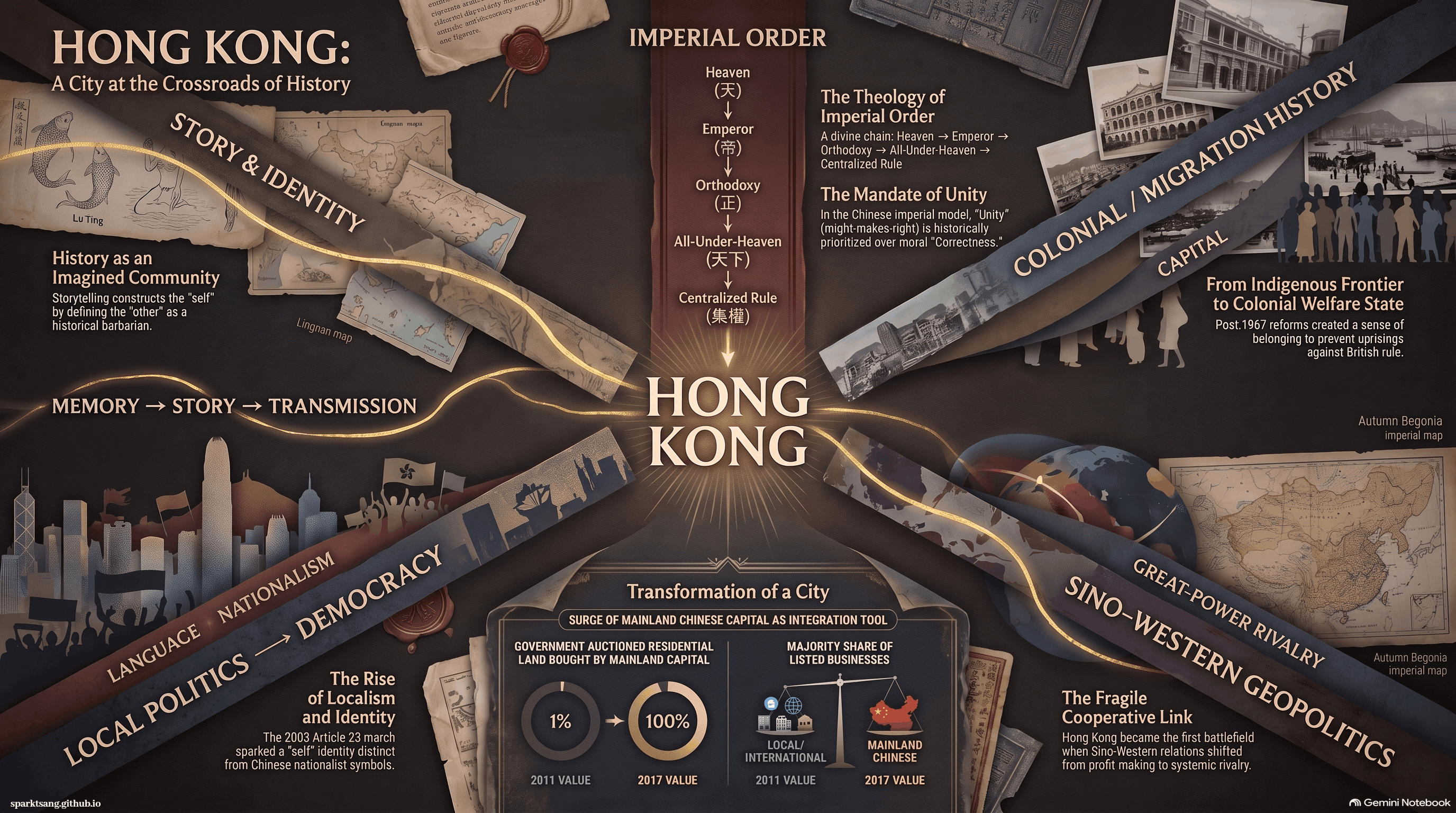
Notes on Like Water to the Ravine
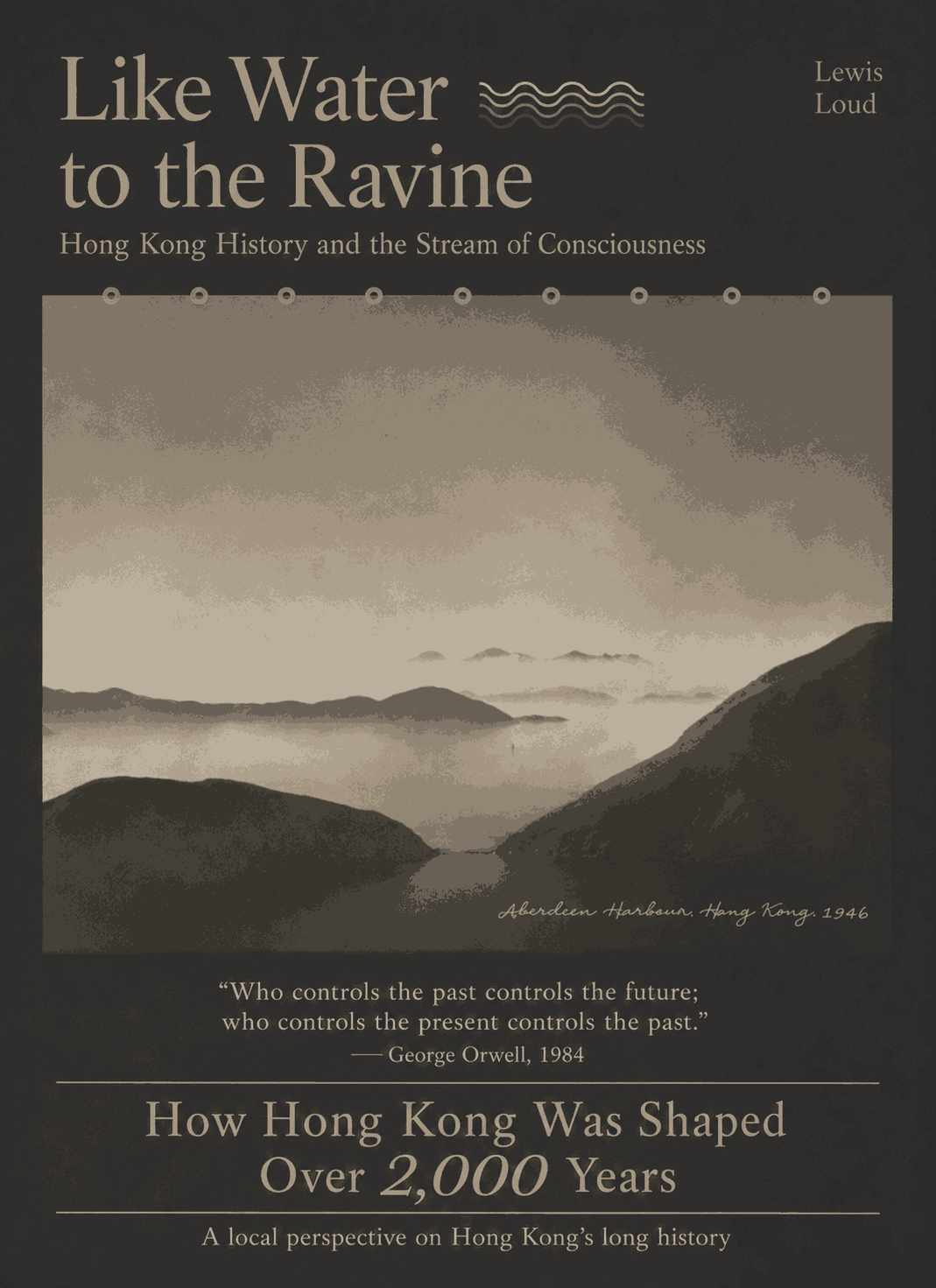
Like Water to the Ravine: Hong Kong History and the Stream of Consciousness by Lewis Loud
Original notes here.
Read until the end to get a bonus. Enjoy reading.
History uses the power of storytelling to bring together people of vastly different backgrounds, incorporating isolated individuals into an imagined community.
Who counts as a “barbarian” is a political designation that takes precedence over everything else, constructing the self by distorting the other.
A barbarian is someone who has lost their history and can only import a historical worldview. Just as Black people, beyond their original identity, may develop another consciousness that compels them to conform to the image of Blackness as seen through white eyes, they find themselves torn apart, their sense of self disappearing.
During the Eastern Jin, the rebel leader Lu Xun (盧循), a subordinate of Sun En, roamed southern China. One remnant group made its way to Lantau and Hong Kong Island, perhaps giving rise to the legend of the “Lu Ting fish people.”
In 1197, the islanders of Lantau clashed with the authorities over illicit salt. The imperial court sent troops to attack them and killed the islanders.
Cantonese only became Hong Kong’s mainstream language in the early twentieth century. By then Guangzhou had lost its economic position, and large numbers of Cantonese merchants moved to Hong Kong.
When the famous writer Lu Xun (魯迅) came to Hong Kong to give a speech, he attacked Sir Cecil Clementi for advocating the study of traditional Chinese culture, accusing him of “using our corrupt culture to govern this corrupt nation of ours.”
Nearly fifty years after the fall of the Qing, its laws still lingered in Hong Kong; bigamy, for instance, was not abolished as a criminal offense until the 1970s.
After the 1967 riots, the Hong Kong government developed social welfare and public services, giving Hong Kong people the sense that they could settle here for the long term.
Murray MacLehose built public housing, new towns, and the Mass Transit Railway, established the ICAC, and introduced free education. Hong Kong developed at extraordinary speed, perhaps partly in the hope that a stronger sense of belonging would prevent another 1967-style uprising.
In the student movements of the 1970s, the main factions were the nationalist camp and the social activist faction. The former identified with the Chinese Communist state, while the latter took localism as its guiding principle and could broadly be regarded as a collective term for those outside the nationalist camp.
After Britain decided to transfer all of Hong Kong, Kowloon, and the New Territories to the Chinese Communist state, some “socialist camp” university students participated in the propaganda campaign for a “democratic return.”
During the final years of British rule after June Fourth, the democrats consistently won elections by overwhelming margins.
After the “handover,” the electoral system remained unchanged for years. The executive dominated, the legislature was only half elected, and although it resembled a two-party system, the legislature had only extremely limited control over public finances and a right to question the government that had no substantive effect.
In 2002, the CCP sought to legislate Article 23 in Hong Kong. Jiang Shigong argued that “one country” was merely an empty symbol to Hong Kong people; in 2003, a march of 500,000 people erupted. It was the first genuinely local political movement without Chinese symbols, and 600 members of the elite signed a joint statement setting out Hong Kong’s core values.
The Article 23 concern group of the time was later reorganized into the Article 45 Concern Group, and then into the Civic Party. Other pro-democracy parties also emerged in succession, collectively known as the pan-democrats. Political parties became the driving force in politics.
In 2006, a new model of social movement emerged. Political outsiders opposed the demolition of the Star Ferry Pier, creating for the first time a voice capable of exerting influence outside the political parties. It was fundamentally different from the traditional pan-democrats, who concentrated on constitutional reform and democracy, and it also retrospectively recognized the history of anti-colonial struggle, rejecting progressivism, developmentalism, and the Lion Rock Spirit.
That same year, the League of Social Democrats was founded, marking the first clearly populist political party. It appealed to emotion and direct action; in 2008, it won three Legislative Council seats, becoming the third-largest democratic force. Its confrontational tactics in the legislature shocked conservative society and stood as a counterweight to the elite-inflected rationalism of representative politics.
The broad social changes after the handover were as follows: the target of protest shifted from Britain to China; the financial crisis put 500,000 people on the streets; although the Individual Visit Scheme revived the local economy, it shattered Hong Kong people’s romanticized illusions about mainland compatriots that had been sustained by distance; the spread of the internet made bad behavior by mainlanders widely visible; changes in the economic structure gave mainland visitors a mentality of entitlement; and the One-Way Permit system deepened fears of integration.
The pan-democrats had two roots: the “Greater China complex” represented by the Democratic Party, and the liberal cosmopolitanism represented by the Civic Party.
When the issue was mainland visitors causing disruption, the pan-democrats’ stance resembled that of the northern (mainland) media, which only made Hong Kong people more resentful.” In the 2010s, a number of “Liberate Hong Kong” protests erupted.
In 2009–10, the CCP opened the floodgates of credit. State-owned banks lent without limit to allies, and businesses invested heavily in Hong Kong: land prices were pushed so high that even local developers could no longer make money from the investments; from 2011 to 2017, the share of government-auctioned residential land bought by mainland Chinese capital surged from 1% to 100%, and property ownership gradually became monopolized by Chinese capital. At the same time, mainland capital made massive acquisitions across different industries; mainland Chinese companies became the majority of listed businesses, and government tendering projects also showed signs of being taken over by Chinese capital.
The CCP loudly proclaimed that the “critical decade” after the financial crisis would be the decade in which China overtook the United States to become the world’s most powerful economy, while also aggressively promoting the nationalist “Entering the Pass” meme (Ruguanxue).
Localism began to emerge: there were two forces. One was populist parties such as the League of Social Democrats and People Power; the other was the city-state theory, which held that Hong Kong preserved the finest elements of Chinese civilization and should sever itself from the Red North. In 2014 they converged, forming an electoral alliance, but lost to Hong Kong Indigenous and Youngspiration.
Other new forces outside localism included Scholarism and the book Hong Kong Nationalism, which received widespread attention after being singled out by the “Wolf” (CY Leung).
In 2014, the NPC’s decision was seen as the shattering of the dream of universal suffrage. Society arrived at two lines of protest: Occupy Central, and the class boycott launched by the Hong Kong Federation of Students together with Scholarism. These developed into the Umbrella Movement.
After its failure, the major organizations gradually withdrew from the alliance, severed ties with the Alliance in Support of Patriotic Democratic Movements of China, and found it difficult to contain the despair toward China.
At the beginning of 2016, the Lunar New Year incident was classified as a riot, and Edward Leung’s reputation soared. In the February by-election, he suffered a historic defeat despite winning a remarkably high number of votes.
That same year, Chan Chak-to formed the Hong Kong National Party, while Nathan Law of Demosistō, only 23, entered the Legislative Council.
The Civic Passion–Proletariat Political Institute–Hong Kong Resurgence Order alliance was regarded as part of the localist camp, but it did not coordinate with the political outsiders; Wong Yuk-man and Chin Wan both lost.
Beijing then weaponized disqualification (DQ), stripping Leung and Chan of their eligibility to run, and declaring the oaths taken by various political outsiders invalid. Nearly all of the new forces that emerged after the Umbrella Movement were driven out, and the Hong Kong National Party was formally outlawed in 2018.
The counterforce was released again during the anti-extradition movement, creating enormous effects both locally and overseas.
Beijing imposed the National Security Law, and the loyalty oath and disqualification mechanisms were extended to numerous public offices. National security arrests targeted those involved in the primary elections; the legal system came under pressure to reform; teachers, legislators, and civil servants all faced disqualification pressure; educational materials had to be politically correct; and national security education was rolled out across the board.
Some people may still cling to a hope that, had they endured a little longer, old Hong Kong might have lasted a little while longer. But the narrative that “it was all because XXX made the protests more radical and angered Daddy” has been repeated for more than a decade: it sees only individual links in the chain and not the broader climate.
The origins of the Fugitive Offenders Ordinance remain a mystery, but based on the broader context, one can speculate that in early 2019 the United States and Canada suddenly arrested Meng Wanzhou, China retaliated, and sought to use the amendment to turn Hong Kong into a place unwelcome to foreign visitors, all within less than half a year.
Huawei was simply too important. The West was not going to stop for Hong Kong; at most, it would pull out its capital and leave, while absorbing the talent and funds.
The situation was like Japan and Russia fighting a war on someone else’s territory.
Huawei has already been taking over the world through cyberspace and infrastructure. Apple and Google, lacking the state backing enjoyed by Huawei, make Huawei appear formidable. The whole-of-nation system hurts others at its own expense, stealing their technology and imposing a heavy price on American capital.
The traditional method in American politics was to suppress China through the entire system. Even under Obama, resources were provided to allies to resist the enemy. Trump, however, created job losses for American voters and fought a trade war using heavy medicine and the nation’s own capital as the stake.
No matter what Hong Kong people did, China and the United States were going to turn against each other. The countdown had already begun around 2008.
Hong Kong was the first major battlefield because it was the most fragile “cooperative link” in the relationship between China and the West. It was not the mainland proper; Hong Kong was merely a point of projection. No one expected Hong Kong people to react so violently.
In China, the movement had already shaken the social order, so Beijing used the chaos to pursue order on a larger scale. Everything it had endured in silence for twenty years, everything it had once been afraid to do, suddenly poured out all at once. If the previous two or three decades had been about buying time to build strength, that strength was now being blockaded by the West, and there was no longer any reason to tolerate Hong Kong’s semi-free order.
Hong Kong’s transformation amid such sweeping upheaval was a matter of historical contingency; the implosion of the global system was inevitable. The West wanted to maintain the status quo, while China wanted to “transform the barbarians through Chinese culture” (yong xia bian yi), believing that national rejuvenation was historically inevitable.
Britain opened its doors wide to China and pursued a scorched-earth strategy because it anticipated that its gains from the Sino-American community would diminish. There was no longer any need to honor its tacit understanding with China, and China exploded in fury at the loss of face.
In brief: the Chinese military wanted to conquer the world through Huawei; Europe and the United States fought back; China used Hong Kong as a trap for Westerners; the West said it opposed this but believed it could bear the cost; Hong Kong people’s anger exploded; China saw that the disorder had already erupted and, using a combination of suppression and dispersal, imposed a national security system to restore surface order before moving on to occupy the great mountain.
The West also responded with the same strategy of suppressing while dispersing, believing that Hong Kong had once been a happy playground where Chinese and Western capital could make money together but had then been monopolized by China. It therefore played the immigration card, leaving China with a mess in its hands and making sure that, even after getting Hong Kong, it would have little use for it.
If a whole-of-nation system state separates itself from European and American democracies, approaching mutual isolation and autarky, they may coexist peacefully. But once they enter the same market and the same international framework, friction is almost unavoidable.
Hong Kong’s historical contingency provided an epic-scale East-West conflict with a story.
The whole-of-nation system has stories for domestic consumption, but it is at a disadvantage when it comes to telling stories to the outside world.
The forces on every side jointly created the Hong Kong of the past century and more, built upon the shifting sands of temporary chaos. History has given Hong Kong people much that will never return.
Some say Hong Kong cannot be compared with the Jews because it has no religion. But religion is only one kind of story, not a necessary form of one.
Even if a story goes out, someone will pick it up and carry it forward, even if the people who finally finish writing it are not of our bloodline.
The story of Hong Kong today is this: a group of carefree people encounter enormous upheaval; some leave and some stay, but all of them use different methods to pass the same story on.
Severing Heaven and Earth: The Story of an Imperialist Religion
Without understanding the nature of the dynastic concept, it is impossible to understand what China is.
The religious consciousness embedded in the dynastic order is unfathomably deep, and it contains judgments of orthodoxy and value. The Bohai Kingdom and the Nanyue Kingdom did not call themselves dynasties.
Zhuanxu’s “severing Heaven and Earth” cut off the connection between heaven and earth, which also meant monopolizing the right to conduct sacrifices. Tribal chiefs of other groups could no longer communicate with Heaven on their own and had to go through the Son of Heaven. This was an early religious reform: authority was centralized, centrifugal forces were broken down, and political authority was established.
The emperor was Heaven’s agent; to resist the emperor was to defy Heaven. When the emperor conquered the barbarians, kingship spread outward. This was the beginning of Chinese religion.
Emperor Wu created reign titles, bringing time itself into a unified list. This was a unity of politics and religion on the model of God’s chosen people, long before the West; Christianity and Islam had not yet come into existence.
The Qin conquest of the Hundred Yue involved deliberate wars of aggression and ethnic massacres; colonialism, too, began far earlier here than in the West.
The Chunqiu-style historiography of Dong Hu, who wrote “Zhao Dun killed his ruler,” emphasized conveying profound moral meaning through subtle wording. Right and wrong came before truth and falsehood; social position determined what counted as right and wrong. The tradition of distorting facts can be seen even today in Taiwan’s refusal to accept “one country, two systems,” for which it is branded with the crime of “undermining cross-Strait peace.” Hai Rui’s judicial principles of wronging the junior (nephew/younger brother) rather than the senior (uncle/elder brother) have precedents that can be traced through this tradition.
From the family to the state, all history is moralized. Determining which regime is orthodox resembles a doctrinal dispute among religious sects.
Because Song China coexisted with Liao and Jin, anxiety over orthodoxy became especially acute. Chinese people today dislike the Northern and Southern Song because they do not fit the conception of All-under-Heaven: the Song, which signed international treaties and paid tribute to barbarians, looked more like one state among many than a “dynasty.”
Seeing itself as the center of the world and as having received Heaven’s mandate is a recurring feature of many early religious traditions: Mongolian religion, the self-deification of Roman emperors, Christendom, and the Islamic caliphate all belong to the same category as the “Chinese empire.”
Only Christianity was domesticated after being overturned by sectarianism, the civic class, science, and the nation-state. Chinese and Islamic civilization, by contrast, resemble thousand-year-old monsters: they were once dormant, then suddenly forced awake to confront the modern nation-state system, and therefore always seek to overcome modernity and restore their original nature.
Empires have always been systems of one country with multiple regimes. The Qing governed different regions through different systems within one empire. For Jiang Shigong, the greatness of “one country, two systems” lies in the fact that China can use it as practice for infiltration and takeover, refining its techniques.
First build influence through the economy, then exert cultural influence and united-front work, eventually establish feudal relations, and finally move from feudalism to prefectural and county administration, imposing direct rule and replacing native chieftains with centrally appointed officials. This is globalization in the East Asian world.
The imperial nostalgia for the “Autumn Begonia” (the shape of the Republic of China’s claimed territory map) remains a cultural, even religious, force for more than a billion people.
Lingnan was always regarded by people from the Central Plains as a land of barbarians. When Liu Zongyuan was exiled, he described himself as having “lived among barbarians for a long time.” During the Song, northerners migrated south. Outsiders and locals lived together, and to compete for advantage, people often fabricated genealogies, secured recognition from the imperial court by using tax payments, and became pioneers of colonization, appropriating land on a massive scale and reproducing Central Plains order around ancestral temples. Those who paid no taxes, owned no land, or lacked fabricated northern origins became barbarians, even monsters, such as the Lu Ting fish people of legend.
The multilayered internal order that maintained the scale of civilization also buried many contradictions. Japan, Korea, and Vietnam in particular either reacted against China or reflected the hierarchy embedded in Chinese civilization. In Cantonese, there is even the derogatory term “lou lo,” used for northerners. This is also why there have been so many incidents of collaboration with foreigners and treason in the Central Plains, from Wu Sangui to the collaborators who guided the Eight-Nation Alliance into Beijing, and to Hong Kong’s Ah Kwan.
Hidehiro Okada’s account in The Origins of Japan: the Wa king alliance with Baekje was destroyed by Tang, the Wa people went to Baekje’s rescue and were defeated, and were driven out of Korea, becoming orphans in the world. They then united to build a unified dynasty. In 668, Tenchi ascended the throne at Otsu, established the first legal code, the Omi Code, and called himself the “Emperor of Japan who reigns as the Manifest Divine One.”
Lu Chuan’s The Last Supper describes the power cycle of dynastic replacement with remarkable fluency. A commoner rises to become emperor through the philosophy that “rebellion is justified” and that ordinary people have the right to revolution; but once he becomes a ruler, he has to preserve the status quo and forbid others from rebelling. This is why Chinese curricula removed The Hereditary House of Chen She and replaced it with Zhou Yafu, implicitly praising practical enforcement of Party directives.
China’s indigenous religion was not Daoism but an imperial theology that began with “severing Heaven and Earth” and was completed by Dong Zhongshu. It emphasized orthodoxy and required a strong center and a hegemonic great power.
Yet when Emperor Min of Jin was killed, there was one year without a Son of Heaven, and orthodoxy was severed. Historians regarded the Eastern Jin as orthodox, but after the fall of the Eastern Jin, the argument could no longer continue.
Once the northern Xianbei rebuilt a China, historians could only regard both the Northern and Southern Dynasties as orthodox.
During the Song, when anxiety over orthodoxy was especially intense, Ouyang Xiu proposed that “correctness” and “unity” were independent concepts, referring respectively to “rightful possession of the throne” and “bringing All-under-Heaven together as one.” Beginning with him, the latter became more important than the former: having unity without correctness was superior to having correctness without unity, providing a way to regard the Song, which inherited the northern political lineage, as orthodox. Later, Su Shi said, “To speak of orthodoxy is merely to say that one possesses All-under-Heaven,” showing the influence of Ouyang Xiu’s model. This armed historiography of might-makes-right became one of the beliefs of contemporary Chinese people.
The Song’s historical circumstances later provided the template for a singular nationalism: “The ruler does not govern the barbarians” (Su Shi). Revolutionary nationalists sought to distinguish themselves from other ethnic groups, while the four peoples brought into the republic were reduced to minorities. The CCP found class solidarity with other peoples inconvenient and instead returned to a Han-centered model, assimilating other ethnic groups.
Everything the CCP does bears a Chinese imperial imprint: defending territorial integrity, refusing to recognize Taiwan as the legitimate government, assimilating other ethnic groups, and rejecting universal values in the inward-looking spirit of the Song.
Nazi Germany: “One people, one empire, one Führer.”
Chiang Kai-shek’s China’s Destiny: “One party, one doctrine, one leader.”
The pursuit of supreme moral rectitude for the gentleman and absolute unity under the ruler has deep roots and has nothing to do with Marxism-Leninism. No wonder Liu Xiaobo wanted China to be colonized for three hundred years.
The film version of The Shining delves into the dark underside of the American founding myth. The hotel is built on an Indian burial ground, and the cannibalism is a metaphor for the manifest destiny beneath the machinery of American Dream propaganda, its foundation unmistakably one of killing. The naked woman is the American Dream, a reward for proving oneself to the state. The hotel provides work and becomes the protagonist’s only source of self-worth; eventually he comes to believe that his wife and child interfere with his work and must be dealt with. Bringing order and healing to foreign lands can give an empire a sense of dignity.
China is the same: after the collapse of the planned economy and the failure of the red revolution, economic development became the only source of self-respect.
The CCP is China; the CCP is governance; the Chinese consciousness is a haunted hotel, built on a burial ground and continuously expanded.
The West first called China an empire under the Yuan dynasty. The Ming was called a kingdom because its ethnic character appeared more uniform, while the Qing was once again called an empire.
To lack an imperial lineage, or to have no legitimate succession, is terrifying, which is why Chinese people have perfected the art of claiming fathers: the conqueror becomes your father, someone else’s empire becomes your own empire. It is like the bullied Ah Q consoling himself with the psychological victory of saying, “I was beaten by my son.”
Through the engineering of historical selection, the outline of a single empire emerged, its roots linked back to ancient myths. Only then could the two republics inherit the estate of this empire, giving rise to the imagined civilization of five thousand years.
Assessing Ng Man-tat’s place in Hong Kong history: after World War II, growing numbers of Japanese came to praise the pro-shogunate camp, those who had “stood on the wrong side of history,” including the armed force known as the Shinsengumi, recruited by the shogunate and later regarded as men of loyalty and righteousness. Whatever the outcome, they were part of Japanese history.
Textbooks say: China never had imperialism in the past; it was gentle, good-natured, courteous, frugal, and yielding, governed by benevolence, righteousness, propriety, and wisdom, treasuring harmony above all. Its vast territory arose naturally, formed when ancient sage-kings civilized the barbarians through their influence. In modern times, China became a victim of Western imperialism, suffering national humiliation and the loss of sovereignty. In his final speech in Kobe, Sun Yat-sen likewise said that the West represented the way of power, while Asia represented the culture of kingship and virtue.
The fact is that the advanced feature of Chinese civilization is precisely that it was an imperialism from the beginning: there cannot be two suns in heaven or two kings among the people; under Heaven, all land belongs to the king; lands beyond the reach of royal civilization were places awaiting the transformation of customs and morals, effectively proto-colonies. “When All-under-Heaven is unified, the six directions share one custom and the nine provinces follow one thread” (Book of Han).
Using economic power as a condition for diplomacy, intervening elsewhere through military force, or establishing proxy regimes is far older than Western imperialism. For long stretches of history, the Chinese model was the only available path of development, and surrounding states could do little but imitate it and accept a China-centered international order.
According to Jun Yonawa, East Asia had already reached the “end of history” a thousand years ago: the Song-style state, with centralized power, economic freedom, civil-service examinations for recruitment, and freedom of status.
There was only one All-under-Heaven. Attacking another country therefore posed no inherent moral problem, and traditional culture contained abundant resources for justifying territorial expansion.
Jiang Shigong, advocating the revival of an imperial world under All-under-Heaven, argued that “one country, two systems” was a form of feudal governance on the frontier, followed, as the center grew culturally and materially stronger, by the increasing centralization or prefectural administration of the frontier. He also added that this mode of governance reached its extreme under the Qing.
Why did Japan assist the Chinese revolution? In 1927, Uchida Ryohei said: help the Han Chinese push the Manchus to the point where they have no choice but to rely on Russia; then Japan and China can join forces to defeat Russia, bring Manchuria and Siberia under our control, and lay the foundation for operations on the continent.
It is said that Sun Yat-sen made a secret agreement with Japan, allowing Japan to take Manchuria and Mongolia. But when he became provisional president that year, he was evasive about the issue, and he soon left office, so Japan had to fight for it itself.
Japan was then embracing Pan-Asianism: as the representative of the Eastern bloc, it had the right and responsibility to lead Asia in resisting colonialism by distant powers. This worldview was inherited from their historical memory of the “Tang ships” (karabune), casting Japan as the new bearer of “high civilization” to the rest of Asia. Hideyoshi’s two invasions can be seen as an early rehearsal, three hundred years ahead of time, for the Greater East Asia Holy War.
In 1943, with Chiang Kai-shek beginning to see a glimmer of hope in the Sino-Japanese War, he produced the monumental nationalist propaganda work China’s Destiny, sharing with Pan-Asianism the core of “Chinese civilization” and hence a “proto-colonial” mentality.
How enlightened and liberal China’s reformists and liberals really were can be seen from the renaming of Siam. Fu Sinian publicly expressed his opposition, saying Japan was interfering and stirring up nationalism in Siam, while Gu Jiegang used the history of the tributary system to argue that China was its mother country. The mentality of being a historical patron has a strikingly timeless familiarity.
In 1942, Fu Sinian prevented Tian Rukang, who was researching popular customs in Yunnan, from receiving an award. The prize had been established by the Republic of China as an academic award for research on mainland Southeast Asia. Fu argued that if Tian won, it would amount to government recognition that Yunnan and other regions belonged to mainland Southeast Asia. Ge Zhaoguang quotes him as saying that scholarship should not be overly controlled by politics, but if an idle piece of scholarship had adverse political consequences, it should naturally be suppressed.
Qian Mu, in writing Chinese history, declared at the outset that history should embody the Way, and “must in particular be accompanied by a certain warmth and respect for the past history of one’s own country.”
Joseph Lian Yi-zheng: judged by the moral standards and historical vision of the traditional scholar-officials since the Song and Ming, today’s CCP government could be called a golden age. And the conditions for a “golden age” as defined by national history amount to four things: educated people have official positions, the people have food, there is no large-scale war, and the territory expands.
The value of imperial unity often overrides democracy, human rights, and freedom. Even a democratic China conceals territorialism within it; hidden at the front is the word “one.”
Many people still comfort themselves with the ideology of the loyal minister: the emperor has merely been misled by corrupt ministers; Deng Xiaoping was an enlightened reformer; some even fantasized that Xi Jinping might implement political reform.
Deng’s concealment was only because the Cultural Revolution had shaken the Party’s rule. Had that not happened, no matter how bad the Cultural Revolution was, it would not have been rejected. Concealment was about avoiding the Party’s destruction, then planning for the future: withdraw, recover strength, and later crush the enemy.
Once a snake has shed its skin, the old skin is useless, which is why Deng is now merely concealed. Xi is Deng in his complete form, just as Legalism was the completion of Confucianism, empire the completion of the republic, and the bully the completion of the bullied.
Reform and opening was like the term “comfort woman,” a euphemism for sexual slavery: merely a smokescreen for introducing foreign capital, stabilizing the situation, and surviving. On the one hand, it advanced into the world; on the other, it kept its own market firmly under control.
It was through this that China survived when it seemed to have nowhere to go, and for that it is indeed worth celebrating.
The scholar-officials emphasized putting learning to practical use and bringing order to the country and peace to All-under-Heaven. Social mobility created the imagination of an enlightened monarchy. Jin Yong once said that China would ideally operate an enlightened socialism. The desire to save the world arose from this, and so did the scholar’s attachment to being tutor to the emperor. The scholar-officials eventually served the ruler, hoping to offer advice and even wield power.
In 1981, Deng Xiaoping summoned Jin Yong. What an extraordinary honor. When June Fourth came, Jin Yong was full of compassion for suffering humanity, but afterward the ministerial sickness returned. In 1999, he warmly referred to Chairman Mao, saying that “the entire nation supports and rallies around the Chinese Communist Party.” After that, he was like a fish in water in the old country: throughout his life, he remained a living fossil of the Chinese scholar-official class, with a genetic thirst for power embedded in the culture.
The lower classes remain slaves forever; the educated remain establishment figures forever. This is China.
For the last of the scholar-officials, he had seen the sage ruler and experienced the illusion of putting his learning to practical use. He could therefore die without regret.
“One country, two systems” was originally intended as a model for Taiwan, but after Taiwan completed democratization in 1996, its demonstrative value fell to zero.
The American role in Taiwan’s democratization was this: after World War II, just like its support for dictatorships in Latin America or the Middle East, the United States granted fiefdoms and honors to regimes so long as they served Cold War interests and did not upset the overall balance. But after aligning with China against the Soviet Union, Taiwan was no longer on the front line of the Cold War. America’s blessing was no longer reserved exclusively for the Kuomintang, so democratization became possible.
In Hong Kong, both China and the United States gained enormous benefits. The Democratic Party’s 2010 proposal was blessed by both sides, and the inability to introduce democracy immediately was also a consensus between the two countries.
After China and the United States came to blows, Hong Kong changed in America’s eyes from a place for making money into an avenue of attack. The United States therefore supported Hong Kong’s protests, entering through the dimensions of human rights, democracy, the economy, and finance, turning a destabilized Hong Kong into a bleeding point for China.
But China was still blocking Hong Kong’s democratization, and because Hong Kong controlled too many of the arteries of financial security, China was even less willing to let it run free.
The “resource curse” makes it difficult for Hong Kong to experience mass slaughter, while also ensuring that vested interests never want to let go.
Finished reading on Nov 9, 2021
Loud reveals how political empires operate like “imperial theologies”—engineering grand historical narratives to dictate orthodoxy, absorb identities, and justify total control.
But this mechanism of weaponizing stories to organize and dominate millions is not unique to Eastern history; it is the fundamental operating system of human civilization. How do these imaginary constructs become the reality we live and die for? In Homo Deus, Harari deconstructs this exact phenomenon on a global scale, explaining how “intersubjective fictions”—from ancient empires to modern political systems—have always been the true architects of our reality.
Thank you for reading until the end. This is a bonus infographic just for you.