Notes on The Journey of Humanity
The Journey of Humanity: A New History of Wealth and Inequality with Implications for Our Future by Oded Galor
Original notes here.
Read until the end to get a bonus. Enjoy reading.
The Industrial Revolution brought unprecedented change. A person from Jerusalem in the first century transported to 1800 would still have been able to adapt, but in the 21st century would have been unable to make a living.
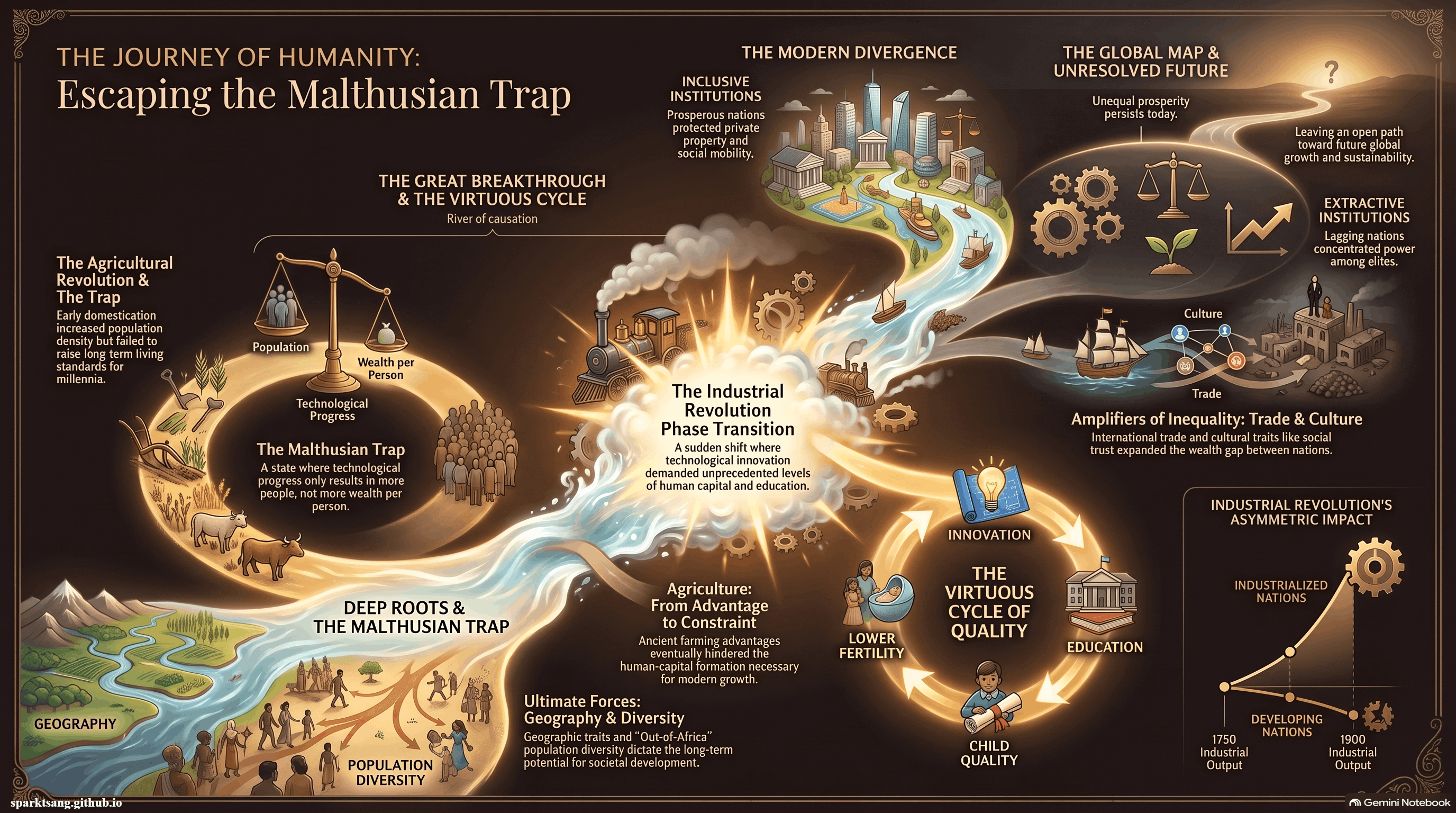
Before the Industrial Revolution, human civilization had never escaped the Malthusian trap. Understanding how it happened helps explain the enormous disparities in wealth and poverty across human societies.
Because the brain consumes enormous amounts of energy, while an oversized head makes childbirth difficult, few species could evolve powerful cognitive abilities. The fact that humans were able to develop high intelligence in the early stages of our evolution may have resulted from ecological, social, cultural, and sexual selection, setting off a virtuous cycle between evolutionary development and technological progress.
Evidence for the Malthusian trap: in 1500, whether a region was technologically advanced had no relationship with its income per capita, but was related to population density; the Black Death’s effect in raising income per capita was only temporary; the introduction of potatoes into Europe and maize into China had no long-term effect on income per capita.
Escaping the Malthusian trap requires a unified theory of growth. The author likens the process to liquid water turning into steam: a change in temperature can produce a sudden and complex transformation. Likewise, escaping the trap involved changes in both population size and population composition.
A larger population makes society more complex; technological progress triggers a shift toward the “quantity-quality trade-off” in reproduction, and this improvement in population quality creates a virtuous cycle with progress.
The Industrial Revolution unleashed wave after wave of invention and innovation. With the spread of education, human capital was formed on an unprecedented scale in human history. Previously, education was the preserve of the upper classes, and when it was made more widely available, it was intended for specific social purposes rather than to help individuals make a living. The causal relationship between the two can be demonstrated through quasi-natural historical experiments: in France, for example, places closer to a remote location where the first steam engine appeared had more steam engines, and the increase had a more positive effect on school enrollment and literacy.
As noted above, improvements in population quality drove further technological innovation. This can be supported by evidence from encyclopedia subscriptions in French towns and, a century later, technological innovation by companies, as well as the effect of the number of engineers in different countries on income per capita. It also helps explain why, although many countries possessed abundant coal, only Britain experienced an Industrial Revolution.
Marx predicted that intensifying competition among capitalists would inevitably worsen the exploitation of workers and eventually lead to revolt.
There are explanations for why this prediction failed: one holds that industrialized countries, seeing the danger, took steps to reduce inequality. Another argues that investment in human capital was becoming increasingly important, leading industrialists, parents, and workers to form an alliance based on their common interests against the resistance of landowners, the only group unable to benefit. This eventually produced a revolution in the spread of education; policies banning child labor were a parallel product.
In the second half of the nineteenth century, the Demographic Transition took place: birth rates in wealthy countries fell sharply, breaking the millennia-old rule that fertility rose with income and thereby escaping the Malthusian trap.
In ancient times, income and the cost of raising children dominated decisions about childbearing. Under the Industrial Revolution, however, human capital became extraordinarily important, greatly increasing the returns to investing resources in each child, reinforced by longer life expectancy and lower child mortality.
Evidence for a causal relationship between greater investment in children and lower fertility: the Reformation of 1517 encouraged people to study the Bible on their own. Three hundred and fifty years later, places closer to Wittenberg had more education and lower fertility; before 1517, there was no such relationship. In the United States in 1910, excluding the effect of hookworm on children’s learning ability, comparisons between affected and unaffected regions showed that the returns to educational investment helped trigger lower fertility. From the thirteenth to the twentieth century, in China, a larger share of people from small families took the imperial examinations.
Another factor was the narrowing of the gender wage gap. It had many consequences, but the main cause was the rise of cognitively intensive work, which increased women’s earning potential and therefore raised the opportunity cost of childrearing.
Technological innovation ⇆ human capital investment ⇆ low fertility
↖ ⇅ ↗
narrowing of the gender wage gap
This virtuous cycle later moved beyond narrowly defined industrialization: many manufacturing towns eventually declined as their factories and industries faded.
Innovations such as the telephone, Edison’s phonograph, wireless transmission technology, radio, and motion pictures arrived in rapid succession, transforming human life on every front and gradually eliminating poverty.
In short, technological change created an urgent need for human capital capable of adapting to a changing environment. Parents were consequently compelled to limit fertility in order to increase their investment in their children, while longer life expectancy and sharply reduced child mortality made the process even more favorable.
Can the era of growth continue? It depends on the long-term fundamental forces operating beneath it. Cross-country analysis shows that larger populations lead to higher carbon emissions, whereas rising income does not have the same effect. Therefore, under the forces driving the demographic transition described above, technological progress should be able to offset the environmental damage.
Even many years after the Industrial Revolution, global wealth remained extremely unequal, and even within the same country, inequality persisted across racial groups. In 2018, an American farmer produced 147 times as much as an Ethiopian farmer. Technology, education, and training were only proximate causes; they could not explain the ultimate origins of the disparity.
International trade expanded dramatically in the nineteenth century. The share of global products traded across borders was 2% in 1800, 10% in 1870, 17% in 1900, and 21% in 1913. Advanced countries exported manufactured goods, while less-developed countries exported raw materials and agricultural products.
International trade had important asymmetric effects on industrial countries and other countries. Industrial countries entered the demographic transition, whereas in less-developed countries specializing in raw-material production, the environment did not encourage investment in human capital. The demographic transition did not occur; instead, the system encouraged a larger supply of low-skilled labor.
From 1750 onward, industrial countries experienced exponential growth in industrial output per capita, while developing countries actually moved backward. It took them more than two centuries to recover to their 1750 levels.
The differences between North and South Korea cannot be explained by geography or culture; they stem from institutions.
Institutions can broadly be divided into two types: extractive institutions, in which elites monopolize and allocate resources, and inclusive institutions, in which political power is dispersed, private property is protected, and private enterprise and social mobility are encouraged. See Why Nations Fail.
Modern authoritarian political systems can coexist with open economies, as in South Korea, Taiwan, Singapore, China, Vietnam, and Chile, but these are historical exceptions rather than the norm.
Britain pulled ahead because of its more open political system. Historically, it lagged behind under feudalism. In 1589, Elizabeth I refused to grant a patent for a textile machine, and its inventor, William Lee, went to France.
After the coup commonly known as the Glorious Revolution, William III took the throne. Because his position at home was weak, he agreed to constitutional constraints and a division of power. Parliament subsequently passed legislation encouraging free market competition, and reinvestment of profits became widespread. In Spain during the same period, profits were used for war and luxury goods.
William III also reformed the financial system, introducing Dutch-style exchanges, government bonds, and a central bank, greatly reducing the government’s borrowing costs.
The deeper roots can be traced to the Black Death. Labor shortages increased workers’ bargaining power, weakening the feudal system, decentralizing power, and promoting social mobility. As a result, the institutions of Eastern and Western Europe diverged sharply thereafter.
British guilds often obstructed invention in order to protect the interests of their members. Their weakening made technological change more feasible. Possible causes included the largely unregulated rebuilding of London after the Great Fire of 1666, and the expansion of markets to a scale at which the guilds could no longer supply enough craftsmen on their own.
Did social openness cause economic prosperity, or was it the other way around? Or was there a third factor acting by chance, such as technological diffusion accompanying the adoption of particular political systems?
Evidence that extractive institutions damage the economy can be seen in Spain, which conscripted one-seventh of the population in parts of colonial Peru; even after the policy was abolished, the affected areas continued to suffer long-term damage.
Evidence that inclusive institutions benefit the economy can be seen in parts of France that were occupied by Prussia, where the Napoleonic Code was imposed and guilds and the aristocracy were suppressed. Even after the occupation ended, those areas remained more prosperous in the long run than unoccupied regions.
Hypotheses include the institutional advantage reflected in the greater wealth of former British colonies compared with other colonies; climate affecting crop abundance and the demand for low-skilled labor, thereby reducing incentives to invest in human capital; places where the climate favored smallholder farming, such as North America (except the southern United States), tending toward more open societies; heavily populated regions before colonization being more likely to develop extractive institutions, while sparsely populated regions had to encourage investment and development and therefore promoted openness; and places with fewer epidemics, which attracted more immigrants, also becoming more prosperous.
Yet institutional factors themselves have origins, and institutions alone cannot fully explain the disparities in wealth and poverty within democratic societies.
How Culture Can Shape Institutions
Christian teachings traditionally condemned love of money, as in the saying that “it is easier for a camel to go through the eye of a needle than for a rich man to enter heaven.”
After the Reformation, literacy, thrift, and economic activity were encouraged. Weber pointed out the relationship between the Protestant ethic and the development of capitalism; the differing levels of development across regions of Prussia in relation to the share of Protestants provide supporting evidence.
Take Jews, for example, whose culture encouraged education. At the beginning, cultural genes that arose randomly would be subject to natural selection.
Evolution tends to make communities inclined to preserve traditions. For most of human history, those who questioned tradition had no better alternatives. Technological progress, however, created the first situation in human history in which questioners gained an advantage, giving rise to the Enlightenment.
Just as a taste for sugar was once advantageous but now merely causes obesity, some cultural traits that were adaptive in ancient times may be maladaptive today and nevertheless difficult to change. This cultural inertia can help explain why the family-centered culture of southern Italy has struggled to absorb the benefits of modernization, as Edward Banfield argued in 1958. The American economist and Nobel laureate Kenneth Arrow also noted that low levels of social trust lead to weaker economic development. As for where family-centeredness and low social trust came from, Robert Putnam provided a historical explanation: southern Italy was once ruled by Norman kings and remained steeped in feudal legacies.
Italian cities that had already achieved independence in the Middle Ages enjoyed greater democracy and civic participation, higher levels of social trust, and greater economic prosperity.
There are other examples. Areas ruled by the Habsburg dynasty, renowned for administrative efficiency, still enjoy higher trust in government and lower corruption than neighboring regions; areas affected by the slave trade still have lower levels of social trust today.
Certain types of political systems and cultures influence one another and technological progress, producing virtuous effects. But why did particular places develop particular institutions or cultures in the first place? This requires tracing the roots further back to deeper causes such as geography and population diversity.
Geography: The Ultimate Driver
Central Africa suffered from tsetse flies and malaria, while livestock struggled to survive; all the cradles of civilization were near rivers; natural resources influenced forms of labor.
Beyond these, geography also had more indirect effects. Europe’s rivers were difficult to navigate, and its coastline was highly irregular, making regions easy to defend and difficult to conquer, which in turn led to political fragmentation. The vast plains of Asia, by contrast, allowed movement in all directions and often favored centralized authoritarian rule.
In ancient times, political unification facilitated the movement of goods by ship. But during periods of major technological innovation, fragmentation intensified competition, benefiting entrepreneurship and reversing the earlier advantage. Now that China has modernized, if there is no major technological paradigm shift, the geographic advantage of being easy to traverse in all directions may reassert itself.
Geography created different labor requirements for different crops, affecting how open institutions would be. Crops requiring large amounts of low-skilled labor were more likely to encourage slavery and exploitation.
Geography also affected whether people developed a long-term orientation. Data confirm that people whose ancestral homelands cultivated crops with long-term investment payoffs are more likely to exhibit long-term thinking; those whose ancestral homelands cultivated crops requiring large-scale cooperation, such as rice in China, are more collectivist.
Geography shaped gender attitudes: people whose ancestral homelands relied on plow agriculture tend to have weaker beliefs in gender equality.
Geography influenced attitudes toward risk: people from ancestral homelands with more stable climates tend to be more cautious, while those from more variable climates tend to be more venturesome, because variable climates allowed risk-takers to succeed in years or areas less affected by adverse conditions, spreading the associated cultural traits.
Language is also influenced by geography. Places with heavy snowfall developed richer vocabularies for describing snow. Similarly, languages in places that used the plow tend to distinguish more strongly between male and female. In ecologically diverse regions, because trade required communication across different groups, languages also tend to have more elaborate status distinctions. Places with high-calorie crops, because they encouraged more future-oriented planning, also tended to develop an indirect future tense.
Given geography’s enormous influence, why was Europe, seemingly destined to launch the Industrial Revolution, so backward for most of its history? This requires tracing the relationship between the Agricultural Revolution and geography.
Looking Back to the Agricultural Revolution
In 1989, evidence of cultivation from 23,000 years ago was discovered in northern Israel. The Agricultural Revolution first emerged in places with the geographic advantage of domesticable plants and animals. Large-scale domestication produced immune responses, and in historical warfare, the victorious peoples were often carriers of more deadly pathogens. At the same time, the expansion of agricultural civilization caused hunter-gatherer tribes to shrink, a pattern that repeatedly appeared around the world over the course of 10,000 years.
Yet the Agricultural Revolution was not a sufficient condition for technological advancement. New Guinea had agriculture early on but developed only tribal societies. Complex class societies with extensive specialization required effective taxation. At the stage when taxes were paid in grain, food had to be easy to identify, transport, and store. Historical evidence shows that areas producing grains were more likely to develop complex hierarchical societies, whereas areas producing root crops tended to develop only simpler societies.
The early advantage of the Agricultural Revolution persisted until around 1500. After that, the center of innovation shifted from the countryside to cities, and the initial advantage of agriculture became a constraint: large populations engaged in farming hindered the formation of human capital and the demographic transition.
Institutions and culture certainly influence change over decades and centuries, but viewed across the full span of history, neither was a core determinant of the journey of civilization.
Beyond geography, there is another ultimate factor: population diversity. To understand it, we need to go back to the Out-of-Africa migration.
The Story of Out-of-Africa
Cultural diversity can generate creativity, much like the birth of rock music. At the same time, ethnic diversity can reduce trust and generate conflict. Therefore, without measures to reduce the damage that diversity can do to social cohesion, both extreme homogeneity and extreme diversity can reduce economic prosperity; a moderate level is optimal.
According to the serial founder effect, population diversity across regions of the world is inversely proportional to the distance of migration from Africa. Using distance from Africa as a measure of the degree of social diversity, it is striking that, in both the premodern and modern eras, indicators of economic prosperity form a bell curve when plotted against diversity (population density in the former and income per capita in the latter, both in logarithmic form).
In the modern era, because growth is driven by innovation, the peak of the curve has shifted slightly to the right, toward greater diversity. In the ancient world, the peak was found in areas such as China, Japan, and Korea; in the modern world, it is found in places such as the United States (Ashraf and Galor 2013).
Humanity left Africa such a long time ago, yet this factor still matters. It can explain one-quarter of the previously unexplained variation in social wealth (Ashraf et al. 2021).
Epilogue
The Washington Consensus sought to improve poor countries through a series of policies, but ignored the deep-rooted causes of wealth and poverty in human societies; in reality, this was little different from cargo cults.
Some places that once practiced cargo cults have today become tourist destinations, with incomes far higher than before. The fate of nations is not fixed.
This book surveys the sweep of human history and identifies the fundamental forces that shape economies. By comparison, accidental events may appear to have major effects, but their long-term impact is limited.
May this understanding help human societies design policies conducive to prosperity and move farther away from poverty.
Finished reading on May 29, 2022
Galor demonstrates that the wealth and inequality of modern nations are not historical accidents, but the inevitable result of deep geographic and demographic forces that shaped the evolution of their institutions. He warns that trying to impose superficial economic policies without understanding these deep roots is nothing more than a “cargo cult”.
But how exactly did these geographic pressures translate into the complex political structures we have today? In The Origins of Political Order, Fukuyama provides the definitive macro-historical map of this process, tracing the evolutionary paths that allowed some civilizations to develop the rule of law and accountable government, while others fell into cycles of authoritarian decay.
Thank you for reading until the end. This is a bonus infographic just for you.