Notes on Foragers, Farmers, and Fossil Fuels: How Human Values Evolve
Foragers, Farmers, and Fossil Fuels: How Human Values Evolve by Ian Morris
Original notes here.
Read until the end to get a bonus. Enjoy reading.
Every age acquires the ideas it needs; the way energy is obtained determines its values
Values are intangible. This book therefore focuses on specific targets, limiting itself to equality, concepts of hierarchy, and attitudes toward violence
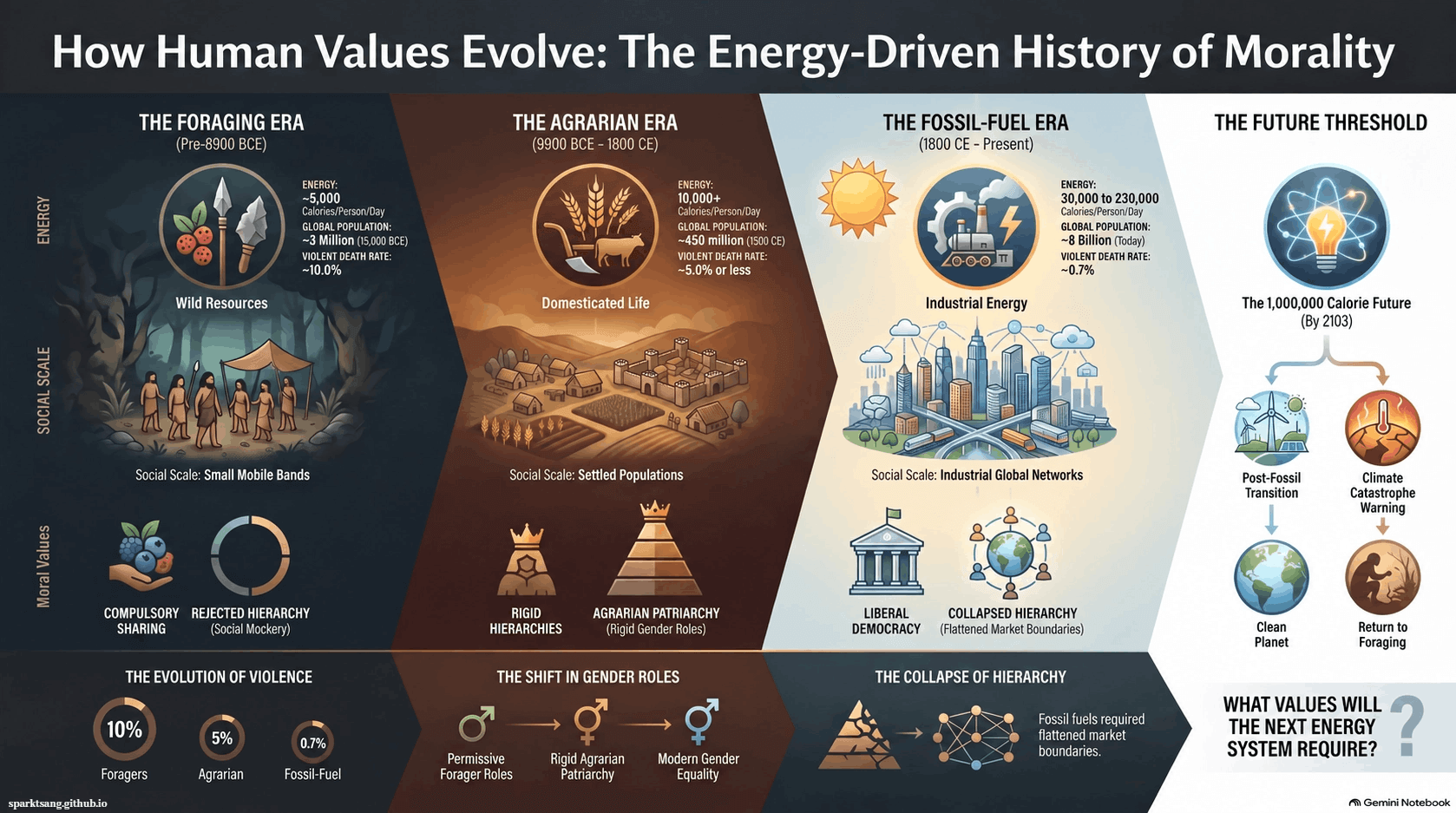
First stage: Foraging values: equality is prized, while violence is tolerated to a considerable degree
Second stage: Agrarian values: hierarchy is valued above equality, and violence is less tolerated
Third stage: Fossil-fuel values: equality is more precious than hierarchy, and violence is completely intolerable
Perhaps this principle proves that the search for a perfect morality is futile; today’s values are of little use for the future
Research into cultural upheaval involves a struggle between those who explain and those who seek to understand. There have been three waves of explanation: conjectural history, which declined in the 1790s; classical evolutionism, which took shape in the 1850s; and neo-evolutionism, which emerged in the 1950s
Refuting “reductionism”: all disciplines are products of reductionist thinking
“Materialism”: organizational systems reward particular values; cultural, religious, moral, and philosophical thinkers occupy only a minor place in the long history of values
“Universalism”: acknowledging that some regions are exceptions because they cannot sustain foraging or agrarian ways of life, but believing that the principle applies to 95% of humanity
“Functionalism”: values are adaptive traits and functional components of larger systems
“Evolutionism”: life is not a blank slate; it allows people to choose their preferred values
Peter Richerson & Robert Boyd: some values become popular and spread among individuals, while others fail to attract people and disappear
Leslie White: C=ET (culture, energy, technology). This book argues that the formula is broadly correct: energy drives cultural evolution
The World Values Survey quantified values along two dimensions: traditional to secular-rational values (attitudes toward religion, family, and authority), and survival to self-expression values (physical and economic security, trust, and tolerance). It found that the composite value score correlates with economic development at 0.43, and that the overall range of where countries fall on the value spectrum can be divided by cultural traditions (Confucian, Protestant, Catholic, English-speaking, Orthodox, Muslim, Latin). Although there are anomalies, it is difficult to believe they are mere coincidence
https://www.worldvaluessurvey.org/photos/EV000190.JPG
Foraging
A gene pool that does not alter the source of its resources
Share of humanity: 20,000 years ago, 100%; before 9500 BCE, 99%; 500 years ago, 10%; 1800, 1%
The closer people live to the equator, the less energy they need
The “original affluent society” view: foraging can provide food but little else materially; even the easiest foraging lives are punctuated by periods of scarcity; life expectancy is only somewhere in the mid-20s to mid-30s
Hierarchy: anyone who regarded himself as the boss because of his hunting prowess was treated as reactionary, mocked, ignored, or expelled
There was a culture of compulsory sharing, stemming from the fact that people had little portable property and could not accumulate wealth; the average Gini coefficient was 0.25
Gender: men were all captains, women all sailors; men monopolized violence, while women had to negotiate for protection. Attitudes toward adultery were permissive: although a man might beat a promiscuous wife, it was rarely regarded as a permanent disgrace. Men who overreacted would be mocked. This was because there was no wealth that could be passed down across generations, so the issue of paternity did not matter much
Violence: men competed for women and treated one another violently; violent men had more sexual partners and children. One adult in ten died violently. The prevailing view was that there were circumstances in which violence was the proper solution, and the only way to stop a reactionary was to unite and kill him
Agrarian
The energy source was domesticated plants and animals, modifying the gene pool from which resources were obtained. People lived in large groups and rarely moved
The typical farmer sits in the middle of a three-pointed star, with each point representing an extreme case: slash-and-burn cultivators (who had domesticated organisms but retained a foraging way of life; the dividing line was reached when typical farmers came under the domination of another class), proto-industrial states (on the verge of the Industrial Revolution: Qing China, the Mughal Empire, the Ottoman Empire, Enlightenment Europe), and commercial city-states (which shared features with fossil-fuel societies: ancient Athens, medieval Venice)
Like foragers, agrarian societies began in particular places and times, then spread across the globe. Foragers took more than 50,000 years to spread throughout Africa and beyond, with the population growing sixfold (70,000–15,000 BCE; 50,000–3 million). Farmers needed only 11,000 years, while the population grew ninefold (9500 BCE–1500 CE; 5 million–450 million)
Differences in how farmers made a living and organized themselves were largely driven by geography. Around 1000 BCE, the Roman Empire controlled the Mediterranean and its capital had a million inhabitants; in the East, after the Grand Canal was developed in 609, Chang’an also had a million people by 700
The explosive evolution of energy acquisition: domestication initially brought 5,000 calories per person per day; slash-and-burn cultivation reached 6,000; more efficient domestication (selective breeding of grains and legumes, wool and milk production, using oxen to pull ploughs) raised this to 8,000
Population growth during the medieval warm period around 900 forced farmers to work harder
The Black Death wiped out half of Europe’s population, and with skilled labor suddenly scarce, wages surged to a peak. After the recovery, they fell back again
Gender: as the population grew, land became scarcer and labor more arduous, making male upper-body strength advantageous in agriculture
With abundant mouths to feed, women averaged seven children and had to devote enormous amounts of time to pregnancy
Food often required processing, so women, who spent more time indoors, took responsibility for it (special joint disorders among women provide evidence)
The inheritance of fields, houses, and livestock could determine life or death, giving rise to a concept of chastity designed to ensure that children were truly one’s own
Organizing labor on a larger scale required institutions beyond the family. Markets did play a role: much of the labor that built Rome’s marble monuments was wage labor. Overall, however, anyone with enough land to support a family preferred working the land to selling labor, and wages based on the marginal product of labor were often extremely low. This gave rise to forms of coerced labor rarely seen among foragers, including slavery and serfdom
Greater specialization of labor also made intellectual life more specialized. Writing appeared in many regions. Complex divisions of labor depended on specialists in “the masters of violence.” In every such case, energy acquisition rose to 10,000 calories per person per day, or more than 10,000 for townspeople, allowing a small number of people to seize power: Mesopotamia around 3500 BCE; the Indus Valley around 2500 BCE; northern China around 1900 BCE
To preserve royal power, kings granted vast estates to nobles. To make themselves seem more important, nobles portrayed themselves as experts in religion, law, writing, and warfare
Farmers in each region developed their own dialects, rituals, and traditions, and were also horizontally isolated from one another (Gellner 1983). The miraculous exceptions were often city-states, but Athens, for example, still contained large numbers of horizontally isolated slaves. Rather than eliminating the divide, it expanded the elite, astonishingly, to one-third of the population. Its population level should still be classified as that of an agrarian state, however, far below the next stage
Hierarchy: the old order differed from the new order after the Industrial Revolution. The basic idea was simple: some people gave orders, others obeyed; everyone played his role, and the world would function accordingly. The clearest description is found in the Book of Rites. At bottom, it was a divinely ordained doctrine of the Mandate of Heaven based on circular reasoning. Most people regarded inequality as perfectly natural. Society was deeply attached to the meaning of hierarchy, and even rebellions were usually directed not against the system itself but against a small number of rulers who had failed to uphold the old order. They were also often directed at local power rather than the core of authority
In the first century, the Roman Empire had a Gini coefficient of between 0.42 and 0.44
Around 1000 BCE, a new concept challenged sacred kingship. This was the Axial Age. Philosophers in different places began questioning human nature and proposed transcendent ideals (nirvana, benevolence, beauty, heaven, the Dao), urging people to abandon desire and follow reason, to refrain from doing to others what they would not want done to themselves. These ideas threatened the status quo, but all the ancient civilizations eventually collaborated with them, defusing their force and incorporating them into the system: Ashoka followed the “Dharma,” Han China elevated Confucianism, and Rome first adopted Stoicism and then domesticated Christianity. This demonstrated the remarkable adaptability of the old order. Later, al-Ghazali, Zhu Xi, and Aquinas combined the idea that people were equal before heaven with the earthly need for hierarchy into complex syntheses
Every age acquires the ideas it needs: the only way to make more than 10,000 calories available to every person each day was political and economic inequality. Moral systems adapted to energy requirements. Only when those requirements continued to be met did people’s attitudes change. Consider the Greek city-states
At 30,000 calories per person per day, the old order began to be dismantled in both East and West: Richard Rumbold in England; Chinese peasants in 1644
Gender: almost no one had seriously considered the possibility of gender equality. Evidence of challenges to patriarchy is scarce. When ethnographers interviewed women in the early twentieth century, they found that many accepted gender inequality as legitimate. Just as among foragers, people mocked reactionaries: entire villages would ridicule men who let their wives dominate them or be “under the thumb” of their wives
Violence: violent death exceeded 10% among foragers, but was only around 5% or lower among farmers. Only an agrarian society with such complex divisions of labor could function this way. Rulers wanted to do little more than collect taxes and maintain peace, giving them strong incentives to subdue their subjects and make them work hard, and to persuade everyone through law that only the rulers possessed legitimate violence. The concept of the gentleman/man of honour evolved from someone prepared to use violence into someone capable of self-control. Underneath it all was the principle of the old order: force is righteous only when demanded by the ruler
The Fossil-Fuel Tribe
Two thousand years ago, people in northwestern Europe had already discovered that burning coal produced heat. Yet it was not until around 1000 in China and 1600 in England that coal truly began to compete with wood as a major fuel
An Egyptian engineer in the third millennium BCE discovered that steam generated by burning wood could provide the kinetic energy for an automatic temple door, but the idea never became widespread
In the seventeenth century, fossil fuels and steam began to be used in production. In 1776, Watt and others developed a separate condenser, dramatically reducing coal consumption. By 1800, energy use had reached 30,000 calories per person per day; by the 1970s, it had reached 230,000
As with the previous two eras, the process began in a particular place and time and then spread across the globe. During the nineteenth century, the share of the world’s population living in Europe and North America rose from 15.8% to 23.6%. Growth then spread more widely, and global population rose from 1.6 billion to 6 billion during the twentieth century
Agrarian purchasing power was low; markets were fragmented, tiny, and inefficient, making it difficult to gather enough people. Fossil fuels changed the structure of markets and generated a virtuous cycle, removing old obstacles. Profits gave workers extra income with which they could buy products, while higher wages drew more people out of farming and into factories. Factory work was dangerous and filthy, but still better than starving
Wages initially rose only slowly, but began accelerating at an unprecedented rate in the 1830s, at exactly the time Marx and Dickens were writing. Britain’s Gini coefficient was 0.55 in 1867, then fell back to eighteenth-century levels by 1913. France stood at 0.60 in the 1860s, falling to 0.48 by 1901
Higher wages made forced labor unnecessary, and abolitionism swept across the world: Britain in 1833, Russia in 1861, the United States in 1865, Brazil in 1888
Infant mortality fell dramatically. Women no longer had to spend most of their lives reproducing, freeing decades for participation in the market. Markets also provided solutions that sharply reduced the time they had to spend on household labor, and consciousness of gender equality surged everywhere
Agrarian states operated by drawing boundaries, reinforcing hierarchical structures. The optimal way for fossil-fuel societies to function was to erase boundaries: the larger the market, the more efficient it became
There were two paths, free and unfree. The former removed traditional norms while allowing differences; the latter directly flattened differences, even at the cost of violence. The two could not be reconciled
In free societies, secular systems of thought spread rapidly and church participation fell sharply. In the 1960s, political barriers based on property, kinship, religion, education, and even gender came under attack and finally collapsed
Nineteenth-century liberals championed small government, but fossil-fuel societies were too complex to sustain that ideal rigorously. By the end of the nineteenth century, neoliberalism relied not only on the invisible hand but also on the state’s invisible fist to provide public services
Both free and unfree industrial states at times segregated unpopular groups, seeking to protect their own people from contamination
The free side won decisively. According to Freedom House: in 1972, 29% of societies were free and 46% unfree; by 1998 the proportions had reversed, with 46% free and 26% unfree. Its success depended not only on its ability to produce wealth but also on its ability to prevail through violence: without cooperating with the Soviet Union, liberal democracy could not have defeated Nazi Germany
One result of competition between the two political systems was that the power of both states expanded dramatically, creating a new liberal order
In almost every country, the post-tax Gini coefficient plunged sharply beginning with the Second World War, bringing inequality close to forager levels (Smith et al. 2010; Chu et al. 2000). Although inequality later increased, it still did not reach the typical agrarian Gini coefficient of 0.48. Globally, moreover, the figure has been declining since 2002. Before that, most of the gap reflected the gulf between industrial and agrarian countries
Within ten generations, hierarchy, once regarded as naturally just, rapidly collapsed. The new thinking began with the Enlightenment’s challenge through reason, itself a response to the entirely new economy of the North Atlantic coast (Why the West Rules—For Now). At first, European monarchs adopted Enlightenment criticism, just as ancient emperors had submitted to Axial Age ideas. In 1740, Frederick the Great accepted Christian Wolff’s view that philosophers should serve as mentors to the world and its rulers. It was not until the second half of the eighteenth century that the old order faced genuine pressure. Rousseau’s Social Contract, published in 1672, declared that “the only source of political legitimacy is the common will of the people,” becoming a foundation for the new constitutions of France and America. By the middle of the nineteenth century, societies without rigid boundaries had gained the upper hand, and their values flourished
Lenin and Mao Zedong attempted to concentrate power in order to abolish class. Both countries eventually abandoned personality cults, leaving only Kim Jong-un still hanging on. Even those at the very top can no longer simply overturn the system at will; the head of the International Monetary Fund was accused of rape and dismissed
For two centuries, equality of opportunity and equality of outcome have pulled against each other. Unfree regimes have undertaken enormously damaging experiments, while free regimes have also discovered that there is no perfect solution
Violence: it prevents the open social space in which industrial societies’ replaceable citizens can function. Such societies depend heavily on peace. The violent death rate was 1%–2% in the twentieth century and, according to the WHO, has now fallen to 0.7%
There were few absolute pacifists in the twentieth century. The twenty-first century has changed that dramatically
Taken together, the attitudes of the three societies toward political inequality, economic inequality, gender inequality, and violence:
Foraging: bad, bad, medium, medium
Agrarian: good, good, good, between medium and bad
Fossil fuel: bad, medium, bad, bad
The Taliban’s mistake is that they remain trapped in agrarian-state thinking. The age that required this kind of value system has already disappeared, and the remnants will disappear as well
The Evolution of Values
Why did systems of energy acquisition change, and was the change inevitable?
Like an evolutionary feedback system, beneficial changes accumulate. The outcome is not inevitable, but the probabilities are overwhelmingly tilted in its favor, making non-occurrence exceedingly unlikely
Conditions for the invention of agriculture: long summers (caused by climate change), and modern humans capable of husbandry
Domestication mostly originated in a fortunate band of latitudes, one more strongly affected by warming
Most people did not face an extreme binary choice. Rather, it was a question of whether to do a little less foraging and a little more planting and herding. There was a gradual transition zone between agriculture and foraging
After thousands of years, farmers left descendants while those who clung to the old ways gradually died out
When people shifted to agriculture and created larger societies, the best solution in almost every region was to invent gods
Agrarian city-states became hotbeds of invention and creativity, giving birth to Axial thought. Around 1000 BCE, competition grew increasingly intense, pushing societies toward centralization. Rome and, a thousand years later, the Song dynasty reached the hard developmental limits of agrarian states; revolutionary change was the only way to break through them
Fossil-fuel society also emerged in a particular place and time, for the same reason as agrarian society: pure geography. China possessed seafaring capabilities by 1200, but the Pacific was too vast. It took centuries more before crossing the Pacific became commercially attractive. Western Europe, being closer to the Americas, discovered them in 1492 and by 1700 had become a powerful wealth-creating machine, smashing through some of the limits of agrarian states
The basic technologies of fossil fuels were familiar in many places, but only eighteenth-century Europe learned how to exploit them. Economic growth drove wages to very high levels, giving northwestern Europe stronger incentives to experiment than other regions. England, where those incentives were strongest, unsurprisingly became the first breakthrough point. By 1850, it ruled the world like a giant
Future:
What is commonly called “the West” would be better described as “the fossil-fuel world.” Otherwise, it would be like claiming that agrarian values are products of Southwest Asia and foraging values are products of Africa
The spread of liberal democracy arose from the Industrial Revolution’s expansion across the world, and those values were most effective within industrial countries
Japan’s inability to fully liberalize its political system is related to the economic stagnation of the 1990s. East Asia’s inability to liberalize its economic systems is related to the major economic crisis of 1997. For China in the future, maintaining economic growth may leave its greatest challenge as how to handle its own liberalization. India’s greater degree of freedom could become an advantage over China within a few decades
A completely new way of acquiring energy may now be taking shape. Why the West Rules—For Now: by 2103, the East surpasses the West, with both reaching social development scores above 5,000 points, more than four times today’s level. This implies one million calories per person per day (compared with 230,000 today), cities with 140 million inhabitants, weapons that make hydrogen bombs look like matchlock muskets, and perhaps a revolution that redefines what it means to be human
Agrarian states reached their hard developmental ceiling five times (Rome, Song China, the Mughal Empire, Qing China, and early modern Europeans). Whether fossil-fuel society also has a hard ceiling seems likely to have an affirmative answer. Climate scientists unanimously agree that unfettered fossil-fuel burning will bring catastrophic disaster. The four horsemen of the Apocalypse seem to be stirring again in the twenty-first century
Whether humanity flies toward 5,000 points or plunges straight into nuclear winter, another post-fossil-fuel stage may have to be added before 2103: will the future be a new kind of society, or will humanity fall back into foraging?
Values cannot be separated from reality. Moral philosophers are ultimately arguing over which values are best for the current stage of energy acquisition, but clarifying the kind of thinking our own era requires is still an enormous contribution
Seaford’s Critique
Forager equality exists because their groups were small, like a camping party; the author acknowledges an innate sense of justice and also notes that agrarian societies had their own cries against injustice, yet classifies agrarian society’s valuing of inequality as “good”; the frequency of violent incidents may simply be a function of group size, creating a need for defensive measures
Regarding the exceptional case of Athens, the author overlooks the difference between democratic states and states ruled by a supreme deity. Economically, Athens was also more equal than Britain or the United States today. It compelled the rich to fund public works and thus did not conform to agrarian values so much as challenge them. Agriculture was only one of several factors that gave rise to values; geography, scale, and the degree of foraging mattered as well. Greece was small because it was divided by mountains and seas, and animal sacrifice preserved elements of hunting culture
Finally, he questions the author’s account of moral nature and cultural evolution, criticizing his emphasis on competition, quantification, and efficiency as the ideology of capitalism’s ruling class rather than concepts belonging to ancient economic systems. He also asks what it means for something to be “effective” at a particular stage of energy acquisition, and argues that conscience, in an age now nearing the brink of extinction, is not merely appealing but necessary (rather than a justification for using more fossil fuels)
Jonathan Spence’s Critique
He praises the author’s comprehensive coverage across time and space and his astonishing research skills, but argues that tiny branches and details may have vast consequences, ultimately producing a picture radically at odds with reality. There is no idea in the world capable of preventing the magnificent edifice of the “Human Development Index” from being altered, or even completely transformed
Korsgaard’s Critique
Animals cannot make value judgments. The conception possessed by someone who judges value correctly is precisely the conception of moral truth. Reason itself evolved, but that does not undermine its ability to arrive at correct judgments. Believing in moral truth makes action more effective, and acting on the assumption that one’s own values are true is itself more effective
The relationship between values and value judgments is a philosophical question. Some philosophers believe that values are intrinsic and value judgments are responses to them, with a correct judgment representing the recognition that something really has value. Others believe that value judgments come first, and that things are valuable simply because value has been judged correctly. The latter view may be more congenial to contemporary scientific concepts
Many philosophers connect moral judgment with our evaluative or normative conceptions of people and of ourselves. Harry Frankfurt points out that “caring” involves “wanting to continue to desire” something until a goal is achieved, representing a commitment to one’s desires. Values must therefore be connected with evaluative or normative conceptions of the self, pushing the self toward a standard and determining what kind of person one wants to become. If this is true, then only beings with such concepts can make value judgments. Other animals seem to lack this ability; they do not regard themselves as beings of value or worthlessness. Humans can view themselves as Kant’s “ends in themselves” or Rawls’s “self-authenticating sources of valid claims”
The only point the reader needs to accept is this: if there are moral truths, and if they are knowable to us, then our capacity for value judgment is not an accidental by-product, regardless of how the two are connected
Three views:
One, human value judgments can be explained by evolutionarily driven social motivations
Two, the Enlightenment view: humans possess the capacity for value judgment, and that capacity has a natural tendency to latch onto moral truth, developing slowly through history
Three, the distorted view: humans possess the capacity for value judgment, and that capacity has a natural tendency to latch onto moral truth, but it is easily distorted by social motivations
The first view has already been criticized above: if values are merely methods of maintaining a given form of energy acquisition, and everyone understands that, it is difficult to see how such values can actually work
An egalitarian society in ancient times where everyone was a chief may later have been suppressed by demands for energy
What the author cannot persuade himself of:
One, the author sometimes merely shows that opposite values would not be especially necessary under a particular set of circumstances, without explaining why the particular values were necessary. For example: why does foraging require equality? Why does foraging permit promiscuity and infidelity?
Two, the fact that agriculture requires a strict division of gender roles does not mean that it requires a patriarchal gender hierarchy. A world in which women ordered men out to work would be perfectly viable
Three, he cannot explain why foraging societies tolerated violence. Perhaps people had stronger incentives toward violence and therefore distorted their conception of moral truth; perhaps it came from the importance of honor in that era, where humiliation was equivalent to being physically attacked
Another thought: today a murderer does not need to wield the knife or pull the trigger himself, so statistics on violent death cannot capture everything
The main argument: acknowledging that social forms exert pressure on the formation of values does not require believing that social forms completely determine the whole of the value system
Regarding the author’s comment that the Taliban who shot Malala were not morally wrong because they believed that a girl who wanted to go to school should be subjected to violence: if this means that “their view contains no defect of moral character whatsoever,” then there is room for doubt. If it means that their action was not wrong, then the author is simply a hypocrite who does not believe in moral truth
Margaret Atwood’s Critique
The critic says that his expertise is more traditional than that of scientists and philosophers. Addressing the great question “Where are we going?” among the three ultimate questions, she cites The Age of Empathy, The Social Conquest of Earth, and The Meaning of Human Existence
Imagining the collapse of civilization and the many possible paths it could take is highly advantageous to novelists
Pastoralism also had a profound influence on human civilization: large-scale warfare originated among horse-riding pastoralists of the steppe (John Keegan)
I would add a sixth and seventh horseman of the Apocalypse: the collapse of the oceans (algae produce 60%–80% of the oxygen; if Agent Orange had sunk into the sea during the Vietnam War, humanity would have been finished), and biological engineering
There is a basis for humanity’s love of speculating about the future. Endel Tulving pointed out that the brain’s episodic-memory system is not for remembering the past but for predicting the future
The Author’s Response
Although he has read extensively through the literature, he does not recall anyone withdrawing a position because of harsh criticism. He does not want to be the first, but after clarifying his thoughts, he lays out here the assumptions, claims, and implications of his entire theory
Two assumptions:
One, almost all humans care about a number of core values (fairness, justice, respect…)
Two, these values are biologically evolved adaptations
Korsgaard should have little disagreement with the second point, but he disagrees with her claim that animals lack value judgments. His dog at home, for instance, believes it has a duty to punish any animal that refuses to regard itself and his wife as the lead dogs
Claim One: In the 20,000 years during which humans have interpreted core values, the process can be divided into three major stages, each broadly associated with one of the three main methods of energy acquisition
In response to the writer’s criticism that he omitted the pastoralist stage, the author admits his mistake in a deliberately ambiguous tone, saying that he omitted it because he thought it would take him too far away from the main theme. In a footnote, he mentions that he discussed his views on nomadism in detail in his 2014 book
Spence criticized him for imposing modern ideas on antiquity, such as the idea that ancient societies were dispersed and settlements had no clear boundaries. The author responds that, as far as the argument of this book is concerned, the most important component of the social development index is energy acquisition. As for the criticism that quantitative data are boring and bourgeois, he replies that quantification is necessary
Seaford criticized the harm caused by his failure to take the Athenian exception seriously. The author responds again: free Athenian women could own property but could not freely dispose of it, and transactions were subject to limits. Examples of slaves who became wealthy while managing their masters’ property and then purchased their freedom were quite rare. Because Greece was relatively distant from religious power, it produced a question that most ancient societies did not have to confront: “If the gods did not teach us, how should we live a good life?” But this was merely the local Greek version of the Axial movement of the first millennium BCE, and it also generated many achievements absent from other ancient societies. Both Greek and Jewish cultures took shape through large-scale resistance to imperialism; they had an historical context and did not exist in isolation
Claim Two: Building on the first, there is a causal relationship between energy acquisition and human values
Seaford points out that forager societies were equal because they were small. The author responds that scale may indeed be one of the direct causes of hierarchy, but energy acquisition is the ultimate cause, because the latter determines the scale of settlements
In response to Professor Korsgaard’s argument, humans have free will to decide whether, after obtaining more energy, to take leisure or consume it. But at the macro level, those who work harder ultimately have more offspring. Likewise, people can freely oppose agriculture and hierarchy, but compared with egalitarian societies, hierarchical societies are better able to mobilize people for war and major engineering projects. As a result, agrarian states spread across the globe
Moreover, ancient village life could also be highly hierarchical. Take the Egyptian village of Kerkeosiris. Russian populists in the 1860s also imagined villages as egalitarian communities, but in practice they found themselves disgusted by the way elders ruled every aspect of life
Treating farmers as deviations from the norm for ten thousand years seems to push essentialism too far. It is not that bonobos are essentially peaceful while humans and chimpanzees love hierarchy and violence; rather, these are evolutionary outcomes produced by differences between the species. Korsgaard packages the issue as an either-or explanation of human nature
Regarding gender hierarchy, since Homo habilis/Homo erectus, humans practicing serial monogamy faced an entirely new strategic problem on the sexual battlefield and evolved love. At the same time, individuals sought to maximize their reproductive potential by extra-pair copulations (cheating) to beat the system, while preventing their partners from doing the same. There were three methods: humiliation (publicly exposing the other person’s worthlessness), violence, and economics. The more effectively one could inflict pain by these means, the more likely one was to induce one’s partner to remain faithful (while making oneself more able to cheat as well). Different societies’ tolerance of chastity depended on the amount of pain each sex could inflict on its partners; agricultural society greatly increased men’s ability to do so
As for Korsgaard’s claim that the author has not explained why foragers tolerated violence, he replies that natural selection left human foragers with roughly the same level of violence as chimpanzees: 10%–15% died from intraspecific violence. Humans, however, went through cultural evolution that reduced it
The author challenges his own argument: many “fossil-fuel values” had already emerged before the Industrial Revolution, so how can they be called products of fossil fuels?
He compares affluent foragers, commercial city-states, and proto-industrial states. Each captured more energy than was typical for its stage, and their values correspondingly diverged. Affluent foraging societies tended toward agrarian values. City-states showed the characteristics described earlier but ultimately could not escape them and were absorbed by agrarian empires. Proto-industrial states also experimented with new forms of organization, but differed in one crucial respect: the conditions favoring proto-industrial states really could give rise to an Industrial Revolution
If the Enlightenment had occurred in the Middle Ages, that would have proved his argument wrong. But because it occurred in the seventeenth and eighteenth centuries, when energy acquisition was accelerating at an unprecedented rate, it can serve as powerful evidence
Although the point cannot be proved experimentally, he suspects that if northwestern Europe’s energy acquisition had remained at its 1776 level, the Enlightenment could not have produced liberal democracy that spread across the globe
Implication One
There is no “true moral value” in Korsgaard’s sense
To ask what values humans would adopt if they did not live by energy is like asking what language people would speak if they belonged to no language family
In today’s fossil-fuel society, the rules established behind Rawls’s “veil of ignorance” are consistent with fossil-fuel values. But if the material conditions behind the veil were those of the Middle Ages, people holding feudal views would flourish
Korsgaard argues that if people do not believe in moral truth, their moral commitments become powerless. The author counters that the findings of history and anthropology are quite clear: people usually do believe that their own values are true, because the evidence across societies overwhelmingly points to that conclusion
If Korsgaard believes agrarian society distorted the capacity for correct value judgment, then she is effectively rejecting the old maxim: “You can fool all the people some of the time, and some of the people all the time, but you cannot fool all the people all the time.”
Farmers adopted the values of their age simply because they had common sense. Common sense told them that in a society consuming 8,000–35,000 calories per person per day, those values could provide adequate food and security
Common sense is not an ideal tool for understanding reality (the sun revolving around the earth and a flat earth were once common sense), but it is excellent for clarifying what works and what consequences behavior produces. After decades of experimentation, common sense told people in the Soviet Union and Tanzania that socialism did not correspond to reality
As for the Taliban’s attack on Malala: for Korsgaard, the wrong lies in violating moral truths independent of human nature. For the author, the wrong lies in violating human values as shaped by biological evolution and interpreted through a fossil-fuel society. We live in a fossil-fuel world, so that view is the correct one
Implication Two
As energy acquisition accelerates more rapidly, human values will evolve at an unprecedented speed
The civilizational competition that drives historical progress continues to operate, making energy acquisition accelerate further. Genetics, nanotechnology, and robotics will connect with biological evolution, changing what it means to be human. The risk of nuclear war will increase
He disagrees with Richard Seaford’s accusation that he mistakes capitalist logic for the logic of the world as a whole. The relentless pursuit of economic efficiency was also one of the defining features of classical Greece and Rome
Since 10,000 BCE, the economy has grown exponentially. The rate of that exponential growth has always been influenced by the scale of the system, the intensity of communication, and the amount of knowledge available; those factors, in turn, are driven by the amount of energy acquired
Capitalism does not possess a uniquely powerful engine of expansion. Almost every post-industrial political system seeks greater economic growth than existed before industrialization. Fascist Japan grew by 4.1% from 1930 to 1941; Nazi Germany by 7.2% from 1933 to 1939; Soviet Russia by 3.65% from 1928 to 1989 (compared with 3.25% in the United States over the same period)
Granted, China and Russia would probably grow faster under liberal systems, but that does not alter the conclusion that fossil fuels, rather than capitalism, are the most important driver of economic growth
Seaford believes humanity will never accept the restrictions required to save the environment. The author replies that much of the new consumption comes from people around the world demanding the things that Seaford and the author themselves have long enjoyed
The market is searching for alternative fuels. The great discovery of neoliberalism was that government intervention can strengthen markets by reducing regulations that create distortions
No one can predict how, or whether, we will break through the limits of a fossil-fuel economy. Over the past 2,000 years, at least five societies approached the hard ceiling of agrarian economics, and only one succeeded in breaking through it. Today, humanity is conducting a single global experiment. Failure would mean global catastrophe
There are precedents for a species that dominates an ecosystem, changes its environment, and ultimately drives itself to extinction. Methanogenic archaea evolved a completely new way of acquiring energy 252 million years ago, with enormous success, but simultaneously released vast quantities of methane. Over the next several million years, 96% of marine species and 70% of terrestrial vertebrates became extinct. For the following ten million years, only a tiny fraction of life remained on Earth. Michael Benton describes this in When Life Nearly Died
The author of Men and Women at the End of the World believes that civilizational collapse would cause humanity to return to foraging. The author disagrees. Many people would generate electricity with bicycles, start battered trucks, own guns, and still be literate
If the biological engineering she mentions succeeds, the super-organisms of the twenty-second century—posthumans whose minds and values have been transformed—will be even stranger and harder for us to understand. The gap would be vastly greater than that between Neanderthals and the people debating the human values center at Princeton
Finished reading on June 17, 2021
Morris concludes that our deepest moral values are not eternal truths, but merely evolutionary adaptations to our systems of energy capture—warning that as we push beyond the fossil-fuel era, genetically and technologically altered “posthumans” will develop values entirely alien to us.
But if our current humanist ideals are just a temporary phase bound to a specific economic era, what system of meaning will replace them when biology and technology merge?
In Homo Deus, Harari explores this existential threshold, revealing how the quest to upgrade humanity into gods will inevitably dismantle the very humanist fictions we currently hold sacred.
Thank you for reading until the end. This is a bonus infographic just for you.