Notes on The Hundred-Year Marathon
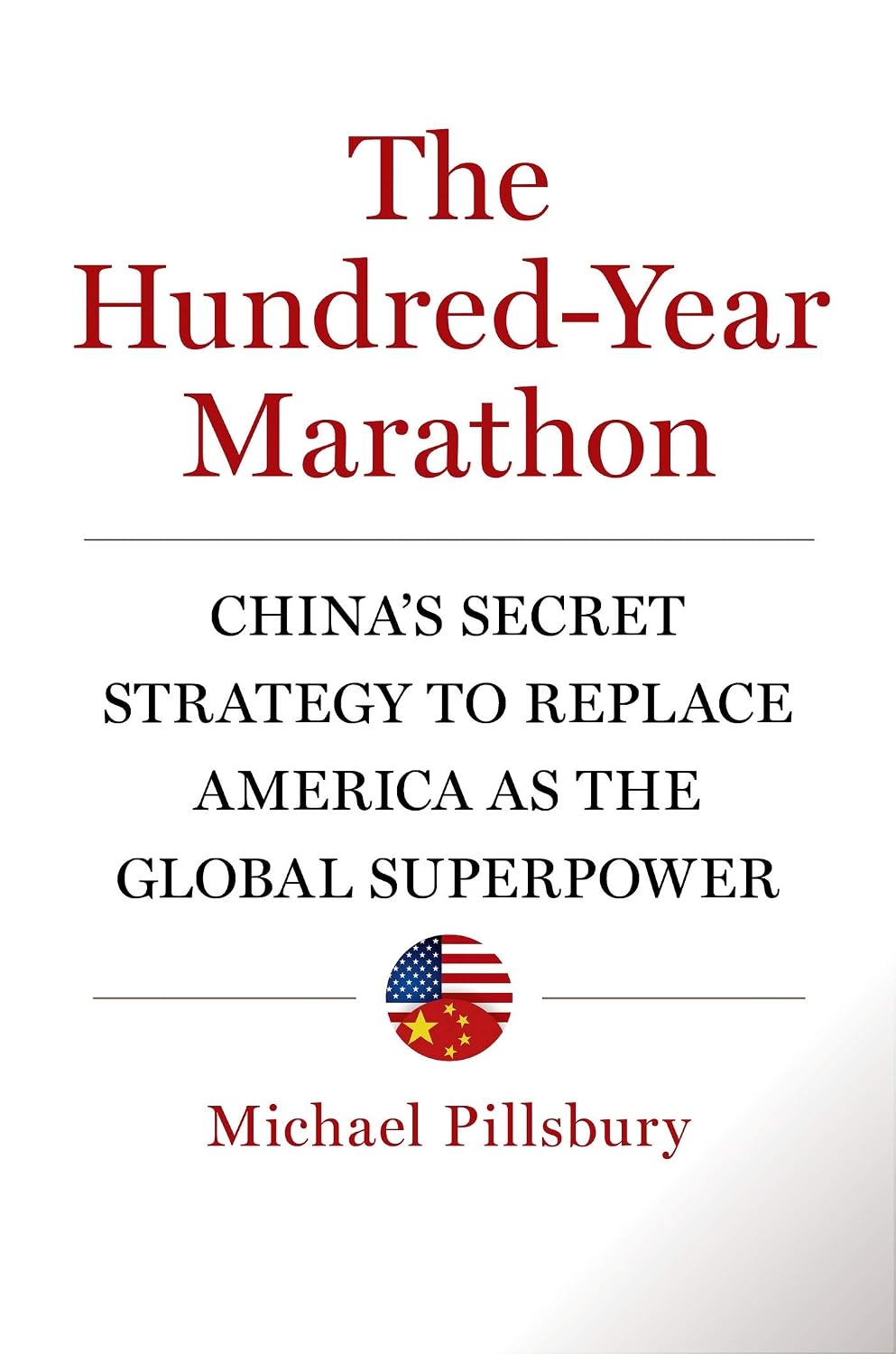
The Hundred-Year Marathon: China’s Secret Strategy to Replace America as the Global Superpower by Michael Pillsbury
Original notes here.
Read until the end to get a bonus. Enjoy reading.
There are many false assumptions the West has made about China, including that China would become democratic and that China thinks the same way as the United States; these have now been clearly exposed as false.
In the 1970s, China deliberately arranged matters to make the West believe it was on the verge of collapse, thereby securing massive Western assistance.
The Sino-Soviet split stemmed from the Soviet Union seeing through China’s ambitions. In 1969, Soviet diplomat Arkady Shevchenko warned the author at the UN headquarters, revealing that Beijing had long-term global ambitions, which can now finally be proven true.
The China-centered ideas in Liu Mingfu’s The China Dream and Zhao Tingyang’s The Tianxia System: An Introduction to the Philosophy of World Institutions have already become mainstream thinking in China.
Because of its ignorance, the West believes Chinese hawks are merely fringe figures. In fact, they are not.
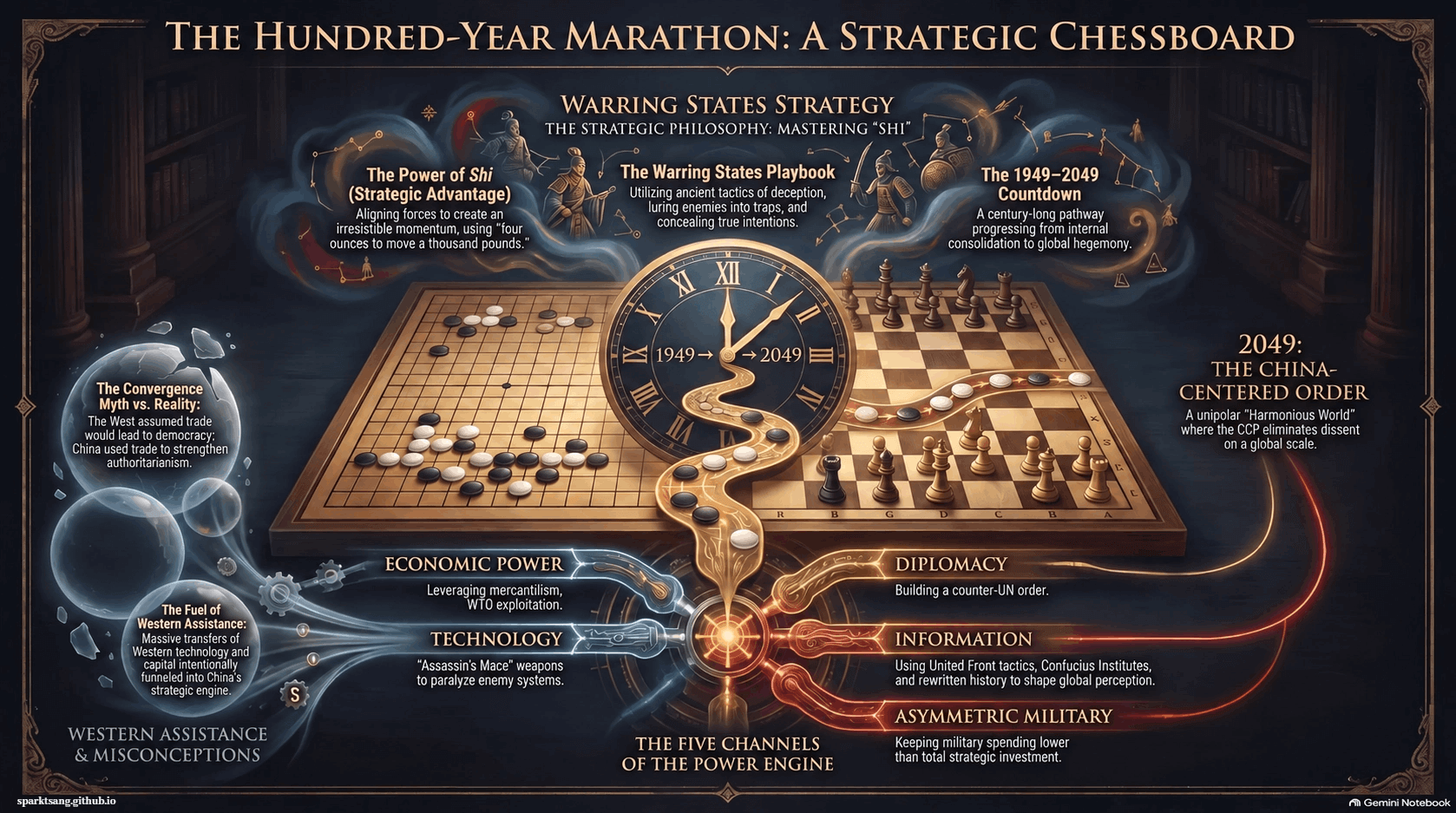
Beneath the facade of Confucian culture, the West fails to understand that China’s strategic thinking draws on ideas from the Warring States period.
In particular, it fails to grasp the concept of shi (strategic advantage or alignment of forces), which is unfamiliar to the West.
There are study rooms accessible only to Chinese military officers, containing large collections of ancient strategic texts, while foreigners are forbidden from seeing them.
The Battle of Red Cliffs is an example of the use of shi, with extensive tactics for luring the enemy into traps.
From the historical experience of the Soviet Union once believing that China sought to become the hegemon of the communist world and moving to contain it, China learned not to expose its true intentions to the United States.
At the same time, China also believes that the United States uses the same strategic way of thinking, and that even goodwill can be a tactic for luring the enemy in.
Shi emphasizes using four ounces to move a thousand pounds. As early as the founding of the PRC, the CCP had already set a century-long marathon strategy and continually reassessed it, with military power accounting for only one-tenth of the whole.
From the historical collapse of the militarily powerful Soviet Union, China became even more convinced that military power was not the only means of achieving hegemony, and adjusted its assessments accordingly.
That is also why China did not invest heavily in military power.
The establishment of diplomatic relations between China and the United States was in fact orchestrated by the CCP, and secret cooperation had already begun long before relations were publicly established.
The scale of the secret cooperation was enormous, and even the US intelligence agencies were kept in the dark.
Before the Tiananmen Incident, the West regarded Deng Xiaoping as a reformer and did not believe that the students were advocating democratic reform.
After the event, the author and other pro-China figures still believed at the time that it was a temporary setback and an overreaction, and that China was still on the road toward democracy.
Even as successive defectors seeking freedom brought ominous warnings, the West still did not want to pay attention or listen.
The low-priced defector Mr. White could identify genuine and forged documents and disclose highly sensitive details such as the operations of CCP spies infiltrating the United States. He said that the hawks were in power, that Tiananmen was an event in which the ruling faction suppressed the pro-American faction, and that the CCP’s new government would adopt nationalism as its ideology. He was not believed.
Ms. Green, who cost two million dollars, spoke fluent English but could not distinguish genuine from forged documents or recognize confidential details, and claimed that Deng Xiaoping and his successors admired America. Yet she was believed.
Clinton initially took a hard line toward China, but China aggressively cultivated pro-China figures, and under their lobbying the government changed its original position.
Based on hawkish thinking and Warring States strategic thought, Mr. White correctly predicted that China would make a big issue out of the accidental bombing of the embassy and treat it as an opportunity, but the United States still regarded it as merely an overreaction and believed that China’s democratization was unstoppable.
Ms. Green was eventually arrested after it was proven that she was a double agent.
CCP textbooks completely distort the historical facts of Sino-American relations, portraying treaties made in good faith that benefited China as evidence of hegemonic aggression against China, while never mentioning that the United States took the lead in restraining the Allied forces from running rampant during the Eight-Nation Alliance campaign. They even smear Lincoln and Nixon as anti-China hegemons.
After 1989, Deng Xiaoping allied with other hardliners, established one-man dominance, and regarded the United States as an enemy; within less than a year, the textbooks had been rewritten.
Beijing has an intricate system for disseminating information that subtly shapes the West’s perception of China.
Dissenting voices are silenced. The United Front departments keep lists identifying who is friendly or hostile toward China, along with systems of rewards and punishments.
Confucius Institutes are disguised as cultural institutions, but their agreements include provisions preventing dissenting information from appearing.
China regards itself as the core opponent in American war plans and is investing heavily in developing asymmetric “Assassin’s Mace” weapons (Shashoujian) capable of paralyzing enemy weapons and information systems at low cost.
Senior CCP officials at party schools must study not only ancient strategy but also America’s two-hundred-year rise, in order to emulate it.
It uses the banner of embracing capitalism to conceal its true intentions; in reality, today half of the economy is controlled by the government.
Following the Warring States period, mercantilism and subsidizing state-owned industries are commonly used strategies. It is by no means simply “crossing the river by feeling for stones” (Deng Xiaoping’s famous maxim), and it violates WTO agreements.
In 1985, a World Bank team privately advised the CCP to increase high-tech exports, avoid excessive borrowing, restrict foreign investment to high-tech fields, promote foreign investment beyond the special economic zones to more regions, phase out foreign trade companies, and establish a nationwide long-term economic framework. Because these recommendations were politically sensitive, and because they supported its socialist methods, they were not made public. The CCP adopted them almost wholesale.
After the collapse of the Soviet Union, China stood at a crossroads, and there was an internal debate over whether state-owned enterprises should be rapidly privatized. The United States did not even know about this debate.
A female defector seeking freedom, Ms. Li, revealed that between 1995 and 2000 the CCP had deliberately fabricated information to conceal its intentions in order to obtain US support for China’s accession to the WTO.
By 2050, China’s overall economy will be three times the size of America’s. By then, the CCP will continue to deny its people human rights (when the American missionary W. A. P. Martin translated international law into Chinese, he discovered that Chinese had no word corresponding to “right” and had to coin the term “權利”), and will not only oppose democracy but also support authoritarian and dictatorial regimes, while eliminating dissent on an even larger scale.
The CCP has repeatedly supported America’s enemies in the past in an attempt to weaken American power, and will continue to do so.
To pursue economic growth, China will continue burning coal. Coal receives state subsidies, and the resulting massive pollution accounts for 29% of particulate pollution in California.
China’s food supply is disastrous, and cancer is rampant among its people.
China is powerful through technology theft, unfair protection of state-owned enterprises, and the creation of asymmetric advantages; the difficulties faced by foreign companies in China are innumerable.
To dismantle the old order, China will undermine the United Nations and the WTO. If India becomes a member, the Shanghai Cooperation Organisation in 2050 will encompass the world’s three largest economies and could stand as a counterweight to the United Nations.
China is also very likely to continue selling arms to rogue states for profit, as it has always done.
The international order China hopes for is probably a unipolar “Harmonious World” under its hegemony—the realization of the “China Dream.”
American films such as Gravity flatter China in order to enter the Chinese market, which plays directly into Chinese hands.
In particular, books arguing that the balance of power has tilted toward China—such as Gompert and Saunders’s The Paradox of Power—were followed in recent years by a clearly more belligerent Chinese attitude after their publication.
Because goals and scripts differ, different countries make different assessments of the balance of power, which may create misperceptions and lead to war.
In the 1970s, China once encouraged Japan to expand its military; now the balance has changed.
According to a 2013 survey, hostility between the peoples of both sides had intensified; China’s increasingly forceful stance toward Japan seemed inconsistent with its long-term, step-by-step strategy of a century-long marathon.
But the author admits that he was wrong. China will not merely bide its time and wait until the very end to unsheathe its sword; instead, it follows a gradual, stage-by-stage approach. Moreover, some Chinese leaders have already concluded that China has advanced far beyond the expected pace in its century-long marathon, perhaps ten or even twenty years ahead of schedule. The United States should prepare to face an increasingly hard-line China.
The United States must recognize the facts, explicitly calculate the assistance provided to China, emulate China’s competitiveness assessments and develop competitive strategies, establish a grand domestic coalition to change China, and build a countervailing coalition abroad.
There is already a precedent in the successful rescue of CCP dissident Yang Jianli. The United States should better protect Chinese dissidents, including defenders of religious freedom (countless Uyghurs, Tibetans, and Christians have suffered CCP persecution), just as front-line fighters in the Cold War refused to bow their heads and eventually brought down the Soviet Iron Curtain.
The United States needs to restore Congressman Frank Wolf’s initiative (the Wolf Amendment) to prevent China from stealing intellectual property, and expand it further.
On environmental issues and censorship, it should pressure China, speak up in defense of American technology companies such as Wikipedia, Facebook, and Yahoo, and emulate Radio Free Europe during the Cold War by giving Radio Free Asia a corresponding role.
The United States should strongly support democratic reformers within China. The hawks are particularly worried that America could use the power of ideas against China as it did during the Cold War to subvert the Soviet Union from within.
Closely monitor internal struggles within China and accurately distinguish genuine reformers from false ones.
In August 2001, former US Ambassador to China James Lilley told a congressional committee that his greatest regret was that he had been ten years too late in learning from internal Chinese documents how far China had already progressed toward democracy and how close the protesters had come to overthrowing the Communist Party.
Had he known, he would have strongly urged George H. W. Bush to intervene firmly rather than being deceived by Chinese leaders into believing that they were reformers.
The two factions often interpret American actions differently. For example, in the case of improved US-Myanmar relations, the hawks saw it as containment, while the reformers saw it as an improvement in Myanmar’s economy from which China would also benefit.
Although Lee Kuan Yew has been highly praised by the West, regrettably few people accepted his insights into China; he knew long ago that China wanted to become a hegemon.
Three traps must also be avoided: worrying about the China threat too early, mistakenly believing that China wants to conquer the United States, and misjudging the extent of underground cooperation between one’s own officials and the CCP.
The CCP hawks have no intention of conquering the United States. On the contrary, they are quite fascinated by books about how America rose to power, such as Warren Zimmermann’s First Great Triumph: How Five Americans Made Their Country a World Power.
Finished reading on Feb 18, 2019
Pillsbury reveals how China’s grand strategy relies on systemic deception—manipulating Western perceptions while ruthlessly silencing domestic dissent to conceal its true ambitions.
But this weaponization of truth and information is not a new tactic; it is the classic playbook of authoritarian survival. How exactly do such regimes construct and maintain these alternate realities without collapsing under their own lies?
In How to Be a Dictator, Dikötter deconstructs the mechanics of 20th-century tyranny, exposing how power is maintained not just through brute force, but through the control and distortion of truth.
Thank you for reading until the end. This is a bonus infographic just for you.