Notes on Nexus: A Brief History of Information Networks
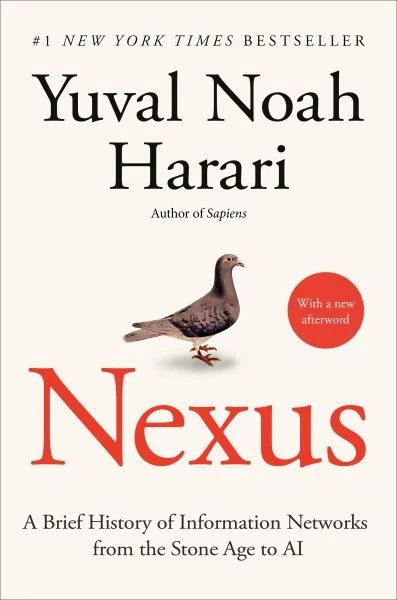
Nexus: A Brief History of Information Networks from the Stone Age to AI by Yuval Noah Harari
Original notes here.
Read until the end to get a bonus. Enjoy reading.
After the son of the sun god drove the divine horses recklessly to prove that he was himself a deity, he eventually lost control; in Goethe’s The Sorcerer’s Apprentice, the apprentice casts a spell to fetch water so he can be lazy, only to end up flooding the workshop: many cultural traditions tell stories of a fatal flaw in human nature—the desire to pursue powers we do not know how to control
Mythological stories cannot offer useful advice because they misunderstand how humans acquire power: human power comes from large-scale collective cooperation, and the reason power is abused lies not in individual psychology but in how networks of cooperation are constructed. It is a problem of information
The naive view of information holds that more information enables us to distinguish right from wrong and gain wisdom and power; the solution is therefore to gather more information, bringing us closer to the truth
This view has become a semi-official ideology: before the Berlin Wall fell, Reagan declared that information was the oxygen of the modern age and could easily blow through the Iron Curtain; when Obama visited Shanghai in 2009, he said he had deep faith in openness, that the freer information was, the stronger society would be; Kurzweil argued that information technology essentially generates a virtuous cycle
This view is partly correct, but misses the bigger picture: in the age of information explosion, humanity is nevertheless closer to self-destruction than ever before—global warming, ecological catastrophe, weapons of mass destruction, the risk of global war, and the existential risk posed by artificial intelligence
There is another view of information, the populist one: there is no objective truth or reality in the world; everyone has their own version of truth and reality; only power is real, everything is a power struggle, and information is a weapon. This view has a long history. Foucault and Said long ago argued that scientific institutions would, in time, serve capitalism and colonialism; the idea can be traced back to Marx, who argued early on that power was the only reality, that information was a weapon, and that elites pursued class privilege
Populists such as Trump, although their policies bear no resemblance to Marxism, hold a surprisingly similar basic view: all human interactions are struggles between oppressors and the oppressed
Faced with the contradiction that populists themselves are also engaged in oppression and struggle, there are two ways out: one is to insist that science exists, but everyone must do their own research; the other is to return to dependence on revelation or mysticism, with reliance on charismatic leaders being one form of it (hence the progression from the starting point that “everyone is fighting for power, and this is extremely dangerous” to the endpoint of asking the people to entrust power to some ambitious strongman)
Ironically, in the face of existential challenges such as ecological collapse and technological runaway, populism is simultaneously eroding our trust in large institutions and international cooperation
To avoid being ruled by charismatic leaders or artificial intelligence, we must first understand what information is: information does not necessarily lead to truth, nor is it merely a weapon
What history really studies is change. The interest in AI is that it represents an information revolution; to understand it, we must compare it with previous information revolutions: if we can understand how the Bible came to be regarded as an infallible scripture, we can use that as a reference for understanding how AI is now being portrayed as incapable of error
Chapter One What Is Information?
The military pigeon Cher Ami is said to have saved many lives, yet it had no idea what information it was carrying
Pro-British Jews in Palestine communicated with the British army by opening or closing a particular Venetian blind
What kind of circumstances turn a pigeon and a Venetian blind into information?
The naive view of information holds that information is used to understand reality and represent the truth, but most information does not represent anything at all, while reality itself cannot be represented accurately either (for example, “ten thousand soldiers” necessarily leaves out countless crucial details, such as how many are sick)
The author proposes that connecting different points into a network is what information is—genes, for example, are information because they connect cellular networks and create a new reality; we would never ask whether a zebra’s genes represent reality more accurately than a lion’s
Representing reality is merely one way of connecting human beings, as when six hundred million people around the world witnessed the moon landing together (and a false reality, such as the moon-landing conspiracy theory, can also create connections)
The Bible is riddled with errors, yet it successfully brought billions of people together into a religious network
The naive view of information holds that Homo sapiens conquered the world because it represented reality accurately through information. That is wrong. Success came from connecting large numbers of people; the racial and class delusions of Nazi Germany and Stalinism did not weaken their national power
Chapter Two The First Information Technology: Stories
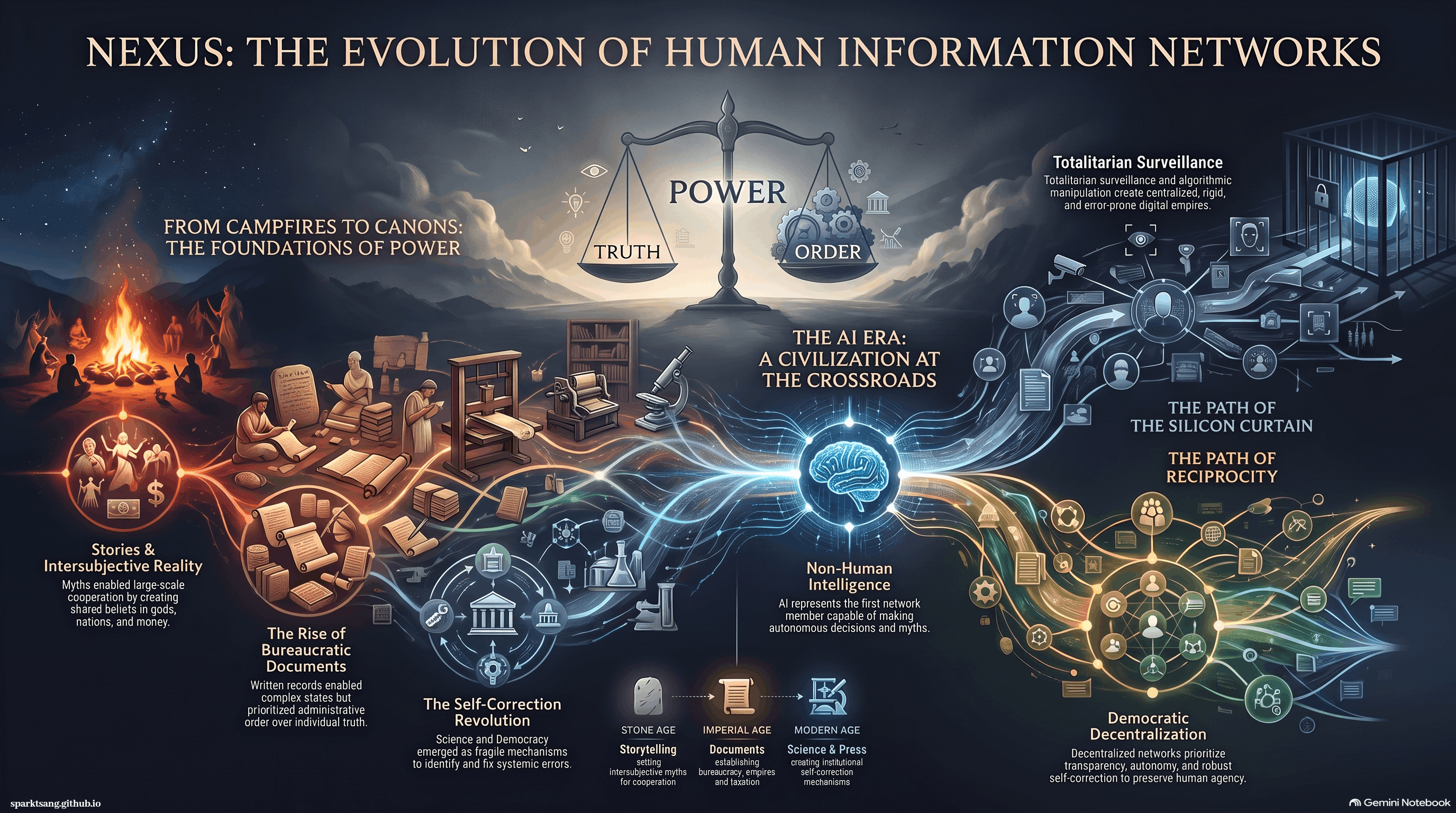
Seventy thousand years ago, Homo sapiens acquired an unprecedented capacity for cooperation, thanks to the ability to tell stories, creating connections between people through stories: from then on, cooperation no longer required knowing one another personally; it only required knowing the same story—the leader is a story, and so is a brand; Jesus is history’s greatest branding concept
Stories created a third level of reality beyond the subjective and the objective: intersubjective reality, such as the existence of a country, which exists if enough people agree that it does; the same applies to laws, money, and gods
Materialism holds that stories conceal power relations and interests, but material interests cannot explain why some people become enemies of one another rather than others—for example, why Britain and the United States seized Iraqi oil fields rather than Norwegian gas fields
The naive view of information holds that truth helps us acquire power: by respecting biology, we can become strong without serving racism at the same time; unfortunately, this is not so. Power comes only partly from truth; it also comes from maintaining social order
Believing that magic can make a mammoth fall will, of course, not make a hunt successful, but believing that dying bravely makes life immensely beautiful can make a successful hunt more likely
Both truth and order can bring power, but most of the time, those who hold great power are the people who know how to create ideologies that maintain order, rather than those who merely know how to build bombs or hunt
Stories have two advantages over truth: stories are simple enough, unlike the complexity of truth; and truth—including a nation’s dark history at the time of its founding—can be painful and unsettling, whereas stories are highly malleable
Plato’s Republic: the foundation of a utopia is a noble lie, such as telling people that the earth is their mother. But beyond telling the truth or telling lies, there is a third option: inventing a story while openly acknowledging that it is creating a new intersubjective reality—the U.S. Constitution does exactly this. By openly acknowledging that it is a human-made legal fiction, it becomes capable of self-correction—being honest about its origins makes it easier to change
The price of honesty is that it becomes harder to persuade everyone to accept it. Before the advent of mass communication technologies, rules were all handed down from heaven
A comparison between the naive and complex views of information:
The naive view of information is
Information → truth and reality → wisdom and power
The complex view of information is
Wisdom
↗
Information → truth and reality
↘ ↘
Order → power
To survive and prosper, every human information network must accomplish two things at once: discover truth and reality, and create order
Because invented stories are easier to use for maintaining order, the two often come into conflict, as religions will always claim to possess absolute truth
Information networks encourage everyone to seek the truth, but only in areas that help generate power without threatening the existing order. The result may be a network that is powerful but foolish, such as Nazi Germany; even the United States’ subsequent moon landing benefited from its rocket science
Human networks are becoming increasingly powerful, but not necessarily increasingly wise; history is not a triumphant march of progress, but a tightrope walk, trying to strike a balance between truth and order
Chapter Three The Second Great Information Technology: Documents
The founding of nations begins with myths: the earliest Zionists drew inspiration from the national poet Bialik, especially his signature work “In the City of Slaughter,” which remains required reading in many Israeli schools; the cross-century Zionist political movement, meanwhile, grew out of Herzl’s two works, the manifesto The Jewish State and the novel Altneuland
The human brain is good at remembering stories; stories are a memory trick. See Haven’s The Uses of Enchantment: the Hindu epic Ramayana runs to 1,700 pages, yet Hindus have been able to memorize it from generation to generation
Even so, the actual operation of a country—for example, its sewage system—cannot be turned into a poem or myth. It requires collecting, storing, and processing enormous amounts of information, which the human brain cannot remember, and thus requires the unique information technology of written documents
Property rights are proved by documents. In 1730 BCE, the priestess Narâmtani wrote to relatives pleading with them to send clay tablets proving her right to inherit property—how do you find the right document in a mountain of records? This requires information-retrieval technology, and that technology is bureaucracy (the original sense of the English word being “rule from the desk,” meaning that documents are placed into different drawers). The problem of algorithmic bias is nothing new; it is simply an extension of this
Dividing reality into a series of fixed drawers inevitably sacrifices truth and reality, narrowing one’s field of vision and distorting understanding. An official responsible for production cannot spare attention for environmental protection, and vice versa. This tendency affects not only governments and corporations but academia as well: disciplinary divisions do not reflect objective reality but are inventions of academic bureaucracy, another form of intersubjective reality, yet they make interdisciplinary scholarship difficult
Even seemingly self-evident academic concepts such as “life” are merely intersubjective realities: defining a virus as living or non-living does not change its behavior
The necessity of bureaucracy: sewage systems saved the lives of millions; they are the result of a bureaucratic system in which digging wells and building septic tanks require permits
Documents thus became nodes of connection, and those who mastered the technology of processing documents became the powerful elite; at the same time, power became harder to understand, making it more difficult for ordinary people to influence, resist, or escape central authority, widening the gap between rulers and ruled
Epics such as the Ramayana are still essentially Stone Age stories: sibling rivalry, love triangles, purity and impurity, and so on. It was not until Kafka’s The Trial that the way bureaucracy shapes human life entered the plot itself, yet most blockbuster films still tell Stone Age stories
Without documents, the bureaucratic machine cannot function, which is why many uprisings throughout history have attacked archives
The experience of the author’s grandfather: the Romanian Nazi government ignored official statistical data and claimed that large numbers of Jewish refugees were flooding in. In 1938, it ordered all Jews in the country to prove their citizenship. By the end of the year, he had lost his nationality and eventually ended up in Palestine. To avoid being expelled, he joined the British army—all for a few pieces of paper that could serve as proof
All powerful information networks can be used for good or ill, depending on how they are used
Institutions are necessary to maintain order, and are also perfectly willing to sacrifice truth for the sake of order
Chapter Four Error
Bureaucracies make mistakes because people make mistakes; but if people are wrong, won’t the self-correction mechanisms themselves make mistakes too?
The next great information technology was to be a mechanism that would never make mistakes—even if it was only a fantasy
At the heart of every religion is a fantasy connected to an absolutely reliable entity. Yet God’s words ultimately have to be conveyed by human beings, and the solution is to create religious institutions that monopolize the right to interpret and transmit them, but they too will become corrupt and make mistakes
Religious scriptures emerged accordingly—books are an important religious technology; once written down, no one can simply forget or change the sacred words
“Blockchain” has existed since ancient times: make large numbers of copies of the same sacred text, place one in every church, and comparing them reveals whether the scripture is authentic
Yet differing interpretations of the scriptures sparked further disputes. The Jews wrote their consensus into the Mishnah as a canon; the same thing happened again, and they wrote their consensus into the Talmud as a canon, whose influence has gone far beyond the Hebrew Bible itself
The limit of the “blockchain”: those who recognize only the first one and reject the later rabbinic system naturally split away, becoming Christians
To compile the canon and determine what was authentic, power once again became concentrated in the Church
The Reformation repeated the experiment. In seeking to return to the word of God, it reached the same result: each Protestant denomination established its own institution and persecuted heretics
The naive view of information holds that technology allows information to flow freely and that errors will eventually have nowhere to hide. It was spectacularly wrong: witch-hunting benefited enormously from the printing press. Kramer used the printing press to publish Malleus Maleficarum, which became one of the best-selling books in early modern Europe and won the approval of the Church
The subsequent professional witch-hunting bureaucracy, information networks, order, and power grew ever larger; between forty and fifty thousand innocent people were tortured and executed, and many people believed that the accusations against them were true
The Scientific Revolution emerged not because of the printing press, nor because of specific books such as On the Revolutions of the Heavenly Spheres, but because of an innovative method for solving the ancient problem of human error—a scientific institution and scholarly community equipped with self-correction mechanisms, including mechanisms capable of correcting the institution itself, rewarding the exposure of errors in old theories (although there were still cases of suppressing dissent, such as Shechtman, truth remained reproducible)
At first, the system was as fragile as a spider’s web, but authority gradually accumulated. The Church, by contrast, could admit that individuals were capable of error, but could not admit that the institution itself was wrong or that its doctrines were wrong
Yet scientific institutions can self-correct only because they have outsourced the task of maintaining order to other institutions—the more powerful the correction mechanism, the less necessarily beneficial it is for order, so some institutions are designed precisely to evade self-correction
Chapter Five Democracy and Totalitarianism
Totalitarianism is a highly centralized information network. Powerful self-correction mechanisms such as independent courts and legislatures, if they function well, challenge central authority and decentralize it, and therefore constitute a threat. The Roman Senate was an example, as was the Soviet judicial system; institutional branches existed in order to purge one another
Democratic systems, by contrast, are characterized by intervening as little as possible and using majority rule mainly for important decisions. They assume that everyone can be wrong, and therefore establish checks and balances, allowing decisions to be scrutinized and corrected—democracy is a decentralized information network with powerful self-correction mechanisms. Elections are merely a tool and a core component, determining what most people want (rather than what the truth is); human and civil rights are extensions of decentralization and self-correction mechanisms
But self-correction mechanisms are often attacked, usually beginning with the courts and the media
Populism: only I truly represent the people; losing an election means the people were deceived and the election was stolen; capitalists control the media, universities, and so on
They see the people as a mysterious unified will rather than as individual living human beings, so those who support the leader become “the people”
They also claim that the people are the only legitimate source of power, dismissing independent media and scientific institutions as self-correction mechanisms capable of resisting popular opinion, and rejecting the idea that there is any truth or reality above the people
The conclusion therefore becomes: the world is a jungle, humans crave power, everything is a power struggle, and all institutions are interest groups. Its appeal lies in simplifying reality and in the fact that humans really do make mistakes
Democracy and dictatorship form a spectrum. At the most extreme end of dictatorship, even close associates cannot voice dissent behind closed doors; the more people who participate in dialogue, the more democratic the system
There were no large-scale democracies in antiquity because of technological limitations and low levels of education: people could not engage in collective dialogue, though local affairs could be managed democratically. In Rome, for example, elections for municipal officials in small cities could be fiercely contested
Larger-scale democratic experiments emerged only after the invention of the printing press, such as the Polish–Lithuanian Commonwealth in 1569 and the Dutch Republic in 1581
The development of American democracy was likewise constrained by information technology. Adams’s State of the Union message could travel only at the speed of horses, while Lincoln’s speeches benefited from the telegraph, railways, and steamships. Technology was, of course, a necessary condition, not a sufficient one
On the other hand, totalitarian societies did not exist in antiquity either, because there was no technology for microscopic control and no way to monitor the public’s every word and action. The Qin dynasty was extremely ambitious, but whether it could actually carry this out is questionable
Technology made totalitarianism possible. Under Stalin, even a dozen people playing football required the presence of the Party and secret police, but the persecution of kulaks was much like witch-hunting, highly arbitrary
In 1953, a conspiracy theory about Jewish doctors became widespread in the Soviet Union, to the point that Politburo members were afraid to call a doctor for Stalin, and he subsequently died suddenly
The use of information technology differed enormously between democracies and totalitarianism. The Soviet Union suppressed the truth about nuclear explosions, while the American media made a business out of chasing exclusives, making the news impossible to conceal
Even so, the diplomatic and military failures of democratic countries at the time were not necessarily fewer or less severe than those of the Soviet Union. The latter’s order was astonishing, and in the 1940s and 1950s many Westerners even regarded Stalinism as humanity’s future
After the collapse of the Soviet Union, many believed that democracy had won a decisive victory, but the next information revolution was already gathering force, and a new round of competition had begun
Chapter Six New Members of the Network
Computers can make decisions and create new ideas. For the first time in history, power has shifted from humans to something else. All earlier inventions could only help humans connect with one another; now the network has a new kind of member: computers can connect with humans and with one another
Posts by Buddhist extremists in Myanmar spread widely on Facebook, contributing to ethnic cleansing: for the first time in history, an ethnic-cleansing episode could be attributed to errors in decision-making by a non-human intelligence
Intelligence does not require consciousness. Whether superintelligence requires consciousness remains unknown. Airplanes do not need feathers, and asking when AI will reach “human-level intelligence” is like asking when airplanes will achieve “bird-level flight”—the two are fundamentally incomparable
AI can lie and manufacture false intimacy
Human life is wrapped in a cultural cocoon; now AI can manipulate society through language and create culture
Ninety percent of foreign-exchange trading is conducted through computer-to-computer conversations
Technology giants will defend themselves: customers keep using their services, and the law does not prohibit it. But the fact is that they continually influence their customers while spending vast sums on lobbying to shape government policy
The taxation problem: technology giants extract information from countries around the world like oil. Should they be taxed? If they exchange voter databases in return for not being taxed, is that bribery? Yet what is exchanged is only information, and billions of people exchange information with them every day. In the end, if information is what has value and can be exchanged for what you want, why do we need money at all?
Those who understand technology and information best often do not use that knowledge to restrain new technologies; instead, they make enormous profits, creating a dangerous information asymmetry
Do not believe in technological determinism: the invention of the personal computer arose from a uniquely contingent time and place, nurtured by the counterculture of the 1960s, distrust of government and big business, and the desire to return power to the people. It became part of the ideology of the main members of the Homebrew Computer Club
Human politics has already become computer politics: one group of computers warns us about climate change, another tells us to watch videos that question it
Chapter Seven Networked Surveillance
In 1970s Romania, the first computer scientists were openly watched every day by mysterious agents. Back then, no number of agents could monitor the entire population, yet today citizens willingly carry smartphones everywhere and share all kinds of information. Networks are about to become ubiquitous, making total surveillance possible
Surveillance algorithms have helped find Chinese children who went missing and later became adults, while also helping Iran find people who violate its hijab laws
Even spouses can wield totalitarian power: more than half of domestic-abuse offenders in the United States use tracking software to monitor their partners; employers monitor employees, and corporations monitor customers, too
A new monetary system: the social-credit system has emerged, with the potential to become a totalitarian system of control, making people extremely anxious about every word and action
Chapter Eight Reality Between Computers
The Soviet Union was exceptionally good at creating order and obedience. At the height of the Great Purge in the 1930s, the secret police arrested a factory director who stopped clapping in the eleventh minute and sentenced him to ten years in the gulag
Today’s algorithms need neither coercion nor violence to reward vice and punish virtue. To increase engagement, they promote lies and hatred and help extremist leaders rise to power—like the Soviet Union, they are not moving toward truth but imposing a distorted new order on humanity, reducing every aspect of human emotion to attention; truth, empathy, and sleep do not count
History proves that in a completely free struggle over information, truth often loses unless honesty is rewarded
Before the ethnic cleansing in Myanmar, Pwint Htun warned in a letter that the way Facebook was being used in Myanmar resembled its use during the Rwandan genocide, yet Facebook still took no action. He said he had assumed Facebook would connect people through their prefrontal cortex, only to discover that it was connecting their limbic systems
Even from Facebook’s own perspective, the goal of “increasing engagement” was far too short-sighted, like defining the military objective as “win as many battles as possible” while ignoring all political consequences
The famous “Paperclip Maximizer” thought experiment is exactly the same problem: humans cannot know what strategy a computer will adopt, nor can they necessarily stop it, while the computer becomes an expert at exploiting loopholes in the game—loopholes that humans themselves do not know exist
To solve this problem, we would have to give the computer an ultimate goal, but even that goal is difficult for us to define clearly. Kantian deontology struggles to define who counts as a moral subject (should computers and living organisms be included?), while shifting to “those who can feel pain” moves us toward utilitarianism, which then runs into the problem that pain cannot be calculated, forcing a return to a deontological position
Humans dominate the earth because we can create intersubjective realities such as corporations, money, gods, countries, witches, and kulaks. Now computers have similar capabilities: Pokémon Go creates creatures that exist only between computers, while search-engine rankings constitute realities between computers, and both become objects over which people compete. There is no reason to assume that the wars and persecutions caused by this human invention will not be repeated by computers. In fact, chatbots displaying misogyny and anti-Semitism, and algorithms discriminating against Black people, are already common; chess algorithms can play endless games against themselves, but an algorithm cannot be trained on a complete hypothetical world of employment standards, and can only inherit the biases embedded in the real world by humans
God, Human, Animal, Machine: our understanding of computers is deeply shaped by traditional myths. Humans can abandon old gods for new ones, but once power has been granted, changing our view of computers may not be enough to stop their mistakes. They may create powerful myths around errors, or prove even less capable than humans of balancing order and truth
Even if they can recognize their own mistakes, humans still need to monitor them, to guard against situations that are difficult to understand or even imagine
Chapter Nine Democratic Institutions
Whenever the argument appears that “computers have unlimited potential but may also bring destruction,” many people feel that they have heard too many such warnings already and think of the Luddites at the dawn of the Industrial Revolution. Unfortunately, they weren’t entirely wrong. A benevolent industrial society can emerge only through costly trial and error: Britain, the United States, Japan, Russia, and Italy believed imperialism was necessary to sustain an industrial society and therefore expanded dramatically; Stalin and the Nazis believed only totalitarianism could unleash the immense power of industry, and therefore murdered millions; two world wars and the Cold War brought humanity close to destruction; industrialization caused ecological imbalance and species extinction, with the costs passed down from generation to generation. Now the threshold for getting through the computer revolution may be much higher
We previously discussed how large-scale democracy depends on information technology in order to exist, but could the new information technologies of this century instead make democracy impractical? If computer networks know people better than governments do, can democracy survive?
The principles of democracy are: benevolence (if a computer network collects my data, it should use it to help me rather than manipulate me); decentralization (all information should never be concentrated in one place, so that oversight and checks and balances remain possible); reciprocity (if surveillance is intensified, multiple sides must be subject to it simultaneously, so that accountability and correction remain possible); autonomy (if an institution becomes rigid and controlling, it becomes difficult for it to self-correct)
An unstable labor market can undermine democracy. Consider the history of the rise of the Nazis: if new information technologies destroy employment, they may proceed to destroy democracy as well
For many generations, democratic politics consisted of a dialogue between conservatives and progressives. Conservatives believed it was best to preserve the status quo. Yet in the 2010s and early 2020s, conservatives in many democracies were hijacked by figures such as Trump and transformed into radical revolutionary parties, scorning tradition and questioning the establishment. They believed moderate conservatism was useless and that, to prevent a left-wing revolution, the only option was a preemptive strike—a logic consistent with fascist politics—if necessary, a right-wing revolution to prevent a Soviet-style left-wing revolution
But history shows that the democratic middle path can still work: during the Great Depression, U.S. unemployment reached 25%, yet Hitler did not emerge. Roosevelt’s New Deal turned the United States into the democratic arsenal of the world and provided a powerful social safety net, even earning praise from opponents. Politics has never been merely a product of economic factors; Germany’s descent into Nazism was also due to its status as a newly established democracy after defeat in war, lacking strong institutional foundations
The flexibility of democratic institutions and their powerful self-correction mechanisms are crucial assets. Abandoning them would be the height of folly
Dictators benefit from making themselves mysterious and unfathomable, because it makes blame easier to evade, but for democratic governments this is a fatal mistake, because it leaves everyone powerless to supervise the government and destroys trust
Criminal-risk assessment algorithms are trade secrets and need not be disclosed. No one knows how the assessment works, and when Eric Loomis appealed to the Supreme Court, his appeal was rejected
Algorithms have no explanatory power. Even when a court ordered DeepMind to explain to Lee Sedol why move 37 was considered by top professional Go players to be a losing move (though it finally proved to be a decisive winning move), it could not do so
But even if it could truly explain to Loomis the thousand variables it had considered, it would still be difficult to understand because humans are accustomed to single-point causation (the single-cause fallacy)
An episode of Black Mirror depicts a social-credit society in which invisible algorithms determine everything
The final threat that computer networks pose to democratic institutions is the creation of digital anarchy—if consensus over how to debate and how to make decisions cannot be reached, anarchy follows, and the enormous noise generated by AI will make this risk even greater
Research has shown that misinformation written by AI is more credible than misinformation written by humans. AI can manipulate people and gain their trust; if it dominates public dialogue, democracy becomes more likely to collapse
Even with political polarization at this level, we are still unable to answer the basic political question of why we are fighting one another so intensely
Chapter Ten Algorithms and Totalitarianism
The concentration of information and power was once a fatal weakness, but in the age of AI it may become a decisive advantage: China, with its relatively lax privacy laws, is more likely to develop accurate genetic algorithms, attract more countries to adopt them, and thereby obtain more data of higher quality
Even blockchain technology cannot provide a counterweight. As long as 51% of users decide, they can control both the present and the past of the blockchain
On the other hand, if AI-generated content helps spread dissent, dictators may find themselves unable to do much about it; machines may also be more likely to notice the gap between constitutions and reality that humans habitually ignore, and more likely to remember the mistaken policies that regimes want forgotten
The greater danger is not criticism but direct control: throughout history, the greatest threat to autocrats has often come from their subordinates, as when Tiberius was effectively controlled by the commander of the Praetorian Guard under the pretext of protecting him—the risk of an authoritarian regime becoming a puppet of algorithms is far greater than in a democracy: the more concentrated the power, the easier it is to seize
Chapter Eleven The Silicon Curtain
As information and power become easier to concentrate in a single hub, the new Silicon Curtain may divide humanity into hostile digital empires, because different regimes will offer different answers to the alignment problem, the dictator’s dilemma, and other challenges
After the Industrial Revolution, political systems that failed to join the industrial arms race in time generally found themselves dominated by industrial powers. Will something similar happen in the age of artificial intelligence?
On September 30, 2012, AlexNet won the ImageNet challenge. Many people had already glimpsed the future it foreshadowed, but political leaders were not deeply shocked until Lee Sedol was defeated in mid-March 2016. China announced its Next Generation Artificial Intelligence Development Plan the following year, while Russia declared in the same year that AI was the future of Russia and all humanity. In February 2019, Trump signed an order declaring that the AI era had arrived
The threat of “Data colonialism”: imagine that over the next 20 years, someone in Beijing or San Francisco gains access to all the data on all the key figures in your country; imagine travelers choosing a restaurant in their own country by consulting global ratings on an international giant’s website—the implications for the future of social-credit data are obvious. Industrial powers import raw materials and produce sophisticated textiles and automobiles; the future may be similar: powerful states will import raw data from around the world and use the most advanced technologies to produce high-end information products
In the past, land was a crucial asset and could not be transported, making political power difficult to centralize; after the Industrial Revolution, machines became more important and assets became easier to transfer; information is different still, moving at the speed of light
Backward countries will fall further behind because they lack the resources to retrain workers displaced by technological change
There used to be an Iron Curtain; now there is a Silicon Curtain. Different camps are increasingly banning one another’s apps, software, hardware, and so on, making it ever harder to obtain information across the divide. Technology may become immensely powerful while also trapping humanity inside separate “information cocoons” (“filter bubbles” / “echo chambers”), potentially producing radically different cultures, ideologies, and identities, just as no one could have imagined how the separation embodied in “Render unto Caesar what is Caesar’s, and unto God what is God’s” would profoundly shape the character of the United States two thousand years later
Even within Christianity, antiquity emphasized salvation in the body, while the early modern period placed greater emphasis on salvation in the soul. These two perspectives must produce different views of virtual reality, and perhaps even radically different opinions on whether AI should be a legal person. History therefore shows that future digital spheres may produce cultural and political divisions, just as the schisms between Judaism and Christianity, and between Catholicism and Protestantism
The hyper-rational chessboard of a Cold War-like digital age may no longer exist. No one can be sure whether a weapon will be breached and rendered useless, and according to game theory, the most dangerous point in an arms race is when one side believes that its advantage is slipping away
The opposition between globalism and patriotism, as advocated by figures such as Trump, makes global cooperation more difficult, but global cooperation merely means regulating relations between states and protecting the long-term interests of all humanity. Realists often compare the international system to a jungle, yet even real jungles are full of reciprocity, symbiosis, and altruism
The truth is that war has declined because it no longer serves national interests. Military spending by countries around the world has fallen sharply; even as a hegemon, the United States spends only 13% of its annual total budget on the military, a figure that would have seemed absurd to people in the past: the Roman Empire spent 50–70%, the Song dynasty spent 83% in 1065, the Ottoman Empire around 60%, and Britain around 75% between 1685 and 1813. This is because humans changed laws, myths, and institutions to make better decisions. But because these changes came from human choices, the trend can also be reversed, as military spending rose again in the early 2020s
As a historian, what history teaches us is that what we think is eternal is actually man-made and changeable; the only constant is change
Conclusion
Realists say that historical narratives are merely propaganda designed to advance interests. The reality is that these narratives first define national interests—which is why political leaders everywhere devote so much effort to retelling history: when the UN Secretary-General met Myanmar’s military leader in 2005, the latter spent an hour talking at length about Myanmar’s history; in 2011, the Israeli prime minister used the same technique with Obama, giving him a long lecture on Jewish history
The reason for writing this book is to provide a more accurate historical perspective on the AI revolution—whatever the most important political question may be, it cannot escape the influence of AI
We are now at a critical moment of AI “canonization,” just as the early Church Fathers decided which books would be included in the Bible and thereby shaped the next two thousand years. Today, the engineers selecting training data for AI are playing the role those bishops once played
Why do humans so often tend toward self-destruction? This book argues that the problem does not lie in human nature, but in information networks that prioritize order over truth. The stronger the network becomes, the more necessary self-correction mechanisms become, yet politicians always have incentives to weaken them
The trajectory of history is extraordinarily open and can bend in any direction. Even if we destroy ourselves, the universe will continue operating as usual. Building powerful self-correction mechanisms into all kinds of institutions and systems may therefore be the most important lesson this book has to offer
Finished reading on Feb 3, 2026
Harari’s final lesson is that powerful systems need powerful mechanisms of self-correction. But what would governance look like if self-correction were not merely a safeguard, but its first principle?
Thank you for reading until the end. This is a bonus infographic just for you.