Notes on The Origins of Political Order: From Prehuman Times to the French Revolution
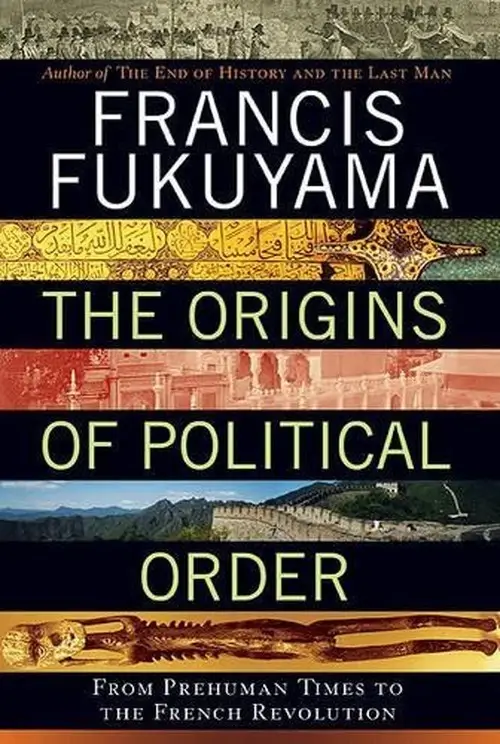
The Origins of Political Order: From Prehuman Times to the French Revolution by Francis Fukuyama
Original notes here.
Read until the end to get a bonus. Enjoy reading.
Huntington’s Political Order in Changing Societies takes the late-stage political world of human history—states, political parties, laws, armies—as something to be taken for granted.
Many countries, including East Timor, Papua New Guinea, Indonesia’s Papua province, and the Solomon Islands, have encountered severe difficulties in rebuilding modern states.
In Western eyes, the behavior of Melanesian politicians is indistinguishable from corruption. But from the perspective of their traditional tribal societies, the “big men” are simply doing what they have always done: distributing resources to their relatives.
Between 1970 and 2010, democracies spread across the world, increasing from just 45 to 120 by the late 1990s. This was what Huntington called the Third Wave of democratization, driven by the spread of education, the dissemination of ideas accelerated by information technology, the low cost of “voting with one’s feet,” and greater prosperity, which led people to demand fuller rights.
Yet development has given rise to several concerns:
In the first decade of this century, democratic backsliding emerged: one in five Third Wave democracies returned to authoritarian rule or suffered severe erosion of their democratic institutions.
Some countries became trapped in a gray zone during their transition from authoritarian government, such as Kazakhstan and Uzbekistan.
Some countries’ political systems have failed to provide basic services, as in Ukraine after the reformist Yushchenko came to power. Conditions in Latin America and India have likewise undermined the legitimacy of democracy.
Capitalism has failed to find the right mechanisms for taming market volatility.
American politics is deeply polarized, the quality of deliberation has deteriorated, both left and right have become more extreme, intergenerational social mobility is low, and the power of financial oligarchs is not far removed from that found in countries such as Russia and Indonesia.
Examples of institutional inertia resulting in dysfunction are everywhere.
The failure of democracy lies not in the idea but in execution: without the difficult and arduous process of institution-building, democratic government will not succeed.
The left believes that destroying old power structures will eliminate economic injustice; the right believes that a market economy will make government unnecessary. People in wealthy countries take government for granted, forgetting how difficult it is to create one in the first place. Poor countries are poor precisely because they lack institutions. We therefore need a deeper understanding of the origins of political institutions.
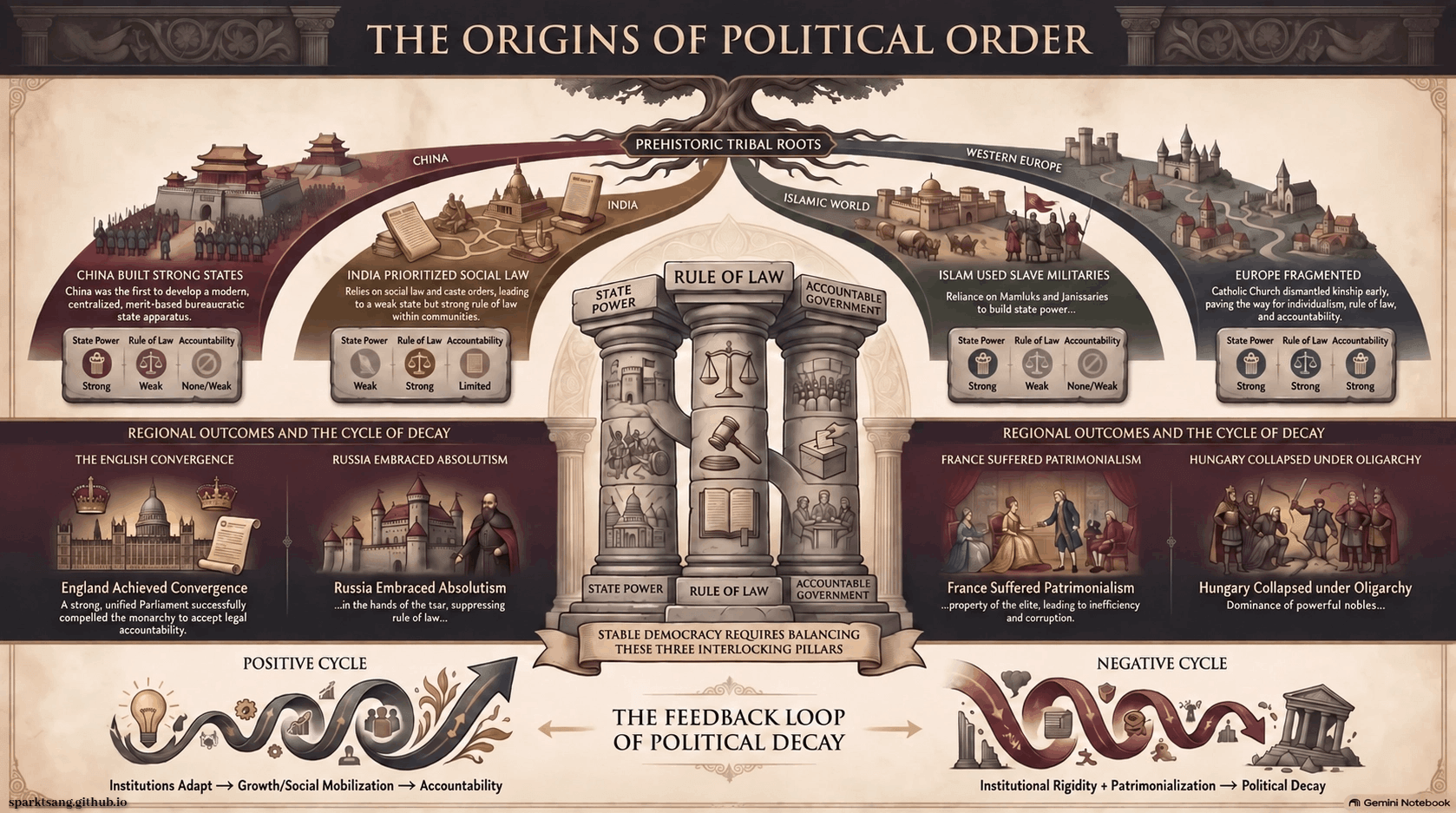
There are three major categories of political institutions: the state, the rule of law, and accountable government. Successful modern liberal democracies possess all three, maintaining a stable balance among them:
State power compels people to obey the law and protects them against threats and foreign invasion.
The rule of law and accountable government constrain public power, forcing the state to exercise authority according to publicly known and transparent rules and to submit to the will of the people.
Understanding the process of state-building can answer such questions as: Why do Afghanistan and Melanesia remain organized along tribal lines? Why has the kind of centralized rule taken for granted in China appeared only briefly in India’s three-thousand-year history? Why are authoritarian modern states concentrated in East Asia? Why did liberal democracy and the rule of law take root in Scandinavia but fail to take root in Russia? Why has Latin America suffered repeatedly over the past century while the United States and Canada have prospered?
China was the first country to develop state institutions. Modern theory often treats Europe’s development as the norm, but this book treats China as the paradigm of government formation and then asks why other civilizations failed to follow its example.
Human beings have never existed in isolation as in Hobbes’s “state of nature”; they have always lived in groups.
Only two animals—the chimpanzee and the human being—do this: eliminate the males of neighboring groups and abduct their females to incorporate them into their own group.
Chimpanzees recognize the personalities of other individuals, understand certain social rules that ought to be followed, and can form fission-fusion societies organized at the level of bands. Humans have language, and therefore can form organizations at much higher levels.
The reproductive strategies of human males and females differ, strongly encouraging deception and requiring advanced linguistic ability.
Religion provides rewards and punishments, reinforcing norms and the benefits of cooperation.
China
At the beginning of the Xia dynasty there were ten thousand states; at the beginning of the Zhou, twelve hundred; by the Warring States period, only seven major powers remained. Duke Xiao of Qin employed Shang Yang, laying the foundations of the first modern state.
The highly ritualized Zhou feudal society, centered on honor, closely resembled European feudal society.
Compared with the rest of the world, warfare in the Eastern Zhou was exceptionally violent. Qin mobilized 8 to 20 percent of its entire population, compared with only 1 percent in the Roman Republic and 5.2 percent in the Delian League; early modern Europe was lower still.
Intensive warfare transformed chariot warfare into infantry and cavalry warfare, a process largely completed by the end of the Spring and Autumn period. The aristocracy declined, while merit-based military advancement gradually became dominant. Taxation became institutionalized: Lu taxed agricultural land between 594 and 590 BC; Zheng soon surveyed and regularized the boundaries of farmland throughout the state; Chu measured land nationwide.
The shi—educated men and intellectuals—traveled among the various states, creating ideologies and helping national cultures take shape.
Shang Yang abolished the well-field system and introduced the commandery-county system, with county magistrates appointed by the central government. Han Fei’s ideas rationalized Shang Yang’s policies, producing Legalism. Human beings were treated as economic rather than moral actors; good was rewarded and evil punished. This bears an obvious resemblance to the Communist Party’s anti-Confucian thinking.
Before the reforms, Qin had fought 160 wars against other major states, but had initiated only 11 of them. After the reforms, it fought 96 major wars, initiated 52 itself, and won 48.
China became unified, while Europe remained divided into many states, perhaps because of the absence of geographic barriers, cultural homogeneity—including the ability to absorb foreign rulers—the high quality of Qin’s statecraft, and the early development of capacities for social mobilization.
The harshness of Qin rule caused popular rebellions. The institutional system of the early Han became a compromise between Xiang Yu’s feudalism and Qin’s centralized rule. After the Rebellion of the Seven States, centralization was restored. Confucian scholars introduced a degree of accountability into government, institutions became more sophisticated, appointments became more meritocratic, and Gongsun Hunxie, of Xiongnu descent, attained high office.
A government of literati controlled the military, unlike in other countries. This benefited from the lower degree of institutionalization of the military compared with the civilian bureaucracy, as well as from strong normative ideas.
The Liang consort clan installed Emperor Huan. Emperor Huan then used the eunuchs to stage a coup and massacre the Liang clan, after which the Confucian scholars eliminated the eunuchs.
Wang Mang’s land reform failed, and the disparity in landholding grew increasingly severe. By the end of the Han, aristocratic clan power had already been restored; Cao Pi’s Nine Ranks system accelerated the trend. Official positions became far more likely to be hereditary than before, and holding office became the only route to high status. The patrimonial system flourished until the end of the Tang.
In the south, the Wang, Lu, Zhang, and other great clans continued to dominate. Emperor Xiaowen of Northern Wei invited the great aristocratic families to enter government, creating a unified aristocratic class.
Although the Sui reunified the country, the struggle against the patrimonial system continued for another three hundred years.
China’s eventual unification may be explained by several factors, including the early modernization of the state apparatus, cultural homogeneity—including the capacity to absorb foreign rulers—and ideas about legitimacy.
India
India did not experience the relentless violence of Chinese warfare. Population density was far lower, and there was no comparable demand for intense social mobilization.
Moreover, before and during state formation there already existed the varna hierarchy of priests, warriors, merchants, and untouchables—Brahmins, Kshatriyas, Vaishyas, and Shudras—together with the later jati system, which subdivided the varnas into hundreds of castes: endogamous occupational groups with rigid boundaries (a shoemaker’s daughter was expected to marry the son of a shoemaker from another caste).
The absence of widespread written culture further obstructed the formation of a powerful centralized state.
The raja is often translated as “king,” but was little different from a chief.
Even after the first states emerged in India, warfare remained relatively limited. There was nothing like the enormous evolutionary pressure placed on all states in China. The relatively unified Mauryan Empire lasted only 136 years (the empire held together for only one generation under Ashoka), and from then until 1947 there was no strong indigenous state.
Religion played an important role in India. Law emerged from ritual rather than political authority. The king existed to protect the already existing varna order, rather than the other way around.
Economic forces alone cannot explain the widespread influence of Brahmanism, or why warrior and merchant classes were willing to remain beneath the priestly class. Occupations were passed down from generation to generation, leaving almost no individual mobility, in direct conflict with the logic of modern commerce.
The priestly class insisted on transmitting the Vedic literature orally, fiercely protecting its monopoly. Paper was also adopted late; it was not used for routine administrative work until the middle of the seventeenth century.
Caste and village organizations resisted penetration and control by the state, producing what Joel Migdal called the phenomenon of a weak state and a strong society—a pattern that has never entirely disappeared.
Even the Mauryan Empire never achieved genuine centralization. Officials were recruited through patrimonial mechanisms, under strict caste constraints, and were almost uniformly Brahmins.
Nor, unlike China or Europe, did India uproot local rulers after conquering a state.
India never produced an ideology comparable to Chinese Legalism. War caused enormous loss of life, leading Ashoka to regret his conquests and renounce further warfare; imperial expansion therefore came to a halt.
The Gupta dynasty, which failed to conquer southern India, likewise introduced no political innovation and continued to operate according to established Indian patterns.
After Muslim conquerors took northern India, their states lasted longer than any indigenous Indian empire had, but they still failed to reshape Indian society. British rule had a much greater impact.
Although Indians never experienced the same degree of state tyranny found elsewhere, individual freedom was nevertheless more heavily constrained by kinship relations, caste rules, religious obligations, and traditional customs.
Islam
At the height of the Ottoman Empire in the early sixteenth century, the devshirme system recruited Christian boys by force from various regions. The best tenth served in the imperial palace and later entered high office; the remaining nine-tenths went into the Ottoman Janissary corps. Their wealth and official positions could not be inherited. This was the devshirme system.
This was an attempt to solve the problems of tribalism. Forces recruited from tribes could be mobilized rapidly, but internally they were governed by strong egalitarianism and were difficult to control, making it hard to hold territory for long.
At first, Muhammad relied on personal charisma to maintain the unity of the Arab tribes. By the time of the caliph Muawiya, there were already armies, police, tax collectors, and judges.
The supporters of Muawiya developed into Sunnism, while those who supported Ali developed into Shiism, which held that only a direct descendant of Muhammad was qualified to succeed as caliph.
Caliph al-Mahdi began employing slaves and discovered that a slave military system could solve the instability created when political power rested on kinship.
Under Caliph al-Ma’mun, a guard of four thousand Turkic slaves was created, known as the Mamluks. Although the institution emerged too late to stabilize the Abbasid dynasty, it flourished in later periods.
The Mamluks eventually escaped government control and took over the state, foreshadowing the military dictatorships of twentieth-century developing countries.
The Mamluk regime had two major defects: it lacked a mechanism for selecting the sultan, and it lacked a political authority capable of commanding the entire realm.
The Mamluks served the sultan while also being contenders for the throne themselves, making the principal and the agent one and the same. Once powerful Mamluks gained control, they also worked to preserve the status of their descendants, donating land to endowments and placing their descendants in charge, thereby circumventing the principle that noble status ended with death. An institution created to combat tribalism thus ended up retribalizing itself.
The Ottoman Empire, which replaced the Mamluk regime, improved and expanded the slave military system. Unlike European feudal lords, its enfeoffed nobles could not inherit their positions; they were responsible for recruitment and taxation.
Yet the Ottoman system still lacked rules for succession to the throne. Religious tradition held that succession was determined by God. Civil wars among princes frequently broke out after a sultan’s death. When Mehmed III came to the throne, he immediately had nineteen of his brothers executed and kept the remaining princes under confinement.
Unlike Chinese emperors, the sultan was subject to Islamic law, while the ulema—the religious institution responsible for preserving the law—had jurisdiction extending to family matters, marriage, property, and inheritance.
In the sixteenth century, the global population surged, causing severe inflation across the empire. The central government also encountered a fiscal crisis, yet the empire still displayed remarkable vitality and survived for another three centuries.
Western Europe
China, India, and the Middle East all failed to break the foundation of social organization based on kinship.
Demographer John Hajnal argued that, as early as 1400 to 1650, Western Europe’s marriage patterns differed markedly from those of every other region: the proportions of men and women who never married were high, social status was more equal, and women had more opportunities to acquire property.
Europe moved early toward individualism. Alan Macfarlane argued that individual freedom and the right to property were firmly established in English common law by the early sixteenth century; secure land tenure had already become widespread in England three hundred years earlier; and by the thirteenth century, inter vivos transfers of property were common.
Marc Bloch argued that the single-line patrilineal family had disappeared from Europe long ago. Jack Goody traced the transformation back to the sixth century and attributed it to the Catholic Church.
The Catholic Church strongly opposed close-kin marriage, marrying widows, adoption, and divorce—all practices that allowed property to remain within kin groups. Divorce could be understood as a form of serial concubinage. Together with women’s property rights, these policies benefited the Church by generating enormous donations. By the end of the seventh century, one-third of the productive land in France was in the hands of the Church.
Wherever people with political power feel bound by law, the rule of law exists.
Unlike economists, who emphasize modern property rights and the enforcement of contracts, the point is that an effective property-rights system can create enormous wealth even without genuine rule of law, as in Communist China. Conversely, even where modern property rights and the rule of law exist, they may still fail to produce prosperity because other constraints remain.
Hayek believed that social order was fundamentally spontaneous, arising gradually from the bottom up, and that such order ought to stand above deliberately created rules. But he completely misunderstood a crucial fact: law enforcement requires a strong centralized state. Contrary to the usual assumption, England was highly centralized at the time.
The Domesday Book, compiled soon after the Norman Conquest, reveals the enormous power of the central government: the landholdings of people throughout every county of the kingdom were surveyed. The nobles who compelled the king to accept Magna Carta nevertheless expected the creation of a unified government for the entire country. France, by contrast, was far less unified, and the king could tax only a relatively small domain centered on the Île-de-France.
England had already completed the remarkable transformation from a customary law system to a modern legal system. In the beginning, different courts competed for judicial dominance across England. Eventually the king’s courts prevailed, extending a uniform common law throughout the country. These courts were seen as more impartial, less biased in favor of local lords, and more capable of enforcing judgments.
Other European countries completed similar transformations in the thirteenth century, but on the basis of the very different civil-law tradition derived from Justinian. The behavior of the Catholic Church was crucial.
During the French Revolution, manor houses and estates throughout the country were burned. Peasants did not regard land deeds as legitimate because the courts were controlled by the lords and were therefore biased.
In the late eleventh century, Pope Gregory VII argued that all Christians were subject to papal authority. He also reformed the Church, making clerical celibacy mandatory for priests and bishops, thereby uprooting the foundations of patrimonialism.
Excommunicated Henry IV stood barefoot at Canossa and submitted to papal authority, but did not accept the Church’s right to appoint bishops. After Gregory died bitter and embittered, several succeeding popes again excommunicated the emperor.
Because secular governments were generally weak at the time, the Concordat of Worms in 1122 finally led the emperor to renounce his right to appoint bishops. The Church became an independent institution.
In the late eleventh century, the Church rediscovered in a library in northern Italy the Corpus Juris Civilis compiled in Constantinople in the early sixth century by order of Emperor Justinian. This had an effect similar to the spread of common law in England: Germanic customs were suddenly abandoned in favor of a coherent set of rules that transcended national boundaries.
In the Eastern Orthodox Church, bishops continued to be appointed by the political authorities. The Church did not declare itself independent of the state, and its path of development was therefore different.
The existence of an independent religious authority accustomed rulers to the idea that they were not the ultimate source of law.
In summary, two fundamental institutions determining the success or failure of economic modernization—individualism and the rule of law—were institutions created before modern times by the medieval Church. The rule of law was not produced by economic forces, but by religious forces.
India and the Islamic Middle East both possessed the rule of law to varying degrees. In India, however, the Brahmin class never formed a hierarchical structure capable of issuing commands to the king. In the Middle East, caliphal authority declined sharply while secular rulers held real power. Neither of these two traditions of the rule of law survived the shock of modernization. In 1864, the British began appointing judges who interpreted traditional Hindu law themselves, thereby dismantling the living tradition of Hindu law. In 1877, the Ottoman Constitution reduced Islamic law to one of several bodies of law, and traditional scholars were gradually replaced by judges trained in Western law.
The rule of law has two meanings: one concerns property and contract law; the other concerns whether rulers are willing to obey the law. The Mamluks and Ottomans possessed both forms of the rule of law, but in the latter sense they retained enormous discretion in interpreting the law.
The degree to which a legal system is institutionalized depends on:
Codification: the Vedas relied on oral transmission, while all three Abrahamic religions were grounded in authoritative scriptures.
Professionalization: every religion had experts who interpreted the law, but in Western Europe legal education became institutionalized.
Institutional independence: only in the West did the Church force rulers to accept limits on their authority.
The only universal civilization that lacked the rule of law was China, yet imperial China was not particularly known for the harshness of its rule.
The Eastern Despotic Path
The states that existed between the fall of Han and the rise of Sui were largely ruled by aristocratic clans. From the Sui through the late Song, patrimonial government was transformed back into something resembling the centralized system of the Western Han. By the end of this period, the scholar-official class dominated the government, laying the foundations for the vast governmental system of the Ming.
The examination system only became an important recruitment mechanism in 605, and even then it was not a rigorous or effective channel. By 960, the Song emperor no longer faced a serious threat from the aristocratic clans. The civil service examinations opened up, commoners were no longer bound by obligations to aristocratic landlords, and civic equality was achieved.
In other countries there were elite assemblies that legitimized the accession of new dynasties, such as the Estates-General in France and the representative assemblies of Spain and Portugal. In China, by contrast, there was only the “Mandate of Heaven,” which was to a great extent merely a retrospective acknowledgment of the outcome of warfare among warlords.
Once the “Son of Heaven” possessed the “Mandate of Heaven,” his power was almost unlimited, yet he rarely exercised it to the fullest. Taxation was often far below the profit-maximizing rate that, according to Mancur Olson’s theory of the stationary bandit, would have been in the ruler’s own interest to collect.
Imperial power was basically constrained in three ways: the lack of administrative capacity to execute orders; the absence of a unified monetary system; and the declining efficiency caused by repeatedly delegating power down through layers of officials.
The administrative hierarchy was slow to respond, so emperors repeatedly added new layers to the bureaucracy, along with parallel network organizations such as the Eastern Depot. Yet the emperor often found that he could not control these parallel structures either.
China’s bureaucracy established a model emulated by modern bureaucratic organizations: a centrally controlled system of appointment and promotion. Yet such a capable and well-organized bureaucracy served a single autocrat. Society itself was never institutionalized; cities lacked independent autonomy; and there was never a rule of law or system of accountability.
China lacked the spirit of maximization that economists regard as a universal human impulse. A pervasive complacency stifled innovation. After Zheng He’s seven voyages to the West, the emperor cut the navy’s budget, and the Age of Discovery ended before it had even begun. Su Song invented the world’s first mechanical clock, but after the Jin captured Kaifeng it was abandoned, and technologies could even be lost for generations.
One of the major legacies of imperial China was a high-quality authoritarian government. Countries that completed modernization under authoritarian rule—including South Korea, Taiwan, Singapore, and today’s China—are almost all East Asian societies sharing a common Chinese cultural tradition. This is clearly no coincidence.
A powerful authoritarian government can achieve astonishing efficiency and decisiveness. But when the emperor is incompetent or capricious, it often undermines the efficiency of the administrative system. The only form of accountability was that the emperor was taught from childhood to care about the people.
The same remains true in China today. The Communist Party sits at the top of the administrative hierarchy, while a surveillance and intelligence network composed of security organs forms a parallel structure much like the eunuchs of old. The quality of the bureaucracy is high, but there is no rule of law or system of accountability. As in dynastic China, most abuses of power and violations of law occur not at the center but at the local level.
The rule of law and accountability help reduce fluctuations in the quality of governance. They constrain good governments while also ensuring that bad governments are controlled. China has never solved the problem of a bad emperor.
China’s backwardness in the past and its impressive performance today may have more to do with its cultural attitude toward science, learning, and innovation than with any fundamental political or economic deficiency.
The Western Democratic Path
Europe’s state-building project began late, yet it became the source of Europeans’ later political freedom. Without the rule of law and accountability, centralization merely makes despotism more effective; every material and technological advance simply means that the regime becomes better able to control society and achieve its own objectives.
In the Whig view of history, freedom, prosperity, and representative government were seen as inevitable stages of progress. Yet this cannot explain why they emerged in England rather than elsewhere. Hungary, for example, had its own Eastern European version of Magna Carta, the Golden Bull, but it did not become the foundation of political liberty.
From the fifteenth to seventeenth centuries, global population increased dramatically and per-capita wealth rose. Europe’s territorial states transformed into tax states. Tax revenues and administrative departments expanded sharply across the continent, helping produce the rise of nation-states. From the sixteenth century onward, this development was driven almost entirely by war. The transformation in many respects resembled that of the Eastern Zhou, except that the result in Europe was still a continent of multiple states.
In Spring and Autumn China, the main military force was initially the aristocracy fighting from chariots. This evolved into nationwide conscription and large infantry armies. In twelfth- and thirteenth-century Europe, a similar transformation occurred: armored knights gave way to infantry equipped with bows and spears. European monarchs, however, except in Russia, did not forcibly conscript peasants because they were constrained by the rule of law.
Europe’s divergent political development resulted from the struggle among four forces: the monarchy, the aristocracy, the gentry, and the townspeople. Peasants constituted the majority, but they failed to mobilize into corporate bodies capable of representing their interests. There were four main paths:
Weak absolutism: France and Spain in the sixteenth and seventeenth centuries
Successful absolutism: Russia
Failed oligarchy: Hungary and Poland
Accountable government: Denmark and England
France’s Revolutionary Path
France under Louis XIV somewhat resembled the Soviet Union as seen by Americans during the Cold War: a land power that nevertheless rested on a decaying foundation.
The three estates were loosely organized. Unlike England, France did not conceive of itself as a single nation, instead subdividing itself into smaller ranks and carefully protecting their privileges.
From the Bourbon dynasty to the Revolution, France became increasingly centralized while simultaneously becoming more patrimonial.
In 1557, the government refused to repay the banking syndicates of the financial community, completely destroying its credit. In 1602, it defaulted on 36 million livres owed to Swiss mercenaries. To solve the credit problem, the government sold offices through a public-finance mechanism. Henry IV later imposed an office tax that made positions inheritable. This allowed people to use office for private gain, legitimizing and institutionalizing corruption. The term “rent-seeking” itself originated in conduct of this kind in France.
The financial system encouraged self-dealing. Elites invested in privileges that allowed them to redistribute wealth to themselves, tax exemptions, and the like rather than in wealth creation, sharply weakening entrepreneurial spirit.
The long-running transfer of wealth from the poor to the rich produced a series of tax revolts, all of which were brutally suppressed.
Although France’s high courts could reject legislation imposing new taxes, the king could summon a lit de justice (bed of justice) to force passage of such laws. In 1648, leaders of the high courts were arrested, triggering the Fronde. The nobles rebelled militarily but failed because they could not act together. Afterward, centralization became even stronger. In 1692, the election of local magistrates was abolished and appointments were made centrally.
Louis XIV died in 1715, leaving enormous debts. The government, behaving almost like a protection racket, summoned a special court and threatened creditors with investigations into their finances in exchange for reducing their claims.
Under the direction of the finance minister John Law, people were forced to exchange coins for banknotes at a fixed exchange rate, after which the currency was sharply devalued. The result demonstrated that government edicts cannot break economic laws.
In the eighteenth century, ideas of human rights spread across Europe. The French bourgeoisie became increasingly wealthy, radically altering the political balance. In 1771, Louis XV attempted to reform taxation, but traditional patrimonial elites strongly opposed him. After his fall, Louis XVI had no choice but to restore their privileges. The finance minister Turgot also attempted reform and failed.
In France, the rule of law protected neither modern political institutions and liberal market economics nor the general public. It protected traditional privileges and a dysfunctional economic system. The government had to respect elite property rights and could not simply confiscate them; instead, it had to borrow, resort to increasingly bizarre financial tricks, and place ever more of the tax burden on the poor. The resulting injustice ultimately brought the system down.
The French monarchy never completely triumphed, but its opponents also failed to force it to accept accountability. Why did the French Estates-General fail to achieve collective action in the way England’s political assemblies did? Why did French municipalities fail to develop into something like New England towns and instead become passive administrative units? These questions can only be answered through comparison among countries.
England also sold offices, but talented men were more easily admitted into the aristocracy than elsewhere in Europe during the same period, and noble status was not purely hereditary.
Spanish and Latin American Corruption
In Peru, Bolivia, and Mexico, as many as 60 to 70 percent of people live in the so-called informal economy, largely outside the protection of the law.
Latin America has been extremely inefficient at redistributing wealth, often even redistributing it from the poor to the rich. This political system was inherited from Spain through the colonial viceroyalties of Mexico and Peru.
In 1469, Ferdinand and Isabella married, and the Spanish state rapidly rose to prominence.
Although precious metals poured continuously into Spain from the Americas, constant warfare left Spain financially strained. In the 1520s, national debt reached one-third of annual revenue; by 1560 it exceeded 100 percent. Spain later defaulted repeatedly and continually renegotiated its debts.
In 1519, Charles V packed the Cortes (assembly) with his supporters and imposed a new tax system. Urban citizens revolted and established an elected assembly, but because it attacked the aristocracy, the aristocrats switched their allegiance to the king. The royal family regained control of the military. The king, recognizing popular discontent, restored the previous system of tax-sharing.
In 1557, the government suffered its first bankruptcy. The king sent people to sell offices, and by 1650 some thirty thousand offices had been created as de facto private property.
In 1533, Castilian soldiers repelled an Ottoman attack during the defense of Vienna. By the middle of the seventeenth century, however, because the military had been increasingly outsourced, the crown had almost no control over its own armed forces.
Under the Recopilación de las Leyes, the king was required to obey the law. Royal decrees that conflicted with traditional rights could be resisted through the established practice of “I obey but I do not comply” (obedezco pero no cumplo), meaning that, as in France, the king could infringe property rights only within the existing legal framework.
The sale of offices reached its peak in the seventeenth century and was exported to the Americas by colonial elites seeking to increase their own privileges. Although the central government wanted to establish a merit-based system of appointment, it was too weak and too distant to stop them. The Spanish system of primogeniture, which helped prevent the breakup of large estates in Spain, was also introduced into the Americas.
By the end of the sixteenth century, American mineral production began to decline. The Thirty Years’ War began, increasing the government’s need for tax revenue, and the state became increasingly unwilling to prevent the emergence of an aristocratic class in the Americas.
The sale of offices eventually led to revolution in France, but in Spain, although state power declined over the long term, there was no revolution.
In Latin America, even after formal democratic institutions were established, patrimonial habits did not disappear. Democracy depended on elites granting concessions rather than on negotiated consensus. Once a democratic system ceased to serve their interests, they could simply take those concessions back.
Weak Hungary
In Hungary, the king was chosen from among the aristocracy. Powerful nobles constrained royal authority through constitutional arrangements, but this merely entrenched the interests of the oligarchic elite. They squeezed peasants even harder and sought to evade taxes, ultimately leaving the state unable to resist Turkish invasion. Hungary had already been devastated by the Mongols in 1241.
Military pressure forced weak kings to allow the army to fight for the great magnates. By the fourteenth century, royal soldiers and castle guards believed their interests aligned with the nobles rather than with the king.
Dynasties were short-lived, often of foreign origin, and repeatedly fell into succession struggles. During these struggles, nobles were induced to support one claimant through ever greater rewards. In contrast, the Grand Principality of Moscow was able to centralize power in large part because its founding dynasty continued to produce male heirs until the end of the sixteenth century.
From 1458 onward, Matthias Corvinus ruled for thirty years and successfully modernized the central government. He created the powerful Black Army, established a royal chancery, replaced the patrimonial offices of the aristocracy, imposed nationwide taxation, and won major military victories. His military achievements put the nobles under pressure. After his death, however, the nobles retook power, funding for the Black Army disappeared, and in 1526 Hungary was defeated by Suleiman the Magnificent at the Battle of Mohács, after which Hungary was divided among its neighbors.
Autocratic Russia
The modern Russian government is fundamentally authoritarian. Although elections are held, the quality of democracy is very low: dissent is not tolerated, opposition candidates are intimidated and disqualified, and the rule of law is even weaker. Journalists who expose corruption and criticize the regime may be sent to their graves, while judicial authorities have never seriously investigated such cases. Senior officials can kill without being held accountable.
Russia originated in Kievan Rus’. In the 1230s, Batu and Subutai invaded, leaving the land devastated and severing its religious and cultural connections with Byzantium and the Middle East. Political development had to start over.
As in the Zhou Dynasty in China, the descendants of the ruling Kievan princes multiplied and spread across the territory. After the Mongol invasion, Kievan Rus’ fragmented into numerous small principalities.
The Mongols were pure predators—thorough and honest ones. Russian leaders learned their methods over generations and intermarried with them.
The Grand Principality of Moscow rose to power. Unlike Hungary, its soldiers served the principality directly rather than being absorbed into the aristocracy.
The rule of law was weaker from the outset than in Western Europe. The Ecumenical Patriarch of Constantinople was appointed by the Byzantine Empire, where church and state were united. When the Mongols severed communications, the Russian Church became completely subordinate to the state.
The free city of Novgorod was conquered by Ivan III and incorporated into the Grand Duchy of Moscow in 1478. Its distinctive republican institutions were completely abolished.
When Ivan the Terrible returned to Moscow in 1565, he established the oprichnina and its black-clad, black-horsed forces, arbitrarily confiscating aristocratic estates and annihilating noble families. He personally killed his own heir, foreshadowing Stalin’s purges.
The aristocracy agreed to grant the king special powers over themselves because they believed they could not govern effectively on their own and feared that a lack of centralized leadership would bring ruin to the country. When the death of Ivan the Terrible’s son without a male heir plunged the country into the Time of Troubles, this demonstrated that their fears had not been entirely irrational.
Peter the Great moved the capital to St. Petersburg, reformed the army, abolished the national assembly, and in 1722 restructured the aristocratic system, tying aristocratic interests to those of the state.
After his death, his achievements unraveled. The aristocracy again patrimonialized the administrative system. On the one hand, the Russian government resembled imperial China in lacking a meaningful conception of the rule of law; on the other, its patrimonial character was even stronger than China’s. Even today, although Russia has a formal constitution, power is still effectively controlled by elite families who acquire it through non-legal means.
The Birth of Accountability in England
Only in England did Parliament become strong and united enough to successfully compel the king to accept accountability.
On the one hand, Parliament raised its own army and killed the king in the Civil War. On the other, by the end of the seventeenth century it successfully eradicated the sale of offices and eliminated the corruption of the early part of that century.
Three things explain Parliament’s unity: first, customary law was regarded as legitimate and as vital to the interests of all property holders, giving Parliament a sense of higher purpose; second, England had already been organized into counties capable of holding their populations accountable before the Norman Conquest, while the king was willing to support commoners’ property rights and use county courts to restrain the courts of lords and weaken the aristocracy; third, religion played an important role in mobilizing and maintaining aristocratic unity.
Marx argued that the bourgeoisie was a product of economic modernization and derived its political influence from wealth. This argument has had enormous influence.
Yet The Wealth of Nations offers a more convincing account of the bourgeoisie’s origins. The growth of international trade undermined the aristocracy’s position. Aristocrats used primogeniture to preserve power rather than maximize returns, partly because trade undermined the scarcity of consumer goods on which their position depended. Commerce and manufacturing clustered in towns, where people could live freely and accumulate wealth. This depended on independent cities. English kings and self-governing townspeople shared an interest in opposing aristocratic lords, leading the crown to grant cities independence from lordly authority. Later, aristocrats abandoned privileges in pursuit of wealth, setting modern government on its way.
The English Parliament was initially a judicial body and later began governing jointly with the king. Its members included most landowners and played a crucial role in tax oversight. In the fourteenth and fifteenth centuries, the House of Commons joined with the king to abolish venal offices.
In 1619, Charles I dissolved Parliament and greatly expanded royal power, abusing the Star Chamber to conduct arrests. Parliament’s execution of the king damaged its reputation, while the Protectorate became increasingly radical and lost support. Charles II was restored in 1660. As external threats increased, the Anglo-Dutch Wars weakened national defense. The king wanted to live within his means so that he would not have to rely on Parliament. Reformers emerged domestically, eventually producing fiscal reform and striking a major blow against patrimonialism.
The Glorious Revolution ended the struggle between crown and Parliament and brought William III to the throne. The Bill of Rights was born, after which taxation was explicitly grounded in the consent of the people. Hobbes wrote Leviathan and other works on government.
In 1694, the Bank of England was established. In the eighteenth century, national power rose sharply with the government’s ability to borrow, bringing centralization, the rule of law, and accountability together.
Kojève: Napoleon’s defeat of Prussia in 1806 carried the principles of freedom and equality into Europe, bringing history to an end and establishing the basic principles of modern government. Everything afterward was merely their implementation in different places.
General Discussion
Weak absolutism: emerges where royal power is constrained, social organization is well developed, yet the ruler can still dominate society.
Strong absolutism: Russia had an open geography that created an enormous need for military mobilization; feudalism lasted only two hundred years, leaving the aristocracy weak; there was no tradition of the rule of law, and the isolated Church could only depend on the political authorities; serfs had nowhere to flee, allowing the tsar to win aristocratic support by suppressing them; and Russia’s remote location made modern ideas difficult to transmit.
Balance: Why did the existence of developed accountability in England uniquely strengthen the state, rather than, as in Hungary, serve privileged aristocrats who enriched themselves and ultimately brought the country to ruin?
First, although England’s Parliament was oligarchic, the society beneath it remained open and socially mobile. The gentry were powerful and cohesive, and there was a grassroots political tradition embodied in hundred courts, county courts, and similar institutions. Lords were also accustomed to meeting with vassals and tenants to deliberate. Hungary, by contrast, lacked independent peasants, its towns were controlled by the aristocracy, and it had no bourgeoisie.
Second, although England had a strong tradition of individualism, there was also broad acceptance of centralized government. Faced with increasingly radical demands for social revolution, the aristocracy did not want to abolish the monarchy; it wanted a ruler who would accept accountability.
Denmark also possessed all three elements, but followed a different path from England.
The Reformation produced a Lutheran state church in 1536. Material incentives may also have mattered: the king recognized an opportunity to confiscate Church property, amounting to about one-third of the country’s land. Lutherans strongly believed that ordinary people should be able to understand the Bible and therefore promoted literacy among peasants. Literate peasants organized themselves and improved their economic conditions. Between 1760 and 1792, the crown abolished serfdom, and The Wealth of Nations was published during this period.
In 1864, Denmark was defeated by Prussia and lost much of its territory, becoming a small country in which Danish speakers formed an overwhelming majority.
The political movement led by Grundtvig strongly demanded direct political participation after the establishment of constitutional monarchy in 1848, helping secure voting rights the following year.
The Danish example is full of contingency and accident. The acceptance of ideas mattered greatly, suggesting that there may be several different paths to achieving all three elements.
Political Development and Decay
Political development is by no means deterministic. The institutional advantages of one society can be imitated and improved by others.
Politics originates in human biology. Humans have never existed in a pre-social condition; they are inherently social and are built around two core principles, kin selection and reciprocal benefit. Humans have an innate tendency to follow norms. They also have tendencies toward violence. Beyond material resources, people also seek recognition, and recognition is a zero-sum game. Behavior aimed at obtaining religious recognition is difficult to explain economically, while the pursuit of recognition for fairness lies at the heart of modern democratic politics.
Political institutions evolve somewhat like biological organisms: those that adapt poorly are eliminated, while successful ones spread through cultural transmission.
Some by-products eventually acquire their own characteristics and meanings, like the spandrels between two arches. No one would have anticipated the consequences of allowing women to inherit property, or that the struggle over investiture would evolve into the spandrel we know as the rule of law.
Adopting Huntington’s definition, an “institution” is a stable, valued, recurrent pattern of behavior. The “state,” following Max Weber, is an organization that holds a legitimate monopoly on the use of force over a territory. Weber’s standard for the “modern state” is also adopted: rational division of labor based on technical specialization and specialized knowledge, with recruitment and the administration of citizens conducted without regard to private relationships.
Huntington used four criteria to measure the development of state institutions: adaptability versus rigidity; complexity versus simplicity; autonomy versus subordination; and coherence versus disunity.
English common law has continuously been reinterpreted and expanded by judges in response to changing circumstances, making it a paradigm of adaptability. More complex institutions are more highly specialized and are no longer like early states, where a ruler could simultaneously serve as general, priest, tax collector, and judge. Autonomy means that an institution is not controlled by other social forces and can conduct appointments, promotions, and dismissals without political interference; this is closely related to specialization. An unintegrated society contains many organizations performing the same function without any clear indication of who occupies the leading position.
The gap between the pace at which institutions and environments change explains why political decay occurs: cognitive imbalance prevents people from recognizing that institutions no longer fit the needs of the age; patrimonialization repeatedly reemerges; and deeply entrenched interest groups resist change.
Many modernization theorists believe that all the good things associated with modernity tend to arrive together. This book’s analysis shows instead that Europe’s path to modernization consisted of a series of fragmented transformations. The political, economic, and social dimensions of development must be separated so that their interactions can be understood.
Society before the Industrial Revolution can be understood through the Malthusian model, but cooperation should not be ignored, nor should the dominance of zero-sum thinking be overstated.
The development of modern societies depends on many different factors. Institutions and economic growth can be mutually causal. The rule of law is not inevitable, but stable protection of property rights helps economic growth, while economic growth also helps establish the rule of law. Economic growth makes it difficult for democratic societies to regress into dictatorship. Economic growth can also increase social mobilization and thereby promote liberal democracy. Accountable government in England was inseparable from common law, revealing the relationship between democracy and the rule of law.
South Korea’s path of development from 1954 to 1999 can be described as follows: state-building produced economic growth, which drove social mobilization (civil society), which in turn generated demands for democracy. Economic growth and democratic ideas produced a conception of legitimacy. Economic growth and democratic society then drove the development of the rule of law.
Democratic countries can too easily fall into paralysis and rigidity, making it difficult to take decisions that are painful but beneficial for long-term development. Yet they remain preferable to societies without accountability, because accountability allows institutions to adapt peacefully to new environments. Modern China still has not solved the problem of a bad emperor.
This book makes particular mention of:
Max Weber, The Religion of China
Joseph Needham, Science and Civilisation in China
Alexis de Tocqueville, Democracy in America
The Wealth of Nations
Finished reading on Jan 26, 2021
Fukuyama concludes that political institutions decay when “cognitive imbalance” prevents them from adapting to new realities. But how can any political order adapt if its foundational system for processing truth is structurally paralyzed by noise and gatekeepers?
To prevent the decay of our civilization, my philosophy argues that we must evolve beyond mere political accountability, establishing a structural framework that holds society accountable to the truth itself.
Thank you for reading until the end. This is a bonus infographic just for you.