Notes on China Under World History Coordinates
China Under World History Coordinates by Zhang Hongjie
Original notes here.
Read until the end to get a bonus. Enjoy reading.
Chinese civilization is the only major civilization in the world that has never been interrupted; it developed in the most geographically isolated environment, yet matured early while also enjoying the advantages of a latecomer.
Apart from the two ends of the Zhou-Qin Transition and China’s entry into globalization, the more than two thousand years in between were characterized by repeated cycles. Political techniques continuously evolved, while imperial power grew ever stronger relative to the power of the chancellor.
Moreover, almost all the new regimes that emerged throughout Chinese history came from frontier regions.
The Xia dynasty emerged in Henan because it lay in the Central Plains, where different regions converged, making it easier to acquire new technologies and receive stimuli for progress.
It was much like the Middle East, where civilization first developed because it was situated at the center of the known world.
The development of Xia civilization was inseparable from the introduction into China of wheat, bronze, horses, cattle, and sheep.
The transliterations found in the Erya, such as “When Tai Sui is in Yin, it is called Shetige,” provide evidence that the twelve zodiac signs did not originate in China.
But this alone cannot establish that Chinese civilization came from the West, because China had already developed a distinctive character before these things arrived, manifested above all in bloodline-based kinship and ancestor worship.
When other advanced civilizations experienced the breakdown of the clan system, they generally abandoned ancestor worship and turned instead to a God who had entered into a covenant with humanity.
The reason was that the Greek economy depended on maritime trade, whereas China depended on settled agriculture.
The former therefore came to value wealth, striving, and youthful vitality; the latter revered the wisdom of the elderly and the solidarity of kinship communities, giving rise respectively to cultures of “killing the father” and “killing the son.”
L. S. Stavrianos’s A Global History argues that the Shang conquest of Xia was not an isolated event, but part of the world’s first great nomadic invasion, around 1700–1500 BCE, which originated in the invention of the horse-drawn chariot.
Afterward, governing techniques also underwent a leap forward. The Shang enfeoffed members of the royal clan, making rule more stable and giving rise to the beginnings of feudalism.
The Zhou strengthened the enfeoffment system. Of the 71 feudal states, 53 belonged to the Ji clan, and the system of primogeniture was explicitly established, reducing internal conflict within the royal house.
The Shang emphasized ghosts and spirits; the Zhou believed in the Mandate of Heaven. By invoking the Mandate of Heaven to justify political legitimacy, while also acknowledging that the ruler himself was subject to it, a political civilization and aristocratic culture emerged.
In the early Zhou, the rites of Zhou flourished, and warfare was conducted almost like a sporting contest. The conduct of Duke Xiang of Song at the Battle of Hongshui was quite normal for the time. The stories of Song Gongzi Cheng and Huabao, King Gong of Chu and Xi Zhi, Zilu correcting his cap before battle, and the Chu army helping the fleeing Jin army escape during the Battle of Bi are all examples, comparable to the chivalric spirit of medieval Europe.
The story of King You of Zhou using beacon fires to amuse the feudal lords is fabricated. Beacon fires could not possibly have been visible across distances spanning whole provinces, and with transportation so undeveloped, a journey of a thousand li would have taken several months. But the story does reveal that by then the Zhou king could no longer summon the feudal lords.
The Warring States period became brutally violent because iron tools had become widespread and competition had grown ruthless, giving rise to the entirely new philosophy of Legalism.
As productivity increased, peasants continually reclaimed new land. The well-field system collapsed, and in 594 BCE Lu became the first state to levy taxes on private plots, an event known as the “First Tax on Acreage”. Chu, Zheng, and Jin soon followed.
Chu did not enfeoff newly acquired territory. Instead, it was the first state to establish counties, with tax revenues going directly to the King of Chu, creating the embryonic form of the commandery-and-county system.
The Qin were very different from the states of the Central Plains and were regarded as a frontier, non-Central-Plains people. They did not practice primogeniture, instead “choosing and establishing the most valiant” (Gongyang Commentary on the Spring and Autumn Annals, Duke Zhao, Year Five), and “father and son were not distinguished; they lived together under one roof.”
At the beginning, Duke Mu encountered You Yu, an envoy from the Xirong, and asked: “China governs through poetry, books, rites, music, laws, and institutions, yet disorder still arises from time to time. The Rong and Di have none of these; how then do they govern?” You Yu replied that once a state became wealthy and powerful, its ruler would inevitably become “arrogant and licentious”; “when those below are exhausted, they blame those above in the name of benevolence and righteousness; above and below exchange grievances and contend, usurp, and murder one another,” resulting in internal disorder.
Grassland societies had relatively little disparity between rich and poor. They lacked concepts of democracy and rights, regarded absolute obedience as a sacred duty, and possessed a high degree of cohesion, with those above and below united as one.
Qin therefore turned away from the Central Plains and expanded toward the Rong and Di. While China gradually abandoned human sacrifice, Qin only intensified it.
When Han sought help, Queen Dowager Xuan of Qin talked at length with the envoy about sex, displaying a simple and direct concern for material matters rather than the spiritual realm.
Shang Yang copied Wu Qi, and his reforms in Qin were enormously successful because they suited the character of the Qin people.
After the reforms, the people of Qin did nothing but farm or fight. Inns were abolished, merchants were forbidden to travel, and those who participated in political discussion were dismissed as “all people who corrupt the transformation of the state” and forcibly relocated to frontier towns. People were encouraged to denounce even their own relatives.
The Book of Lord Shang, “Weakening the Strong,” says: “A state that uses good people to govern wicked people will inevitably fall into disorder and eventually be weakened; a state that uses wicked people to govern good people will inevitably be well governed and eventually become strong.”
The aim was to make the people submit to rule by ruffians, leaving them increasingly timid and weak.
Only Qin had the social soil necessary to impose such inhuman institutions.
Military merit was calculated by heads taken in battle. “When the people see battle, it is like hungry wolves seeing meat.”
Legalist culture ultimately achieved its final victory, just as the barbaric Spartans destroyed the highly civilized city-state of Athens.
The Hundred Schools of Thought in the Spring and Autumn period attacked one another relentlessly, yet they shared one thing in common: the pursuit of unification.
According to the Basic Annals of the Five Emperors, in the beginning there was no common ruler over the realm, only great disorder, until the Yellow Emperor unified it. Archaeology also provides supporting evidence: from the Yangshao period to the Longshan period, warfare was continuous and large in scale.
The Yellow Emperor entered the historical record through the great achievement of unifying the Central Plains, showing that the Chinese nation’s psychological tendency toward unity arose very early.
The Greeks of the same period, by contrast, never called for unification, because their interior was mountainous and their coastline long. Compared with besieging cities and conquering territory, setting sail and making profits overseas was more rewarding.
The geography was open, and an enemy could flee by sea at any time.
The Spring and Autumn period has been regarded by later generations as a golden age, yet nowhere in the surviving classics can one find people of the time praising their own era. Unification was the result of a shared national will.
Before and after the transformation from Zhou to Qin, China became fundamentally different. The logic of survival had changed. In the earlier period, the family was greater than the state: when Wu Zixu destroyed Chu and flogged the corpse of King Ping, he was regarded as one of the famous worthies of the Spring and Autumn period. We cannot, however, imagine Yue Fei’s descendants joining the Jin to destroy Song and flog Emperor Gaozong.
This was because pre-Qin China was an age of small communities, like the self-sufficient manors of medieval Europe, where “one could hear the crowing of chickens and barking of dogs from afar, yet people would reach old age and die without ever going to and fro.”
When the minister of Cui Zhu killed Duke Zhuang of Qi, he could justify himself openly by saying that he served only Cui Zhu and did not acknowledge two masters. It was much like medieval Europe: each person was accountable only to his immediate superior, not to his superior’s superior.
Only the feudal lords were responsible to the Son of Heaven. That is why Confucius passed through the Son of Heaven’s territory several times without paying homage.
Beginning with the Qin dynasty, China became a large political community. The aristocracy was eliminated; household registration made ordinary people equal; families divided and clans were dissolved on a large scale.
Research shows that even during the Three Kingdoms period, when great clans were still capable of standing on equal terms with imperial power, kinship groups had nevertheless been thoroughly dispersed, to the point that the degree of mixed residence was highly unnatural. The stable clan villages found today are largely the result of the revival of clans after the Song dynasty.
Confucius never wrote books himself, and although he had not yet experienced Shang Yang’s reforms, he had already lived through the “initial taxation of acreage” and, with the saying “harsh government is fiercer than a tiger,” had begun to sense the trend of the Zhou-to-Qin transformation.
In reality, he was simply calling for the restoration of the rites of Zhou and the continuation of the Way of the Duke of Zhou, continuing to solve problems through blood ties. There was no real innovation.
The Legalists, by contrast, advocated pushing the wheel of history forward even faster.
But did a large political community necessarily have to adopt Qin’s methods? In Western culture, mature traditions of self-government survived under large political communities; royal authority was constrained, and society remained vibrant. By contrast, under unconstrained royal power, society turns into a desert.
Qin Shi Huang exhausted every conceivable means to rule for a thousand generations: confiscating civilian weapons, dismantling the strongholds of the Six States, building the Great Wall, constructing imperial roads, and burning books and burying scholars alive.
Yet Legalism was also the very thing that brought about its own downfall: it was a system with no braking mechanism. It kept rushing forward until it exceeded society’s capacity to bear the strain, thereby lowering the cost of rebellion.
Legalist figures themselves often met terrible ends: Wu Qi was shot full of arrows like a hedgehog, Shang Yang was torn apart by chariots, and Han Feizi was poisoned to death by Li Si in a Qin prison.
Even before Qin had unified the realm, the people of the other states already feared Qin rule deeply. In the forty-seventh year of King Zhaoxiang of Qin, Shangdang in Han surrendered to Zhao rather than Qin (Basic Annals of Qin). When Qin fell, Pei Gong “abolished all Qin laws, and the people of Qin were overjoyed” (Basic Annals of Gaozu).
The fall of Qin proved that the system itself was defective. It lacked a faith and value system and therefore needed a major upgrade.
Legalist thought could be practiced but could not be openly espoused. The Confucian claim that “the people are the most important” was profoundly subversive. Early Han Huang-Lao thought proved inadequate to deal with the problem.
In the presence of Emperor Jing, Huang Sheng argued: “Though the shoe is new, it must still fit the foot”; “Even Tang and Wu, though sages, were still ministers below.”
But when the Confucian Yuan Gusheng asked, “Gaozu replaced Qin and took the position of Son of Heaven—is that not so?”, he had nothing to say.
By 134 BCE, Emperor Wu summoned the ministers, and Dong Zhongshu proposed dismissing the Hundred Schools and giving exclusive status to Confucianism.
Confucian statecraft fundamentally refashioned Confucianism, effectively changing the entire ideological framework while appearing to preserve it. It introduced the Three Bonds and Five Constant Virtues. Although it retained the doctrine of the Mandate of Heaven, it also added increasingly superstitious practices for sensing Heaven’s will. At the same time, it asserted absolute monarchical authority: “What the heart of the ruler desires, the body must feel at ease with; what the ruler desires, the people must follow.” This went even further than Han Feizi.
From then on, the pattern of Confucianism on the outside and Legalism within was established.
When the Crown Prince, the future Emperor Yuan, criticized his father for excessively harsh punishments and severe laws, Emperor Xuan replied: “The Han house has its own institutions. From the beginning it has combined the ways of kings and hegemons. How can one rely purely on moral teaching and govern according to the institutions of Zhou?” (Book of Han).
The Qin and Han empires and the Roman Empire were remarkably similar. Their lifespans differed by only several decades (221 BCE–220 CE; 27 BCE–476 CE), their territories were both about five million square kilometers, and each consisted of roughly 1,500 to 2,000 administrative units. According to Peng Xinwei’s calculations, their gold reserves were both around 273 tons—almost exactly the same. Both were products of the transition from the Bronze Age to the Iron Age.
The difference was that Roman emperors were authorized by the Senate rather than inheriting the throne. Rome did not operate a commandery-and-county system; local governments retained autonomy, there was no single written language, and different regions followed different laws.
During the reign of Emperor Wu of Han, the Xiongnu split into northern and southern branches. During the Eastern Han, the Northern Xiongnu were dealt a heavy blow and migrated west into Central Asia.
In 304, the Southern Xiongnu moved south, beginning the upheavals of the Five Barbarians. In 311, North China fell and the Western Jin collapsed.
The Huns forced the Visigoths to migrate, and the latter entered Roman territory. In 378 they launched a massive invasion of the Roman Empire and killed its emperor; in 476, the Western Roman Empire fell.
In both cases, half the empire was occupied by barbarians. The resemblance was striking.
In 455, one branch of the Northern Xiongnu invaded India from the north, and the Gupta Empire fell. In 484, another branch invaded Persia.
From the third to the sixth century, all the great Eurasian empires were attacked by the Northern Xiongnu, constituting the world’s second great nomadic invasion.
One cause was imperial corruption; the other was a second technological advance among the nomads: the invention of mounted archery, making the entire population effectively a military force.
As a result, once the Western Roman Empire disintegrated, it never recovered. Small states proliferated across its ruins. China, by contrast, assimilated the Five Barbarians and reunified under the Sui.
Apart from geography, the ideographic writing system, which made it possible to have “one written language,” was also an important factor.
For an emperor, ruling meant taking on the entire world alone. Those who threatened imperial power included members of the royal family, empresses, consorts, maternal relatives, and eunuchs—people without professional training; powerful ministers such as Huo Guang; factions; regional military governors; external enemies; and peasant rebellions.
Almost every emperor was constantly searching for vulnerabilities in his own rule and continually repairing them. This was the basic logic of political development from Qin to Qing.
The title of the chancellor kept changing because whenever an emperor elevated trusted attendants to counterbalance the chancellor’s power, those attendants eventually came to wield the chancellor’s actual authority, and the cycle began again.
Thus the Tang called the office “Director of the Department of State Affairs”, the Song called it “Joint Manager of Affairs with the Secretariat-Chancellery”, the Ming called its members “Grand Secretaries of the Grand Secretariat”, and the Qing called them “Grand Councillors” and “Senior Grand Councillors.”
Qin Shi Huang once became wary of Li Si. Seeing how grand and imposing Li Si’s motorcade was, he muttered a rebuke. Li Si then reduced the number of attendants accompanying him.
The emperor later became angry again and demanded to know who had informed Li Si. No one answered, so he had several hundred attendants executed.
Emperor Wu of Han changed chancellors thirteen times. Five of them committed suicide or were imprisoned, while Tian Fen was so frightened that he suffered a mental breakdown and died.
Zhu Yuanzhang abolished the office of chancellor. He eventually had to deal with 3,391 state matters in eight days and could no longer cope, so he established Grand Secretaries of the fifth rank. Although their official rank was low, this did not prevent Yan Song and Zhang Juzheng from developing into de facto powerful chancellors.
The same pattern often appeared in the relationship between the center and the localities.
At first, a large number of commanderies were established under a two-tier system. Local forces were weak and unable to oppose the center, but they were also unable to suppress disorder.
A provincial level of authority was therefore created to exercise control over the commanderies, producing a three-tier system. But its power became too great, and military governors emerged.
Emperor Wu established thirteen provincial inspectors to supervise the commanderies, separating military, financial, and personnel powers among them. Yet amid the great disorder at the end of Han, the only solution was to establish centralized provincial governors, which ultimately led to fragmentation.
By the Tang, there were 358 prefectures. During the An Lushan Rebellion, history repeated itself: military circuits were granted enormous authority, and regional military governors became entrenched in their own territories.
The Song drew a lesson from this. In the various circuits, equivalent to provinces, powers were divided among multiple offices. But efficiency became too low, and the dynasty eventually fell.
Only the Yuan and Qing allowed provincial governors and governors-general to wield enormous authority, because they did not fear their own clansmen joining with local Han Chinese to challenge their rule.
In the late Qing, the government was forced to rely on Han Chinese to suppress rebellions, leading to the warlord conflicts of the Republic of China.
Thus the recurring patterns in the relationship between central and local government in Chinese history are: first, the cycle between two-tier and three-tier systems; second, the cycle between centralization and decentralization; third, the fact that local officials who eventually grew too powerful were originally mobile inspectors: provincial inspectors, provincial administrations, and governors-general.
In addition, provincial boundaries were deliberately drawn in an intricate, interlocking pattern so that no single province could become a self-contained geographical unit.
The Zhou and Qin originated in the northwest. During Qin, Han, and Jin times, external threats such as the Xiongnu and Turks originated in the north. After the Jin, the Xianbei, Liao, Jin, Yuan, and Qing originated in the northeast.
The sequence moved clockwise, reflecting geography. Eastern and central regions had more rainfall and could support both agriculture and pastoralism, so they could produce regimes that were economically Sinicized but militarily shaped by steppe traditions, giving them a dual structure.
Purely Han Chinese regimes, by contrast, could only control regions suited to agriculture.
The Northern Wei became Sinicized, lost its military strength, and rapidly collapsed. As a result, the later Northern Qi, although ruled by Han Chinese, reacted strongly against Sinicization. Gao Yang followed Han Feng’s advice and killed all the Han Chinese civil officials; the degree of Xianbei-ization became even greater than that of the Xianbei Northern Zhou.
The Hongnong Yang clan served the Xianbei for generations and at one point adopted the surname Puliuru.
The grandmother, birth mother, and empress of Emperor Taizong of Tang were all Xianbei, and many Tang civil and military officials were as well. Both the Sui and Tang were Han Chinese regimes deeply Xianbei-ized in character.
The Xianbei valued mothers and looked down on fathers. Hence Empress Dowager Ling of Northern Wei referred to herself as “Your Majesty”; Emperor Wen of Sui and his empress, and Emperor Gaozong of Tang and Empress Wu, were jointly called the “Two Sages”; and Empress Wu ultimately ascended the throne as emperor.
The Tang regarded plumpness as beautiful; this was a Xianbei standard. Emperor Gaozong’s marriage to his father’s former empress also reflected Hu customs.
That is why Zhu Xi said: “The origins and traditions of the Tang came from the barbarians, and therefore irregularities within the inner chambers were not regarded as unusual.”
After three great periods of division, reunification was always accomplished by either nomadic peoples or Han Chinese who had become nomadic in character: the Northern Di established Zhou; the Western Yi swept away the Six States; Xianbei-ized Han Chinese unified north and south; finally, Tang established the first empire to embody a dual structure.
The equal-field system from Northern Wei through the Sui and Tang was also a steppe tradition.
Chen Yinke said: “Take the barbaric, hardy blood of beyond the frontier and inject it into the decaying body of Central Plains culture. Once the old taint has been removed, new vitality can be awakened; expansion and renewal can follow, and thus an unprecedented world order can be created.”
The debate between feudalism and the commandery-and-county system continued for two thousand years.
Lu Ji: “The heads of commanderies and counties seek profit and pursue goods for themselves.” Hereditary rulers are less short-sighted and brutal than local officials.
Wang Fuzhi: “Commanderies and counties are not to the emperor’s advantage; this is why the state’s lifespan is not long.”
Liu Zongyuan: “Under Qin, Han, and Tang [with the commandery-and-county system], there were rebellious people but no rebellious officials; rebellious generals but no rebellious provinces.”
The author’s analysis: Feudal systems produced longer-lasting states, without nationwide peasant uprisings or frequent changes of dynasty. This was unique to China. In the West, Britain, for example, may appear to have repeatedly changed dynasties, but these were only nominal changes, mostly resulting from the extinction of a royal line or coups within the ruling family—equivalent to internal struggles within a single great dynasty.
The West itself had a feudal system, and when Europeans discovered China during the Enlightenment, they engaged in a similar debate.
Frequent dynastic changes and peasant uprisings caused enormous rises and falls in China’s population, as seen in Ge Jianxiong’s History of China’s Population.
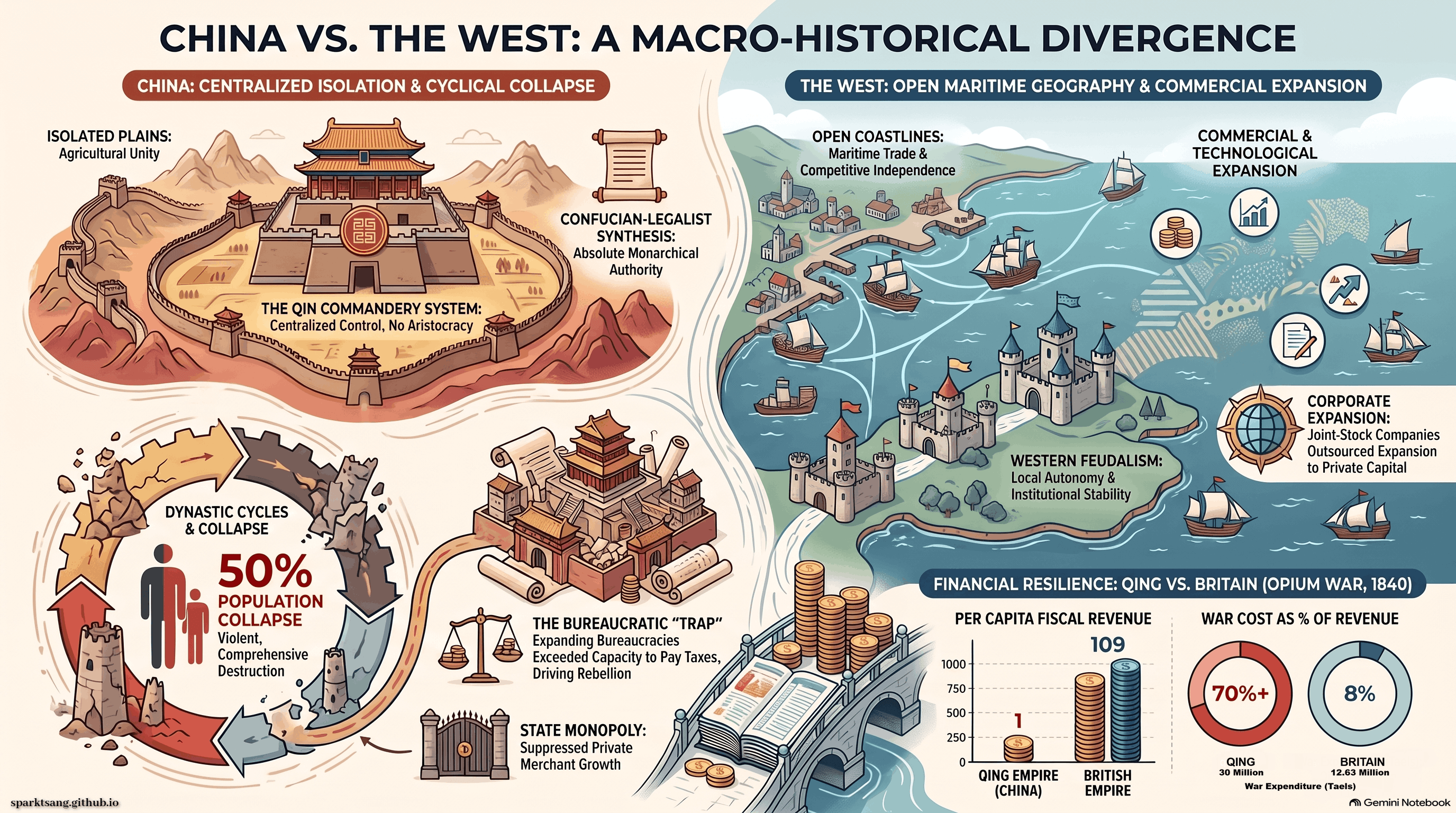
Between Qin and Han, at the end of Han, between Sui and Tang, during the An Lushan Rebellion, between Song and Yuan, and between Ming and Qing, more than half the population died.
In feudal China, during the Three Dynasties and the Spring and Autumn and Warring States periods, even though wars were frequent, there were no violent population collapses and recoveries.
Under feudalism in the West, population remained relatively stable. The two major declines in population were not caused by warfare, but by the decline of the Roman Empire and the Black Death.
Even when politics were dark under feudalism, destruction remained limited. Under the commandery-and-county system, social order was much better than under feudalism, but once that order collapsed, destruction became comprehensive and violent.
Song scholar Luo Mi said: “In the age of commanderies and counties, when one person loses his virtue, the whole structure collapses like a tumbling wall, and the whole world suffers from the calamity.”
Why has China experienced repeated cycles of order and disorder since Qin?
One explanation is Huang Yanpei’s law: each succeeding ruler is born deep within the palace and raised by women, becoming progressively more incompetent until the state eventually collapses.
But this cannot explain why other countries do not exhibit the same Chinese pattern.
Another explanation is climate. But Chinese history does not show a Little Ice Age occurring every one or two hundred years.
Another is land concentration. But according to Qin Hui’s research on peasant studies, China did not have a serious problem of unequal land distribution. There was no trend of landlords continually accumulating more and more land. Even when the rich repeatedly divided their property among their descendants, wealth rarely lasted more than three generations.
Nor is there evidence of peasants rebelling against landlords. The targets of peasant uprisings and massacres were always members of the imperial family and government officials.
The real cause lay in the continuous expansion of the bureaucratic system under each dynasty, eventually exceeding society’s capacity to bear it.
First, it was the result of strengthening imperial power.
Second, the bureaucracy became an independent interest group.
When Emperor Renzong of Song wanted to cut the number of officials, five hundred officials protested, so the reform was abandoned.
When the Guangxu Emperor attempted to eliminate redundant positions, the reform movement immediately failed.
As the bureaucracy expanded numerically, corruption increased as well. Everyone who managed to enter the bureaucratic system did so in order to profit.
This created a huge gap between legally imposed tax rates and actual tax burdens, while corruption caused large amounts of tax revenue to disappear.
Zhu Yuanzhang stipulated that members of the imperial clan could not pursue occupations. The only way for them to increase their income was to have more children.
By the middle of the Ming dynasty, officials around the country discovered that provincial revenues were already insufficient to support the imperial clan.
In the third year of Zhengde, Prince Qingcheng reported: “The imperial clan branches are too numerous … there is no means of counting them.” The population of the princely estates could no longer even be determined.
There was a huge gap between statutory tax rates and actual tax burdens, something even the emperor understood clearly.
An imperial edict from the third year of the Xuande era of Emperor Xuanzong of Ming stated: “Of every ten parts used by the public treasury, only two or three are actually used; private expenditure is often ten or more times that amount.”
The tax system established by the central government usually allocated too little to local governments.
The central government could only tolerate the additional charges collected by local authorities, while there was no fixed standard for how much extra could be collected.
During Emperor Wu’s reign, extravagant spending became excessive, so wealth was extracted from the people. The first step was selling titles, followed by higher taxes and demands that people voluntarily declare their wealth. “The wealthy all competed to conceal their wealth.”
Then came the decree on denouncing hidden wealth: anyone who reported undeclared property received half of it.
Next came an intensified version. Denunciations spread throughout the empire, and those who informed on others were soon denounced themselves.
The combination was so devastating that people across the empire had no means of resisting it. The state seized property from the people worth hundreds of millions, and slaves numbered in the tens of millions, while the entire national population at the time was only forty million.
Finally, the government announced that the value of the titles would be reduced. Promises made earlier no longer counted, while people were still required to perform service.
As a result, the population fell by fifteen million. Refugees spread everywhere and the realm fell into turmoil, gradually showing signs of Qin’s impending collapse. Emperor Wu had no choice but to issue the Edict of Luntai and pull back from the brink.
Research shows that the large numbers of refugees at the end of dynasties were not caused by land concentration, but by peasants’ inability to pay taxes, leaving them with no choice but to stop cultivating their land even when they still possessed it.
Even when aristocrats did seize land, the people usually fled first and the land was occupied afterward.
The burden borne by those who fled was shifted onto those who remained. Eventually, everyone had no choice but to flee.
In Europe at the same time, lords and serfs were bound by very concrete and clearly defined manorial customs.
Both sides in a dispute could argue freely before the manorial court, and serfs often won their cases.
Serfs only had to deal with the lord of the manor rather than arbitrary government exactions. Their burdens were fixed and did not grow heavier and heavier toward the end of a Chinese dynasty.
Modern states can broadly be divided into two kinds: large-government welfare states and small-government liberal states.
The successive Chinese dynasties, however, were large governments without assuming responsibility for the people’s basic welfare.
Han Feizi said that even if the state had the capacity to rescue disaster victims, it should not do so, preferring to throw supplies away.
King Zhaoxiang of Qin responded to the proposal to relieve the people: “If the people are rewarded equally whether they have rendered service or not, that is the path to disorder.”
Even after the exclusive dominance of Confucianism, this often remained nominal rather than real.
Upright officials and conscientious administrators who, without waiting for imperial approval, overruled colleagues’ objections and opened the granaries to provide disaster relief became famous precisely because such acts were extremely rare.
The more economically and culturally developed an area was, the more disaster records it has. This plainly contradicts objective expectations and can only demonstrate that remote regions were much less likely to receive relief.
In Europe, serfs had holidays and were provided with livestock and vehicles. If the main laborer in a household died, the manor lord was responsible for supporting the family. During natural disasters, the lord distributed grain for relief.
This also served his interests by protecting his labor force.
Serfs themselves formed mutually supportive communities, while churches cared for the old, weak, sick, and disabled.
The only major difference in the era of the Three Dynasties was the absence of churches; otherwise, the two were similar.
Wang Yangming: “The governance of the world after the Three Dynasties cannot serve as a model for later generations.”
Huang Zongxi: “Before the Three Dynasties there were laws; after the Three Dynasties there were no laws.”
Xue Fucheng: “Before Yao and Shun, all were democracies.”
Tan Sitong: “For two thousand years, the political system has been Qin’s system; all have been great bandits.”
Wang Chuanshan: “The Way and institutions of the Three Dynasties fell to the ground and were never restored.”
The commandery-and-county system also had advantages: long periods of peace under unification, unprecedented social mobility, and the achievements of prosperous eras.
A breakthrough within the cycle: Qin broke up the clans, but the Han practice of selecting officials through the recommendation of men of filial piety and integrity turned into private patronage, which was little different from hereditary succession. By the end of Han, great clans and powerful local families had risen again.
Officials were exempt from corvée service. Common people voluntarily donated land to officials to obtain exemption from service. Eventually the great clans had “thousands of slaves and tens of thousands of dependents,” and built armed forces that could “block the roads with troops and defend their borders,” creating a semi-aristocratic society.
In the Eastern Jin, Sima Rui depended on the support of the Langya Wang clan and invited Wang Dao to sit beside him on the imperial throne, giving rise to the saying, “The Wang and Ma share the empire.”
Great clans effectively restrained imperial power. In the Tang, an even stronger system of reviewing and rejecting edicts was established. Imperial orders had to be examined by Supervising Secretaries, while remonstrating officials enjoyed enormous authority.
Zhu Jing even remonstrated with Empress Wu not to accept too many male favorites: “Desire is the same in the wise and the foolish. The worthy can restrain it and keep it from excess; this is indeed an old maxim of the sages.”
According to the Book of Tang, the overall success rate of remonstrances in the Tang was 68%, while officials who died because of remonstrating were extremely rare (“International Symposium on Jiangnan Society in the Tang Dynasty and the Second Session of the Eleventh Annual Meeting of the Chinese Association for Tang History,” p. 422).
When Emperor Xianzong read The Song of Everlasting Sorrow, he did not blame Bai Juyi for satirizing Emperor Xuanzong. Instead, he summoned him to serve as a Hanlin Academician.
Yet the system of talent selection remained largely unchanged. Emperor Yang of Sui created the imperial examinations, but during the Tang, nine-tenths of officials still entered government through family background or military merit.
The real transformation occurred in the Song.
Apart from a few founding meritorious officials, only three men ever became chancellors without passing the imperial examinations.
Beginning with the Song, the semi-aristocratic society that had existed since the end of Han finally came to an end. China became a commoner society, escaped the threat of the great clans, and solved the problem of local power.
Officials appointed and transferred by the central government truly became “mobile,” no longer constrained by powerful clans.
The balancing of imperial power by civil officials also reached its peak. The tradition of following principle rather than the ruler was revived: “Although the ruler may command his ministers, he must not violate principle and act arbitrarily.”
The state stopped killing scholar-officials, and a tacit understanding emerged that the ruler would “share the world with the scholar-officials.”
Fang Tingshi admonished Emperor Gaozong: “The realm belongs to the Chinese people; it is not Your Majesty’s realm.”
Li Hang, in front of the eunuchs, burned the edict by which Emperor Zhenzong intended to establish a favored consort.
The court’s system of collective deliberation also expanded. Whenever a policy affected ordinary people, they could be invited to participate in political discussion: “When it was proposed to establish a tea law, several dozen tea merchants were summoned, and each was asked to set out the advantages and disadvantages” (History of Song, Biography of Chen Shu).
“People from the marketplaces, butchers and peddlers alike, were all summoned and brought into the Government Hall” (Xu Zizhi Tongjian Changbian).
Freedom of news, publication, and association reached unprecedented levels. Popular tabloids gained even greater momentum than official court newspapers.
Qin Hui used back-door connections to make his son the top scorer in the examinations. A play was written about it and publicly performed, leaving Qin Hui helpless.
Emperor Huizong watched a play in which an actor satirized the government onstage: “It is simply that the common people all suffer immeasurable hardship.”
The emperor “felt compassion and reflected on it for a long time, without treating it as a crime.”
Chen Yinke: “The culture of the Chinese nation, after evolving for thousands of years, reached its highest point in the age of Zhao and Song.”
Throughout Chinese history, agricultural taxation was the main source of state revenue. Under the Song, however, taxes from commerce and industry accounted for as much as 70%, while agricultural taxes accounted for only 30%.
The Ming suffered a major reversal, with industrial and commercial miscellaneous taxes falling back to 12%.
According to Xia Zhenkun (2014), the Song urbanization rate was 22%, leading the world. Under the Ming and Qing it was only 7%; according to Zhang Jie (2008), it was just 4%.
The Song enjoyed free trade, extending even to land. Human rights also reached an extraordinary level. Slavery was abolished for the first time; the so-called slaves and servants were actually wage laborers, fundamentally different from those of earlier periods.
Selling people carried the death penalty, with punishment harsher than today’s, but slavery revived under the Ming.
In the early Ming, the ancient practice of burial sacrifice was revived as well, and was not abolished again until the middle of the dynasty.
The drastic reversal occurred because under the Mongol military system, prisoners of war became private property, officials became servants, and the people were divided into rigid categories, each bound for life to a single occupation.
The whole population was effectively reduced to slaves of the state.
The Ming inherited this system and invented the practice of publicly beating officials with the imperial staff.
The Qing admired the Ming system enormously. While carrying forward what it had inherited, it also greatly expanded literary inquisitions.
Shunzhi said: “Among all the worthy rulers of the past, none compares with Hongwu.”
Kangxi personally wrote at the Ming Xiaoling mausoleum: “The governance surpasses that of Tang and Song.”
While China was suffering severe regression, medieval Europe, despite periods of darkness in which heretics, witches, and philosophers were burned, continued to advance overall.
After the fall of the Roman Empire, slavery disintegrated. Medieval manors became self-sufficient, and the burdens on serfs were limited. When harvests increased, serfs could improve their living standards, giving them an incentive to improve technology.
During this period, the heavy plow was invented, with sharper blades; harnesses were developed that rested on a horse’s shoulders, allowing horses to pull plows; and the ancient windmill and waterwheel were improved.
Animal, wind, and water power replaced human labor, allowing vast amounts of wasteland to be reclaimed.
Economic development came into conflict with religious culture. To resist religious culture, Europeans turned to ancient Greek and Roman culture, eventually producing the Renaissance.
Although the West as a whole did not surpass China until around 1750, some parts of Europe, such as Italy, were already ahead by 1300, and England surpassed them again by 1400.
In sixteenth-century England, a peasant household produced 5,007 kilograms of food per year. Even Jiangnan, the most developed region of Ming China, produced only 2,173 kilograms.
After the barbarian invasions, Europe’s towns had almost completely disappeared by 900, and each manor was self-sufficient.
Merchants made up only a small part of society, yet they greatly stimulated the development of civilization.
Merchants had money but no privileges, while lords had privileges but no money. The two sides therefore found common ground: merchants bought autonomy with money.
Drawing on the wisdom of ancient Rome, municipal councils gradually emerged.
In 1138, Florence held its first election for consuls, explicitly modeled on ancient Rome. Two consuls were elected at the same time, each serving for only one year.
After the rise of the city-states, they all learned from the systems of Florence and Venice, and municipal councils spread throughout Western Europe.
Citizens enjoyed equal legal status, property rights, and personal freedom. Unlike feudal manors, the city-states became vessels for the development of capitalism. A runaway serf who remained in the city for one year and one day became a free citizen.
City-states even united to challenge the authority of kings and popes.
The Assyrians began signing commercial contracts around 3000 BCE. The Romans invented the legal corporate entity, creating the prototype of the modern company. Ancient Greece emphasized commerce, while in Japan there was a saying: “When the merchants of Osaka become angry, all the feudal lords tremble.”
Chinese dynasties suppressed merchants. Guan Zhong proposed the principle that “profit should flow through a single channel”: “Whether I grant it lies with the ruler; whether I take it away lies with the ruler; whether I make [a person] poor lies with the ruler; whether I make [a person] rich lies with the ruler.”
The Han ordered that merchants “may neither wear silk nor ride in carriages.”
The Jin ordered merchants to wear “one white shoe on one foot and one black shoe on the other.”
Fu Jian ordered that “the homes and servants of merchants and artisans may not wear gold, silver, brocade, or embroidery; offenders shall be executed in the marketplace.”
Under the Tang, merchants were not allowed to take the imperial examinations.
Under the Ming, merchants could not wear silk or gauze.
China had no concept of private property. At any time, the state might “move the wealthy families of the entire realm to the capital,” while also exploiting merchants through coercive buying and selling.
When public finances became strained, the government openly plundered private wealth.
Anyone who wanted to become rich through commerce could only do so by colluding with political power.
Edwin Reischauer argued that given China’s enormous market, if commerce had not been suppressed, privately owned enterprises should have emerged.
Major goods such as salt and iron were historically monopolized by the state. Product design was irrational, quality was inconsistent, prices were high, and official exploitation made the development of a commodity economy even more difficult.
The Song’s private economy was extremely active. Commercial taxes remained around ten million guan, yet many officials still held negative views.
Wang Anshi said: “Even the lowly people in the lanes and villages can privately seize the power of buying and selling, monopolize the profits of all things, and compete with the ruler.”
His reforms enriched the state but harmed the people, and historians have argued that this helped cause the fall of Northern Song.
The ideal city of ancient Greece placed health and sanitation first. The basic principle of Chinese cities was order and regularity, reflecting political needs.
In medieval Europe, citizens collectively funded and built the walls of large cities; in China, forced labor was requisitioned for such construction.
Before the Song, Chinese cities operated under the lifang system: highly enclosed and tightly controlled, shops were not allowed to open freely, and night curfews were imposed.
The Ming became even more strictly regulated. Household registration could not be changed for life, and even clothing, the size of one’s residence, what kind of pot could be used for drinking, and women’s hairstyles were strictly prescribed.
During the Ming and Qing, even the private economy itself was not based on equality. Masters and hired workers were in a master-servant relationship and could be beaten and punished arbitrarily. As long as no bone was broken, the master was generally not held accountable. Hired workers had to obey household rules: “If a hired worker curses the head of the household, he shall receive eighty strokes and two years of penal servitude.”
The late Ming experienced explosive prosperity because political corruption inadvertently relaxed the constraints on the market.
Max Weber: “Outside the West there were no cities.”
Li Bozhong: “There was no so-called germ of capitalism in China.”
City-states helped create nation-states.
Faced with nobles and kings whose powers were limited, rulers needed military force and were willing to use crowns and ministers as collateral.
City-states were willing to help kings because the nobility was their common enemy. Each autonomous territory had its own tariffs, laws, weights and measures, and currency, all of which hindered the circulation of goods.
In this process, Western Europe produced several political models: the extreme absolutism of Spain, the centralized absolutism of France, British constitutional monarchy, and the loose federation of the Netherlands.
After long competition, the British system ultimately determined the shape of today’s world.
After unifying to form the first empire on which the sun never set, Spain irrationally abolished the autonomy of cities within its borders and suppressed the joint uprising of eleven city-states.
The Dutch and English extended autonomous city-states overseas in the form of corporations, each establishing an East India Company.
The two East India Companies purchased from parliament or the King the right to operate freely, each becoming like a large city-state with its own parliament, government, and laws.
At first, overseas ventures were led by a small number of people.
The Netherlands did not have the powerful king and great fortunes that England possessed, so it came up with the idea of issuing shares to all citizens.
The system was attractive because it offered limited liability, separation of decision-making from management, and free transferability.
The world’s first stock exchange was therefore born in Amsterdam.
At first Spain looked down on it, but within only five years the fleet of the Dutch East India Company exceeded the combined fleets of Spain and Portugal. It subsequently defeated enemy states and seized huge amounts of territory.
By 1669 it had become the world’s wealthiest private company, paying dividends of 40%.
The joint-stock company was a simple institution, yet it reflected the spirit of rule of law and contract: tens of thousands of people dared to invest their money in an organization with which they had absolutely no personal connection, and they trusted its board of directors.
The dominant force in trade between China and Britain, and in the colonization of India and the Americas, was not the government but companies, as though governments had outsourced overseas expansion to private contractors.
The British East India Company soon learned the joint-stock system as well. Because Britain possessed more effective centralization, it became more successful than the Dutch.
The Dutch, by contrast, each acted independently. Lacking unified power, they found it difficult to protect their overseas interests effectively.
Philip II of Spain imposed crushing taxes, provoking a Dutch revolt. The Dutch initially placed their affairs under the English queen, but English taxation proved even heavier than Spain’s, so the seven provinces eventually united and established a state of their own.
Its structure remained loose. It had no standing army and relied on hired mercenaries, leaving it without the powerful military backing Britain possessed.
High labor costs create incentives to improve technology. This is why the Industrial Revolution arose in the West rather than in China or India.
Britain was rich in coal. The Netherlands, once the world leader, was constrained by its lack of natural resources.
Spain became enormously wealthy by plundering its colonies, but this only encouraged luxury. Absolute monarchy suppressed commerce and industry, checkpoints were everywhere, and taxes were repeatedly imposed.
Spain eventually collapsed and became the poorest country in Western Europe.
The Industrial Revolution was related to the political system.
In 1603, the King of Scotland was invited to become King of England. Later, the end of feudal fragmentation in Ireland strengthened British power after unification, but it also increased royal power, which frequently led to arbitrary taxation and exactions.
The success of companies inspired the English to separate ownership from management in the administration of the state.
In 1688, the Glorious Revolution brought the Dutch prince William III to the English throne. The king signed the Bill of Rights, establishing the framework of the modern democratic system.
After creating a company-style imperial model, Britain enjoyed unprecedented political stability and ceased to suffer from internal civil wars. It defeated Spain, challenged the Netherlands, and private property rights encouraged investment.
Britain, isolated overseas, had no standing army until 1645.
The Constitutions of Clarendon of 1166 established the jury system. Even occasional violations of the king’s laws could still be recognized, playing a major role in cultivating the English consciousness of rights.
Maddison’s The World Economy: A Millennial Perspective: in 1820, China’s GDP accounted for 32.9% of the world total.
The population exploded, yet under the so-called age of prosperity, per capita food availability was only 780 jin, the lowest since the Qin dynasty.
Hong Liangji: “The peasants of the late Qianlong and early Jiaqing period worked diligently throughout the year and spent their whole lives anxiously striving, yet even the relatively fortunate among them still faced the fear of ending up in the ditches.”
In 1793, the British embassy visited Qing China, urgently seeking to buy goods from around the world while selling its own textiles and steel products.
The Qing implemented the Canton System, with the Thirteen Factories monopolizing foreign trade.
Before this, Europe had been seized by a “China craze.” Voltaire worshipped an image of Confucius, while Leibniz praised China as possessing humanity’s most advanced culture and technological civilization.
But the British soon discovered that a military commander could force civilians to leave their homes and act as unpaid pilots, arbitrarily violating their rights.
At the sight of an official, an ordinary Chinese person would suddenly become cautious and submissive, as though he had become a different person.
Some people, in their eagerness to see the foreigners, crowded onto boats and caused them to capsize, while Qing subjects could coldly watch people drown without rescuing them.
Because the British envoy did not kneel with both knees, Qianlong refused to summon him to explain the gifts.
Those gifts represented the latest cutting-edge technological achievements of the Western world, including models of the solar system and astronomical telescopes.
The emperor decided they were nothing special and rejected the British requests, missing the last opportunity the world offered China.
The meticulously prepared display of military strength instead exposed its weaknesses. Besides becoming a joke, it also revealed the deficiencies of Qing defenses.
When Macartney returned home, he said that if the Qing government were replaced by one that protected civil rights, the skills and ambitions of Asia’s merchants, craftsmen, and farmers would be stimulated, benefiting the whole world.
China was like an old ship that, once struck, would be incapable of repair.
From that moment, the intention to wage war began to take shape.
At first, Britain exchanged large quantities of silver for Chinese tea.
As American silver mines faced depletion, Colonel Watson of the East India Company proposed growing opium in India and selling it into Qing China. The plan was approved in 1773, while Qianlong knew nothing about it.
Opium was originally kept as a bargaining chip; only after Macartney’s failed mission was it deployed on a large scale.
In 1840, George Thomas Staunton, who had conversed with Qianlong in Chinese and had learned how to deal with the Chinese, argued forcefully in the House of Commons that Britain must adopt a hard line.
On April 7, a vote of 271 to 262—a margin of only nine votes—determined that Britain would send troops against the Qing.
Historical facts show that the Opium War was directly connected to Qianlong, rather than simply being the result of the incompetence of the late Qing emperors.
During the war, although both countries possessed firearms, the quality gap was enormous.
After the Qing army captured large numbers of Western-style weapons from Ming forces, its military industry stagnated.
Financially, the Qing spent 30 million taels on a war fought on its own territory, more than 70% of the 39.04 million taels of government revenue in 1840.
To rebuild its military capabilities was almost equivalent to creating an entirely new army. Corruption swallowed one-third of military funds. Officials such as Zheng Dingchen even fabricated armies to deceive the court.
Combined with an extremely backward accounting system, this produced enormous expenditure.
Britain spent only £4.21 million, equivalent to 12.63 million taels, just 8% of annual fiscal revenue of £155.4 million.
Britain had only 15 million people, while the Qing had 410 million—twenty-seven times as many.
British per capita fiscal revenue was 109 times that of Qing China.
The enormous gap arose because after the Glorious Revolution, taxation became transparent, taxes were taken from the people and spent for the people, private property was protected, people felt secure enough to work and invest, and they willingly paid taxes.
Chinese people did everything possible to evade taxes, while 80–90% of tax revenue was swallowed by the bureaucratic system through corruption.
Direct taxes made up only a small portion of the fiscal revenue described above.
Britain also possessed tremendous borrowing power, enabling it to sustain large-scale wars with extraordinary resilience.
In the sixteenth century, when the Habsburgs needed to fight France, the Dutch borrowed money in the name of the provincial States of the Netherlands, opening a new era.
Borrowing in the name of the state proved more successful because the credit of parliament was strong, tax revenues grew steadily, and parliament was a permanent institution.
After the Glorious Revolution, William III brought this national debt system into Britain. Its high transparency enabled Britain to borrow money from the entire world.
In 1786, British Prime Minister William Pitt declared: “The vitality, and even the independence, of this nation rests upon the national debt.”
Absolutist France copied the system, but parliament could not control the king and therefore lacked credibility. It could not borrow, and had to rely on continually increasing taxes.
In the century before the Glorious Revolution, France won the Hundred Years’ War, while England lost almost all its French territories.
After the Glorious Revolution, Britain’s military power rose and it won comprehensively.
The regime after the French Revolution went even further, wiping out two-thirds of its debt. Credit collapsed even further, and in the end, even Napoleon, with his extraordinary genius, still had to meet his Waterloo.
Chinese emperors had no concept of borrowing; they only knew how to seize.
Even when the late Qing attempted to issue bonds, the effort ended in failure. In the end, it returned to compulsory levies while refusing to pay interest.
Chen Zhiwu’s The Logic of Finance: around 1600, countries such as Ming China and India had large cash reserves, while countries such as Britain, the Netherlands, and Italy were heavily indebted. The latter group are all developed countries today.
After absolutist monarchy emerged in France, the country took the old Qin road. The original feudal society based on human relationships disintegrated and fragmented, and local self-governing capacity was lost.
Even when Louis XIV undertook public works with good intentions, he still provoked resentment among the people, helping to explain why the subsequent revolution became so violent.
For nearly a century afterward, France remained trapped in a cycle of revolution and restoration.
In 1853, the United States Navy sent a letter to Japan demanding the opening of its ports. Japan signed a treaty the following year, opening the modern era of Japan.
Kang Youwei believed that China and Japan shared the same written culture and the same ancestry, and that China could surely succeed by imitating Japan’s reforms.
This was profoundly mistaken.
Nominally, Japan was governed by an unbroken imperial line stretching back through ten thousand generations. In reality, it was very similar to Europe: a manor-based feudal system, primogeniture, hereditary social classes, plural centers of power, and a warrior system.
Unlike China’s civil-official model of government, hereditary Japanese warriors generally had little education and emphasized practical affairs.
Wei Yuan’s Illustrated Treatise on the Maritime Kingdoms was ignored in China, yet Japanese readers treated it as a treasure and repeatedly reprinted it.
Kang Youwei also believed that China’s modern transformation would proceed much faster than Japan’s because imperial power was concentrated in one hand.
The facts were exactly the opposite.
China could produce only one response, while Japan’s many domains could generate a wide range of responses, allowing the correct choice to emerge.
The Treaty of Nanking placed the British “barbarians” and the Qing emperor on an equal footing and was regarded as a national humiliation and loss of sovereignty. The court therefore decided to limit the number of people who knew about it as much as possible.
In opposition to the entry of foreigners into the city, the people of Guangzhou launched a vigorous anti-entry movement.
The Proclamation of the Righteous and Loyal People of Guangdong declared: “Chinese and barbarians must not live mixed together; human beings and beasts cannot coexist. It is truly like opening the gate to welcome thieves and opening the door to invite wolves.”
This became one of the triggers of the Second Opium War.
After the Treaty of Tianjin, Xianfeng, unwilling to have the foreign ambassadors who refused to kneel before him reside in Beijing, actually considered, for a time, exchanging all customs duties in return for that concession. He stopped only after repeated remonstrance.
Since ancient times, China had followed a policy of lavish giving to tributary states and taking little in return.
Tribute goods were purchased at prices above market value and then accompanied by return gifts. As a result, all the peoples surrounding China competed eagerly to send tribute.
During the Ming, Mongols launched several wars simply to force their way into the tribute system.
Two factions of Japanese even fought one another on the spot over the profits from tribute trade, and tribute envoys eventually became wakō pirates.
This diplomacy of face was remarkably similar to that of Burma, where royal authority was equally absolute.
The Burmese king, regarding himself as the king of the universe, demanded tribute from British India. When the British refused, he declared war and suffered a crushing defeat.
Even after the defeat, he still showed no desire to reform, instead becoming obsessed with accumulating religious merit by building temples and stupas on a grand scale. On one occasion he gave away 5,000 kilograms of gold.
Grand Councillor Gui Liang once told the Tongzhi Emperor that the treaty was merely “a temporary expedient of making peace; bringing matters to a swift conclusion is the best policy.”
Like the Tongzhi Emperor, the Burmese king also believed that he could simply reverse course at any time and refuse to recognize the treaty.
In 1837, the new Burmese king Meng Keng received Burney and announced that he would not recognize the Treaty of Yandabo, leading to the Second Anglo-Burmese War.
Just as China required foreign envoys to kowtow, Burma required foreign envoys to remove their shoes, ultimately causing diplomatic relations between the two sides to break down and deteriorate further.
After the Third Anglo-Burmese War, Burma became a province of British India.
At first, the Chinese under the Qing believed that this was merely a repetition of the historical invasions of barbarian peoples.
Later, some people realized that this time was different: the invaders had captured the capital yet did not seek to replace the dynasty. They only wanted trade.
In the third year of Xianfeng, the Small Swords Society uprising broke out. Shanghai customs officials fled, and the British, Americans, and French collected the customs duties on behalf of the Qing.
Revenue increased.
Two years later, when Shanghai was recovered, more than 700,000 taels of customs revenue were returned in full to the Qing court.
The Qing government therefore allowed the British to administer the customs.
Although their motive was selfish profit, in pursuit of huge and lasting returns, British colonialists chose to develop their colonies and establish production lines, making them rich enough to buy the products they themselves produced.
Spanish colonialism, by contrast, was built on absolutist monarchy and violence, with social classes rigidly divided according to birthplace and bloodline.
As a result, although Latin America was fertile and richly endowed, power remained in the hands of whites or mixed-race whites, nepotism became pervasive, and modernization has still not been achieved.
After the Opium War, the Qing discovered that the ideal government of the Three Dynasties could actually be realized, but only in a “barbarian country.”
Xu Jiyu, A Short Account of the Maritime Circuit of the Earth: “The method of election is almost such that the realm belongs to all; it gradually approaches the aspirations inherited from the Three Dynasties.”
“The United States of America has made a country of itself, extending across ten thousand li. It does not establish titles of kings and feudal lords, nor does it follow hereditary succession. Public institutions are entrusted to public opinion. It has created a political order never seen before in ancient or modern times. How extraordinary!”
Xue Fucheng’s diary: “Mencius’ saying that ‘the people are the most precious, the state comes next, and the ruler is the least important’ still operates among them. Could they not now be like Britain and the other such countries, where ruler and people govern together?”
“Before Tang and Yu, all were democratic … Any commoner who possessed virtue could be embraced by the people and made ruler, and would then become a feudal lord. A feudal lord who possessed still greater virtue could then be honored by all the feudal lords as Son of Heaven. This is all a model of democracy today.”
Liu Xihong, Private Notes from a Mission to Britain: “Officials, gentry, scholars, commoners and others all present their views and discuss current affairs. Debates that begin during the day often continue until night.”
“Every year, expenditures and revenues are itemized and displayed publicly to the gentry and people. If there is even a little falsification or extravagance, the people jointly question and challenge it … With many ears and many eyes, no one dares deceive; because public funds are publicly accounted for, no one is willing to deceive.”
Liu Xihong was especially impressed by Britain’s educational system, schools, and prisons.
When the British invited him to inspect a prison, he thought he had prepared himself in advance to refuse. But the visit turned out to be an unannounced inspection, and he was astonished.
He praised its cleanliness, sanitation, and humane treatment: “…in the prison there were neither old nor young who did not appear well-nourished and healthy.”
Many people believe that the Opium War marked the beginning of China’s so-called century of national humiliation, lasting until the fall of the Republic of China, during which there were wars and famine, warlord conflicts, economic decline, and widespread misery.
The facts are exactly the opposite.
From 1911 to 1936, the population growth rate of the Republic of China averaged 1.03% per year, an unprecedentedly high level in Chinese history (History of China’s Population), breaking the supposed rule that “times of disorder inevitably bring mass death.”
Before 1869, although there were invasions by foreign powers, including the Opium War, China’s traditional natural economy remained basically unchanged (Zhao Jin, 2006).
In 1869, the opening of the Suez Canal greatly reduced the cost of British manufactured goods and machinery, finally causing China’s traditional natural economy to disintegrate.
In 1898, in order to resist foreign capital, the Qing court recognized private enterprises as legal.
Six years later, it promulgated the first company law in Chinese history.
From 1894 to 1913, the capital of Chinese private enterprises increased from 7.1 million to 162 million.
From 1895 to 1911, China’s total railway mileage increased from 467 kilometers to 9,292 kilometers.
From 1869 to 1894, the average annual growth rate of the quantity of goods in China’s market was 1.25%.
From 1894 to 1908, it reached 4.02% (Wei Sen, 2007).
From 1894 to 1931, China’s GDP increased 3.52 times, while that of the United States increased only 1.98 times during the same period.
The so-called warlord conflicts of the Beiyang period were actually the period of fastest growth for China’s private economy in modern history.
The later “Golden Decade” was an extension and expansion of this trend.
Beginning in 1900, foreigners could no longer tolerate the filth and disorder of Beijing, so they greatly improved its sanitation and urban appearance.
When Empress Dowager Cixi returned to Beijing from Xi’an and saw the improved sanitation, she even praised the foreigners for their competence.
China was able to overtake as a latecomer because it had adopted feudalism very early and had also begun centralized rule earlier than the West.
But this also destroyed almost all social organizations and mechanisms of local self-government, giving rise to an unrestrained monarchy and a huge bureaucratic system.
Europe explored many paths toward centralization. Eventually, the British system emerged: more cohesive than the Dutch and better able to constrain royal power than Spain.
The Ming government was roughly the same size as the British government, but their spending priorities were completely different.
The British invested in the economy; apart from flood control, the Ming government spent primarily on the court and the pleasures of the imperial family.
Many non-Western countries have suffered setbacks in the process of modernization because the driving force was not endogenous but implanted from outside.
After democratization, Turkey could not easily withstand the strong religious consciousness of the countryside. It came within one step of joining the European Union, yet ultimately turned back.
Latin American populations are easily influenced by radical slogans and displays of authority. They elected Chávez, who promised free housing and gasoline for the poor.
His radical nationalization policies produced severe corruption, and a petroleum-rich country eventually fell so far that it had to import oil.
The author believes that there are two cultures capable of providing fertile soil for modernization: Puritanism and Confucianism.
Puritanism emphasizes fulfilling one’s duties in worldly life.
Confucianism pursues self-cultivation and the ordering of the family. “Heaven moves with vigor”; “a great burden rests on a long road.” These contain a vigorous and enterprising spirit of striving, remarkably similar to the Protestant ethic.
Catholic culture contains a medieval character, believing that everything has already been determined by God and cannot be reversed.
Path dependence is difficult to reverse, just as a person entering middle age will not suddenly change his character overnight.
China had already made its initial choice when Qin swept across the Six States. History, culture, and geography determined the tendency toward unity under one realm.
Within this framework, China should absorb the achievements of the civilizations of all humanity, achieve a systemic upgrade, and activate the driving force of the entire society.
Though Zhou is an old state, its mandate remains ever renewed.
Finished reading on May 4, 2020
Zhang concludes that China’s unique trajectory—early centralization leading to a 2,000-year cycle of bureaucratic expansion and stagnation—was largely dictated by its geography and the absence of institutional brakes. But why did other civilizations, starting from much weaker foundations, manage to escape this cycle?
In The Origins of Political Order, Fukuyama provides the global mirror to this phenomenon, tracing how the delicate balance between state power, the rule of law, and accountability determines whether a society evolves or decays.
Thank you for reading until the end. This is a bonus infographic just for you.