Notes on Enlightenment Now
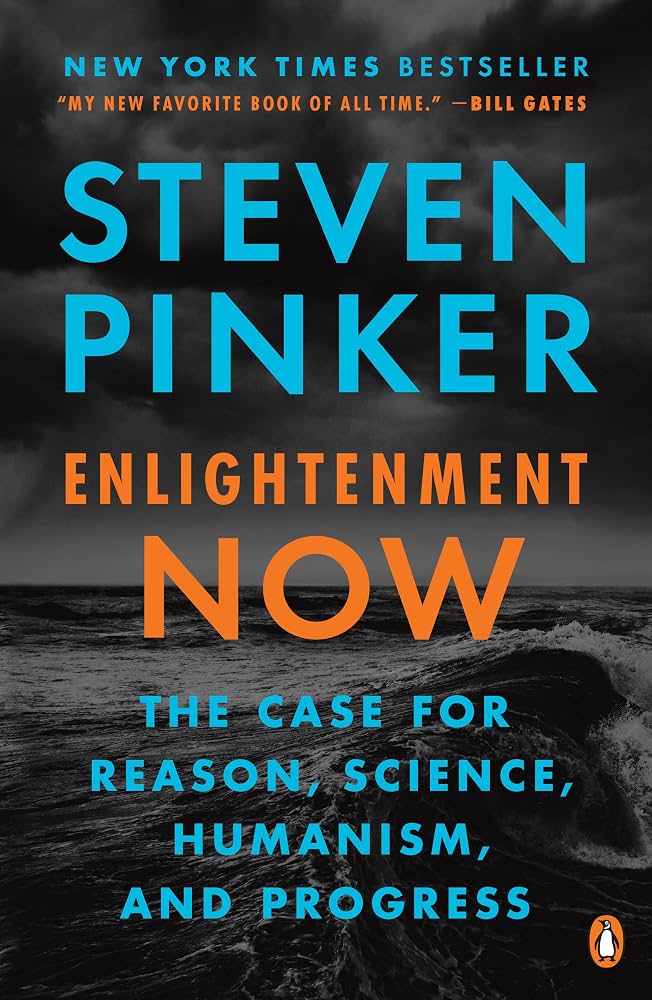
Enlightenment Now: The Case for Reason, Science, Humanism, and Progress by Steven Pinker
Original notes here.
Read until the end to get a bonus. Enjoy reading.
National leaders portraying the current state of the world as pitch-black is an error on the level of Flat Earth Theory
A lecture at which a female student asked, “Why should I go on living?” inspired this book
Now more than at any other time, someone needs to step forward to defend the ideals of the Enlightenment. Sadly, their victories go uncelebrated and are even taken for granted and questioned
In 1784, Kant answered the question of what enlightenment is, passionately declaring its motto to be Sapere aude—dare to know
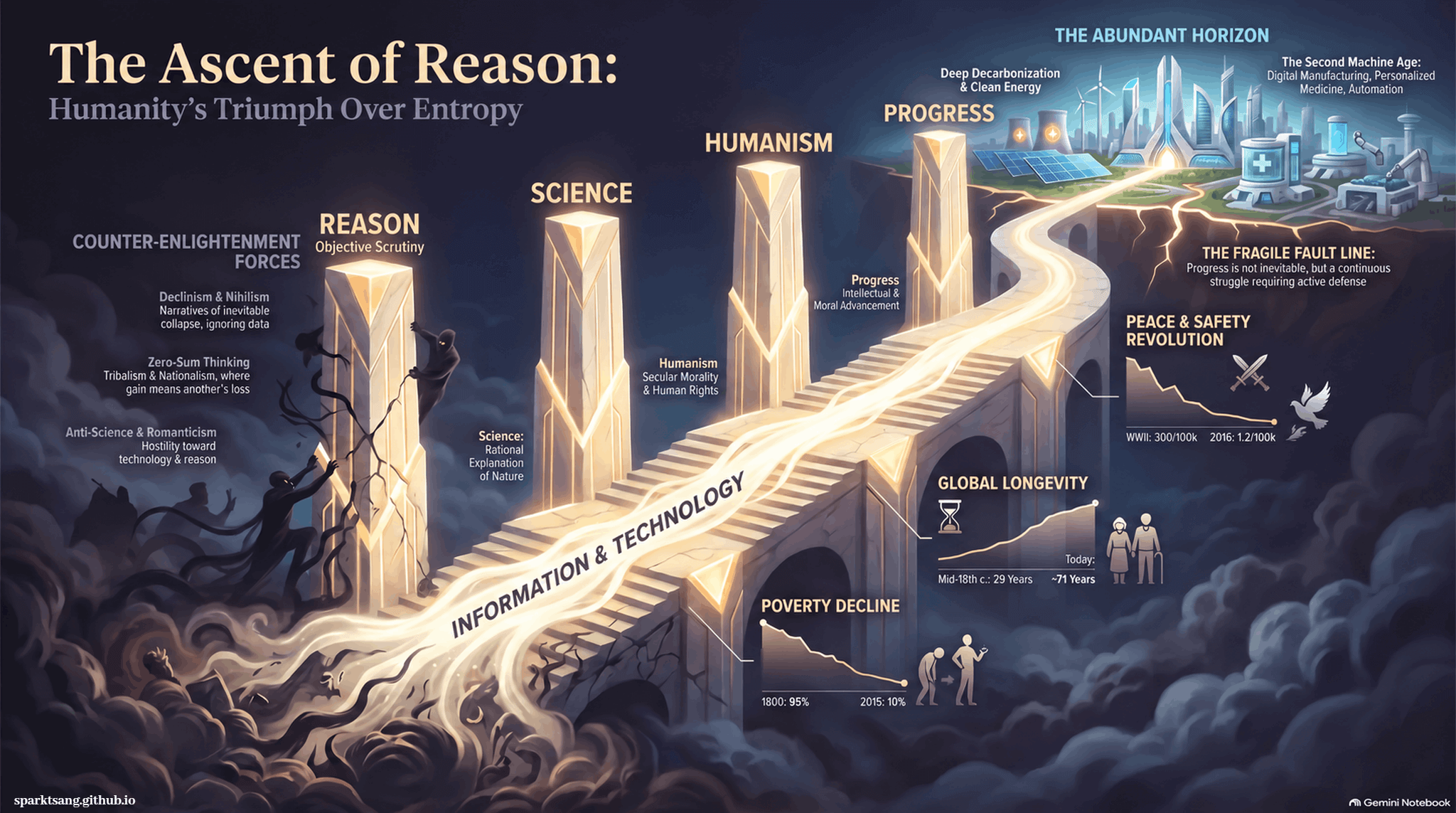
The four pillars of the Enlightenment: reason, science, humanism, and progress
Loyalty to reason means subjecting one’s own beliefs to objective scrutiny; science advances rational explanations of the world (on the eve of the Industrial Revolution, educated English gentlemen believed that witches could summon storms, that werewolves and monsters existed, that a monster had turned Odysseus’s crew into pigs, that mice could grow from straw, that unicorns existed, that corpses would bleed when their murderers were nearby, and that the Earth stood still); humanism establishes a secular moral foundation in which individual well-being takes precedence over tribe, race, nation, and religion; by using science to deepen our understanding of the world and reason and cosmopolitanism to expand the scope of our sympathy, humanity can make intellectual and moral progress
The most famous product of the Enlightenment is the Declaration of Independence, which guarantees the rights to life, liberty, and the pursuit of happiness; governmental power must rest on the consent of the governed; punishment should not be excessive but should serve the purpose of deterrence; rational analysis of prosperity led to specialization, mutual assistance, and cooperation, and peace followed
Three themes intimately connected to the human condition: entropy, evolution, and information
Entropy is the degree of disorder; the second law of thermodynamics states that the entropy of an isolated system does not decrease, revealing the ultimate meaning of the fate of the universe and of life, mind, and human struggle: using energy and knowledge to fight entropy, creating useful order out of chaos
Living organisms absorb energy to create order; information is a reduction in entropy; useful activity in turn reduces information entropy, and life also accumulates information
The first piece of wisdom distilled from this: misfortune does not necessarily mean that someone has done something wrong
The Counter-Enlightenment
Since the 1960s, public trust in modern institutions has steadily declined, leading to today’s rise of populism and an open rejection of Enlightenment ideals: tribalism, a liking for authoritarianism, disrespect for knowledge, no expectation of a better future, nostalgia for a simpler past, and contempt for reason, science, humanism, and progress, including:
“The Enlightenment came from the West and is therefore not universal”
Romanticism: “Human beings should struggle bravely,” denying that reason can stand apart from emotion, that individuals can stand apart from culture, that people need reasons for their actions, that values transcend time and place, and that peace and prosperity are the purposes of humanity (Rousseau, Johann Herder, Friedrich Schelling)
Religious faith: the existence of supernatural entities, which by definition conflicts with reason: accepting a savior, venerating scriptures, performing rituals, avoiding taboos, and punishing heretics
Tribalism: human beings are disposable cells within superorganisms such as tribes, religions, nations, races, classes, and states; the highest good is to glorify the group rather than care for the well-being of its members, as expressed in pathological patriotic slogans
Sacrificing oneself for everyone is admirable, but sacrificing oneself for the charisma of a leader, a piece of colored cloth, or patches of color on a map is another matter entirely; there is nothing beautiful or honorable about it
Both ends of the political spectrum have people who put their faith in nation and religion; some on the left believe ecology should take precedence over human well-being, while the Green movement, itself a form of romanticism, does not regard humanity’s acquisition of energy as a fight against entropy but as a grave crime against nature
The two political camps increasingly resemble secular religions: they organize believers, have sacred beliefs and doctrines and demonic enemies, demand faith without questions, and yearn for a better world
Declinism: humanity is heading toward self-destruction. Arthur Herman’s The Idea of Decline in Western History points out that the prophets proclaiming the end of civilization form a star-studded lineup in the humanities, including Nietzsche, Schopenhauer, Heidegger, Adorno, Sartre, Foucault, and Said; a survey of eleven developed countries at the end of 2015 found that most people said the state of the world was getting worse
Nihilism: the human soul drifts in a void, alienated, anxious, apathetic, and listless; civilization will decline and collapse; cold reason cannot bring liberation, so one must place one’s hopes in a more authentic heroic, whole, divine, powerful being-in-itself and will to power (Nietzsche)
The reaction against separating the humanities from science: science is the “first culture,” the arts are the “second culture”; science’s only function is to solve secular problems, while elite art is the sole moral high ground; science strips life of its enchantment, human freedom, and dignity
Negative, sensationalist news distorts people’s view of the world; the correct method of analysis is calculation. In his 2011 book The Better Angels of Our Nature, the author uses extensive data to show that violence has steadily declined throughout history
The author demonstrates a multitude of irrational objections from every direction—none of which can stand up, all of which reveal obvious logical fallacies, yet which never cease
Large quantities of data on human progress can be found at
https://ourworldindata.org/
https://www.humanprogress.org/
https://www.gapminder.org/
Health and Longevity
In the middle of the eighteenth century, global life expectancy was 29; humanity had made no progress at all since our hunter-gatherer ancestors. Age-specific analysis shows that the reason was not simply a decline in child mortality, and measurements from the Global Burden of Disease project show that increased longevity was not simply the result of stretching out unhealthy lives
In nineteenth-century Sweden, one of the world’s wealthiest countries, between one-third and one-quarter of children died before the age of five; today, the figure is below 1% in developed countries, and globally it had fallen to 4% by 2015
In mid-eighteenth-century Sweden, the maternal mortality rate in childbirth was 1%; today it is 0.04% in Europe and 0.2% globally
Karl Landsteiner’s discovery of blood types saved more than one billion people
Abel Wolman & Linn Enslow discovered the chlorination of drinking water, estimated to have saved 177 million people; William Foege eradicated smallpox, saving 131 million… More than a hundred scientists have saved over a billion lives
(Note added by the note-taker: https://www.weforum.org/agenda/2018/03/the-50-most-important-life-saving-breakthroughs-in-history)
In poor countries, 35% of people were undernourished in 1970; by 2015, the figure had fallen to 13%
Norman Borlaug single-handedly developed wheat varieties with yields several times those of earlier strains, turning India, Pakistan, and other famine-stricken countries into food exporters almost overnight; he deserves to be regarded as a savior of humanity
From 1961 to 2009, the area of farmland increased by 12%, yet total agricultural output quadrupled
Of the 70 million people who died in the great famines of the twentieth century, 80% were associated with communist regimes’ forced collectivization, punitive confiscation, and totalitarian central planning
Wealth
Economist Peter Bauer: there is no reason for poverty, but there are reasons for wealth
The problem with comparing wealth across eras: even when everything is converted into international dollars of a particular year, improvements in quality still cannot be quantified; many goods in the past simply could not be bought at any price, making comparisons impossible. Once goods become widely available, consumer surplus emerges—the price is far below what consumers are willing to pay—and this grows explosively, making it impossible to measure effectively. We can therefore no longer determine the value of each individual good
Three major causes of the explosion in wealth:
Science: reduces trial and error and increases the probability of success
Institutions: open economic systems that allow goods, services, and ideas to be freely exchanged, replacing the old culture of cronyism (granting privileges to prevent elites from fighting and killing one another)
Values: commerce finally stood on the moral high ground
In 1800, 95% of people lived in extreme poverty; by 2015, only one in ten did. Not only the proportion but the absolute number has fallen
Reasons for development: the failure of communism (look at satellite photographs of North and South Korea), global leaders turning toward pragmatism (partly benefiting from the spread of democracy), the end of the Cold War (the domino-like collapse of dictatorships ending many civil wars), globalization (an explosive increase in trade and greater business efficiency) (Radelet, 2015)
Half of the world’s adults have smartphones; each smartphone adds $3,000 to annual GDP in poor countries
Inequality does not equal poverty: total wealth is not finite but grows exponentially; Capital in the Twenty-First Century makes the grave mistake of comparing wealth as a percentage of the total
Sociologists Jonathan Kelly & Mariah Evans, in a study spanning 30 years, directly severed the presumed causal link between inequality and happiness: in poor countries, inequality was surprisingly not depressing but encouraging, because it symbolized opportunities for upward mobility (in rich countries there was no obvious difference)
Psychologists Christina Starmans, Mark Shesskin & Paul Bloom, after reviewing the literature, found that human beings prefer inequality, provided that it seems fair
The idea that primitive hunter-gatherers were communists is a misunderstanding; hunter-gatherer societies had a Gini coefficient of 0.33, comparable to the United States in 2012 (Smith et al. 2010)
The Kuznets curve: after the Industrial Revolution, global inequality continued to rise until about 1980, then began to fall, and is now narrowing, because social spending has increased explosively. In the United States, social spending is actually higher than the headline figures suggest because many subsidies are provided by employers; combining public and private spending would move the United States from 24th among OECD countries to second, behind only France. The historical trend is toward higher social spending, and the next step may be universal basic income
Economist Leonardo Prados de la Escosura found that social welfare, health, and education levels are strongly correlated with social spending, but the curve flattens at around 25%, and can even decline beyond that
Milanovi 2016, fig. 1.3: from 1988 to 2008, income growth was concentrated in the 10th–70th percentiles and the richest 1%; growth for the 80th–90th percentiles was only around 10%—the lower-middle strata of rich countries, who became those abandoned by globalization
Meyer & Sullivan 2017: the proportion of Americans living in poverty has steadily declined, whether measured by disposable income or consumption
Environment
Francis: advances in science and technology do not mean that history and human nature are progressing
Some environmentalists compare humanity to the cancer cells of the Earth
Brand 2009: from the ecologist’s perspective, not a single agricultural product is natural; ecosystems are confined to one location, cut into rectangles, flattened, stripped bare, reproduction accelerated, repeatedly flooded, and reduced to a single crop; weakened from birth, unable to survive on its own, and forced to domesticate humans into serving as its permanent nanny
Since the 1960s there have been endless predictions that the Earth’s resources would run out, and all have been wrong; in 2013 The Atlantic ran a cover story reporting that humanity would not run out of oil
The belief that humans need resources is a conceptual mistake; what satisfies human needs is ideas: formulas, recipes, technologies, blueprints, algorithms—not a fixed stockpile of particular resources (Deutsch 2011)
Since the United States established the Environmental Protection Agency in 1970, five major pollutants have steadily declined despite growth in GDP, vehicle miles traveled, and population; carbon emissions have also fallen from their peak at the beginning of this century
Many changes are visible to the naked eye: London is no longer shrouded in smog, waterways in the city have recovered their vitality, and people even swim in them
From 2004 to 2013, the rate of development in the Amazon basin fell by 80%
From 1973 to 2016, oil-spill incidents fell from 100 to five, while the volume of oil transported by sea continued to rise
The share of the world’s land and ocean areas designated as protected areas has continued to increase over time
Environmental progress is inseparable from technology: technology allows us to make more from less, growing large amounts of food on smaller areas of farmland (organic agriculture is the opposite: it requires more land while producing lower yields, so it can hardly be called green or sustainable); to reduce material use (smartphones have eliminated the need for telephone lines and utility poles, while vinyl records have become MP3 files); and to reach “peak material” (in some advanced countries, material consumption is now declining)
Deep decarbonization is indeed a formidable challenge: a survey of 69,406 peer-reviewed scientific papers found that only four authors rejected the human contribution to global warming, and among peer-reviewed papers there is no clear evidence rejecting that hypothesis
Carbon emissions mainly come from heavy industry 29%, buildings 18%, transport 15%, land use 15%, and electricity generation 13%. Yet the public habitually judges moral worth by how much one sacrifices rather than by the actual benefit produced, leading some people to call for abandoning airplanes and jewelry
Each country’s carbon dioxide emissions per dollar of GDP are declining; China is the only exception, with carbon emissions soaring during its backyard-furnace era while economic output was effectively zero
Deep decarbonization begins with carbon pricing: charge people or companies according to their carbon emissions. The side effects on the poor can be adjusted by redistributing the tax burden. Another key point is a fact the traditional environmental movement has been unwilling to face: nuclear power is the world’s most abundant and controllable carbon-free energy source. Unfortunately, when humanity should have been expanding nuclear power, it chose to scale it back
Even if greenhouse-gas emissions are halved by 2050 and reach zero by 2075, the Earth will continue warming and the crisis will not be over. David Keith: by 2075, do we really think humanity still will not have figured out how to pull five billion tons of carbon dioxide from the atmosphere every year? I don’t think that is possible
Peace
From 1500 to 2015, the downward trend in wars between great powers is obvious; in ancient times war was the norm, and the Korean War became the last great-power conflict to date
Even wars between individual countries have almost disappeared
During World War II, 300 people per 100,000 died in war each year; after 1990, the figure fell almost to the floor, reaching only 1.2 in 2016 (Human Security Report Project 2007)
How did the Enlightenment create peace? Democratic governments’ systems of oversight (restraining tyrants and despotism); the concept of realpolitik (putting national interests first); the legal conception that war is an illegal act (for most of history, might made right, war was simply another instrument of policy, and taking spoils was considered perfectly legitimate); and the value that human life is precious (previously, war held an exalted place in the public mind, representing glory, holiness, masculinity, nobility, bravery, and selflessness, cleansing selfishness, extravagance, weakness, indulgence, and decadence)
Oona Hathaway & Scott Shapiro studied the 100 years before the Kellogg–Briand Pact: every year, great powers annexed territory totaling an area equal to eleven Crimean Peninsulas, and most of those annexations became permanent; after 1928, almost all annexed territories were returned
The greatest driver of romantic militarism was actually the pessimistic discourse of decline: intellectuals could not stand seeing ordinary people enjoy peace and prosperity
Before World War II, Germans saw themselves as independent of Western civilization, prided themselves on being warriors, and strove to resist the evil ideas that were supposedly draining the vitality of the Western world through an Anglo-American conspiracy; only catastrophe, they believed, could allow them to be reborn through fire
Some commentators still project the arrogance of human males onto all intelligent life, warning us not to look for extraterrestrials lest higher beings enslave us
War may simply be another obstacle that humanity must overcome after the Enlightenment, like disease, famine, and poverty
Safety
The global homicide rate shows a clear downward trend. Historian of crime Manuel Eisner and the WHO set a goal in 2014 of reducing it by another half within 30 years. How can the recipe be summed up in one sentence? Effective legal rules, legitimate law enforcement, protection of victims, prompt trials, appropriate punishment, humane prisons
The typical hardline right-wing view of criminals has been shown to be ineffective; harsh punishment and strict laws are not particularly successful
Behavioral treatment that breaks the habitual thought patterns and behaviors leading to crime also helps; another driver of violent crime is trafficking. Drug prohibition has been ineffective, while drug courts and treatment have consistently been more effective
Deaths per unit of vehicle travel have continually declined, falling 24-fold from 1921 to 2016; safety equipment and anti-drunk-driving campaigns are major contributors. In the future, autonomous vehicles may become humanity’s second greatest lifesaver after antibiotics
Otto Bettmann, in 1974, citing the National Safety Council, noted that the death rate caused by horses was ten times that of modern automobiles (and the automobile death rate at the time was twice today’s)
Pedestrian deaths, deaths in plane crashes, deaths from falls, fires, drowning, gas poisoning, occupational accidents, lightning, and natural disasters have all steadily declined
The statistics for deaths from terrorism, which the world fears so greatly: 2015 deaths from terrorism: United States 44/2,626,418; Western Europe 175/3,887,598; global 38,422/56.4M
As for its historical trend, the picture is murky because the scope of what counts as terrorism can be defined broadly or narrowly
Democracy
Historically, people tolerated tyranny because chaos was more frightening; a dictator might kill hundreds of thousands, but a civil war could kill millions
Benefits of democracy include a degree of force sufficient to prevent people from fighting one another without infringing on their freedom; higher economic growth; fewer wars and massacres; relatively better health and education; democratic countries almost never experience famine
First wave: democracy took root in the United States in the nineteenth century, peaking in 1922 at 29 democracies. With the rise of fascism it declined, leaving only 12 in 1942
Second wave: independence after World War II triggered another wave, reaching 36 democracies in 1962. Military governments emerged in Greece and Latin America, dictatorships in Asia, and communist parties gained strength, bringing the second wave to an end. By the mid-1970s democracy’s prospects looked bleak, and the West German chancellor lamented that Western Europe would be surrounded and overwhelmed by dictatorships
Third wave: before the ink was dry on those lamentations, the third wave swept in. Military juntas and fascists in Southern Europe, Latin America, and Asia became history; the wall came down, the Soviet Union collapsed, and Fukuyama proposed the “end of history”
Today’s historical pessimists claim that the third wave is receding. The fact is that, according to quantitative analysis, both the world’s democracy score and the number of democratic countries are at an all-time high
http://www.systemicpeace.org/polity/polity1.htm
If democracy were defined as everyone thinking deeply and voting from genuine public-spiritedness, there has never been a democratic country. Ordinary voters’ political beliefs are superficial and contradictory, so how could democracy have functioned until now? Karl Popper: a tool for replacing bad leaders without bloodshed
Democracy is neither profound nor demanding; its prerequisite is simply that the government be strong enough to restrain violence and prevent a strongman from rallying the population around himself
Human-rights abuses often dominate headlines, while moral standards keep rising and the trajectory of progress is continually buried. Christopher Fariss’s research shows that the world’s overall level of human-rights protection is rising
The number of countries that have abolished the death penalty is now at a historic high. The five major death-penalty countries are China, Iran, Pakistan, Saudi Arabia, and the United States. The United States is too democratic to have experts drive criminal-law reform as they do in Europe, but executions per 100,000 people are already at a historic low, and abolition may not be far away
Equality
The proportion of Americans agreeing with racist, sexist, and anti-gay statements has steadily declined; analysis of the frequency of searches for discriminatory jokes shows the same trend. Hate crimes based on race, violence against female partners, and the proportion of victims of rape and sexual assault have all steadily declined, while the number of countries that have decriminalized homosexuality is at an all-time high
Political scientist Welzel’s World Values Survey found that the same people become more liberal-minded as they age, and people of the same age in different periods show the same pattern. Moreover, people in every region are becoming more open-minded. The graph looks like a rising musical staff: Protestant countries are the most open-minded, Catholic countries next, followed by the former Soviet region, East Asia, Latin America, South Asia and Southeast Asia, and finally the Middle East
School violence against children has declined dramatically; rates of physical abuse and sexual abuse have also steadily declined
Knowledge and Living Standards
Literacy in poor countries, the proportion of the world receiving education, and the length of education have all steadily increased. The long-term upward trend in IQ (the Flynn effect) is real; inadequate nutrition and health cannot fully explain it. The surprising result is that the gain lies in the ability to think and analyze abstractly
The Human Development Index has risen almost in a straight line, from around 0.1 in 1870 to above 0.5 today
Weekly working hours in Western Europe and the United States, the proportion of older people remaining in employment, and weekly time spent on housework by American households have all steadily declined from 1870 to the present. The proportion of income that Americans spend on necessities has steadily fallen since 1925. The cost per mile of air travel in the United States has fallen sharply since 1979; weekly leisure time among Americans has steadily increased since 1965; and international tourist numbers more than doubled from 1995 to 2015
The price of lighting in England has fallen from £35,000 in 1300 to less than £3 today (in 2000 pounds)
Even in rural areas today, people can enjoy hundreds of television channels, more than 500 million websites, all kinds of newspapers and magazines, all the great works of literature in the public domain, an encyclopedia more than 70 times the size of Encyclopaedia Britannica but accurate to roughly the same degree, all kinds of artistic and musical classics, mathematics and science courses through Khan Academy, an expanded vocabulary with the American Heritage Dictionary, intellectual inspiration from the Stanford Encyclopedia of Philosophy… Many second-hand paperback classics cost only one dollar
Happiness
The Easterlin paradox (within a country, the rich are happier than the poor, but as a country becomes richer over time, people do not become correspondingly happier, and the same is true internationally) has been shown to be false
The facts: within countries, the rich are happier than the poor; internationally, richer countries are happier; and humanity has also become happier over time:
http://1.bp.blogspot.com/_nuCgpsJ1SE0/SqtnqGeXkBI/AAAAAAAAAR8/3eOAF-LwXIE/s1600-h/Leonhardt_NY+Times+Measuring+Satisfaction.JPG
Age, period, and cohort form a triangular model, showing that historical changes in happiness are three times more complicated than they appear on the surface. This point is very important to modern analyses of loneliness
Among American students in different grades, loneliness steadily declined from 1978 to 2011 (Clark, Loxton & Tobin 2015)
Suicide rates in the United States, England, and Switzerland are more unstable, but show no upward trend; on the contrary, they have declined overall (Thomas & Gunnell 2010)
A frequently cited study (Lewinsohn et al. 1993) claimed that each American generation experiences more depression than the one before it, but the survey was unreliable because it relied on memory
The reason historical interpretations are distorted: social attitudes change, and stigma surrounding depression declines; mental-health professionals lower the threshold for defining mental illness (a phenomenon known as “concept creep”), causing the “empire of psychopathology” to expand. In reality, this is a manifestation of moral progress: society is becoming more right in recognizing the suffering individuals experience
Today people enjoy enormous personal freedom, but also have more things to worry about. From 1972 to 2016, the proportion of Americans who agreed that life is exciting and stimulating rose slightly but steadily, while the proportion agreeing that they were “very happy” declined slightly; the two are not contradictory
Catastrophe
The idea that civilization will destroy itself has attracted widespread attention; the Y2K bug was once described as being on an apocalyptic scale
The AI-catastrophe fallacy: saying that a jet being faster than an eagle would mean it would crash into the ground to catch cattle and sheep; we have already seen that high intelligence does not necessarily come with the same defect of wanting to become a conqueror—the life form in question is called women; intelligence has specific goals; its operation is constrained by reality
The madman-will-destroy-the-world fallacy: the more complex and powerful a technology is, the more human hands are required to operate it; the more people involved, the more effectively social control can suppress and prevent harm. Society has already invested hundreds of thousands of person-years in preventing network collapse; there are few madmen in the world, otherwise the public would have to face random knife attacks every day. Gwern Branwen estimates that a planned serial killer can kill hundreds before being caught; creating chaos is also extremely easy, and even anonymous false reports of poisoning can be highly destructive, while product recalls can cause losses amounting to hundreds of millions of dollars
Terrorist catastrophe: terrorists have a lower proportion of highly intelligent people than the average population; mindless attempts to create chaos are not feats of exceptional intelligence. To threaten a country’s infrastructure requires state-level resources
Even when catastrophe occurs, research in disaster sociology finds that humans display powerful resilience, spontaneously and consciously joining together to rebuild order. The horror of World War II resulted entirely from both sides trying to use the destruction of civilian areas to break the enemy’s society, a goal they never achieved
Biological catastrophe: biological agents are unsuitable for terrorism. Robert Carlson: a cell must remain alive long enough for a virus to produce enough material, but the result must also have enormous lethality; enhancing its lethality after production is extremely difficult
The Doomsday Clock is not credible. Its founders themselves say it exists to “use the threat of catastrophe to stimulate rational thought among the public and safeguard civilization”
Nuclear catastrophe: in the 1960s, people expected there to be 25–30 nuclear-armed countries; fifty years later there are only nine. Few people notice how rapidly nuclear weapons have been reduced globally: the peak was over 60,000 nuclear warheads; today there are only about 10,000
The Future
Even without catastrophe, some say the best era is already behind us, for two reasons
Economic stagnation: since the early 1970s, annual growth rates have fallen sharply, and low growth has persisted for many years
Culture: America has lost its original purpose; in an economic downturn, workers no longer relocate elsewhere but instead live on benefits
Yet technological observers firmly believe humanity is entering an age of abundance. Peter Diamandis & Steven Kotler have written about clean water, nutritious food, inexpensive housing, personalized education, top-tier medical care, and pollution-free electricity available everywhere. The author says that from a technological standpoint, these possibilities have already taken shape or come very close
Fourth-generation nuclear power has no proliferation or waste problem, can be mass-produced, has low maintenance costs, and has virtually limitless fuel; nanotube solar panels can achieve efficiencies more than 100 times those of current photovoltaic systems and represent the solar industry’s equivalent of Moore’s law; electricity can be stored in liquid-metal batteries, with a single shipping container able to supply a community; fossil fuels also have a future, with the latest designs aiming for zero emissions while using natural gas as fuel, directly driving turbines with the gas instead of losing energy through water cooling, and storing the carbon dioxide underground
Digital manufacturing combined with nanotechnology, 3D printing, and rapid-prototyping technologies can produce composites stronger and cheaper than steel and concrete, and can manufacture them instantly on construction sites
Nanofiltration; converting waste into resources; genetically modified crops with dramatically higher yields; chips replacing laboratories so that a drop of bodily fluid can diagnose disease; 3D-printed tissue
All of the above derive from another anti-entropic force of the second machine age: information
Traditional economic indicators have great difficulty tracking the real changes when technology is exploited to the fullest, because:
Information technology reduces the need for money: many services that once required payment are now free;
A higher proportion of wealth goes toward improving priceless services, such as drugs for rare diseases
Threats to progress include the following
Populism: the common thread is zero-sum thinking. The left sees economic class as a zero-sum competition; the right sees nations or races as a zero-sum competition. Populist parties entered the cabinets of eleven countries, seized power in Poland and Hungary, and contributed to Brexit and Trump’s election
How Trump threatened the achievements of the Enlightenment:
Health and Longevity: Trump claimed that preservatives in vaccines cause autism, and legislated to take health insurance away from tens of millions of people while making major cuts to welfare
Wealth: viewed international trade as zero-sum competition, abandoned agreements, advocated regressive tax rates for the rich, appointed tycoons to his cabinet, and opposed measures to reduce inequality
Environment: openly claimed that climate change was a hoax
Safety: scorned evidence-based measures that effectively prevent crime, praised Putin, and provoked the Syrian war
Democracy: proposed changing the law so that he could sue journalists, encouraged crowds to respond violently to dissenters, refused to promise that he would respect the election results, threatened to imprison political opponents, attacked the judiciary as illegitimate, embodied a collection of authoritarian traits, praised multiple authoritarian regimes, and condemned democratic allies such as Germany
Equality: demonized Latinos, proposed banning Muslims from entering the country, denigrated women, tolerated white-supremacist groups, and appointed a civil-rights opponent as attorney general
Knowledge: made an enormous number of false statements; his remarks were not based on facts, but simply on attacking political opponents
Catastrophe: said he would continue the nuclear arms race
Yet the Enlightenment has lasted for centuries, which means there must be systemic forces behind it, and presidents are constrained by the government as a whole
Some people believe Trump voters were mostly from the lower middle classes. In fact, the top four income groups leaned toward Trump. Nate Silver found that the best predictor of voting for Trump was not income but education. The geographical distribution of searches for “nigger” overlaps with Trump supporters. Ronald Inglehart & Pippa Norris found that populists tend to be older, more religious, and more rural. They certainly are failures, but not economically; culturally, they feel they cannot keep up with mainstream values and have been left behind by the tide of progress
Fortunately, support for populism declines with age across generations, using Trump, Brexit, and European populist parties as three lines of comparison
Countermeasures should avoid identity politics and the escalation of confrontation
The power of populism can be seen in the groups most affected not voting: young Britons in the Brexit referendum; African Americans, Latinos, and millennials in the U.S. presidential election. In the author’s view, this is because public opinion has been hijacked by powder-keg politics, as if the country were beset by a hundred ills and required radical reconstruction, with nothing left to lose
Reason
Opposition to reason is itself irrational. Natural selection has made humans dependent on reason to explain the world accurately, and even primitive tribes have scientific skepticism
The irrationality of the twenty-first century can be explained by expressive rationality: besides white lies (for the other person’s benefit), there are blue lies (for the group’s benefit)
Politics makes people stupid, destroying their arithmetic ability; subjects were unable to reach simple mathematical conclusions when those conclusions contradicted their own political positions (E. Klein 2014)
https://www.vox.com/2014/4/6/5556462/brain-dead-how-politics-makes-us-stupid
This bias applies equally to conservatives and liberals (Daniep Klein & Zeljka Buturovic)
Right-wing conservatism believes humans are deeply flawed and cannot be improved, so the best approach is to preserve tradition. It believes the good age of the West ended because people abandoned the noble morality of Christianity, willingly indulged in pleasure, and would inevitably destroy themselves through such permissiveness, ignoring the fact that life before the Enlightenment was dark and plagued by famine, disease, and superstition
The left regards the free market as unregulated, above the law, and free to do as it pleases. In reality, markets coexist with laws governing medicine, education, and welfare; countries with the highest welfare spending can also be the most economically free
Right-wing libertarianism reduces the proposition that “excessive social spending may be harmful” to “all social spending is superfluous,” refusing to search for an appropriate tax-and-spending balance
It is hardly surprising that mainstream ideologies cannot explain human progress: their history is more than 200 years old and stems from lofty, abstract ideas
Philip Tetlock’s research: the worst forecasters are “Hedgehogs”—idealistic, ideologically driven, inclined to push analysis to its limits, fond of words such as “further” and “even more,” extraordinarily confident in their forecasts, often declaring “it is absolutely impossible” or “it absolutely will,” and when they are wrong they refuse to revise their views, saying only that the time has not yet come. The best performers are “Foxes” who use multiple analytical tools, choosing among them according to the problem, gather the most data, frequently switch positions, and use transitional words such as “but,” “although,” and “on the other hand.” Their discussions focus on probability, not dogmatic absolutes; they are relatively comfortable admitting mistakes and adjust their thinking. They also have two other characteristics: they believe in the wisdom of crowds and reject fatalism
Asked to predict how people in the future would assess prediction, he said that people in the year 2515 looking back at how people in 2015 judged politics would feel no less contempt than we feel toward the witch trials of 1692
Americans are becoming increasingly polarized. Fortunately, most people remain relatively moderate; the proportion describing themselves as politically neutral has changed little over 40 years (General Social Survey)
Academia is broadly left-leaning; in moderate doses this can lead progress, but today it is affecting the quality of research. See the author’s other book, The Blank Slate
The illiberal left produces aggression: disagreeing that racial discrimination is the root of all problems gets one labeled racist; speakers who are not on the left are protested and prevented from appearing, and even when they appear they are drowned out by ridicule; professors avoid sensitive topics for fear of ideological scrutiny; comedians can say almost anything and still have students become angry… It is even worse in politics because its influence reaches everywhere
Emphasizing human irrationality is meaningless: if humans were entirely irrational, they could not discover that they were irrational. Nor is there such a thing as a “post-truth era”; the claim implies that ordinary people can only submit to propaganda and lies. Human rationality has advanced enormously: few people today believe in werewolves, unicorns, witches, alchemy, astrology, bloodletting, animal sacrifice, or the divine right of kings. Persuading others with facts and logic is the most direct way to improve standards of reasoning. Psychologists’ recently designed debiasing courses have also proved effective. In addition, suitable principles must be established for different social contexts and decision-making situations, issues should be depoliticized, and data should be consulted before answering questions
The power of reason has conquered one city after another: newspapers append fact-checks and data, intelligence agencies hire forecasters to peer into the future using Bayesian inference, medicine relies on evidence, psychotherapy has evolved from notebooks into Feedback-Informed Treatment, more and more major cities use real-time data analysis in policing to prevent crime, leading practices in aid to poor countries are randomized controlled trials, charities judge themselves by effectiveness, and sports use Moneyball-style analysis of strategy. Politics, however, is a serious exception, because its rules fundamentally stimulate the least rational side of human nature
Reason’s self-healing power takes time to mature. Bacon identified the cognitive blind spot of mistaking correlation for causation, yet it took centuries before this became a second nature in science. We have only just begun to recognize that tribalism in politics and society is the most serious form of irrationality
Science
An omnipotent god asks humanity what achievement we are proudest of. Human-rights achievements are like putting up roadblocks and then removing them ourselves; works of art may not move other intelligent beings at all. Only science can be displayed without reservation, and it is difficult to imagine an intelligent being that has no curiosity whatsoever about the world it inhabits
As noted in the previous chapter, science gives us life, health, wealth, knowledge, and freedom, yet many members of humanity’s elite still adopt an anti-scientific attitude
In Chris Mooney’s book The Republican War on Science: many politicians reject well-established findings (that condoms can prevent sexually transmitted diseases) and promote bizarre beliefs (that abortion causes breast cancer)
Politically correct standards have spread throughout questionnaires and research topics, especially concerning intelligence, sex, violence, parenting, prejudice, genetic engineering, nuclear power, and other subjects
On the left, Jackson Lears accuses science of giving rise to scientific racism and imperialism
On the right, Leon Kass warns of “soulless scientism” threatening humanity’s self-understanding of freedom and dignity
The humanities fear science invading their territory
Science stands on conjecture and refutation. Many critics of science cite falsified hypotheses as evidence, such as saying, “At first scientists said that the Earth was 8 billion years old”
What distinguishes science from other forms of reason? Certainly not the “scientific method,” a phrase every schoolchild can recite but scientists themselves rarely mention
The first principle is: the world can be understood
The second principle is: let the world tell us whether our understanding is correct
The truce that gives science empirical claims while religion claims morality, meaning, and value is untenable because religious descriptions of the world do not match the facts, while science reveals that the universe operates without purpose, leaving humans responsible for their own welfare, the continuation of the species, and the planet they inhabit
An example of “scholarship” endlessly circling around convoluted racial and gendered language:
https://nationalpost.com/news/world/heres-why-an-article-about-feminist-glaciology-is-still-the-top-read-paper-in-a-major-geography-journal
The racism that flourished in nineteenth-century intellectual circles was not a product of science at all; Hitler even rejected evolution
Eugenics was first proposed by Francis Galton as encouraging the elite to reproduce, but after it spread, it became a movement to prevent the “unfit” from reproducing
In 2006, Harvard revised its general-education standards. The early working groups presented both positive and negative aspects of science’s impact, but did not apply the same standard to other fields; there was no statement such as “classical music can promote economic development and can also become a Nazi spiritual symbol”
The two-sided portrayal of science ignores proportionality: smallpox eradicated and saving hundreds of millions of people is placed on the same level as syphilis experiments that killed dozens
The stigmatization of science affects scientific progress: research involving humans now requires committee approval, and bureaucratic review has expanded far beyond what is necessary. Anthropologists cannot interview illiterate people because they cannot sign consent forms. Jonathan Moss argues that if X-rays, cardiac catheterization, and general anesthesia had been proposed in 2005, they would all have been stillborn
The anti-science climate causes people to ignore evidence; senior UN officials are no exception. They cannot understand even the most basic quantitative descriptions and the meaning of “on average, all else being equal,” and some prominent figure always jumps up to say, “That’s not what we saw in such-and-such a place”
Anti-science scholars often insist that some things cannot be quantified, yet they themselves frequently speak in terms of “more,” “less,” and “better”
Ignoring objective data leads to misjudgment: one widely reported failure can be used to conclude that peacekeeping operations are ineffective, while countless unglamorous successful cases that never make the news are ignored
Many people think that Gandhi’s and Martin Luther King Jr.’s peaceful resistance succeeded through good luck. In fact, between 1900 and 2006, 3/4 of nonviolent resistance campaigns succeeded, compared with only 1/3 of violent campaigns (Erica Chenoweth & Maria Stephan). If terrorists paid attention to quantitative research on political violence, the world might be different
A deeper integration with the humanities will be one of modern science’s potentially major contributions; digital humanities are one example
Humanism
Humanism is a continually expanding movement that promotes non-supernatural factors as the basis of meaning and ethics; the third edition was published in 2003
Facing the objection that humanism is “nothing more than utilitarianism,” the author acknowledges that humanism has a utilitarian cast, but points out that students of moral philosophy can identify within two weeks the contradictions of deontological ethics centered on principles, rights, and duties (for example, whether torturing a terrorist to reveal a nuclear bomb capable of killing a million people would be immoral). Yet the principles of deontological ethics in most situations can maximize happiness for the greatest number, so humanism and human rights are always natural partners
Humanist ethics has also left brilliant achievements in promoting human well-being, because its moral reasoning is understandable to everyone, difficult to oppose, consistent with common human nature, and outside ideology. Joshua Greene points out that when people from different cultural backgrounds try to reach consensus on moral norms, they usually end up adopting utilitarianism
Two rival doctrines remain powerful: Divine Command Theory and romantic heroism (the pursuit of individual or national purity, authenticity, and greatness)
The first problem with the former: there is no way to prove God’s existence (Goldstein, 36 Arguments for the Existence of God: Fiction), and whether God exists or any other proposition can in principle be tested scientifically (Jerry Coyne, Faith Versus Fact). Believers try to use God to fill the last remaining gaps, including coincidences in fundamental constants (Victor Stenger, The Fallacy of Fine-Tuning), and the problem of consciousness (Daniel Dennett, Consciousness Explained; the author, How the Mind Works; Nagel also points out that questions of consciousness such as “what is it like to be a bat?” can never be expressed or understood because human cognitive structure cannot operate with the corresponding concepts). All fail
The second problem: even if divine revelation is expressed through religion, it cannot become a source of morality. Plato’s Euthyphro records Socrates pointing out that if the gods have reasons for declaring an action moral, they could simply state those reasons directly without mediation. This already punctures the fallacy that atheism necessarily leads to relativism. Humanist morality, by contrast, is grounded in universal reason and interests; many contemporary philosophers are moral realists, while religious morality is the relative one. Of the 30 major religious conflicts in history, 55 million people died; 17 were conflicts between monotheistic religions and eight were monotheistic assaults on nonbelievers (Matthew White). Most combatants in World War I were devout Christians (except the Ottomans). In World War II, the Soviet Union was the only explicitly atheist state; the Nazis and the Catholic Church supported each other and jointly condemned secularism and modernity (White 2011). Hitler believed in God (Murphy 1999), saying that crushing the Jews was doing the Lord’s work
In response to the wave generated by the Four Horsemen of New Atheism, religious inclusivism argues that faith should not be abandoned and cites studies suggesting that human cognitive habits and social emotions incline people toward religion. Yet those very studies reveal that faith is merely an illusion, which should weaken the case for religion
It is also argued that religion promotes charity, solidarity, responsibility, and growth, but religious belief itself has no relationship to charity. What correlates with charity is participation in groups; worshipping God alone does not make people more charitable (David Campbell 2010)
It is also argued that science cannot adequately answer questions at the spiritual level, but the human knowledge base is overwhelmingly secular: ancient Greece, Shakespeare, and countless other sources testify to this. By comparison, religion’s answers to major questions are shallow and out of step with the times
What is called “spiritual seeking” is often merely blind faith in fatalism: everything is the arrangement of the universe. This is not wisdom but stupidity
Religion should be praised when it increases human well-being; otherwise it deserves criticism. Some denominations continue to obstruct humanist goals, including treatment, contraception, vaccination, research, and science education
Trump won 81% of the white evangelical and born-again Christian vote, the highest of any group, mainly because he promised to repeal the ban preventing tax-exempt institutions such as churches from engaging in politics (A. Wilkinson, 2017 Vox report): a political check bought Christian morality
The supposed return of religion does not fit the facts. The number of people with no religion is increasing globally: an estimated 0.2% in 1900, 10% in 2005, and 13% in 2013 (WIN-Gallup Int’l 2012). The illusion arises because nonreligious people are unwilling to vote (Jones et al. 2016b)
Divinely ordained morality has also caused great harm in Muslim societies. Fortunately, Tunisia, Bangladesh, Malaysia, and Indonesia have made major advances in liberal democracy, and a humanist revolution in Islam is widely advocated
The second rival doctrine of humanism: romantic heroism, lurking behind authoritarianism, nationalism, populism, reactionary thought, and fascism. Its representative can be none other than Nietzsche. The author quotes Nietzsche as saying: men should make war, women should reproduce warriors; higher men should declare war on the masses, making the strong stronger, destroying false morality, eliminating the base, conquering the world, and reproducing the higher type of human being
Nietzsche inspired romantic militarism, World War I, fascism, and World War II. Even after his death he became the philosopher of the Nazi court and continued to intoxicate countless students because of his belief that the lives of artists and warriors were especially precious
Mussolini called Nietzsche the spiritual mentor of relativists around the world. Nietzsche despised science and the Enlightenment, claiming that there are no facts, only interpretations. He profoundly influenced Heidegger, Sartre, Foucault, and Derrida, and the intellectual movements that opposed science and objectivity likewise treated him as a godfather: existentialism, critical theory, poststructuralism, deconstructionism, and postmodernism
The number of intellectuals in the first half of the twentieth century who turned toward authoritarian dictatorship is astonishing. Mark Lilla, who studied the history of intellectuals, called it “philotyranny”. Some of it came from Marxism, but more came from Nietzsche’s contempt for the masses and worship of the superman; Paul Hollander explained it as “professional narcissism,” because top-down societies could easily give intellectuals the status they desired
The rise of Trumpism is due to tribal thinking and the instinctive authoritarian impulse that still linger in the dark corners of human nature
From 1803 to 1945, the world experimented with international relations organized around nation-states, resulting in two world wars. After that, countries no longer wished to repeat the mistake, so they diluted nationalism and enjoyed seventy years of peace and prosperity
At the end of the book, the author urges humanity not to mistake stories for trends, but to judge everything calmly and put Nietzsche aside: the story of human progress is the true heroic epic, glorious, inspiring, full of spirit, and also the only true one; it belongs to all humanity
Finished reading on April 22, 2021
Pinker urges us to defend reason and humanism against the rising tide of irrationality, portraying human progress as our defining heroic epic. But pleading for reason is no longer enough when the architecture of our world is structurally designed to drown out the truth.
To continue this progress, My philosophy argues that we need more than optimism—we need a new, open-source framework where truth no longer has to beg for survival.
Thank you for reading until the end. This is a bonus infographic just for you.