Notes on The Invention of Yesterday
The Invention of Yesterday: A 50,000-Year History of Human Culture, Conflict, and Connection by Tamim Ansary
Original notes here.
Read until the end to get a bonus. Enjoy reading.
The concept of this book begins with the ripple effects of history: the construction of the Great Wall contributed to the decline of Rome.
Constructing stories is a way of inventing ourselves, like connecting stars into constellations. As long as everyone sees a bear or a hunter, they exist.
Nation-states, companies, tribes, political parties—all are some kind of constellation. Social constellations do not exist in the material universe, yet they can accomplish extraordinary things in the material world: build skyscrapers, wage wars, manufacture cars, land on the Moon.
Different social constellations construct different stories about the same event, just as Catholics and Lutherans have different accounts of the Defenestration of Prague.
Concepts can remain standing for a very long time after being transmitted across generations: for example, Sissa’s invention of chess in sixth-century India is still recognizably the same game today.
Language
Forty-five thousand years ago, complex art, exquisite jewelry, and cave paintings all emerged at roughly the same time. There must have been a reason.
The birth of the Himalayas changed the climate; what is now Africa’s tropical savanna emerged, and some apes developed the ability to walk on two legs, freeing their hands to begin inventing tools.
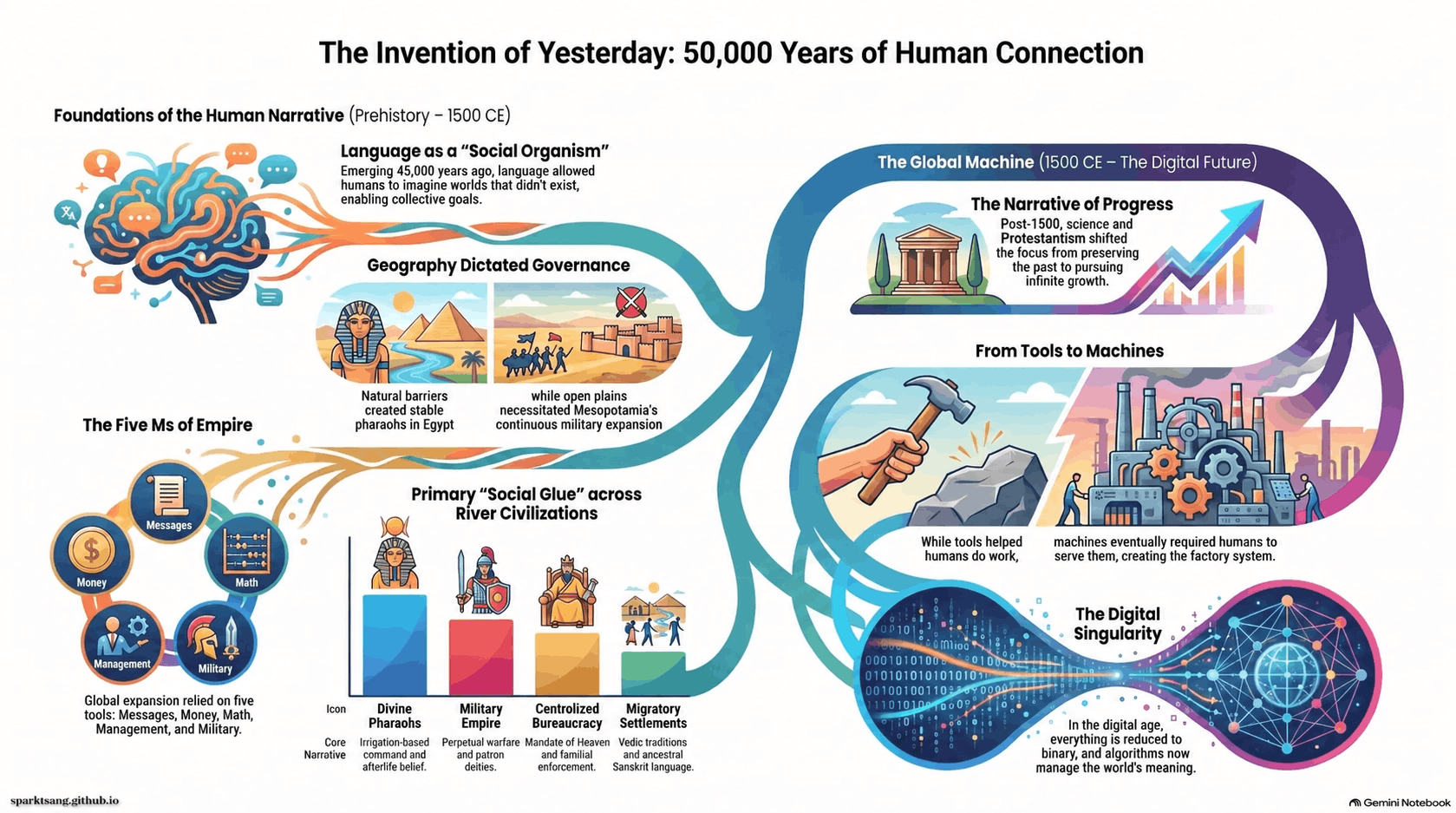
The emergence of language enabled people to imagine a world that did not physically exist, allowing people separated by place and time to work toward a single goal, almost as though society were a living organism. At the same time, the complexity of tools increased dramatically.
Agriculture
The Ice Age ended, the land bridge into the Americas disappeared, and the Old and New Worlds remained separated for eleven thousand years.
Humankind developed three ways of life: fishing, farming, and pastoralism.
About six thousand years ago, some people discovered environments particularly well suited to agriculture, giving rise to the great river civilizations.
The Nile Valley: dry rock to the east, desert to the west, and huge cataracts to the south meant that only the river delta needed defending. Massive irrigation projects gave rise to structures of command and overseers, and eventually to godlike pharaohs who united the population. During the off-season, idle labor and belief in the pharaoh gave rise to the pyramids.
Mesopotamia: there were no geographical barriers, and pastoralists surrounded the region, so armies were needed. To prevent soldiers from sitting idle, warfare had to be continuous, and Sargon of Akkad consequently built the first empire in history.
The Indus Valley: Harappa and Mohenjo-daro were at their height five thousand years ago, with abundant water, but pastoralists from the mountains frequently raided them. Thirty-five hundred years ago, large numbers of former rural pastoralists who called themselves Aryans migrated in, established settlements, and built houses from earth, bamboo, and grass. Harappa was already in decline at the time. These migrants are now known as the Vedic people. Iran is cognate with Aryan, and their ancestral language became Sanskrit in the south and Avestan in the west.
The Yellow River: the soil was deep and fertile, but the river was too turbulent for navigation and liable to flood at any time. A power structure therefore had to be established in advance, beginning with compulsory enforcement within the family. Successful settlements could expand into small kingdoms. Divination on turtle shells looks remarkably like modern Chinese, suggesting that the history of Chinese civilization goes back at least 3,700 years.
Nomadic civilization: like lymph circulating through Eurasia. The domestication of horses led to the invention of trousers and shirts. Because constantly moving populations could not grow too large, people invented chariots and carts; the latter required flat roads, inspiring the invention of roads. They also invented the composite bow and the Indo-European languages.
Trade
Once agriculture, pastoralism, and fishing appeared, long-distance trade could also develop. Geography determined trade routes, and some places became trading towns as streams of people converged there. Trade networks developed between the two great civilizations of the West and the two great civilizations of the East. The habitable Mediterranean rose to prominence because of its excellent sea routes. The Minoans and Mycenaeans held power in succession, and the later Greeks inherited the latter’s heroic legends. The Iliad and The Odyssey acquired enormous prestige.
The monsoon made Southeast Asia a hub of trade and a melting pot of cultures. Indonesian languages can even be heard in Madagascar.
The Nok civilization of West Africa suddenly disappeared around 500 BCE, for reasons unknown. Bantu languages subsequently spread southward across Africa. Swahili in East Africa is a mix of Bantu and Arabic, and is the most widely spoken language in Africa today.
Religion
The grand narratives that enabled social constellations to endure developed into systems of belief.
China: belief in concentric circles, with the emperor holding the Mandate of Heaven and serving as an intermediary between Heaven and humanity. Heaven was a cosmic entity without a personality. When a dynasty lost the Mandate of Heaven, it collapsed. There was only one empire. A particular material order could bring good fortune. Confucius gathered ritual practices into a system of belief: if everyone fulfilled their respective roles, life would be harmonious and meaningful.
Laozi, by contrast, regarded human intention as the source of disorder and urged people to abandon resistance to adversity, govern through non-action, and go with the flow.
India: kingdoms were scattered everywhere, divided into four castes—priests, nobles, farmers and merchants, and laborers—with untouchables beneath them. Everyone was born, grew old, and died. There were countless gods. The Upanishads shaped the worldview, which became Hinduism: the soul is imprisoned in the body, reincarnates eternally, and carries karma with it; only the accumulation of sufficient merit can bring liberation. Jainism advocated asceticism and nonviolence as the path to liberation. The Buddha advocated practicing the Middle Way and engaging in meditation.
Persia: what became the Vedas in India became the Avesta here. Vedic gods belonged to two great groups, the Devas and the Asuras; among the Avestan people they became the Daevas and Ahuras, but the roles of angels and demons were reversed. Zoroaster integrated these ideas into a system of belief much as Confucius did in China. The Aryan fire god became the Avestan creator god Ahura Mazda. Second only in power was the guardian of contracts, Mithra, which suited a trading people. Humans had free will. The creator god would triumph over the god of darkness, after which people would receive immortality in gardens called pairidaeza, the origin of the English word “paradise.”
Mesopotamia: Semitic peoples fought one another constantly, while non-Semitic peoples continually joined in. Every city had a patron deity; conquest was the victory of one god over another, and humans existed merely to carry out divine intentions.
Egypt: the parent gods gave birth to two pairs of children who married one another, one good and one evil. The good god Osiris was murdered by his brother Set. His widow Isis reassembled his dismembered body, became pregnant, and gave birth to Horus, the divine pharaoh. Only a tiny minority of the dead could reach the afterlife.
The Hebrews: the later Israelites initially participated in the Mesopotamian narrative. Their tribal god was Yahweh. They established the Kingdom of Judah and a temple in Jerusalem, but were conquered by the Babylonians in 587 BCE. Over the next fifty years, they reflected on their suffering, giving birth to the world’s first mature monotheism. God was declared to be one, formless, and omnipresent, creating a religious narrative capable of containing the past, present, and future.
Greece: the gods were immortal and possessed divine powers, yet had human passions and desires. People accepted fate and embraced suffering, but meaning could be created through the courage to strive. Thales first asked what matter was made of. Socrates argued that thinking and dialogue could distinguish good from evil. By the time of Aristotle, philosophers had built a conceptual system of knowledge, arguing that humanity stood at the center of the universe and that life should pursue goodness and truth through reason and experience.
The State
Only political entities can form intentions and execute plans, and their reach is limited by the speed at which information travels. If the delay becomes too long, local people can no longer wait for orders; suppose the acceptable limit is seven days. Prehistoric leaders were constrained by walking speed, wild animals, and natural barriers, and could control no more than about thirty miles in radius. After the domestication of horses, that increased to 350 miles, and expanded dramatically further once roads and relay stations existed.
Mesopotamians first used cuneiform, derived from pictures. Egyptian hieroglyphs were pictographic. Phoenician maritime traders dealing with people who spoke different languages needed a way to record other languages, so they developed phonetic writing, which inspired scripts throughout the Mediterranean. Egypt developed the simplified hieratic script for practical purposes, followed later by demotic, which was more closely tied to spoken language. China used an ideographic writing system in which concepts existed independently of sound and established speech, enabling it to govern people who spoke different languages.
There was not only the circulation of information but also the circulation of material goods. Money is like language: it arises spontaneously from human activity. Where there is trade, there is money. In prison, cigarettes automatically become currency.
The question posed by Debt: kings depended on armies and needed to employ large numbers of people to provide soldiers with food, shelter, and clothing. How could this be done? A king could tax the population to pay soldiers and officials, stipulating that taxes had to be paid in gold. People would then have to use resources and ingenuity to sell goods and services to soldiers in order to earn the gold needed to pay their taxes. Gold thereby became money.
Territorial expansion depended on the maturation of the Five Ms: Messages (grand narratives/information), Money, Math, Management (administrative systems), and Military. After conquering the Neo-Babylonian Empire in 533 BCE, Persia moved toward becoming a vast empire. Greece, India, Rome, and China followed soon after. This happened for a reason.
Empire
At the time, everyone knew that spring was the season for campaigning, but Cyrus the Great marched out in the dead of winter, catching his enemies unprepared. His son Darius conquered Egypt. The emergence of great empires can likewise be explained through a few Ms.
Administration: the empire was divided into twenty-three provinces, each ruled by an appointed governor.
Information: roads covered the empire, and carriages and chariots could travel at top speed. Relay stations were placed at fixed intervals, allowing messages to travel without interruption. Royal inspectors toured the empire to prevent distant governors from consolidating their own power.
Money: currency was standardized. Tribute extracted from conquered peoples impoverished them, while subjects paid taxes in coin.
Military: soldiers were recruited from across the vast territory, maintaining a huge standing army known to the enemy as the “Immortals.”
Grand narrative: in the Zoroastrian worldview, light and darkness were in competition, giving Persians a sense that they had both a cause to conquer for and a world to protect.
The limits of Persia: by the time it sought to conquer the Greeks, its territory had already grown too large, with the army 1,800 miles from home.
Greece had no empire and different regions had different laws, but they shared ideas, language, values, gods, and history, which gave them strength.
The Kingdom of Macedon stood at the edge of Greek culture and identified itself as a Greek city-state. Its king Philip conquered the Greek city-states. His son Alexander the Great conquered Persia, but when he sought to cross the Indus he likewise exceeded his limits.
At the same time, India was forming the Mauryan Empire, ultimately larger than the lands conquered by either Persia or Alexander. Like Persia, it minted its own money and had governors and intelligence networks, as well as a grand narrative formed from a synthesis of Hinduism, Buddhism, and Jainism.
There were two still larger empires: China and Rome. Qin had an administrative mechanism as effective as Persia’s. By the Han dynasty, the foundations were already in place, the Great Wall—built at the cost of millions of lives—had been constructed, Legalist bureaucracy had registered the population by household, taxes could still be reduced, Confucian belief had taken root, and China uniquely possessed an elite civil-service system, whereas elsewhere power was generally assigned to relatives and friends. All of this was aided by its ideographic writing system.
At the height of Athens, Rome was still on the periphery. After overthrowing its king in 509 BCE, Rome gradually took shape as a republic. The Senate was elected, and each year the people elected two consuls. To mediate between social classes, Rome established tribunes elected by the plebeians, who wielded considerable power. The Twelve Tables established that no one stood above the law. All men of military age were required to serve. Rome invented concrete and could build bridges over any river. Epic stories gave even the poorest citizens a sense of belonging reaching back to the Trojan War. The entire society was permeated by the secular humanism that came from Greece. The Etruscans in the north sought to restore the Roman monarchy and were absorbed by Rome. In 387 BCE Rome defeated the Gauls. It then went on to defeat the military genius Pyrrhus, king of Macedon, and the Carthaginian general Hannibal, while the victorious Roman commanders remained largely unknown. The first emperor, Augustus, did not take power until 27 BCE.
In the year 1 CE, eighty percent of humanity lived in Eurasia, most of them within political boundaries. Politics had already begun to shape every aspect of people’s lives.
Transformation
Civilizational contact produced ripple effects: Han China persuaded the Yuezhi to ally against the Xiongnu, using barbarians to fight barbarians, but the Yuezhi were soundly defeated and disappeared. The Bactrian city Zhang Qian entered by mistake was a remnant of Alexander the Great’s empire ruled by Greek successors, but these Greek remnants were soon driven out by the Yuezhi, who had abandoned their nomadic life, regrouped, and returned.
The Xiongnu acquired silk made by their enemies from the Yuezhi. Han China traded with the Xiongnu for horses with which to fight the Xiongnu, and later acquired more goods such as honey, wax, leather, aromatic wood, and grapes.
The Kushan Empire, founded by descendants of the Yuezhi, swallowed up the various Central Asian kingdoms left by the Greeks and northern Indian states, eventually coming into contact with the Han. The Silk Road emerged, and cultures blended.
The Kushans embraced Buddhism. Buddhist believers absorbed Greek sculptural culture and began making images of the Buddha. At the same time, the Persian god Mithra became a half-human, half-divine savior figure who could rescue people and grant immortality, and his religion flourished. Buddhism also absorbed these elements, giving rise to the concepts of perfect merit and nirvana. Mithra became Maitreya, the bodhisattva who turns back from the edge of nirvana to help others. Monks and merchants traveled along similar routes, and many merchants converted to Buddhism. Mahayana Buddhism emerged, allowing ordinary people to earn merit through charitable giving without becoming monks. Temples became wealthy enough to finance major enterprises, which at the time amounted to large-scale commercial expeditions.
Iranian and Mesopotamian cultures regarded human beings as tools of the gods, while Buddhism regarded everything as illusory, so the two were difficult to reconcile. Buddhism nevertheless succeeded in spreading eastward. In China, Taoism, which sought inner tranquility, was closer to Buddhist thought, and China had no exclusivist monotheism. After the fall of the Han, the chaos of the age made people more eager for salvation through Taoism and Buddhism.
As Rome expanded eastward, it encountered worshippers of Mithra. Mithraism featured a virgin mother who gave birth to a divine-human figure on December 25, sent him into the world, and was followed by twelve companions. The mystery religion of Mithra reached its height in Rome, eventually losing to Christianity, though traces of it remained in the Christian narrative.
Early spices referred to small luxury goods produced in Arabia. The domestication of camels accelerated trade. Merchants guarded the origins of their goods, embellishing their rarity and inaccessibility through tales like One Thousand and One Nights. Herodotus described frankincense as something obtained at the risk of death. At the time, the spice routes, the Silk Road, and the Mediterranean network all circulated goods among one another.
Blending
The sci-fi novel More Than Human coined the word “bleshing” by combining “blending” and “meshing,” which perfectly describes the merger of grand narratives.
The Jewish narrative possessed its own powerful cohesion. Its believers recognized only God’s law, and religion and politics were one. After being conquered by Rome, restless Jews developed the concept of a Messiah who would lead them to freedom. Any agitator could potentially be the savior.
An agitator named John guided his followers through baptism, a ritual common to several mystery religions. In 29 CE, the son of a carpenter was baptized and declared himself the Messiah. He was executed by Roman officials along with thousands of other rebels.
A small number of followers claimed that Jesus had not died and that they had seen him somewhere. The story spread, and the number of believers surged. The movement soon diverged from mainstream Judaism.
The Jew Paul advocated a covenant not merely between God and the Jews but between God and all humanity, which became the central axis of Christianity. God was understood in a way compatible with Greco-Roman culture, where stories of gods who were half human and half divine were ubiquitous.
In 74 CE, nine hundred Jewish rebels committed suicide rather than surrender. Non-Jewish Christians gradually came to vastly outnumber Jewish Christians. Without a unified church-state framework, the doctrine of “render unto Caesar” emerged.
Roman society was full of slaves. Even free people who owned no slaves found it difficult to make a living in an environment full of free slave labor. Christianity’s emphasis on the afterlife and judgment offered powerful consolation. Christians torn apart by lions were regarded as martyrs, and Christianity flourished in a society where injustice was becoming more acute.
By the fourth century, Christianity had already become a shadow state. Dioceses operated according to church law. Constantine, forced by practical reality to recognize that this system outperformed the corrupt Roman system, converted the empire. Theodosius I banned paganism, and Christianity became the only religion.
In the doctrinal disputes of 325 CE, the emperor personally settled the matter in favor of the Nicene Creed and the doctrine of the Trinity.
China built the Great Wall, making Xiongnu raids more difficult. The Xiongnu therefore turned westward, absorbing other nomadic peoples along the way. One branch, the Hephthalites, moved toward India, destroyed the Kushan Empire, and seized its cities.
The Huns were the Xiongnu. They pressed into Europe and were called Scythians. Germanic tribes such as the Goths and Vandals were forced to migrate into Roman territory. They gradually merged with Rome, from language to clothing, and even rose to high rank in the Roman military, which was far better than fleeing north to survive on agriculture.
The title comes, denoting the highest military command, evolved into count. Those who occupied land and extracted wealth were simply granted governorships; duces, commanders, evolved into dukes.
The Gothic bishop Ulfilas translated the Bible into Gothic. The Germanic peoples gradually converted, but rejected the Nicene Creed, perhaps because they resisted a culture in which the son outranked the father. This became Arian Christianity.
The Gothic king Alaric captured Rome, and later the Vandals sacked it again. By then the Germans had become deeply Romanized, and the population did not feel that Rome was in decline. Attila invaded at this time but died before reaching Rome.
Rome began as a Latin world. During its expansion it became immersed in Greek culture. This Greco-Roman synthesis was then Christianized and finally Germanized. Under Germanic rule, Roman kings, dukes, and counts proliferated, while the old Roman law of serfdom from Diocletian was inherited, leaving the agricultural units controlled by lords largely self-sufficient.
In the East, Rome remained unified and evolved into the Byzantine Empire. The church sought protection from the state and became a church within the state. In the West, the state disappeared and bishops had to assume political responsibilities. In 590 CE, Gregory the Great declared himself the first bishop, and by the time of his death his position was effectively equal to that of an emperor.
Muhammad was born in the same year as Gregory. When he began preaching in 610, people today might have considered him insane, but the distinctive feature of belief at the time was that supernatural mystics and prophets with extraordinary powers could enter the chaos and communicate with God through incomprehensible language.
After ten years of preaching, he had few followers. He led them to Yathrib, naming it Medina, and his community expanded across the whole of Arabia.
Contrary to the Islamic narrative, Muhammad was a CEO, running his wife’s successful trading company.
Judaism and Christianity were like father and son, whereas Islam and Judaism were like cousins. The Islamic community was a later development, and anyone who embraced its teachings could join simply by reciting the shahada. For Muslims, Christianity had misread God: the one God was the truth, and He had no son.
War had a noble purpose: consolidating a community governed by Islamic law so that God’s will would be made manifest on earth. Christianity gained power by taking over the state apparatus; Islam gained power through conquest.
People in conquered lands were not forced to convert, but conversion had advantages, such as lower taxes and exemption from enslavement. In North Africa, Arian Christians who rejected the Trinity converted without major cultural disruption, having already absorbed large amounts of Arab culture.
Muslims exchanged salt for gold from southern Africa. The gold-salt trade drew Ghana, Mali, and Songhai into a global trading network administered by Muslims, producing an African form of Islam.
The Sasanian dynasty in Persia was ancient and corrupt and could not resist the Arab armies. The population opened the gates and surrendered. Iran resisted Arab culture locally; a powerful narrative made cultural blending more difficult than in North Africa. Yet Islam’s struggle between good and evil and its final judgment resonated with Zoroastrian ideas. Iran therefore developed a Shi’a version of Islam, supporting the succession rights of Ali and his son Hasan; their mother was a Persian princess.
In China, the Sui emperor Wen, who was a contemporary of Gregory, established the equal-field system, periodically redistributing land. He and his son Yang dug canals, using artificial waterways to connect the Yellow River and Yangtze, linking the south, which produced most of the grain, with the north, where most people lived. The Grand Canal, though its course has changed, still survives today.
Emperor Wen strongly promoted Buddhism. Buddhist monks did much to develop trade networks, vast quantities of Buddhist scripture were translated, and Buddhism inevitably absorbed Taoist characteristics while also feeding back into Taoism itself, producing a uniquely Chinese cultural synthesis of Buddhism, Taoism, and Confucianism. Chan Buddhism emerged through this blending and exerted influence all the way to Japan.
The Tang inherited the Sui as the Han had inherited the Qin. Confucian spirit spread into Korea and Vietnam, and its influence is still visible today.
Separation
Each civilization became a self-contained, internally coherent microcosm: the “monads of world history.”
China
The Tang advanced the Han system and created the imperial examination. The Chan master Yi Xing invented the first mechanical clock and a water-powered armillary sphere. Woodblock printing was invented. The oldest surviving printed book is the Diamond Sutra, published in 868. Monasteries had been tax-exempt for centuries and had come to own forty percent of China’s land, prompting Emperor Wuzong to suppress Buddhism, confiscate the land, and force monks back into secular life.
The Song inherited the Tang. The social focus shifted from art to technology. Movable-type printing was invented, gunpowder was packed into cannons, the magnetic compass was invented, and paper money emerged, backed by a central government that had to exercise complete control over the economy.
Household production gradually became industrialized. Families with unemployed womenfolk became a source of prestige, and foot binding became widespread.
China opened itself to the world while remaining inward-looking: Chinese people regarded the arrival of tribute missions from all countries as normal, rather than seeing themselves as the ones who were supposed to go abroad.
India
By 800, India should have been the wealthiest society in the world. Political fragmentation did not mean cultural fragmentation, and society advanced rapidly. The Magadha kingdom and the Gupta Empire achieved temporary unification, respectively favoring Buddhism and Hinduism, but both were open and tolerant.
Under the Guptas, metallurgy and medicine advanced substantially. The decimal system was invented and trigonometry was first developed. The Vedic epics, orally transmitted for centuries, were committed to writing. The Laws of Manu became authoritative, setting out explicit Hindu rules.
The caste system became deeply entrenched. Buddhism failed to absorb Hinduism while retaining its own essence, whereas Hinduism could absorb the Buddha as one of its gods. Buddhism therefore gradually faded. Buddhism, once widespread in southern India, became Theravada Buddhism, emphasizing nirvana as an inward, individual quest, and was transmitted to Sri Lanka.
Islam
Clothing and architectural styles became increasingly uniform, while the Prophet’s profession as a merchant gave trade special prestige.
Because Islam overlapped geographically with several civilizations, it could absorb vast amounts of knowledge, including ancient Greek philosophy. It also compiled encyclopedias, and Ibn Sina’s medical canon became a textbook in European medical schools as late as the 1600s.
Words such as alchemy, algebra, algorithm, and alcohol all conceal the ghost of Muslim scholars’ pursuit of knowledge.
The ultimate goal of seeking knowledge was to build the eternal legal framework of sharia, an objective reality that could only be discovered, not invented, much as science would later be understood in Western civilization.
Europe
The Church controlled the power to determine who could enter heaven. Its jurisdiction could rival that of governments. Every village in Western Europe had a church. Except for the wandering Jews, almost everyone in Western Europe was Christian, and the supreme authority over spiritual affairs—and therefore over most matters of importance—was the Pope in Rome.
In 800, the Pope crowned Charlemagne and declared him Holy Roman Emperor. Western Europe subsequently came to call itself Christendom.
People rarely traveled more than a few miles in their lifetimes. Western Europe was poorer than it had been under Rome, technological standards had fallen, engineering maintenance had disappeared, infrastructure had collapsed, fewer people could read and write, and fewer books were being produced. The period became known as the Dark Ages.
People distrusted strangers and money, so barter increased. Strong currencies such as silver left Europe and flowed into the Islamic world.
The Americas
By 800, the Americas held only three percent of the world’s population. Isolated from the Eastern Hemisphere, they repeatedly followed a pattern in which cities flourished and then suddenly collapsed, something that remains a mystery today.
There were no large domesticated animals, so pastoralism was impossible. Transportation was difficult, and the wheel had little practical value.
Around 400 CE, Teotihuacan had 200,000 inhabitants and was perhaps the fifth-largest city in the world. It was a major trading center, but we know almost nothing about how it actually operated.
Turning
At this point, history reached a turning point. The situation changed like a huge table tipping over: ideas, inventions, art, technology, products, and goods slid from East to West, then from China and India back into Western Europe.
The whole process began at one point. Because they were the last Germanic relatives to arrive in Europe, the Scandinavians, the Norse, were left with the worst land. Any significant temperature change, whether upward or downward, could devastate their crops.
The aging and powerful already possessed the good farmland, so strong young men formed gangs, built ships, and went to sea. They became the Vikings. The English called them Danes; the French called them Normans. In 1066, William led the Normans in invading England. Other Vikings merged with the French and gradually became Catholics. Their culture blended into the West. The tree they revered was absorbed into the Christian world as the Christmas tree; the elves they believed in became smaller, cuter, and kinder, and the elves who put coal into stockings as a warning eventually became Santa Claus, who brought gifts.
Another branch of Vikings moved east and called themselves the Rus. They discovered the headwaters of rivers and followed them south toward the Black Sea, encountering Slavic subsistence farmers along the way and raiding them. But there was only so much to plunder, whereas trade could obtain anything they needed, so they captured people and sold them south as slaves. The word slave itself derives from the Slavs. Most of these slaves were bought by Muslim merchants.
Rus men acquired Slavic female slaves, and their descendants adopted their mothers’ culture. After several generations, the Rus disappeared and became a local aristocracy speaking Slavic. These warriors called themselves Russians.
The Russians could not seize Constantinople, so some turned to working instead. They gradually joined the Orthodox Church. The Byzantine cleric Cyril created an alphabet for the Russians, who gradually became literate. Their commercial activity made them prosperous, and silver from the Islamic world flowed into the Russian network and northern Europe.
The Russians continued pushing forward, destroyed the Khazars, a Turkic Jewish state, and seized their trade network. They came into contact with steppe nomadic warriors and clashed with them repeatedly. Their advance slowed, but continued, eventually establishing Kievan Rus.
The living space of the Central Asian nomads was squeezed by the Russians, leaving them with no choice but to turn elsewhere. The ripple effect continued. Around 900, competition for space in Central Asia led the Khitans to attack the Song and establish the Liao dynasty. The Jurchens, from the heart of Siberia, established the Jin dynasty and claimed the Mandate of Heaven, inheriting the mantle of the Han and Tang. The Song eventually lost the north.
The fragmented Islamic world continued fighting Turkic nomads. Turkic boys were captured and trained as elite guards. These Turkic slave soldiers often overthrew their masters and seized power, but still faced the same problems and solved them in the same ways, producing the same results. The Islamic world was therefore gradually eaten from within and without by Turkic peoples who had converted to Islam. They lacked the Arabs’ appetite for learning and preferred warfare, so the road toward scientific development declined.
Beginning with Sultan Mahmud, who invaded India seventeen times, Turkic Muslims developed the habit of plundering India. There were even sultanates along the Ganges. Yet the narratives of Islam and India firmly resisted blending because their cores were incompatible.
Another wave of invaders, the Seljuk Turks, poured out of the steppe, conquered Iran, swept through Anatolia, badly defeated Byzantium in 1071, and conquered Christian holy sites, triggering the Crusades.
Continuation
Throughout history, most people in Western Europe had been serfs producing barely enough to sustain themselves. In the ninth century, a series of tiny improvements accumulated to a critical point. The heavy plow appeared, suddenly making the supposedly infertile poor soils of the north fertile. Improved horse harnesses made horse plowing possible. Then people discovered that the traditional practice of leaving half the land fallow every year was unnecessary: if land rested once every three years, the soil remained fertile, and twenty percent more land could be cultivated.
Surplus food allowed more people to spend time making crafts. Crossroads gradually became busy marketplaces, and fixed trading centers developed into towns. Much of the gold and silver acquired by Viking raids had already flowed back into circulation, while the Russians had brought silver from the Islamic world. The European economy therefore accelerated rapidly.
As productivity rose, surplus labor increased and permanent labor became seasonal. A new occupation emerged: the mendicant friar.
More people began wandering from place to place, and pilgrimages became fashionable. Yet the holy lands were occupied by Turkic Muslims. Under primogeniture, large numbers of aristocratic men wanted to make a name for themselves. Feudal estates merged, and the ambitions of lords became enormous.
In 1095, the Pope received a plea for help from Byzantium, under attack, and called on Christendom to retake the Holy City.
The first Crusade immediately recaptured Jerusalem and established four Crusader states along the eastern Mediterranean. Crowds flowed back and forth. Venetian goldsmiths engaged in currency exchange and placed long benches outside their shops. Bankers evolved from the Italian banque, meaning bench. Their business of storing precious metals developed into allowing customers to trade using paper receipts, giving birth to bills of exchange. Bankers also discovered that they could lend out customers’ deposited gold.
In 1202, Fibonacci, who traveled throughout the Mediterranean, published Liber Abaci, explaining the mathematics the Arabs had learned from India. Arabic numerals and their operations, along with complex accounting, spread throughout Europe.
To protect pilgrims traveling far from home from losing their property to mercenaries, the Church created the Knights Templar. They gradually developed a money-transfer service that no longer required the physical movement of cash: a local office simply issued a paper note. The first international bankers were born.
In the Third Crusade, the Egyptian Sultan Saladin confronted Richard the Lionheart, and Jerusalem was returned.
The Fourth Crusade never reached the Holy Land. Instead, it entered Constantinople and sacked the city, completely breaking East-West Christianity apart.
Pivotal
The conflict between the northern nomadic peoples and the southern agricultural civilizations reached its climax. Temüjin rose to power, declared himself lord of the universe, spent twenty years unifying the Mongols, and another twenty building an empire larger than Rome’s. He destroyed Kievan Rus, conquered the Southern Song, burned the Abbasid capital Baghdad, and by 1241 had reached the gates of Europe.
Ögedei died, and the khans fought over succession. The conquest of Europe was put on hold, and Europe escaped a historical catastrophe. Two years later, the Mamluks halted the Mongol advance. The empire had also reached the administrative limits of the technology available at the time.
The Mongols built a network connecting the Eastern Hemisphere, eliminating obstacles to the movement of tribute and information.
Bubonic plague traveled westward along the network. In 1345, the Mongols threw plague-infected corpses into the refusing city of Kaffa. Within a few decades, the Black Death killed one-third of Europe’s population. Wages rose sharply, and in some places women who inherited property gained unprecedented power.
The long Crusades were a prolonged confrontation between Europe and the Islamic world. Under the Mongol invasions, Europe gradually gained the upper hand. Contact brought countless inventions and technologies into Western Europe.
After the short Crusades—the nine specific military expeditions—the mercenaries returned home and formed bands calling themselves “free lances”. The term later evolved into freelancers.
The Tang did not need firearms and used horses against nomads. Western Europe, fragmented into independent political entities and driven by intense competition, entered what is known as the Hundred Years’ War. Military technology advanced rapidly. Warfare shifted toward ranged combat rather than close combat relying on physical strength, making manpower the crucial factor. Military leadership became a form of commercial management.
The Chinese mechanical clock reached the Islamic world, and the windmill and a series of mechanical techniques developed in the Islamic world then entered Europe. Yet apart from providing more toys for aristocrats, they did not initially produce profound social change.
Once clocks reached Europe, they were improved and widely adopted, eventually being installed in every church.
Movable-type printing had been difficult to develop in China and the Islamic world because there were too many characters, or because letters changed shape in writing. Latin had only twenty-six letters. Once papermaking and movable type had reached Europe, the remaining problem was how to press the shapes onto paper. Gutenberg finally solved it by adapting the wine press.
Chinese maritime technology and the magnetic compass passed through the Islamic world. Malays invented a sail that allowed ships to move against the wind. Europeans, who lived by the coast but had never crossed an ocean and returned, now had the potential to venture into the wider world.
The Caliphate in Spain gathered scholars from all over, and classical works flowed into European monasteries. Muslim law required scholars to complete preparatory courses and obtain certificates. Europe adopted seven preparatory subjects: grammar, logic, rhetoric, arithmetic, geometry, music, and astronomy. The certificate became the baccalaureate degree. The first universities appeared in Naples and Bologna in Italy, and in Paris.
Under Catholicism, which accepted a distinction between the sacred and the secular, the new universities’ monasteries permitted Greece to become a legitimate field of study. A wave of revival in Greco-Roman thought arose, and seeking to understand God through reason became fashionable.
Bacon asked a revolutionary question: how do we know that some piece of information is true? Aquinas derived proofs for the existence of God without relying on textual verification of scripture, and the Moses archetype was born.
Leonardo da Vinci dissected bodies and built machines. The prototype of scientific, analytical observation emerged, and the pursuit of natural principles eventually produced consequences on a major and unpredictable scale.
At the same time, the Crusades gave Europeans a sense that they belonged to one common community. Under this newly formed concept of Europe, the Church created the Inquisition to define heresy, and tens of thousands of witches were condemned.
Because Christians could not charge interest to fellow believers on loans, monarchs used the Jewish minority, regarded as heretics, to lend money and indirectly collect taxes through fines. Jews then had to collect debts in order to pay those fines. Popular resentment grew, and anti-Jewish sentiment intensified.
The love marriage of Ferdinand and Isabella became the most consequential political marriage. The two kingdoms merged into Spain, the Muslims were expelled from their last foothold in Europe, and the rulers styled themselves Catholic Monarchs.
Once the Spanish Inquisition had purged the Muslims, it could define Jews as the other. Yet many Jews had already converted, so the idea developed that Jewish characteristics were innate and that only dilution of the bloodline could remove them.
Revival
The Mongols believed that everything possessed a spirit. Once they became an urban civilization, this could no longer provide meaning. As their civilization declined, different peoples returned to their own original narratives.
Under the Golden Horde, the Russians’ Slavic beliefs grew more closely intertwined with Eastern Orthodoxy. Bootlicking tax collectors enriched themselves through corruption and eventually established the Grand Duchy of Moscow, calling its capital the Third Rome.
The Yuan dynasty claimed the Mandate of Heaven and restored the imperial examinations, while secretly discriminating against Han Chinese. It discouraged bathing, and tax officials wore Mongol clothes and spoke Mongolian. The attempt at blending failed. Rebels arose, and Zhu Yuanzhang, commander of the Red Turban Army, founded the Ming dynasty.
The Ming deliberately returned to the Confucian ideal state: agriculture as the foundation, centralized power, bureaucracy, family values, and a world revolving around China, China revolving around the Son of Heaven.
As a peasant of humble origins, Zhu Yuanzhang had limited trust in the scholar-officials. Imperial power was strengthened, and he sympathized with peasants by reducing taxes. As for military and construction needs, his answer was to call peasants into service when needed, either for war or labor, and manage them through Confucian principles. Landholding hereditary military aristocrats came to be called mandarins by Europeans.
Peasants were organized into tightly knit units and made to supervise one another, reducing administrative costs. Terror was used as a governing method, with mass executions affecting tens of thousands at a time and compelling people to obey. By modern standards, this might be diagnosed as a paranoid personality disorder.
The huge military did not expand outward but instead maintained internal stability. The transformation into totalitarianism became a form of social identification for a traumatized society that wanted to return to normality and the old system. This was the narrative of revival.
The Yongle Emperor could not escape suspicions that he had usurped the throne and therefore sought even more strongly to prove his legitimacy. He moved the capital to Beijing, built the Forbidden City, and dispatched Zheng He on grand voyages to project imperial prestige—not for trade or any other purpose—helping construct an image of imperial authority approaching the supernatural.
Emperor Ren destroyed the fleet, redirecting resources into major projects such as rebuilding the Great Wall and restoring the Grand Canal.
The Ming government controlled the national economy and therefore required a tightly coordinated, well-trained bureaucratic system. It consequently established more than a thousand schools to recruit and train officials, all teaching the same curriculum so that everyone developed the same skills and worldview.
Society functioned well, the population increased by 250 percent, merchants poured in, and new industries and cities emerged. Yet palace intrigue was brutal. The elite lived in an atmosphere of conspiracy and fear, and many scholars wanted to abandon official service early and retire in seclusion.
Preserving what was already known became the highest priority. The Yongle Dadian contained 11,095 volumes. An inward-looking civilization never produced a major technological breakthrough worth mentioning. Officials and ordinary people had little interest in new things. Social harmony was humanity’s great goal. Returning to the glorious past and bringing change to a halt became the highest achievement.
The Islamic world faced the final great wave of steppe offensives. The Turkic Muslim Timur defeated the Mamluks and sacked Delhi. He intended to attack the Ming but died suddenly, after which his empire fragmented. No one adopted the steppe religion, and even Mongol conquerors converted to Islam. Each polity made restoring former glory its central mission.
Three Islamic gunpowder empires arose from the ruins of the Mongol conquest. In 1452, the Ottoman Empire captured Constantinople and became the world’s leading power. Its eastward expansion was blocked by another gunpowder empire bent on restoring a lost past: the Shi’a Safavid Persian Empire. To its east, the Mughal Empire ruled a Hindu majority with a Muslim minority.
In Africa, Mali declined and was replaced by Songhai. In the fifteenth century, Timbuktu became a center of Islamic scholarship.
In this narrative, history’s perfect moment had already occurred. The universe was merely a drama moving toward its end. The key story was Muhammad’s prophetic career. The task of the world was to preserve that perfect state. Sharia law was continually expanded so that people could live safely within it and avoid error. The details of Islamic law differed from country to country, but the underlying spiritual structure was broadly similar.
Sharia was not an Islamic version of Confucian bureaucratic statecraft. It was a framework of meaning originating in tribal society, just as all human societies ultimately arose from tribes: loyalty to relatives ranked above other virtues; obligations extended outward through social networks, becoming patronage networks. Favors could not simply cancel one another out through direct exchange, because they functioned like extensions of family. There were no explicit terms. Networks were mutually open, and the core figures of low-level patronage networks could remain on the periphery of higher-level networks. Family background and achievement both mattered to leadership. Those who behaved appropriately according to tacit expectations gained reputation and power, rising through one network after another. Those who violated the norms saw their influence collapse. Women could improve family standing through arranged marriages and thereby exercise political influence.
The three gunpowder empires also produced magnificent achievements in art, architecture, and literature, such as the Taj Mahal, the city of Isfahan, and Safavid carpet-making. But these expressed aesthetic ideals that were already in existence. The past was the template for the future.
Advance
For most people, Europe was a miserable place of tenant farmers and recurring plague, so revival held little attraction. Epidemics exposed the Church’s inability to cope, and doubts began to spread. With printing now available, people could interpret the Bible for themselves.
In 1519, Martin Luther published the Ninety-Five Theses, rejecting indulgences and declaring that salvation could not be achieved through outward formalities.
The spark spread like wildfire. Churches established themselves independently, and nearly two centuries of religious civil war ended with the Peace of Westphalia in 1648, establishing the right of rulers to determine which form of Christianity their territories would follow. The seeds of the nation-state had been planted.
Copernicus and Kepler used precise mathematical models to reflect the perfection of God’s creation, opening up the possibility that the entire world might be explainable. Newtonian science made the old Christian narrative increasingly unable to provide meaning, while Protestant denominations continued to split.
Science was still only one layer of society, but the society around it increasingly shared a vocabulary of progress and decline for interpreting the world. What counted as advance or retreat remained debatable, but progress became the ultimate goal of human effort. In Western Europe, this belief fused into a new civilization: the narrative of progress.
Breakthrough
The desire for the rich products of East Asia led Europeans to seek a route to the Far East that bypassed Africa. Christopher Columbus, who seriously underestimated the size of the Earth, believed he could reach Asia by sailing west. Queen Isabella funded him. After two months at sea, just as the crew was about to mutiny, they saw birds, and eventually reached the Bahamas, landed in Cuba, and reached Venezuela.
The Vikings had already been to Canada. The historical significance of 1492 was that it connected the Eastern and Western Hemispheres. At the same time, Western Europe was poised to explode into the most rapid growth in history.
Indigenous peoples of the Americas, who had never encountered pathogens from the Eastern Hemisphere, died in enormous numbers. Europeans took over the Americas with ease. The American narrative collapsed easily, and conversion to Christianity could not easily turn them into Christian brethren.
Spanish conquistadors acquired enormous quantities of silver, but instead of investing it in domestic productive capacity, they went on a massive buying spree. The silver flowed into neighboring countries, and prices rose.
The geographically well-positioned English and Dutch eventually took the lead. Long-distance European traders developed new business models: find the market first, sign contracts, then locate high-quality suppliers. Manufacturing took off.
Within the feudal framework, land and titles mattered more than wealth. Now that the environment had changed radically, people skilled in commerce formed partnerships and established limited companies. At first these were created for a single undertaking, but they later became permanent entities.
Expenses came now while profits came later, just as in voyages and wars. A new class of bankers created credit, building a bridge between the present and the future. The Knights Templar were among the first international bankers, but in 1307 they were purged by the covetous French king Philip IV, who did not find much money. People at the time had to decide whether to trust the king and the Pope. Those who did not believe them continued to imagine that small secret groups controlled the world, establishing conspiracy theory as a model of a thought constellation.
In 1600, Queen Elizabeth granted a private consortium a guaranteed monopoly on trade with the Far East. This became the East India Company, and the “limited liability” structure was revolutionary for its time.
Two years later, the Dutch East India Company was established. Soon after its creation it began issuing shares, granting rights to profits and trading but not management control. Stocks had arrived.
Before this, the true value of coins was difficult to measure. In 1609, the Amsterdam Wisselbank was established, producing standardized national money. In 1694, King William III borrowed a huge sum and chartered a group of people to sell the debt in the form of notes. The king’s debt thus became the foundation of the British economy.
The modern foundations of mass media, bureaucracy, postal services, infrastructure, policing, and central banking took shape, and royal power penetrated society as never before.
Under the narrative of progress, The Wealth of Nations was published in 1776. Its central argument was that the pursuit of self-interest was the best way to serve the public, and that wealth was most efficiently managed privately. By the end of the century, corporations were furiously pursuing profits around the globe.
Unlike the English and French, many of the Spaniards and Portuguese who went to the Americas did not bring families with them. The mixed-race population of the Spanish colonies and the gradually recovering indigenous population became large, producing a distinctive Latin American Hispanic culture.
The emerging great powers fiercely competed for colonies. The outcome of the Seven Years’ War between Britain and France produced the British Empire, while the independence of the Thirteen Colonies produced the United States.
The plantation system in the Americas continued to improve, foreshadowing the factory system. Because indigenous populations had become too small, plantation owners turned to enslaved Africans. Skin color was not originally a marker of identity in Africa. The enslavement and sale of Africans was widespread, and the enormous scale of the slave trade led new cities to emerge along the West African coast.
Collapse
China’s neo-Confucian society never achieved perfect blending. It experienced its own Confucian version of a constitutional crisis in the Great Rites Controversy.
In a society that favored agriculture and suppressed commerce, people who could afford it often hired private tutors, and the students who did best in the imperial examinations were frequently sons of merchants.
The Ming printed money to finance government expenses. Unlike European bills of exchange, which arose from commercial transactions, inflation prompted the government to mint copper coins that people did not recognize as legitimate. As silver became widely circulated, the government switched to collecting taxes in silver. Yet arable land was limited, making it difficult to earn the money of European merchants who were desperate for tea.
Fortunately, new crops from the Americas were highly adaptable. Land that had previously been useless became productive, exports expanded, and merchants and artisans became wealthy. But the global Little Ice Age of the 1600s caused crop failures, while the Spanish economy stagnated and sharply reduced the flow of silver. During periods of prosperity, the pressure of the rigid family structure eased, and gangs and brotherhoods that offered alternative or additional identities played a role. Bandits multiplied, and Li Zicheng slaughtered his way into Beijing.
The Manchus, descendants of once-nomadic peoples who were now settled, took power. They embraced neo-Confucianism, inherited the Ming system, and pushed deep into Central Asia. By 1700 they could still claim to be the world’s strongest centralized state.
Economically, China continued to spend through paper money and collect taxes in silver. Tea plantations evolved toward efficiency-first plantation production. The British had become addicted to tea, which was essentially a drug and at the time the only substitute for alcohol. British imports of Chinese tea rose from 200,000 pounds in 1720 to nine million pounds in 1790 and 36 million pounds by the middle of the nineteenth century.
Huge quantities of silver flowed into Qing China, alarming the government, but tariffs could not do much to suppress the tea trade. The British government therefore doubled the tea tax, hurting the East India Company. To protect it, the Tea Act of 1773 forced the American colonies to buy expensive tea rather than cheap smuggled tea. Angry colonists boarded ships and destroyed tea worth millions by today’s standards. Britain retaliated, and revolution eventually erupted. Qing policy helped give birth to the United States.
Like China at the time, the Islamic world could not perceive that it was already entering decline. Unlike Europe, people here had to gain political influence before becoming wealthy, so personal networks and relationships were crucial. They often saw European merchants as potential patrons.
In the Mughal Empire in India, Sikhism emerged from an interaction between Hinduism and Islam, and Sufism also entered Indian religious life, but the narratives of the two religions remained incapable of blending. Wealth from Europe was concentrated among a small number of people and then flowed back out instead of permeating Indian society as a whole.
The British East India Company did not rule locally at first. The tacit arrangement was that rulers would not obstruct British commercial interests. Locals saw the British as potential patrons through whom patronage networks could be built.
European countries passed laws requiring manufacturing to be completed domestically. Asian trading companies supported such legislation because it allowed them to buy cheap materials in the East, sell them in Europe, and then buy European clothes and sell them internationally.
To guard against the French, the British built an army in India. Indians gradually came to see it as a threat. In one province, the British were hunted down, leading to the Battle of Plassey, which turned Bengal into a tax farm. The social shock caused catastrophe: famine killed ten million people. The British government finally intervened, establishing a provincial government and ultimately using the same methods to control India while retaining a puppet emperor until 1857.
The same pattern operated in the Islamic world. European merchants cleverly increased their influence by presenting themselves as advisers to competing factions.
After taking control of India, the British discovered the answer to the China problem: India was well suited to growing opium, and China had a market for it. In 1800, 4,500 chests of opium entered China; by 1834, the figure was ten times higher. Opium became the most valuable single commodity in world trade.
Few wars have been as bloody in consequence and as bloodless in immediate combat as the Opium Wars. Four shallow-draft steam gunboats sailed toward Beijing, and the Qing government fled and sued for peace. The other powers quickly demanded the same privileges.
The narrative collapsed. Farmers were displaced, and the Taiping Rebellion erupted, killing between twenty and sixty million people. By comparison, the American Civil War killed only about 600,000.
Machines
The distinction between tools and machines: tools help humans do things; humans help machines do things.
Once Europeans possessed science, science and technology began to overlap, and inventions spread like wildfire. The Chinese water clock became the Western European pocket watch, while Ibn Sina’s encyclopedia of herbal medicine became a foundation for germ theory.
Under the narrative of progress, machines were continually improved. Each invention produced ripple effects that accumulated. Once electricity was discovered, it was rapidly applied. In 1837, Morse invented the telegraph, making the telephone possible. Alexander Bell rented out telephones, accelerating their adoption.
In 1830, the rotary printing press appeared, capable of printing 18,000 sheets per hour. At first this seemed useless because even the most widely circulated American periodical had only 4,300 subscribers. But someone eventually saw a business opportunity. In 1833, the New York Sun was founded, selling for one cent and earning substantial profits. Competition drove newspapers to hire people to find news, creating a new profession. Long-distance transatlantic telegraph communication was expensive, so in 1848 six newspapers joined together to share the cost. This became the Associated Press.
For the sake of efficiency, people adjusted their routines to accommodate machines, and the factory appeared. Railways entered daily life, and standard time—“railway time”—became ordinary.
The existence of machines demonstrated that the material world could achieve goals through engineering. Freud imagined the human psyche as a hydraulic system; the American Founding Fathers assembled a government through rational laws.
Constitutions have two layers: one is an operating manual, and the other is an agreement among competing interests. The latter easily becomes outdated. The U.S. Constitution is an extreme example of the former; France’s first constitution leaned toward the latter.
The French Revolution was crucial because it made ideology a key element of history. Ideology is a blueprint for social interaction based on mechanical logic, providing the foundation for a prototype of a well-functioning society. The old age of living according to messages from a supernatural supreme authority was over.
As the variety of professions expanded with the variety of goods, society grew more complex and the middle class flourished.
Machine production triggered urbanization, the greatest migration in history. Tribes and clans broke apart, and the basic functional unit of society shrank dramatically toward the individual.
The material conditions underpinning patriarchy also became obsolete. There was no longer any need for someone to keep the household fire burning, physical strength lost much of its value, and gender narratives changed. In 1848, the sentimental declaration regarded as the founding document of the feminist movement was published, and by the end of the century women had won the right to vote in multiple countries like falling dominoes.
At one point, a fashion retailer discovered that putting clothes out for customers to choose from increased sales. In 1852, the French businesswoman expanded Le Bon Marché from a grocery store, and the department store appeared. More jobs for women emerged.
Change
Marx believed that humans were naturally divided into classes, with the upper class controlling the means of production. History was class struggle, and industrialization would cause workers to organize and revolt. But his prediction failed.
Russian workers were too dispersed to organize, and Marxism did not fit Russia. Lenin revised it and produced Leninism: revolution would lead to industrialization, rather than the other way around as Marx had predicted; the revolution had to be led by the party as a vanguard rather than by the “proletariat”; and ideological unity was essential.
As the monarchy collapsed, only Lenin’s vanguard party, calling itself the Bolsheviks, possessed the unified discipline needed for decisive action, so it seized power.
China’s circumstances were also incompatible with Marxism-Leninism. Mao Zedong took on the role of Qin Shi Huang, Emperor Wen of Sui, and the Hongwu Emperor, seeking to place the whole country within a single network and indoctrinate it with one doctrine. He therefore absorbed Marxism-Leninism and revised it himself. Although he rejected Confucianism, he used the same methods as an instrument of administration.
Chinese history entered a familiar cycle. Successors tried to restore China’s dominance in Asia and even the world. The Party assumed the role of emperor. Authority became centralized, Western-style corporate organizational models were adopted to sustain development, and the ancestors of Chinese mythology continued to exert influence in the present in ghostly form.
For the first time, the Islamic world confronted technology and understood that a mechanical society would eventually dominate. The question was: if refusing Western science and machines, what exactly was being refused? The answer was social norms and attitudes toward sex. The Islamic world therefore moved against the current, strongly restricting women and reinforcing patriarchy. But the impact of machines was ultimately unavoidable.
The prototype of the nation-state goes back to the Anglo-French Hundred Years’ War of the fourteenth century, when kings mobilized armies through national identity. Nation-states made laws and minted money. In executing collective intentions, they were more effective than earlier forms of social and political organization, and they rose with the spread of nationalism in the nineteenth century.
The United States expanded aggressively westward, sometimes alongside the extermination of indigenous peoples. California governor Peter Burnett promised that the government would support a war of extermination until the Indians were extinct. The Yreka Mountain Pioneer praised the governor in 1853, saying that anyone who first proposed peace was a traitor.
The great powers divided Africa among themselves. German Chancellor Bismarck attempted to civilize the colonial competition by convening a conference to discuss how Africa should be partitioned.
Germany and Italy each fused into nation-states. Many nation-states were already gestating within empires, struggling to be born and willing to resort to assassination. In 1914, a Serbian nationalist fired a gun and killed a man who happened to be the heir to the Austro-Hungarian Empire, immediately putting the situation beyond anyone’s control.
A thousand years from now, historians may regard the two world wars as one twentieth-century World War. After the armistice in 1918, many nation-states emerged by stripping away imperial shells. The Ottoman Empire collapsed, the borders of the new nation-states became clearer, Germany abandoned its emperor, and China had already collapsed under the Qing.
Peace at this point was only an illusion. The great powers rebuilt their militaries, preparing for another great war. The bloodiest civil war in history transformed Russia into a totalitarian state. Reparations intended to cripple Germany backfired and helped ambitious extremists rise to power. Military totalitarian nationalism also emerged in Japan. The United States once again changed the balance during World War II. When the dust settled, sovereign nation-states seemed to have become the final form of political organization.
Today
Beyond the nation-state, supranational entities began to take shape. In 1948, the United Nations issued the Universal Declaration of Human Rights, challenging the absolute authority of sovereignty. Supranational entities dealing with economic affairs and resolving problems in international trade, such as the World Bank and the International Monetary Fund, possessed even more real power.
After the prewar explosion of ideological competition, only communism and capitalism emerged victorious. One sought to unite the world under a single planned economy, consciously directed and coordinated by collective will. The other allowed everyone to pursue self-interest in order to preserve overall happiness. The two then competed for control of humanity’s story, producing the Cold War. They exploited the weaknesses of the nation-state system to wage war. In reality, no nation-state consisted of a single ethnicity. If the capitalist side supported a government, the communist side supported rebels; and vice versa. Proxy wars in the Third World killed millions, but most regions remained at peace, and in retrospect the period looked like forty years of stable prosperity.
After the Soviet Union collapsed, the Islamic Revolution cast its shadow over the Middle East and inherited the region’s front line.
The concept of sovereignty began to disintegrate. Saddam attacked neighboring countries to seize oil. In 1989, the United States arrested the president of Panama. Iran sentenced a British citizen who had nothing to do with Iran to death. In the 1990s, citizens of the world united to demand that South Africa abolish apartheid. In 2001, an Islamic organization belonging to no country attacked the United States.
Multinational corporations became another rival to the nation-state system. They could reject unpopular government demands and move to other countries, giving them a form of autonomy. By the mid-1970s, several multinationals were already richer than entire countries. In 1995, the World Trade Organization was established, becoming a seed of a global management system.
One invention became a turning point in history: the transistor, which can transmit or interrupt electrical power. Its key feature was its binary property—only on or off. Electrons move at the speed of light and, even through silicon, where they slow somewhat, still move extremely fast. Moore successfully predicted that the density and complexity of silicon chips would double every two years. The digital age arrived, and it turned out that everything could be digitized: two numbers could represent everything that exists.
Networks expanded to encompass the world of circulation, and smartphones made physical location almost meaningless. We humanized our devices, and our devices digitized us. We can communicate with them only through algorithms.
The Internet of Things and 3D printing have blurred the boundary between physical objects and concepts. The door to biological computing has been opened.
A program that successfully predicts things must take itself into account. If that is not self-awareness, I do not know what is. Yet we have always assumed that intention was a feature unique to life.
Some experts have discussed the threat of superintelligent AI. The singularity is like a religion. If it happened today, only the rich would gain immortality. The poor could only serve the rich until machines became completely humanlike.
Epilogue
In the machine age, tools became our environment. Now we are the tools. We have become our own environment. In 1800, only three percent of people lived in large cities. Today, apart from pests and pets, urban people interact only with other people and manufactured objects.
Population explosion, global warming, species extinction, machines replacing labor—the future economy may no longer need workers. Products may become free, giving rise to universal basic income. Marx’s upper class may become those who control the digital world, like the metaverse depicted in the 1992 novel Snow Crash.
Humans capable of destroying the Earth could act together and give up fossil fuels, feeding the entire world. Yet everyone lives in a different world of meaning, while every community of belief again claims to welcome dialogue and debate.
A network of meaning resembles many points connected together. The points are given to us by the world; the connections are added by us. A small number of points that cannot be connected to the network are treated as exceptions. When too many exceptions accumulate and the network can no longer adapt, it must be replaced by a new one. This is like the social version of the scientific paradigm shifts discussed by Thomas Kuhn. Social paradigm shifts always seem to come suddenly, as with the collapse of the Soviet Union and the Islamic Revolution in Iran. The paradigm of the present always feels eternally true. The author envisions the emergence of a universe of meaning that contains a global community in which no one is an other, and hopes that it will endure.
Finished reading on June 1, 2022
Ansary describes how societies construct networks of meaning, and how accumulated exceptions can eventually force one paradigm to give way to another.
My philosophy asks a more fundamental question: what should a system of knowledge do when its own framework becomes the obstacle to seeing what is true?
Thank you for reading until the end. This is a bonus infographic just for you.